Moderate
Dwarf Puffer (Carinotetraodon travancoricus)
22–28°C · pH 6.8–8 · 20L
£9.49

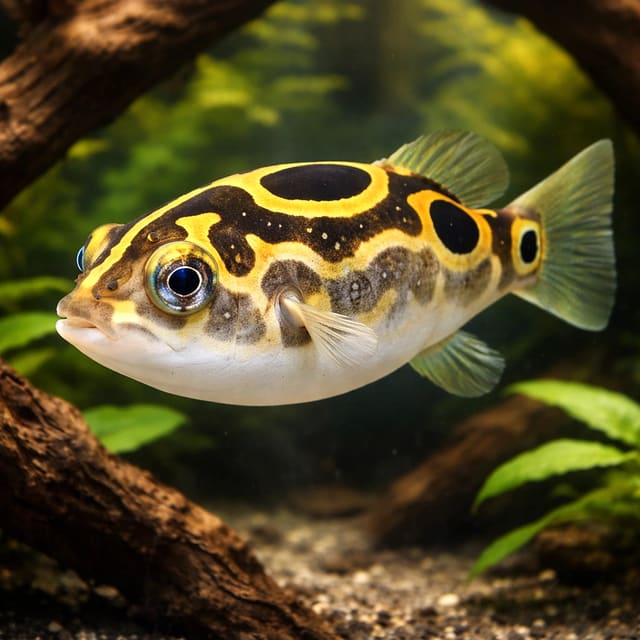
Green Spotted Pufferfish (Dichotomyctere nigroviridis) is an active, hard-water puffer that reaches 17 cm and needs light salt, shell-on foods and a 120 cm aquarium. Each purchase is one fish, 2–3 cm, 4–5 cm or 6 cm.
Adult size is the maximum length this species reaches at full maturity (scientific sources). The livestock you receive will be younger and smaller — pick a size above for the actual shipping size. Product-photo provenance and any image-specific limitations are stated on the listing.
Dichotomyctere nigroviridis
Save when buying multiple fish. Each quantity is one fish; sex and pair formation are not guaranteed unless the selected variant explicitly states them.
Green Spotted Pufferfish (Dichotomyctere nigroviridis) is an active, hard-water puffer that reaches 17 cm and needs light salt, shell-on foods and a 120 cm aquarium. Each purchase is one fish, 2–3 cm, 4–5 cm or 6 cm.
Adult size is the maximum length this species reaches at full maturity (scientific sources). The livestock you receive will be younger and smaller — pick a size above for the actual shipping size. Product-photo provenance and any image-specific limitations are stated on the listing.
Maintain these water conditions for optimal health and vibrant colors
The Green Spotted Pufferfish (Dichotomyctere nigroviridis) is a bold, active puffer from Asia, where it ranges from Sri Lanka to Indonesia and north to China. It is still widely sold as Tetraodon nigroviridis; FishBase now lists it as Dichotomyctere nigroviridis within Tetraodontidae, the pufferfish family. Both names describe the same fish: a rounded body with a bright back covered in black spots, a pale belly and sharp teeth that never stop growing.
Each purchase supplies one live fish in the size you choose: 2–3 cm, 4–5 cm or 6 cm. The size you select is the size supplied, not the adult size. FishBase records this species at up to 17 cm, and Seriously Fish gives a comparable 170 mm, so even the largest choice is a young fish with most of its growing ahead. Plan the aquarium, filter and heater for the adult rather than for the fish that arrives.
This is a specialist fish, not a community fish. FishBase notes that it needs salt in the aquarium, describes it as aggressive with its tankmates and marks it as not recommended for home aquariums. We class it as an advanced fish for those reasons; that label is our own store assessment, not a scientific grading. For a keeper who already manages hard, alkaline water, is comfortable mixing marine salt and can supply snails and shellfish regularly, it makes a lively centrepiece for a brackish oddball aquarium.
| Scientific name | Dichotomyctere nigroviridis, long traded as Tetraodon nigroviridis |
|---|---|
| Family | Tetraodontidae (pufferfishes) |
| Native range | Sri Lanka to Indonesia and north to China |
| Adult length | Up to about 17 cm |
| Sizes supplied | 2–3 cm, 4–5 cm or 6 cm, one fish per purchase |
| Water | Hard, alkaline and lightly salted, 24–28 °C |
| Suits | Experienced keepers planning a single-puffer or brackish oddball aquarium |
| Not suited to | Soft-water community tanks, shrimp tanks and long-finned or slow fish |
Before you order, check that you can answer yes to each of these:
If any answer is no, another species will suit you better. If every answer is yes, you are the kind of keeper this puffer does well with. You may also see it labelled spotted green pufferfish, and FishBase notes that it is assessed as Least Concern on the IUCN Red List.
Give yourself time. A new aquarium needs a day or two to settle, then time for its filter bacteria to mature, and hardness and salt take practice to hold steady. Order the fish once the aquarium is stable and your test results have been where you want them for a while, not on the day the tank is filled.
All three sizes grow into the same fish with the same needs. The choice mainly decides how much time you have before the full adult set-up must be running, and how small the first foods need to be. A 2–3 cm juvenile needs tiny snails and worms it can manage; a 6 cm fish can tackle larger pieces sooner. None of them is a stop-gap for a small community tank.
Sex is guaranteed only when the selected option explicitly states male or female. This Green Spotted Pufferfish listing has no sex-guaranteed option. Seriously Fish describes the sexes as seemingly impossible to tell apart by external characteristics, so nobody can pick a male or female by eye.
Gallery images have been digitally enhanced to improve image quality. Natural colour, pattern, size and maturity can vary between live animals.
If you are still weighing up unusual species, browse our loaches and oddball fish collection alongside this one.
The single most useful thing you can do before ordering is to design the aquarium around a 17 cm fish. A 3 cm juvenile looks lost in a large tank, but it grows into an active, messy eater that needs space, stable water and a filter with plenty in reserve.
Seriously Fish gives a minimum aquarium base of 120 × 30 cm for this species, which works out at roughly 108 litres in a tank 30 cm tall. Treat that as the floor for one adult, not the goal. OATA's freshwater aquarium care sheet advises buying an aquarium as big as possible, ideally one that can house your fish once fully grown, because a larger volume is more stable and less susceptible to swings in temperature and pH. OATA adds that if the tank cannot hold the adult, you must be prepared to buy a bigger set-up as the fish grows. A juvenile can start in a smaller mature aquarium only when that upgrade is already planned.
Seriously Fish recommends a heavily planted aquarium with twisted roots and branches for extra cover, a sandy substrate and floating plants to diffuse the light. Leave open spaces between the planted areas for swimming, because this is an active species. Expect soft-leaved plants to be chewed; choose tougher plants or accept some damage. If you ever keep more than one puffer, many hiding places stop being a nice extra and become essential.
The RSPCA's guidance on fish environments is blunt: no fish should be kept without a well set up and maintained filter. Fish release ammonia; a working biological filter lets bacteria convert it to nitrite and then to the less harmful nitrate. Puffers eat meaty foods and crack shells, and OATA notes that waste and leftover food both add to ammonia, so buy more filtration than the minimum.
Size the filter and heater for the water you actually have; the checklist below gives figures for a tank at the minimum footprint.
A new aquarium needs time before any puffer goes in. OATA advises leaving a freshly filled and dechlorinated tank for 24 to 48 hours so the temperature settles and the equipment can be checked, then letting the filter mature so that nitrifying bacteria can deal with ammonia and nitrite. You will need test kits for ammonia, nitrite, nitrate and pH. Our guide to setting up a tropical tank takes you through each step, including how to tell when the filter is ready.
Most problems with this puffer start before it arrives: a tank that is too small, water that is too soft or no plan for hard food. Tick off each item before you choose a size.
| Aquarium with at least a 120 × 30 cm base | The minimum footprint for one adult; a larger tank is more stable. |
|---|---|
| Filter rated around 430–540 litres per hour | Seriously Fish's figure for a 120 × 30 × 30 cm tank of about 108 litres, four to five turnovers an hour. |
| Heater of roughly 125–175 W | The same worked example, holding 24–28 °C in a room at around 20 °C; a bigger tank needs more. |
| Marine salt and a hydrometer or refractometer | For the light brackish level of about 1.005 specific gravity. |
| Test kits for ammonia, nitrite, nitrate, pH and hardness | Weekly checks catch problems while they are small. |
| Sand, roots, branches, tough plants and floating plants | Cover, open swimming space and softened light. |
| A steady supply of snails and shell-on seafood | Hard food keeps continuously growing teeth in check. |
Buy and run the equipment first, then choose the fish. A mature, stable aquarium waiting for the puffer is far easier than rushing the set-up after it has arrived.
The Green Spotted Pufferfish is a hard-water fish, and every value below points the same way: warm, alkaline, mineral-rich water with a little marine salt. Soft, acidic community water is the wrong starting point.
| Temperature | 24–28 °C |
|---|---|
| pH | 7.5–8.5 (FishBase records 8.0) |
| General hardness | 10–20 dGH (FishBase gives 9–19 dH) |
| Salt | Marine salt to a specific gravity of about 1.005 |
| Ammonia and nitrite | Zero |
This puffer occurs in both fresh and brackish water. FishBase lists it under freshwater and brackish environments and records wild adults in freshwater streams, rivers and floodplains, yet its aquarium note is clear that the fish needs salt. Seriously Fish's species profile explains the practical side: although the fish is often treated as a true freshwater species, it tends to be longer-lived with marine salt added to a specific gravity of around 1.005. It can be kept in fresh water, but a long-term plan should include that light brackish level.
Doing the same steps in the same order every time is the easiest way to keep this fish's water stable.
Salt alone does not make water hard or alkaline. If your tap water is soft, you will need a plan to raise and hold hardness and pH within the ranges above before the fish arrives, and you should keep that plan simple enough to repeat at every water change. Our guide to aquarium water parameters explains which values to test and why, and the water parameter matcher compares your own readings with these targets so you can see the gap before you buy.
Keep changes gradual in every direction. Stability matters more than chasing one exact number within these ranges, and sudden jumps in salinity, temperature or pH stress fish.
Diet is where puffer keeping differs most from ordinary fishkeeping. In the wild, FishBase's species summary records it feeding on molluscs, crustaceans and other invertebrates, as well as some plant matter. In the aquarium, Seriously Fish says it relishes all kinds of shellfish, along with worms and other live and frozen foods.
Like other puffers, this fish has teeth that grow continuously. Hard, shelled food wears them down; without it they overgrow and become a problem for the fish. Seriously Fish advises feeding snails and unshelled shellfish, such as crab legs and prawns, regularly to keep the teeth sharp and in check. A diet of soft frozen food alone, however varied, does not do that job.
| Snails | The classic puffer food; the shell wears the teeth. Small snails suit juveniles. |
|---|---|
| Unshelled shellfish | Crab legs, prawns, cockle or mussel in the shell, sized to the fish. |
| Worms | A soft, readily taken food that adds variety. |
| Other live and frozen foods | Rotate them so the diet does not rest on a single item. |
Breeding small snails in a separate container gives you a steady supply of hard-shelled food in sizes to suit the fish as it grows.
Seriously Fish describes this species as very sensitive to deteriorating water conditions and says regular partial water changes are a must. A shell-crunching carnivore in a brackish tank leaves you no room for a neglected month, so build a routine you can keep.
OATA sets zero as the target for ammonia and nitrite but leaves nitrate to species care sheets and local conditions, pointing out that nitrate in tap water varies widely from area to area. Test your tap water as well as the aquarium, so you know what each water change is actually removing or adding.
OATA suggests testing more frequently when an aquarium is new and when fish are added. For a puffer, add the weeks after any change of salinity or diet, and any time the fish stops eating.
Every fish is hand-bagged in pure oxygen and packed in an insulated poly box, with a heat pack when the weather calls for it. We email you a tracking number and a confirmed delivery date, and a courier licensed to carry live fish brings the parcel to your door. The full terms are on our delivery and Live Arrival Guarantee page.
For any Live Arrival Guarantee claim, the guarantee requires someone to have been at the address to receive the parcel, the parcel to be opened and inspected on the day it arrives, and that continuous unboxing video showing the parcel still sealed.
A healthy Green Spotted Pufferfish is alert and busy, moving between cover and open water and taking food with interest. Learn what normal looks like in the first weeks so that changes stand out.
FishBase classes the species as demersal, meaning it lives close to the bottom in the wild, but Seriously Fish describes it as an active fish that needs open spaces for swimming between planted areas. Expect it to use the whole aquarium, to explore roots and plants, and to chew soft leaves. Some individuals grow more spiteful with age, so a fish that tolerates companions as a juvenile may not do so as an adult.
Pufferfish can fill their elastic stomachs with water or air, swelling to two or three times their normal size. Seriously Fish explains that this is usually a response to a threat, making the fish large enough to put off predators and hard to swallow, although many aquarium specimens inflate for no obvious reason. An occasional inflation is part of normal puffer behaviour; frequent inflation alongside other changes is a reason to test the water and look more closely.
OATA's advice for any of these signs is to test your water quality first, then get further guidance. With this species, check salinity and hardness as well as ammonia, nitrite and nitrate, and look at the teeth if feeding has changed.
Many parts of a puffer's body contain tetrodotoxin, a powerful neurotoxin. Seriously Fish notes that it causes paralysis and death when eaten in sufficient quantity and that no antidote is known, which is why puffer is prepared in Japan only by highly trained chefs. The risk comes from eating the fish, so never eat a puffer or feed one to another animal.
Breeding is not easy, but the species has been spawned in aquariums. Seriously Fish reports that the fish spawn only in brackish water and should be given flat rock surfaces as possible spawning sites. Eggs are laid directly onto the substrate or a flat rock and guarded by the male. They hatch in around seven days, after which the male moves the fry to a pit he has already dug in the substrate and continues to guard them, rather like many cichlids.
Raising the young is the hard part: most foods are apparently unsuitable for the fry, although some success has been had with Cyclops nauplii. With no reliable external differences between the sexes, anyone attempting it has to keep several fish in a very large aquarium and accept the aggression that comes with them. For most keepers, one well-kept puffer is the realistic goal.
Treat every tank mate as a planned risk. Seriously Fish says this species can be kept in a community, but only with care over companions, because it tends to nip the fins of slow-moving or long-finned fish and some individuals become particularly spiteful with age. FishBase describes it as aggressive with its tankmates and notes that it may eat scales and fins.
One per aquarium is the safest arrangement. These puffers are usually belligerent towards their own kind, and males will fight constantly. Seriously Fish suggests that a keeper set on a group should buy at least four fish so that aggression is spread out, and arrange the décor with many hiding places; that only works with a lot of space.
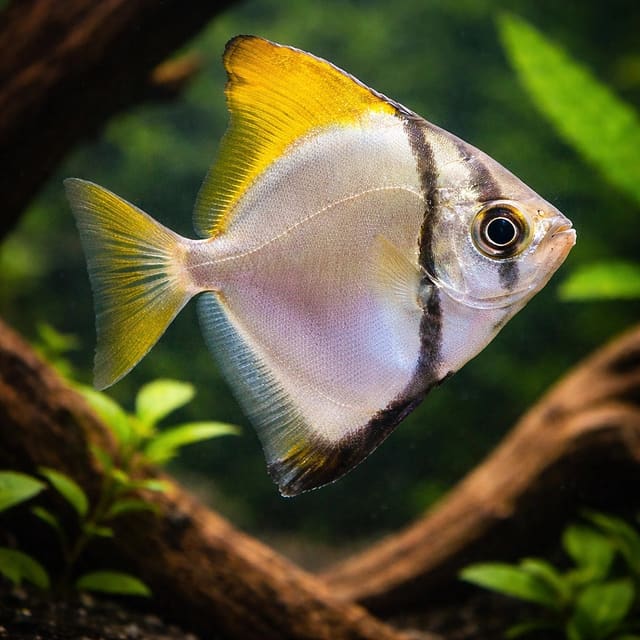
Seriously Fish names robust, active species that suit the same hard, brackish water: scats, archerfish and Arius catfish, and perhaps monos. Choose companions large and quick enough to move away, and add the puffer only once you know those fish will thrive in its salinity.
| Slow-moving fish | Easy targets for fin nipping. |
|---|---|
| Long-finned fish | Fins are bitten, and damage builds up. |
| Shrimp and other crustaceans | Part of the natural diet, so treat them as food. |
| Snails you want to keep | Molluscs are prey; snails belong in the feeding plan. |
| Soft-water community fish | They need very different water from this puffer. |
Watch the whole community in the first weeks after any introduction. Frayed fins on companions, fish hiding more than usual or a puffer guarding one corner are early warnings. OATA notes that some species are territorial or aggressive and will not live together peacefully; when that proves true here, rehome the companion or the puffer rather than hoping it settles.
Up to about 17 cm. FishBase records a maximum length of 17 cm and Seriously Fish lists 170 mm, so a small juvenile grows into a heavy-bodied adult. Plan the aquarium, filter and heater around that final size from the start.
For one adult, choose an aquarium with a base of at least 120 × 30 cm, the minimum footprint Seriously Fish gives for this species; that is roughly 108 litres in a tank 30 cm tall. A bigger tank is easier to keep stable, and more than one puffer needs far more room.
One per aquarium is the usual and safest choice. These puffers are belligerent towards their own kind and males will fight constantly. Seriously Fish suggests that anyone set on a group should start with at least four fish, in a very large aquarium arranged with many hiding places.
Not usually. FishBase notes that it needs salt and is not recommended for home aquariums, and Seriously Fish describes it as very sensitive to deteriorating water. It suits keepers who already test their water every week, can mix marine salt accurately and are happy to source snails and shellfish.
Shellfish, snails, worms and other live and frozen foods. Offer snails and unshelled shellfish such as crab legs and prawns regularly, because its teeth grow continuously and need hard food to keep them ground down.
Keep it at 24–28 °C, pH 7.5–8.5 and a hardness of 10–20 dGH. Seriously Fish also recommends adding marine salt to a specific gravity of around 1.005, which it links to a longer life in aquariums.
Yes, it can be both. FishBase describes it as aggressive with its tankmates and notes that it may eat scales and fins, and Seriously Fish says it tends to nip slow-moving or long-finned fish. Some individuals become more spiteful with age.
Only robust, active fish that share its hard, lightly salted water. Seriously Fish names scats, archerfish and Arius catfish, and perhaps monos. Keep it away from shrimp, snails you want to keep, slow-moving fish and long-finned fish.
It is hand-bagged in pure oxygen, packed in an insulated poly box with a heat pack when the weather calls for it, and carried by a licensed live-animal courier. Someone must be in to receive the parcel. Film one continuous unboxing video from the sealed parcel to the fish still in its bag, open and inspect it the same day, then float the bag for 20–30 minutes before releasing the fish without the bag water. The video is needed for any Live Arrival Guarantee claim.
No reviews for this item yet. Bought one? Honest reviews only, good or bad.
What customers say about ordering from us
I have a small group of long finned mountain minnows. So was delighted to be able to order ten of this variety to increase the genetics in my tank . The ones I recieved are healthy but it’s to early to give a verdict on wether they are of a long finned type since they are small currently.
Gordon Walker · 23 Sept 2026
100% success travel and "installation". Pleased with quality of purchase. The Siamese fighter a bit "shy" so have not yet seen him at his best yet but looking good. Happy customer. GG
George E Garratt · 21 Sept 2026
Reviews of our shop, collected by Judge.me, an independent third-party review collector. Newest first.