−13%
Moderate
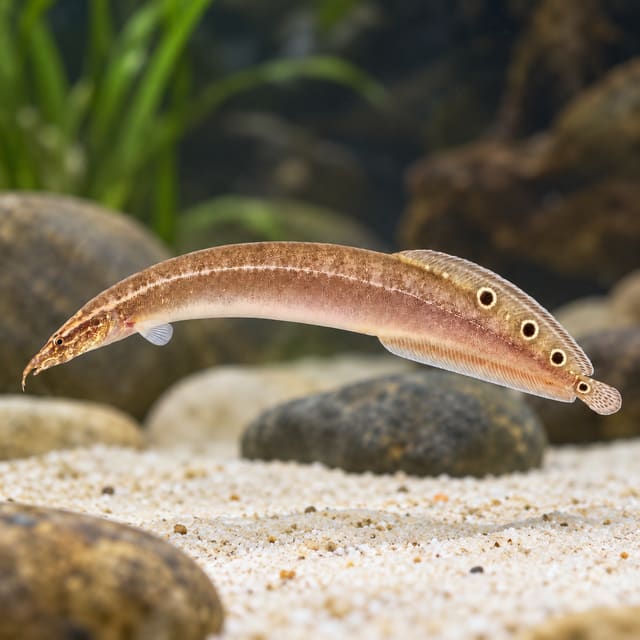
Half-Banded Spiny Eel (Macrognathus circumcinctus)
24–27°C
£17.39£19.99

Add a dramatic Fire Eel to your aquarium for a captivating, peaceful display. Best kept in larger tanks. Buy online today with UK delivery.
Adult size is the maximum length this species reaches at full maturity (scientific sources). The livestock you receive will be younger and smaller — pick a size above for the actual shipping size. Product-photo provenance and any image-specific limitations are stated on the listing.
Mastacembelus erythrotaenia
Confirm your email, then we’ll send an availability message for this exact item if it returns within 180 days.
This request is only for this product—no newsletter or other promotions. A mail-provider retry may very rarely duplicate the same availability message. Unconfirmed addresses are removed after 48 hours. See our privacy policy.
Add a dramatic Fire Eel to your aquarium for a captivating, peaceful display. Best kept in larger tanks. Buy online today with UK delivery.
Adult size is the maximum length this species reaches at full maturity (scientific sources). The livestock you receive will be younger and smaller — pick a size above for the actual shipping size. Product-photo provenance and any image-specific limitations are stated on the listing.
Maintain these water conditions for optimal health and vibrant colors
The Fire Eel, Mastacembelus erythrotaenia, is one of the most dramatic oddball fish available in the tropical fish UK hobby. Despite the name, it is not a true eel, but a large freshwater aquarium eel like fish from Southeast Asia with a long pointed snout, rich chocolate body colour, and glowing orange-red markings that intensify as it matures. A full grown fire eel can reach around 60 cm in home aquariums, with exceptional specimens growing larger, so this is a species for aquarists planning a serious display tank rather than a small community setup. Its fire eel lifespan can exceed 15 years with stable water quality, a secure lid, and a thoughtful fire eel tank setup.
What makes the Fire Eel so popular is its combination of intelligence, bold feeding response, and unusual behaviour. Many keepers report remarkable fire eel intelligence, with fish learning feeding times, recognising their keeper, and even taking food from forceps or fingers. See our detailed photos showing the elongated body shape, red lateral patterning, and strong snout that make this tropical fire eel such a standout in large aquascapes. For aquarists looking for rare tropical fish UK enthusiasts admire, or anyone searching tropical fish uk for sale, buy live fish online uk, or where to buy fire eel UK, this species offers a truly captivating centrepiece for a spacious aquarium.
The Fire Eel belongs to the spiny eel family, a group of elongated freshwater fishes known for their pointed snouts and small dorsal spines. In the aquarium hobby, it is widely regarded as one of the largest and most impressive spiny eels, sitting above smaller species such as peacock eels and half-banded spiny eels in both size and care demands.
The Fire Eel is native to Southeast Asia, especially river systems, floodplains, marshes, and slow-moving waters in countries such as Thailand, Cambodia, Vietnam, Laos, Malaysia, and Indonesia. In the wild, the fire eel habitat often includes soft-bottomed areas with mud, sand, submerged roots, leaf litter, and dense marginal vegetation. This matters in captivity because a good fire eel aquarium setup should recreate that sense of cover and soft substrate rather than leaving the fish exposed on bare glass or sharp gravel.
Wild fish spend much of the day hidden, with fire eel hiding behaviour increasing in bright conditions or sparse tanks. They emerge at dusk to hunt worms, insect larvae, crustaceans, and small fish. That natural pattern explains why many new keepers worry about a fire eel not eating during the first few days after arrival. In most cases, the fish is simply settling in and waiting for low light before feeding. This species is also known for occasional colour shifts; a fire eel pale appearance is often linked to stress, poor substrate choice, bright lighting, or unstable water quality rather than disease alone.
In nature, juveniles may show amber or yellow markings before developing stronger red tones with age. That is why some hobbyists refer to young fish as a yellow fire eel, while adults with intense patterning are sometimes described as a red fire eel. Rare colour variants such as xantic fire eel, golden fire eel, or even references to albino fire eel appear in the trade from time to time, but the classic form remains the most reliable and striking.
Because the species has declined locally in parts of its range due to fishing pressure and habitat change, responsible sourcing matters. For aquarists searching fire eel for sale, live fire eel UK, or freshwater eel UK, choosing healthy, well-conditioned stock is far more important than chasing a cheap fire eel UK listing that may result in losses later.
Mimicking the natural habitat with soft sand, shaded areas, driftwood, and snug tubes improves confidence, feeding response, and colour. Fire Eels kept in barren tanks are far more likely to hide constantly, scrape their snouts, or attempt a fire eel escape through tiny gaps.
Getting the fire eel tank size right is the most important part of long-term success. Although juveniles are often sold small, this fish grows into a powerful predator with a heavy body and high oxygen demand. The fire eel minimum tank size is 500 litres, but a larger footprint is strongly recommended for any specimen expected to approach fire eel full grown dimensions. A tank around 180 cm long gives the fish room to turn comfortably, patrol the bottom, and establish secure resting areas. If you are asking how many fire eel in a tank, the safest answer for most aquariums is one. Adults are usually best kept singly unless the system is extremely large and the keeper is experienced with oddball fish behaviour.
The practical answer to fire eel size is that most aquarium specimens reach 45-60 cm, though wild fish can exceed that. Because of this, the ideal fire eel tank setup is wide and long rather than tall. This species spends most of its time near the bottom, weaving through decor and partially burying itself. A cramped tank often leads to stress, poor feeding, and abrasion injuries around the snout.
Stable fire eel water parameters matter more than chasing a single perfect number. Aim for a fire eel temperature of 24-28°C, with 25-27°C being ideal in most mixed tropical systems. The recommended fire eel water temperature should not swing rapidly between day and night. The fire eel pH level should stay between 6.5 and 7.5, while fire eel water hardness is best kept around 5-15 dGH. These fire eel ideal conditions support appetite, colour, and skin health.
Fire eel filtration needs are substantial because this is a large carnivore that produces heavy waste. Use oversized external filtration with strong biological media and moderate turnover, but avoid blasting the fish with harsh current at substrate level. Good oxygenation is essential. If you notice fire eel breathing heavy, check ammonia, nitrite, temperature, dissolved oxygen, and whether decor is trapping detritus. Pairing the tank with a reliable external filter and a correctly sized heater is far safer than relying on undersized equipment in a large tropical display.
For keepers building a big oddball aquarium, browsing our wider tropical fish collection can help you plan tankmates and suitable large species around the Fire Eel.
Soft sand is strongly recommended. Sharp gravel can damage the snout and belly when the fish burrows. A depth of 3-5 cm allows natural digging without creating deep anaerobic pockets. This is especially important in a fire eel in planted tank design, where rooted plants should be protected with stones or pots so the eel cannot uproot them during nighttime activity.
A good fire eel aquarium setup includes PVC tubes, smooth caves, driftwood arches, and shaded corners. Hardy plants attached to wood or rock work better than delicate stems. If you enjoy spiny eels, smaller relatives such as Macrognathus Circumcinctus - Half Banded Spiny or the larger Mastacembelus Armatus - Zig-Zag Eel - can also inspire layout ideas, though their adult size and temperament differ.
Moderate to subdued lighting suits this species best. Bright, exposed tanks often increase stress and daytime hiding. Floating cover or shaded zones help the fish feel secure enough to emerge. That is one reason many keepers looking for the best aquarium eel comparison find Fire Eels more rewarding in mature, dimly lit displays than in stark showroom-style tanks.
Always cycle the aquarium for 4-6 weeks before adding a Fire Eel. In large tanks, immature filtration is one of the fastest ways to trigger stress, fire eel twitching, poor feeding, and bacterial problems.
The fire eel diet is carnivorous. In nature, these fish hunt worms, insect larvae, crustaceans, and small fish by scent and touch, using their long snout to probe substrate and crevices. In captivity, successful fire eel feeding usually centres on frozen and fresh meaty foods rather than dry flakes. The best results come from variety: bloodworm for juveniles, chopped earthworms, mussel, prawn, lancefish, krill, and occasional sinking carnivore pellets once the fish is settled.
A practical fire eel feeding guide starts with foods the fish recognises quickly. Earthworms, chopped prawns, mussel, and defrosted bloodworms are excellent staples. Juveniles often respond best to smaller items, while larger adults can take strips of seafood. If you are wondering how often do fire eels eat, juveniles usually do best with one small meal daily, while established adults often thrive on 4-5 feeds per week.
Supplemental foods add variety and help condition fish that are shy or recently imported. Blackworm, river shrimp, and chopped white fish can all work. A newly imported juvenile fire eel may need dim lighting and target feeding with forceps. Questions such as what to feed baby fire eels are common; for a baby fire eel, use finely chopped bloodworm, blackworm, tubifex from safe sources, and tiny pieces of earthworm.
Live feeder fish are best avoided because they can introduce parasites and encourage poor feeding habits. Fatty mammal meats should also be avoided. If your fire eel not eating persists beyond a week, review water quality, hiding places, transport stress, and lighting before assuming illness. Many Fire Eels begin feeding once the room is dark and the tank is quiet.
| Time | Food | Amount |
|---|---|---|
| Evening | Earthworm, prawn, or mussel | What is eaten within 2-3 minutes |
| Late evening | Bloodworm or sinking carnivore food for juveniles | Small supplemental portion if needed |
Overfeeding causes ammonia spikes, cloudy water, and obesity. Remove uneaten meaty foods promptly, especially in warm tanks where waste breaks down fast.
The Fire Eel has a long, laterally compressed body, a pointed snout, an underslung mouth, and a flowing dorsal profile lined with small spines. Adult fire eel size in aquariums commonly reaches 45-60 cm, making it much larger than many hobbyists expect when they first see a juvenile in store. A full-grown fire eel has serious presence and should be viewed as a large oddball fish, not a novelty eel substitute for medium community tanks.
Base colour is usually dark brown, smoky grey, or chocolate, with orange to red stripes and spots along the flanks and fin edges. Younger fish may look more amber than scarlet, but colour deepens with age, stable water, and a calm environment. Our photos show the intense body contrast that develops when the fish is kept over dark substrate with subdued lighting. In some cases, hobbyists use terms like yellow fire eel, golden fire eel, or red fire eel informally to describe colour intensity rather than a fixed strain.
Sexing is difficult, so fire eel male vs female differences are not reliable in most retail specimens. Females may become heavier-bodied when mature, but this is subtle. If you are comparing species, remember that spiny eel size varies hugely across the family. A Fire Eel dwarfs many smaller species, and even discussions about zebra spiny eel size or tire track eel size can mislead buyers into underestimating how large this fish becomes.
The most important rule for fire eel tank mates is simple: choose fish too large to be swallowed and calm enough not to harass the eel. Although often described as semi-aggressive, the real issue is predation and feeding competition rather than constant open aggression. Fire eel with other fish can work very well in large aquariums if those fish occupy different zones and do not nip, outcompete, or stress the eel.
Suitable companions include large gouramis, robust characins, peaceful big catfish, and some broad-bodied fish that are clearly too large to fit in the eel's mouth. For example, the Gold Giant Gourami can work in very large systems where both species have space. Similarly, aquarists building a giant oddball display may consider fish such as Piaractus Brachypomus - Red-Bellied Pacu - or Red-Bellied Pacu - Piaractus Brachypomus, though tank size must be enormous and feeding must be carefully managed.
Other eel-like species can be compared for temperament and size, including African Starry Night Eel - Mastacembelus and Freshwater Moray - Gymnothorax Polyuranodon -, but mixed eel communities are for advanced keepers only. If you are looking for the best eel for community tank, the Fire Eel is not the easiest choice for a standard community, but it can be excellent in a carefully planned large oddball setup.
Avoid small tetras, guppies, shrimp, and slim fish that can be swallowed. Even attractive but tiny species such as the Albino Sky Blue Guppy are not appropriate fire eel compatible fish. Invertebrates are usually viewed as food. Fast fin-nippers and hyperactive cichlids can also create problems.
Many keepers ask can fire eels live with african cichlids. Usually, this is not ideal because African cichlids often prefer different water chemistry and can be too aggressive, territorial, or boisterous at feeding time. Fire eel with cichlids is only worth attempting in specialist, very large setups with carefully chosen species and close observation. By contrast, fire eel with discus is also risky because discus prefer quieter feeding conditions and warmer, cleaner, more controlled environments. Fire Eels may outcompete them at night or disturb them with sudden movement.
| Species | Compatible? | Notes |
|---|---|---|
| Gold Giant Gourami | ✅ Yes | Works in very large tanks with calm, spacious layout |
| African Starry Night Eel - Mastacembelus | ⚠️ Caution | Possible only for advanced keepers in huge aquariums |
| Small guppies, shrimp, nano fish | ❌ Avoid | Likely to be eaten sooner or later |
When planning fire eel tank mates, think in terms of adult size, feeding style, and temperament. This is not a fire eel for beginners species, but it can become a superb long-term display fish in the hands of a keeper who respects its size and predatory nature.
Always quarantine new arrivals for 2-4 weeks before adding them to a Fire Eel aquarium. Large eels are resilient in some ways, but they react badly to parasite introductions and sudden medication use in display tanks.
Fire eel breeding is difficult and uncommon in home aquariums. Most specimens offered in the trade are not bred routinely by average hobbyists, and reliable reports of natural spawning in private tanks are limited. If you are researching how to care for fire eel with breeding in mind, focus first on long-term health, size, and conditioning rather than expecting quick results.
A dedicated breeding attempt would require a very large, mature aquarium with excellent water quality, soft substrate, and multiple retreats. Stable fire eel pH level, warm water, and heavy conditioning with varied meaty foods are essential. Since fire eel male vs female is hard to determine, obtaining a compatible pair is itself a major challenge.
Spawning triggers are poorly documented in the hobby. Seasonal water changes, heavy feeding, and environmental cues may play a role. If eggs are produced, they would need immaculate water and protection from predation. This is one reason fire eel breeding remains an advanced project even for experienced oddball keepers.
The fire eel growth rate is moderate when fish are fed well and kept warm, but young fish still need time to develop. A baby fire eel or juvenile fire eel requires tiny meaty foods and excellent hygiene. Questions like what to feed baby fire eels are important because fry and juveniles are easily lost to starvation if foods are too large or introduced too infrequently.
Comparisons such as fire eel vs peacock eel, fire eel or spiny eel, or even fire eel and peacock eel often come up when hobbyists consider breeding projects. In practice, smaller species are usually more realistic than Fire Eels. If your goal is simply to keep a spectacular display fish, this species is far better appreciated for its behaviour and presence than for easy reproduction.
If you ever attempt breeding, condition a potential pair for months rather than weeks. Offer earthworms, mussel, and prawn, keep nitrate very low, and provide seasonal changes in water volume and feeding intensity to mimic floodplain cycles.
Comparing species helps avoid expensive mistakes. A Fire Eel is often purchased by people who really wanted a smaller spiny eel, a ropefish-type oddball, or a manageable community show fish. The key difference is scale: the Fire Eel becomes a large, long-lived predator that needs a genuinely spacious aquarium.
| Feature | Fire Eel | Zig-Zag Eel |
|---|---|---|
| Max Size | 60 cm+ | Up to 90 cm+ |
| Care Level | Moderate to advanced | Advanced |
| Temperature | 24-28°C | 24-28°C |
| Price | £60.97 | Varies |
| Best For | Large oddball display tanks | Very large specialist eel systems |
| Feature | Fire Eel | Half Banded Spiny |
|---|---|---|
| Max Size | 60 cm+ | Much smaller |
| Care Level | Moderate to advanced | Moderate |
| Temperament | Predatory toward small fish | Less imposing but still predatory |
| Best For | Statement fish | Smaller spiny eel enthusiasts |
| Choose If | You want a true centrepiece | You want eel-like behaviour in less space |
Shoppers also search terms like fire eel vs ropefish, fire eel vs fire eel, and even references to tanganyika eel when comparing oddballs. The simplest answer is this: choose a Fire Eel if you want one of the most striking large tropical fish UK keepers can own and you have the tank size to match. Choose a smaller spiny eel if you want similar behaviour without the same adult footprint. If you are still comparing, species such as Mastacembelus Armatus - Zig-Zag Eel - and Macrognathus Circumcinctus - Half Banded Spiny are useful reference points.
Good fire eel health starts with prevention. A healthy specimen has clear eyes, intact skin, steady breathing, strong feeding response, and smooth movement along the substrate. It should not spend all day thrashing against decor or showing repeated fire eel twitching. Mild daytime hiding is normal, but frantic dashing, heavy respiration, or refusal to feed for prolonged periods usually points to husbandry issues.
The most common fire eel diseases in captivity are stress-related bacterial infections, skin abrasions from rough substrate, parasitic outbreaks after import, and secondary issues caused by poor water quality. A fire eel pale body can indicate stress, while fire eel breathing heavy often suggests oxygen problems, ammonia, nitrite, or temperature stress. Because the species likes to burrow, skin damage can happen quickly if gravel is sharp.
Prevention means stable water, soft substrate, excellent filtration, and careful quarantine. Keep nitrate low with regular water changes and avoid sudden chemistry swings. If treatment is needed, dose cautiously and confirm the diagnosis first. Hobbyists sometimes ask do fire eels bite or do fire eels have teeth. They do have small teeth suited to grasping prey, and while a defensive nip is possible, they are not generally dangerous when handled sensibly. More important is avoiding unnecessary handling altogether.
Use medications carefully with scaleless or sensitive fish. Fire Eels can react badly to overdosing, and rough treatment often causes more harm than the original problem. Never medicate blindly when the real issue may be ammonia or low oxygen.
For buyers searching fire eel seriously fish level care detail, the key lesson is that this species rewards patience. Most health issues trace back to undersized tanks, poor substrate, weak filtration, or unsuitable tankmates rather than some mysterious eel-only disease.
Fire eel behaviour is one of the main reasons aquarists fall in love with this species. It is usually crepuscular to nocturnal, spending daylight hours tucked into sand, caves, or pipes, then emerging in the evening to investigate the tank. Over time, many individuals become surprisingly interactive and show clear fire eel intelligence, learning where food comes from and approaching the front glass when their keeper enters the room.
This species is generally solitary, which is why most keepers answer how many fire eel in a tank with “one.” It is not a schooling fish, and crowding can lead to stress or conflict. In a secure, well-designed aquarium, a Fire Eel will weave through decor, probe the sand with its snout, and sometimes rest with only its head visible. These are normal behaviours and part of what makes it such a fascinating fire eel fish for dedicated keepers.
If your eel hides constantly, review lighting, decor, and disturbance around the tank. A calm room, soft substrate, and predictable feeding routine usually bring out the best behaviour.
When you buy fire eel UK stock, conditioning matters. Fire Eels are not fish that should be rushed from import bag to display tank without observation. We select specimens for body condition, alertness, intact snouts, and feeding potential, then hold them under stable tropical conditions so they can settle before sale. That matters far more than chasing the lowest fire eel price UK or a random fire eel sale listing.
For customers searching fire eel online UK, order fire eel UK, fire eel delivery UK, fire eel shop UK, fire eel for sale UK, or even best place to buy tropical fish online uk, the goal is simple: receive a healthy, feeding fish packed correctly for transport. Each shipment is prepared in insulated packaging, with seasonal heat packs when needed, and sent by tracked delivery using professional fish-bagging methods suited to large, active species. We also include practical acclimation guidance because a Fire Eel entering a new aquarium often needs a quieter introduction than standard community fish.
Because this is a long-lived oddball, aftercare matters too. Buyers of aquarium eel UK species often need help with first feeds, secure lids, and choosing suitable tankmates. We focus on those real-world details so your new fish has the best start possible in a mature aquarium. If you are looking to buy eel UK, eel for sale UK, or live eel UK options for a serious display tank, this species is one of the most rewarding choices available.
Order your Fire Eel today with confidence if you have the space, filtration, and secure setup this species deserves.
If you enjoy unusual eel-shaped fish, compare the Macrognathus Circumcinctus - Half Banded Spiny for a smaller spiny eel option or the Mastacembelus Armatus - Zig-Zag Eel - for an even larger specialist challenge. For giant companion fish in very spacious aquariums, the Gold Giant Gourami and Piaractus Brachypomus - Red-Bellied Pacu - are worth researching carefully. You can also explore our broader tropical fish UK freshwater collection for other oddballs and large display species suited to custom setups.
No reviews for this item yet. Bought one? Honest reviews only, good or bad.
What customers say about ordering from us
I have a small group of long finned mountain minnows. So was delighted to be able to order ten of this variety to increase the genetics in my tank . The ones I recieved are healthy but it’s to early to give a verdict on wether they are of a long finned type since they are small currently.
Gordon Walker · 23 Sept 2026
100% success travel and "installation". Pleased with quality of purchase. The Siamese fighter a bit "shy" so have not yet seen him at his best yet but looking good. Happy customer. GG
George E Garratt · 21 Sept 2026
Reviews of our shop, collected by Judge.me, an independent third-party review collector. Newest first.