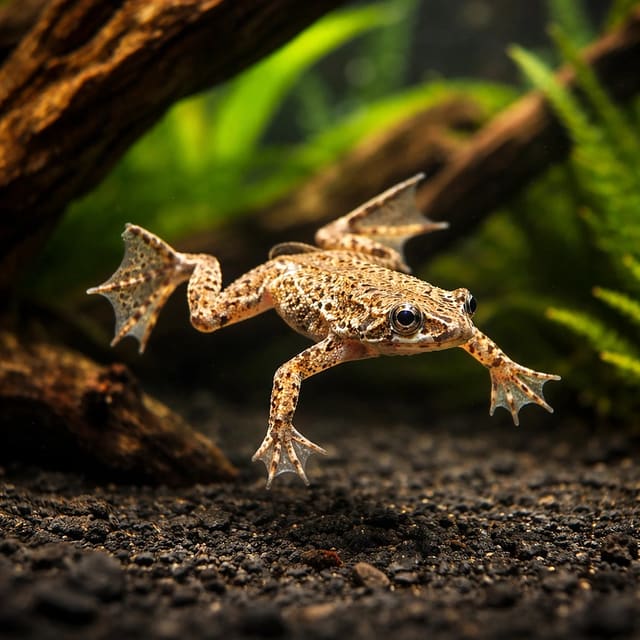
African Dwarf Frog (Hymenochirus sp.)
22–25°C · pH 7–8
£5.39
One live Zaire dwarf clawed frog (Hymenochirus boettgeri), sex not selected. A small, fully aquatic African dwarf frog that reaches about 3.5 cm, it lives underwater but must reach the surface to breathe. Not to be confused with the much larger African clawed frog (Xenopus).
Adult size is the maximum length this species reaches at full maturity (scientific sources). The livestock you receive will be younger and smaller. Product-photo provenance and any image-specific limitations are stated on the listing.
Hymenochirus boettgeri
One live Zaire dwarf clawed frog (Hymenochirus boettgeri), sex not selected. A small, fully aquatic African dwarf frog that reaches about 3.5 cm, it lives underwater but must reach the surface to breathe. Not to be confused with the much larger African clawed frog (Xenopus).
Adult size is the maximum length this species reaches at full maturity (scientific sources). The livestock you receive will be younger and smaller. Product-photo provenance and any image-specific limitations are stated on the listing.
Maintain these water conditions for optimal health and vibrant colors
This listing sells one live Zaire dwarf clawed frog, Hymenochirus boettgeri. Each unit is one frog. The sex is not chosen for you, because the listing carries no male or female option, so you may receive either. There is no size option on this listing either.
The name confuses plenty of people, so it is worth untangling. "African dwarf frog" is the everyday name for the whole genus Hymenochirus, which Wikipedia lists as four species: the Zaire dwarf clawed frog (H. boettgeri), the eastern dwarf clawed frog (H. boulengeri), the western dwarf clawed frog (H. curtipes) and the Gaboon dwarf clawed frog (H. feae). This listing is for the first of those, named to species. Zaire was the former name of the Democratic Republic of the Congo, which is part of this frog's natural range; the species is also called the Congo dwarf clawed frog. Tornier described it in 1896, originally as Xenopus boettgeri, in the same genus as the African clawed frog. It has long since been moved to Hymenochirus, and the two are now treated as quite different animals, which matters a great deal when you buy one (more on that below).
The frog is fully aquatic: it spends its whole life in water. It is also an air breather. Wikipedia puts it simply: these frogs live their entire lives underwater but need to rise to the surface to breathe air. That one fact shapes almost everything about keeping them, from tank depth to how you fit the lid.
A correction for anyone who read the older text on this page: it gave the adult size as 1 to 2 cm, which is too small. Wikipedia records females of this species reaching up to 35 mm, with males smaller, so expect an adult of roughly 3 to 3.5 cm. That is still a very small animal, and a group of them fits comfortably in a modest aquarium, but it is a little larger than the old figure suggested.
The Zaire dwarf clawed frog is listed as Least Concern by the IUCN, according to Wikipedia, which also notes that it is bred and sold as an aquatic pet and can be kept in most standard aquarium set-ups. With a few adjustments for an animal that breathes air, feeds by touch and smell, and has delicate skin, that is a fair summary. The rest of this guide covers those adjustments in detail.
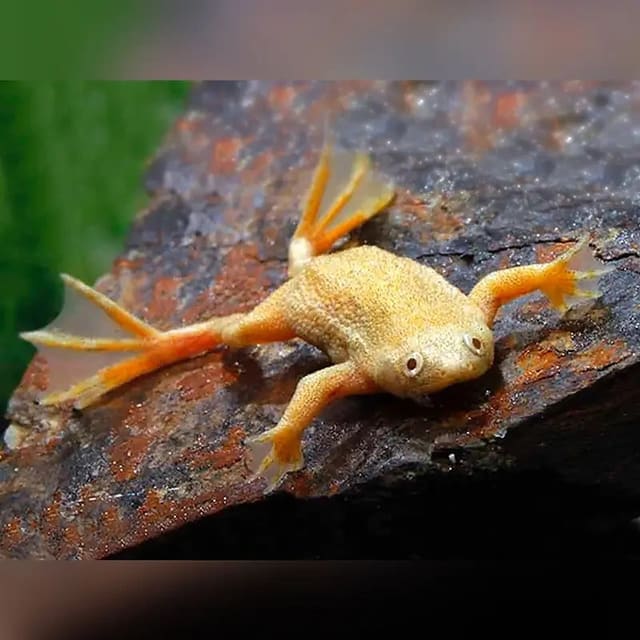
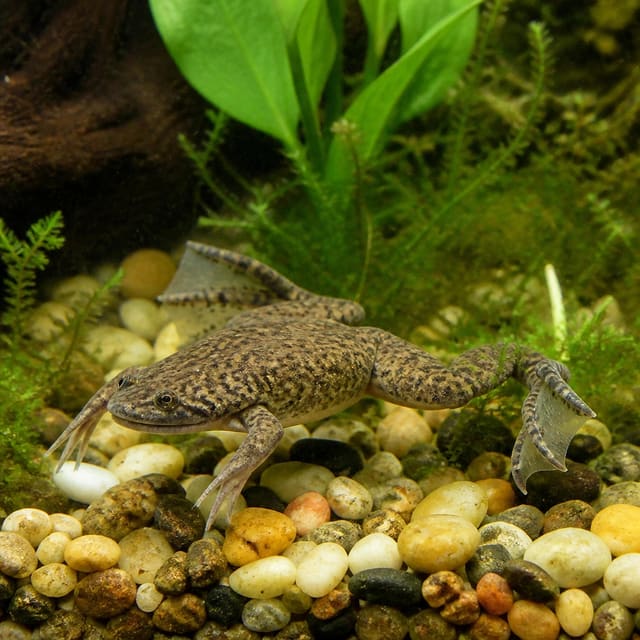
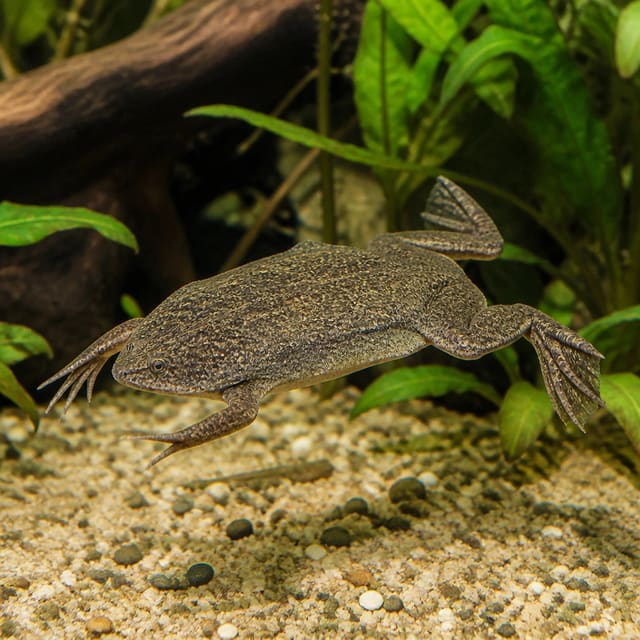
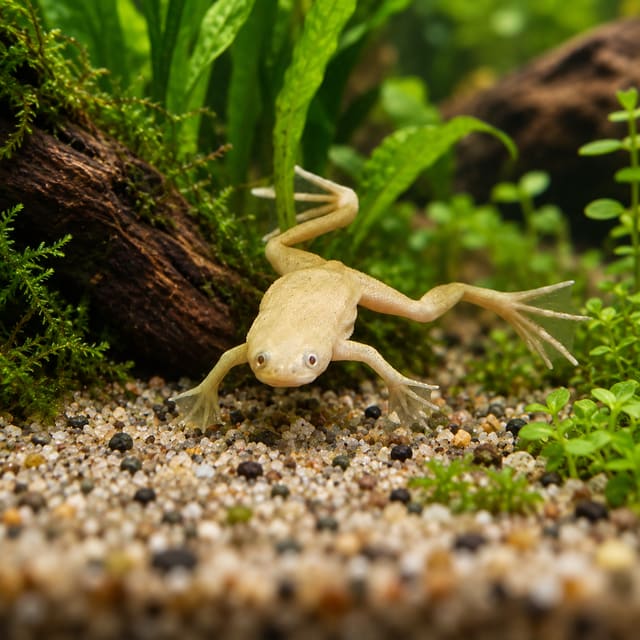
The Zaire dwarf clawed frog is a small frog, usually some shade of brown or grey speckled with darker spots, according to Wikipedia's species description. The head is narrow and tapering. It has no tongue and no eyelids. The legs are long, the feet are webbed, and there are small claws on the hind feet, as the name suggests.
Wikipedia gives three useful differences. Females are the larger sex, reaching up to 35 mm, and its page on the genus puts fully mature females at about 40% larger than males. Males have a tympanum, the external eardrum, roughly twice the size of a female's, which gives them a slightly swollen-headed look. Males also carry a large gland under the skin at the back of the forearm, which shows as a white spot near the armpit. OATA, the UK's ornamental aquatic trade association, adds that in the breeding season male aquatic frogs develop nuptial pads, a spiny thickening of the skin on the "thumbs" and forelegs, and look slimmer than females. On a young frog these differences may not be obvious yet.
This is the most important identification point on the page. The African clawed frog, Xenopus laevis, is a different and much bigger animal, and the two are often confused. OATA gives a simple field test:
| Feature | African dwarf frog (Hymenochirus) | African clawed frog (Xenopus) |
|---|---|---|
| Webbed feet | all four feet webbed | only the two hind feet webbed |
| Eyes | on the sides of the head | on top of the head |
| Adult size (OATA) | up to about 5 cm | up to about 15 cm |
| Tank for a small group (OATA) | at least 50 litres | at least 100 litres |
The difference is not only size. Wikipedia describes the clawed frog as larger and more aggressive than the dwarf frog, as a scavenger that will eat almost anything living, dying or dead, and as an animal that can live 25 to 30 years in captivity. Put a clawed frog in a community aquarium and the fish, and any dwarf frogs, become potential food. If you were searching for an African clawed frog, this is not that animal. If you want dwarf frogs, check any frog you are offered against the table above, and never house the two together.
There is a disease reason as well as a size reason. Wikipedia notes that the African clawed frog may be an important carrier, and possibly the original source, of Batrachochytrium dendrobatidis, the chytrid fungus linked to amphibian declines, while the clawed frog itself is not affected by it. Keeping different frogs apart, and giving any new amphibian a spell in a separate tank before it joins an established group, is sensible practice for that reason alone.
On size, sources differ a little. Wikipedia gives up to 35 mm for female H. boettgeri and 2.5 to 3.8 cm for the genus as a whole, while OATA's sheet says African dwarf frogs grow to 5 cm. We have used the species figure of 3.5 cm as the adult size for this frog, and OATA's 5 cm as a general ceiling for the genus.
Wikipedia records H. boettgeri from Nigeria, Cameroon, Equatorial Guinea and Gabon, east to the Central African Republic and the eastern Democratic Republic of the Congo. It is presumed to live in the Republic of the Congo too, though it has not been recorded there. The genus as a whole occurs in forested parts of equatorial Africa, from Nigeria and Cameroon south through Gabon and east across the Congo River Basin.
The habitat note is short and telling: the species generally occurs in still, shaded water in lowland rainforest and in pools beside slow-flowing rivers. Wikipedia's genus page adds shallow rivers, creeks and ponds, and flooded areas of forest. Put together, the wild home of this frog is calm, shallow, shaded forest water, a long way from the bright, fast-flowing tanks some fish prefer.
Three things follow for the aquarium. First, gentle flow: these are frogs of still water and slow margins, and OATA says the filter should not produce a strong current. Second, shade and cover: forest pools are dim and full of roots and leaves, and OATA asks for relatively dim lighting because bright light may cause stress. Third, shallow-water habits: a frog that has to swim up for every breath is better served by a tank that is long and wide than by one that is tall and deep.
This is also a tropical animal. OATA's temperature range of 22 to 25 °C means a heated aquarium unless your room holds that temperature day and night. The water section below gives the full numbers.
OATA recommends an aquarium of at least 50 litres for a small group of African dwarf frogs, and suggests it should be as long and wide as possible to give plenty of surface area. That surface matters for an animal that breathes air: a frog needs to reach it easily, often, and without a long climb through the water column.
OATA advises a cover on any tank holding amphibians, to stop them escaping, and warns that with a tight-fitting lid it may be important to drop the water level slightly so the frogs can reach the air above the surface. In practice, leave a clear gap of air between the water and the lid, check there are no openings around pipes and cables, and avoid filling the tank to the brim. A tank that is not especially deep makes each trip to the surface shorter.
The frogs' skin is delicate, so OATA recommends a bare base or a layer of sand. Avoid sharp gravel. If you use pebbles anywhere in the layout, OATA's rule is that they must be large and rounded, too big for a frog to swallow. Small gravel is a risk for an animal that feeds by grabbing at whatever it touches.
OATA lists pipes, caves, wood and large rounded pebbles to give lots of cover. Cover gives the frogs places to rest out of view, and a well-decorated tank lets a group spread out. Live plants suit the shaded forest-pool feel of the wild habitat and give resting spots near the surface; floating plants also soften the light, which OATA asks to be relatively dim. Leave some open water and a clear route to the surface, so the plants never become a mat a frog has to push through to breathe.
A filter is always essential, OATA says, but it should not produce a strong water flow. Spread the outflow with a spray bar or turn it against the glass, and make sure an intake cannot trap a small frog; a sponge over the intake does both jobs. Remember that these frogs come from still and slow water.
OATA recommends overhead lighting to keep a proper day and night cycle, but relatively dim, since bright light may cause stress. Position the tank out of direct sunlight and away from loud noise, vibration and sudden movement. A quiet corner of a living room, away from doors and speakers, is ideal.
OATA describes aquatic frogs as social and says they should ideally be kept in small groups of at least four, all of a similar size, because frogs kept singly or in groups that are too small often become stressed. A 50-litre tank is OATA's minimum for a small group; more room is always kinder, especially if you plan to add any fish.
OATA's care sheet for axolotls and aquatic frogs, which covers African dwarf frogs by name, gives these targets:
| Measure | OATA target for dwarf frogs |
|---|---|
| Temperature | 22 to 25 °C |
| pH | 7.0 to 8.0 |
| General hardness | medium-hard, 8 to 18 °dH |
| Carbonate hardness | medium-hard, 10 to 15 °dKH |
| Ammonia | zero |
| Nitrite | zero |
| Nitrate | no more than 20 mg per litre above your tap water level |
Use a heater with a reliable thermostat and a separate thermometer you can read at a glance. Aim for the middle of the range, around 23 to 24 °C, rather than the top or bottom of it.
Zero ammonia and nitrite mean a biologically mature filter. Set the aquarium up and let the filter establish before the frogs arrive, test the water, and only then order. Regular partial water changes with dechlorinated water at the tank's temperature keep nitrate in check. Small, steady changes are kinder than occasional large ones, because the frogs live in the water full-time and, as OATA notes, their scaleless skin makes them sensitive to what is in it.
OATA points out that, as scaleless animals, aquatic frogs are sensitive to aquarium treatments, and that half doses should normally be used. Read every label before adding anything to a frog tank, check whether it is suitable for amphibians, and if in doubt ask before you dose. This applies to treatments added for fish in the same tank too: whatever goes in, the frogs are exposed to it.
OATA advises washing your hands and rinsing off all soap before putting them in the aquarium, or wearing long rubber gloves. Soaps, hand creams and other residues end up in the water, and the frogs live in it. The same sheet warns never to start a siphon by mouth, because tank water can harbour bacteria that are harmful if swallowed. There is more on hygiene in the health section below.
Feeding is where dwarf frogs differ most from fish, and it is where most keeping problems start. The frog has no tongue. Wikipedia's genus page explains that these frogs find their food using their sensitive fingers, their sense of smell and their lateral line system, which senses movement in the water. In other words, they find food by touch, smell and vibration as much as by sight.
OATA describes aquatic frogs as carnivores and says smaller frogs should be fed brine shrimp, bloodworm and other insect larvae. Wikipedia's species page lists suitably sized foods sold for aquarium fish, including live, frozen and freeze-dried bloodworms, tubifex worms and brine shrimp, and the same page notes that they can take prepared food that sinks to the bottom. A practical mix is frozen bloodworm and brine shrimp as the staple, with a sinking prepared food the frogs have learned to accept.
OATA notes that frogs may not recognise prepared foods at first and that frozen or live food may need to be offered alongside until they learn the prepared food is edible. Do not switch suddenly. Mix a few sinking pellets in with the frozen food for a while, and watch whether the frogs pick them up.
OATA says aquatic frogs should be fed only once a day, with the food left for about 15 minutes to give them time to feed, and anything uneaten removed afterwards. Feed small amounts, little enough that the frogs clear it in that time. Leftover bloodworm fouls water quickly and pushes ammonia up in a small tank.
Because the frogs hunt by touch and smell, food that drifts away or is snapped up by a fish never reaches them. Thaw frozen food in a little tank water, then place it where the frogs are, using a pipette or long tweezers, or feed into a shallow dish on the tank floor that keeps the food in one spot. Feeding in the same place at the same time each day helps the frogs find it, and makes it easy for you to see who is eating. A frog that is thin, or that never seems to reach the food, needs individual attention.
Once a day, feed a small portion where the frogs can find it, count the frogs as they come to eat, and lift out leftovers after about 15 minutes. Through the week, compare the frogs' shapes: OATA lists noticeable weight loss among its warning signs, so a frog that looks thinner than its tank mates is not getting enough. Once a week, test the water and make a partial change with dechlorinated water at tank temperature, cleaning debris from the floor as you go. That steady routine, rather than any special food or gadget, is what keeps a dwarf frog tank healthy, because so many of the problems in this guide trace back to uneaten food or poor water.
It is a common question, and OATA gives a balanced answer. Its general advice is that aquatic frogs and axolotls are best kept in species-only aquariums, because they will prey on any fish they can fit in their mouths. It then makes a specific exception: African dwarf frogs can be kept with some species of fish, provided the fish are not small enough to be eaten, nor so large, nippy or predatory that they stress the frogs.
That leaves calm, mid-sized community fish that are too big to be swallowed but too peaceful to bother a frog. Even then, the safest set-up for dwarf frogs is still a tank of their own, which is OATA's first recommendation.
The other reason to think twice about fish is food. A frog that finds its meal by touch and smell is slow at the table, and quick, greedy fish will eat the bloodworm before the frogs get near it. If you do keep fish with your frogs, target-feed the frogs as described above and check every frog is eating. If a frog in a community tank is getting thin, competition at feeding time is the first thing to check.
Keep dwarf frogs with their own kind, in a group of at least four frogs of similar size, as OATA recommends. Never add an African clawed frog: it is far larger and, as Wikipedia puts it, will eat almost anything living, dying or dead. Mixing sizes is also unwise; OATA asks that all individuals in a group be of a similar size.
Building a group is straightforward. Each unit on this listing is one frog, so order the number you want for your tank. We also list the African Dwarf Frog (Hymenochirus sp.) and the Gold African Dwarf Frog (Hymenochirus sp. "Gold"); those listings are named only to genus, so if you want a group that is all H. boettgeri, build it from this listing alone.
OATA warns that aquatic amphibians as a group are prone to fungal infections. Its list of warning signs, adapted for a dwarf frog, is worth keeping by the tank:
When you see any of these, test the water first: ammonia, nitrite and temperature are quick to check and easy to put right. Remember OATA's advice on medicines: scaleless amphibians are sensitive to treatments, and half doses should normally be used. Ask before dosing if you are unsure.
This part matters, especially in a family home. Amphibians are known carriers of Salmonella. Between 2008 and 2011, an investigation published in the journal Pediatrics linked 376 human Salmonella Typhimurium infections across 44 US states to African dwarf frogs. Most of those affected were children, the median age was five, and 29% of the patients for whom information was available were admitted to hospital. Nobody died, but it is a clear reason to take simple precautions:
Wikipedia gives an average life expectancy of about five years for African dwarf frogs, and adds that some are reported to have lived longer than 20 years; treat that as an exceptional report, not something to expect. OATA's sheet is more cautious, noting that some of the smaller aquatic frogs live only a couple of years. A well-kept frog in a stable, clean tank has the best chance of a long life.
OATA reminds keepers that releasing aquarium animals into the wild is illegal. Frogs are no exception. Wikipedia records feral colonies of African clawed frogs established in South Wales, an example of what released aquatic frogs can do. If you can no longer keep your dwarf frogs, find them a new home through an aquatic shop or another keeper.
Dwarf frogs can breed in home aquaria, and the first sign is often a sound. Wikipedia notes that males are known to "sing" or hum during mating, and OATA describes male aquatic frogs courting a female by singing to her. If you hear a quiet buzzing or humming from the tank, that is very likely a male calling.
According to OATA, the pair then swim up to the surface and back down again as the female releases eggs, which the male fertilises immediately. The male's nuptial pads, the spiny thickening on his "thumbs" and forelegs that OATA describes, are a sign he is in breeding condition.
OATA is clear that the parents will eat their own eggs and tadpoles, so the eggs should be separated soon after fertilisation. A small, mature, heated tank or a breeding container fed with water from the main aquarium works well. Move the eggs gently, keeping them in tank water at the same temperature throughout.
Once the tadpoles have used up their yolk, OATA says they need microscopic live food such as infusoria, with the size of live food increased as the tadpoles grow and change into frogs. That first feeding is the difficult stage: tadpoles of a frog that is itself only a few centimetres long are tiny, and they need food small enough to eat from day one. Keep the water clean and the temperature steady, and expect losses with a first brood.
You need both sexes, and the sex is not selected on this listing. A group of four or more, as OATA recommends for welfare anyway, gives you the best chance of having both. Once the frogs are mature, the features described earlier, larger females, males with bigger eardrums and the white spot behind each foreleg, help you see what you have.
Before ordering, please read our delivery and live-arrival information. Your aquarium needs to be ready before the parcel arrives: filter running and mature, water tested, heater set and the temperature matched to the range above. Someone must be at the delivery address to take in the parcel, because it contains live animals.
Live animals travel in oxygen-filled bags inside insulated packaging, with heat packs when conditions call for them, by a tracked courier licensed to carry live animals. The confirmed delivery date and tracking details arrive by email.
Begin a continuous unboxing video while the parcel is still sealed, then open it in the same recording and show the frog in its still-sealed bag. If a frog arrives dead, dying or clearly compromised, email hello@tropicalfishco.co.uk on the day of delivery with your order number and the video. Photos on their own do not meet the policy. The resolution, subject to the guarantee terms, is a replacement sent with your next order or a refund for the affected animal.
Expect the frog to hide at first. Over the first week, watch its breathing, appetite and behaviour. A healthy dwarf frog makes regular, unhurried trips to the surface for air and then settles back down; very frequent gulping at the surface is worth checking against your water tests. Offer a small portion of frozen bloodworm or brine shrimp after a day or so, placed close to the frog, and remove whatever is left after about 15 minutes. If you have fish in the tank, make sure the new frog is actually getting food rather than watching the fish take it.
Within a week or two a settled frog should be feeding reliably, moving around the tank and resting in view rather than staying hidden. Keep testing the water through this period, because a new animal in a small aquarium adds to the load on the filter.
These are the sources behind the facts on this page:
No reviews for this item yet. Bought one? Honest reviews only, good or bad.
What customers say about ordering from us
Easy website plenty of info on fish your buying great to pick a time slot
TRACEY DURRANT · 7 Oct 2026
Got some lovely fish thank you
Kevin Mackie · 7 Oct 2026
Reviews of our shop, collected by Judge.me, an independent third-party review collector. Newest first.