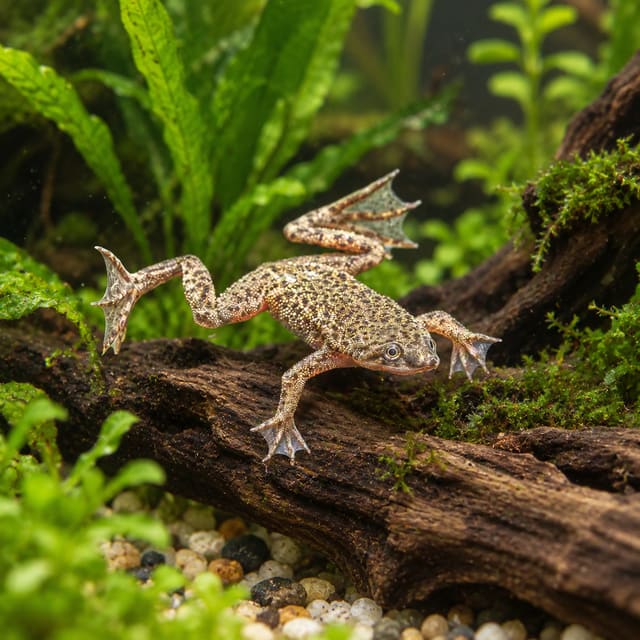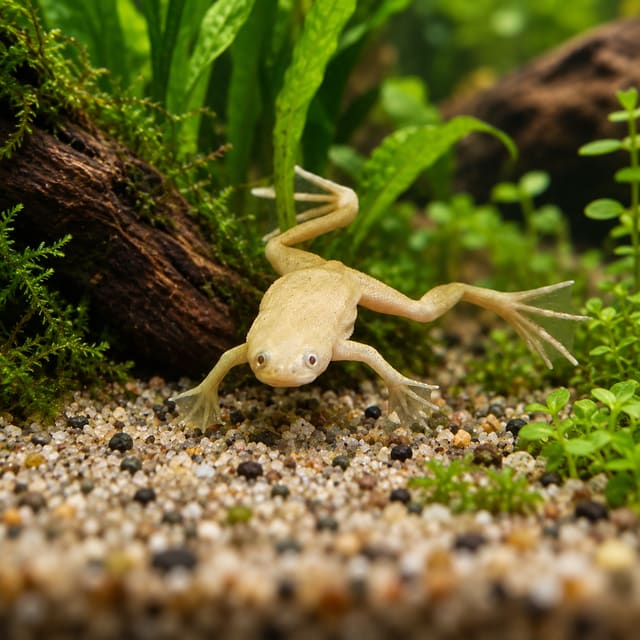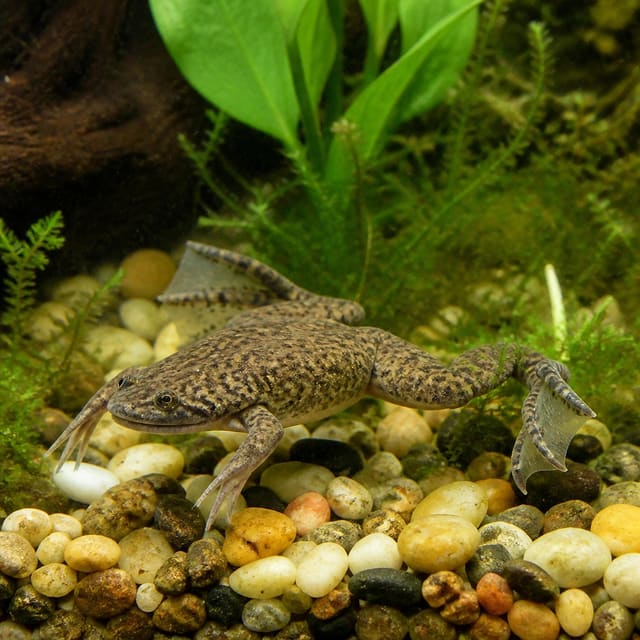
Gold Axolotl (Ambystoma mexicanum)
10–22°C · pH 7–8
£26.99
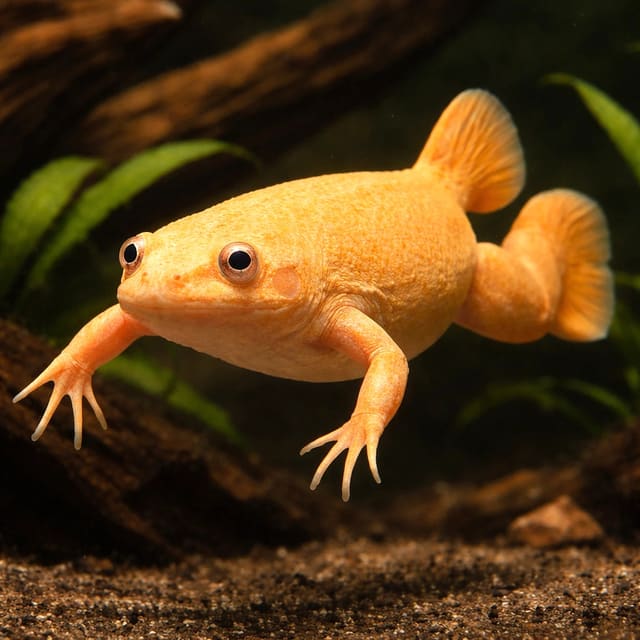
A young golden albino axolotl, the gold colour form of Ambystoma mexicanum, sent at about 3–5 cm. A cool-water amphibian that grows to around 23 cm and needs an unheated tank at 14–22 °C, a gravel-free floor, gentle flow and no fish for company.
Adult size is the maximum length this species reaches at full maturity (scientific sources). The livestock you receive will be younger and smaller. Product-photo provenance and any image-specific limitations are stated on the listing.
Ambystoma mexicanum
Save when buying more. Each quantity is one axolotl; sex is not guaranteed unless the listing explicitly states it.
A young golden albino axolotl, the gold colour form of Ambystoma mexicanum, sent at about 3–5 cm. A cool-water amphibian that grows to around 23 cm and needs an unheated tank at 14–22 °C, a gravel-free floor, gentle flow and no fish for company.
Adult size is the maximum length this species reaches at full maturity (scientific sources). The livestock you receive will be younger and smaller. Product-photo provenance and any image-specific limitations are stated on the listing.
Maintain these water conditions for optimal health and vibrant colors
An axolotl is not a fish, whatever aisle it ends up in. It is an amphibian, a salamander, and the Caudata Culture species entry names it as the largest member of its family, the Ambystomatidae. What sets it apart from almost every other salamander is that it never really grows up. Most salamanders lose their gills as adults and move onto land. The axolotl reaches sexual maturity without metamorphosing, keeps its gills and spends its whole life in water. Biologists call this neoteny, and the Caudata entry describes the axolotl as an obligate neotene that can only be pushed through metamorphosis with hormone treatment. Put simply, the gilled youngster you unpack will still be a gilled, fully aquatic animal as an adult.
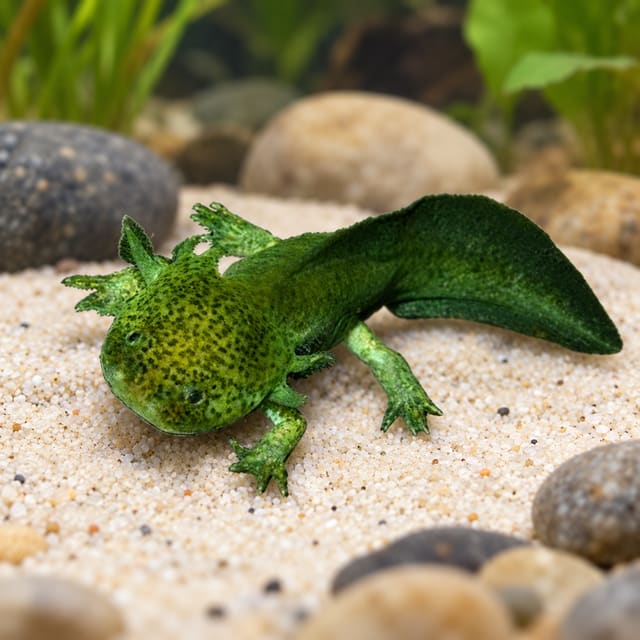
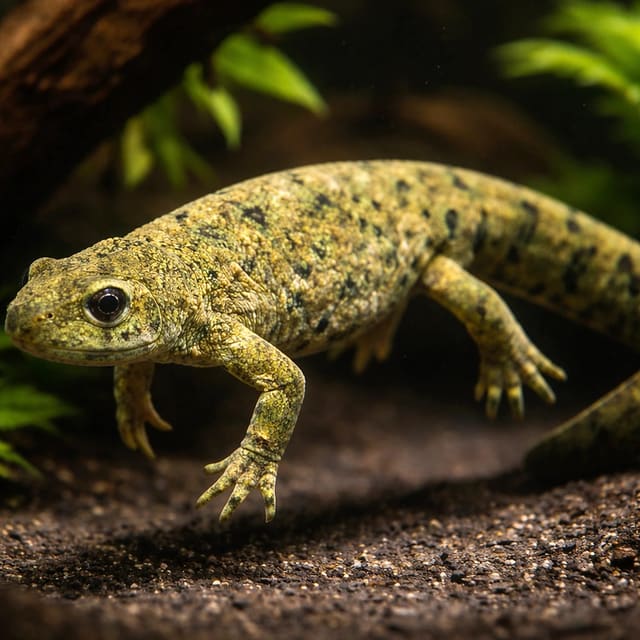
Three pairs of feathery gill stalks fan out from behind a broad, flat head, each lined with fine filaments that take oxygen from the water. The eyes have no lids. The four legs look small for the body and end in long, thin digits, and a fin starts just behind the head, runs the length of the back, wraps round the tail and finishes at the vent. Wikipedia's description lists each of these features, and you can see every one of them on a healthy animal in the tank.
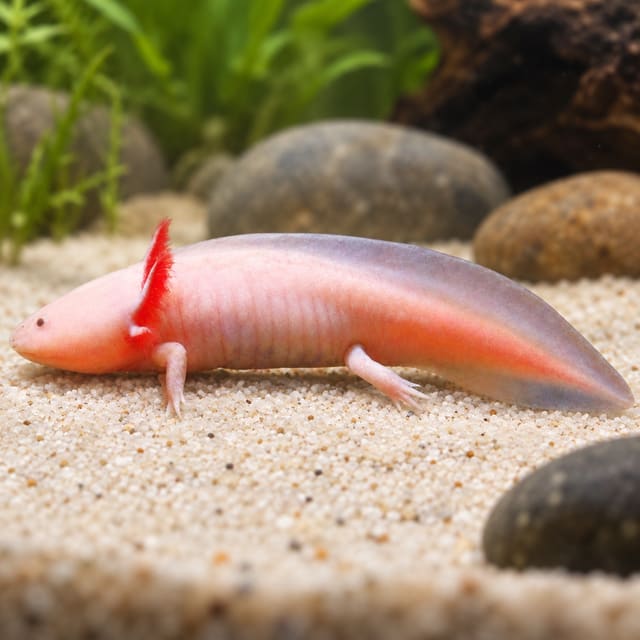
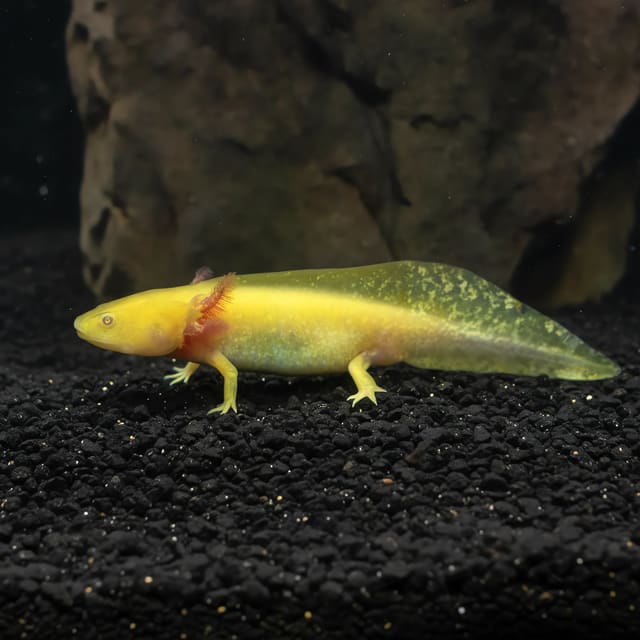
Wild axolotls are brown or tan with gold speckles and an olive undertone. The animal on this page is a captive colour form. Keepers on Caudata.org call it the golden albino: albinism affects every pigment cell except the yellow ones, and what remains is a gold axolotl. The colour runs from pale lemon to a strong, bright yellow, and many show shiny, lighter patches over the body and tail.
Sources differ slightly on the eyes. The Caudata care sheet describes the albino as golden with pink eyes, while a Caudata forum guide to colour forms describes yellow eyes. Either way the eye is pale, never the solid black eye of a wild-type or leucistic axolotl. Our photo shows those traits plainly: a lemon-yellow body, red gills folded back along the neck, a pale eye and a scatter of silvery flecks across the tail fin.
It helps to know the neighbours, because they are easy to mix up in a shop tank. The same Caudata.org colour guide describes the white albino as completely white with pink or transparent eyes and light pink to red gills, while the leucistic is also white but keeps dark eyes and may show black freckles on the face and back. Melanoids sit at the other extreme, so dark they look black, with small, dark eyes that lack a shiny ring. Coppers are described as rusty yellow with brown speckles and dark eyes. The golden albino is the one that is properly yellow all over with pale eyes, and the Caudata care sheet lists it simply as the albino, golden with pink eyes. Wikipedia adds that animals carrying two colour mutations at once are common in the pet trade, and the colour guide's own range, from light yellow to very bright yellow, means individual animals vary in shade.
This listing used to carry the name "Axolotl Gold Salamander", and you will also see the animal sold simply as a gold axolotl. All three names describe the same thing: the golden albino form of Ambystoma mexicanum, the species described by Shaw and Nodder in 1798. The word axolotl itself comes from Nahuatl and has been translated in many ways, from "water dog" to "water monstrosity".
Every axolotl traces back to two freshwater lakes south of Mexico City, Xochimilco and Chalco. Chalco no longer exists. Xochimilco survives as a network of canals and lagoons with muddy bottoms, and Wikipedia describes the axolotl's preferred habitat there as water channels and deeper lakes with plenty of aquatic vegetation. Draining of the lakes began under the Aztecs and sped up through the twentieth century, and much of the old lake bed now lies under Mexico City.
The survey figures make grim reading. Wikipedia reports around 6,000 axolotls per square kilometre in 1998 and about 100 per square kilometre by 2008. A search in 2013 at first found none, and only two were seen later that year. Introduced fish, tilapia and carp in particular, have pushed wild axolotls to the edge of extinction. The species is assessed as Critically Endangered by the International Union for Conservation of Nature and sits on Appendix II of CITES, the convention that controls international trade in threatened wildlife. The Caudata entry records the same Critically Endangered listing.
For anyone setting up a tank, the wild habitat explains the most important rule on this page. Wikipedia notes that the water in Xochimilco rarely rises above 20 °C and can drop to 6–7 °C or lower in winter. This is a cool-water animal from top to tail. A heated tropical aquarium, the right home for nearly everything else we send out, is the wrong one for an axolotl.
There is an odd contrast here. The axolotl is one of the most familiar amphibians in aquariums and laboratories, studied closely for its power to regrow lost limbs, while the wild population clings on in what is left of Xochimilco. Keeping one well means copying the conditions it evolved in: cool, still, plant-filled water over a soft bottom, with nothing sharp, small or hungry sharing the space.
Each unit on this listing is a single golden albino axolotl. Our listing gives the dispatch size as roughly 3–5 cm, so you are buying a youngster with nearly all of its growing still ahead of it. Build the tank for the adult, not for the small animal in the bag.
Wikipedia gives sexually mature adults, at 18–27 months old, a length of 15 to 45 cm, with about 23 cm the most common size and anything over 30 cm rare. The Caudata species entry puts typical adult length at 20–28 cm and mentions specimens over 43 cm in total length. Treat 45 cm as the very top of the recorded range rather than something to expect. Plan for an animal of around 23–28 cm and your setup will be right.
How fast it gets there depends heavily on warmth and food. Caudata reports that a well-fed axolotl kept at 24 °C can reach 25 cm and sexual maturity in under six months. That temperature sits above the 14–22 °C range the same page recommends for adults, so read it as the upper limit of what is possible rather than a target to chase. Caudata puts maturity at about 20 cm, usually somewhere between six months and a little over a year old, and Wikipedia gives around 18 months for wild animals.
We do not sell this listing by sex. The visible differences belong to mature animals: Wikipedia describes males with a swollen cloaca lined with papillae, and females carrying eggs as noticeably wider in the body. With maturity coming at around 20 cm, there is nothing reliable to read on a 3–5 cm youngster, so any guess at that size would only be a guess.
Wikipedia gives the life expectancy of a wild axolotl as 10–15 years. Before you order, think about who will feed it during holidays, how you would move the tank if you moved house, and how you will keep the water cool through a hot British summer.
| Feature | Golden albino axolotl |
|---|---|
| Scientific name | Ambystoma mexicanum (Shaw and Nodder, 1798) |
| Animal group | Amphibian; salamander family Ambystomatidae |
| Typical adult length | About 23 cm (recorded range 15–45 cm; over 30 cm is rare) |
| Size when sent | Roughly 3–5 cm |
| Water temperature | 14–22 °C, ideally 16–18 °C; no heater |
| pH | 6.8–7.6, with about 7.0 preferred |
| Tank | About 150 litres for one adult |
| Floor | Bare glass, smooth sand under 1 mm, or stones larger than the head |
| Diet | Carnivore: worms, bloodworm, sinking pellets |
| Wild status | Critically Endangered (IUCN); CITES Appendix II |
Sources disagree on tank size, and it helps to know why. The Caudata species entry, written in 2001, treats a 60 × 30 × 37 cm aquarium as adequate for two adults, which is roughly 66 litres. Wikipedia's current captive-care section says a single axolotl typically needs a 150-litre tank. We side with the larger figure. An axolotl feeds from the bottom, sucking in whatever lies near its mouth, so a long, wide footprint is worth more than height, and a bigger body of water also warms up more slowly on a hot afternoon.
Get this wrong and the consequences can be fatal. Caudata explains how axolotls feed: they empty their mouths of water and then open them suddenly and very wide, so that anything close by is drawn in, food or substrate. Gravel goes down with the food and can cause digestive impaction, sometimes leading to death. Wikipedia cites a laboratory care guide that names bowel obstructions as a common cause of death and recommends that nothing with a diameter below 3 cm, roughly the size of the animal's head, should be within reach.
That leaves three sensible choices:
Whichever you pick, walk round the tank before the axolotl arrives and take out anything small and loose: pebbles in plant pots, decorative chippings, glass beads, the small stones glued onto some ornaments. Repeat the check every time you change the décor.
Wild axolotls live among dense aquatic plants, so planting is welcome, either rooted in sand or tied to large stones and wood. Add at least one solid hide with smooth edges and no narrow gaps where a leg or gill could catch; a ceramic cave, a wide section of pipe or a rounded piece of bogwood all work. Lighting is optional. The Caudata entry says it is only needed if you want to see the animal more easily, so a modest light on a timer for viewing, plus a shaded corner, is plenty.
Caudata is clear that axolotls are stressed by flowing water, and advises reducing or diffusing the output of a power filter so that large volumes of water are not pushed around the tank at speed. A sponge filter suits small setups. On a larger tank, an external or internal filter can still be used if the return is spread through a spray bar along the back glass, or baffled so the surface ripples rather than churns. Run the filter until the tank is fully cycled before the axolotl goes in; a brand-new, uncycled tank is a poor place to start any aquatic animal.
Leave the heater in its box. The Caudata species entry gives 14–22 °C as reasonable for adults and warns that anything over 25 °C is unsuitable for more than a few days, because high temperatures stress axolotls and loss of appetite, fungal infections and bacterial infections often follow. Wikipedia suggests 16–18 °C so that the animal keeps eating properly, and notes that temperatures above 24 °C push up its metabolic rate. Aim for the 16–18 °C sweet spot and treat 22 °C as a line you do not want to sit above for long.
In a British home the winter is rarely the issue. Summer is. A tank in a sunny room, or beside a radiator, oven or games console, can climb well past 22 °C during a warm spell. Fit a thermometer you can read at a glance and look at it every day. Practical ways to hold the temperature down:
Wikipedia states that chlorine, commonly added to tap water, is harmful to axolotls. Treat all tap water before it goes in, using a conditioner that deals with chlorine, chloramine and metals, as the Caudata entry recommends. Match the temperature of new water to the tank as closely as you can.
Ammonia and nitrite should both read zero. A keeper's checklist on Caudata.org sets ammonia at 0, nitrite at 0 and nitrate below 40 on a standard test kit, and that is a sensible standard to test against. A liquid test kit costs far less than a sick axolotl.
Axolotls do not need unusual water chemistry, but they do like it steady. In a Caudata.org thread on the subject, keepers give pH 6.8–7.6 as acceptable, with 7.0 the ideal, and the same post gives general hardness as 140–180, which in the usual ppm units works out at roughly 8–10 °dGH. An older Caudata thread adds that axolotls prefer somewhat hard water and that animals in soft water often suffer temporary anaemia, and another reply there warns that soft water tends to drift acidic, so pH needs watching. Test your tap water before you order. If it is very soft or very different from these figures, ask us first.
Caudata suggests that changing about 20% of the water every two weeks is usually enough, unless many axolotls share a small tank or the animal is being overfed. Treat that as a minimum. A large animal eating worms and pellets produces a lot of waste, so keep testing, and change water more often if nitrate creeps up.
| Measure | Aim |
|---|---|
| Temperature | 16–18 °C ideal; 14–22 °C acceptable; never above 25 °C for more than a few days |
| pH | 6.8–7.6, about 7.0 preferred |
| General hardness | About 140–180 ppm (roughly 8–10 °dGH) |
| Ammonia and nitrite | 0 |
| Nitrate | Below 40 |
| Water change | At least 20% every two weeks |
Axolotls are carnivores. Wikipedia notes that they find food by smell and take it by suction, and in the wild they eat small prey such as molluscs, worms, aquatic insects, crayfish and other arthropods, small fish and other salamanders. In the tank that translates into meaty foods sized to fit the mouth, offered where the axolotl can find them on the bottom.
For newly hatched larvae, Caudata lists young daphnia, microworm and newly hatched brine shrimp, with the cyst shells removed, as ideal first foods. A youngster at our dispatch size is past that first stage but still small, so start with small live or frozen foods it can swallow easily, such as bloodworm and blackworm, and move on to chopped earthworm as it grows. Young, growing axolotls are fed more often than adults. Caudata warns that where several young axolotls share a tank, infrequent feeding leads to bitten-off limbs and gills, and to deaths.
Earthworms appear in both main sources and make an excellent staple once the axolotl is big enough to take them whole or chopped. Other foods the sources name:
Variety is no bad thing, but a diet built around good worms and a quality sinking pellet covers the basics.
Both sources warn against feeder fish. Wikipedia notes that fish may carry parasites, and the Caudata entry advises against tadpoles and feeder fish for the same reason. Live fish also bring the gill-nipping problems described in the tank mates section below.
Caudata gives a simple guide: offer as much as the axolotl will eat in 15 minutes. An adult kept at 22 °C should only need feeding every two to three days. Long tongs or a shallow feeding dish keep food off the sand and make leftovers easy to spot. Whatever is left after that 15-minute feed should come out, because uneaten food quickly spoils the water.
Temperature and appetite go hand in hand. Wikipedia's suggested 16–18 °C is chosen to keep the animal feeding properly, and Caudata lists loss of appetite among the first effects of overheating. If a settled axolotl suddenly ignores food, check the thermometer before anything else.
The honest answer to "what can live with my axolotl?" is nothing, or another axolotl of similar size. Caudata Culture keeps a long article of species-mixing incidents sent in by keepers, and its verdict is blunt: mixing species is a bad idea, because salamanders and frogs are carnivorous predators and the potential for disaster is high. The axolotl examples are worth reading before you consider any companion:
Two problems run through those stories. Fish nibble the waving gills, and the axolotl treats any small animal as food. Its suction feeding draws in anything that fits, so shrimp, snails and small fish are simply prey. There is also the temperature clash: tropical fish need warm water, and the axolotl does not.
The Caudata entry sizes its tank recommendation for two adults, so a pair can share, but the same page warns that most bloodlines are quite cannibalistic and advises against keeping many in one tank. Caudata's warning about lost limbs and gills is aimed at groups that are fed too rarely, so hunger makes things worse. If you want two, match them closely for size, feed generously, give each a hide and enough floor space to get away from the other, and be ready to separate them if bites appear.
Axolotls are famous for regrowing lost parts. Wikipedia describes them regrowing limbs and tails over months. It goes further than limbs: Wikipedia also lists tissues of the eye and heart and parts of the central nervous system. That ability is a safety net, not a reason to put up with nipping.
If you want a matching animal, our listing for the Gold Axolotl (Ambystoma mexicanum) is the same species; match sizes before you put two together. Other gold animals we keep, such as the Gold African Dwarf Frog or the Gold White Cloud Mountain Minnow, belong in tanks of their own. Read each animal's own care page rather than assuming any of them could share with an axolotl, because none of them should.
The main risks named in our sources come down to a handful of causes, and every one of them can be dealt with before the animal arrives. Get the temperature, the floor and the company right and you remove the big risks.
Caudata links high temperatures with stress, loss of appetite, and fungal and bacterial infections, and says anything over 25 °C is unsuitable for more than a few days. If your axolotl goes off its food in warm weather, treat the temperature as the first suspect and bring it down gradually using the cooling measures in the water section, rather than with a sudden cold shock.
Swallowed gravel can block the gut. Caudata describes digestive impaction from substrate, sometimes leading to death, and Wikipedia cites a laboratory guide naming bowel obstructions as a common cause of death in axolotls. The fix is preventive: a bare, fine-sand or large-stone floor, and nothing loose in the tank under 3 cm across.
Fish nibble gills and other axolotls bite limbs, as the tank mates section explains. Keep the axolotl alone or with one similar-sized companion, and check the gill stalks and feet every time you feed.
Chlorine is harmful (Wikipedia), ammonia and nitrite should read zero, and strong flow stresses axolotls (Caudata). A weekly test, a dechlorinator used every time and a filter outlet that ripples rather than churns cover most of it.
Now and then someone hopes an axolotl will turn into a land salamander. The Caudata entry treats the axolotl as an obligate neotene that only metamorphoses with hormone treatment. A gilled, fully aquatic adult is exactly what a healthy axolotl looks like; do not try to change that.
Most aquarium treatments are formulated for fish. Before using any medicine, contact us or a vet with amphibian experience. Day to day, the useful checks are simple: is it feeding with interest, are the gill filaments full and intact, is the skin clean, and is the temperature where it should be? A sudden change in any of those deserves a closer look, starting with a water test.
Axolotls breed readily in captivity. Wikipedia describes them as especially easy to breed compared with other salamanders, and the Caudata species entry gives the practical detail. Most success is reported in December and January. Animals usually mature at about 20 cm, somewhere between six months and over a year old, and a single spawning produces anywhere from a hundred to more than a thousand eggs. At 24 °C, the eggs hatch after about 14 days.
The numbers are the real challenge. Caudata's first foods for the larvae are young daphnia, microworm and newly hatched brine shrimp with the cyst shells removed, all needed in quantity and often. The same page warns that most bloodlines are quite cannibalistic and that infrequent feeding of groups leads to lost limbs and gills, and to deaths. Raising even part of one spawning means several tanks, a steady supply of live food and a plan for where hundreds of young axolotls will go.
Sexing becomes possible only with maturity. Wikipedia describes males with a swollen cloaca lined with papillae and gravid females as distinctly wider in the body. The youngster sold here is far too small to show either, and we do not sell it by sex, so do not buy two expecting a breeding pair.
Colour inheritance is a topic of its own. The Caudata.org colour guide states that albinism is recessive to the wild type and that golden albino is dominant over white albino, which is how two gold parents can sometimes produce white albino young. If breeding is your aim, read up on axolotl genetics first and plan where every youngster will go before eggs appear.
Have everything ready before you order: the tank cycled with the filter running, the floor safe, the water dechlorinated, tested and sitting at its normal cool temperature. Someone needs to be at the delivery address to take in the parcel, because live animals cannot be left on a doorstep. Please read our delivery and live-arrival information before ordering. Animals travel in oxygen-filled bags inside insulated packaging, with heat packs when conditions call for them, carried by a tracked courier licensed to transport live animals. We email your confirmed delivery date and tracking.
Start a continuous video while the parcel is still sealed, and open it in the same take so the axolotl can be seen in its unopened bag. If the animal arrives dead, dying or clearly compromised, email hello@tropicalfishco.co.uk on the day of delivery with your order number and that video. Photos on their own do not meet the policy. The resolution is a replacement with your next order or a refund for the affected animal, subject to the guarantee terms.
Keep the lights low and the room quiet, and watch the axolotl's breathing, appetite and behaviour. Offer a small amount of a food it can manage, such as bloodworm, and remove whatever is left. Check the thermometer every day, test ammonia and nitrite during the first week, and hold back on rearranging the tank. A youngster that is exploring the tank and taking food is settling in well. If anything worries you, contact us and we will talk it through.
These are the sources behind the care figures on this page:
No reviews for this item yet. Bought one? Honest reviews only, good or bad.
What customers say about ordering from us
Easy website plenty of info on fish your buying great to pick a time slot
TRACEY DURRANT · 7 Oct 2026
Got some lovely fish thank you
Kevin Mackie · 7 Oct 2026
Reviews of our shop, collected by Judge.me, an independent third-party review collector. Newest first.