African Dwarf Frog (Hymenochirus sp.)
22–25°C · pH 7–8
£5.39
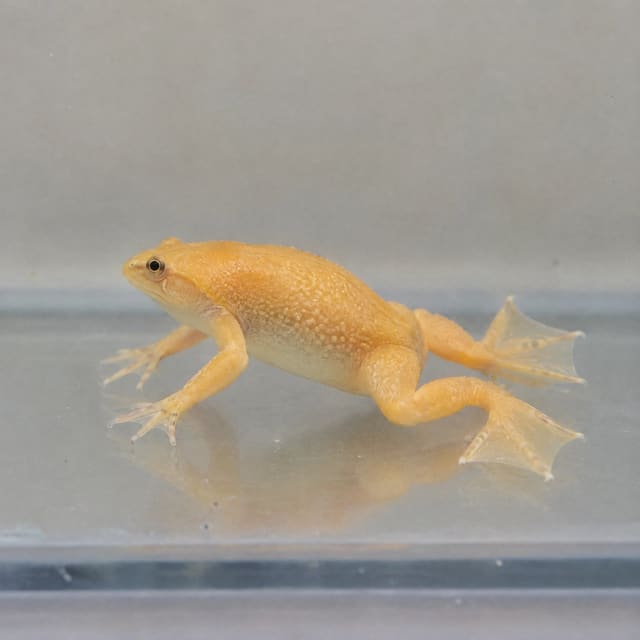
One gold African dwarf frog, Hymenochirus boettgeri, sent at about 1-2 cm with the sex unchosen. A fully aquatic, air-breathing amphibian reaching about 3.5 cm, it needs a covered, gently filtered tank of 40 litres or more at 24-26.7 C, small sinking meaty foods and calm tank mates it cannot eat or be eaten by.
Adult size is the maximum length this species reaches at full maturity (scientific sources). The livestock you receive will be younger and smaller. Product-photo provenance and any image-specific limitations are stated on the listing.
Hymenochirus boettgeri
Save when buying more. Each quantity is one frog; sex is not guaranteed unless the listing explicitly states it.
One gold African dwarf frog, Hymenochirus boettgeri, sent at about 1-2 cm with the sex unchosen. A fully aquatic, air-breathing amphibian reaching about 3.5 cm, it needs a covered, gently filtered tank of 40 litres or more at 24-26.7 C, small sinking meaty foods and calm tank mates it cannot eat or be eaten by.
Adult size is the maximum length this species reaches at full maturity (scientific sources). The livestock you receive will be younger and smaller. Product-photo provenance and any image-specific limitations are stated on the listing.
Read the full care guidance when planning conditions for your aquarium.
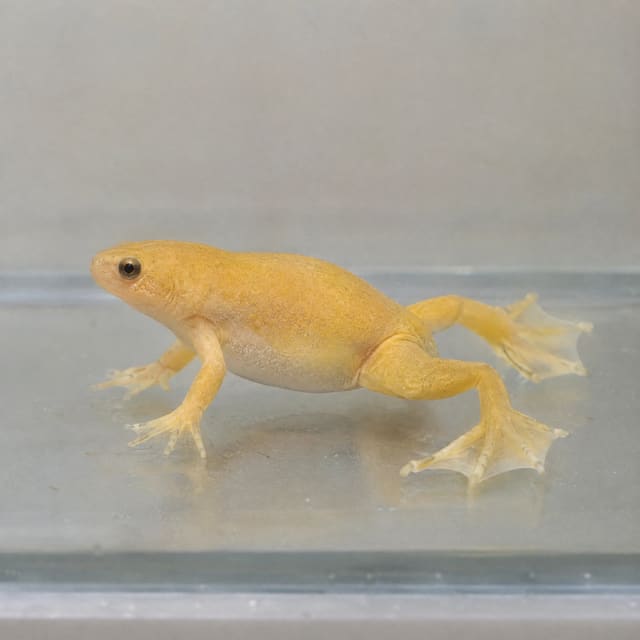
This listing is for one Gold African Dwarf Frog, Hymenochirus boettgeri, sent at roughly 1–2 cm. That is a young frog with growing still to do, and its sex is neither chosen nor promised. If you want two or three for the same aquarium, simply order the number you need; each is a separate frog of the same gold colour form.
The first thing to settle in your mind is that you are buying an amphibian, not a fish. Dwarf clawed frogs belong to the family Pipidae, which also contains the much larger African clawed frog, and like the rest of that family they never need to leave the water. What they do need is air. They have lungs, not gills, so a dwarf frog swims up to the surface to gulp a breath and then sinks back to the bottom. Nearly every part of good care follows from that: permanent water to live in, and an easy, short route to the air above it.
In English the wild species is called the Zaire dwarf clawed frog or the Congo dwarf clawed frog, and its scientific name honours the German zoologist Oskar Boettger. Shops and keepers almost always say “African dwarf frog”, a name that is used loosely for all four species in the genus Hymenochirus. That looseness matters less than it sounds. When a University of Michigan team sequenced frogs bought through the aquarium trade under the label “Hymenochirus sp.”, all eight they tested matched H. boettgeri, so the everyday pet dwarf frog is very often this species.
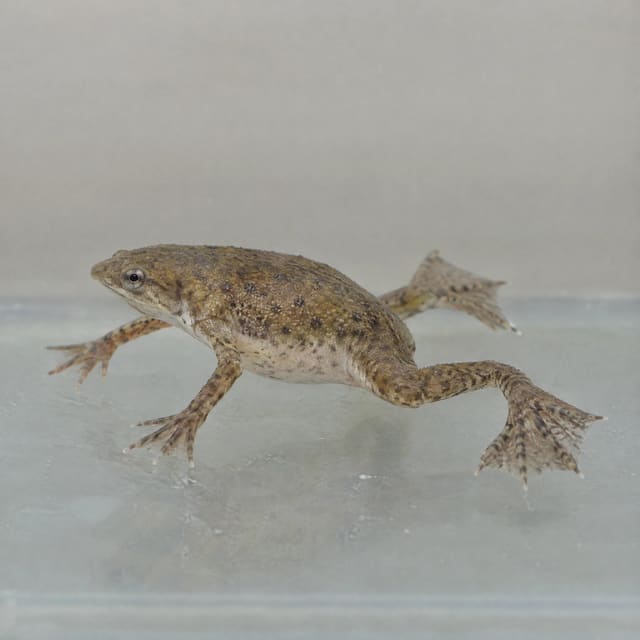
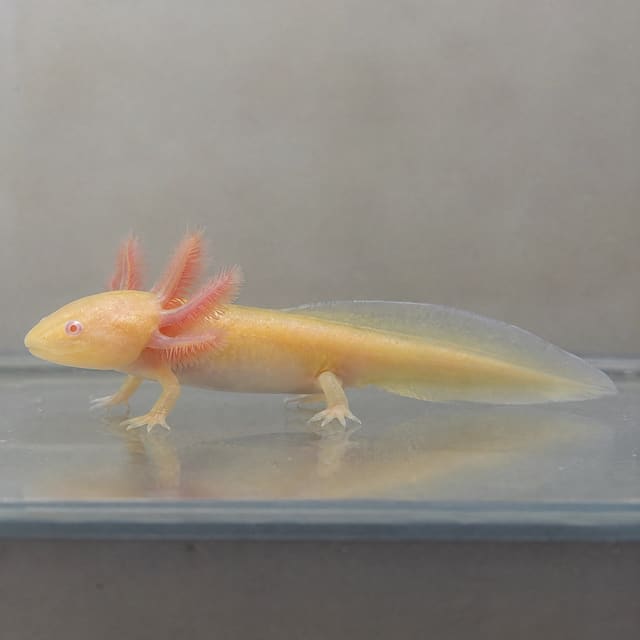
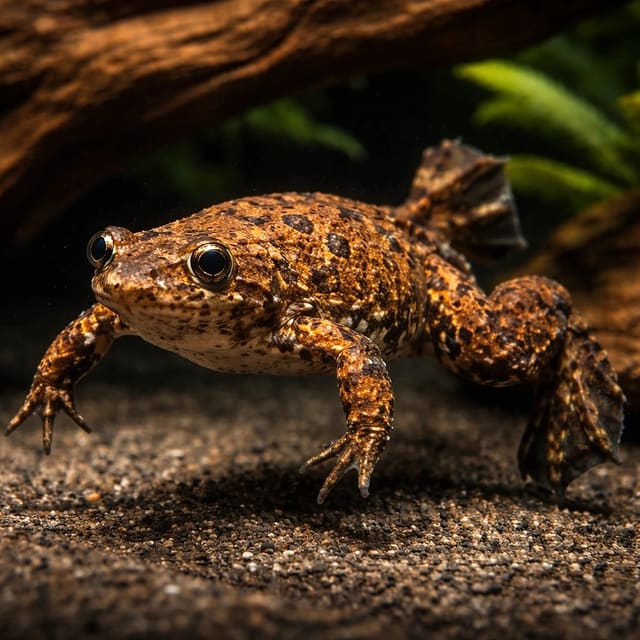
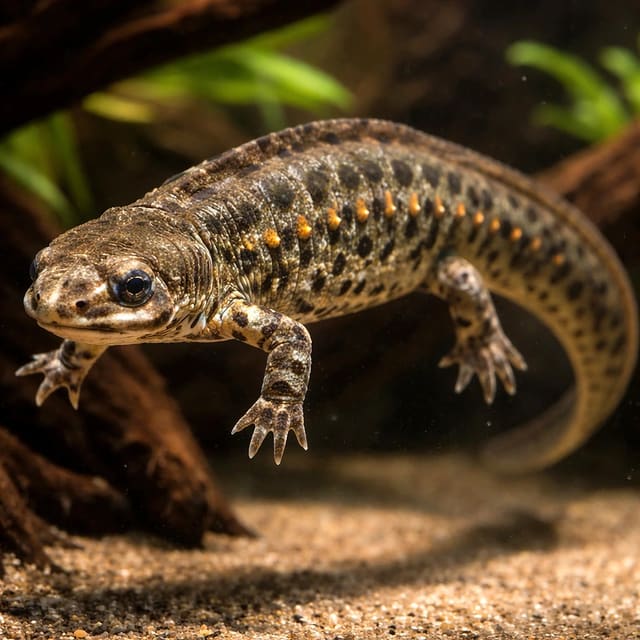
The gold form is a colour variety of that species. Wild H. boettgeri are some shade of brown or grey with darker speckling, and across the genus the range runs from olive green to brown with black spots: camouflage for an animal that feeds on a muddy, leaf-strewn pool bottom. A gold frog does the opposite and shows up clearly against dark sand or wood, which is exactly why people choose it. Its care is the care of the species, so everything below applies to the gold frog just as it would to a brown one.
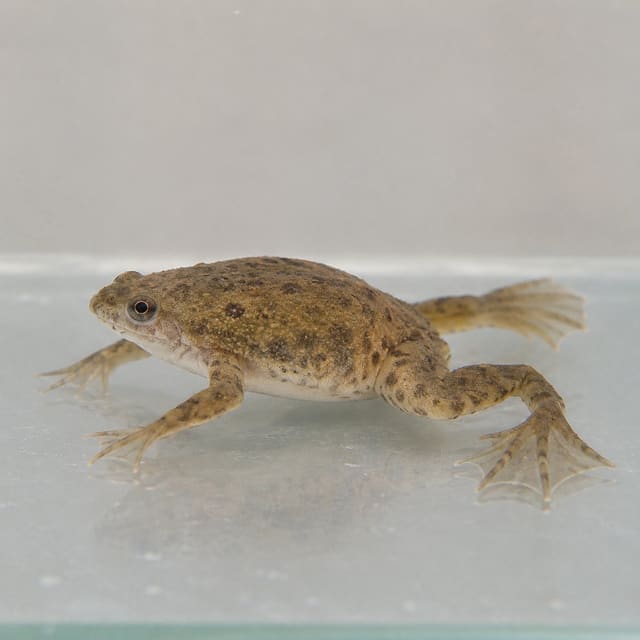
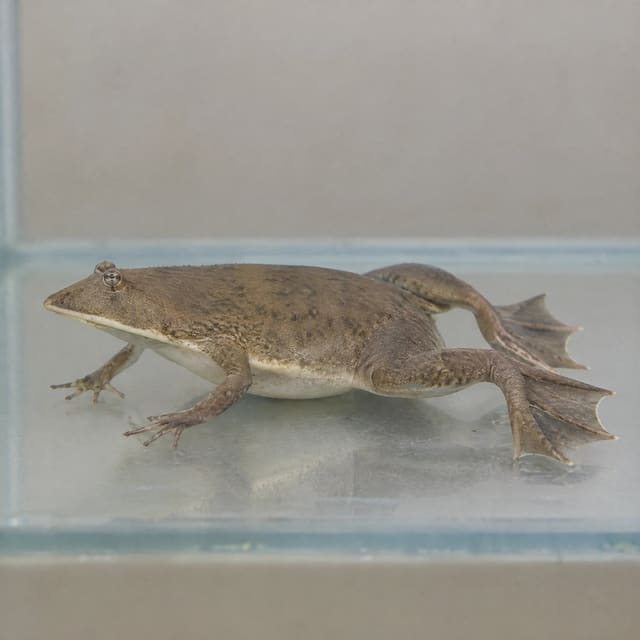
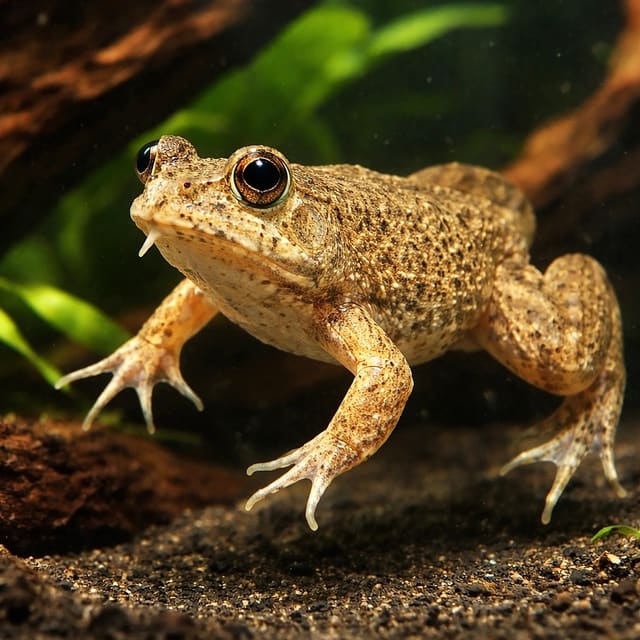
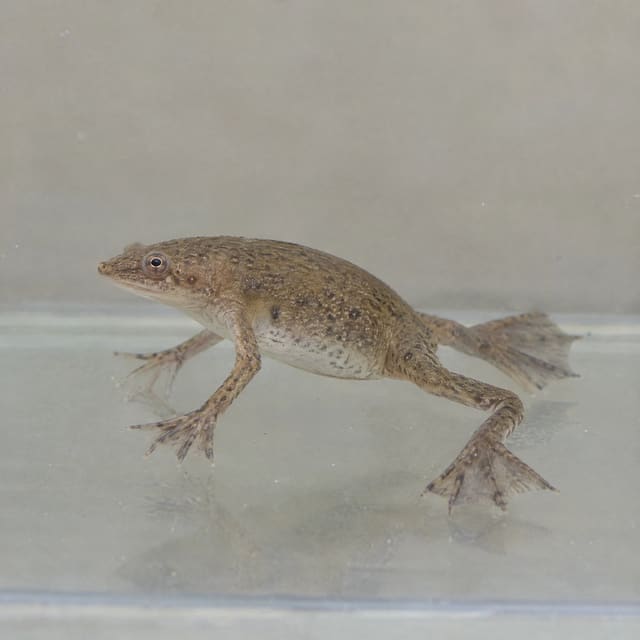
Up close, a dwarf clawed frog has a narrow head that tapers to a point, no tongue and no eyelids. The hind legs are long and powerful for the size of the animal, the feet are webbed, and the back toes carry small dark claws. Those claws are where the “clawed frog” name comes from, although the black tips are easily worn down on sharp gravel, one of several reasons we suggest a smooth floor for the tank. Running along the body and underside is a lateral line, a system that lets the frog sense movement and vibration in the water around it.
Females are the larger sex and reach up to 35 mm measured from snout to vent, the standard way frogs are measured. The genus account puts these frogs at about 2.5–3.8 cm overall and notes that a fully mature female is around 40% bigger than a male. For a sense of what is typical rather than the maximum, the Michigan researchers weighed and measured a hundred adults for their experiments and found an average snout–vent length of about 2.4 cm and an average weight of 0.85 g. In other words, a typical full-grown dwarf frog is roughly the diameter of a 2p coin, and it weighs less than a gram.
Every one of those signs belongs to an adult. A frog sent at 1–2 cm is well below the average adult size above, so please treat it as unsexed. If you keep several, you may well find both sexes among them as they mature, but we cannot select males or females for you.
Young African clawed frogs (Xenopus) have often been sold as dwarf frogs, and the two get mixed up regularly. They are different animals. The clawed frog is larger and more aggressive, and captive individuals have lived 25–30 years, which is a very different commitment from a dwarf frog. A genuine dwarf frog tops out below 4 cm; one that keeps growing well beyond that was never a dwarf frog. If you are comparing listings on our site, the African Dwarf Frog (Hymenochirus sp.) listing covers the standard frog rather than this gold form, and there is a second Gold African Dwarf Frog listing as well.
Hymenochirus boettgeri has a wide range across forested equatorial Africa. It is recorded from Nigeria, Cameroon, Equatorial Guinea and Gabon, and east through the Central African Republic to the eastern Democratic Republic of the Congo. It is presumed to live in the Republic of the Congo as well, though it has not been formally recorded there. The genus as a whole stretches from Nigeria and Cameroon in the north, south through Gabon and east across the Congo River Basin.
Within that range the species keeps to still, shaded water: pools and backwaters in lowland rainforest, and pools alongside slow-flowing rivers. The broader genus account describes a seasonal shift, with frogs in shallow rivers, creeks and ponds through the dry season and spreading into flooded forest when the rains arrive. They prefer to feed close to the bottom, where their dappled colours disappear against mud and fallen leaves and they are less exposed to predators.
The species is common over most of its range, and the IUCN assesses it as Least Concern. It is also readily available through the aquarium trade, which is one reason scientists have proposed it as a laboratory model for studying amphibian disease: researchers can obtain it without taking animals from the wild.
We recommend an aquarium of at least 40 litres. A single frog is tiny, but a small volume of water fouls quickly when the diet is all meaty food, and a larger body of water changes more slowly when something goes wrong. For a sense of scale, the Michigan team kept mixed-sex groups of adults in 38-litre glass tanks measuring 25 × 30 × 50 cm, each with its own heater and internal filter on a cycled system.
Shape matters as much as volume. A dwarf frog has to swim to the top for every breath, and the species account is plain that tanks for it should not be too tall and must be well covered. Choose a long, fairly low aquarium rather than a tall column, and fit a lid that closes properly, because these frogs can escape from an open tank. The research tanks used covers with small ventilation holes and always kept at least 1 cm of air between the water and the lid, so a frog breathing at the surface had space to do it. That is a sensible rule to copy at home: a secure, ventilated cover and a clear layer of air above the water.
The researchers furnished their tanks with artificial plants, lengths of PVC pipe and broken terracotta pots for the frogs to retreat into, and they noted that adding this cover improved the animals’ quality of life. Every item was checked to make sure it had no rough surfaces or sharp edges that could damage the frogs’ skin. At home that translates to smooth caves, rounded wood, clay pot halves with the broken edge sanded or buried, and plants. Live plants are welcome, and floating plants add the shade these frogs come from. A broad leaf or a piece of wood reaching towards the surface gives a frog somewhere to pause on the way up.
Use a filter that keeps the water clean without creating a current: a sponge filter or a small internal filter with its outlet turned against the glass works well. Fit a heater with a thermostat, as the research tanks had, and consider a guard around it so a resting frog cannot sit against the glass of the heater. Lighting needs nothing special; ordinary aquarium lighting for plants is fine as long as there is shade somewhere in the tank.
| Feature | What we suggest |
|---|---|
| Volume | 40 litres or more, fully cycled before the frog arrives |
| Shape | Long and low rather than tall |
| Cover | Tight, ventilated lid with at least 1 cm of air under it |
| Flow | Gentle; sponge filter or a baffled internal filter |
| Substrate | Smooth sand or fine rounded gravel |
| Cover and shelter | Smooth caves, pipes, pot halves, live or artificial plants, some floating plants |
| Heating | Thermostatic heater set within 24–26.7 °C |
Our care range for this frog is 24–26.7 °C, pH 6.5–7.8 and a general hardness of 5–20 °dGH. Those numbers sit comfortably around the conditions the University of Michigan colony lived in: a steady 25 °C (plus or minus 0.5), pH 7 (plus or minus 0.4) and a conductivity of about 900 µS/cm, which is moderately mineralised water rather than very soft. Hold the temperature steady somewhere in the middle of our range and you will not go far wrong.
The same paper cites earlier work showing that the species has bred in water whose temperature swung between 19 °C and 30 °C over a day. That is useful to know if your room is warm in summer, but it is a record of what the frogs survived and bred through, not a target. Steady water is kinder than water that rises and falls.
Some keepers reach for reverse-osmosis water assuming purer is better. The Michigan team did fill their tanks with RO water, but they pointed out that RO on its own is extremely hypo-osmotic, so they added 0.5 g of synthetic sea-salt mix per litre to raise the conductivity to around 900 µS/cm and used sodium bicarbonate when needed to keep the pH near 7. At home, ordinary tap water treated with a good dechlorinator and sitting within our ranges is the simple answer. If you do use RO, remineralise it; never give a frog bare RO water.
Frogs in the family Pipidae excrete their waste mainly as ammonia, and a meaty diet adds more. The research colony worked to these limits, which make a good checklist for a home tank:
They started their filters by seeding them with nitrifying bacteria, and in tanks that were not yet cycled they had to change water roughly twice a week for about six weeks to keep waste within safe limits. That is the strongest argument for cycling the aquarium fully before the frog arrives rather than learning about the nitrogen cycle with a live animal in the water. Once the tank is mature, test weekly and change water as your readings require; weekly partial changes suit most home set-ups.
Before each change, the researchers matched the new water to the tank for both temperature and conductivity, and when a water change fell on a feeding day they waited at least four hours after the meal. Both habits are easy to copy. Bring replacement water to tank temperature, make sure it comes from the same source as before, and avoid sudden swings in either direction.
Watching a dwarf frog eat explains a lot about how to feed one. Pipid frogs have no tongue and no teeth. Instead they use their webbed feet to push food into the mouth and a throat pump, called a hyobranchial pump, to draw food in by suction, and the claws on the hind feet help tear larger pieces. They find food with their sensitive fingers, their sense of smell and the lateral line rather than by spotting it and darting after it. In the wild they are scavengers that will eat almost anything living, dying or dead, along with organic debris.
Suitable foods are small items designed for aquarium fish, with meaty foods at the centre of the diet:
The research colony was fed newly hatched brine shrimp and frozen bloodworm three times a week, as much as the frogs would take at each meal, and any leftovers were removed. That is a good template for a home tank. Frozen food should be thawed first and offered in pieces small enough for a very small mouth.
Because a dwarf frog hunts by touch and smell, it may still be nosing around for a meal after faster tank mates have finished. Drop food where the frog is, or use a shallow feeding dish on the substrate so food stays in one place and you can see who has eaten. Long tweezers or a pipette let you place a few bloodworms right in front of it.
Dwarf frogs are not fussy eaters, and the species account warns that overfeeding quickly leads to obesity. A healthy frog is plump, not round. Feed small amounts, take out anything left after the meal, and if your frog is starting to look bloated, cut back. Uneaten meaty food is also the quickest way to push ammonia up in a small tank, so tidiness at feeding time protects the water as well as the frog’s waistline.
Yes, African dwarf frogs can share a tank with fish. The species account says they can live peacefully among other fish, and it gives one rule that does most of the work: tank mates must be neither large enough to pose a predatory threat to the frogs, nor small enough to become food for them. Hold every candidate up against those two tests before you think about anything else.
The upper limit is easy to picture. An adult dwarf frog averages about 2.4 cm and the biggest females reach 3.5 cm, so any fish with a mouth big enough to swallow a frog that size, or the temperament to harass one, is out. The lower limit catches people out. These frogs are scavengers that will eat things that are living, dying or dead, so very small animals such as newborn fry or baby shrimp sit in the “small enough to become food” category. Fish of a sensible size are not on the menu; tiny animals the frog comes across may well be.
Size is not the whole story. Choose calm species that will not nip at a frog resting on the bottom or crowd it out at the surface when it rises to breathe. Feeding is the other pressure point: a frog that finds its food by touch and smell is slow compared with a shoal of quick, sight-feeding fish, so whatever you keep with it, make sure the sinking food actually reaches the frog. A feeding dish placed near its favourite spot helps a great deal.
Any companion also has to be happy in the frog’s conditions: 24–26.7 °C, a pH around neutral and gentle flow. Fish that need a strong current, cool water or very soft, acidic water belong in a different aquarium.
Dwarf frogs live well together, and the research colony kept adults in mixed-sex groups. More frogs mean more waste, so add volume and filtration as the group grows. Never add an African clawed frog to a dwarf frog tank: the clawed frog is bigger and more aggressive and is a different animal altogether.
Dwarf frogs are hardy when the water is right, but they are amphibians, and amphibians come with a few health points that fish keepers do not always meet. Most problems trace back to water quality, overfeeding or rough décor. A few are infections worth knowing by name.
Chytridiomycosis is a disease of amphibians caused by the fungus Batrachochytrium dendrobatidis, often shortened to Bd, and it has been linked to amphibian declines and extinctions around the world. Dwarf clawed frogs are susceptible to it. When the Michigan team screened a sample of trade-bought frogs with a sensitive DNA test, 18% carried Bd, even though their first visual check had not picked it up. The same study cleared those infections by raising the water temperature slowly from 20 °C to 30 °C over ten days, holding it at 30 °C for ten days and then bringing it down to 25 °C over five days, and every positive frog tested negative afterwards. That was a carefully monitored laboratory protocol; if you are worried about chytrid, speak to a vet with amphibian experience rather than attempting it on a hunch.
Two habits follow from all this. Keep new frogs in their own tank for a few weeks before they join others, and never release a frog, or empty frog-tank water, into a garden pond, stream or ditch. Pour old tank water down a household drain.
In 2024, vets at the University of Michigan described a high-mortality outbreak of Mycobacterium ulcerans ecovar Liflandii in a research colony of this species, the first time that bacterium had been reported in the genus. The frogs showed lethargy, widespread infection, lumps in the skin, fluid building up in the body cavity, and sudden deaths. The authors noted that the bacterium is a possible risk to human health as well, and that sampling the tank system itself was a practical way to detect it.
Amphibians are known carriers of Salmonella. Between 2008 and 2011 an outbreak of Salmonella Typhimurium in the United States sickened 376 people in 44 states, most of them young children; where patients knew what frog they had been exposed to, 79% named African dwarf frogs, and the outbreak strain was traced back to a single breeding facility. Nobody died, but 29% of the patients whose records were available were admitted to hospital. None of this means a frog is dangerous to keep. It means simple hygiene: wash your hands with soap after feeding or tank maintenance, supervise young children around the aquarium, and keep buckets, nets and tank water well away from the kitchen.
Get to know what normal looks like: a frog that sits calmly on the bottom, swims up to breathe without effort, and comes to food. Act promptly if you see:
Test the water first, because ammonia or nitrite is the commonest cause of a sudden decline. Move an unwell frog to a separate, cycled tank if you can, and contact a vet who treats amphibians. Do not add fish medicines on a guess; frogs are not fish.
Dwarf clawed frogs breed readily in captivity, and the Michigan paper describes the species as reproducing throughout the year. Getting eggs is the easy part. Raising the tadpoles takes tiny live food, very clean water and some patience, so think of it as a project for a keeper who already has a settled frog tank.
Mating usually happens at night, often after the male has spent one or more nights humming. He grips the female around the abdomen just in front of her back legs, a hold called amplexus. She becomes still, sometimes with her front legs twitching, and then begins to swim upwards, towing the male, to lay her eggs one at a time at the water surface before returning to the bottom. The male fertilises them in the water as they are released. Amplexus can last several hours. When the female has finished, she goes still again, and a few minutes later the male lets go and both return to normal behaviour.
In the Michigan colony, the researchers believed that breeding was triggered by richer, more frequent feeding. They kept the sexes apart and fed them as much as they would take for ten days in a row, using newly hatched brine shrimp plus either frozen bloodworm, live blackworms or small-granule fish food, varying the second food each day. Each pair was then placed in its own small tank, and the frogs mated and released eggs within one to three days. One pair alone produced around 600 eggs over three days.
The researchers changed 70% of the water in their breeding tanks every day and removed leftover food, unhatched eggs and dead tadpoles twice a day. That level of care is the real price of rearing dwarf frogs. Tadpoles kept at lower density grew and changed slightly faster than crowded ones, so a wider tank with fewer tadpoles pays off. Newly changed froglets stayed on newly hatched brine shrimp for at least four more weeks before moving on to the adult diet.
Have the aquarium completely ready before the frog arrives: cycled, filter running, heater set, water tested, lid fitted and the temperature matched to the range above. Someone needs to be at the delivery address to take in the parcel, because live animals cannot be left on a doorstep. Please read our delivery and live-arrival information before ordering. Your frog travels in an oxygen-filled bag inside insulated packaging, with heat packs when the weather calls for them, carried by a tracked courier licensed to transport live animals. We email you the confirmed delivery date and tracking details.
Start a continuous video before you open the parcel, while it is still sealed, and keep filming in the same take until you have shown the frog inside the still-sealed bag. If a frog arrives dead, dying or clearly in poor condition, email hello@tropicalfishco.co.uk on the day of delivery with your order number and that video. Photos alone do not meet our live-arrival policy. Where a claim is accepted under the guarantee terms, we replace the affected animal with your next order or refund it.
Keep the lights low for the first day and let the frog find its own hiding place. Over the following week watch three things: breathing, appetite and behaviour. A settled frog swims up to the surface for air without struggling, rests on the bottom or among plants between breaths, and takes food once it has settled. Offer a little bloodworm on the second day, close to where it is sitting, and remove anything left after the meal. If it refuses food for several days or struggles to reach the surface, test the water and get in touch.
If you already have frogs, this is the moment to use a separate tank for a few weeks, for the chytrid reasons explained above. A newcomer kept on its own is also much easier to watch at feeding time.
The care, behaviour and health facts on this page come from these sources:
No reviews for this item yet. Bought one? Honest reviews only, good or bad.
What customers say about ordering from us
Easy website plenty of info on fish your buying great to pick a time slot
TRACEY DURRANT · 7 Oct 2026
Got some lovely fish thank you
Kevin Mackie · 7 Oct 2026
Reviews of our shop, collected by Judge.me, an independent third-party review collector. Newest first.
Moved by UK carriers licensed to handle live animals
Hand-packed with oxygen bags, poly box, heat pack
Email photos the same day; an optional unboxing video helps us review problems faster — claim terms apply
Klarna & PayPal Pay in 3 at checkout