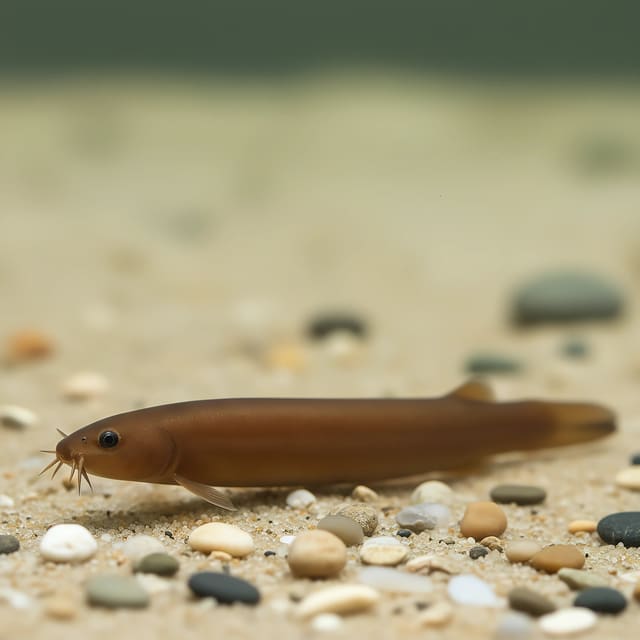
Eel Kuhli Loach (Pangio sp.)
22–27°C · pH 6.5–7.5
£5.99

Panda Loach (Yaoshania pachychilus) is a specialist subtropical hillstream fish for a mature, oxygen-rich, fast-flowing aquarium. Pack count, sex and dispatch size are not explicitly stated; confirm before ordering.
Adult size is the maximum length this species reaches at full maturity (scientific sources). The livestock you receive will be younger and smaller. Product-photo provenance and any image-specific limitations are stated on the listing.
Yaoshania pachychilus
Each quantity is one pair containing 2 fish. Discounts count pairs.
Shoaling fish: kept in a group they feel safer, stay calmer and show their best colour.
Confirm your email, then we’ll send an availability message for this exact item if it returns within 180 days.
This request is only for this product—no newsletter or other promotions. A mail-provider retry may very rarely duplicate the same availability message. Unconfirmed addresses are removed after 48 hours. See our privacy policy.
Panda Loach (Yaoshania pachychilus) is a specialist subtropical hillstream fish for a mature, oxygen-rich, fast-flowing aquarium. Pack count, sex and dispatch size are not explicitly stated; confirm before ordering.
Adult size is the maximum length this species reaches at full maturity (scientific sources). The livestock you receive will be younger and smaller. Product-photo provenance and any image-specific limitations are stated on the listing.
Maintain these water conditions for optimal health and vibrant colors
Panda Loach is the aquarium trade name for Yaoshania pachychilus, a small hillstream loach from a few headwater streams on Dayaoshan Mountain in Guangxi, China. The fish was originally described as Protomyzon pachychilus, and that older combination is still used by suppliers and in older aquarium literature. Both names refer to the same species; Yaoshania pachychilus is the accepted name used by current taxonomic references.
What one quantity means: the current product has one default purchase option, but it does not explicitly state the number of fish, sex or dispatch size supplied per quantity. Do not assume that one quantity is a pair, a fixed group or a particular sex. Confirm the pack count and current size before ordering, then plan a suitable social group rather than relying on the quantity selector to define the husbandry.
This is a specialist subtropical river fish, not a general-purpose algae cleaner for a warm community aquarium. It needs a mature, clean aquarium with brisk current, strong gas exchange, smooth water-worn stones and continuous access to small foods. Its juvenile cream-and-black pattern is the source of the Panda Loach name, but the markings change substantially as the fish matures.
| Purchase unit | One default option; pack count, sex and exact dispatch size are not explicitly stated, so confirm before ordering |
|---|---|
| Accepted scientific name | Yaoshania pachychilus (Chen, 1980) |
| Supplier and original name | Protomyzon pachychilus; an older synonym retained for continuity |
| Family | Gastromyzontidae, the hillstream loaches |
| Published maximum | 5.8 cm standard length in FishBase |
| Social plan | Keep at least five where space, food and current allow; provide several separate grazing and resting areas |
| Aquarium planning | A specialist profile gives 60 x 30 x 30 cm as a lower boundary for a small group; an 80 cm footprint and roughly 75-90 litres or more is this guide's more conservative preference |
| Temperature | 18-23°C; avoid a permanently warm tropical setup |
| Water | Published specialist guidance differs: pH 6.5-7.5 versus 7.2-8.2, and roughly 2-15 dGH versus up to 25 dGH; confirm source water and avoid abrupt changes |
| Diet | Omnivorous micrograzer: natural biofilm and its small invertebrates, plus varied fine sinking and frozen foods |
| Temperament | Generally peaceful; active and social with its own kind, with occasional competition over favoured surfaces |
| Care level | Moderate to advanced because cool, clean, oxygen-rich flowing water and reliable feeding are essential |
These figures are aquarium-planning guides, not proof that any nominal volume or water reading is automatically suitable. Tank shape, summer temperature, oxygen, mature surface area, food availability and the behaviour of every companion matter together. Test the aquarium and observe the fish rather than relying on the label alone.
Chen described this fish in 1980 as Protomyzon pachychilus. In 2012, Jian Yang, Maurice Kottelat, Jun-Xing Yang and Xiao-Yong Chen examined its diagnostic anatomy and established the new genus Yaoshania, with this species as its type. Their revision explains that true Protomyzon is a Bornean genus and that the Chinese Panda Loach belongs in a distinct genus.
The accepted combination is therefore Yaoshania pachychilus. FishBase lists Protomyzon pachychilus as the original combination and synonym. Keeping the older name visible is still useful because it connects the product to our stock records and to aquarium articles written before or shortly after the revision. It should not, however, be presented as though Protomyzon and Yaoshania were two different Panda Loach species.
The taxonomic diagnosis uses structures around the mouth and gill opening, fin-ray counts and scale counts rather than colour alone. The 2012 paper describes an enlarged lip lamina at the angle of the mouth, a large gill opening, paired rostral and maxillary barbels and 71-75 lateral-line scales. The paired fins help the fish hold position against current, but the body is moderately elongate rather than shaped like the very broad, wing-like body of some Sewellia hillstream loaches.
Juveniles are much easier to recognise from the trade name: broad dark bands and blotches contrast with a creamy body. Adults lose much of that high-contrast pattern, developing a more subdued mottled brown and cream appearance, often with a darker lateral band. A paler adult is not automatically a poor-quality fish, and a strongly patterned juvenile should not be promised to keep exactly the same markings for life.
Yaoshania pachychilus is endemic to Guangxi in southern China. FishBase records it from the Meicun, Changtan and Dishui headwater streams on Dayaoshan Mountain. The taxonomic revision likewise places the species in Dayaoshan streams in Jinxiu County and the Xi Jiang drainage. This very restricted range is more informative than a vague label such as "Asian algae eater."
A 2026 genome study describes the Panda Loach as a benthic fish of torrential mountain streams that attaches to rocks with enlarged pectoral and pelvic fins. The habitat is shallow, flowing and oxygen rich. Water movement continually brings dissolved oxygen and small food particles across rock surfaces while carrying waste away. That relationship between current, oxygen and clean hardscape should shape the aquarium.
A powerhead in a dirty or biologically immature aquarium does not reproduce a healthy stream. The fish needs current together with high oxygen, low organic waste, mature filtration and edible surface growth. Flow should travel through the usable lower area rather than only disturbing the top few centimetres. At the same time, the aquascape should include sheltered pockets where fish can rest without being pinned against glass or decor.
FishBase reports a Least Concern IUCN assessment dating from 2007, while more recent scientific work notes pressures from overfishing and habitat degradation. A broad global category does not mean every local population is secure. The responsible aquarium approach is to avoid claiming wild or captive-bred origin unless the current shipment is documented, maintain purchased fish properly and never release aquarium animals or water into the environment.
FishBase gives 5.8 cm standard length as the published maximum for a male or unsexed fish. Standard length excludes the tail fin, so total length can be slightly greater. The 2012 revision examined wild specimens up to 57.7 mm standard length. This is a small species, but its need for a group and for broad feeding surfaces makes floor area more important than its individual body mass suggests.
The habitat-focused Acquariofilia Consapevole species profile gives 60 x 30 x 30 cm as the minimum for a small group. Use that as a documented lower boundary, not a target to crowd. This guide prefers an 80 cm-long aquarium of roughly 75-90 litres or more as a conservative husbandry inference because it can hold several stone runs, a directional current, separate resting places and enough open surface for every fish to feed. A larger mature system is preferable when keeping more than the minimum group or adding compatible midwater fish.
Panda Loaches are not a tightly synchronised open-water shoal, yet they are social and are normally recommended in groups of at least five. In a suitable group they forage openly, interact and use several parts of the hardscape. A single fish may remain hidden or fail to show the behaviour that makes the species interesting.
Group keeping does not mean placing all food in one spot. Provide several stones and feeding areas within the flow so a confident fish cannot monopolise the only productive surface. Watch for weight loss, persistent exclusion or chasing. Add more usable space and visual separation, or reconsider the stocking plan, if one individual cannot reach food.
A tall cube can contain the same litres as a longer aquarium while offering far less current path and grazing area. Choose length and width before height. Account for the water displaced by rocks, the space needed around filter intakes and the route used for maintenance. The aquarium must also be securely covered because hillstream fish can climb on wet surfaces and may find small gaps near cables or pipes.
Use 18-23°C as a practical subtropical range. Practical Fishkeeping gives 18-22°C and stresses that highly oxygenated water is vital; habitat-focused profiles commonly report 20-23°C in nature. A brief warm spell is different from keeping the fish permanently at 26-28°C. Warmer water carries less dissolved oxygen, so summer temperature is one of the first risks to plan for in a UK home.
Published aquarium sources do not agree on one chemistry range. The habitat-focused Acquariofilia Consapevole profile gives pH 6.5-7.5 and 36-268 ppm hardness, approximately 2-15 dGH. Practical Fishkeeping instead recommends pH 7.2-8.2 and hardness up to 25 dGH. The overlap in the pH figures is narrow, but it is not proof of a universal optimum. Confirm the water in which the current stock is held, use clean stable water that avoids an abrupt transfer, and do not chase a number with repeated chemical doses.
| Parameter | Working plan | What to watch |
|---|---|---|
| Temperature | 18-23°C | Summer peaks, heater faults and heat from lights or pumps |
| pH | Published guidance: 6.5-7.5 or 7.2-8.2 | Confirm source water; avoid abrupt transfer and repeated chemical correction |
| General hardness | Published guidance: about 2-15 dGH or up to 25 dGH | Large differences between source, quarantine and display water |
| Ammonia | 0 mg/L | Any detectable reading requires immediate investigation |
| Nitrite | 0 mg/L | Confirms that the biological filter is processing toxic waste |
| Nitrate | Kept consistently low | Rising trends, trapped food and insufficient maintenance |
| Oxygen | High, with strong gas exchange | Fast breathing, gathering near outlets or reduced activity |
Measure the aquarium at the warmest point of the day, not only on a cool morning. Increase surface movement, keep filters clean and maintain safe airflow around the aquarium. A fan can increase evaporative cooling when used safely, but evaporation also changes water level and mineral concentration. In a persistently hot room, a properly sized aquarium chiller may be the dependable option.
Test source water, aquarium water and prepared replacement water. If remineralisation or buffering is required, use a repeatable measured method rather than an occasional untested dose. Match replacement temperature carefully and add dechlorinator before untreated tap water reaches fish or filter bacteria.
The aquarium needs mature biological filtration, effective mechanical capture and enough circulation to prevent low-oxygen pockets. An external canister, sump or carefully arranged internal system can work. The useful measure is not the number printed on a pump box but the flow that remains after pipe length, media, spray bars and hardscape reduce it.
Aim the main return along the length of the aquarium and use a powerhead only when necessary to complete the circulation pattern. Protect intakes with an appropriate guard or pre-filter, especially if small fish are supplied. Strong surface movement supports gas exchange. Check behind rocks with a small amount of food or a safe flow indicator to see whether waste settles in dead areas.
Rinse mechanical media often enough that trapped waste does not restrict flow. Clean biological media gently in removed aquarium water or conditioned water, and avoid replacing every mature medium at once. Siphon debris from accessible pockets while preserving selected mature stones and biofilm. The goal is clean water with living grazing surfaces, not a sterile display.
Because this species depends on oxygen-rich moving water, a stopped pump matters quickly in warm or heavily stocked conditions. Keep a battery air pump available, know how to restore and prime the main filter, and test backup equipment before it is needed. After a long outage, check whether stagnant filter water should be discarded rather than flushed directly back into the aquarium.
Use sand or very fine smooth gravel with rounded cobbles, pebbles and larger flat stones. Avoid sharp-edged gravel that can damage the underside or fins. Position the most useful stones where moving water crosses them and where light can support controlled biofilm growth. Secure every heavy piece so maintenance, current or a fish moving underneath cannot cause a collapse.
Rock colour is less important than texture, safety and usable area. Several separated stone groups are better than one decorative pile when they allow every fish to find a feeding and resting place. Leave narrow open lanes for waste removal and make sure no crevice can trap a fish.
Plants that tolerate cool moving water can be attached to stones or wood without blocking the current. Java fern, Anubias and some mosses are common options, but every plant must suit the actual light and temperature. Keep the main grazing runs open. Large quantities of tannin-releasing wood may alter water chemistry, so add wood deliberately rather than using it to fill space.
Moderate to bright light can encourage useful growth on stones, but increase intensity gradually and monitor algae type, temperature and plant response. A separate tray or spare stones can be matured under light and rotated into the aquarium. This adds feeding area without allowing the display to become clogged with waste or nuisance algae.
Panda Loaches should not be described as strict herbivores or expected to live on visible algae alone. Practical Fishkeeping reports that wild fish feed mainly on tiny benthic invertebrates. In the aquarium they browse biofilm and accept appropriately small prepared and frozen foods. The edible layer on a mature stone includes microorganisms and tiny animals as well as algae.
Offer a varied diet of fine sinking pellets, crushed quality flake, powdered or gel foods applied to stones, daphnia, baby brine shrimp and other appropriately small frozen foods. Vegetable-rich or spirulina-based foods can contribute variety, but they should not replace the animal component. Avoid large hard pellets that a small mouth cannot use and avoid relying on one food simply because it is marketed for algae eaters.
| Food source | Role | How to use it |
|---|---|---|
| Mature biofilm | Continuous natural browsing | Maintain several illuminated, water-worn surfaces without letting waste accumulate |
| Fine sinking food | Reliable daily nutrition | Place small portions across more than one feeding area |
| Daphnia or baby brine shrimp | Small animal-food variety | Feed modestly and confirm food reaches the lower current zone |
| Gel or powdered food on stones | Allows natural surface feeding | Use thin portions and remove excess before it fouls the water |
| Spirulina-rich food | Plant and microbial component | Use as part of a varied omnivorous plan, not the entire diet |
Watch individuals from above and from the side. A healthy fish should maintain a full but not swollen body and graze actively. A pinched abdomen, reduced activity or one fish repeatedly missing meals needs attention. Spread food through the group, feed after faster midwater fish have been distracted where appropriate, and change the stocking plan if competition cannot be controlled.
Adding a large amount of food to help a shy fish can reduce oxygen and pollute the exact lower area the loaches use. Feed small portions, confirm consumption and remove leftovers. Improve access by adding feeding stations or separating a struggling fish into a mature suitable system, not by allowing food to decay.
In a well-prepared aquarium, Panda Loaches move between stones, rest in current and browse exposed surfaces. They use their paired fins to maintain position but also make short active movements across the hardscape. They are generally peaceful toward suitable companions and should be kept with their own kind.
Individuals may compete briefly over a productive stone or preferred rest. That is different from persistent harassment. Normal interaction should leave every fish able to feed and rest. Repeated displacement, weight loss, injury or confinement to a poor corner means the layout or group plan needs correction.
Young fish show the strongest panda pattern. As they grow, the dark bands break up and the overall colour becomes browner and more mottled. Lighting, substrate, stress and photography can further change how the pattern appears. Do not use colour intensity alone to decide health or sex.
The current product does not state a sex. Body fullness or juvenile colour is not a reliable basis for a retail sex guarantee, and ordering a particular number does not guarantee a balanced sex ratio or a breeding group.
The safest plan is a species-focused hillstream aquarium. If companions are added, choose peaceful fish of similar scale that genuinely tolerate the same cool temperature, high oxygen and brisk current. They must not monopolise food or force the loaches away from the lower area. Compatibility is a complete-environment question, not a list of names.
White Cloud Mountain Minnows are often considered because their temperature needs can overlap, but the exact aquarium still needs enough length, calmer zones and food for both levels. Small danios may also be possible in a suitably sized river-style system, provided their activity does not prevent the loaches from feeding.
Avoid warm-water community fish that need a permanent 25-28°C, large aggressive cichlids, boisterous bottom feeders and any species likely to injure or outcompete a small hillstream loach. Do not assume that another fish described as an algae eater has matching temperature, current or social needs.
This species consumes small benthic invertebrates, so tiny shrimplets and fry cannot be guaranteed safe. Larger invertebrates may also have different flow, food or mineral needs. Decide whether the aquarium is intended for conserving a shrimp colony or for the Panda Loach group, and do not promise harmlessness based only on the loach's peaceful manner toward fish.
Browse the loaches and algae eaters collection to compare species, or read the hillstream loach guide before deciding which current-loving fish matches the aquarium. Similar common names do not make different hillstream species interchangeable.
The reviewed specialist sources do not establish a dependable captive-breeding method for Yaoshania pachychilus. Practical Fishkeeping says a larger group may improve the chance of obtaining both sexes and create spawning opportunities, while the cited Acquariofilia Consapevole profile says aquarium reproduction has not been recorded. Because those accounts do not agree, this guide does not claim a spawning site, trigger, egg-care pattern, fry method or difficulty rating.
The current product also does not document sex, a breeding pair, captive-bred origin or reproductive history. Do not order an arbitrary quantity on the assumption that it will form a pair or breeding group.
The most important preventative measures are cool oxygen-rich water, mature filtration, sufficient food and low organic waste. A Panda Loach that cannot maintain body condition may be underfed even when algae is visible. A fish breathing rapidly may be responding to heat, low oxygen, poor water quality, transport stress or disease. Test the environment before assuming a medicine is required.
Quarantine new fish in a separate mature aquarium that can provide the same current, oxygen and temperature as the display. A bare warm quarantine box with a weak air stone is not suitable simply because it is temporary. Observe respiration, body condition, skin, fins and feeding. Use dedicated nets and equipment to reduce cross-contamination.
Do not automatically use a reduced dose or avoid a treatment merely because the animal is called a loach. Medication choice depends on the diagnosis, product instructions, active ingredient, water chemistry and the other animals present. Seek advice from an aquatic veterinarian or experienced fish-health professional when symptoms are severe or unclear.
Prepare the aquarium before ordering. Confirm that it is fully cycled by test results, the current reaches the lower hardscape, the temperature is stable and several feeding surfaces are mature. Check the current stock and dispatch information rather than relying on a permanent body paragraph for a delivery date.
On arrival, keep the transport bag away from direct light and compare bag and aquarium temperature. Follow the current fish acclimation guide and the instructions supplied with the order. Do not leave a fish for an extended period in opened transport water while slowly adding aquarium water unless the current instructions specifically require that method.
Move the fish with minimal chasing, keep lighting subdued and provide immediate access to flow and shelter. Do not feed heavily on arrival. Check breathing and attachment first, then offer a small familiar food after the fish has settled. Review the current live-fish delivery information for courier coverage, packing and guarantee terms.
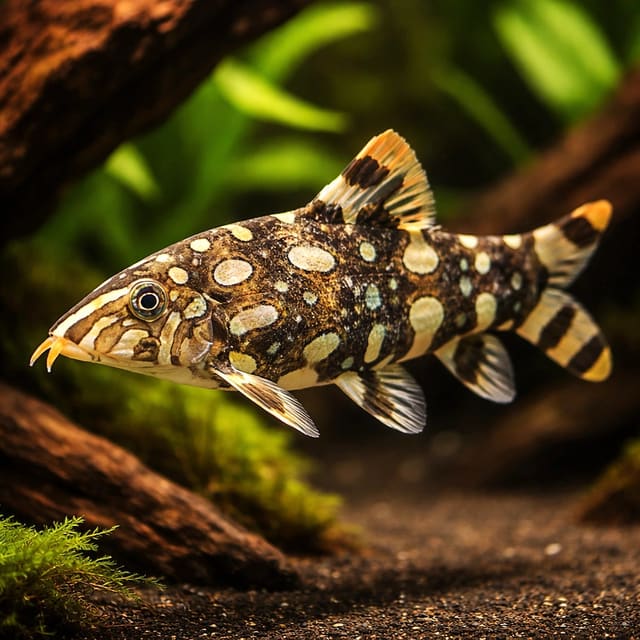
The current gallery image is a representative aquarium illustration. It is not a photograph of the exact fish supplied and should not be used as the sole identification reference. The visible fish in the image does not reliably show the diagnostic mouth, gill and fin characters used to identify Yaoshania pachychilus.
Live Panda Loaches vary with age, condition, lighting and background. Juveniles can show broad cream-and-dark bands; adults become more mottled and subdued. The listing does not guarantee the age, pattern, shade, sex, exact size or individual shown by any representative image. Use the accepted scientific name, supplier identity and current order details when deciding whether this is the intended species.
| A good match when... | Choose a different fish when... |
|---|---|
| You can maintain a mature cool river-style aquarium | Your aquarium stays permanently warm at typical tropical temperatures |
| You can provide high oxygen and reliable current | The lower aquarium has stagnant areas or weak gas exchange |
| You are planning a social group with several feeding surfaces | You want one animal as a decorative algae cleaner |
| You will provide fine animal and plant-based foods | You expect visible algae to be a complete diet |
| You accept that juvenile markings change with age | You require the adult to retain an exact black-and-cream pattern |
| You can monitor summer temperature and power failures | You have no backup plan for heat or stopped circulation |
Panda Loach is rewarding when the aquarium is designed around the fish rather than added as an afterthought. Its small adult size does not make it a low-effort nano fish. The specialist interest comes from watching a group browse and move through current in a stable, mature system.
Scientific references describe the species, not the exact retail specimen. Aquarium sizes are conservative husbandry recommendations derived from adult size, group needs, feeding surface and flow design; they are not experimental biological thresholds. Shipment size, sex, origin and current availability should be confirmed from the live product and order information.
No reviews for this item yet. Bought one? Honest reviews only, good or bad.
What customers say about ordering from us
I have a small group of long finned mountain minnows. So was delighted to be able to order ten of this variety to increase the genetics in my tank . The ones I recieved are healthy but it’s to early to give a verdict on wether they are of a long finned type since they are small currently.
Gordon Walker · 23 Sept 2026
100% success travel and "installation". Pleased with quality of purchase. The Siamese fighter a bit "shy" so have not yet seen him at his best yet but looking good. Happy customer. GG
George E Garratt · 21 Sept 2026
Reviews of our shop, collected by Judge.me, an independent third-party review collector. Newest first.