−15%
Moderate
Doctor Fish (Garra rufa)
14–20°C · pH 6–8 · 243L
£3.99£7.99

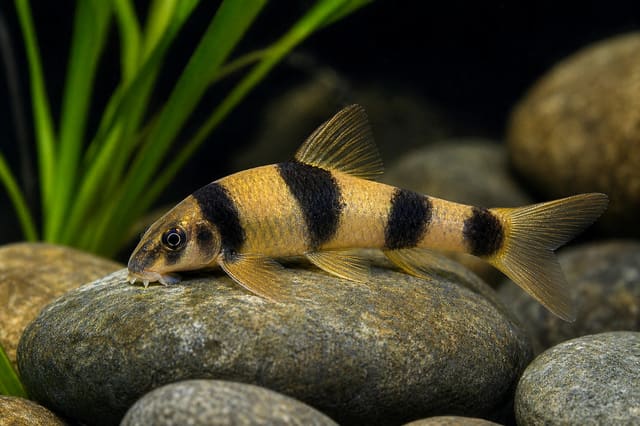
Ten Doctor Fish (Garra rufa) supplied together as a group, recorded at about 3 to 4 cm when supplied. A Middle Eastern stream grazer that reaches around 14 cm, it needs a large, mature, well-oxygenated aquarium with strong flow, smooth rocks, a tight lid and cooler water than a typical tropical set-up.
Adult size is the maximum length this species reaches at full maturity (scientific sources). The livestock you receive will be younger and smaller. Product-photo provenance and any image-specific limitations are stated on the listing.
Garra rufa
Ten Doctor Fish (Garra rufa) supplied together as a group, recorded at about 3 to 4 cm when supplied. A Middle Eastern stream grazer that reaches around 14 cm, it needs a large, mature, well-oxygenated aquarium with strong flow, smooth rocks, a tight lid and cooler water than a typical tropical set-up.
Adult size is the maximum length this species reaches at full maturity (scientific sources). The livestock you receive will be younger and smaller. Product-photo provenance and any image-specific limitations are stated on the listing.
Maintain these water conditions for optimal health and vibrant colors
This listing is for ten Doctor Fish, Garra rufa, supplied together as a social group. Our listing records them at roughly 3 to 4 cm when supplied, so they arrive as young fish with a lot of growing still to do. You receive ten fish in one order; the listing does not sell a particular sex or mix of sexes.
FishBase gives the accepted name as Garra rufa (Heckel, 1843), a member of the carp family Cyprinidae in the subfamily Labeoninae, and lists red garra as its English name. Seriously Fish notes that it is marketed worldwide as the doctor fish, and Wikipedia adds nibble fish. The species name rufa is Latin for red or reddish; Seriously Fish explains that it refers to the reddish colouring on the head of some individuals. Garra itself comes from a local name in the Ganges region for a kind of sand-digging fish.
The doctor fish name comes from their use in spas, where they nibble skin. That has nothing to do with this listing. We sell these fish for aquarium keeping only and make no health or skin claims for them; Seriously Fish describes the reputed skin-cleaning ability as questionable in any case. Kept properly, they are interesting aquarium fish in their own right: busy grazers built for fast, clean water.
There is a taxonomic wrinkle worth knowing about. Seriously Fish points out that Garra rufa probably represents a complex of closely related species rather than a single one, and that it is unclear whether every fish marketed under the name is true G. rufa. Wikipedia lists several species recently separated from it, including G. jordanica, G. turcica, G. gymnothorax, G. mondica and G. amirhosseini. The Fisheries and Oceans Canada synopsis also reports genetic evidence of divergence between populations draining to the Mediterranean and those draining to the Persian Gulf. We list these fish as Garra rufa, the name they are traded under, and the care described below is for G. rufa as the sources describe it.
Ten small fish in a bag look modest. Ten adults at around 14 cm each are a different matter. Before ordering, check that your aquarium has the long-term space for ten grown fish, not just room for ten juveniles. The sections below cover that space, the stream-like conditions they need, and why the water temperature matters more than you might expect.
| At a glance | Detail |
|---|---|
| What you receive | Ten fish, recorded at about 3 to 4 cm when supplied |
| Adult size | About 14 cm total length (FishBase) |
| Wild range | Turkey, Syria, Jordan, Israel and Palestine, Iraq and Iran |
| Temperature | 15 to 20°C where both main aquarium sources agree |
| Aquarium | At least 120 × 45 cm base, about 243 litres, for the species (Seriously Fish) |
| Diet | Grazer of biofilm and algae that also needs meaty foods |
Garras are best known for their mouths. Wikipedia's article on the genus describes the lower lip as expanded at its rear rim into a round or oval sucking pad, and links the flat belly and sucking mouth to a life in flowing water. The Fisheries and Oceans Canada biological synopsis of G. rufa, compiled from the scientific literature, describes the species as having a crescent-shaped mouth on the underside of the head, a well-developed adhesive disc with a free front edge, and two pairs of barbels. It uses that mouth to hold on to rocks by suction while it feeds.
The same synopsis describes a relatively slim, long body that is roughly round in cross-section, a head without scales and a complete lateral line running along the middle of the tail. The scales are moderate to large, typically 29 to 36 along the lateral line. The dorsal fin starts just in front of the pelvic fins, and typical ray counts are 8 in the dorsal fin, 12 to 14 in each pectoral, 7 to 8 in each pelvic, 5 in the anal fin and 17 in the tail.
Colour varies a great deal; some fish are pale and others very dark. The synopsis gives the usual pattern as brownish olive to dark green, with darkly mottled flanks and a yellowish to whitish belly. A dark or bluish-green band runs the length of the flank and ends in a spot at the base of the tail. Behind the upper corner of the gill opening sits a spot that can be black, greenish blue, lime green or dusky blue, sometimes stretching as a bar towards the base of the pectoral fin. The fins can be yellowish with darker edges, the upper tail lobe may carry a few dark grey spots, and there is usually a dark spot at the base of each of the middle four or five dorsal rays. Seriously Fish also picks out the spot at the top of the gill cover, which it describes as dark or iridescent blue, and a second one on the tail stem.
With that much variation between individuals, do not expect ten matching fish. The structural features, the sucker mouth, the two pairs of barbels and the spot behind the gill opening, are more reliable guides than any particular shade.
FishBase gives a maximum of 14.1 cm total length. Seriously Fish gives 120 mm standard length, which leaves out the tail, so the two figures agree well. Wikipedia says the species is typically up to about 14 cm, with some individuals reaching as much as 24 cm. The synopsis traces that larger figure to fish from the Tigris in Iraq, against maximums of 13 cm in Turkey and Iran and 14 cm in Israel. Treat 24 cm as an exceptional wild record, not an aquarium expectation, and plan for ten fish of around 14 cm.
Seriously Fish notes that sexually mature females are noticeably fuller in the body than males, while large males develop extensive patches of tubercles on the head and snout. The synopsis calls the difference limited and tied to breeding condition. Because the differences only appear with maturity, you will not be able to tell them apart at the size supplied, and we do not sell them by sex.
FishBase describes the range as the Jordan, Orontes and Tigris-Euphrates river basins, plus some coastal rivers in southern Turkey and northern Syria. Wikipedia lists Turkey, Syria, Jordan, Israel and Palestine, Iraq and Iran, taking in the Kızıl, Seyhan, Ceyhan, Orontes, Jordan, Tigris-Euphrates, Kor and Mond basins and Lake Maharlu. The synopsis places the native range in a band from roughly 29 to 40 degrees north, a continental climate with cold winters at the northern edge and very hot summers in the south.
Seriously Fish describes the species as living mainly in swiftly flowing headwaters and tributaries, though it also turns up in larger lowland rivers and man-made reservoirs, and it notes a preference for clear, oxygen-saturated water in which sunlight helps a rich film of algae and microorganisms develop. FishBase adds rivers, lakes, small ponds and small muddy streams, and says the fish hides under and among stones and vegetation. Wikipedia notes that it tends to avoid stagnant water.
One field study summarised in the synopsis, from mountain streams in the Amanos range of southern Turkey, found it in 18 of the 20 streams that held fish. Those streams had mainly coarse beds, water typically 30 to 50 cm deep, pH from 7.0 to 9.0, dissolved oxygen from 6.1 to 14.8 mg per litre and temperatures from 5.8 to 31.2°C across the seasons. In the Asi (Orontes) river system it is among the most widespread species and the commonest bottom-grazing fish.
The species is also known from hot springs in Turkey. The synopsis describes one spring that stays at about 35°C all year with low oxygen, and notes that females living there averaged 73.5 mm and 2.8 g, against 97.0 mm and 11.2 g in a nearby stream with more food. The spring fish were smaller and much lighter, and the synopsis notes that food was limited there as well as the water being constantly hot. The same source records Ünlü's finding that G. rufa has a high oxygen requirement. Even that comparison stream ran at 26 to 34°C between May and December, a reminder that wild fish live through wide swings. For an aquarium, the stable, oxygen-rich conditions of a flowing stream are the model, not the hot spring and not the wild extremes.
FishBase gives an IUCN Red List status of Least Concern, assessed in 2013, and rates its resilience as medium, with a minimum population doubling time of 1.4 to 4.4 years. Wikipedia notes that the species is legally protected from capture in the wild in Turkey because of worries about overharvesting, and the synopsis records it as listed vulnerable within Turkey after a regional decline.
Seriously Fish gives a minimum base of 120 × 45 cm, about 243 litres, for this species. That is the starting point for the species in general, and ten fish that will each grow to around 14 cm is a sizeable group, so see that figure as a floor and go larger if you can. The live listing makes the same point: the supplied size should not be the basis for your stocking sums.
Seriously Fish describes doctor fish as living in loose aggregations in the wild but not especially tolerant of their own kind in small aquariums. Kept singly, one may turn aggressive towards similarly shaped fish; kept in a group of three or four or more, where space allows, they form a pecking order among themselves and tend to leave other fish alone. Ten gives that pecking order plenty of members to spread across, provided the aquarium is big enough for them all to find grazing room. In a cramped tank the same group simply has more neighbours to argue with.
No one can tell you exactly how fast your ten will grow. The Fisheries and Oceans Canada synopsis states that growth rates have not been measured for this species, and growth will depend on food, temperature and space. What the research does show is the end point: females in one Turkish stream averaged 97 mm, and Abedi and colleagues found that the fish in their Iranian population kept the same body proportions as they grew. So set the aquarium up for adults of around 14 cm from the start, rather than planning to upgrade later. Moving ten established fish into a new aquarium is far more disruptive than getting the space right first time.
Seriously Fish suggests an aquarium set out like a flowing stream or river: a bed of water-worn rocks of various sizes, sand and fine gravel, perhaps a few small boulders, with driftwood and hardy plants. Smooth stones matter, because these fish spend much of their time working over hard surfaces with their sucker mouths. Leave open runs between the rocks so the group can move freely.
Seriously Fish asks for clean, well-oxygenated water with a turnover preferably more than ten times the aquarium volume per hour. Choose filtration and an extra pump or powerhead with that in mind, and aim the output so it sweeps along the length of the aquarium. Strong surface movement helps keep oxygen levels up.
Bright lighting encourages the film of algae and microorganisms that these fish graze, according to Seriously Fish. Rocks that grow a light coating in a well-lit aquarium give the group something natural to work on between meals.
Seriously Fish is blunt about this: a tight-fitting cover is necessary because doctor fish can literally climb glass, and the species is known to jump. Close off cable and pipe cut-outs as well as the main lid.
Because the species needs stable conditions and grazes biofilm, Seriously Fish says it should never be added to a biologically immature set-up. Have the aquarium running, cycled and growing a film on the rocks well before ten fish go in.
| Set-up point | Guidance |
|---|---|
| Minimum base | 120 × 45 cm, about 243 litres, for the species; larger for ten adults |
| Substrate | Water-worn rocks, sand, fine gravel, a few small boulders |
| Décor | Driftwood and hardy plants |
| Flow | Turnover above ten times the volume per hour |
| Lighting | Bright, to grow biofilm on the rocks |
| Cover | Tight-fitting, gaps closed |
Temperature needs the most thought, because the sources do not say quite the same thing. Seriously Fish gives 14 to 20°C and states that this is strictly not a tropical species. FishBase gives a wider range of 15 to 28°C. Wild fish have been recorded from 5.8 to 31.2°C in Turkish mountain streams, a stream in central Anatolia ran at 26 to 34°C through summer and autumn, and a hot-spring population lives at around 35°C. Those are wild records and extremes, not targets.
Where the two main aquarium sources agree is 15 to 20°C, and that is the range we recommend. In many British homes that means an unheated aquarium, or one with a heater set low as a safeguard against cold snaps. It also means doctor fish are not a natural fit for a heated tropical community kept at the upper end of FishBase's range, which is outside what Seriously Fish advises. If your room runs warm in summer, monitor the temperature, because warm water holds less oxygen and this species needs plenty.
| Parameter | Range | Source |
|---|---|---|
| Temperature | 15 to 20°C | Overlap of Seriously Fish (14 to 20°C) and FishBase (15 to 28°C) |
| pH | 6.0 to 8.0 | Seriously Fish |
| General hardness | 1 to 15 dGH | Seriously Fish |
| Ammonia and nitrite | Zero | OATA |
| Flow | Turnover above ten times per hour | Seriously Fish |
An unheated aquarium follows the temperature of the room, so where you put it matters. Keep it out of direct sunlight and away from radiators, stoves and draughty doors, and fit a reliable thermometer you can read at a glance. Check it daily in a hot spell. If the water climbs above 20°C, increase surface movement and aeration first. A heater set to a low temperature is a sensible safeguard in a cold room in winter, but it should never be used to push these fish into tropical warmth.
The wild streams described in the synopsis held between 6.1 and 14.8 mg of dissolved oxygen per litre, and Ünlü's work cited there describes the species as having a high oxygen requirement. Strong flow, good surface movement and sensible stocking are what keep oxygen up in an aquarium.
OATA, the UK ornamental fish trade association, recommends at least a 25% partial water change every week for unheated aquariums, and asks that ammonia and nitrite stay at zero. When the filter needs cleaning, rinse the media in the water you have taken out, never under the tap, so the beneficial bacteria survive. With ten grazing fish producing waste, keep to that routine and test the water regularly, especially in the first months as the group grows.
Match new water to the aquarium's temperature before adding it, and remove chlorine and chloramine with a water conditioner. Seriously Fish's emphasis on stable conditions applies here: big, sudden swings are what to avoid.
In the wild, FishBase describes G. rufa as a bottom dweller feeding on aufwuchs, the coating of algae and tiny organisms that grows on submerged surfaces. A gut-content study from the Asi river system, summarised in the Fisheries and Oceans Canada synopsis, found the diet was mainly benthic plant material: diatoms such as Navicula and Gomphonema were the commonest items, along with blue-green and green algae, plus some rotifers and protozoa. Young fish ate mostly diatoms, while older fish took more blue-green and green algae, and the season had the biggest effect on what they ate. Wikipedia adds detritus and tiny animals, including arthropods and zooplankton.
Seriously Fish is clear that this is not an exclusive herbivore, even though it will graze algae where it finds it. It recommends meaty foods such as live or frozen bloodworm, Tubifex, Artemia and chopped prawn, alongside good-quality sinking dried foods that contain vegetable matter. Fresh vegetables such as cucumber, melon, spinach and courgette can be offered now and then.
The live listing makes a point worth repeating: these fish are not a substitute for aquarium maintenance, and they still need a balanced prepared diet. Ten growing fish will graze hard, but they cannot live on the film in an aquarium alone, and they are not a fix for an algae problem caused by too much light or too many nutrients.
With ten fish and a pecking order, make sure food reaches the whole group. Spread sinking food across several spots along the aquarium rather than dropping it in one place, so the dominant fish cannot guard all of it. Watch the smaller individuals at feeding time for the first weeks; a fish that is always pushed aside will stay thin while the others grow. Give only what the group clears fairly quickly, and lift out leftovers, because uneaten food quickly becomes waste in the water.
Seriously Fish describes G. rufa as relatively peaceful and says it can be kept alongside other species that need similar conditions. That last part is the real filter. Any tank mate has to be comfortable at 15 to 20°C, in strong flow and well-oxygenated water, and has to cope with ten busy fish working over every rock and pane of glass.
Expect a group to establish a pecking order. Seriously Fish notes that this keeps disputes within the group, so other fish are generally left alone. A lone doctor fish, by contrast, may pick on fish of a similar shape. That is the main reason to keep them in numbers, and a group of ten suits the species when the aquarium is big enough.
In the wild, FishBase notes that the species hides under and among stones and vegetation, and the synopsis describes it holding on to rocks by suction to graze. In an aquarium you can expect to see both sides of that: fish working steadily over rocks, wood and glass with their mouths, and fish slipping into gaps under stones when they want cover. Give them both open grazing surfaces and places to tuck in, and there is less reason for the group to bunch up in one corner.
Because the right temperature is cooler than a typical tropical aquarium and the flow is strong, many popular tropical community fish are simply the wrong match for the conditions, whatever their temperament. Check the care sources for any species you are considering, and make sure its temperature, flow and oxygen needs overlap with the ranges in this guide. Avoid very slow, long-finned or delicate fish that would be battered by the current or crowded by an active group of grazers.
Wikipedia counts more than 160 species of Garra, most from Asia and about a fifth from Africa, and their needs are not interchangeable. If ten is more than your aquarium can hold, we also list a single Doctor Fish (Garra rufa); bear in mind Seriously Fish's advice to keep three or four or more where space allows. We also list relatives such as the Panda Garra (Garra flavatra) and the Redtail Garra (Garra panitvongi). These are different species with their own care requirements, so read each listing rather than assuming they can share an aquarium with doctor fish.
Their habit of climbing glass and jumping, noted by Seriously Fish, matters for tank-mate planning too: an open-topped aquarium shared with other fish is not suitable for this species.
OATA describes a healthy fish as having clear, bright eyes, undamaged fins, intact scales, no ulcers or lumps and normal swimming behaviour. Look over all ten fish in the first days, and keep looking. In a group, one fish that is struggling can be hidden by nine that are fine.
OATA's watch list for fish in unheated aquariums starts with these changes:
For doctor fish, add breathing and appetite to that list. A group gathering at the surface or breathing hard points first to oxygen and flow, given the species' high oxygen requirement; a fish that stops grazing and stops coming to food deserves a closer look at its condition and at the water.
When something looks wrong, test the water before anything else: ammonia, nitrite, nitrate and temperature, and check that pumps and filters are running at full flow. As the group grows it produces more waste, so readings that were comfortable in the first month can drift later on.
The synopsis records several parasites from wild G. rufa, including gill flukes of the genera Dactylogyrus and Gyrodactylus. That is not a description of our fish, but it is a reminder of why new arrivals deserve close observation. If you can, keep the group in a separate, mature aquarium for a while before adding them to an established community, and ask for advice before using any treatment.
The synopsis notes that wild fish have been recorded up to seven years old, and a year-long study of a wild population in central Iran found fish aged up to four years. In a good aquarium a group of ten is a long-term undertaking, which is one more reason to plan their space properly from the start.
Seriously Fish reports that wild populations spawn continuously over a long season, typically from April to November. Eggs are scattered over gravel or rocks and the adults give no parental care. The synopsis gathers several regional studies: spawning in May and June in the Tigris in Turkey, from July in stream and hot-spring populations in the Sivas region of central Anatolia, and mainly in May with further spawning into July in Iran. Ünlü's work cited there notes that the species needs clean, shallow gravel beds to spawn.
Abedi and colleagues, studying a stream population in central Iran over a full year (Turkish Journal of Zoology, 2011), found a long, active reproductive period, an average egg diameter of 0.67 mm, and an average of about 1,180 eggs per female, with larger females producing more. The synopsis cites another Iranian study averaging 761 eggs per female, with a range of 184 to 2,396, which it calls low for a member of the carp family.
The synopsis records aquarium observations that the species scatters its eggs, with no nest building or egg guarding, and that breeding in aquariums appears possible. Seriously Fish notes uncertainty over whether fish in the trade are bred naturally or artificially. So spawning at home appears possible, but with no parental care any eggs are exposed to every fish in the tank. Anyone wanting to raise fry should plan a separate set-up and research it properly first.
The synopsis gives a striking wild example of how exposed the young are. In Israel's Qishon river basin, the species may have disappeared after nutrient pollution and changes to the river bed for flood prevention removed the shelter that larvae and young fish relied on, leaving them open to predation by western mosquitofish. The same synopsis points out that, like most other cyprinids, G. rufa has few defences and is open to predation at every stage of life. In a community aquarium the lesson is simple: without dense cover or a separate tank, eggs and fry are unlikely to last.
Age at sexual maturity has not been firmly recorded, according to the synopsis, which suggests it is most likely reached in the first two or three years. Supplied at 3 to 4 cm, your group has growing to do before breeding becomes a question.
Before the parcel arrives, the aquarium must be ready: filter running and mature, water tested and the temperature matched. Someone must be at the delivery address to receive live animals, and please read our delivery and live-arrival information before you order. We email your confirmed delivery date and tracking details.
The fish travel in oxygen-filled bags inside insulated packaging, with heat packs when conditions call for them, via a tracked courier licensed to carry live animals.
Start a continuous video before you open the box, while the parcel is still sealed, and keep filming as you open it so the fish are shown in their sealed bags in the same take. If any fish arrives dead, dying or clearly compromised, email hello@tropicalfishco.co.uk on the day of delivery with your order number and the video. Photos alone do not meet the policy. The resolution is a replacement with your next order or a refund for the affected fish, subject to the guarantee terms. With ten fish, make sure every bag is clearly in view so each fish can be seen.
Float the sealed bags in the aquarium for 20 to 30 minutes so the water inside reaches the same temperature. That matches temperature only, not pH or hardness, so ask for advice first if your water differs a lot. Then net the fish across, discard the bag water and never pour it into your aquarium. With ten fish, work calmly and steadily; a soft net and a little patience are kinder than chasing fish around a bag.
Keep the lights low at first and watch breathing, appetite and behaviour over the first week. Expect the group to sort out its pecking order in the early days. Feed lightly to begin with, check that every fish is eating, and keep the lid firmly in place from the start.
The facts about the fish in this guide come from these sources, which are worth reading in full:
No reviews for this item yet. Bought one? Honest reviews only, good or bad.
What customers say about ordering from us
I have a small group of long finned mountain minnows. So was delighted to be able to order ten of this variety to increase the genetics in my tank . The ones I recieved are healthy but it’s to early to give a verdict on wether they are of a long finned type since they are small currently.
Gordon Walker · 23 Sept 2026
100% success travel and "installation". Pleased with quality of purchase. The Siamese fighter a bit "shy" so have not yet seen him at his best yet but looking good. Happy customer. GG
George E Garratt · 21 Sept 2026
Reviews of our shop, collected by Judge.me, an independent third-party review collector. Newest first.