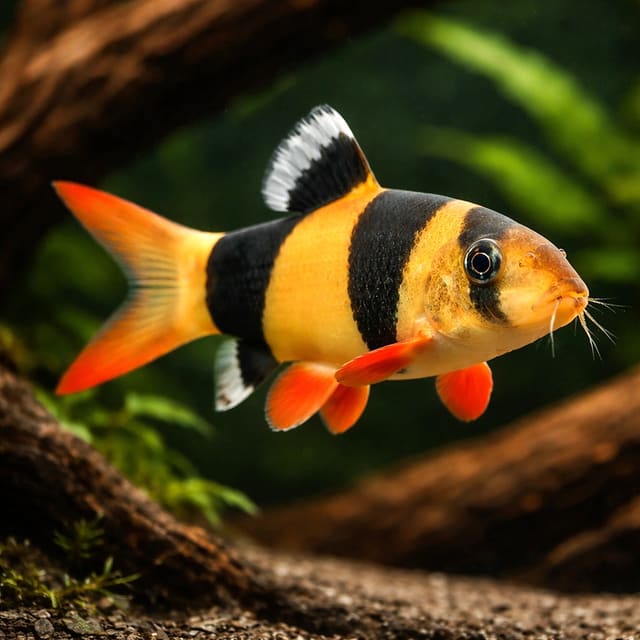
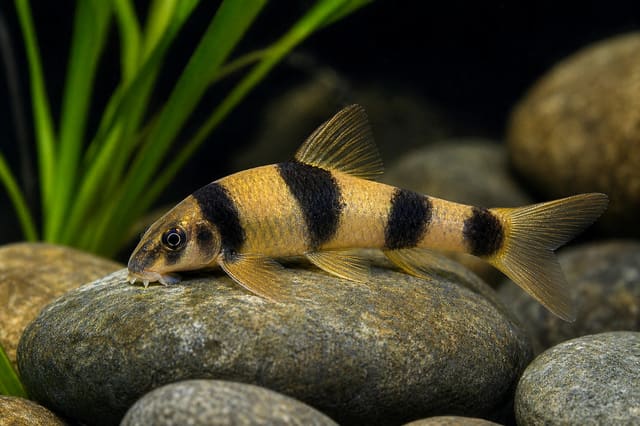
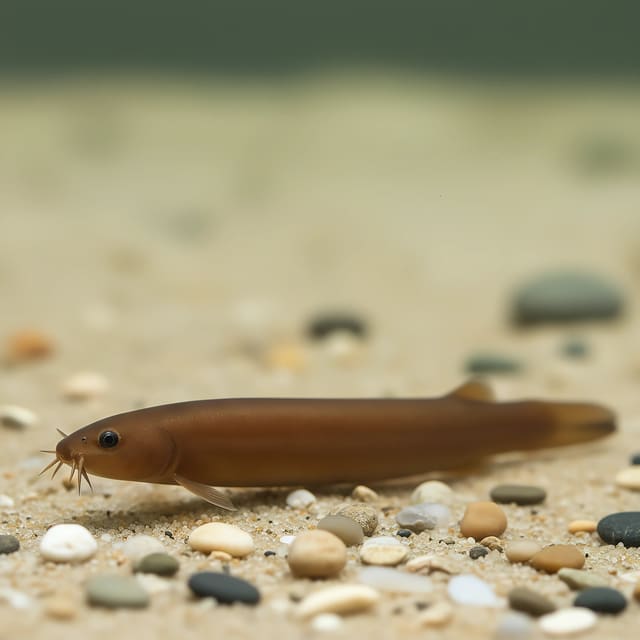
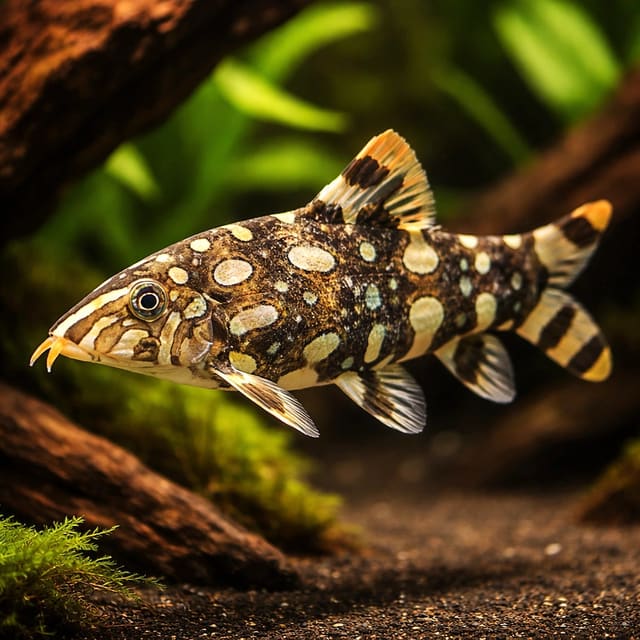
Kuhli Loach (Acanthophthalmus kuhli)
24–27°C · pH 6.5–6.5
£2.99
Photo coming soon
The size, price and care details on this page are for this listing.
Redtail Garra (Garra panitvongi) is a freshwater cyprinid recorded to 11.7 cm SL and associated with swift rocky riffles in Thailand and Myanmar. One purchase supplies one fish; keep it in clean, well-oxygenated water with soft substrate, cobbles and wood, and supplement algae grazing with prepared food.
Adult size is the maximum length this species reaches at full maturity (scientific sources). The livestock you receive will be younger and smaller. Product-photo provenance and any image-specific limitations are stated on the listing.
Garra panitvongi
Shoaling fish: kept in a group they feel safer, stay calmer and show their best colour.
Redtail Garra (Garra panitvongi) is a freshwater cyprinid recorded to 11.7 cm SL and associated with swift rocky riffles in Thailand and Myanmar. One purchase supplies one fish; keep it in clean, well-oxygenated water with soft substrate, cobbles and wood, and supplement algae grazing with prepared food.
Adult size is the maximum length this species reaches at full maturity (scientific sources). The livestock you receive will be younger and smaller. Product-photo provenance and any image-specific limitations are stated on the listing.
Maintain these water conditions for optimal health and vibrant colors
Redtail Garra is the common name for Garra panitvongi, a freshwater, benthopelagic member of the Cyprinidae family. FishBase records the species from western Thailand and south-eastern Myanmar, apparently within the Ataran River drainage. Specimens have been collected from swift, rocky riffles in Myanmar and Thailand, so its natural history points towards an active fish associated with moving water and hard surfaces.
A Wikipedia summary of Garra panitvongi places it in the Ataran River drainage and the wider Salween River basin of Thailand and Myanmar. The fish had already become popular in the aquarium trade before it was described to science as a new species in 2023. This is a ray-finned fish rather than a loach, although its bottom-oriented habits and algae-grazing role place it naturally within our loaches and oddballs collection.
This fish will graze algae, but it should form part of a planned aquarium rather than being introduced as a remedy for dirty glass or persistent algae. It still needs prepared food, stable water, oxygen, cover and enough room to reach its recorded maximum size. Persistent algae can point to water-chemistry or maintenance issues, and adding another animal also increases the biological load handled by the filter.
| Suits | Not suited to |
|---|---|
| Established, filtered aquariums with clean, well-oxygenated water | Aquariums without a well set up and maintained filter |
| Layouts with soft substrate, cobbles, wood and usable cover | Plans that rely on one fish to solve persistent algae |
| Keepers prepared to test water every week | Systems where stable water and adult space have not been planned |
It suits a keeper prepared to test the water every week, maintain an established biological filter and provide a soft substrate with cobbles and wood. The aquarium should offer both accessible hard surfaces and sheltered areas rather than an empty floor. Its recorded riffle habitat can inform the layout, but the practical priorities are clean, well-oxygenated water and stable conditions.
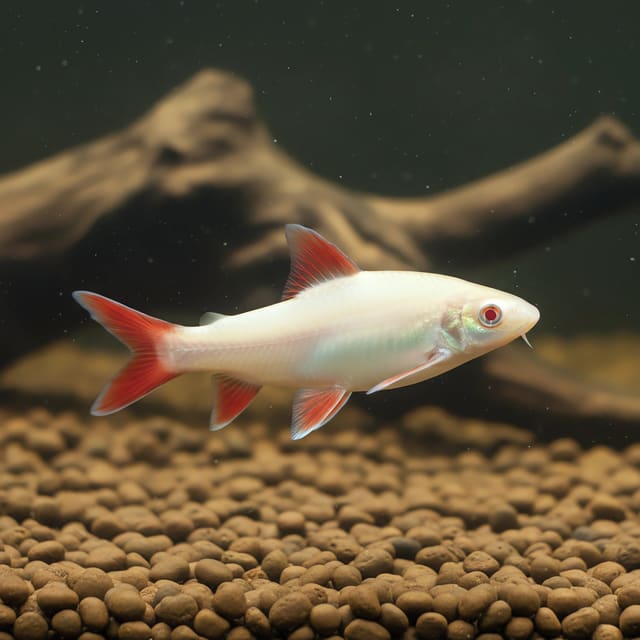
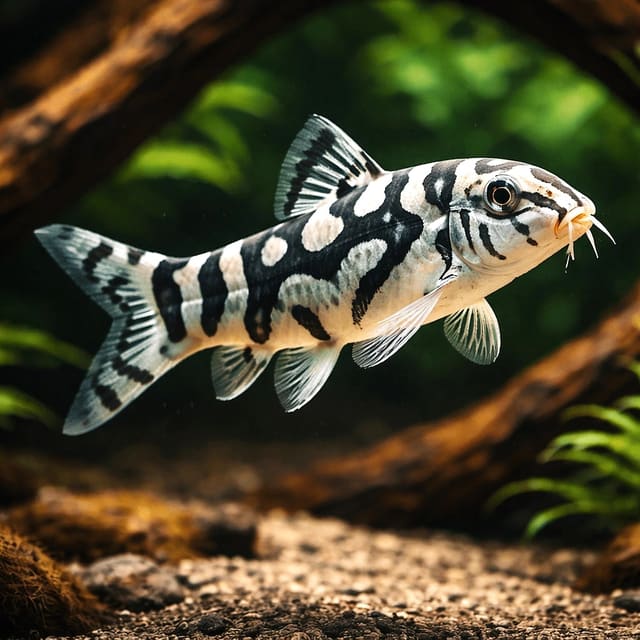
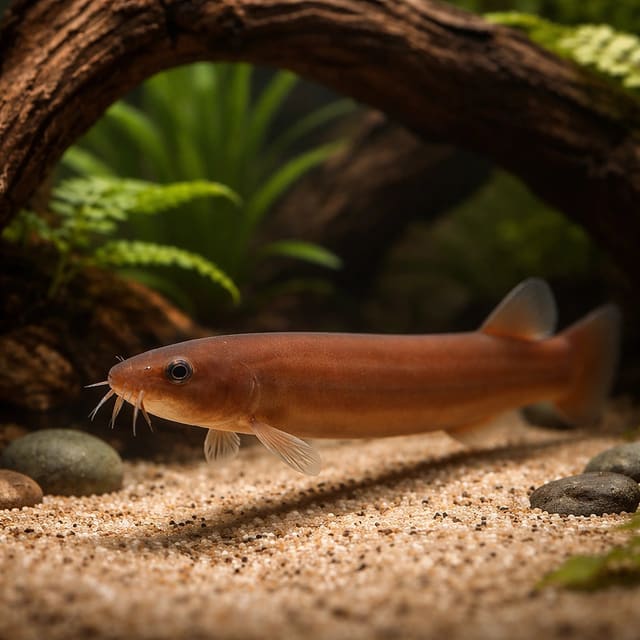
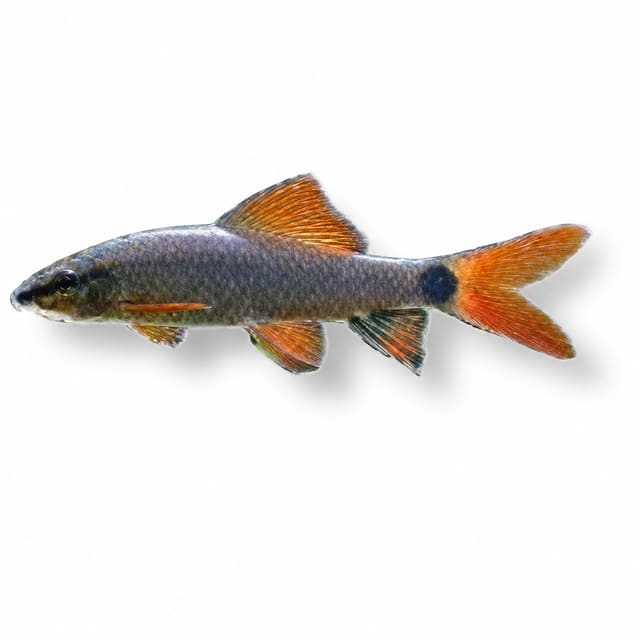
The gallery images are representative of this type of animal rather than photographs of the exact animal supplied, so colours can look slightly different from the live animal.
Garra panitvongi has a recorded maximum length of 11.7 cm SL. Treat that figure as the decisive size for long-term planning rather than as a promise that every individual will reach exactly the same measurement. The aquarium must continue to work as the fish approaches that recorded maximum.
One purchase supplies one animal. Judge the aquarium by the 11.7 cm SL planning reference, the swimming footprint, oxygenation, cover and the needs of every existing fish.
Sex is guaranteed only when the selected option explicitly states male or female. This Redtail Garra listing has no sex-guaranteed option.
OATA’s tropical algae-eaters sheet gives 22–27°C, pH 6.0–8.0, general hardness of 4–12°dH and carbonate hardness of 3–10°dKH as broad Garra group guidance, not a species-specific optimum. Keep ammonia at zero mg per litre, nitrite at zero mg per litre and nitrate at no more than 20 mg per litre above the normal level in the tap water.
| Planning point | Instruction |
|---|---|
| Maximum recorded length | Plan around 11.7 cm SL |
| Routine temperature | 22–27°C |
| Routine pH | 6.0–8.0 |
| General hardness | 4–12°dH |
| Core environment | Clean, well-oxygenated water with soft substrate, cobbles and wood |
Choose the largest practical aquarium that can hold those conditions steadily. A larger body of water is generally more stable, but litres alone do not settle the decision: usable footprint, filtration, stocking, shelter and oxygen all matter.
Begin with the recorded maximum of 11.7 cm SL and assess the aquarium as a complete system. The right choice has enough usable floor and open-water space for the fish, room for cobbles and wood without creating a cramped route, and sufficient filtration for the whole stocking plan. OATA recommends choosing as large an aquarium as is practical because greater water volume helps stabilise temperature and water quality.
A useful worked check is to sketch the aquarium from above. Mark the filter outlet, open route, cobbles, wood and sheltered areas. If the only clear route ends at equipment or a solid barrier, simplify the hardscape before adding the fish. If the layout leaves open movement space while retaining several areas of cover, it makes better use of the same aquarium footprint.
Prepare the biological system before livestock arrives. Our first tropical aquarium guide explains how to establish and mature the aquarium rather than relying on fresh water and newly installed equipment on arrival day.
Choose a permanent setup that can support the long-term plan. Moving a growing fish later adds another transition, while choosing the permanent aquarium from the outset lets the filter, layout and stocking develop around its full requirements.
Provide a soft substrate, well-oxygenated water and cover formed from cobbles and wood. These are the practical Garra requirements given by OATA. They also fit the species’ association with swift, rocky riffles, but the aim is not to reproduce a river by crowding the aquarium with stone. The aim is to create useful surfaces and shelter while preserving an open route through the layout.
| Layout element | What it should achieve |
|---|---|
| Soft substrate | Create a gentle lower surface around the hardscape |
| Cobbles | Provide solid structure, cover and accessible algae-grazing surfaces |
| Wood | Add cover and break up an otherwise exposed floor |
| Open route | Keep the aquarium navigable after the hardscape is installed |
| Water movement | Support good oxygenation throughout the occupied area |
Place cobbles securely so normal activity cannot shift them into unstable positions. Arrange wood and stone before filling the final stocking space, then inspect the layout from the front and above. A sheltered area should still have an open entrance; a tight dead end is less useful than cover the fish can enter and leave easily.
Plants are optional within OATA’s general aquarium guidance. Live plants can add cover, while suitable artificial plants and ornaments can provide shelter when live plants are not used. Keep whichever choice you make compatible with the open route, soft substrate and access to grazing surfaces.
Judge oxygenation by the complete system rather than by one visibly moving patch near the filter. Hardscape can interrupt circulation, so review what happens behind wood and around cobbles as well as at the outlet. Adjust the layout or equipment when a large section is cut off from water movement.
A river-inspired appearance is secondary to function. Do not add so many cobbles that waste becomes trapped out of sight or the fish loses usable room. A simpler arrangement that remains accessible for inspection and maintenance is more useful than a dense display that cannot be managed properly.
Run the aquarium at 22–27°C, pH 6.0–8.0 and 4–12°dH general hardness. Carbonate hardness guidance is 3–10°dKH. Stability within those values is the routine objective; do not chase a particular point by making repeated adjustments when the aquarium already sits safely within range.
Test ammonia, nitrite, nitrate, pH and hardness before introduction, then continue regular weekly testing. Temperature also needs checking as part of the routine. Our water-chemistry guide explains what the main aquarium readings mean, while the water matcher helps compare measured aquarium values with this guidance.
| Test result | Decision |
|---|---|
| Ammonia above zero | The required zero mg per litre target has been missed; restore safe water and filter performance before proceeding with the stocking plan |
| Nitrite above zero | Treat the aquarium as outside the required conditions until the reading returns to zero mg per litre |
| Nitrate more than 20 mg/l above tap water | Review maintenance, feeding, stocking and filtration rather than adding an algae grazer as a remedy |
| Values within guidance | Keep testing weekly so a change is found before it becomes established |
Always compare aquarium nitrate with the normal tap-water level because the guidance is expressed as an increase above that starting point. For example, if tap water reads 10 mg per litre, the stated ceiling in the aquarium is 30 mg per litre. If tap water reads 20 mg per litre, the corresponding ceiling is 40 mg per litre. This calculation does not change the zero targets for ammonia and nitrite.
Record results with the date so trends are visible. A reading that remains inside the range can still be useful when compared with earlier weeks, particularly after a stocking or feeding change. Consistent measurement is more informative than relying on the water’s appearance.
A properly established filter is essential. The RSPCA’s aquarium welfare guidance explains that fish release toxic ammonia into the water. Beneficial bacteria in a working biological filter convert ammonia to nitrite, which is also toxic, and then to the safer nitrate measured during routine testing.
This process is why clear-looking water is not enough. Ammonia and nitrite cannot be judged by appearance, and a newly installed filter is not equivalent to an established biological filter. Confirm zero mg per litre ammonia and zero mg per litre nitrite with tests before relying on the aquarium for another fish.
If ammonia or nitrite rises above zero, treat the water as outside the stated requirements. Re-establish safe conditions and reliable filter performance before adding livestock. Do not try to solve the reading by adding an animal that grazes algae; algae consumption and nitrogen-waste processing are different functions.
Keep access to the filter and the areas around wood and cobbles practical. The layout should let you inspect the aquarium and carry out routine maintenance without dismantling the entire environment. This is another reason to favour a clear, functional hardscape over a densely packed arrangement.
A larger aquarium can make environmental conditions more stable, but it does not remove the need for filtration or testing. Volume, filter maturity, oxygenation, sensible feeding and appropriate stocking work together; none replaces the others.
Redtail Garra will eat algae in the aquarium, but algae is not a complete feeding plan. Supplement its grazing with prepared algae-based wafers or flakes and offer fresh cucumber. Use organic vegetables where practical or wash them thoroughly because pesticide residues may harm aquarium animals.
Offer a measured portion and watch how the fish uses it. Algal foods may need additional grazing time compared with food taken immediately, so observe the portion before adding more. The objective is a sufficient meal without leaving an excess to break down into toxic waste.
Competition matters as much as the food selected. A prepared food is only useful when this fish can reach it. Observe the feeding area and distribute the food in a way that allows the complete stocking group to eat without placing an excessive total amount into the aquarium.
Do not judge appetite by the amount of visible algae on the glass. A clean surface does not remove the need for prepared food, and a surface covered with algae does not show that the fish is receiving balanced nutrition. Keep the feeding routine consistent and use direct observation to adjust portion size.
Uneaten food adds to the work of the biological filter. When a feeding change is followed by rising nitrate, review the portion and stocking plan as connected decisions. Continue weekly water tests so feeding remains compatible with the zero ammonia, zero nitrite and nitrate targets.
Use the Redtail Garra’s algae grazing as one part of its natural aquarium activity, not as a replacement for maintenance. OATA warns that persistent algae can indicate underlying water-chemistry issues caused by incorrect maintenance. Adding a fish without addressing those conditions can increase stocking pressure while leaving the original cause unchanged.
| What you find | What to do next |
|---|---|
| Persistent algae with rising nitrate | Review feeding, stocking, filtration and the maintenance routine |
| Ammonia or nitrite above zero | Restore the required zero readings before considering another animal |
| Water within guidance but algae persists | Continue investigating aquarium management rather than expecting grazing to clean every surface |
| Very little visible algae | Continue prepared algae-based foods and fresh cucumber |
| Food accumulates after feeding | Reduce the next portion and keep testing the water weekly |
A useful sequence begins with measurements. Test the aquarium and tap-water nitrate, then compare the difference. Check ammonia and nitrite against their zero targets. Review whether the filter is established, whether the stocking plan has changed and whether the food portion is being consumed.
Do not add livestock solely because an aquarium surface looks untidy. First confirm that the system can support another fish at up to the recorded 11.7 cm SL planning size. The same aquarium must provide oxygen, cover, food access and stable water after the new biological load is included.
Grazing can still be a valued part of the fish’s behaviour even when it does not produce a spotless aquarium. Keep cobbles and wood accessible, provide the prepared diet, and maintain the aquarium according to measured water quality. This approach treats the fish as an animal with complete care needs rather than as equipment.
Complete the aquarium, establish the filter and confirm the water readings before the delivery window. The fish should move into clean, well-oxygenated water at 22–27°C, with pH 6.0–8.0, general hardness of 4–12°dH and carbonate hardness of 3–10°dKH. Add the soft substrate, cobbles and wood in advance so arrival day does not involve rebuilding the environment.
Read the current instructions on our delivery and Live Arrival Guarantee policy. Prepare everything else beforehand so the bag is not left waiting while equipment, cover or water conditions are adjusted.
During the first week, keep the measured feeding routine described above and check that the portion is eaten without accumulation. Test the water as part of the weekly schedule, with particular attention to the zero ammonia and nitrite targets after the stocking change. Keep nitrate within 20 mg per litre above the normal tap-water level.
During the first month, continue the same measurements rather than assuming that a good first reading settles the matter. Check that the fish can reach prepared food and use the areas around cobbles and wood. If its condition changes, contact us with the dated water readings and a clear account of what has changed.
A calm arrival begins with prior decisions: established filtration, measured water, an uncluttered route, suitable cover and a screened stocking plan. Acclimatisation cannot compensate for an aquarium that was not ready before the parcel arrived.
Assess compatibility fish by fish rather than using a universal list. Garra species vary in size, colour, temperament and care requirements, so a shared group name does not settle how two animals will interact. For Redtail Garra, the practical screen begins with water, oxygen, adult-size planning, usable space, cover and access to food.
Compatibility outcomes can also vary with the aquarium layout and the individuals involved. Treat a proposed match as conditional, then watch how the complete stocking group uses food and cover after introduction.
| Compatibility check | A workable plan requires |
|---|---|
| Water | Every fish can be kept within 22–27°C, pH 6.0–8.0 and the stated hardness guidance |
| Oxygen | All occupants suit a well-oxygenated aquarium |
| Adult size | The stocking plan uses the 11.7 cm SL maximum reference |
| Space | Hardscape, equipment and all fish leave a usable route and accessible cover |
| Feeding | The Redtail Garra can reach algae-based prepared food and cucumber |
| Waste load | The established filter keeps ammonia and nitrite at zero after the stocking change |
A proposed companion fails the screen when its required conditions conflict with well-oxygenated water, the stated temperature or chemistry, or the aquarium cannot provide enough usable space for the complete adult plan. Do not rely on two fish occupying different labelled levels of the aquarium; both still share water quality, oxygen, cover and feeding access.
Review the aquarium after hardscape is installed, because the nominal dimensions do not show how much room remains. Cobbles and wood are important, but they should create useful cover without dividing the aquarium into cramped dead ends.
For a stocking and compatibility assessment, contact us with the aquarium dimensions, current water readings, filter status and the common or scientific names of every existing fish. That gives the decision a concrete basis instead of relying on a generic community label.
Choose the number of Redtail Garras only after assessing the aquarium dimensions, usable footprint, filtration and complete stocking plan. Do not treat a general label such as solitary, social or community-safe as a substitute for that assessment. Garra species differ in temperament, and the aquarium must work for the particular combination being considered.
Observation after introduction should focus on practical access. Watch whether each fish can move through the layout, enter and leave cover and obtain prepared food. If any occupant cannot use those resources, change the layout or stocking plan rather than adding more food or more animals.
Use weekly tests to check the effect of the final stocking level. A group that appears settled still requires the same zero ammonia, zero nitrite and nitrate limit. Rising waste readings are a system-level warning that filtration, feeding, stocking or maintenance needs attention.
Do not assume that adding more individuals will correct an interaction problem, and do not assume that keeping one individual automatically removes every compatibility concern. Make the choice from the aquarium’s measured capacity and the requirements of all occupants.
When comparing possible companions, give priority to compatible water and oxygen needs, enough adult space and reliable food access. Appearance, retail category and a shared interest in hard surfaces do not establish a match. The final plan should remain manageable when every fish reaches its adult planning size.
It is the Redtail Garra, a freshwater cyprinid from Thailand and Myanmar associated with swift, rocky riffles in the Ataran River drainage and described to science in 2023.
One purchase supplies one fish.
FishBase records a maximum of 11.7 cm SL. Use that figure for long-term aquarium planning.
Provide clean, well-oxygenated water, soft substrate and cover made from cobbles and wood. Preserve an open route through the hardscape and use an established biological filter.
Choose the number only after assessing aquarium dimensions, usable footprint, filtration, cover and all existing fish because Garra species vary in temperament and care requirements.
OATA’s Garra group guidance gives 22–27°C, pH 6.0–8.0, general hardness of 4–12°dH and carbonate hardness of 3–10°dKH. Keep ammonia and nitrite at zero mg per litre.
Offer a measured portion of algae-based wafers or flakes, allowing suitable grazing time before adding more. Give thoroughly washed or organic fresh cucumber as a supplement.
Start filming the sealed parcel before opening it, continue in one take as it is opened and show the fish inside the sealed bag. Then float the bag for 20–30 minutes before releasing the fish, and do not pour bag water into the tank.
Check that every proposed companion suits the same water and oxygen conditions, then assess adult space, cover, food access and whether the established filter can support the complete stocking plan.
No reviews for this item yet. Bought one? Honest reviews only, good or bad.
What customers say about ordering from us
Easy website plenty of info on fish your buying great to pick a time slot
TRACEY DURRANT · 7 Oct 2026
Got some lovely fish thank you
Kevin Mackie · 7 Oct 2026
Reviews of our shop, collected by Judge.me, an independent third-party review collector. Newest first.