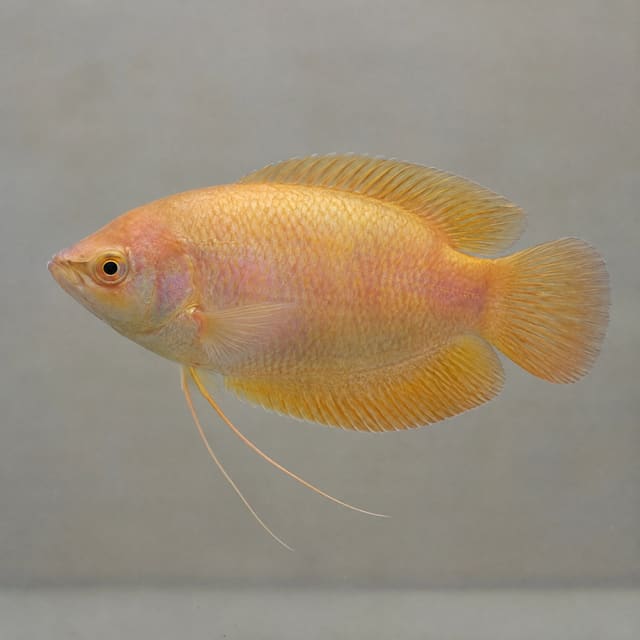
Gold Giant Gourami (Osphronemus goramy)
20–30°C · pH 6.5–8 · 681L
£35.99
The Red Tail Giant Gourami (Osphronemus laticlavius) is a giant, air-breathing gourami from Borneo with a deep, dark body and bright red edges and filaments on its fins. It reaches about 50 cm and needs an aquarium of at least 180 × 60 cm (about 648 litres), strong filtration and a mainly plant-based diet. Sold individually as a young fish in two sizes.
Osphronemus laticlavius
The Red Tail Giant Gourami (Osphronemus laticlavius) is a giant, air-breathing gourami from Borneo with a deep, dark body and bright red edges and filaments on its fins. It reaches about 50 cm and needs an aquarium of at least 180 × 60 cm (about 648 litres), strong filtration and a mainly plant-based diet. Sold individually as a young fish in two sizes.
Read the full care guidance when planning conditions for your aquarium.
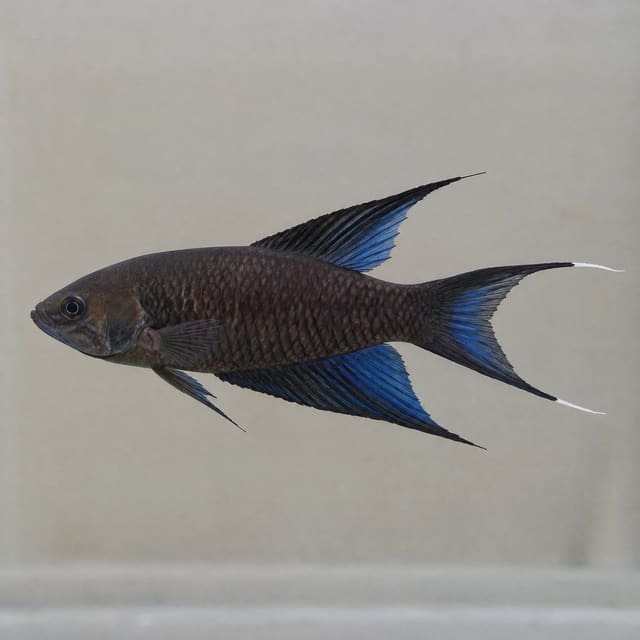
The red tail giant gourami, Osphronemus laticlavius, is one of the true giants of the gourami family. Adults have a deep, almost oval body in dark blue-green to near-black, a snub-nosed head with a heavy jaw, and bright red edges and trailing filaments on the dorsal, anal and tail fins. FishBase and Seriously Fish both give a maximum of 50 cm standard length, so this is a fish only for keepers with the space and budget for a very large aquarium.
In return it becomes a calm, impressive centrepiece. Seriously Fish notes that giant gouramis can develop real personality and learn to recognise their owner. Like all gouramis it breathes air at the surface, and FishBase describes this species as an obligate air-breather. OATA adds that gouramis have a long ray on each pelvic fin that works like a whisker to feel their surroundings, which you will see as the two thread-like fins under the body.
| Name | What it is |
|---|---|
| Red tail giant gourami, giant red tail gourami | Common names for Osphronemus laticlavius Roberts, 1992 |
| Osphronemus goramy | The common giant gourami, a larger, widespread species; Seriously Fish gives 700 mm standard length |
| Osphronemus septemfasciatus | A Bornean relative found in the parts of Borneo where the red tail is absent |
| Osphronemus exodon | The elephant ear gourami of the Mekong basin |
These four species make up Osphronemus, the only genus in its subfamily and by far the largest gouramis, as Wikipedia’s summary of the genus explains. Seriously Fish says the red tail is told apart from the common giant gourami by its red finnage and that the two need the same care. Compare it with our Gold Giant Gourami, browse the gouramis and labyrinth fish range and the labyrinth fish category, or see other big show fish among our centrepiece fish and rare and collector fish.
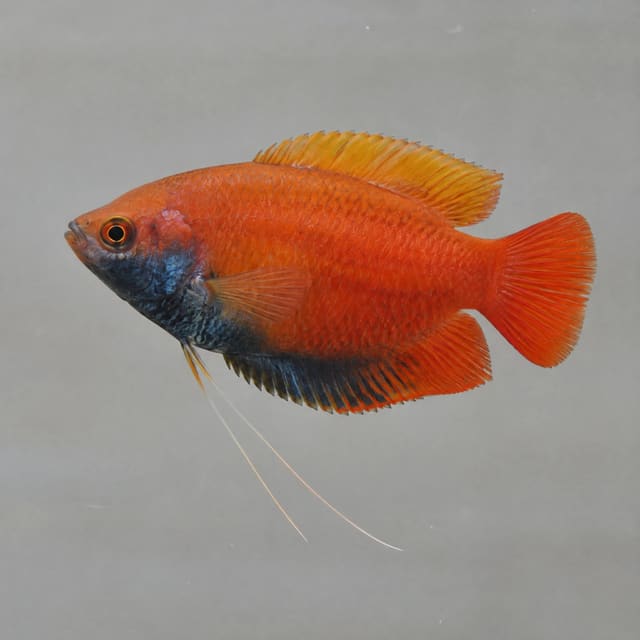
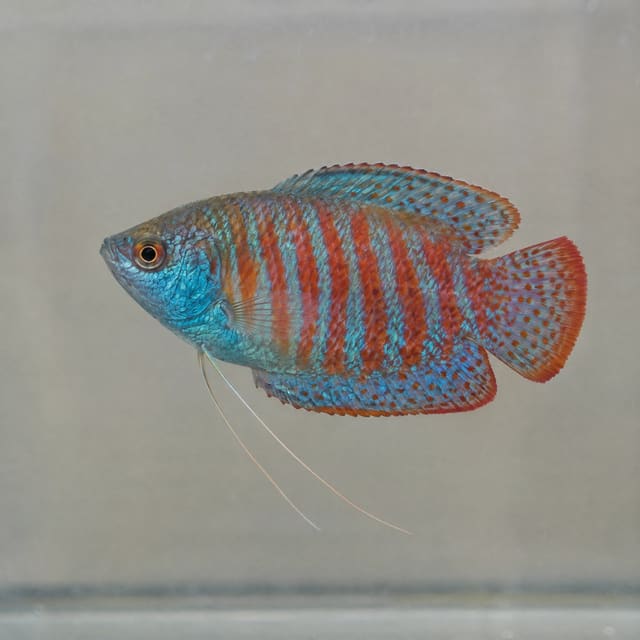
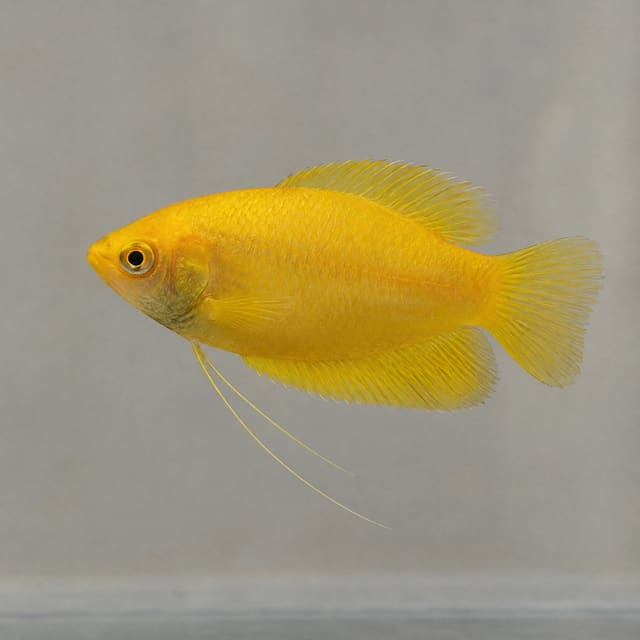
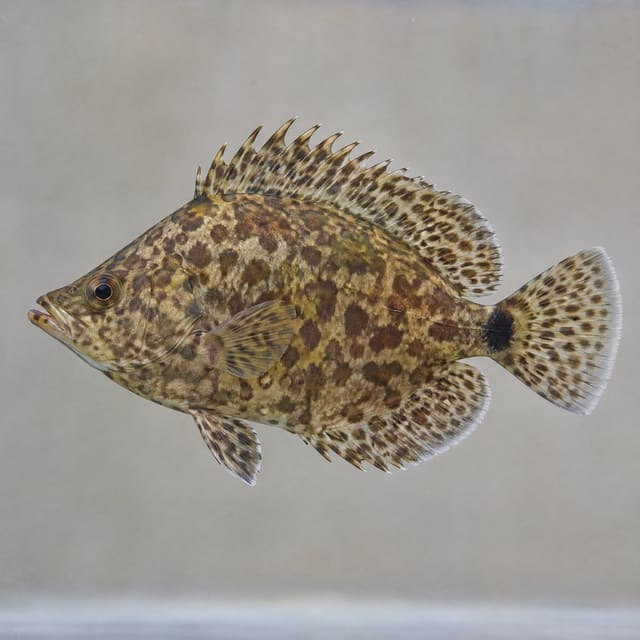
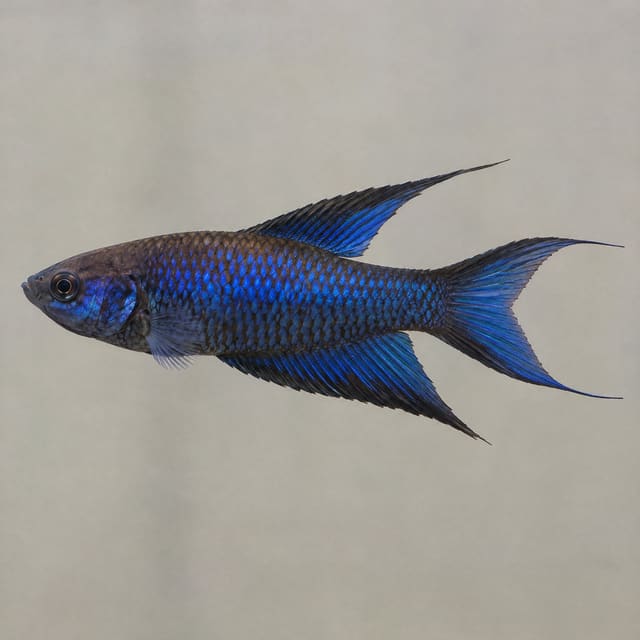
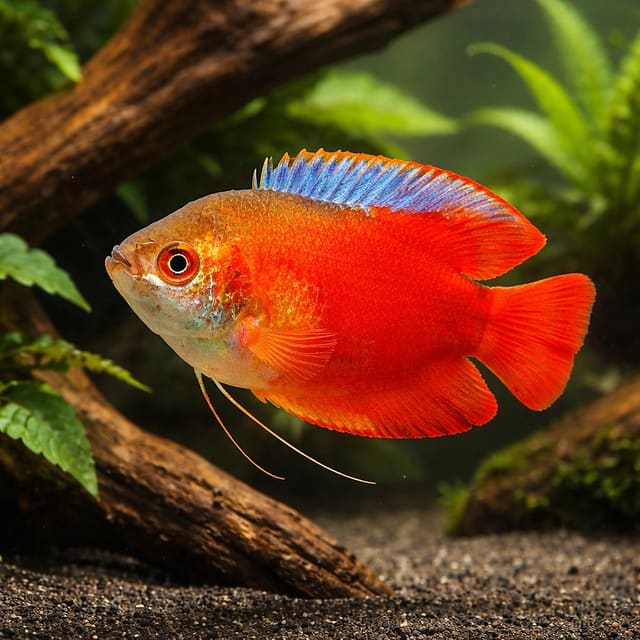
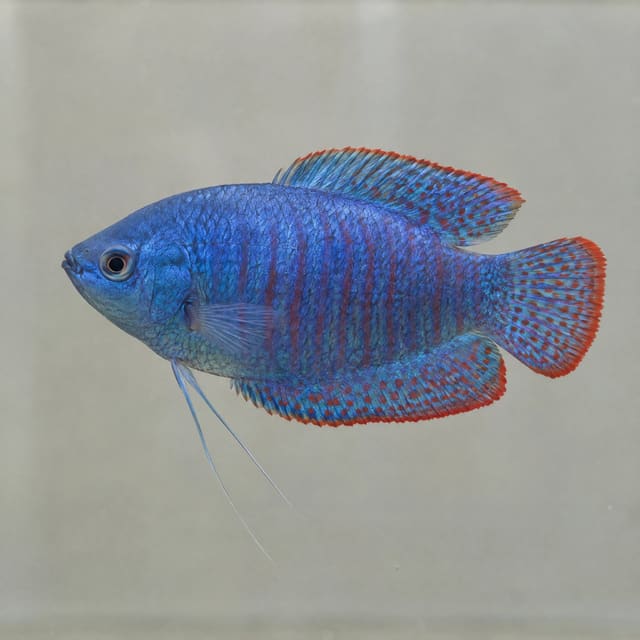
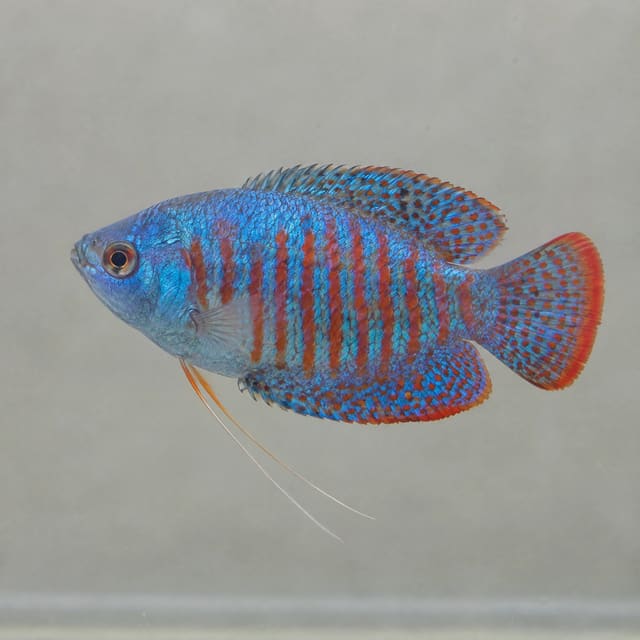
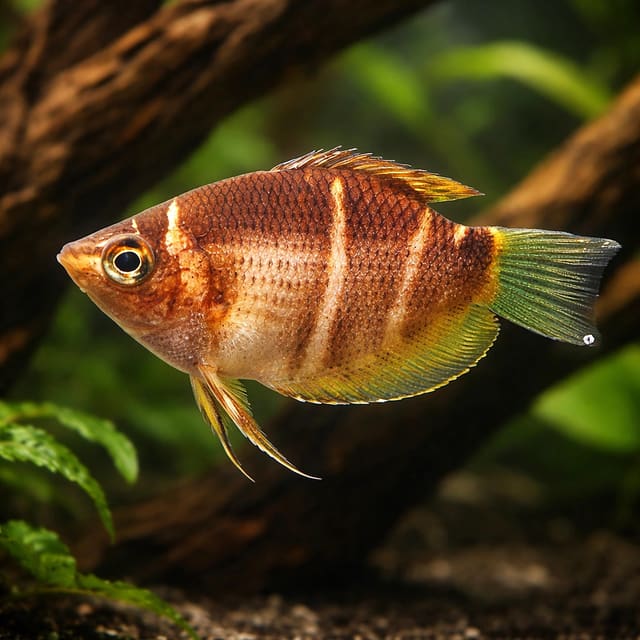
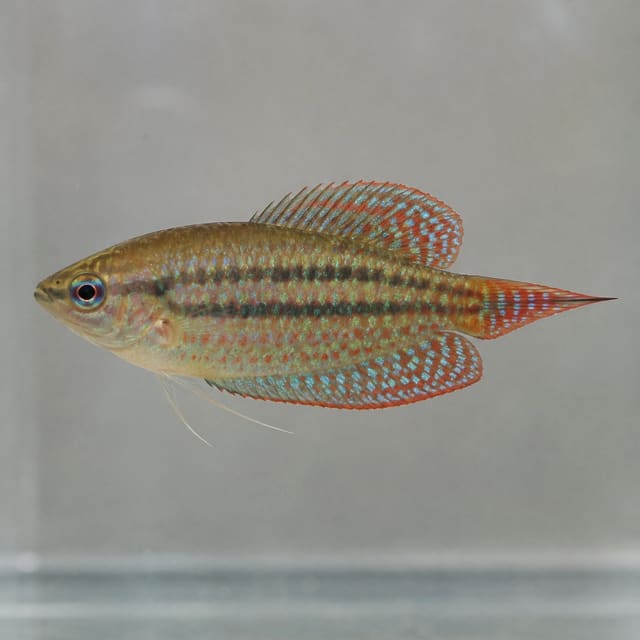
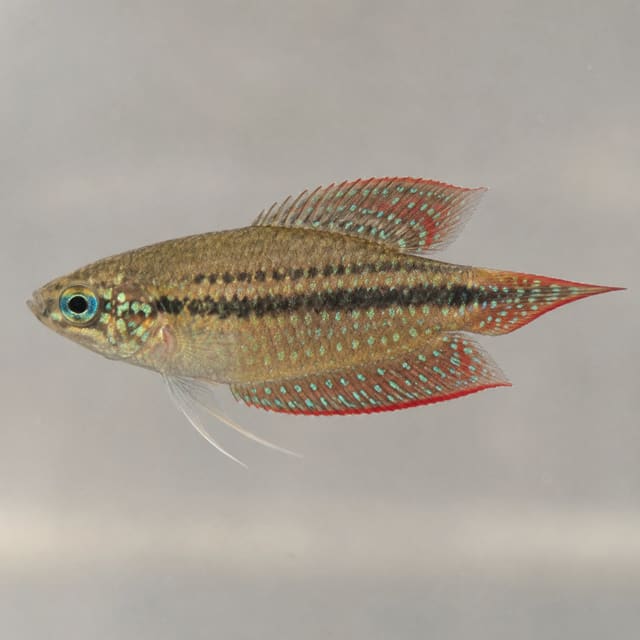
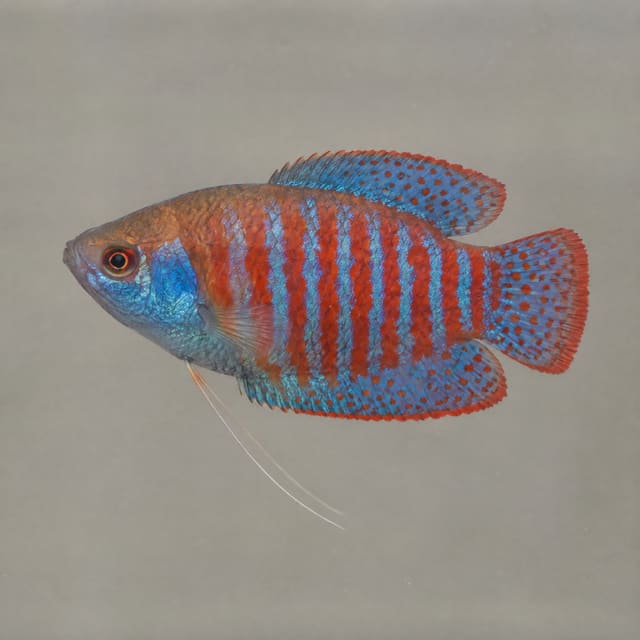
One purchase supplies one live young red tail giant gourami in the size you choose: 7–8 cm or 9–10 cm. Sex is not chosen. The photographs show a grown adult to illustrate the species; a young fish looks noticeably different.
| Feature | Young fish (7–10 cm) | Adult |
|---|---|---|
| Size | Hand-sized | Up to 50 cm standard length |
| Fin colour | Less vivid; the red develops with age | Bright red edges with filament extensions |
| Body colour | Paler, less contrasting | Blue-green, grey-green or brown to almost black, darker on the back |
| Markings | May show bars, as young giant gouramis do | A black spot at the base of each pectoral fin and a larger one near the tail |
The adult description combines Seriously Fish and Wikipedia’s species summary, which also notes that females are duller than males. Seriously Fish describes the barred pattern of young common giant gouramis fading as they grow; the young of this species are less well documented, so expect some change. Young giant gouramis grow quickly, and OATA warns that very large fish need welfare planning before they are bought, including their whole long life. No lifespan has been published for the red tail, but Seriously Fish records the common giant gourami living for more than 20 years in captivity. Never release an aquarium fish into the wild.
Read our delivery and Live Arrival Guarantee information before ordering, and have the aquarium matured and running at temperature before the fish arrives.
Seriously Fish gives a base of 180 × 60 cm, with 60 cm of height, about 648 litres, as the absolute bare minimum for an adult, and says bigger is better. OATA’s gourami care sheet gives 400 litres or more for giant gouramis, and its care sheet for very large fish says such species often need more than 500 litres, or an indoor heated pond, and that an off-the-shelf aquarium is unlikely to suit them in the long term. We recommend the Seriously Fish figure as the minimum.
Some keepers start a young fish in a smaller aquarium and upgrade later. If you do, have the final aquarium planned and budgeted from the start, because a fast-growing gourami kept cramped can turn aggressive; Seriously Fish links aggression in adults mainly to tanks that are too small.
Seriously Fish suggests water-worn rocks and large pieces of bogwood, with floating plants if you can keep them, although this fish may eat them and most other aquatic plants. OATA warns that very large fish can knock over décor, so rocks must be secured and heaters protected, and asks for gravel or sand without sharp edges that can be kept clean.
| Item | How to make it safe |
|---|---|
| Rocks | Stand directly on the glass or a base layer, never on loose sand, and keep stacks low |
| Bogwood | Choose large, heavy pieces and wedge them so they cannot roll |
| Heaters | Fit guards or use external or in-line heating |
| Cover | A secure, fish-proof cover with a gap of air above the water |
| Open water | Leave a long, clear swimming lane through the middle |
Because the fish must breathe air, OATA’s advice to leave at least a small gap between the water surface and the cover is essential, not optional. Keep the aquarium out of direct sunlight and away from draughts, heat sources and constant noise, and give it overhead lighting on a regular day and night.
Seriously Fish gives 20–30°C with about 24–27°C as best, pH 6.5–8.0 and 5–25 dGH. OATA’s general range for gouramis is 20–28°C, pH 6.0–8.0, 4–12 dGH and 3–10 dKH. Aim for the overlap:
| Reading | Target |
|---|---|
| Temperature | 24–27°C |
| pH | 6.5–8.0 |
| General hardness | 5–12 dGH, where both sources overlap |
| Carbonate hardness | 3–10 dKH (OATA) |
| Ammonia and nitrite | 0 mg/l |
| Nitrate | No more than 20 mg/l above your tap water (OATA) |
For an aquarium of the minimum size in a room at about 20°C, Seriously Fish estimates 150–225 W of heating, spread over three heaters; splitting the heating also means one failed heater cannot overheat or chill the tank. Our article on tropical fish tank temperature covers thermometers and heater checks. Most treated UK tap water falls inside these ranges; test yours, compare it in our water matcher, and see the water chemistry guide for what each value means.
Seriously Fish calls giant gouramis very messy and recommends two filters, each rated 1,295–1,620 litres per hour, turning the water over four to five times an hour. For a 648-litre aquarium that is about 2,590–3,240 litres per hour in total. OATA suggests several large filters or a pond filter for very large fish, to cope with the volume of solid waste. Mature the system fully before the fish goes in; our pages on the nitrogen cycle and understanding aquarium filtration explain the process.
Seriously Fish describes the species as omnivorous and unfussy but primarily herbivorous by nature, accepting pellets, frozen foods and vegetable matter, and advises plenty of vegetables, a quality dried food and algae wafers. In the wild, adult giant gouramis eat mostly plant matter, including fruits, seeds, leaves and flowers from land plants as well as water plants and algae, with insects, worms, crustaceans and small fish taken too, according to Wikipedia’s summary of the genus. OATA advises food of a suitable size, fresh vegetables for herbivores, and feeding once a day only as much as is eaten within a few minutes.
Fast growth tempts keepers to overfeed. A steady, measured routine keeps the water cleaner and the fish in better shape than large, irregular meals.
Add the fish only when ammonia and nitrite read zero. OATA describes two methods for big fish. The floating-bag method: lights off, float the bag for about 10 minutes, then add small amounts of aquarium water over up to 20 minutes before releasing the fish. The bucket method: place the fish in a clean bucket or box and slowly siphon aquarium water in through an airline until the water matches, without letting it cool too much, then net the fish across. Our guide on how to acclimatise new fish covers both.
| Checkpoint | What to do |
|---|---|
| Before arrival | Heaters at 24–27°C, filters matured, cover fitted with an air gap |
| Arrival | Acclimatise in dim light and leave the fish to settle |
| First feed | A small portion of herbivore pellets the next day; remove leftovers |
| Days 2–7 | Watch breathing, swimming and visits to the surface for air every day |
| End of week | Retest the water and carry out the first weekly change |
Seriously Fish describes the red tail as generally peaceful with other large fish but warns that it will eat smaller fish and that some adults become very aggressive, usually in a tank that is too small. It suggests knifefish, large barbs, catfish and loricariids, the suckermouth catfish family that includes plecos, as tank mates. OATA adds that very large fish should not be mixed with much smaller ones and that herbivores are more likely to be compatible than predators, though not always.
| Suits | Avoid |
|---|---|
| Knifefish of similar adult size | Any fish small enough to fit in its mouth |
| Large barbs and other big, calm cyprinids | Small community fish and shrimp |
| Large plecos and other big catfish | Aggressive predators in a cramped aquarium |
| Fish happy at 24–27°C and pH 6.5–8.0 | Fish that need very soft, acidic or cool water |
Candidates from our range include the Clown Knifefish, the Tinfoil Barb, the Silver Shark (Bala Shark) and the Leopard Sailfin Pleco, all large fish in their own right that need the same kind of very big aquarium. Check every mix, at adult sizes, with our tank mates tool.
OATA describes a healthy fish as having clear, bright eyes, undamaged fins, intact scales, no ulcers or bumps, normal swimming and steady breathing. Warning signs include clamped fins, flicking against décor and shimmying. Note how often your gourami rises to breathe and how it feeds in its first weeks, so changes stand out later.
| If you see | Do this |
|---|---|
| Rising to breathe much more often than usual | Test ammonia, nitrite and temperature, and increase surface movement |
| Loss of appetite | Test the water first, then check for bullying or a failed heater |
| Torn fins or missing scales | Look for collisions with décor or a chasing tank mate |
| White spots or fluffy patches | Test the water and read our white spot treatment article before treating |
| Sudden aggression | Review the space; cramped conditions are the usual cause |
Seriously Fish says breeding has not yet been reported in aquaria and is presumed to follow the common giant gourami: the male builds a large nest of plant material, spawns nearby and carries the eggs to it, chasing the female away. In that species the eggs hatch in 24–36 hours, the fry swim freely three to five days later, and in the wild the male guards them for two to three weeks. A breeding attempt would need a very large aquarium or a tropical pond.
The species was first described in 1992 from fish in the aquarium trade: Eschmeyer’s Catalog of Fishes lists the holotype, held at the California Academy of Sciences, as aquarium stock from Bangkok. Its wild range is disputed. FishBase lists Malaysia and Indonesia, while the checklists summarised on Wikipedia restrict it to the Kinabatangan and Segama river basins in Sabah, Malaysian Borneo, and regard Indonesian records as errors. FishBase lists it as Endangered on the IUCN Red List (assessed 2019), and Wikipedia reports that an eight-year survey of the Segama caught only a few specimens. All the more reason to give every red tail giant gourami in an aquarium a home for life.
It is Osphronemus laticlavius Roberts, 1992, one of four giant gourami species. Adults have a deep, dark body and bright red edges and filaments on the fins. It comes from Borneo and reaches about 50 cm.
FishBase and Seriously Fish both give 50 cm standard length, measured without the tail. The 7–10 cm fish you buy will grow far larger, so plan the aquarium for the adult.
Seriously Fish gives a base of 180 × 60 cm, about 648 litres, as the absolute bare minimum for an adult, and says bigger is better. OATA’s general figure for giant gouramis is 400 litres or more; we recommend following the larger Seriously Fish figure.
No. The common giant gourami is Osphronemus goramy, a larger, widespread species. The red tail giant gourami is a separate species described in 1992, recognised by its red fin edges. Seriously Fish says their care is the same.
It is omnivorous but mainly a plant eater by nature. Feed a quality herbivore pellet or stick, algae wafers and plenty of vegetables, with frozen foods as extras, once a day and only as much as is eaten in a few minutes.
Large, calm fish that are too big to swallow, such as knifefish, large barbs and big catfish including plecos, in a very large aquarium. It will eat smaller fish.
Yes. FishBase describes it as an obligate air-breather, so it must always be able to reach the surface. Use a cover with a gap of air above the water.
No lifespan has been published for this species. Seriously Fish says the closely related giant gourami can live for more than 20 years in captivity, so plan for a long-lived fish.
One live young red tail giant gourami in the size you choose: 7–8 cm or 9–10 cm. Young fish are less vividly coloured than the adult in our photographs.
No reviews for this item yet. Bought one? Honest reviews only, good or bad.
What customers say about ordering from us
Easy website plenty of info on fish your buying great to pick a time slot
TRACEY DURRANT · 7 Oct 2026
Got some lovely fish thank you
Kevin Mackie · 7 Oct 2026
Reviews of our shop, collected by Judge.me, an independent third-party review collector. Newest first.
Moved by UK carriers licensed to handle live animals
Hand-packed with oxygen bags, poly box, heat pack
Email photos the same day; an optional unboxing video helps us review problems faster — claim terms apply
Klarna & PayPal Pay in 3 at checkout