Easy
Orange Thick-Lipped Gourami (Trichogaster labiosa)
22–27°C · pH 6–7.5 · 80L
£6.99

A rare, stunning blackwater gourami that rewards expert keepers with its unique chocolate-brown beauty and fascinating mouthbrooding behavior. Expert care, peaceful. 22-28C, pH 5.0-7.0.
Adult size is the maximum length this species reaches at full maturity (scientific sources). The livestock you receive will be younger and smaller — pick a size above for the actual shipping size. Product-photo provenance and any image-specific limitations are stated on the listing.
Sphaerichthys vaillanti
Shoaling fish: kept in a group they feel safer, stay calmer and show their best colour.
Confirm your email, then we’ll send an availability message for this exact item if it returns within 180 days.
This request is only for this product—no newsletter or other promotions. A mail-provider retry may very rarely duplicate the same availability message. Unconfirmed addresses are removed after 48 hours. See our privacy policy.
A rare, stunning blackwater gourami that rewards expert keepers with its unique chocolate-brown beauty and fascinating mouthbrooding behavior. Expert care, peaceful. 22-28C, pH 5.0-7.0.
Adult size is the maximum length this species reaches at full maturity (scientific sources). The livestock you receive will be younger and smaller — pick a size above for the actual shipping size. Product-photo provenance and any image-specific limitations are stated on the listing.
Maintain these water conditions for optimal health and vibrant colors
Chocolate gourami (Sphaerichthys vaillanti) represents one of the most challenging and rewarding species available for sale UK, captivating advanced aquarists with its delicate beauty and fascinating mouthbrooding behavior. This rare blackwater specialist originates from peat swamps and tannin-stained lowland waters of Borneo, where it inhabits some of the most extreme freshwater environments on Earth. Available in sizes from 2-3.5cm, the species reaches only 3.5cm at maturity, making it one of the smallest gouramis. The chocolate-brown body, intricate finnage, and subtle patterning appeal to enthusiasts seeking a true specialist species. Expert-level care, very soft and acidic water, and a meticulously maintained blackwater setup are absolutely essential—Sphaerichthys vaillanti is not forgiving of errors and should be attempted only by experienced aquarists committed to replicating its natural habitat.
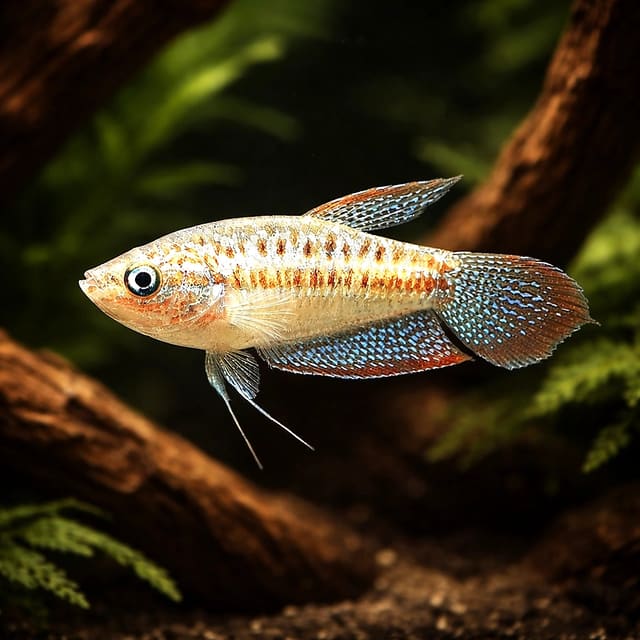
Sphaerichthys vaillanti displays subtle but beautiful coloration dominated by chocolate-brown to reddish-brown tones across the body. Depending on mood, water chemistry, and lighting, the body may show olive, amber, or darker brown hues with faint vertical barring or mottling. Males develop more intense coloration and slightly longer, more pointed dorsal and anal fins than females. The eyes are relatively large and expressive, often showing a reddish or golden iris. All fins feature delicate extensions and intricate ray patterns that contribute to the species' elegance. Coloration intensifies during spawning condition, with males displaying deeper tones and more defined patterning. The overall appearance is delicate and refined rather than bold—this gourami's beauty lies in subtlety and the tranquil way it moves through heavily planted, dimly lit blackwater aquariums.
This species inhabits blackwater peat swamps, shallow forest pools, and slow-moving streams in Borneo, particularly in Kalimantan, Indonesia. The water is heavily tannin-stained, extremely soft (often near zero hardness), and highly acidic (pH 4.0-5.5 in the wild). Submerged leaf litter, fallen branches, and dense aquatic and marginal vegetation create a dark, sheltered environment with minimal water flow. Dissolved oxygen levels fluctuate, but the species' labyrinth organ allows it to breathe atmospheric air when needed. Natural habitats experience high humidity, warm temperatures year-round, and dim lighting filtered through dense forest canopy. The gourami feeds on tiny invertebrates, insect larvae, and zooplankton, picking carefully at biofilm and plant surfaces. Water conditions are incredibly stable due to the buffering effect of organic acids and tannins.
A minimum 40-litre aquarium with a footprint emphasizing length over height provides suitable space for a small group or pair. Use very fine sand or bare-bottom setup with abundant driftwood, dried leaves (Indian almond, oak, beech), and densely planted areas using species like Cryptocoryne, Java fern, and floating plants to diffuse light. Subdued, dim lighting is essential—bright light stresses the fish and inhibits natural behavior. Add peat filtration, Indian almond leaves, or blackwater extracts to achieve deep tannin staining and very soft, acidic water. Filtration should be gentle to avoid strong currents; sponge filters or small internal filters work best. Maintain high humidity by covering most of the water surface or using a tight-fitting lid, as this helps preserve stable water chemistry and supports the labyrinth organ. Avoid boisterous tankmates, bright lighting, and any disturbances—this species thrives only in calm, heavily planted, dimly lit blackwater biotopes.
Expert Tip: Use reverse osmosis or distilled water remineralized to very low hardness (1-3 dGH) and acidified with natural tannins. Tap water, even if soft, often contains unsuitable minerals or contaminants.
Maintain temperatures between 22-28°C, with 24-26°C representing optimal conditions. The species tolerates slightly cooler water but becomes less active. pH must remain between 5.0-7.0, with 5.0-6.0 strongly preferred to replicate natural blackwater conditions. Achieving and maintaining such low pH requires RO or distilled water, peat filtration, and constant input of tannins from leaves and wood. Water hardness should be very soft, ideally below 3 dGH, as the species is extremely sensitive to mineral content. Ammonia and nitrite must be undetectable, while nitrates should stay below 20 ppm. Perform small, frequent water changes (15-20% weekly) using carefully prepared, matched water to avoid shocking the fish. Test water parameters regularly, as pH can drift in blackwater setups. The species is highly sensitive to abrupt changes and poor water quality—stability and cleanliness are paramount.
Sphaerichthys vaillanti is a micro-predator requiring small live or frozen foods. Offer live or frozen daphnia, baby brine shrimp, micro worms, grindal worms, mosquito larvae, and bloodworms sized appropriately for the fish's tiny mouth. Some individuals may accept high-quality micro pellets or granules after acclimation, but live or frozen foods should form the dietary foundation. Feed small amounts twice daily, ensuring food remains suspended in the water column or settles slowly, as the gourami prefers to pick at food rather than competing on the substrate. Variety is essential to maintain health and breeding condition. In blackwater setups with ample biofilm and microorganisms, the fish may supplement its diet by grazing naturally, but deliberate feeding remains necessary.
Vaillant's chocolate gourami is shy, peaceful, and best observed in calm, dimly lit environments. The species moves slowly and deliberately through planted areas, often hovering near cover or exploring leaf litter. Males establish loose territories during breeding periods but are not aggressively territorial. The species is social and should be kept in small groups (6+) or as a pair rather than singly. Spawning behavior is fascinating—males are paternal mouthbrooders, incubating eggs in their buccal cavity for approximately two weeks before releasing fully formed fry. During this period, the male does not feed and remains reclusive. The species is sensitive to disturbances, loud noises, bright light, and water quality fluctuations, responding with stress coloration, hiding, or loss of appetite. In optimal conditions, the gourami becomes more confident and displays natural foraging and social behaviors.
Selecting tankmates for Sphaerichthys vaillanti requires extreme caution. Only small, peaceful blackwater species that share identical water chemistry and temperament are suitable. Potential companions include dwarf rasboras (Boraras, Microdevario), small pencilfish (Nannostomus), peaceful Corydoras pygmaeus, and other tiny, gentle species. Avoid any boisterous, fast-moving, or competitive feeders, as they will outcompete and stress the chocolate gourami. Fin-nippers, aggressive cichlids, large barbs, and active schooling fish are entirely unsuitable. Many experienced aquarists maintain this species in single-species setups to eliminate competition, reduce stress, and optimize breeding success. Given the demanding water chemistry requirements, finding truly compatible tankmates is challenging, and species-only aquariums often yield the best results.
Breeding Sphaerichthys vaillanti is possible in carefully maintained blackwater aquariums but remains uncommon. A well-conditioned, bonded pair in very soft, acidic water (pH 5.0-5.5, <3 dGH) with subdued lighting and minimal disturbance may spawn. The male incubates 10-40 eggs in his mouth for approximately 12-16 days, during which he does not eat and should not be disturbed. After the fry are released, they are tiny and require infusoria, paramecium, or liquid fry food initially, graduating to newly hatched brine shrimp within a week. Fry are delicate and extremely sensitive to water quality; small, frequent water changes with matched parameters are essential. Raising a brood to maturity requires dedication, exceptional water management, and appropriately sized foods at each developmental stage.
Tropical Fish Co supplies healthy, carefully selected Sphaerichthys vaillanti specimens suitable for expert aquarists committed to blackwater biotopes. We provide comprehensive care guidance covering the critical requirements for water chemistry, tank setup, feeding, and breeding. Our team ensures all fish are acclimated to stable conditions and feeding before dispatch. With reliable UK delivery using specialist livestock couriers, your chocolate gourami arrives safely in insulated packaging with oxygen and thermal protection. We support advanced fishkeeping and offer ongoing advice to help you succeed with this demanding but deeply rewarding species. Trust Tropical Fish Co for rare, specialist livestock and expert guidance.
No reviews for this item yet. Bought one? Honest reviews only, good or bad.
What customers say about ordering from us
I have a small group of long finned mountain minnows. So was delighted to be able to order ten of this variety to increase the genetics in my tank . The ones I recieved are healthy but it’s to early to give a verdict on wether they are of a long finned type since they are small currently.
Gordon Walker · 23 Sept 2026
100% success travel and "installation". Pleased with quality of purchase. The Siamese fighter a bit "shy" so have not yet seen him at his best yet but looking good. Happy customer. GG
George E Garratt · 21 Sept 2026
Reviews of our shop, collected by Judge.me, an independent third-party review collector. Newest first.