Moderate
Gold Gourami (Trichopodus trichopterus)
24–28°C · pH 6–8 · 81L
From £2.99Some sizes on sale
Three-Spot Gourami (Trichopodus trichopterus) is an air-breathing labyrinth fish of the family Osphronemidae, a group that originates from Asia, for a mature community aquarium of at least 100 litres. OATA's gourami care sheet gives 20–28°C and pH 6.0–8.0 as general guidance and advises robust tankmates rather than timid species. Sold as one live fish of about 4–5 cm from a mix of gold, Cosby and Sumatra colour forms.
Trichopodus trichopterus
Save when buying multiple fish. Each quantity is one fish; sex and pair formation are not guaranteed unless the selected variant explicitly states them.
Three-Spot Gourami (Trichopodus trichopterus) is an air-breathing labyrinth fish of the family Osphronemidae, a group that originates from Asia, for a mature community aquarium of at least 100 litres. OATA's gourami care sheet gives 20–28°C and pH 6.0–8.0 as general guidance and advises robust tankmates rather than timid species. Sold as one live fish of about 4–5 cm from a mix of gold, Cosby and Sumatra colour forms.
Maintain these water conditions for optimal health and vibrant colors
The Three-Spot Gourami (Trichopodus trichopterus) is a gourami, a labyrinth fish of the family Osphronemidae, a group that originates from Asia. FishBase records the species and lists Cosby, Gold and Golden gourami among its common names, which is why gold and Cosby fish are sold under the same scientific name. This offer brings those colour forms together with the form traded as Sumatra. Gouramis are popular aquarium fish, and OATA notes that most gouramis in the trade are captive bred.
It suits a keeper with a mature, filtered aquarium of at least 100 litres and a community of robust fish, and it carries our easy care rating. That rating rests on OATA's gourami care sheet, which notes that tank-reared gouramis are usually undemanding of water chemistry, but it comes with a condition: the same sheet stresses that good husbandry is essential and that an air-breathing fish needs no less care than any other.
| Suits | Not suited to |
|---|---|
| A mature, filtered aquarium of at least 100 litres | Small or newly set-up tanks |
| Communities of robust fish | Aquariums built around timid species or very small fish |
| Steady water within 20–28°C and pH 6.0–8.0 | Set-ups where temperature or chemistry swing widely |
| Keepers who test weekly and change 25% of the water every week | Owners who skip routine maintenance |
| Buyers happy to receive any of the three colour forms | Buyers who need one particular colour |
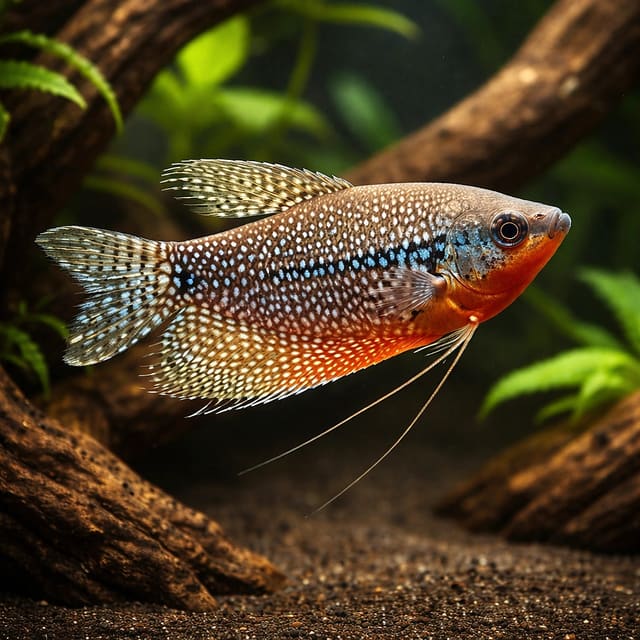
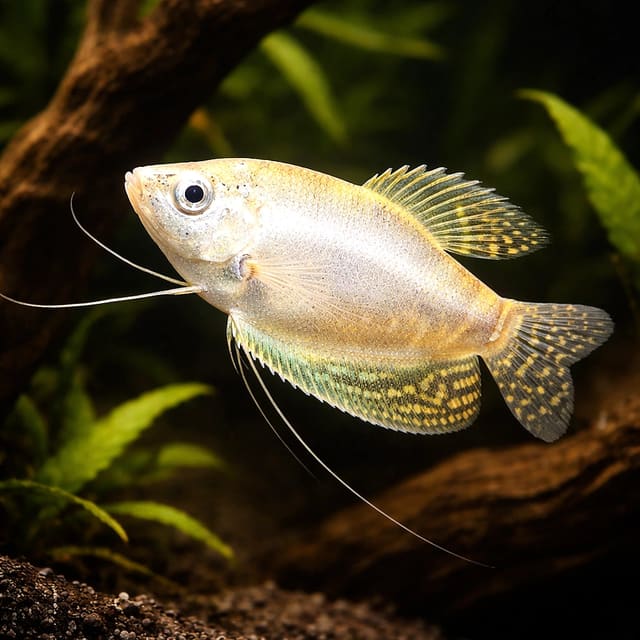
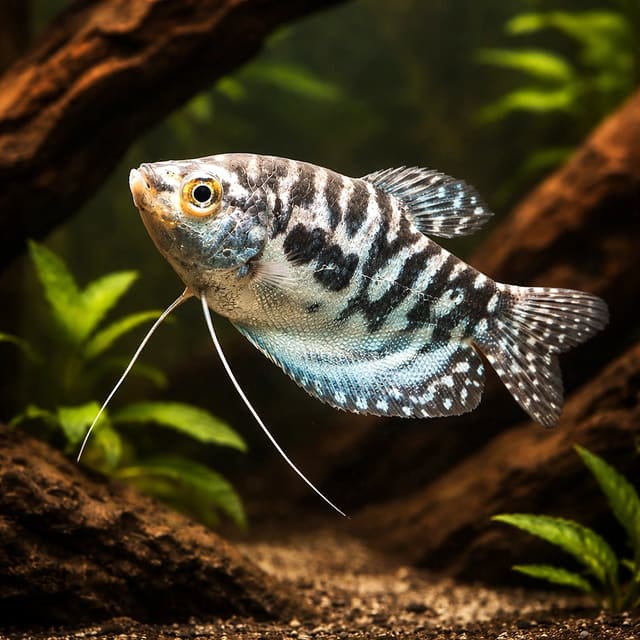
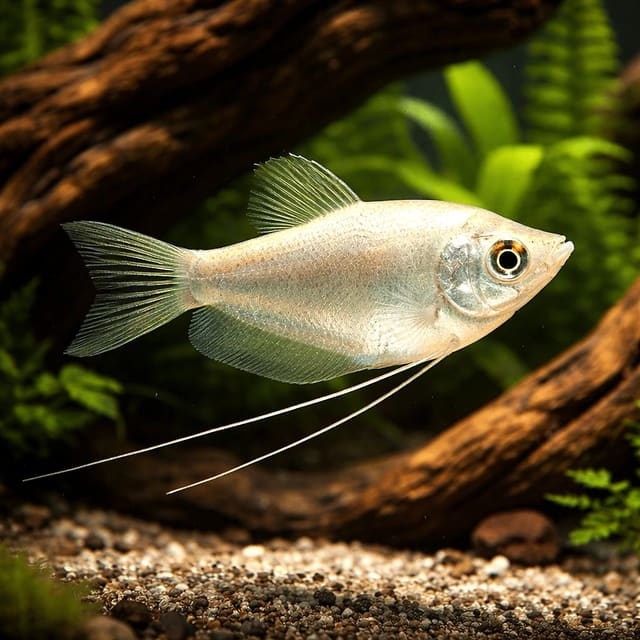
Two features make gouramis easy to recognise in a planted tank. Their labyrinth organ lets them breathe atmospheric air, so you will see them rise to the surface to take a breath, and each pelvic fin carries a long, thread-like ray that works like a whisker, used to sense their surroundings. Watching a gourami explore the plants with those rays is a large part of its appeal.
Choose this mixed offer if you want gouramis for their shape, their unhurried exploring and a variety of colour within one species, and you are happy for chance to decide which colours you receive. If you need one particular colour, a single-colour gourami listing is the better route; the care on this page applies either way.
Each purchase supplies one live Three-Spot Gourami from a mixed batch of gold, Cosby and Sumatra colour forms. The colour form is not chosen at purchase, so the fish you receive may be any one of the three. Fish are supplied at about 4–5 cm, which is their size at dispatch rather than their adult size, so plan the aquarium for grown fish from the start.
| Offer detail | What it means |
|---|---|
| Sold as | One live fish per purchase |
| Size at dispatch | About 4–5 cm |
| Colour form | Gold, Cosby or Sumatra, from a mixed batch |
| Species | Trichopodus trichopterus, whichever colour arrives |
In the trade this offer is also known as Trichogaster mix. FishBase records the species itself as Trichopodus trichopterus, and that is the name used for the care advice on this page.
Sex is guaranteed only when the selected option explicitly states male or female. This Trichogaster mix listing has no sex-guaranteed option.
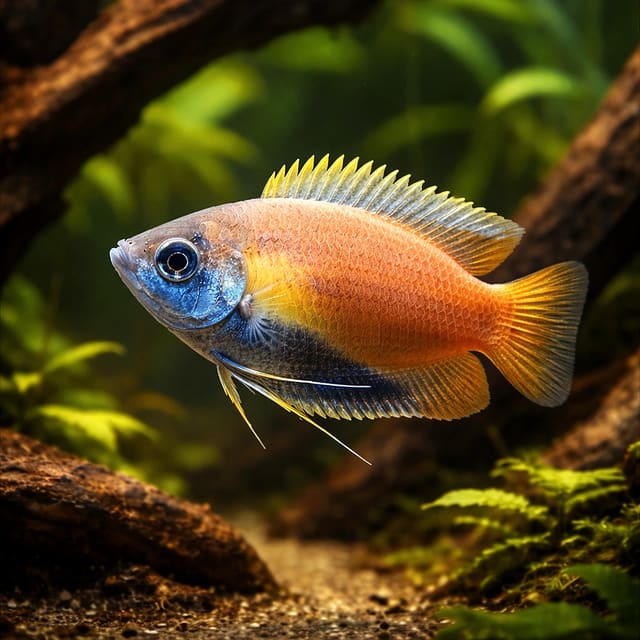
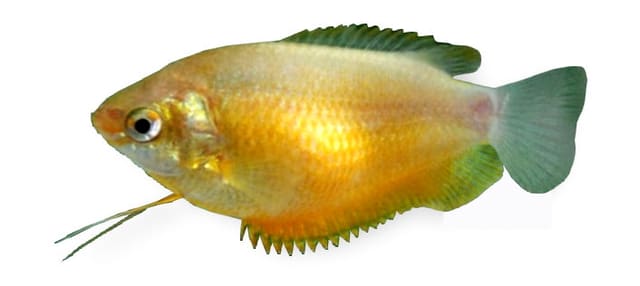
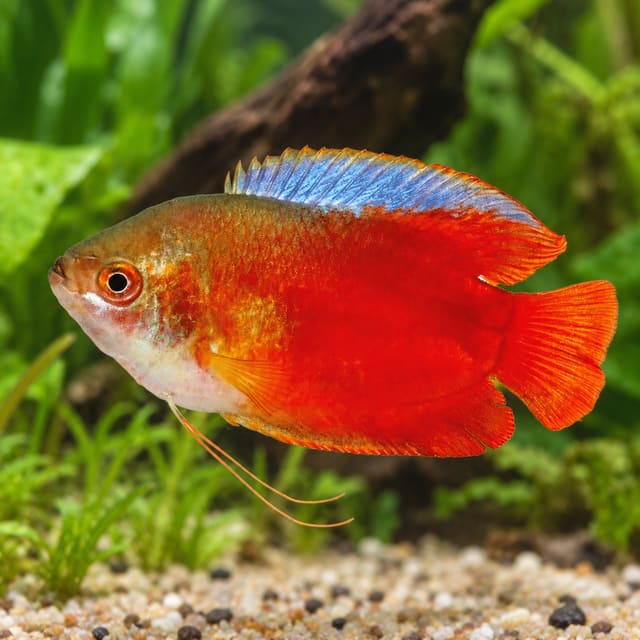
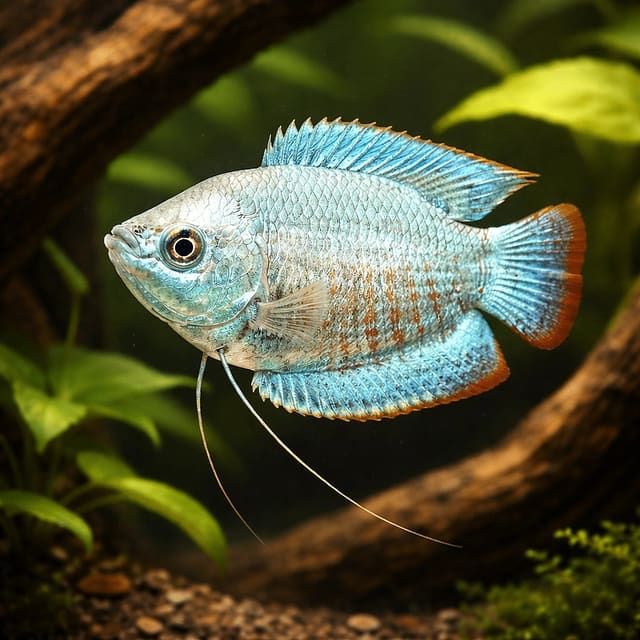
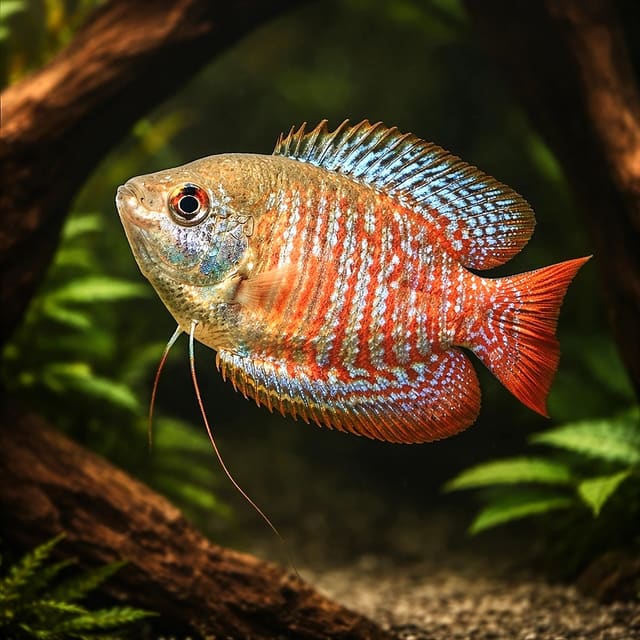
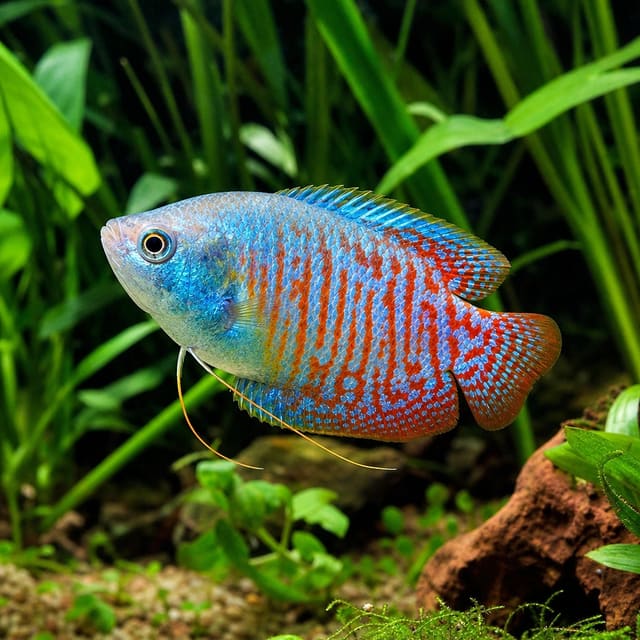
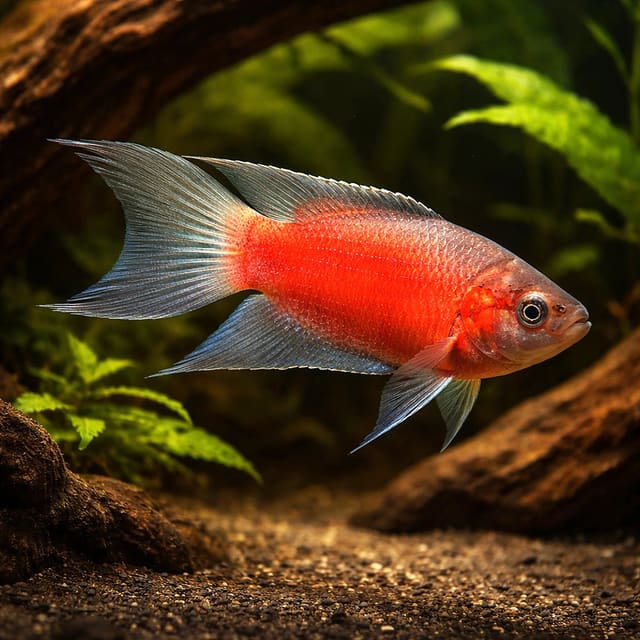
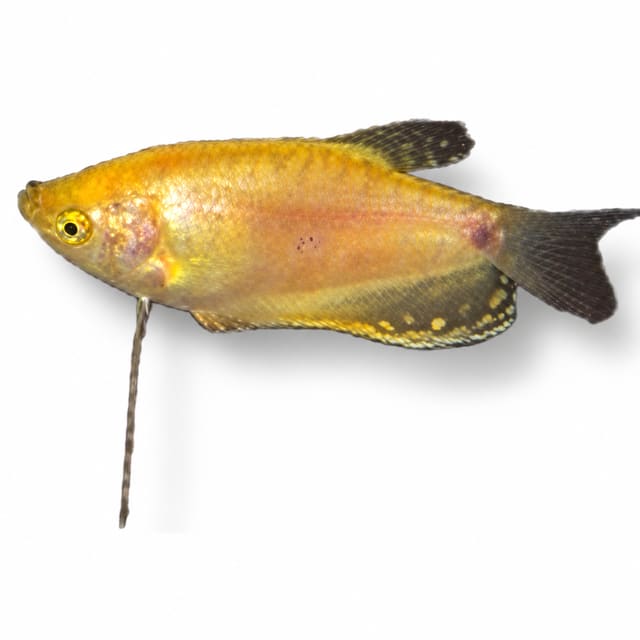
Gallery images have been digitally enhanced to improve image quality. Natural colour, pattern, size and maturity can vary between live animals. The photograph shows three differently coloured fish to illustrate the mix; each purchase supplies one fish.
Because each purchase is one fish, you control how many gouramis you add and when. That suits the slow stocking pace OATA recommends: add one or a few fish, let the filter catch up, then decide on the next. A group built this way over several orders may end up with a different balance of gold, Cosby and Sumatra fish than you expect, so order the mix when any combination will please you.
If you would rather compare other gouramis and air-breathing species before you decide, browse our gouramis and labyrinth fish collection.
Gouramis and paradise fish are anabantids: fish that have developed a specialised labyrinth organ which allows them to breathe atmospheric air. It is easy to read that as permission to skimp on filtration or water changes. OATA is clear that it is not, and that these fish need as much care as any other species.
That last point is where the RSPCA's aquarium welfare guidance fits in. Fish release ammonia, which is toxic. A working biological filter grows beneficial bacteria that turn ammonia into nitrite, which is also toxic, and then into nitrate, which is safer. No fish should be kept without a well set up and maintained filter, gouramis included.
Learn the difference between a normal breath and a problem. A gourami that goes up for air and then swims back into the plants is behaving normally. A fish that hangs at the surface, or whose gill covers are moving faster than usual, is showing two of the changes OATA lists as warning signs, and the first step is always to test the water.
OATA sets two starting points for gouramis: at least 45 litres for a small group of the smaller species, and at least 100 litres for the larger species of gourami and for paradise fish. Plan this gourami in the larger category and start at 100 litres. Its general rule is to buy an aquarium as large as possible, within reason, because the larger the aquarium, the more stable its temperature and water quality stay.
| Your plan | Starting volume |
|---|---|
| Three-Spot Gouramis on their own | At least 100 litres |
| Gouramis plus one group of robust companions | More than 100 litres |
| Several groups of fish | Larger again, because each group adds to the volume required |
OATA also says the aquarium should ideally hold at least a small group of gouramis, and that the more groups of fish you keep, the larger the volume you need. A 100-litre tank is therefore a floor for this fish, not a target for a busy community.
Buy the full-sized aquarium from the start rather than planning to upgrade: it avoids a second move later and gives the filter a stable volume to work with from day one. Whatever the size, a filter is always essential.
To check what your aquarium really holds, multiply the inside length, width and water depth in centimetres and divide by 1,000. A tank 80 cm long and 35 cm wide, filled to a depth of 36 cm, holds about 100 litres of water; decorations and substrate take a little of that space, so round down rather than up.
If you are unsure whether your aquarium suits the number of gouramis you have in mind, send us its dimensions and your stocking plan before ordering and we will look at it with you.
OATA recommends aquarium gravel or sand as the substrate and, ideally, live plants in the tank. For a gourami, plants do more than decorate: they give the fish something to explore with the whisker-like rays on its pelvic fins and places to move out of sight when it wants to.
Aim for a layout that stays easy to clean. Siphoning gravel or sand is part of every weekly water change, so leave open areas of substrate that the siphon can reach without uprooting the plants.
Settle the layout before any fish arrives. Moving plants and decorations around a newly introduced gourami disturbs it at the point when it most needs steady surroundings.
Live plants are worth the effort OATA suggests. Established planting gives a newcomer places to rest out of the open water while it settles, and it gives the whole group more to explore than bare gravel ever can.
Most problems with new fish start with missing or untested equipment. Have everything below installed and working, with the filter already matured, before you place an order.
| Equipment | Why it matters |
|---|---|
| Filter sized for the aquarium | OATA calls a filter always essential; its bacteria turn ammonia into less harmful nitrate |
| Heater with a thermostat | Holds the water steady within the 20–28°C gourami range |
| Thermometer | A daily reading shows drift before it becomes a problem |
| Test kit | Ammonia, nitrite and nitrate at least weekly, plus pH and hardness |
| Tap water conditioner | Removes chlorine or chloramine from replacement water |
| Siphon and marked bucket | For the weekly 25% change and removing waste from the gravel |
Run the complete set-up for long enough to confirm that the temperature holds and that ammonia and nitrite read zero before the first fish goes in. Our first-tank guide, linked in the stocking section below, covers how to mature the filter.
Keep the Three-Spot Gourami at 20–28°C and pH 6.0–8.0, with a general hardness of 4–12°dH, zero ammonia and nitrite, and nitrate no more than 20 mg per litre above your normal tap water level. These are OATA's general guide values for gouramis and paradise fish as groups, not a species-specific optimum, and they apply to tank-reared fish, which OATA describes as usually undemanding of water chemistry.
| Water value | OATA gourami guidance |
|---|---|
| Temperature | 20–28°C |
| pH | 6.0–8.0 |
| General hardness | Soft to medium, 4–12°dH |
| Carbonate hardness | Soft to medium, 3–10°dKH |
| Ammonia and nitrite | Zero |
| Nitrate | No more than 20 mg per litre above normal tap water levels |
OATA adds that some gourami species, mainly specialist or wild-caught specimens, may need more specific conditions. Treat the ranges above as the routine target for tank-reared fish, and choose a steady point within them rather than moving between the extremes.
The nitrate figure is measured against your own tap water, so test the tap as well as the tank. If your tap reads 10 mg per litre, the aquarium should stay at or below 30 mg per litre. Our guide to what to test in aquarium water and why explains each reading, and the water parameter matcher lets you compare your results with these values before you order.
OATA strongly recommends a partial water change of 25% at least once every week for gouramis, and stresses that good husbandry is essential. A steady weekly rhythm keeps the water clean and stable between tests.
Never run the filter media under the tap. Chlorine or chloramine in tap water may kill the beneficial bacteria established in the media. Rinse it lightly in the tank water you removed during the water change instead, which reduces the number of bacteria lost.
| Aquarium volume | Weekly 25% change |
|---|---|
| 100 litres | About 25 litres |
| 160 litres | About 40 litres |
| 200 litres | About 50 litres |
Measuring the volume once, with a marked bucket, makes the routine quick and consistent, and a notebook of dates and readings shows you at a glance whether anything is changing. OATA's advice is a 25% change at least once every week, so keep to it even when the readings look good.
Gouramis are omnivorous and will take most food types. OATA recommends a good quality flake, granule or pellet as the everyday food, with small items of live or frozen food such as daphnia, small bloodworm or tubifex for variety.
Feed once a day, giving only what the fish eat within a few minutes. Take care not to overfeed, because uneaten food breaks down and releases toxic waste into the water.
| Food | How to use it |
|---|---|
| Flake, granule or pellet | The everyday base, in a portion cleared within a few minutes |
| Daphnia | A small live or frozen treat to vary the diet |
| Small bloodworm | Another small live or frozen option |
| Tubifex | A further live or frozen choice for variety |
Watch the whole group at feeding time. A fish that shows reduced intake or loses interest in food is showing one of the changes OATA lists as worth attention, and it is easiest to notice when every fish comes forward for the daily meal.
Scale portions to the fish, not the container. A 4–5 cm gourami needs only a small pinch, and if food is left on the gravel after a few minutes, siphon it out and give less the next day.
When you mix dried and frozen foods, keep the daily total the same. The once-a-day meal should still be cleared within a few minutes, whatever combination of flake, granules, pellets or small frozen foods it contains.
Before any gourami goes in, check that ammonia and nitrite read zero. OATA advises increasing the number of fish slowly, because the beneficial bacteria in a matured filter have to multiply every time fish are added and feeding increases.
Overstocking, or stocking too quickly, can cause new tank syndrome. There are not enough nitrifying bacteria to cope with the extra waste, so ammonia and nitrite rise to unhealthy levels, which may cause fish to become ill or die. Our guide to setting up a first tropical tank in ten safe steps explains how to mature a filter before livestock arrives.
If you are unsure how many fish your aquarium can take, send us its volume and your planned stocking before ordering. OATA's advice is to get that check before any fish is added, and it is far easier to adjust a plan than an overstocked tank.
Your gourami is hand-bagged in pure oxygen and packed in an insulated poly box, with a heat pack when the weather calls for it. We email the tracking number and your confirmed Thursday or Friday delivery date, and a licensed live-animal courier carries the parcel on a tracked service. Live fish cannot be left unattended, so plan to be in.
For the Live Arrival Guarantee to apply, someone must be at the address to receive the parcel, the parcel must be opened and inspected the same day it arrives, and the unboxing video must be continuous from the sealed parcel. Film every delivery that way, because our licensed courier may ask for continuous unboxing evidence when a claim is raised. The full conditions are on our delivery and Live Arrival Guarantee page.
The first weeks decide how well a new gourami settles, and a simple plan makes problems easy to catch. Use this sequence for every fish you add, whether it is your first gourami or the latest addition to a group.
Follow the delivery steps above, float the bag, release the fish and leave the aquarium as it is. Note how the fish looks and moves on that first day, because that is the picture you will compare against for the rest of the month.
Watch every fish at the daily meal: is it coming forward, eating and swimming normally? Test ammonia and nitrite during the week, and straight away if anything looks wrong. Carry out the first 25% water change on your normal day.
Keep the weekly test and water change going without changes to the layout. Consider the next fish only when ammonia and nitrite have stayed at zero and every gourami in the tank is feeding well. If a warning sign from the list below appears, hold any further additions until it is resolved.
OATA describes a healthy fish as having clear, bright eyes, undamaged fins, intact scales, no ulcers or bumps and normal swimming behaviour. Any of the changes below is worth a closer look.
Every fish varies a little, so judge each gourami against its own normal behaviour. With a mixed batch, remember that a gold fish and a Cosby fish look different by nature; compare each one with itself over time rather than with its neighbour.
If you see a change, test the water first, because ammonia, nitrite and nitrate readings show quickly whether the aquarium itself is the cause. Then contact us with the readings and a short description of what the fish is doing, and we will help you work through it.
OATA's rule for mixing gouramis with other species is short and practical: choose robust tankmates, and avoid timid species, small fish which could be eaten and fish which may nip their fins. Gouramis vary in temperament and requirements, from small, timid, delicate species to some that are large and aggressive, so the safest community is one built from fish that can hold their own.
| Choose | Avoid |
|---|---|
| Robust tankmates | Timid species |
| Fish that live well at 20–28°C | Small fish which could be eaten |
| Companions with room for their own group | Fish which may nip fins |
A companion that fails any of these questions belongs in a different aquarium, however good it looks in the shop.
The long pelvic rays that make gouramis so distinctive are one reason to keep fin nippers out. They trail through the water as the fish explores, and a companion that nips at fins has an easy target.
Build the community in the same slow steps described in the stocking section, and watch temperament after each new addition.
If aggression rises or a fish starts hiding more than normal after a new addition, test the water first, then reconsider the mix before adding anything else.
Gold, Cosby and Sumatra fish differ in colour, not in care. As colour forms of one species, they share the same water values, feeding and space needs, and a keeper who builds a group from this mixed batch is managing one species, not three.
That makes the mix a straightforward way to build a varied display: one set of water values, one feeding routine and one stocking plan cover every fish, whatever its colour.
Colour is also one of the health signals OATA asks keepers to watch: a fish turning darker or paler than its normal shade deserves a closer look. In a mixed group, learn each fish's usual colour in its first days, so a gold fish fading or a Cosby fish darkening stands out against its own normal rather than against a neighbour of a different form.
Treat a mixed-colour group exactly as you would a group of one colour: add fish slowly, give them space and cover, and keep an eye on temperament as the group grows, judging each fish by its behaviour rather than its colour.
Plan for at least 100 litres. OATA's gourami care sheet recommends at least 100 litres for the larger gourami species and at least 45 litres only for a small group of the smaller species, and it advises buying the largest aquarium you reasonably can, because a bigger volume keeps temperature and water quality more stable. Every extra group of fish adds to the volume you need.
OATA advises choosing an aquarium that can hold at least a small group of gouramis, then building the numbers up slowly so the filter bacteria keep pace with the extra waste. Gouramis vary in temperament, so add fish gradually and watch for rising aggression or a fish hiding more than normal as the group grows.
It carries our easy care rating, because OATA notes that tank-reared gouramis are usually undemanding of water chemistry. That does not mean less care: a beginner still needs a mature, filtered aquarium of at least 100 litres, weekly tests and a 25% partial water change at least once every week.
Gouramis are omnivorous and take most food types. OATA recommends a good quality flake, granule or pellet, with small live or frozen foods such as daphnia, small bloodworm or tubifex, fed once a day in an amount the fish eat within a few minutes.
OATA's gourami care sheet gives 20–28°C, pH 6.0–8.0, a general hardness of 4–12°dH and a carbonate hardness of 3–10°dKH, with zero ammonia and nitrite and nitrate no more than 20 mg per litre above your normal tap water level. These are general guide values for gouramis, so keep conditions steady within them.
OATA notes that gouramis vary in temperament, from small, timid species to some that are large and aggressive, so judge the individual fish in your own aquarium. Add fish slowly, give the group room and cover, and look for rising aggression or a fish hiding more than normal, which are the temperament changes OATA lists as warning signs.
OATA's advice for mixing gouramis with other species is to choose robust tankmates and avoid timid species, small fish that could be eaten and fish that may nip their fins. Pick companions that also live well in 20–28°C water, and check each one's own adult size and needs before adding it.
Film the delivery from the start: record the sealed parcel with the outer box visible, then open it in one continuous take until the fish can be seen in its sealed bag, because that unboxing video is needed for any Live Arrival Guarantee claim. The fish travels hand-bagged in pure oxygen inside an insulated poly box, with a heat pack when the weather calls for it, and a licensed live-animal courier brings it on your confirmed Thursday or Friday, so someone must be in. Float the bag for 20–30 minutes before releasing the fish, and never pour the bag water into your tank.
No reviews for this item yet. Bought one? Honest reviews only, good or bad.
What customers say about ordering from us
Easy website plenty of info on fish your buying great to pick a time slot
TRACEY DURRANT · 7 Oct 2026
Got some lovely fish thank you
Kevin Mackie · 7 Oct 2026
Reviews of our shop, collected by Judge.me, an independent third-party review collector. Newest first.