Easy
Pearl Gourami (Trichopodus leerii) – 2.5–7cm & XL Size Grades
24–28°C · pH 6–8 · 81L
£5.99
The Assorted Male Dwarf Gourami (Colisa lalia) is a freshwater gourami from Pakistan, India and Bangladesh that reaches 9.5 cm. It suits a keeper able to provide a planted 60 cm aquarium with gentle flow; Seriously Fish gives 22–27°C, pH 6.0–7.5 and 2–18 dGH. Sold individually as one male fish.
Adult size is the maximum length this species reaches at full maturity (scientific sources). The livestock you receive will be younger and smaller. Product-photo provenance and any image-specific limitations are stated on the listing.
Colisa lalia
Save when buying multiple fish. Each quantity is one fish; sex and pair formation are not guaranteed unless the selected variant explicitly states them.
The Assorted Male Dwarf Gourami (Colisa lalia) is a freshwater gourami from Pakistan, India and Bangladesh that reaches 9.5 cm. It suits a keeper able to provide a planted 60 cm aquarium with gentle flow; Seriously Fish gives 22–27°C, pH 6.0–7.5 and 2–18 dGH. Sold individually as one male fish.
Adult size is the maximum length this species reaches at full maturity (scientific sources). The livestock you receive will be younger and smaller. Product-photo provenance and any image-specific limitations are stated on the listing.
Maintain these water conditions for optimal health and vibrant colors
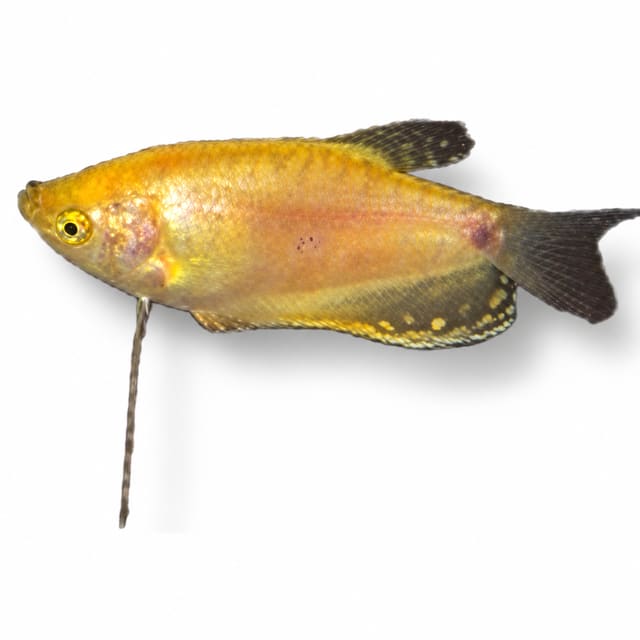
The Assorted Male Dwarf Gourami (Colisa lalia) is a freshwater fish in Osphronemidae, the gourami family, from Pakistan, India and Bangladesh. FishBase records a maximum length of 9.5 cm. It suits a keeper who can provide a planted aquarium at least 60 cm long, gentle flow, shade and carefully screened companions. Its deep, laterally compressed body and threadlike pelvic rays create the familiar gourami outline. Those elongated pelvic rays help gouramis sense their surroundings, while a specialised labyrinth organ allows them to breathe atmospheric air as well as using their gills.
The name Colisa lalia remains familiar in the aquarium trade. FishBase now lists it as Trichogaster lalius. FishBase describes the wild fish in slow-moving streams, rivulets and lakes with abundant vegetation. That association with calm, sheltered water helps explain why the aquarium should combine gentle flow, dense planting, shade and reliable access to the surface.
One purchase supplies one animal. Plan the aquarium around the adult measurements below.
Sex is guaranteed only when the exact product or selected option explicitly states male or female. This Assorted Male Dwarf Gourami listing is sold as male.
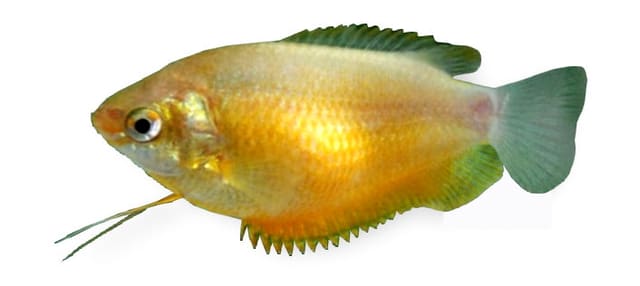
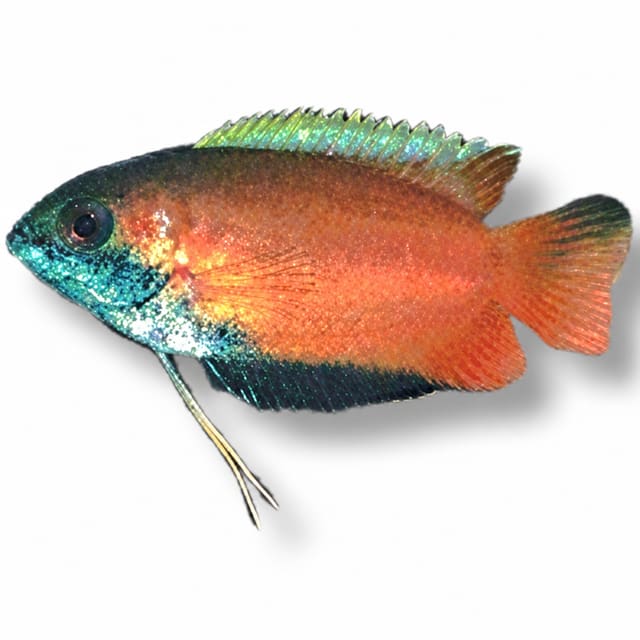
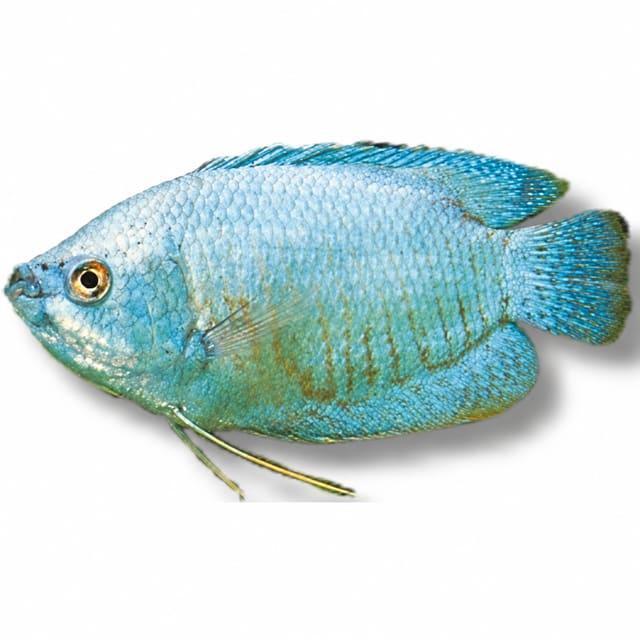
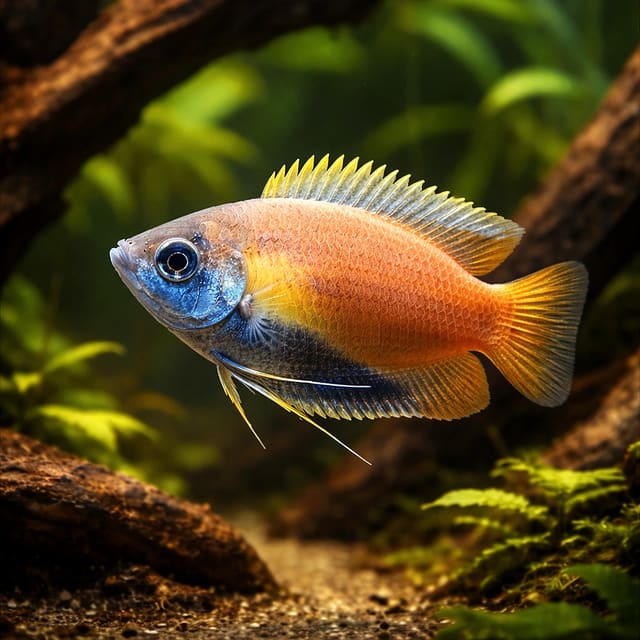
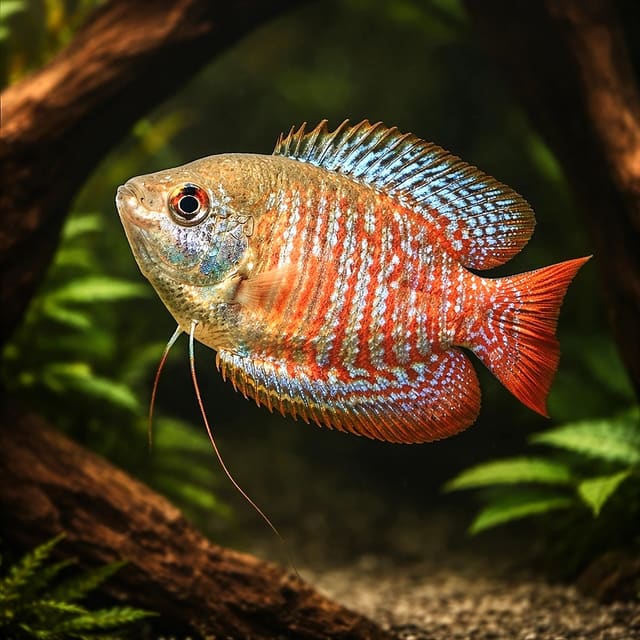
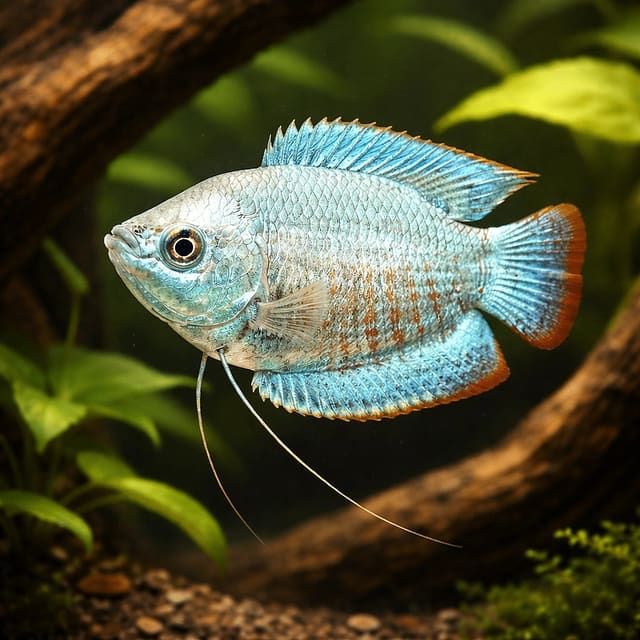
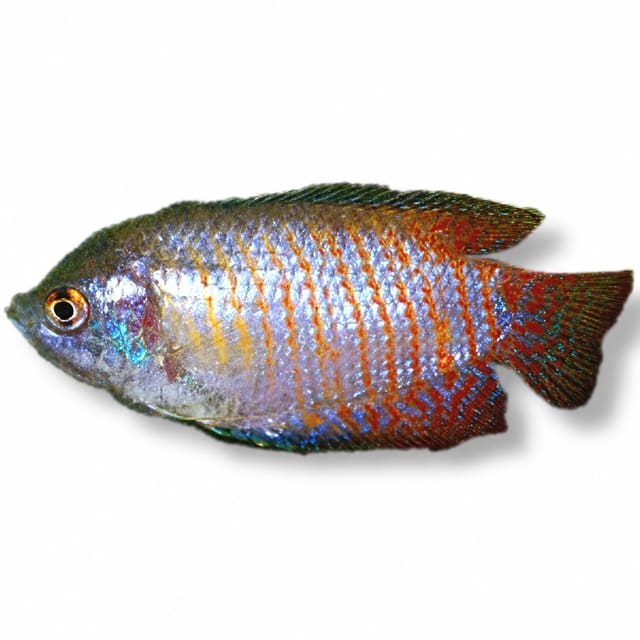
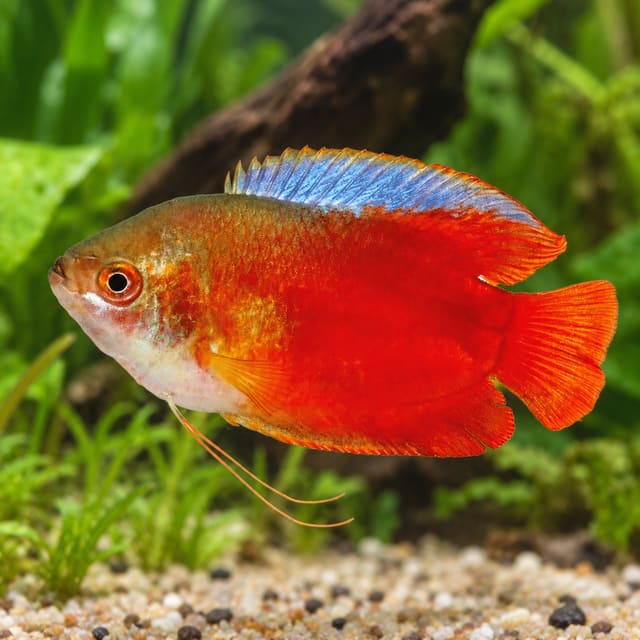
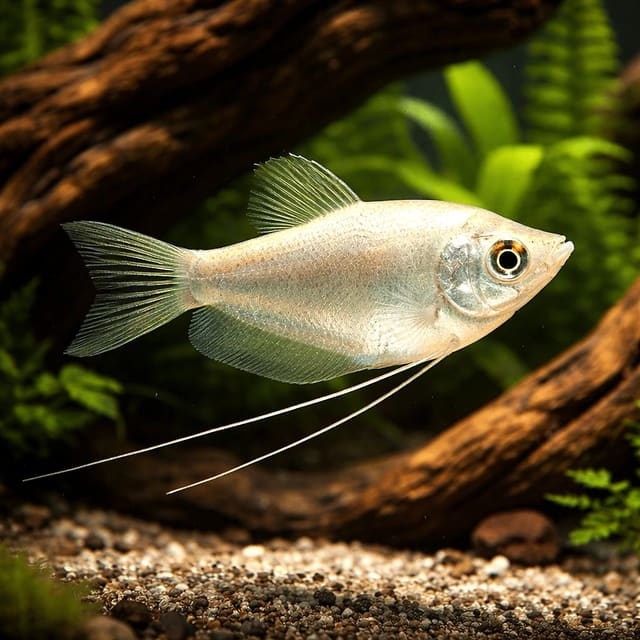
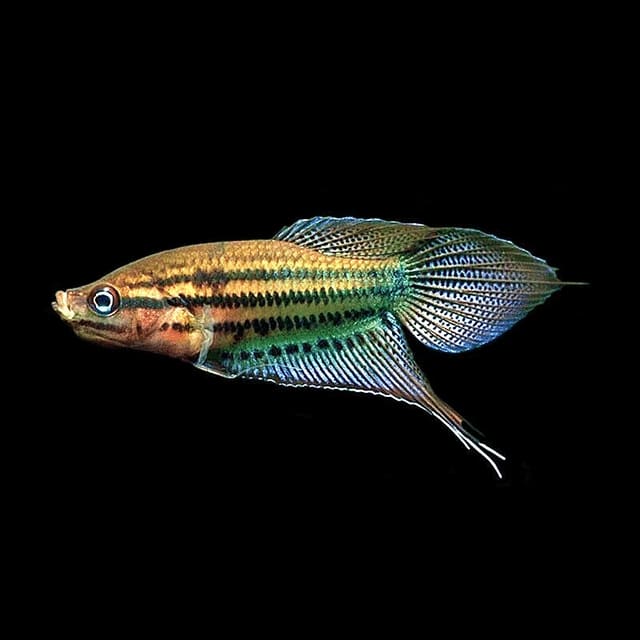
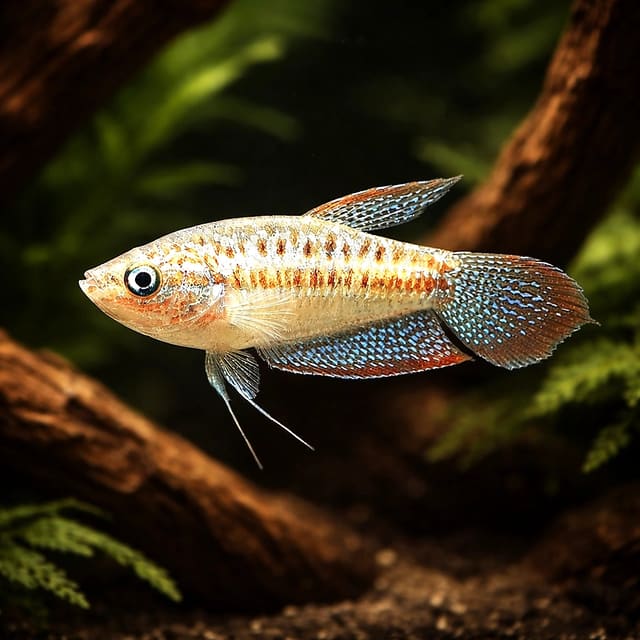
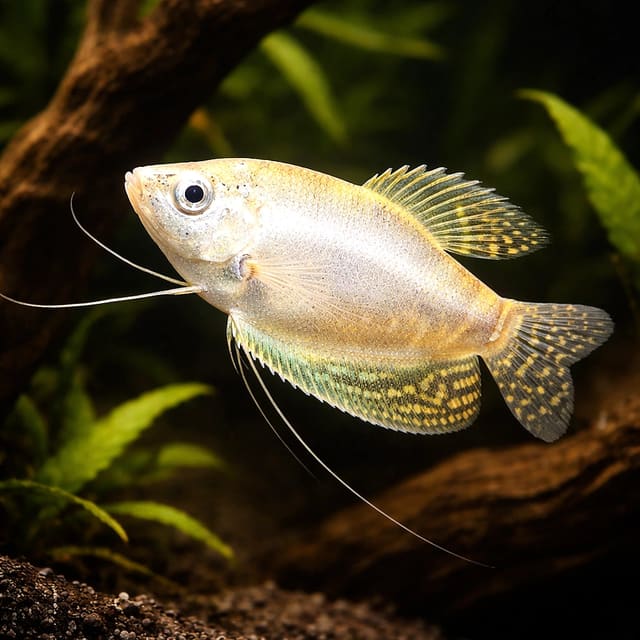
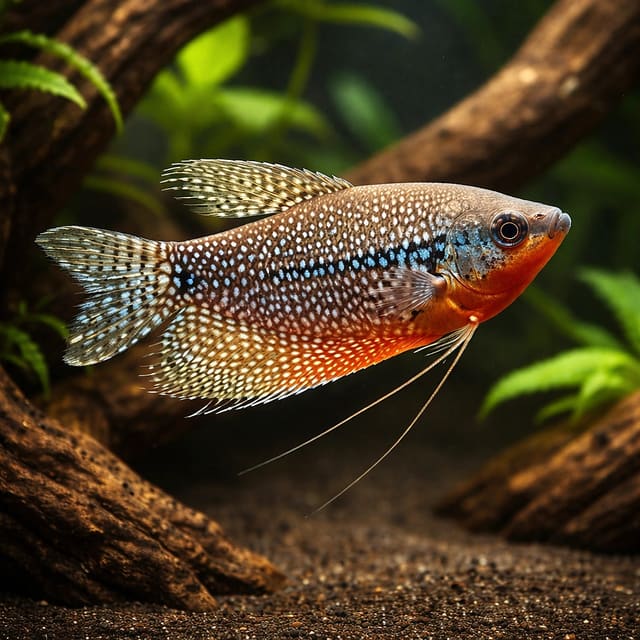
The gallery images are representative of this type of animal rather than photographs of the exact animal supplied, so colours can look slightly different from the live animal.
You can also browse our gouramis and labyrinth fish collection when comparing body size, behaviour and aquarium requirements.
Two published length measurements describe this fish. FishBase records a maximum of 9.5 cm total length. The Seriously Fish husbandry profile records 8.8 cm standard length. Use the 9.5 cm figure when checking clearances around wood, plants and equipment.
| Planning decision | Working figure |
|---|---|
| Adult length | Up to 9.5 cm total length |
| Aquarium footprint | 60 × 30 × 30 cm baseline |
| Baseline volume | 56 litres is just about big enough for a pair when correctly arranged |
| Routine temperature | 22–27°C |
| Routine pH | 6.0–7.5 |
| Routine hardness | 2–18 dGH |
| Flow | Low rather than fast or turbulent |
The 60 × 30 × 30 cm, 56-litre example is described as just about big enough for a pair when the aquarium is set up correctly. Treat it as a floor for planning rather than a generous target. More water and floor area give you greater freedom to create separate shaded refuges, maintain stable conditions and manage relationships with other fish.
Length alone does not decide whether the aquarium works. A bare 56-litre tank with exposed surroundings and forceful flow is a poorer match than an aquarium of the same dimensions with plants, floating cover, quiet water and several places to withdraw. When choosing between two aquariums, prefer the one that gives this male more usable sheltered space.
This male suits a keeper who can provide a planted, gently filtered aquarium and make deliberate tank-mate choices. Dwarf gouramis are both shy and territorial: a fish may withdraw when housed with larger or vigorous companions, yet become aggressive towards another conspicuous labyrinth fish. That combination makes behaviour more important than a simple label such as peaceful.
| Suits | Not suited to |
|---|---|
| Water maintained at 22–27°C, pH 6.0–7.5 and 2–18 dGH | Water that changes abruptly or falls outside the aquarium range |
| A planted aquarium at least 60 cm long with shade and sheltered areas | A sparsely decorated aquarium without hiding places |
| Gentle flow with effective biological filtration | Fast or turbulent circulation throughout the aquarium |
| Calm companions that do not intimidate or outcompete it | Persistent fin-nippers, vigorous tank mates or fish small enough to be eaten |
| A keeper prepared to monitor territorial interactions | Adding conspicuous territorial gouramis without additional space and refuges |
The species has a reserved recommendation for a community aquarium rather than being an automatic fit for every mixed tank. Make it the primary inhabitant in a modest setup: choose the layout, flow and companions around its needs instead of adding it as a decorative extra to an already busy community.
Start with the aquarium structure before choosing companions. Dense live planting creates shade and gives a reserved fish somewhere to withdraw. Floating vegetation adds overhead shelter, while a dark substrate can make the surroundings feel less exposed. Twigs, branches and leaf litter may be used to create a natural-looking layout, provided every item is suitable for aquarium use and leaves the fish a clear route to the surface.
| Area | What to provide |
|---|---|
| Surface | Accessible calm water with some floating vegetation |
| Upper cover | Tall plants and shaded spaces beneath floating growth |
| Middle | Planting and sheltered areas rather than one exposed open span |
| Lower structure | Rooted plants, suitable wood, branches or leaf litter |
| Retreats | More than one sheltered area so a fish is not trapped |
Keep circulation low around the places the gourami will use. This does not mean switching off filtration or accepting stagnant water. Position the outlet so it moves and filters the aquarium without creating a forceful jet across every refuge. If plants bend sharply throughout the tank or the fish continually works against the current, redirect or diffuse the outlet while preserving adequate filtration.
The labyrinth organ allows atmospheric air-breathing, but it does not reduce the need for clean water and a working biological filter. Keep the route to the surface unobstructed. Floating plants should provide cover rather than forming a continuous barrier across the entire surface.
Use the 60 cm length and 56-litre volume as the smallest worked example, not as permission to crowd the interior. After adding substrate, wood and equipment, check that the fish still has connected swimming routes between sheltered zones. In a larger aquarium, use the extra room to increase separation and cover rather than replacing all planting with exposed open water.
Use 22–27°C, pH 6.0–7.5 and 2–18 dGH as the routine aquarium range. Seriously Fish gives these values for dwarf gourami husbandry. FishBase records 25–28°C, pH 6.0–8.0 and 5–19 dH for the wild environment; the routine aquarium targets remain inside those broader recorded limits.
Aim for a stable point within each range rather than moving values towards both ends. For example, an aquarium holding steadily at 25°C and pH 7.0 is already within the stated range. There is no benefit in changing it repeatedly to chase a different number. Measure your source water and aquarium water before making stocking decisions, and use our water chemistry guide to understand what each test represents.
| Result | Action |
|---|---|
| 22–27°C | Hold the temperature steady within the range |
| pH 6.0–7.5 | Avoid abrupt correction when the reading is stable |
| 2–18 dGH | Match the fish and companions to the measured hardness |
| Ammonia above 0 mg/l | Pause livestock additions and address biological filtration |
| Nitrite above 0 mg/l | Pause additions and protect water quality immediately |
| Rising nitrate | Review water changes, feeding and stocking load |
OATA's gourami guidance gives group targets of zero ammonia, zero nitrite and nitrate no more than 20 mg per litre above the normal tap-water level. These waste readings describe whether the aquarium is processing the fish's waste safely; they do not replace the temperature, pH and hardness checks.
Compare your measured results with the target range using our water matcher. If source water sits near an edge of the range, favour stability and compatible livestock rather than repeated large chemical adjustments.
A mature biological filter is essential because fish release toxic ammonia. Beneficial bacteria convert ammonia to nitrite, which is also toxic, and then to the safer nitrate. The RSPCA aquarium welfare guidance explains why every fish aquarium needs a properly established and maintained filter.
Our first tropical aquarium guide sets out the preparation and maturation sequence. Do not use the calendar alone to decide that a tank is ready; use water tests to confirm the biological filter is functioning.
When the filter media needs cleaning, rinse it lightly in aquarium water removed during the water change. Do not run it under the tap because chlorine or chloramine may kill the beneficial bacterial population established in the media.
Use trends to catch problems early. A rising nitrate reading, accumulating food or reduced filter flow is a reason to review feeding, waste removal and stocking before water quality deteriorates. A larger aquarium can make conditions more stable, but volume never replaces testing and maintenance.
Dwarf gouramis are thought to be omnivorous in nature, taking small invertebrates, algae and other aufwuchs. In the aquarium, use a good-quality dried food as the staple and supplement it regularly with suitably small live or frozen foods. Appropriate examples include daphnia, small bloodworm or tubifex; an algae-based food can add further variety.
| Part of the diet | How to use it |
|---|---|
| Staple | Good-quality flake, granule, pellet or other suitable dried food |
| Variety | Small live or frozen items such as daphnia or bloodworm |
| Plant-based element | An algae-based food as part of a varied omnivorous diet |
| Frequency | Once a day |
| Portion | Only what is eaten within a few minutes |
Start with a deliberately small portion and watch the fish eat. If food remains after a few minutes, remove what you can and reduce the next portion. Uneaten food breaks down and adds waste, increasing pressure on the biological filter. The correct amount is therefore judged by consumption and water quality, not by filling a fixed scoop.
Account for competition in a community aquarium. This species can be reserved, while vigorous companions may rush to every meal. Spread a small ration where the gourami can reach it and observe whether it actually feeds. Do not solve competition by repeatedly adding food after the faster fish have already eaten; change the stocking or feeding placement instead.
Use body condition, appetite and weekly water-test trends together. A fish that stops showing interest in food, loses condition or is repeatedly displaced needs prompt investigation. Conversely, a rounded fish and rising nitrate are reasons to reduce excess food rather than adding more variety. Keep the diet varied within the stated food types, but preserve the once-daily, few-minutes portion rule.
Prepare the aquarium before the parcel arrives. Confirm that someone will be present to receive the fish, test the aquarium, and check that the heater and filter are operating normally. Do not begin rearranging wood, cleaning filter media or making large water adjustments while the fish is waiting in its transport bag.
These steps come from our delivery and Live Arrival Guarantee policy. Keep the video and order number if you need to make a Live Arrival Guarantee claim, and contact us the same day if anything has gone wrong.
A newly introduced gourami has to orientate itself around plants, flow, companions and feeding areas. Give it access to the shaded retreats prepared in advance. Look for controlled swimming, regular breathing and the ability to move away from other fish. Surface visits can form part of normal labyrinth-fish breathing; judge them alongside gill rate, posture, appetite and water-test results rather than reacting to one surface visit alone.
Do not add several more fish immediately. Every livestock addition increases waste and requires the established bacterial population to adjust. A slow stocking sequence makes it easier to identify both water-quality changes and behavioural conflicts.
Learn the fish's normal routine once it has settled: where it rests, how it approaches food, how often it uses cover and how it moves through the current. A change from that individual baseline can be more informative than one isolated pose. Daily observation should be brief but deliberate, with water testing used whenever behaviour changes.
| What you notice | What to do first |
|---|---|
| Faster or slower gill movement | Test temperature, ammonia and nitrite immediately |
| Erratic swimming | Check water quality, flow and tank-mate pressure |
| Persistent hiding | Review aggression, cover and feeding competition |
| Darker or paler colour | Compare behaviour and water readings with the normal baseline |
| Reduced appetite | Check water quality and observe whether companions block food |
| White spots or fluffy growths | Separate observation from guesswork and seek prompt guidance |
| Fin or scale loss | Check for nipping, sharp surroundings and wider health changes |
| Weight change | Review measured portions, appetite and access to food |
Healthy fish should show clear, bright eyes, intact scales and undamaged fins, without ulcers or bumps. These checkpoints do not replace knowing the individual: a shy fish may use cover, but a sudden increase in hiding combined with appetite or colour changes deserves attention.
When a health change appears, test the aquarium before altering several things at once. Record temperature, pH, ammonia, nitrite and recent maintenance or stocking changes. Correct an immediate water-quality problem through the established maintenance routine, preserve stable temperature and reduce obvious behavioural pressure. Contact us for health changes after collecting those readings and observations.
At the end of the first month, compare the fish's body condition, feeding response and use of space with its first settled week. Also review nitrate trends, filter flow and interactions. This checkpoint helps distinguish a layout or stocking problem from a brief arrival response.
Start with temperament and interaction rather than relying on a community-fish label. A male dwarf gourami can be shy around large or vigorous companions and territorial towards conspicuous rivals. The best candidate is calm, non-threatening, unable to swallow or injure the gourami, and comfortable within the same water range.
Seriously Fish identifies non-threatening shoals of small, peaceful cyprinids as possible companions, including harlequin rasboras, many other rasboras and some barbs. It also identifies Pangio loaches and Yasuhikotakia sidthimunki as choices to consider. These examples remain conditional: aquarium dimensions, water values, group requirements and the behaviour of every species still have to fit.
Individual reactions vary, so compatibility remains a monitored relationship rather than a permanent guarantee. Ask us for a stocking and compatibility assessment with the aquarium dimensions, measured water values, filter flow and complete livestock list.
Plan this purchase as one male. In a modest aquarium, make him the primary inhabitant and arrange other stocking around his need for shelter and calm water. A 60 × 30 × 30 cm, 56-litre aquarium is described as just about big enough for a pair only when correctly arranged; it should not be treated as permission to add several territorial gouramis.
Use dense planting, floating cover and several shaded routes. Choose a calm shoal or suitable bottom-oriented companions only after checking their own social needs and water requirements. Watch whether the male patrols a limited area while allowing other fish to feed and move normally. Occasional awareness is different from repeated chasing that prevents another fish from settling.
Increase space beyond the baseline and add separate refuges before introduction. Male harassment of females is one reason the layout must contain effective refuges, while male territoriality makes another male a particularly careful decision. Do not infer that a pair will be harmonious merely because the minimum example mentions a pair.
| Observation | Decision |
|---|---|
| Brief display, then both fish disengage | Continue close observation |
| Repeated chasing across the full tank | Increase separation and reassess the combination |
| One fish cannot reach food | Change the stocking or feeding access |
| Continuous hiding with colour or appetite change | Check water and remove behavioural pressure |
| Fin damage or nipping | Separate the incompatible fish |
For a larger community, scale the aquarium around every species rather than multiplying the 56-litre figure. More fish require more biological capacity and usable territory, not merely more litres on paper. Add livestock slowly, test after each increase and allow behaviour to settle before the next decision.
The Assorted Male Dwarf Gourami reaches a maximum recorded 9.5 cm total length. Plan the aquarium and clearances around plants, wood and equipment around that adult figure.
Use a planted aquarium at least 60 cm long with gentle flow, shade and several retreats. Seriously Fish describes a 60 × 30 × 30 cm aquarium of 56 litres as just about big enough for a pair when correctly arranged, so treat it as a planning floor.
Plan this fish as one male and make it the primary inhabitant in a modest aquarium. Adding another gourami requires more space, separate refuges and close monitoring of territorial behaviour.
The Assorted Male Dwarf Gourami suits a keeper who can maintain 22–27°C, pH 6.0–7.5 and 2–18 dGH, provide gentle flow and dense cover, and monitor territorial behaviour and health changes.
Feed a good-quality dried food as the staple, with regular small live or frozen foods such as daphnia or bloodworm and an algae-based food for variety. OATA's gourami guidance says to offer only what it eats within a few minutes once a day.
Keep it at 22–27°C, pH 6.0–7.5 and 2–18 dGH; Seriously Fish gives these routine aquarium values for dwarf gouramis. Maintain ammonia and nitrite at 0 mg per litre.
Some male dwarf gouramis can become very aggressive towards other anabantoids, including Bettas, or gaudy fish such as guppies. Avoid fin-nipping companions, timid fish and fish small enough to be eaten.
Seriously Fish identifies non-threatening shoals of small peaceful cyprinids, including harlequin rasboras, many rasboras and some barbs, plus Pangio loaches and Yasuhikotakia sidthimunki, as conditional choices. Every companion must share the water range and have adequate space and fair feeding access.
Film every Assorted Male Dwarf Gourami delivery continuously from the sealed parcel as it is opened, with the fish still inside the sealed bag before anything is disturbed. Someone must be present to receive it; float the bag for 20–30 minutes, then release the fish without pouring the bag water into the aquarium.
No reviews for this item yet. Bought one? Honest reviews only, good or bad.
What customers say about ordering from us
Easy website plenty of info on fish your buying great to pick a time slot
TRACEY DURRANT · 7 Oct 2026
Got some lovely fish thank you
Kevin Mackie · 7 Oct 2026
Reviews of our shop, collected by Judge.me, an independent third-party review collector. Newest first.