Moderate
Gold Gourami (Trichopodus trichopterus)
24–28°C · pH 6–8 · 81L
From £2.99Some sizes on sale
The Neon Dwarf Gourami (Colisa lalia neon dwarf) is a freshwater labyrinth fish from Pakistan, India and Bangladesh that reaches 9.5 cm. It suits a planted, low-flow aquarium at least 60 cm long; keep it at 22–27°C, pH 6.0–7.5 and 4–12 dGH, an overlap of Seriously Fish and OATA guidance. Sold individually in XL and 3–4 cm sizes.
Adult size is the maximum length this species reaches at full maturity (scientific sources). The livestock you receive will be younger and smaller — pick a size above for the actual shipping size. Product-photo provenance and any image-specific limitations are stated on the listing.
Colisa lalia neon dwarf
Save when buying multiple fish. Each quantity is one fish; sex and pair formation are not guaranteed unless the selected variant explicitly states them.
The Neon Dwarf Gourami (Colisa lalia neon dwarf) is a freshwater labyrinth fish from Pakistan, India and Bangladesh that reaches 9.5 cm. It suits a planted, low-flow aquarium at least 60 cm long; keep it at 22–27°C, pH 6.0–7.5 and 4–12 dGH, an overlap of Seriously Fish and OATA guidance. Sold individually in XL and 3–4 cm sizes.
Adult size is the maximum length this species reaches at full maturity (scientific sources). The livestock you receive will be younger and smaller — pick a size above for the actual shipping size. Product-photo provenance and any image-specific limitations are stated on the listing.
Maintain these water conditions for optimal health and vibrant colors
The Neon Dwarf Gourami (Colisa lalia neon dwarf) is a freshwater labyrinth fish in the family Osphronemidae from Pakistan, India and Bangladesh. It reaches a recorded maximum of 9.5 cm total length and suits a planted aquarium at least 60 cm long with gentle flow, shade and hiding places. Its shy and territorial behaviour calls for calm companions and enough cover for the fish to retreat.
FishBase now lists it as Trichogaster lalius and treats Colisa lalia as a synonym. The trade label identifies the Neon colour form of the Dwarf Gourami and remains useful when comparing the animal with the name on the live size selector.
In the wild, the species inhabits slow-moving streams, rivulets and lakes with plenty of vegetation. It is an air-breathing fish with a specialised labyrinth organ, although it still depends on clean, filtered aquarium water. Its long, threadlike pelvic-fin rays also help it sense its surroundings.
This is not simply a brightly coloured fish for any mixed community. Dwarf gouramis can be shy and territorial, especially where space, shade or retreat cover is limited. Plan for a calm aquarium in which it can move between planted cover and the surface without being chased or pushed aside by vigorous companions.
A well-arranged home uses dense planting, floating vegetation, shade and hiding places while keeping the current gentle. Those features reflect the sheltered, vegetated conditions associated with the species and reduce the exposure that can make a reserved fish withdraw. Browse the gouramis and labyrinth fish collection when comparing body size, behaviour and setup needs across related fish.
| Suits | Not suited to |
|---|---|
| Planted aquariums at least 60 cm long | Fast-moving or turbulent water |
| Shade, floating vegetation and hiding places | Sparse aquariums without sufficient refuges |
| Calm, non-threatening companions | Fin nippers or fish small enough to be eaten |
| Keepers prepared to monitor territorial behaviour | Communities dominated by larger or more vigorous fish |
One purchase supplies one animal of the size selected on the live selector. The selector uses the labels XL and 3–4 cm; check it when ordering rather than relying on a static statement about which choice can be selected.
The size you select is the size supplied, not the adult size. A 3–4 cm fish therefore still needs an aquarium planned for its mature proportions, behaviour and waste production. The XL label is a dispatch grade rather than a measured adult-length promise.
FishBase records a maximum of 9.5 cm total length for male or unsexed fish. Seriously Fish records a different figure of 8.8 cm standard length. Use the 9.5 cm total-length figure as the practical upper planning reference rather than adding the two values together or treating either one as a guaranteed final size.
Sex is guaranteed only when the selected option explicitly states male or female. This Neon Dwarf Gourami listing has no sex-guaranteed option.
Colour and fin shape can differ between individual fish, and neither a size label nor a gallery scene guarantees sex. Arrange the aquarium so any individual has shaded cover and a route away from attention, rather than relying on a presumed male or female temperament.
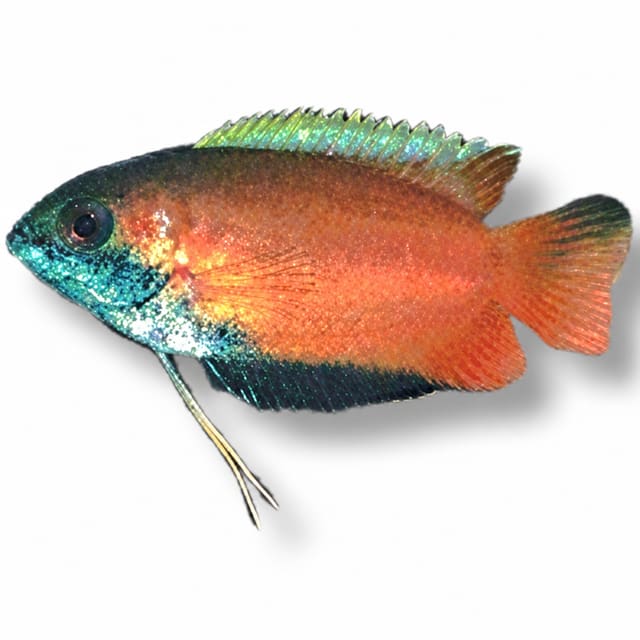
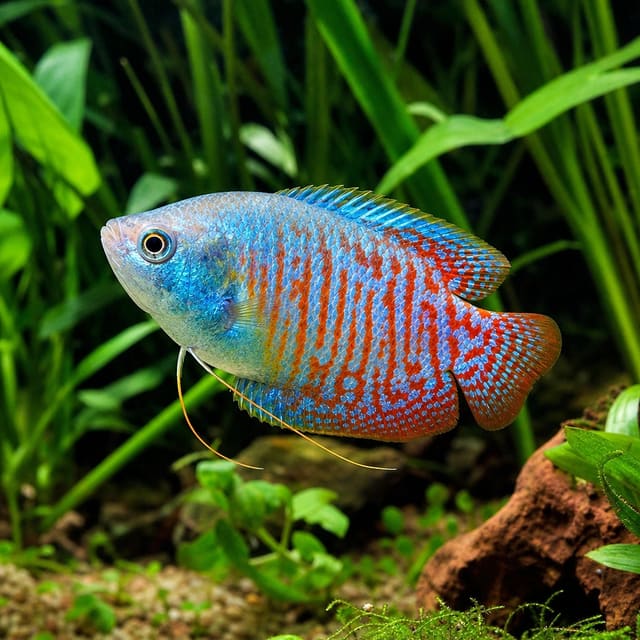
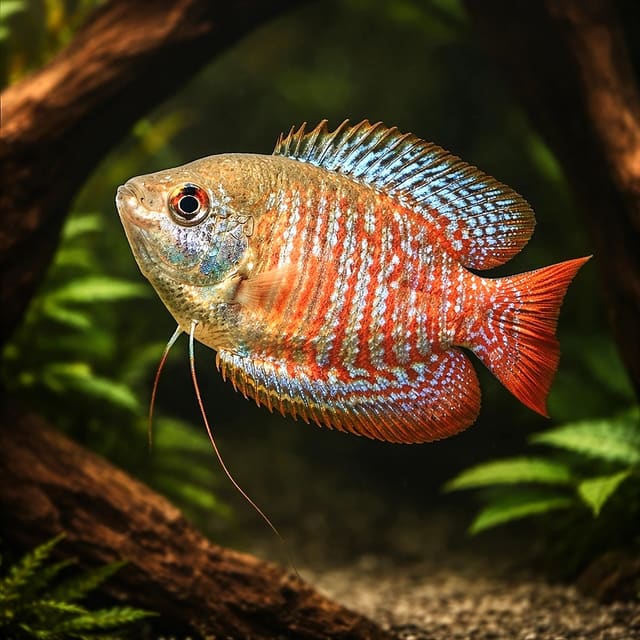
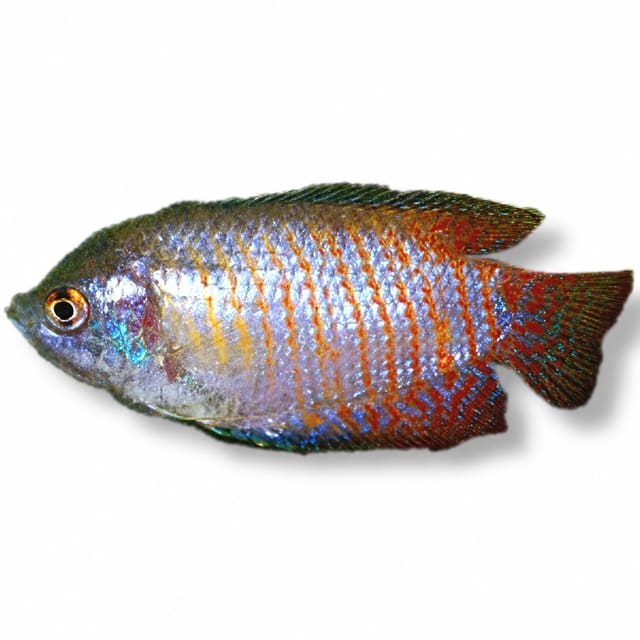
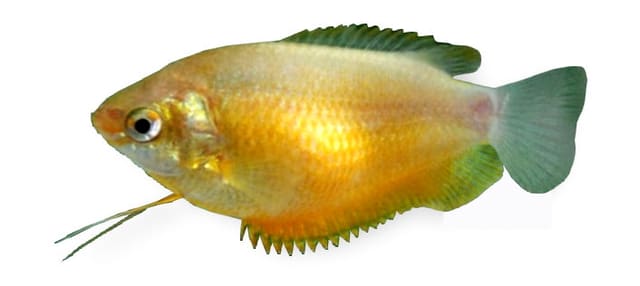
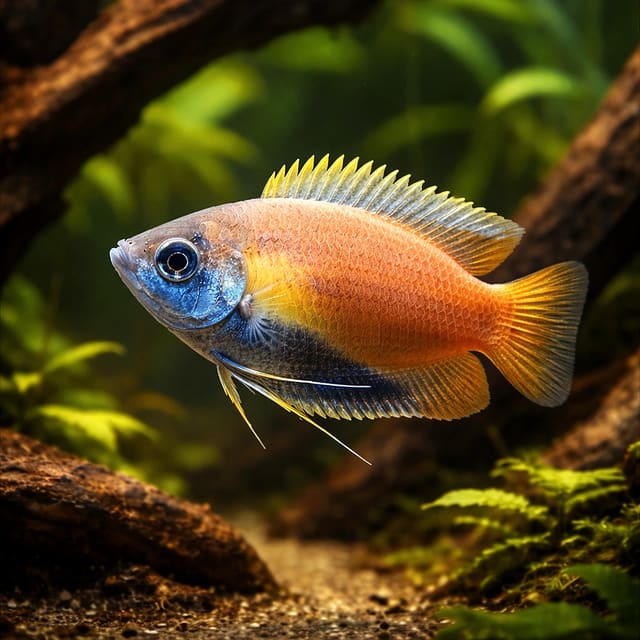
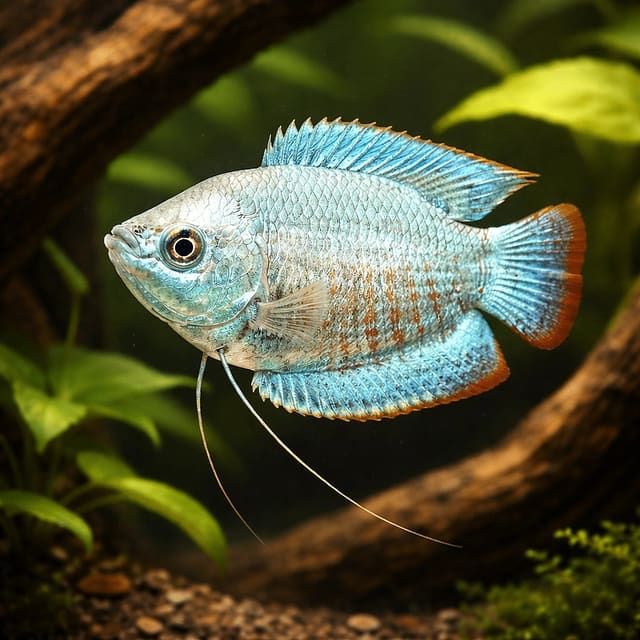
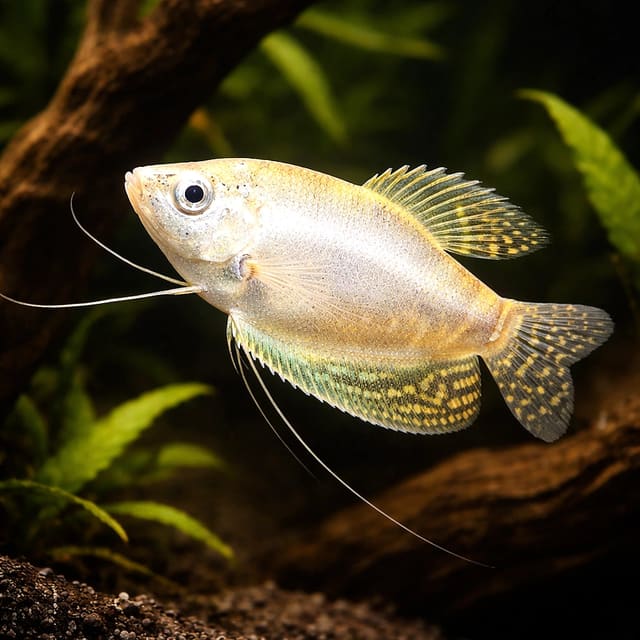
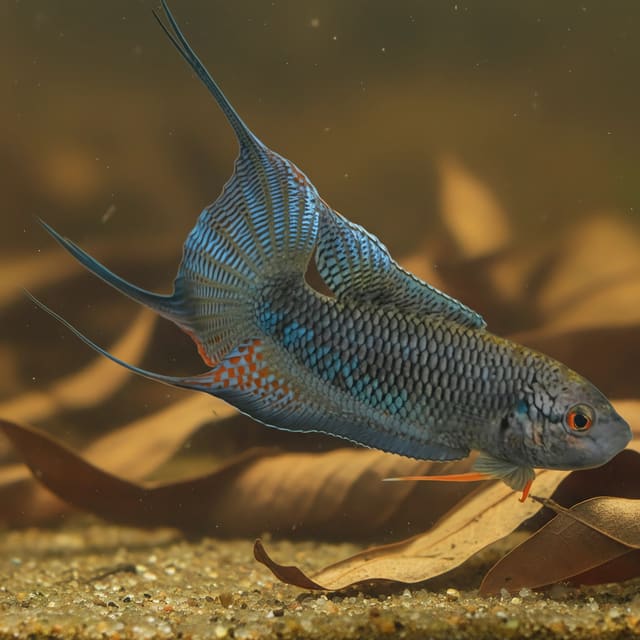
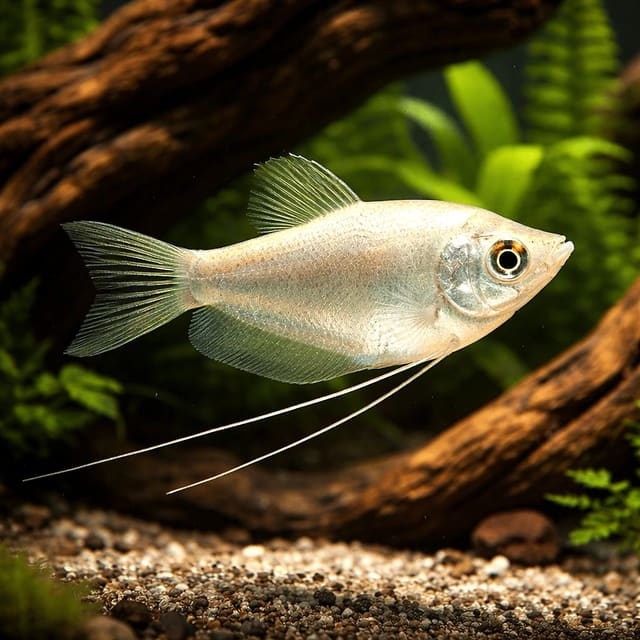
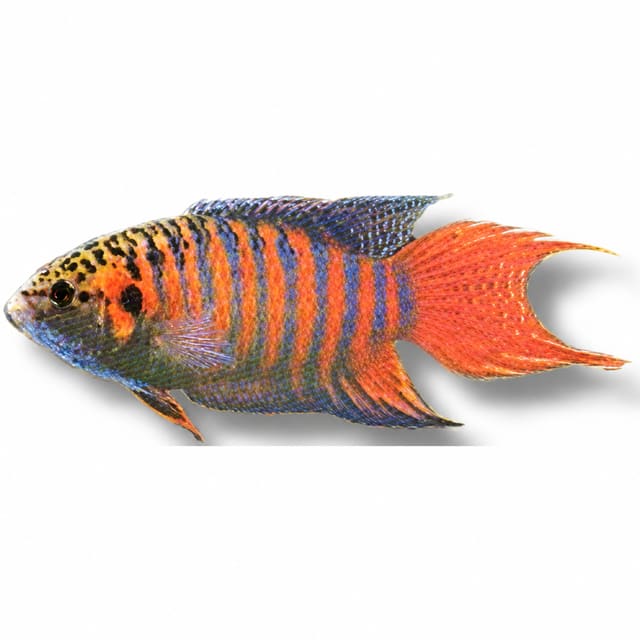
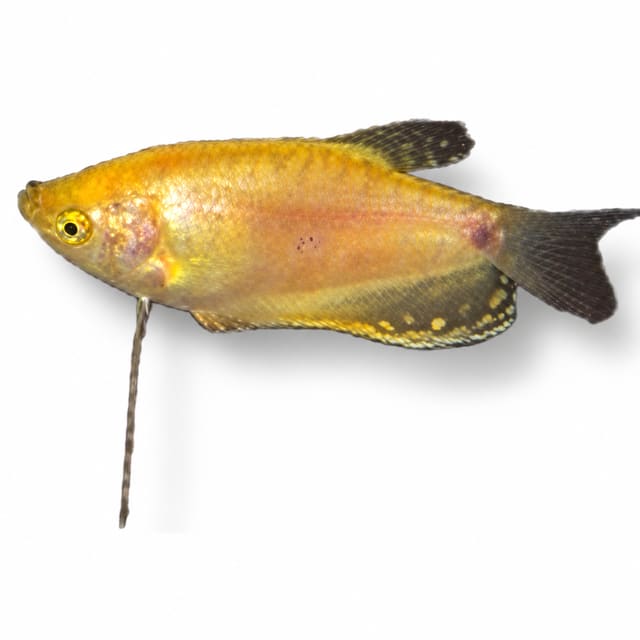
The gallery images are representative, based on reference photographs of this species, so colours can look slightly different from the live animal.
The scenes show representative body shape, banding and threadlike pelvic fins. They do not change the retail unit: two fish being visible in one gallery scene does not mean that two animals are included in one purchase.
Start with an aquarium that is at least 60 cm long. FishBase gives 60 cm as the minimum aquarium size, while the Seriously Fish species profile describes a 60 × 30 × 30 cm, 56-litre aquarium as just about large enough for a pair when set up correctly. Treat length, planting and usable retreat space as part of the minimum decision; litres alone do not describe whether a territorial fish can move out of another fish’s path.
For routine aquarium care, use 22–27°C and pH 6.0–7.5. Seriously Fish gives those species-level ranges and hardness of 2–18 dGH, while OATA’s broad gourami guidance recommends a narrower soft-to-medium range of 4–12 dGH. Use 4–12 dGH as the routine target so the hardness remains within both ranges.
| Decision | Working value |
|---|---|
| Aquarium length | At least 60 cm |
| Pair planning reference | 56 litres, 60 × 30 × 30 cm, set up correctly |
| Temperature | 22–27°C |
| pH | 6.0–7.5 |
| General hardness | 4–12 dGH |
| Ammonia and nitrite | 0 mg/l |
A larger aquarium gives more room for planting and separate retreats while helping temperature and water quality remain stable. Before choosing a companion or another gourami, compare the adult fish count, aquarium dimensions and amount of cover rather than working from volume alone.
These values are a practical screening set. Measure the aquarium rather than estimating from appearance, and use the live selector only for the dispatch-size decision.
Use a heavily planted layout with plenty of shade and hiding places. Floating vegetation, a dark substrate and sheltered areas can help this essentially shy fish remain settled. Twigs, branches and leaf litter may also be used to create a more natural-looking arrangement, provided the aquarium remains easy to maintain.
A sparse aquarium leaves a shy fish exposed and gives a territorial individual fewer ways to disengage. Dense cover is particularly important when keeping two dwarf gouramis because one fish may need refuge from persistent attention. Place retreats in separate parts of the aquarium rather than creating one dense clump that can be controlled by a single fish.
If this is your first setup, follow our guide to preparing and maturing a tropical aquarium before livestock arrives. Maturation allows the biological filter to establish the bacteria needed to process fish waste.
Do not trade planting for open emptiness simply because the fish is colourful. It is more likely to display normal movement when it can choose between visible and sheltered areas.
Set the heater and monitor the aquarium within 22–27°C, pH 6.0–7.5 and 4–12 dGH. Stability within the range matters more than repeatedly moving the water towards one exact midpoint. Test the actual aquarium and replacement water so changes are based on measurements rather than assumptions.
Use our aquarium water chemistry guide to understand temperature, pH, hardness and nitrogen waste, then enter measured values in the water matcher when comparing them with this range.
The RSPCA explains that a working biological filter houses beneficial bacteria that convert toxic ammonia into nitrite and then the safer nitrate. A labyrinth organ does not reduce the fish’s need for this process. Keep ammonia and nitrite at 0 mg/l, and do not add the fish to an aquarium before those values are stable.
| Test result | Action |
|---|---|
| Ammonia above 0 mg/l | Pause further stocking, check the filter and restore safe water quality. |
| Nitrite above 0 mg/l | Pause further stocking and protect the established biological filter. |
| Nitrate rising | Review water changes, feeding and fish load. |
| Temperature outside 22–27°C | Correct the cause gradually and recheck the thermometer. |
| Strong surface turbulence | Reposition the flow so filtration continues without churning the aquarium. |
OATA advises that nitrate should not exceed 20 mg/l above the normal tap-water level. Test the source water as well as the aquarium so the result has a useful baseline. A reading cannot be interpreted properly if the starting nitrate level is unknown.
Increase the aquarium population slowly. Every added fish and every increase in feeding creates more waste, so the established bacterial population needs time to respond. Adding too many fish too quickly can lead to new tank syndrome, with harmful ammonia or nitrite accumulating before the filter catches up.
At least once a week, carry out a partial water change of 25%. Use a siphon to remove solid waste from the gravel or sand, and treat replacement tap water with an aquarium conditioner before it enters the aquarium so chlorine or chloramine does not harm the fish or filter bacteria.
Do not rinse filter media under the tap. If cleaning is needed, rinse it lightly in aquarium water removed during the partial water change. This reduces the loss of beneficial bacteria compared with exposing the media to chlorinated tap water.
Gentle flow does not mean weak or neglected filtration. The filter must continue processing waste, but its return should not create the fast-moving or turbulent conditions that dwarf gouramis dislike. Check both functions separately: test water quality to assess biological performance and watch plant or fish movement to assess current strength.
| If you notice | Check first |
|---|---|
| Reduced filter output | Intake and media for blockage |
| Increasing waste on substrate | Siphoning coverage and feeding quantity |
| Ammonia or nitrite | Filter operation, recent stocking and feeding |
| Fish struggling against current | Direction and turbulence of the return |
Record weekly results in the same units each time. A consistent record makes gradual change easier to spot than isolated readings and shows whether the routine is keeping waste within the required limits.
Dwarf gouramis are thought to be omnivorous in nature, taking small invertebrates, algae and other aufwuchs. In the aquarium, use a good-quality dried food as the staple and supplement it regularly with suitably small live or frozen foods.
Feed only what the fish can finish within a few minutes, once a day. Watch the fish eat rather than adding a fixed amount without checking. Remove uneaten food because decomposing leftovers add waste to the water and can contribute to deteriorating water quality.
| Food role | Suitable choice |
|---|---|
| Staple | Good-quality flake, granule or pellet |
| Animal-food supplement | Small live or frozen daphnia, bloodworm or tubifex |
| Plant-based element | An algae-based food |
The fish’s mouth size and feeding response should determine the particle size. Choose pieces it can take promptly rather than allowing large items to remain untouched. Regular live or frozen foods can support health and colour, but they supplement rather than replace a balanced staple.
Do not turn variety into repeated meals throughout the day. The group feeding schedule is once daily, with an amount consumed within a few minutes. This gives a clear limit while still allowing the type of food to vary.
Prepare the aquarium in advance. OATA’s introduction guidance says to confirm that ammonia and nitrite are 0 mg/l before adding fish; also check that the filter is operating, the temperature is within 22–27°C and the planned refuge areas are ready.
Follow the delivery and Live Arrival Guarantee policy when the parcel arrives.
Slow stocking remains important after acclimatisation. The biological filter must adjust whenever fish numbers and feeding increase, so avoid adding a large population in one step. A successful float does not compensate for an immature filter or measurable ammonia or nitrite.
During the first days, note where the fish rests, whether it can reach the surface without being chased and whether it takes its daily food. At the weekly test, confirm ammonia and nitrite remain at 0 mg/l and compare nitrate with the tap-water baseline. Continue the normal 25% water change at least once a week rather than waiting for visible cloudiness.
If another fish repeatedly blocks access to food, cover or the surface, treat that as a compatibility problem. Adding more planted cover may provide another refuge, but persistent pursuit means the stocking plan itself needs reassessment.
Learn the individual fish’s normal swimming, colour, breathing, appetite and use of cover. A change from its own pattern is more useful than expecting every dwarf gourami to behave identically. Reserved behaviour can be normal, but increasing withdrawal alongside appetite, breathing or appearance changes calls for an immediate water-quality check.
| Change | First response |
|---|---|
| Hanging at the surface | Test water quality and compare breathing with normal behaviour. |
| Sitting on the bottom | Check ammonia, nitrite, temperature and signs of injury. |
| Erratic swimming | Test the water and observe whether another fish is pursuing it. |
| Darker or paler colour | Check water values, cover and recent social changes. |
| Faster or slower gill movement | Test the water immediately and observe the fish closely. |
| Reduced food intake | Remove leftovers and check water, competition and appearance. |
| White spots or fluffy growths | Check water quality and separate observation from guesswork. |
| Fin or scale loss | Look for fin nipping, pursuit or abrasive damage. |
Healthy fish should have clear, bright eyes, undamaged fins, intact scales and no ulcerations or bumps. Condition should remain steady rather than showing a marked increase or decrease in body weight. Record what changed and when, including recent additions, maintenance and test results.
Do not select a treatment from appearance alone. Start with measured water quality because even small amounts of ammonia or nitrite can stress gouramis. If you are concerned about a health change, contact us with the test results and a clear description of swimming, breathing, appetite and appearance.
Social stress may appear as hiding, colour change, damaged fins or missed meals. Check whether the affected fish can reach multiple refuges, food and the surface without crossing an aggressively defended area.
The labyrinth organ allows this fish to breathe atmospheric air, but it does not replace the gills, filtration or routine maintenance. Keep the surface accessible through the planting and continue testing ammonia and nitrite at least weekly.
The elongated ray on each pelvic fin acts like a sensory whisker. Arrange décor so the fish can move between plants, wood and open routes without becoming trapped in one refuge. A layout with several paths is more useful than a single cave surrounded by uninterrupted open water.
Do not interpret bright colour as proof that the fish is socially confident, or quiet behaviour as proof that it is suitable with every companion. Use repeated observations: who approaches whom, which routes are blocked and whether the same fish repeatedly misses food.
When evaluating space, consider the full adult planning length of up to 9.5 cm and the territory created by plants and décor. Two aquariums of the same volume can function differently if one has a longer footprint and several separated retreats while the other has one open, exposed area.
Normal air breathing and a preference for gentle water make surface design important. Retain floating cover while leaving gaps for access, and avoid turning the entire surface into a turbulent filter-return zone.
Dwarf gouramis receive a reserved community recommendation because they combine shy and territorial behaviour. Compatibility depends on the individual fish, aquarium dimensions, cover and the behaviour of every companion, so no named species is an automatic match in every setup.
Other anabantoids, including Bettas, and gaudy fish such as guppies can provoke aggressive responses from some male dwarf gouramis. Larger or more vigorous tank mates can create the opposite problem by intimidating or outcompeting a shy gourami. Treat these as behaviour screens rather than promises based only on species labels.
| Candidate behaviour | Decision |
|---|---|
| Small, peaceful and non-threatening | Consider if water values, adult size and feeding match. |
| Fast or forceful at every meal | Use caution because the gourami may be outcompeted. |
| Territorial near the surface | Use caution because key space may overlap. |
| Known fin nipper | Avoid. |
| Small enough to be swallowed | Avoid. |
Non-threatening shoals of small, peaceful cyprinids can be considered after screening. Seriously Fish gives Harlequin Rasboras, many other rasboras and some barbs as examples, together with bottom-oriented loaches such as Yasuhikotakia sidthimunki and Pangio species. Use those examples conditionally: confirm matching water values, suitable adult size and calm feeding behaviour for the exact fish being considered.
Before mixing species, send us the aquarium dimensions, measured water values, existing adult fish count and names of the proposed companions for a stocking assessment. Include a description of planting and surface flow because usable retreat space matters alongside litres.
A 60 × 30 × 30 cm, 56-litre aquarium is described as just about large enough for a pair when set up correctly. This is a conditional planning reference, not a rule that every two dwarf gouramis will coexist peacefully. Individual behaviour and sex can affect the result, while this offer does not guarantee sex.
Use heavy planting, shade and more than one hiding area. Place planted retreats in different parts of the aquarium so a fish has another sheltered area when moving away. Cover is particularly important where a female may need refuge from male harassment, but the same layout also helps any subordinate fish avoid persistent attention.
A single dwarf gourami can be treated as the primary inhabitant of a modest community aquarium. If keeping two, base the decision on the pair-sized 56-litre reference, at least 60 cm of aquarium length and a layout designed around separate refuges. More fish require more room; do not scale the stocking plan by simply dividing litres by the number of animals.
Brief territorial displays and persistent harassment are not the same. If one fish repeatedly chases the other, blocks food or controls the surface, add more planted cover immediately and prepare to revise the stocking combination. Damaged fins, sustained hiding, colour change or reduced appetite show that the social arrangement is affecting welfare.
Apply the same test to other gouramis and labyrinth fish. Shared family traits do not guarantee compatibility, and overlapping surface territories can increase pressure even when water values match.
The Neon Dwarf Gourami reaches a recorded maximum of 9.5 cm total length. Plan the aquarium around that adult figure rather than the dispatch size.
Use an aquarium at least 60 cm long with gentle flow, heavy planting, shade, floating vegetation and multiple hiding places. Seriously Fish describes a 60 × 30 × 30 cm, 56-litre aquarium as just about large enough for a pair when set up correctly.
A single fish can be the primary inhabitant of a modest community aquarium. A pair needs the conditional 60 × 30 × 30 cm, 56-litre setup, separate retreats and close observation for territorial pressure.
A beginner needs a mature, filtered aquarium at least 60 cm long, stable water at 22–27°C and the confidence to monitor shy and territorial behaviour. This fish should not be treated as an automatic match for every community.
Feed a good-quality flake, granule or pellet once daily, giving only what it finishes within a few minutes. Add regular small live or frozen foods such as daphnia or bloodworm and include an algae-based food.
Keep it at 22–27°C, pH 6.0–7.5 and 4–12 dGH, an overlap of the Seriously Fish species range and OATA’s broad gourami guidance. Keep ammonia and nitrite at 0 mg/l.
It can be shy and territorial, and some male dwarf gouramis may become very aggressive around other anabantoids or gaudy fish. Avoid fin-nipping companions and watch for pursuit, blocked feeding, damaged fins or sustained hiding.
Consider non-threatening shoals of small, peaceful cyprinids such as Harlequin Rasboras, many other rasboras and some barbs, or bottom-oriented Yasuhikotakia sidthimunki and Pangio loaches. Confirm matching water values, adult size and calm feeding behaviour; avoid fin nippers and fish small enough to be eaten.
Start filming the sealed parcel before it is opened. Someone must be present to receive it; film continuously as the parcel is opened with the fish still inside the sealed bag, float the bag for 20–30 minutes, then release the fish without pouring the bag water into the aquarium.
No reviews for this item yet. Bought one? Honest reviews only, good or bad.
What customers say about ordering from us
Easy website plenty of info on fish your buying great to pick a time slot
TRACEY DURRANT · 7 Oct 2026
Got some lovely fish thank you
Kevin Mackie · 7 Oct 2026
Reviews of our shop, collected by Judge.me, an independent third-party review collector. Newest first.