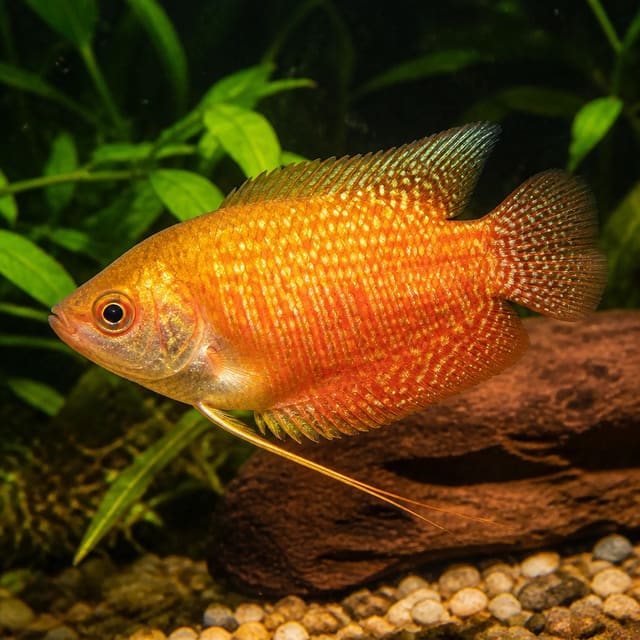
Moderate
Paradise Fish (Macropodus opercularis)
18–24°C · pH 6–8 · 80L
£3.99
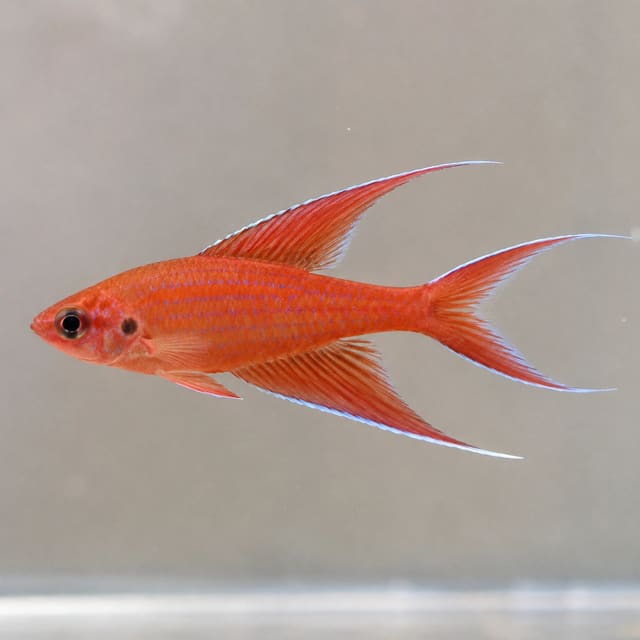
The Albino Paradise Fish is a farmed colour form of Macropodus opercularis with red eyes and a cream body crossed by pale pink-red bars. It is a hardy labyrinth fish for a cool indoor aquarium of about 80 cm and 100 litres at 16–22°C, best kept as one male, alone or with females. Sold individually as one live fish in the small size grade.
Macropodus opercularis
Save when buying multiple fish. Each quantity is one fish; sex and pair formation are not guaranteed unless the selected variant explicitly states them.
The Albino Paradise Fish is a farmed colour form of Macropodus opercularis with red eyes and a cream body crossed by pale pink-red bars. It is a hardy labyrinth fish for a cool indoor aquarium of about 80 cm and 100 litres at 16–22°C, best kept as one male, alone or with females. Sold individually as one live fish in the small size grade.
The Albino Paradise Fish is a farmed colour form of the paradise fish, Macropodus opercularis, one of the oldest and toughest aquarium fish there is. Because it lacks dark pigment, it has red eyes and a cream to pearly-white body crossed by soft pink-red bars, and the long dorsal, anal and tail fins carry the same pink-red wash. If you want a bold, characterful labyrinth fish that does not need a warm tropical aquarium, the Albino Paradise Fish is a striking choice.
Paradise fish are part of fishkeeping history. Seriously Fish records that a French soldier named Gerault brought the species to Europe in 1869; only 22 of the 100 fish survived the journey, and Pierre Carbonnier bred them later that year. FishBase calls it the first ornamental fish brought to Europe after the goldfish. Today, Seriously Fish notes, farmed xanthic, albino, red, blue and stripeless strains are far more common than wild fish.
| Need | What to plan |
|---|---|
| Aquarium | About 80 cm long and at least 100 litres, with a cover and an air gap |
| Temperature | 16–22°C; often no heater needed in a room that stays in that range |
| Company | One male per aquarium, alone, with females, or with calm, robust shoaling fish |
| Food | Small live and frozen foods plus a quality flake or granule |
| Where | Indoors only: in England and Wales paradise fish may not be kept in a garden pond |
The paradise fish, also written paradisefish, belongs to the family Osphronemidae with the gouramis and bettas. Like them it is a labyrinth fish: FishBase describes it as an obligate air-breather, which is why it regularly rises to take a gulp of air at the surface. Wild fish come from China south of the Yangtze, including Taiwan and Hainan, northern and central Vietnam and north-eastern Laos, where Seriously Fish records them in lowland streams, river backwaters, ponds, irrigation canals, rice paddies and reservoirs.
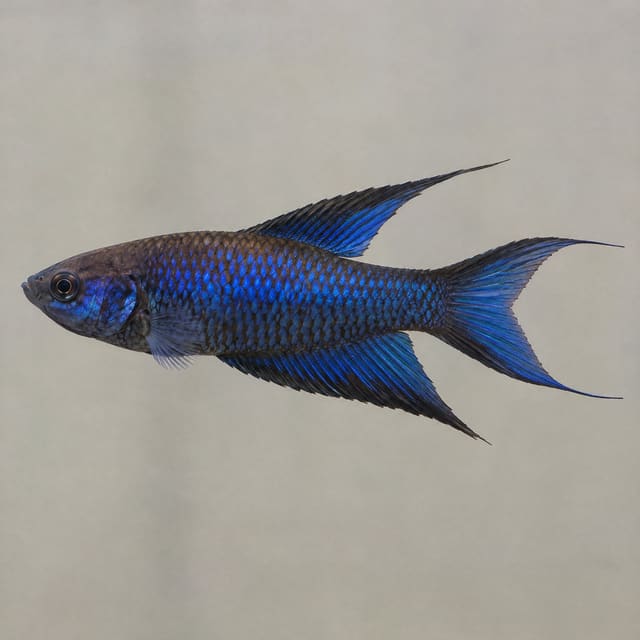
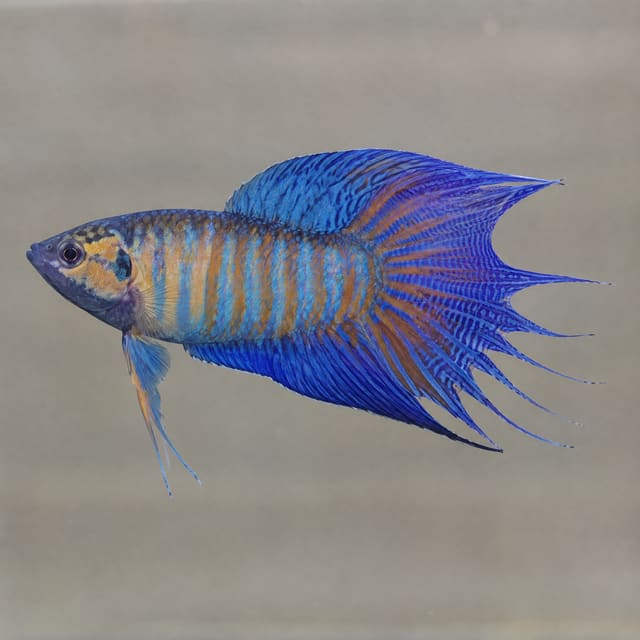
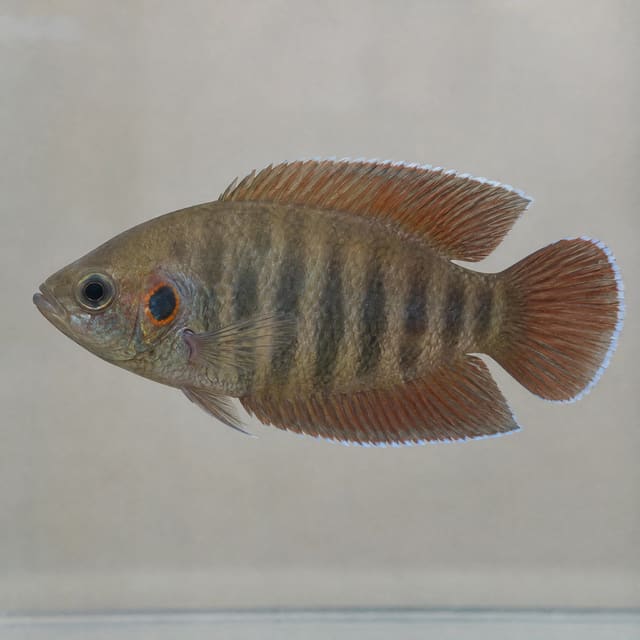
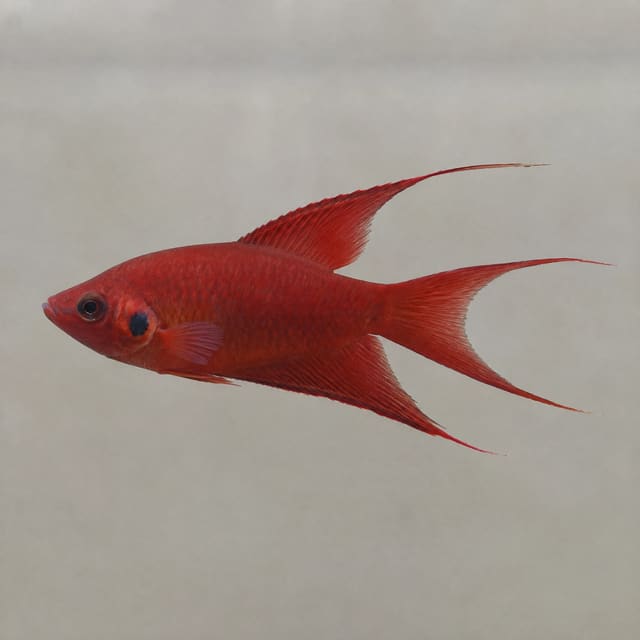
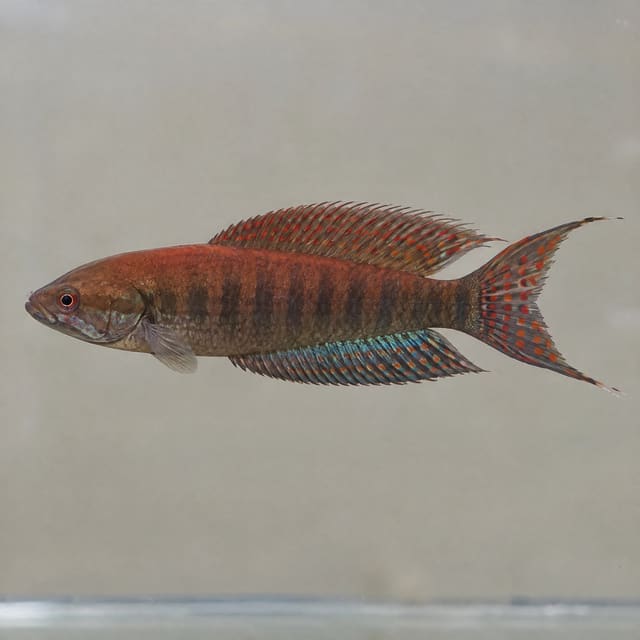
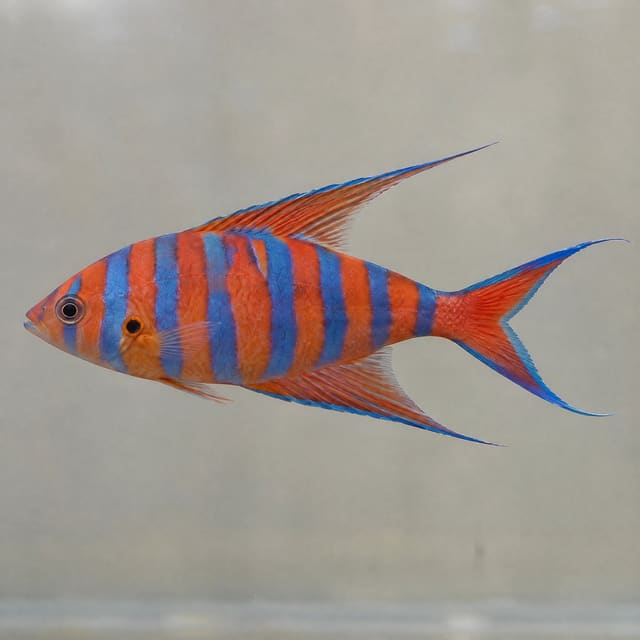
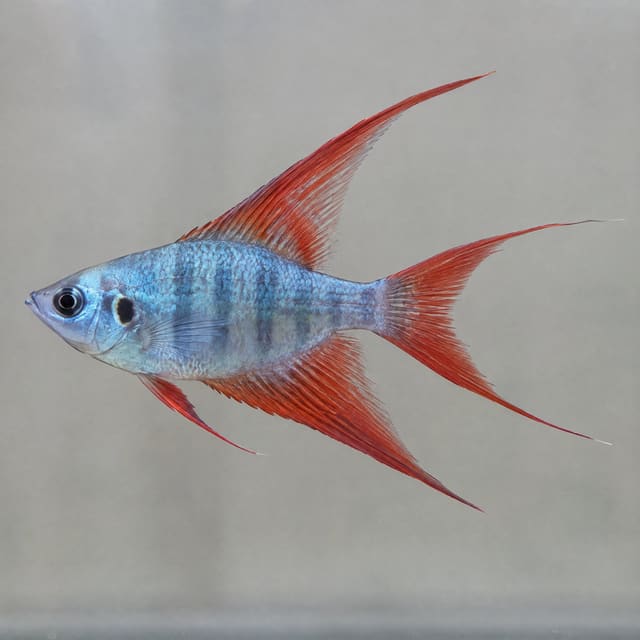
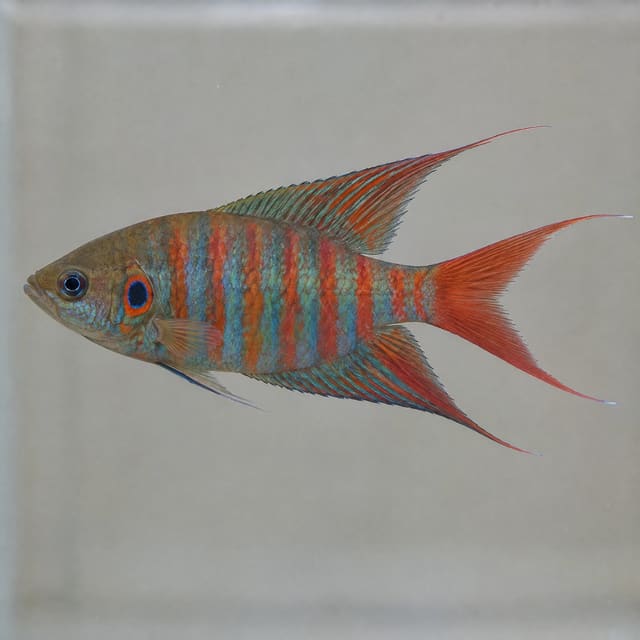
The classic form is banded in blue and red. In the albino, dark pigment is missing, so the eye looks red and the bars show as pale pink-red stripes on a cream background. Mature males grow larger than females and develop the long, trailing fin tips you see in our photographs; Seriously Fish describes these as extended soft rays in the dorsal, anal and tail fins.
| Fish | Difference from the Albino Paradise Fish |
|---|---|
| Paradise Fish | The same species in the classic barred colouring |
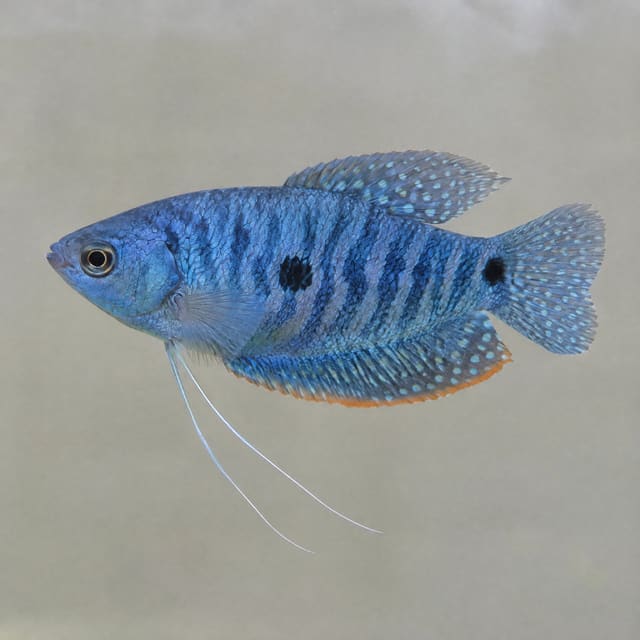
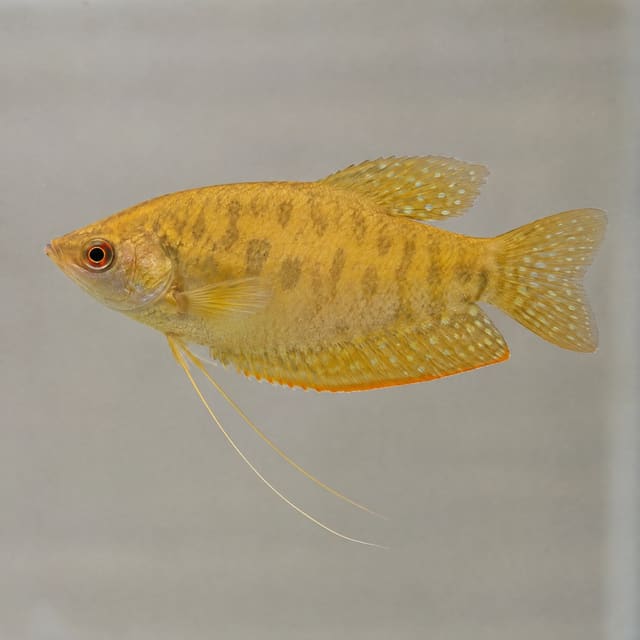
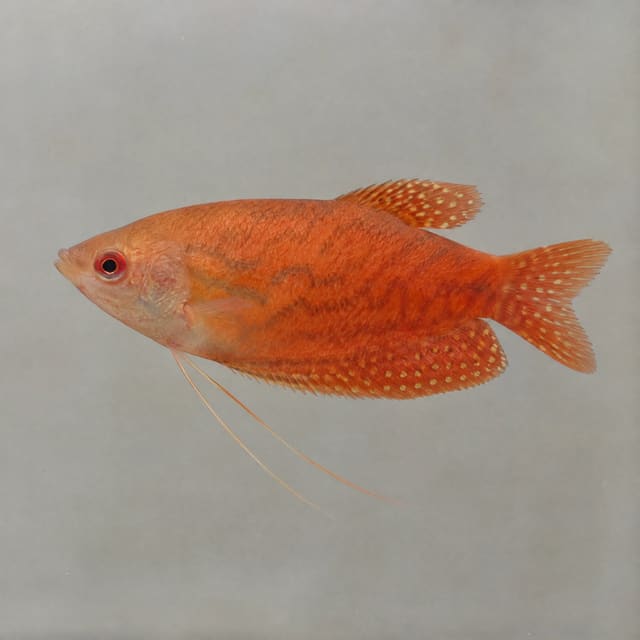
| Blue Paradise Fish and Red Velvet Paradise Fish | Other farmed colour forms of the same species |
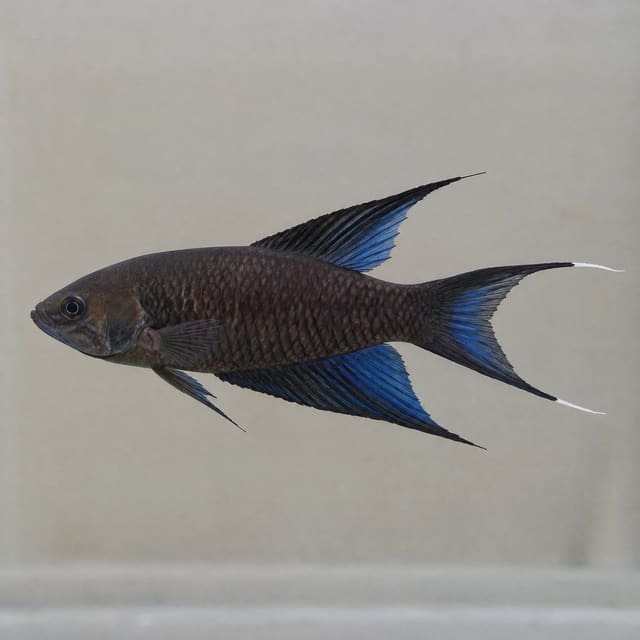
| Black Paradise Fish | A different species, Macropodus spechti |
| Round-Tailed Paradise Fish | A different species, Macropodus ocellatus, with a rounded tail |
Our paradise fish buying guide compares them in more detail, and you can see every species on our Macropodus paradise fish page.
One purchase supplies one live Albino Paradise Fish in the small size grade: a young fish that still has growing to do, with its full fin length and colour still developing. Sex is not chosen or guaranteed. As the fish matures, males become larger and more colourful with longer fins, while females stay smaller and rounder. The photographs show the colour form, not the individual you will receive, and the depth of pink and the length of the fins vary from fish to fish.
Sources give slightly different adult sizes. Seriously Fish gives up to 80 mm standard length (measured without the tail), FishBase gives 6.7 cm standard length, and OATA describes paradise fish as about 10 cm long overall. Plan for a fish of around 8–10 cm including its fins.
For the aquarium, Seriously Fish recommends a base of at least 80 × 30 cm, about 72 litres, for a single pair, and FishBase also gives a minimum length of 80 cm. OATA advises at least 100 litres for paradise fish and larger gouramis. An 80 cm aquarium of 100 litres or more meets all three.
Paradise fish like a well-planted aquarium. OATA suggests gravel or sand, live or artificial plants and shelter, avoiding sharp ornaments that could tear long fins. Floating plants are especially useful: Seriously Fish describes males building their bubble nests under surface vegetation.
The cover matters for two reasons. A lid stops a lively fish jumping out, and OATA stresses that labyrinth fish need a gap between the water surface and the cover glass so they can reach air. Seriously Fish adds that a tight-fitting cover helps the labyrinth organ develop properly in young fish.
| Area | Purpose |
|---|---|
| Floating plants at one end | Shade, cover and a site for a bubble nest |
| Taller plants along the back | Hiding places for females and companions |
| Open water at the front | Space to swim and display |
| Air gap under the lid | Warm, humid air for breathing |
The Albino Paradise Fish needs the same water as other paradise fish, but the sources give different temperature ranges. Seriously Fish gives 10–22°C and says the species can usually be kept in an unheated aquarium and benefits from a cooler period in winter. FishBase gives 16–26°C. OATA's sheet covers gouramis in general and gives 20–28°C with a heater, which suits the tropical gouramis rather than this cool-water species. The range that satisfies Seriously Fish and FishBase together is 16–22°C.
| Reading | Target |
|---|---|
| Temperature | 16–22°C (Seriously Fish and FishBase overlap) |
| pH | 6.0–8.0 (all three sources agree) |
| General hardness | 5–12 dGH (Seriously Fish 5–20, FishBase 5–19, OATA 4–12) |
| Ammonia and nitrite | 0 mg/l (OATA) |
| Nitrate | No more than 20 mg/l above your tap water (OATA) |
Water hardness varies across the UK, so check your water company's report for your postcode and use our water matcher to compare your readings with this range. Treat every water change with a tap water conditioner. If your room stays between 16°C and 22°C all year, the aquarium may not need a heater; if it gets colder in winter or warmer in summer, use a heater or move the tank. Our tropical fish temperature guide and water chemistry guide explain the readings.
Paradise fish cope with cool water, so people sometimes ask about ponds. In England and Wales the answer is no. OATA explains that only six kinds of fish, including goldfish, koi and orfe, may be kept in garden ponds, and that every other freshwater fish, temperate species included, must be kept only in an indoor aquarium. The government's non-native fish guidance links to a checklist that lists Macropodus for indoor aquaria only. Seriously Fish records paradise fish established outside their native range in several countries, mostly through the ornamental trade, which is exactly what these rules aim to prevent. Never release any aquarium fish.
OATA says a filter is always essential and recommends a gentle current for long-finned fish. Wild paradise fish live mostly in ponds, backwaters, canals and rice paddies, so avoid strong outflows that push them around or break up a bubble nest.
In the wild, Seriously Fish says, paradise fish eat insect larvae and similar prey, and FishBase adds small aquatic animals, including small fish. In the aquarium, Seriously Fish recommends small live or frozen foods such as daphnia, brine shrimp (artemia), white worm and grindal worm, noting that farmed strains readily accept good dried foods. OATA advises feeding once a day, only what the fish eats within a few minutes.
| Part of the meal | Example |
|---|---|
| Staple | A pinch of quality flake or small granules |
| Frozen extra, in place of the staple on some days | Frozen daphnia or frozen artemia, thawed first |
| Amount | What it clears in a few minutes; remove any leftovers |
Add the fish to an aquarium that has been running and cycled for several weeks. Follow OATA's floating-bag method: switch the aquarium lights off, float the sealed bag for about 10 minutes to match the temperature, then add small amounts of aquarium water to the bag over up to 20 minutes before netting the fish into the aquarium with as little bag water as possible. Our guide on how to acclimatise new fish gives more detail.
| When | Check |
|---|---|
| Day 1 | Lights low and no food; let it explore the plants |
| Day 2 | Offer a small meal and remove what is left |
| Days 1–7 | Watch for clamped fins, rubbing or hiding, and test ammonia and nitrite |
| End of week 1 | Routine 25% water change; note how it behaves with any companions |
Paradise fish are bold and territorial. Seriously Fish describes males as territorially aggressive, more so when breeding, and FishBase notes that males fight each other. OATA describes paradise fish as semi-aggressive and usually best kept alone. Seriously Fish recommends peaceful schooling companions that share the same water needs and advises avoiding fish of a similar shape, which males treat as rivals. OATA adds: choose robust tank mates, and avoid timid fish, small fish that could be eaten and fin-nippers.
| Suits | Avoid |
|---|---|
| Adult White Cloud Mountain Minnows, which share cool water | A second male paradise fish |
| Peppered Corydoras on the bottom | Gouramis, bettas and other similarly shaped fish |
| Other calm, robust shoaling fish that like 16–22°C | Fin-nippers, timid fish, very small fish, fry and shrimps |
Read our White Cloud Mountain Minnow guide for that species' needs, and check any mix in our tank mates tool before you buy.
OATA describes a healthy fish as having clear, bright eyes, undamaged fins, intact scales, steady breathing and normal swimming. Warning signs include clamped fins, flicking against objects, shimmying, and changes in colour, appetite or behaviour.
| You see | What to do |
|---|---|
| Trips to the surface for air | Normal for a labyrinth fish; keep the air gap clear |
| Torn fins on a companion | Watch for chasing; separate fish if it continues |
| Clamped fins or rubbing | Test the water and check the temperature first |
| A raft of bubbles under the plants | A male building a nest; leave it undisturbed |
Paradise fish are bubble-nesters. Seriously Fish says soft water and a slightly raised temperature can trigger spawning. The male builds a nest under floating plants and displays to the female with spread fins; she turns paler when ready, and the pair spawn beneath the nest in an embrace. According to FishBase, the male collects the eggs in his mouth, places them in the nest and guards them, and a female can produce up to 500 eggs; Seriously Fish describes several hundred floating eggs.
The sources disagree on timing. Seriously Fish says the eggs hatch in three to four days, while OATA's general gourami sheet says about one day for gouramis. The fry stay in the nest until they have used their yolk. Seriously Fish advises removing the adults once the fry swim freely and feeding them infusoria for the first few days, then microworm, such as our live microworms, and newly hatched brine shrimp, with small, regular water changes. OATA notes that breeding rarely succeeds in a community aquarium, so use a dedicated set-up.
Browse our full range of gouramis and labyrinth fish and other labyrinth fish. Before you order, read our delivery and Live Arrival Guarantee information.
It is a farmed colour form of the paradise fish, Macropodus opercularis, a labyrinth fish from China, Taiwan, Vietnam and Laos. The albino form lacks dark pigment, so it has red eyes and a cream body crossed by pale pink-red bars. Seriously Fish lists albino among the farmed strains of the species, alongside xanthic, red, blue and stripeless forms.
Often not. Seriously Fish says the species can usually be kept in an unheated aquarium and benefits from a cool spell in winter. Keep it within 16–22°C, the range Seriously Fish and FishBase share, and add a heater if the room falls below that.
Not in England and Wales. OATA explains that only six kinds of fish, such as goldfish and koi, may be kept in garden ponds there, and the government checklist lists Macropodus for indoor aquaria only. Keep your paradise fish in an indoor aquarium all year.
Seriously Fish gives up to 8 cm standard length and FishBase 6.7 cm; OATA describes paradise fish as about 10 cm long, tail included. Males grow larger than females and have longer fins.
Not in a normal aquarium. Seriously Fish advises against keeping males together unless the tank is very large, and suggests two or more females for each male. OATA says paradise fish are usually best kept alone.
Calm, robust shoaling fish that like the same cool water and are too big to be eaten, such as adult White Cloud Mountain Minnows or Peppered Corydoras. Avoid other gouramis and bettas, fin-nippers, timid fish, very small fish and shrimps.
Small live and frozen foods such as daphnia, brine shrimp, white worm and grindal worm, plus a quality flake or granule. Feed once a day, only what it eats within a few minutes.
One live Albino Paradise Fish in the small size grade, a young fish that has not reached adult size. Sex is not chosen, and colour and fin length vary from fish to fish.
No reviews for this item yet. Bought one? Honest reviews only, good or bad.
What customers say about ordering from us
Easy website plenty of info on fish your buying great to pick a time slot
TRACEY DURRANT · 7 Oct 2026
Got some lovely fish thank you
Kevin Mackie · 7 Oct 2026
Reviews of our shop, collected by Judge.me, an independent third-party review collector. Newest first.
Moved by UK carriers licensed to handle live animals
Hand-packed with oxygen bags, poly box, heat pack
Email photos the same day; an optional unboxing video helps us review problems faster — claim terms apply
Klarna & PayPal Pay in 3 at checkout