Moderate
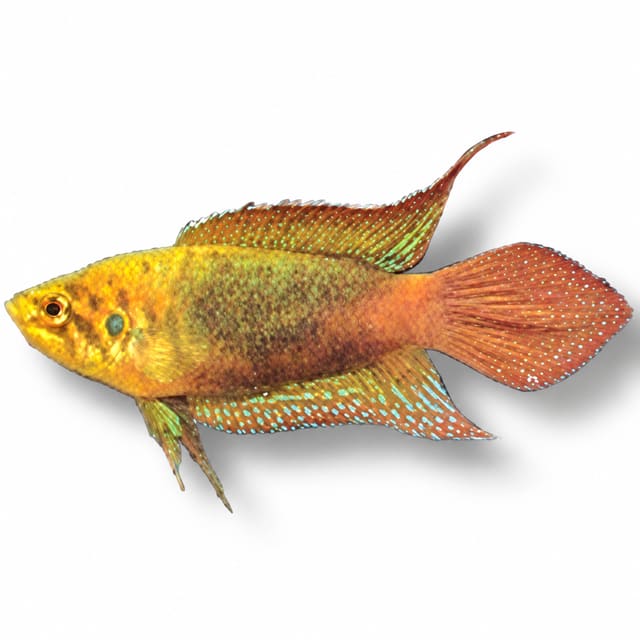
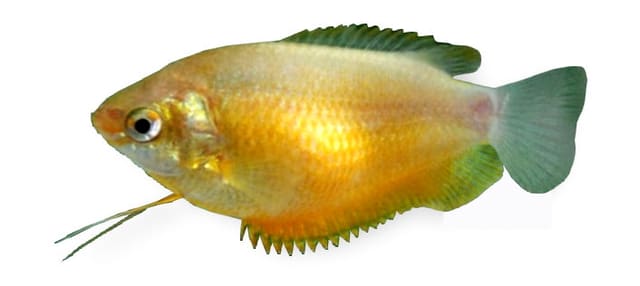
Gold Gourami (Trichopodus trichopterus)
24–28°C · pH 6–8 · 81L
From £2.99Some sizes on sale
Macropodus spechti royal blue is a blue-coloured trade form of Macropodus spechti, an air-breathing labyrinth fish from Vietnam recorded at up to 8 cm standard length. It suits a mature aquarium with a base of at least 80 × 30 cm for a pair, water at 20–26 °C and small live or frozen foods. Each purchase is one fish in the size you choose.
Adult size is the maximum length this species reaches at full maturity (scientific sources). The livestock you receive will be younger and smaller — pick a size above for the actual shipping size. Product-photo provenance and any image-specific limitations are stated on the listing.
Macropodus spechti
Save when buying multiple fish. Each quantity is one fish; sex and pair formation are not guaranteed unless the selected variant explicitly states them.
Macropodus spechti royal blue is a blue-coloured trade form of Macropodus spechti, an air-breathing labyrinth fish from Vietnam recorded at up to 8 cm standard length. It suits a mature aquarium with a base of at least 80 × 30 cm for a pair, water at 20–26 °C and small live or frozen foods. Each purchase is one fish in the size you choose.
Adult size is the maximum length this species reaches at full maturity (scientific sources). The livestock you receive will be younger and smaller — pick a size above for the actual shipping size. Product-photo provenance and any image-specific limitations are stated on the listing.
Maintain these water conditions for optimal health and vibrant colors
Macropodus spechti royal blue is a blue-coloured trade form of Macropodus spechti, a compact labyrinth fish from Vietnam in the gourami family Osphronemidae. It belongs to the genus Macropodus, which also contains the familiar paradise fish, and like its relatives it is an obligate air-breather: it must be able to reach the surface to take air through its labyrinth organ. Each purchase supplies one live fish in the size you choose. The key condition before ordering is a fully matured, well-filtered aquarium with shady cover, open surface access and a steady supply of small live or frozen foods.
The fish is offered at three dispatch sizes: 3–4 cm, 4–5 cm and 6–8 cm. The size you select is the size supplied, not the adult size. The Seriously Fish species profile records adults at up to 8 cm standard length, while FishBase gives a maximum of 5.8 cm standard length, so plan tank space around the larger figure. Standard length is measured from the snout to the base of the tail, so the flowing fins of a mature male add noticeably to what you see in the tank.
| Suits | Keepers with a mature aquarium of at least 80 × 30 cm base for a pair, who can offer small live or frozen foods |
|---|---|
| Sold as | One live fish per purchase |
| Size choices | 3–4 cm, 4–5 cm or 6–8 cm at dispatch |
| Adult size | Up to 8 cm standard length (5.8 cm in FishBase) |
| Temperature | 20–26 °C |
| pH and hardness | pH 6.5–7.8 and 5–20 dGH |
| Social needs | A pair or a group; relatively peaceful except when breeding |
| Diet | Small live or frozen foods such as Daphnia and Artemia, plus quality dried food if accepted |
| Origin | Vietnam: hill streams, river margins and backwaters, small streams and farmland irrigation channels |
All three sizes are the same species and need exactly the same aquarium, water and food. The 3–4 cm and 4–5 cm fish still have growing to do, while the 6–8 cm size is close to the recorded adult size and shows more of the grown body shape from the day it arrives. Smaller fish suit a keeper who enjoys watching them develop; the larger size suits someone who wants a more finished look straight away.
This is a fish for keepers who enjoy watching behaviour. Seriously Fish describes the species as relatively peaceful unless breeding and notes that a pair or group shows interesting interactions, including the male’s fin display when he is ready to spawn. It fits a quiet aquarium furnished with driftwood, surface plants and leaf litter, and it rewards keepers who are happy to buy or culture small live foods. The IUCN lists the species as Data Deficient, meaning there is not yet enough information to assess its conservation status in the wild.
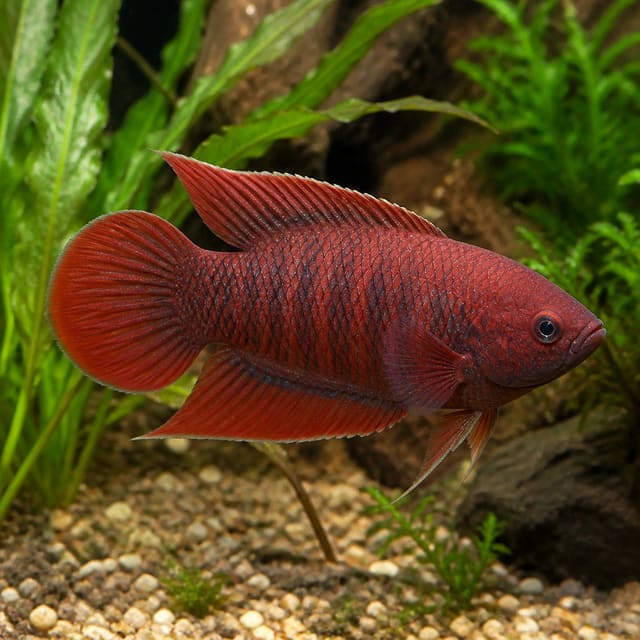
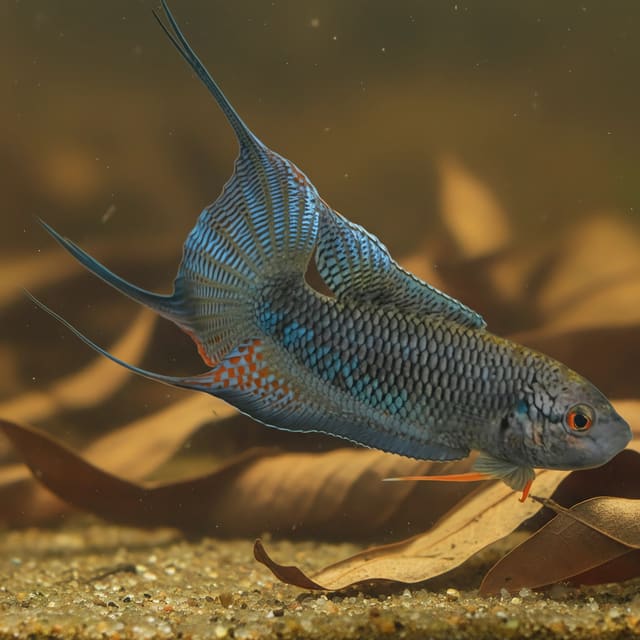
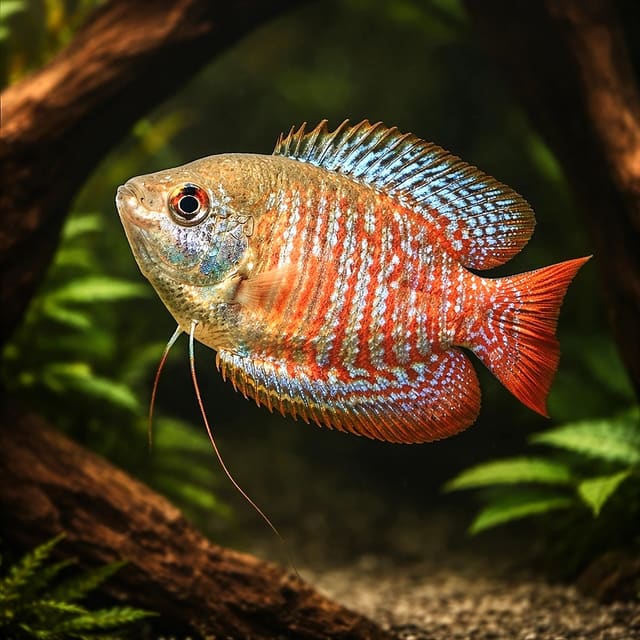
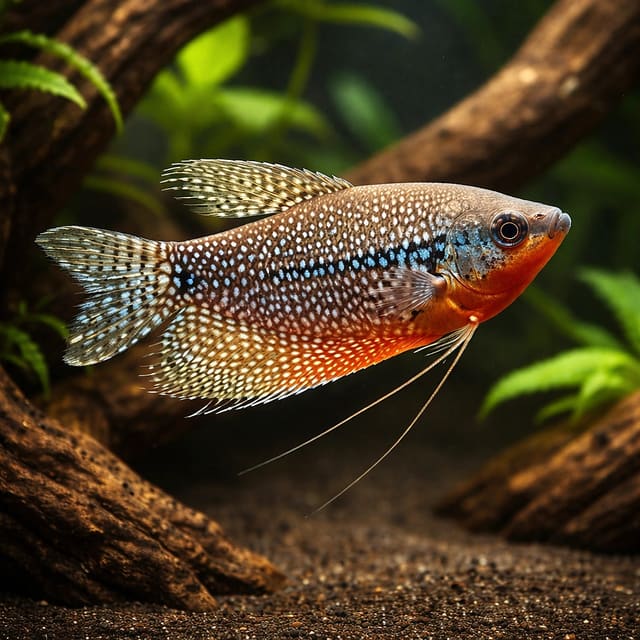
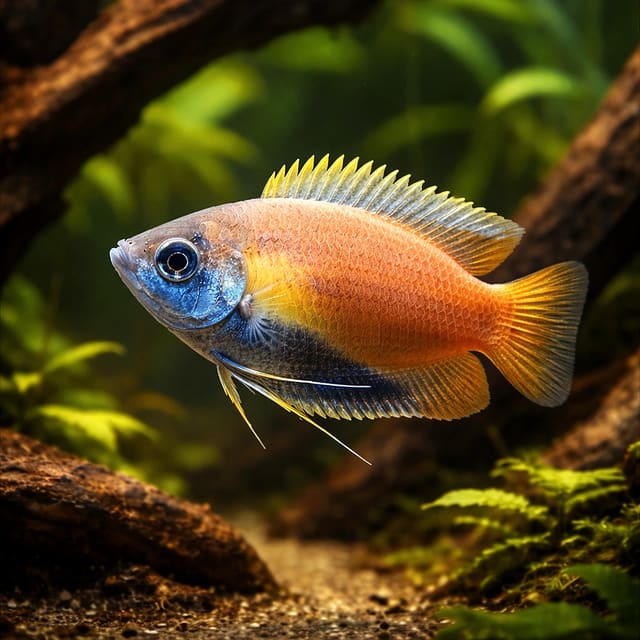
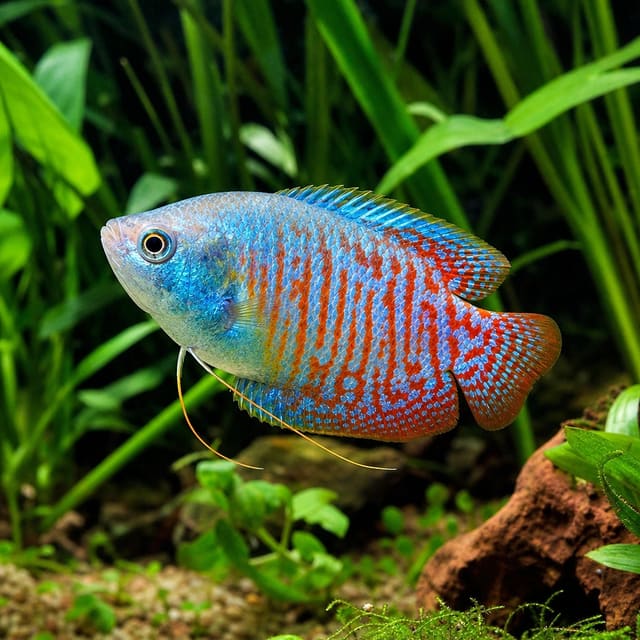
The trade name refers to the fish’s blue colouring. Identification notes for the species describe darker edges to the scales on the head and body, black spots and bars on the dorsal and tail fin membranes, blue rear dorsal and tail fin membranes, a forked tail and a red tip to the first pelvic fin ray. Extended soft rays in the dorsal, anal and tail fins are a male trait, so not every fish will develop the long filaments seen in the photographs.
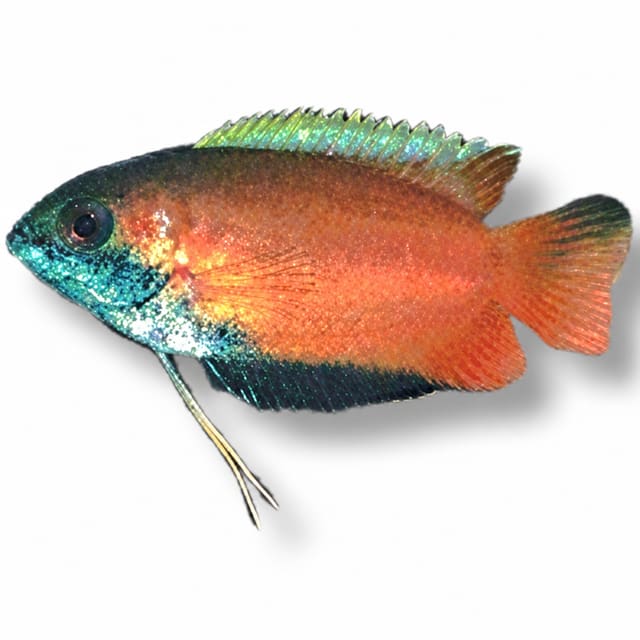
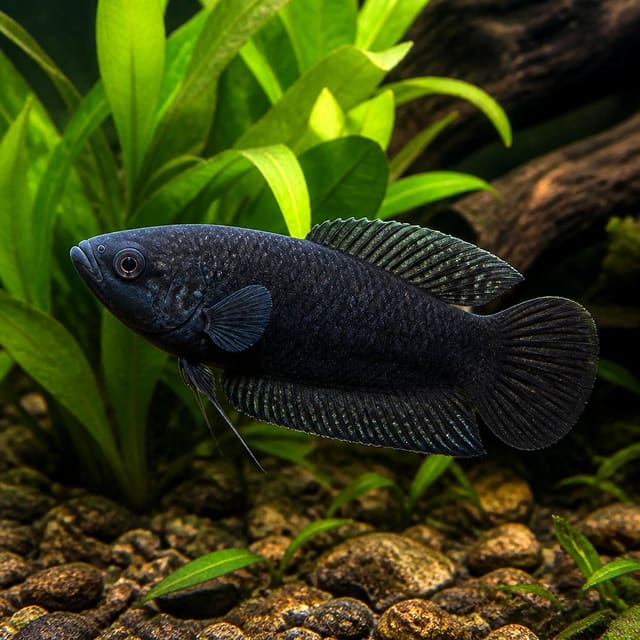
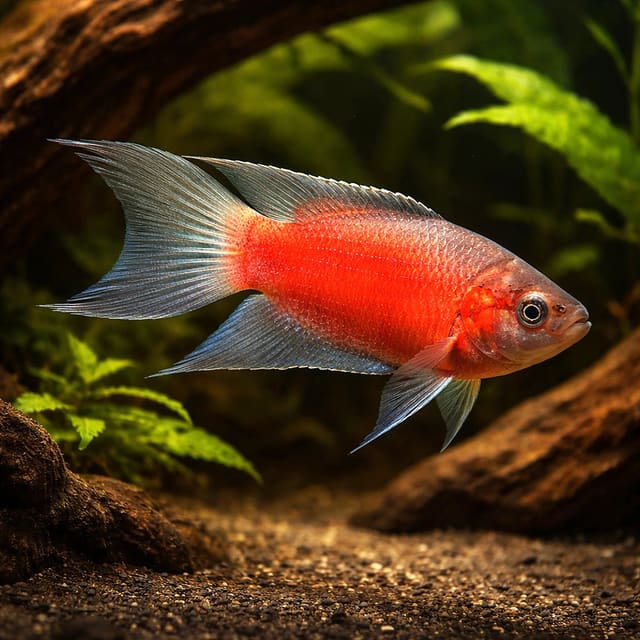
Gallery images have been digitally enhanced to improve image quality. Natural colour, pattern, size and maturity can vary between live animals. The photographs show a fish with long fin extensions against a background of dried leaves.
Sex is guaranteed only when the selected option explicitly states male or female. This Macropodus spechti royal blue listing has no sex-guaranteed option. Adult males are larger than females and carry the extended fin rays.
This fish is sometimes called Macropodus concolor, particularly in older books and articles. That name proved to be a junior primary homonym: the same name had already been published by another author in 1936. The International Commission on Zoological Nomenclature resolved the dispute in 2006, so Macropodus concolor Ahl, 1937 is permanently invalid and Macropodus spechti is the name to search for. If you are comparing other air-breathing species, the gouramis and labyrinth fish collection brings the range together in one place.
The Seriously Fish profile for Macropodus spechti suggests an aquarium with a base of 80 × 30 cm, or an equivalent footprint, as the minimum for a single pair. That works out at roughly 72 litres. The profile gives the size as a base area rather than a height, so choose a tank with a generous footprint rather than a tall, narrow one.
A group needs more room. The species can be kept in a group, and extra floor space lets other fish move away from a displaying or nesting male. OATA’s broad guidance for gouramis and paradise fish is an aquarium of at least 100 litres for the larger species and paradise fish, with more volume for every extra group you add. OATA also points out that a larger aquarium keeps temperature and water quality more stable.
Seriously Fish notes that the species can be kept in a fully decorated aquarium, although many breeders leave out the substrate to make cleaning easier. For a display tank, OATA recommends aquarium gravel or sand and ideally live plants. Driftwood roots and branches arranged to create a few shady spots suit this fish, and a layer of dried leaf litter adds cover and a natural feel.
Leaf litter does more than decorate. As it breaks down it supports microbe colonies, which Seriously Fish describes as a valuable early food source for fry if the fish ever spawn.
Because Macropodus spechti is an obligate air-breather, it has to reach the surface regularly. Floating or surface plants are worth including, and Seriously Fish recommends them if you hope to breed the fish, because the male builds his bubble nest among surface vegetation. Leave open patches between the plants so every fish can reach the air easily.
A tight-fitting cover is worth fitting from the start. Seriously Fish advises the tightest cover possible for breeding, because fry need a layer of warm, humid air above the water while their labyrinth organ develops. With a cover already in place, an unexpected spawning does not catch you out.
A filter is essential in every aquarium. Seriously Fish suggests a turnover of four to five times the tank volume per hour, which for about 72 litres means a filter rated at roughly 290–360 litres per hour. To hold the tank at its target temperature in a room of around 20 °C, it estimates a heater of about 75–100 W for that volume.
If this is a new aquarium, work through our guide to setting up and maturing a first tropical tank before you order, so the filter has matured by the time the fish arrive.
OATA notes that tank-reared gouramis and paradise fish are usually undemanding of water chemistry, and the species references for Macropodus spechti give a fairly wide range. The practical target below is where the two species references overlap: the FishBase species record gives 20–26 °C, pH 6.5–7.8 and hardness up to 20 dH, while the Seriously Fish species profile gives 20–30 °C, pH 6.0–8.0 and 5–20 dGH.
| Value | Aim for |
|---|---|
| Temperature | 20–26 °C |
| pH | 6.5–7.8 |
| General hardness | 5–20 dGH |
| Ammonia | Zero |
| Nitrite | Zero |
| Nitrate | No more than 20 mg per litre above your tap water |
Seriously Fish lists temperatures up to 30 °C, and OATA’s sheet for gouramis and paradise fish runs to 28 °C. Keeping within 20–26 °C stays inside both species references and leaves headroom for a warm summer room without pushing the tank to the top of the published span. Seriously Fish also notes that soft water with a slightly raised temperature is said to induce breeding behaviour, so a small rise within this band is a breeding measure rather than an everyday setting.
OATA’s care sheet for gouramis and paradise fish gives 20–28 °C, pH 6.0–8.0, general hardness of 4–12 dGH and carbonate hardness of 3–10 dKH. Those are broad values for the whole group rather than a species-specific optimum, and OATA says that some species, mainly specialist or wild-caught fish, may need more specific conditions. Use the species values above as your target and the group sheet as a sense check.
OATA stresses that good husbandry is essential for gouramis and paradise fish. In practice that means reading the thermometer every day, bringing replacement water to the tank temperature before a water change, and avoiding large, sudden adjustments to pH or hardness. In a warm spell, check the tank more often so it stays within 20–26 °C.
Test before the fish arrive, not after. Our guide to aquarium water parameters and what to test explains each reading, and the water parameter matcher lets you compare your own results with the values on this page. Once the tank is running, OATA recommends testing at least once a week so ammonia and nitrite never build up unnoticed.
A worked example: if your tap water reads pH 7.4 and 14 dGH, it already sits inside the target, and it only needs conditioning and bringing to temperature before it goes into the tank. If it reads 24 dGH, it is harder than both species references, so plan how you will lower the hardness before you order rather than after the fish arrive.
In nature, Macropodus spechti is likely to prey on insect larvae and similar small animals. Seriously Fish recommends reflecting that in captivity with small live or frozen foods, naming Daphnia, Artemia, white worm and grindal worm. Some high-quality dried products may also be accepted, including a good dried food and freeze-dried Artemia and Daphnia.
OATA’s guidance for gouramis and paradise fish is to feed only what the fish can eat within a few minutes, once a day. Overfeeding leaves uneaten food to break down and release toxic waste into the water. If food is still drifting or lying on the bottom after a few minutes, feed less next time and remove what remains.
Here is one way to put that advice together, feeding once a day and giving only what is eaten within a few minutes:
If a new fish ignores dried food, keep it on small frozen or live foods; the species profile treats dried food as something that may be accepted rather than a staple. Have that supply ready before the fish arrive, whether you buy frozen packs or start a worm culture.
A simple note of each week’s test results, water change and any change in behaviour makes it much easier to spot a slow drift before it becomes a problem, and gives you something concrete to share if you ever need advice.
The RSPCA’s aquarium welfare guidance explains why the filter matters: fish release ammonia, a working biological filter lets beneficial bacteria turn it into nitrite and then into the safer nitrate, and no fish should be kept without a well set up and maintained filter.
OATA describes healthy fish as having clear, bright eyes, undamaged fins, intact scales and no ulcers or bumps. Check the long fins of adult males closely, because loss of fins is one of the changes OATA lists to watch for.
If you notice any of these, OATA’s advice is to test your water quality first and then seek guidance. You can contact us with your results and a description of what you are seeing.
Tropical Fish Co hand-packs every order: fish are bagged in pure oxygen and packed in an insulated poly box, with a heat pack when the weather calls for it. We email the tracking number and your confirmed delivery date, and a licensed live-animal courier carries the parcel on a tracked service. The full terms are on our delivery and Live Arrival Guarantee page.
OATA advises checking that ammonia and nitrite are at zero before any fish are added, and building up stock slowly. The bacteria in a matured filter need time to catch up each time more fish arrive and feeding increases; adding too many fish too quickly can cause new tank syndrome, where ammonia and nitrite rise to unhealthy levels.
For Macropodus spechti, that means adding the fish to a settled tank and holding back further additions for a while. Offer small portions of live or frozen food once the fish are moving around normally, check that each one eats, and use the list of changes in the health checks above as your guide during the first weeks.
Macropodus spechti is a bubble nester. Seriously Fish describes the process in detail, and it is worth knowing even if you never plan to breed the fish, because it explains changes you may notice in a pair.
Breeding is not something to plan around a single purchase. A pair needs both a male and a female, and adult sexual differences are the only reliable guide. If you do see a bubble nest among the floating plants, check that the cover fits well and keep the routine steady.
The Seriously Fish profile describes Macropodus spechti as relatively peaceful unless breeding. That is a gentler picture than OATA gives for paradise fish in general, meaning mainly Macropodus opercularis, which it says can be semi-aggressive and are usually best kept on their own. Treat that broader note as a reason for care rather than a rule for this species, and watch behaviour closely whenever a male starts nesting.
This species can be kept as a pair or in a group, and Seriously Fish notes interesting behavioural interactions in a group. During breeding the male builds a nest and displays, while females are usually tolerated. In a group, driftwood and plant cover give other fish somewhere to retreat while a male displays.
OATA’s mixing advice for gouramis and paradise fish fits this fish well. If you add other species:
Match water needs as well as temperament. Any companion should be comfortable at 20–26 °C and within the pH and hardness values on this page, and it should not outcompete this fish for the small live and frozen foods it needs.
FishBase classes the species as pelagic, meaning it lives in open water rather than on the bottom, and as an obligate air-breather it makes regular trips to the surface. In the wild it is found in hill streams, along the structured margins and backwaters of large rivers, in small streams and in irrigation channels on farmland, so a varied layout with open water and sheltered edges suits it.
Watch for fish hiding more than usual, more chasing, torn fins or a fish that stops coming up to feed. OATA lists changes in aggression and hiding among the signs of trouble. If a tank mate harasses the Macropodus, or a nesting male pursues other fish hard, separate them before damage builds up.
Seriously Fish records that males are larger than females and have extended soft rays in the dorsal, anal and tail fins. When a female is ready to spawn she becomes paler, which helps to confirm a pair once the fish are mature.
It is recorded at up to 8 cm standard length in the Seriously Fish species profile, while FishBase gives a maximum of 5.8 cm standard length. Plan the aquarium around the larger figure; the long fin extensions of adult males make them look larger than their body length.
Seriously Fish suggests a base of at least 80 × 30 cm, about 72 litres, as the minimum for a single pair. Give a group more room: OATA’s broad guidance for paradise fish and the larger gouramis is an aquarium of at least 100 litres.
Keep Macropodus spechti as a pair or a group. Seriously Fish describes it as relatively peaceful unless breeding and notes interesting behavioural interactions in a group, which needs more space and cover than a single pair.
It can suit a newer keeper who has a fully matured aquarium, tests the water every week and can offer small live or frozen foods such as Daphnia, Artemia or worm cultures. Dried foods are not always accepted, so have a frozen or live supply ready before the fish arrive.
In nature it is likely to prey on insect larvae and similar small animals. In the aquarium, offer small live or frozen foods such as Daphnia, Artemia, white worm and grindal worm, adding a high-quality dried food or freeze-dried Artemia and Daphnia if the fish accept them. Feed once a day, giving only what is eaten within a few minutes.
Aim for 20–26 °C, pH 6.5–7.8 and a general hardness of 5–20 dGH, the values where the FishBase record and the Seriously Fish profile overlap. Keep ammonia and nitrite at zero and nitrate no more than 20 mg per litre above your tap water.
It is described as relatively peaceful unless breeding. Its own long fins are the ones at risk: OATA advises avoiding fish that may nip the fins of gouramis and paradise fish. Watch a pair more closely once the male starts building a bubble nest.
Choose robust tank mates that do not nip fins, and avoid timid species and small fish that could be eaten, as OATA advises for gouramis and paradise fish. Check that every companion is comfortable in the same temperature, pH and hardness range.
Tropical Fish Co hand-bags each order in pure oxygen inside an insulated poly box, with a heat pack when the weather calls for it, and a licensed live-animal courier delivers it on a tracked service. Be at the address to receive it, open it the same day while filming one continuous unboxing video from the sealed parcel, float the bag for 20–30 minutes before releasing the fish, and send the video with your order number the same day if anything has gone wrong.
No reviews for this item yet. Bought one? Honest reviews only, good or bad.
What customers say about ordering from us
Easy website plenty of info on fish your buying great to pick a time slot
TRACEY DURRANT · 7 Oct 2026
Got some lovely fish thank you
Kevin Mackie · 7 Oct 2026
Reviews of our shop, collected by Judge.me, an independent third-party review collector. Newest first.