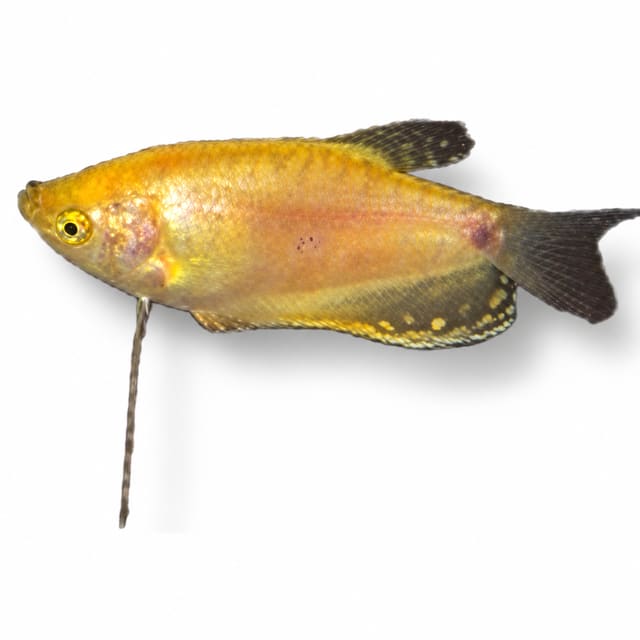
Moderate
Gold Gourami (Trichopodus trichopterus)
24–28°C · pH 6–8 · 81L
From £2.99Some sizes on sale
Photo coming soon
The size, price and care details on this page are for this listing.
The Paradise Fish blue red (Macropodus opercularis) is a labyrinth fish from China, Taiwan and northern Vietnam that reaches 8 cm standard length. It suits keepers prepared for territorial behaviour; keep it at 20–22°C, pH 6.0–8.0 and 5–12 dGH, the overlap of FishBase, Seriously Fish and OATA guidance. Sold individually as one live fish per purchase.
Adult size is the maximum length this species reaches at full maturity (scientific sources). The livestock you receive will be younger and smaller. Product-photo provenance and any image-specific limitations are stated on the listing.
Save when buying multiple fish. Each quantity is one fish; sex and pair formation are not guaranteed unless the selected variant explicitly states them.
The Paradise Fish blue red (Macropodus opercularis) is a labyrinth fish from China, Taiwan and northern Vietnam that reaches 8 cm standard length. It suits keepers prepared for territorial behaviour; keep it at 20–22°C, pH 6.0–8.0 and 5–12 dGH, the overlap of FishBase, Seriously Fish and OATA guidance. Sold individually as one live fish per purchase.
Adult size is the maximum length this species reaches at full maturity (scientific sources). The livestock you receive will be younger and smaller. Product-photo provenance and any image-specific limitations are stated on the listing.
Maintain these water conditions for optimal health and vibrant colors
The Paradise Fish blue red (Macropodus opercularis) is a freshwater labyrinth fish in the Osphronemidae family. Its native range extends from the Yangtze basin south through China, including Hainan, to Taiwan and northern Vietnam. Plan for an adult length of 8 cm standard length. It suits a keeper who can provide relatively cool water, an aquarium at least 80 cm long and a carefully screened social arrangement.
FishBase describes the wild species in lowland habitats ranging from structured river margins and backwaters to small streams, irrigation channels, paddy fields and ditches. It is an obligate air-breather and can use atmospheric oxygen through its specialised labyrinth organ. That ability does not replace filtration, water testing or routine maintenance in an aquarium.
The blue-red name identifies the colour strain in this offer. Seriously Fish includes red and blue forms among the selectively bred ornamental strains of M. opercularis. The species is also known as the Chinese fighting fish, paradise gourami and blue paradise fish, but Paradise Fish blue red is the clearest name for this particular animal.
This is not a passive community fish. Males are territorially aggressive, especially during reproductive periods, and FishBase records that males fight one another. OATA describes Paradise Fish as semi-aggressive and usually best kept on their own. A community arrangement therefore needs more thought than simply matching temperature and aquarium volume.
The species also has a notable place in aquarium history. FishBase records it as the first ornamental fish brought to Europe after the goldfish, while Seriously Fish traces its arrival in France to 1869. That history is interesting, but the practical decision remains its temperament: choose it for a planned aquarium, not as an automatic addition to a peaceful mixed collection.
Keep this fish at 20–22°C, pH 6.0–8.0 and 5–12 dGH. These routine values are the overlap of FishBase’s recorded environmental range, the Seriously Fish aquarium range and OATA’s gourami and Paradise Fish guidance. OATA’s figures apply to the wider group rather than representing a species-specific optimum.
Use an aquarium with a base of at least 80 × 30 cm, equivalent to approximately 72 litres. Seriously Fish presents that footprint and volume as the minimum considered for a single pair, while FishBase independently records a minimum aquarium length of 80 cm. Retain the 80 cm length when planning for one animal; do not treat the smaller dispatch fish as needing less permanent space.
| Suits | Not suited to |
|---|---|
| A keeper prepared to manage territorial behaviour | An aquarium built around timid fish |
| An 80 × 30 cm base or larger | A short aquarium without the stated footprint |
| Measured water at 20–22°C and pH 6.0–8.0 | A permanently warmer plan above the routine range |
| A mature, filtered aquarium with weekly testing | An unfiltered or newly stocked setup |
| A solitary plan or carefully assessed companions | An automatic mixed community arrangement |
A suitable temperature alone does not make an aquarium suitable. The footprint must accommodate territorial behaviour, the filter must process waste and potential companions must share the same environmental requirements. For example, an 80 cm aquarium at 21°C still fails the plan if ammonia or nitrite is detectable, while a larger mature aquarium still fails if its residents are timid, similarly shaped or small enough to be eaten.
Make the decision from the complete set: adult space, routine water values, established filtration and a compatible social plan. This prevents one favourable number from hiding a conflict elsewhere in the aquarium.
One purchase supplies one live Paradise Fish blue red. The dispatch grade associated with this offer is approximately 4–5 cm, while the permanent aquarium must be planned around the 8 cm adult length and the full territorial needs of the species. Dispatch length describes the fish at the point of supply; it is not an adult-size estimate or permission to begin with a smaller aquarium.
Sex is guaranteed only when the selected option explicitly states male or female. This Paradise Fish blue red listing has no sex-guaranteed option.
That distinction matters because male territorial behaviour affects social planning. Prepare an arrangement that remains safe if the animal proves to be male, rather than relying on colour, fin shape or its dispatch size to determine the aquarium plan.
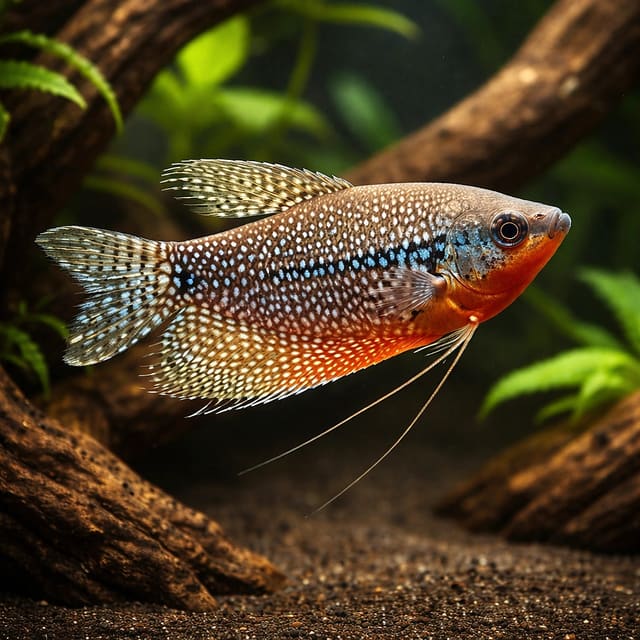
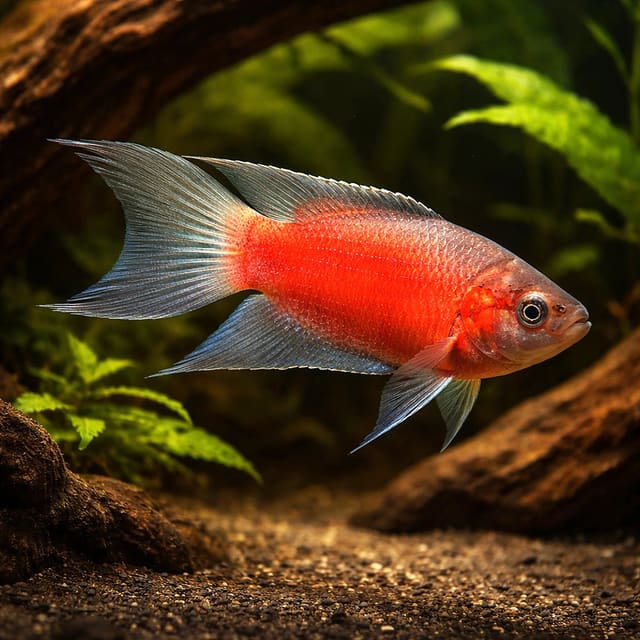
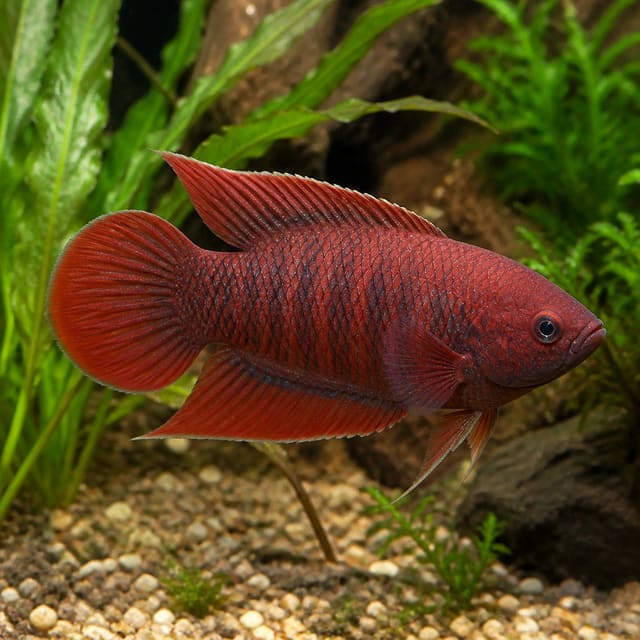
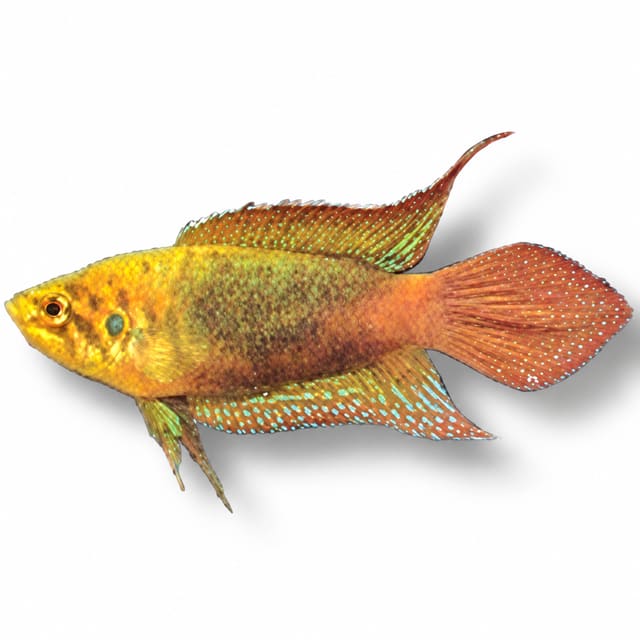
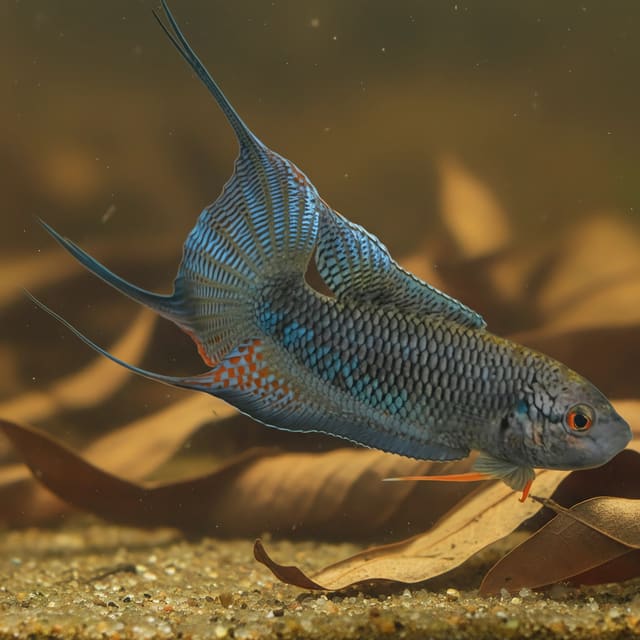
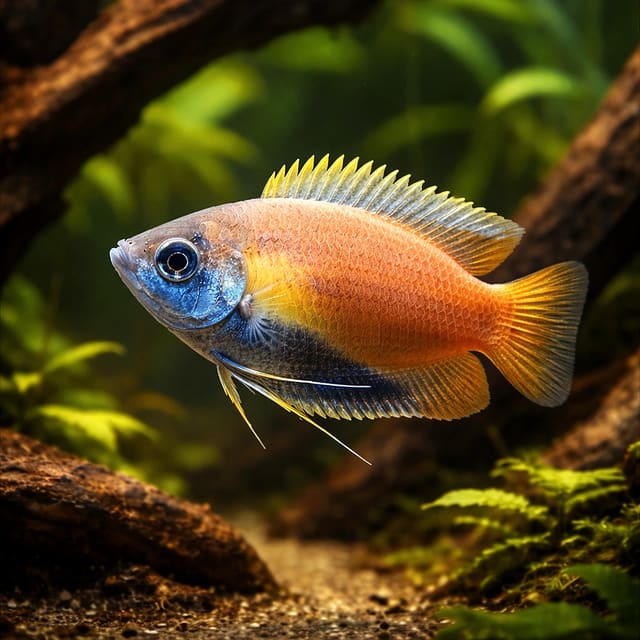
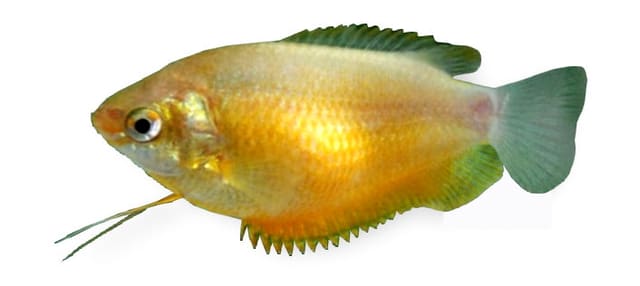
The gallery images are representative of this type of animal rather than photographs of the exact animal supplied, so colours can look slightly different from the live animal.
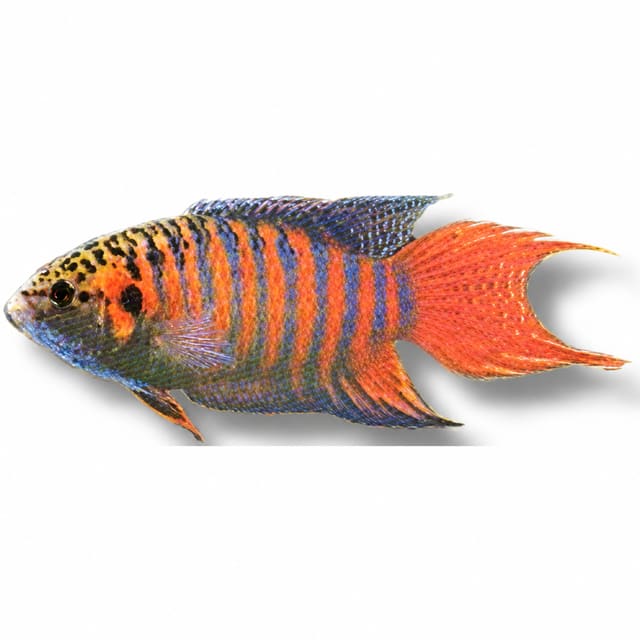
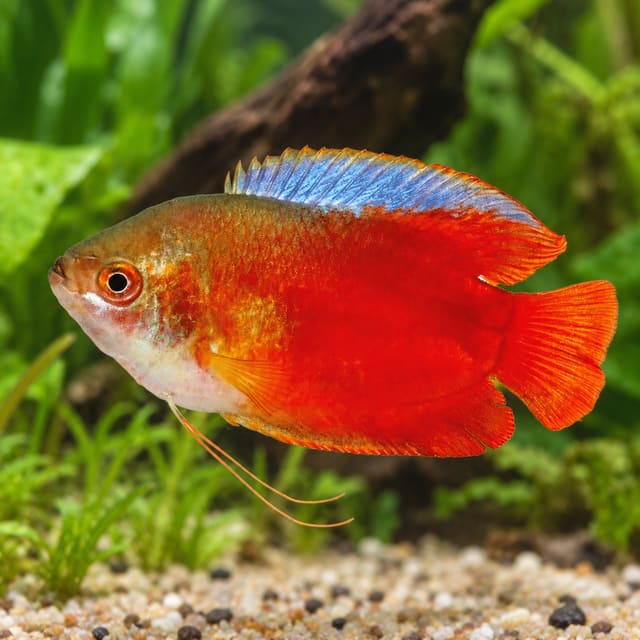
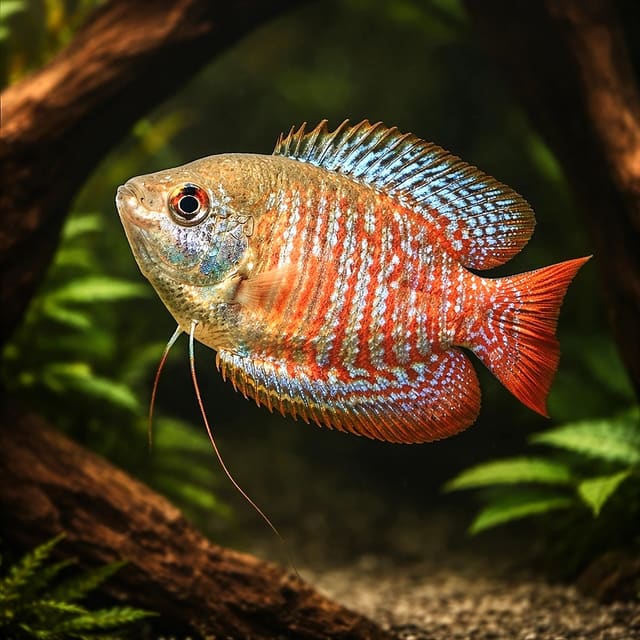
The gallery image shows the elongated fins and alternating turquoise-blue and orange-red markings associated with the named strain. Treat the image as a guide to type and pattern rather than a promise of identical colour placement on every individual.
For other members of the same aquarium family, browse the gouramis and labyrinth fish collection. Compare each animal on its own adult size, water range and temperament rather than assuming that members of one family can share an aquarium.
Plan for an adult length of 8 cm standard length and an aquarium base of at least 80 × 30 cm. Seriously Fish gives approximately 72 litres as the equivalent volume and describes that footprint as the minimum considered for a single pair. FishBase also records a minimum aquarium length of 80 cm, so aquarium length remains a decisive requirement even when only one fish is planned.
The 8 cm standard-length figure is the adult planning reference used throughout this care plan. FishBase records a different maximum of 6.7 cm standard length, while OATA describes Paradise Fish as growing to approximately 10 cm. These figures differ, so use 8 cm consistently for the permanent setup and leave a margin above the minimum footprint where the social arrangement adds pressure.
The 4–5 cm dispatch grade is not a separate space category. Place the fish directly into the mature aquarium intended for its adult needs. Moving a territorial fish through a succession of undersized aquariums creates avoidable setup changes and does not alter the species-level minimum footprint.
Volume and footprint answer related but different questions. The approximate 72-litre figure describes an aquarium based on 80 × 30 cm, while the base dimensions provide the horizontal room used in the minimum recommendation. A taller aquarium can hold the same number of litres without matching that footprint, so check the actual base dimensions rather than relying on the volume printed on the box.
Do not calculate capacity by dividing litres by fish length. Territorial behaviour, companion type, filtration and the physical layout all affect whether the aquarium works. Begin with the published footprint, then make the aquarium larger when the social plan becomes more complex.
Keep the aquarium at 20–22°C, pH 6.0–8.0 and 5–12 dGH. This set is the overlap of FishBase’s environmental figures, Seriously Fish aquarium guidance and OATA’s group range. Aim for measured values within all three bands rather than selecting the broadest upper or lower limit from just one reference.
Test temperature and pH in the aquarium, and establish the general hardness of the water used for changes. The water chemistry guide explains the values to measure, while the water matcher helps compare those readings with the stated range. Record results so that gradual movement is visible rather than judging water from appearance alone.
Seriously Fish notes that this species can be maintained in an unheated aquarium in many cases and may benefit from a cool winter period. Treat “unheated” as a description of equipment, not a temperature target: it works only when repeated measurements remain inside the planned range. If the room allows the aquarium to fall below 20°C or rise above 22°C, manage the aquarium to restore the routine band.
Keep ammonia at 0 mg/l and nitrite at 0 mg/l. OATA also advises keeping nitrate no more than 20 mg/l above the normal level in the tap water used for the aquarium. These waste readings answer a different question from pH and hardness: water can have the right pH while still containing toxic ammonia or nitrite.
A larger aquarium generally offers greater environmental stability, but volume does not remove the need to test. Confirm the values at least weekly and whenever behaviour, breathing, colour or feeding changes.
Use a well-established biological filter and confirm that ammonia and nitrite are both 0 mg/l before introducing the fish. The RSPCA explains that biological filtration supports beneficial bacteria that convert toxic ammonia to nitrite and then to the safer nitrate. The labyrinth organ allows atmospheric breathing, but it does not process dissolved waste.
If this is your first setup, follow the first tropical aquarium guide and complete maturation before livestock arrives. Adding fish to an immature filter can create new tank syndrome because the bacterial population cannot yet process the increased waste.
Seriously Fish recommends turnover of four to five times the aquarium volume per hour for an aquarium of approximately 72 litres. That corresponds to a filter rated around 290–360 litres per hour. Use those figures to compare equipment for the reference setup, then account for the actual aquarium volume and the manufacturer’s rated performance.
Check the filter for blockages as part of routine maintenance. A filter cannot perform its biological role if flow is obstructed, but cleaning must preserve the bacterial population living in its media.
If filter media needs cleaning, do not run it under the tap. Rinse it lightly in aquarium water removed during the partial water change. This reduces the loss of beneficial bacteria and keeps filter maintenance tied to the established weekly routine.
Use a fully decorated aquarium with gravel or sand, live plants and structured cover. Seriously Fish recommends driftwood roots and branches arranged to create shady areas, while OATA advises aquarium substrate and ideally live plants. These features break up an otherwise open layout and provide places where a fish can move out of direct view.
Place wood and plants so that the aquarium contains sheltered areas as well as open routes for swimming. Keep enough access to siphon waste and inspect the fish from both sides. A decorative layout only helps when maintenance can still reach the substrate and the keeper can see changes in fins, scales, body condition and behaviour.
Dried leaf litter can reinforce a natural appearance and support colonies of microbes that may provide early food for fry. That benefit belongs to a breeding context rather than the everyday feeding plan for an adult fish, so do not rely on leaf litter as the animal’s main food source.
Paradise Fish possess a labyrinth organ and breathe atmospheric air. Expect the fish to use the surface as part of normal biology, but assess surface visits alongside its usual pattern. OATA advises watching for changes such as hanging at the surface, erratic swimming or altered breathing rate because a change from the individual’s normal behaviour can point to a developing health or water-quality problem.
Do not use atmospheric breathing as a reason to reduce filtration, water changes or testing. The aquarium still needs a functioning biological filter, 0 mg/l ammonia, 0 mg/l nitrite and a regular maintenance routine.
Make small live or frozen animal foods the core of the feeding plan. Seriously Fish recommends Daphnia, Artemia, white worm and grindal worm, reflecting a wild diet likely to include insect larvae. FishBase also records feeding on small aquatic animals, including small fish. These species-level diet notes make animal-based foods the appropriate staple direction.
Some high-quality dried products may also be accepted, particularly by ornamental strains. Treat acceptance as something to observe rather than assume. A food that remains untouched is not contributing variety and can break down into waste.
Feed once a day and offer only what the fish can eat within a few minutes. OATA applies this portion and frequency guidance to gouramis and Paradise Fish. Remove or reduce any food that repeatedly remains after that window because overfeeding can create uneaten waste and increase the burden on the filter.
Watch the whole feed rather than dropping food and walking away. Confirm that the fish approaches food, takes it normally and maintains body condition. A reduced intake or lack of interest is one of OATA’s warning signs, especially when it appears alongside altered swimming, colour, breathing or temperament.
If food remains, reduce the next portion and remove accessible waste during maintenance. If appetite changes suddenly, test ammonia and nitrite rather than trying several new foods at once. Keeping the diet varied but the portion rule consistent makes it easier to distinguish preference from a broader health or water-quality change.
Complete the aquarium, establish the filter and confirm 0 mg/l ammonia and 0 mg/l nitrite before the fish arrives. Check that temperature, pH and hardness are already within the planned range. Add livestock gradually because every new fish and increase in feeding requires the filter’s bacterial population to process more waste.
Tropical Fish Co animals are hand-bagged in pure oxygen, placed in an insulated poly box and accompanied by a heat pack when the weather calls for it. Follow the current delivery and Live Arrival Guarantee policy for the full terms.
Resume the normal testing routine after release and watch the fish during its daily feed. OATA advises increasing aquarium population slowly because stocking too quickly can produce unhealthy ammonia and nitrite levels. Do not add another animal merely because the first readings appear normal immediately after introduction; continue checking how the biological filter responds.
Keep the social plan conservative while the individual’s behaviour becomes clear. This offer does not guarantee sex, and male territorial aggression can intensify during reproductive periods. Beginning with a plan for one fish avoids committing the aquarium to a group arrangement before sex, space and compatibility have been assessed.
Observe the fish during its once-daily feed and compare what you see with its normal pattern. OATA recommends watching swimming, colour, temperament, breathing, physical appearance, body condition and food intake. A single observation becomes more useful when it can be compared with the fish’s usual behaviour and the latest water test.
Test ammonia and nitrite first and confirm both remain at 0 mg/l. Then check temperature, pH and the filter for blockage. This sequence identifies immediate husbandry problems that can affect any fish and gives a clear set of readings to accompany the observed sign.
Do not begin a disease treatment from appearance alone. Different problems can produce similar behaviour, and a treatment choice is not part of routine Paradise Fish care. If the change persists or the fish’s condition concerns you, contact us with the water readings and a concise description of what changed.
Begin with a solitary plan. OATA describes Paradise Fish as semi-aggressive and usually best kept on their own, while FishBase records that males fight. Seriously Fish adds that males are territorially aggressive, with the behaviour becoming more pronounced during reproductive periods.
Seriously Fish says males should not be housed together unless the aquarium is very large. Plan one potentially male Paradise Fish per setup unless you have a very large aquarium and the complete arrangement has been assessed.
When a deliberately sexed arrangement contains one male and females, provide two or more females per male to disperse male attention. The offer here does not guarantee sex, so do not order several animals and assume their eventual composition will match that ratio.
The species is a bubble nester, and male territorial behaviour can increase during reproductive periods. That biological fact matters even when breeding is not the goal because a social arrangement that appears calm can change. Include structured cover and enough room to separate lines of sight, but do not treat decoration as a substitute for the male-housing rule.
If territorial pursuit prevents another fish from feeding, keeps it hidden or causes fin and scale damage, the social arrangement is not working. Reassess the occupants rather than waiting for the minimum aquarium dimensions to solve a behavioural conflict.
Consider only robust tankmates and peaceful schooling fish with comparable environmental requirements. Those descriptions are screening categories, not a universal tank-mate list. Every candidate must also fit 20–22°C, pH 6.0–8.0, 5–12 dGH and the available aquarium space.
Do not move an animal from the avoid list into the plan merely because the aquarium is mature or the water values match. Water compatibility cannot cancel predation risk, timid behaviour, fin-nipping or a similarly shaped profile.
Treat fish and invertebrates outside the named categories as case-by-case decisions. Provide the exact species, aquarium dimensions, water readings and present occupants when you ask us for a compatibility assessment. Shared temperature alone is not enough to approve a companion.
If the Paradise Fish begins pursuing a companion, blocks it from food or drives it into continuous hiding, act on the observed conflict. Recheck the avoid criteria and change the social arrangement rather than assuming the behaviour will disappear.
The Paradise Fish blue red reaches 8 cm standard length according to Seriously Fish. Plan the permanent aquarium around that adult figure rather than the approximately 4–5 cm dispatch grade.
Use an aquarium with a base of at least 80 × 30 cm, equivalent to approximately 72 litres. Seriously Fish gives this as the minimum for a single pair, and FishBase also records a minimum aquarium length of 80 cm.
Plan to keep one Paradise Fish blue red unless the group is deliberately assessed. Seriously Fish advises two or more females per male and says males should not be housed together unless the aquarium is very large.
It can suit a prepared beginner who can measure the cool routine water range, maintain a mature filter and manage semi-aggressive territorial behaviour, but it is not an automatic choice for a peaceful mixed community.
Feed the Paradise Fish blue red small live or frozen Daphnia, Artemia, white worm or grindal worm as its main rotation. Offer only what it eats within a few minutes once a day; some high-quality dried foods may also be accepted.
Keep it at 20–22°C, pH 6.0–8.0 and 5–12 dGH, the overlap of FishBase, Seriously Fish and OATA group guidance. Maintain ammonia and nitrite at 0 mg/l.
It can be semi-aggressive, and males are territorially aggressive, especially during reproductive periods. Avoid another male unless the aquarium is very large, and avoid companions that may nip the Paradise Fish’s fins.
Consider robust tankmates or peaceful schooling fish with comparable environmental requirements. Avoid timid species, similarly shaped fish, small fish that could be eaten and fish that may nip its fins.
Start filming with the parcel still sealed before opening or floating the bag. Tropical Fish Co hand-bags the fish in pure oxygen, uses an insulated poly box and adds a heat pack when the weather calls for it; be present to receive it, inspect it the same day and float the bag for 20–30 minutes before release.
Independently collected by Judge.me from customers who bought this item. All reviews are shown.
Communication was very poor. Fish was shipped way before the agreed date and so spent two days in the Royal mail post office. Also have been charged for two when I have one (i did ask to change to one but I dont seem to have received a refund for the change). Requested female and was sent a male despite the listing originally being for a breeding pair so surely they should have been able to sex them correctly? WhatsApp number also takes you to the aquatropics number which just seems off. I have emailed several times now and they arent responding. Avoid.
Reply from Tropical Fish Co
Scarlett, I'm sorry. Reading this back, you had an order that went wrong in several directions at once and then couldn't get hold of anyone to fix it — that's the part that bothers me most, and it isn't how we want anyone to be treated. Let me take these one at a time, and where something is ours I'll say so. The emails. No excuse. Chasing us several times and hearing nothing is the failure underneath every other point here, because any one of these would have been a five-minute fix if someone had picked up. I've taken that up with the team. The timing. I think this one is a misunderstanding we caused rather than a mistake, and I'd like to explain it because it may actually be reassuring. The date shown at checkout is your delivery date — Thursday or Friday. We pack and post on the Wednesday so the fish travel overnight and arrive the next morning, rather than being posted on the day and risking a weekend in a depot. So a tracking number showing your parcel with Royal Mail before your date isn't an early dispatch; that's the normal run and it's deliberately built that way for the fish. What we got wrong is not making that clear, so you spent two days watching a tracking page and worrying — which is a horrible feeling when there's something alive at the other end. If it genuinely sat longer than the Wednesday-to-Friday window, tell me and I'll take it up with Royal Mail directly. The charge. If you asked to drop from two fish to one and were still charged for two, that's simply money you're owed. Give me your order number and it goes back today — you shouldn't have to ask twice. The female. The honest version: we only guarantee sex where the listing title says it's a sex-choice item, because on younger stock we can't reliably tell them apart, and we'd rather not promise something we'd get wrong. Where we let you down is that when you changed a breeding pair down to a single fish, someone should have said 'that means we can't promise you a female' — and nobody did. That's on us, not on you for expecting it. So: I'll put a female aside for you and send her on next Wednesday's dispatch, with you Thursday. No charge, nothing to return. The WhatsApp number. It really is ours — Aquatropics is our sister site and we share a team, so both numbers reach the same people. I completely see why that looks off from the outside, and we'll label it properly. If your male is settling in and you'd like a hand getting him right, or you'd rather just have the whole order refunded and be done with us, either is fine — your call, no argument from me. Message +44 7464 593131 or email hello@tropicalfishco.co.uk marked for my attention and it comes straight to me. — Reza, Tropical Fish Co
Healthy and doing well but I only received five out of six paradise i ordered
Reply from Tropical Fish Co
Thanks Tracey - and thank you for flagging the short count rather than letting it slide. Five out of six isn't right and it's ours to fix: email hello@tropicalfishco.co.uk with your order number or WhatsApp +44 7464 593131, and we'll either refund the missing fish or add it to your next shipment, whichever suits you. Glad the five that did arrive are doing well. - Reza, Tropical Fish Co