Easy
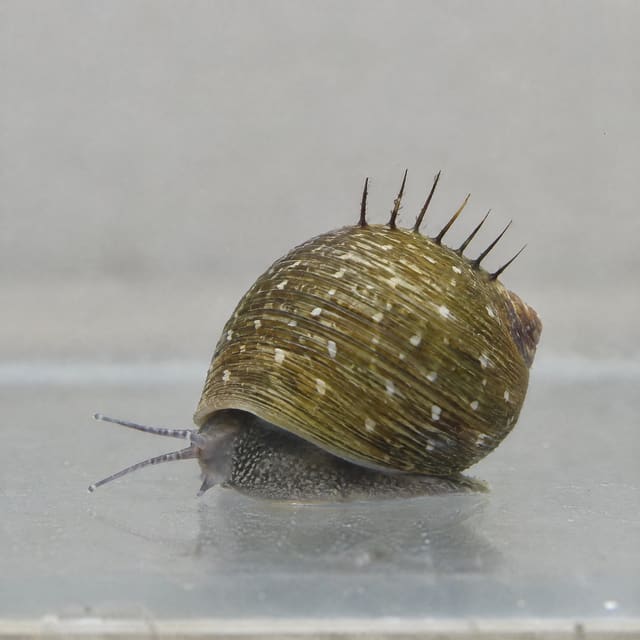
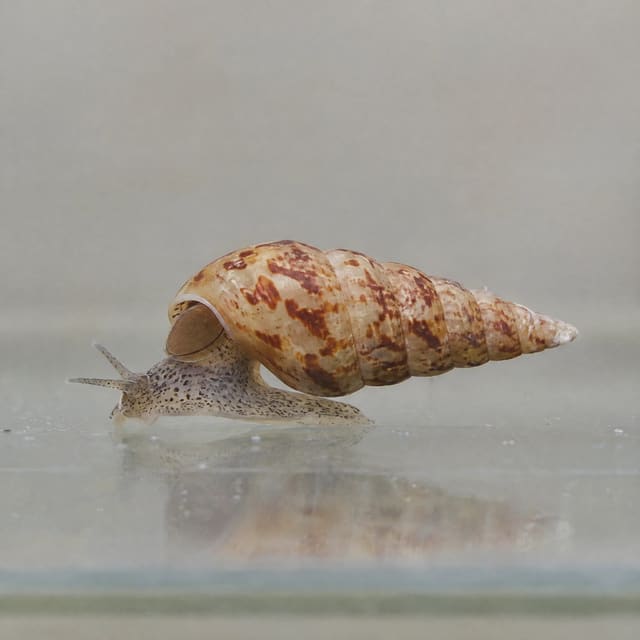
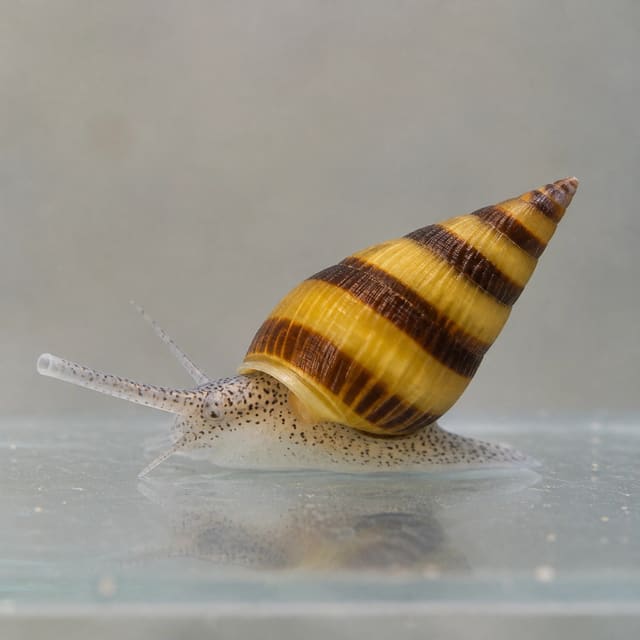
Assassin Snail (Anentome helena) - 0.5-1 cm
22–27°C · pH 6.5–7.5 · 20L
£6.49
The ramshorn pond snail (Planorbarius corneus, often sold as Planorbis corneus) is a native British snail with a flat, coiled, reddish-brown to olive shell about 30–35 mm across. It grazes algae, biofilm and dead plant matter in planted garden ponds and unheated tanks, and needs hard, calcium-rich water with no copper. Choose a pack of 1, 2, 5 or 10 live snails.
Planorbarius corneus
Choose a quantity for your aquarium. Discount thresholds are pricing offers, not a stocking recommendation.
Minimum of 2 per order.
The ramshorn pond snail (Planorbarius corneus, often sold as Planorbis corneus) is a native British snail with a flat, coiled, reddish-brown to olive shell about 30–35 mm across. It grazes algae, biofilm and dead plant matter in planted garden ponds and unheated tanks, and needs hard, calcium-rich water with no copper. Choose a pack of 1, 2, 5 or 10 live snails.
Read the full care guidance when planning conditions for your aquarium.
The ramshorn pond snail (Planorbarius corneus) is a native British freshwater snail with a flat, tightly coiled shell. Garden centres often sell it under its older name, Planorbis corneus, and naturalists call it the great ramshorn. It spends its life grazing algae, biofilm and soft dead plant matter from stones, pond liners and leaves, which makes it a natural, low-fuss addition to a garden pond, a wildlife pond or an unheated indoor tank.
Linnaeus described the species in 1758 as Helix cornea. It now sits in the genus Planorbarius in the family Planorbidae, and the Wikipedia species account lists Planorbis corneus as a superseded name for the same snail. The same account calls it the largest European ramshorn. NatureSpot describes it as common in much of England, with fewer records from Wales and Scotland, and the IUCN Red List assesses it as Least Concern.
| Suits | Not suited to |
|---|---|
| Garden and wildlife ponds with plenty of plants | Ponds or tanks treated with copper-based products |
| Still or slow-moving water with shallow, planted margins | Ponds or tanks that hold assassin snails |
| Hard, mineral-rich water | Very soft water with no calcium source |
| Unheated indoor tanks kept at room temperature | Keepers who want no snail eggs on their plants |
This is not the small ramshorn snail sold for tropical aquariums. Our aquarium Ramshorn Snail is Planorbella duryi, a smaller North American species; Wikipedia notes that its shell is smooth and shiny rather than striated like the great ramshorn's. You can compare the aquarium colour forms on the Planorbella category page, but keep those indoors. The native species on this page is the one for outdoor water.
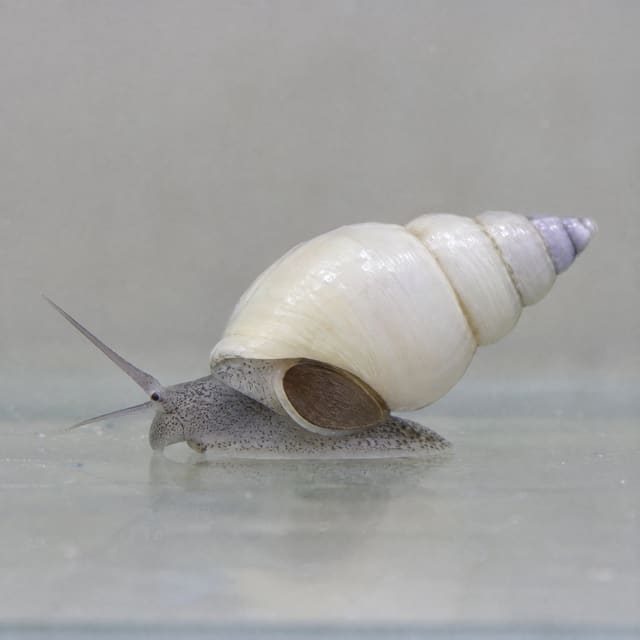
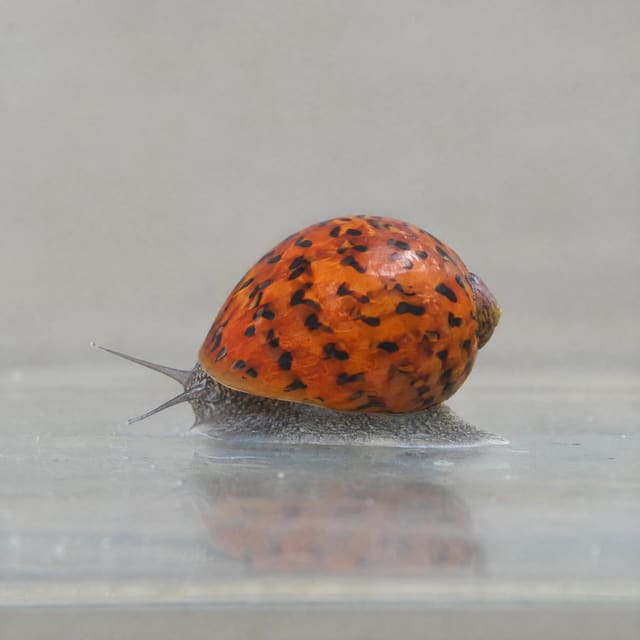
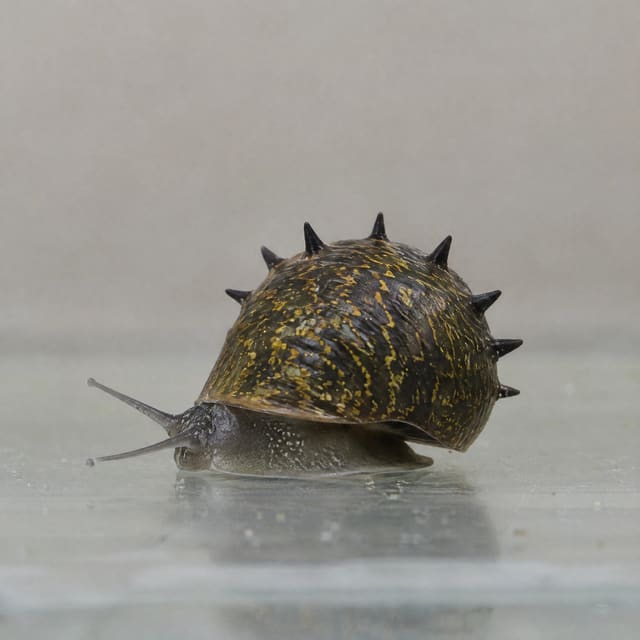
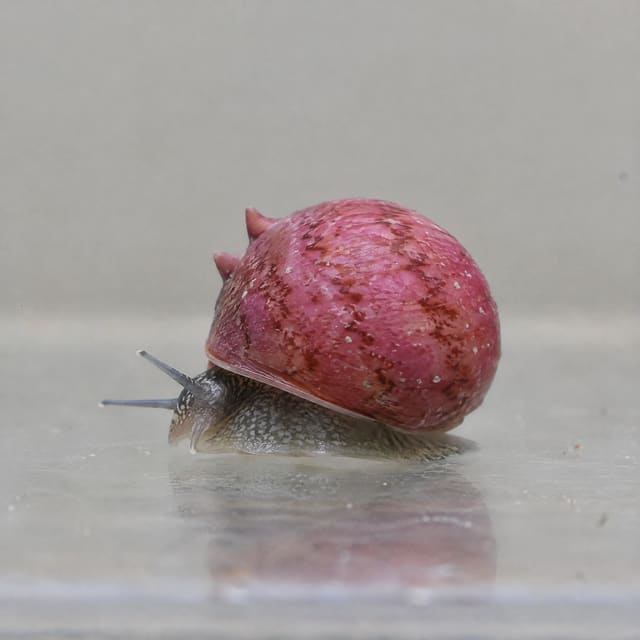
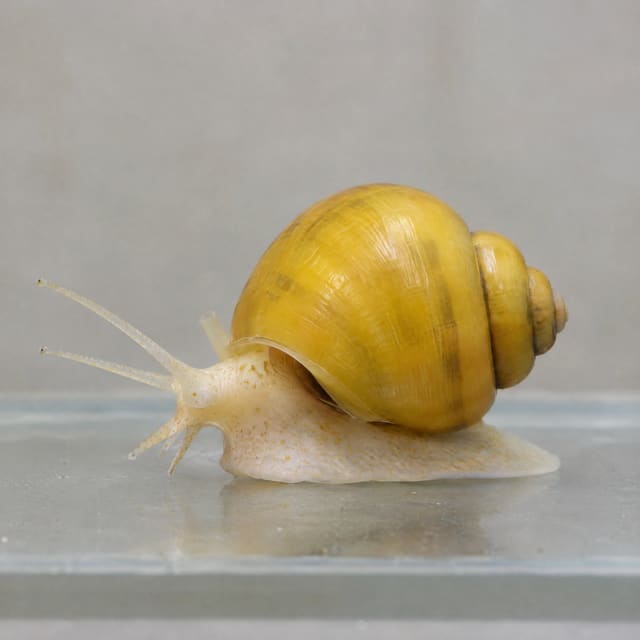
Choose 1, 2, 5 or 10 snails from the pack menu; the pack size is the number of live snails we send. Packs are sold by number rather than by shell size, so shell sizes can vary within a pack. Our photographs show the species; every shell differs a little in shade and in the pale growth marks across its surface. Please read our delivery information before ordering, especially during very hot or freezing weather.
| Feature | What to look for |
|---|---|
| Shell shape | A flat coil when seen from above, like a curled ram's horn, ending in a flared mouth |
| Adult size | About 30 mm across (NatureSpot); Wikipedia gives a typical 35 mm |
| Shell colour | Reddish-brown or olive |
| Body colour | Brown or black; albino snails have a red body because the blood shows through the skin |
| Young snails | Fine hairs on the shell surface, which Wikipedia notes on juveniles |
NatureSpot rates the great ramshorn as common and easily identified, and notes that albino animals are common. Their red colour comes from haemoglobin, the same oxygen-carrying pigment found in human blood. The dark animals in our photographs are the usual wild colour.
Published sizes differ slightly because they measure the shell in different ways. NatureSpot gives a diameter of about 30 mm. Wikipedia gives a typical fully grown shell of 35 mm across and 12 mm wide, and also quotes a wider range of 22–40 mm across by 10–17 mm. In practice, plan for a snail a little wider than a two-pound coin.
Space is rarely the limit. Wikipedia's care notes say this snail needs no minimum tank size and no heating, and that a tank usually does not need extra oxygenation. What matters more is how much food the surfaces produce: a planted pond with algae on the stones and liner feeds far more snails than a bare, newly filled one. To work out the volume of a rectangular pond or tank, use our tank volume calculator.
Wikipedia describes the species in ponds, rivers and canals, with a preference for slow-moving, heavily vegetated water rich in dissolved minerals. NatureSpot describes small, still, weedy ponds and drains. Both point to the same garden habitat: a pond with plenty of submerged and marginal plants, little current and hard water.
The OATA pond care sheet recommends live plants for oxygen, for removing pollutants and as food; shallow ledges for a wider range of plants; some sunlight, but not so much that the pond overheats or fills with algae; and a cover net in autumn if trees overhang the water. Every one of those points also suits ramshorn snails, which graze the film that grows on plant stems and lay their eggs on leaves.
| Area | What it gives the snails |
|---|---|
| Shallow planted ledge | Grazing on stems, emergent plants reaching the surface and a place to lay eggs |
| Submerged plants | Surfaces for the jelly-like egg masses NatureSpot describes, plus algae and biofilm to graze |
| Deeper water | A steadier temperature through summer heat and winter cold |
| Stones and liner | Algae to scrape off with the radula, the snail's toothed, tongue-like feeding organ |
In an indoor tank, fit a lid. Wikipedia notes that poor water quality may cause these snails to leave the water, and the OATA snail and shrimp care sheet recommends a cover to stop snails escaping.
No care sheet publishes exact water chemistry for this species, so the table sets OATA's pond targets beside what the species accounts say:
| Value | OATA pond guidance | Species notes |
|---|---|---|
| Temperature | 4–24°C | Native and seen all year (NatureSpot); needs no heating (Wikipedia); breeds when the water is above 15°C (AnimalBase, quoted by Wikipedia) |
| pH | 6.5–8.5 | Prefers water with plenty of dissolved minerals (Wikipedia) |
| General hardness (GH) | 8–18 °dH | Needs calcium-rich water (Wikipedia) |
| Carbonate hardness (KH) | 5–15 °dKH | Not given |
| Ammonia and nitrite | 0 mg/l | Chlorine and copper must be removed from tap water (Wikipedia) |
| Nitrate | No more than 20 mg/l above your tap water | Not given |
OATA's figures are written for pond fish, but they describe the same water the snails live in, so a pond that meets them suits both. UK tap water ranges from soft to very hard depending on where you live, and rainwater top-ups are soft, so check your hardness with a test kit or our water matcher. If your water is low in calcium, Wikipedia suggests adding cuttlebone or crushed eggshell. Treat tap water with a conditioner that removes chlorine or chloramine, as OATA advises; Wikipedia adds that copper may also need removing, depending on where you live. Our water chemistry guide explains pH and hardness if they are new to you.
The great ramshorn's blood contains haemoglobin. Wikipedia explains that this lets it live in oxygen-poor water: in well-oxygenated water it breathes through its skin, and when oxygen runs low it extends a siphon to the surface to fill its lung. That is a survival tool, not a target. Keep ammonia and nitrite at zero and use a pump or fountain to keep the water moving, as OATA recommends for any pond.
OATA recommends a filter for any pond holding fish, a pump or fountain to circulate and oxygenate the water, and weekly tests for ammonia, nitrite, nitrate, pH and hardness, especially while a pond is new. Rinse filter media lightly in pond water removed during a partial water change, never under the tap, so the useful bacteria survive. UV lamps are normally replaced every year.
Snails help with the cleaning but do not replace it. OATA advises removing dead plants and leaves and trimming marginal plants back before winter, because rotting vegetation can release toxic gases. The snails will graze some of that debris, but not a whole autumn's leaf fall.
| Season | Task |
|---|---|
| Spring | Look for egg masses on leaves once the water passes 15°C; restart any fish feeding slowly, as OATA advises |
| Summer | Top up with conditioned water and keep the pump running for oxygen |
| Autumn | Net falling leaves and trim back marginal plants |
| Winter | Keep part of the surface free of ice with a pond heater or floating device, as OATA recommends |
NatureSpot describes the great ramshorn grazing algae by scraping rocks with its radula. Wikipedia calls it a generalist that eats whatever is available, depending on how hungry it is; in captivity it takes fish food, spinach, lettuce and courgette. It rarely eats water lily leaves and mainly turns to living plants when other food is scarce, so the best protection for your plants is a pond with enough algae and soft debris to graze.
In a new pond, a bare tank or a pond where fish clear every scrap, the snails may need a little extra. OATA's snail and shrimp care sheet suggests feeding two or three times a week, leaving pellets or wafers for at least 30 minutes and avoiding overfeeding; the same light touch works here.
OATA warns that snails and shrimp are very sensitive to copper and die if exposed even to low levels, so check that nothing in the pond or tank contains it. OATA also says ammonia and nitrite must both read zero before any new stock goes in. Then use OATA's floating-bag method: float the sealed bag for about 10 minutes so the temperatures match, add small amounts of pond water over at least 30 minutes, and lift the snails out by hand or with a net so that as little bag water as possible enters the pond. OATA's Plant Wise advice is to tip waste water onto the lawn or onto plants away from ponds and drains. Our acclimatisation guide walks through the same steps for fish.
| When | Check | Action |
|---|---|---|
| Day 1 | Snails gripping plants or stone, or resting inside the shell | Leave them undisturbed |
| Days 2–3 | Grazing trails across algae on stones or glass | No extra food needed in a planted pond |
| Days 3–5 | Ammonia and nitrite, in a tank or new pond | Partial water change if either is above zero |
| Day 7 | Snails active and staying underwater | Move to the normal routine; test the water if they keep climbing out |
The ramshorn pond snail is peaceful. It grazes and scavenges and does not chase or harm fish. Wikipedia records one observation of it eating the egg capsules of another snail, Anisus vortex, possibly by accident. The main risks run the other way: some animals eat snails, and some treatments kill them.
OATA's pond care sheet covers goldfish, rudd, tench, orfe, koi and sturgeon, and gives pond sizes for the larger ones: at least 4,500 litres for koi, tench and orfe, with goldfish and rudd suiting smaller ponds. Larger fish may eat small snails, so a densely planted margin gives young snails somewhere to hide.
| Suits | Avoid |
|---|---|
| The Shubunkin Goldfish and other goldfish in a planted pond | Assassin snails, which OATA notes prey on other snails |
| The Golden Orfe, in a pond of at least 4,500 litres | Copper-based treatments, algicides or plant products |
| The Golden Tench, a bottom-dwelling pond fish for larger ponds | Tropical aquarium snails added to the pond, which OATA advises against |
| The Pearl Roach Rudd, suited to smaller ponds | Snails collected from wild ponds, which may carry parasites |
Our tank mates tool helps with indoor mixes, and our assassin snail guide explains why that species and pond snails do not mix. Browse goldfish and coldwater fish, the Cold Water Fish category and our coldwater fish guide for pond companions.
OATA's invertebrate care sheet lists the changes to watch for: activity that is unusual (restless or inactive), colour that becomes darker or paler, more time spent in oxygen-rich areas, damage to the outer skeleton or shell, growths or lesions, and a reduced appetite. For pond snails, add one more sign: animals that keep leaving the water, which Wikipedia links to poor water quality.
| Observation | First action |
|---|---|
| Snails crawling out above the waterline | Test ammonia, nitrite and nitrate; in a tank, check the lid is secure |
| Snails crowding at the surface | Check oxygen: run the pump or fountain and remove rotting leaves |
| Thin, chalky or pitted new shell growth | Test hardness and add a calcium source such as cuttlebone, as Wikipedia suggests for low-calcium water |
| Several snails dying at once | Stop any treatment, test for ammonia and nitrite, and check products for copper |
Like many freshwater snails, the great ramshorn can host parasitic worms; Wikipedia lists several trematodes and a nematode. OATA's 2020 recommendations warn that imported snails could carry parasites and diseases not present in the UK, which is one reason to buy UK-sourced stock and never move snails from wild water into your pond. Wash your hands after pond work.
Wikipedia summarises several breeding studies. Breeding takes place in spring and autumn at water temperatures above 15°C (AnimalBase), and a 1963 study in southern England found eggs hatching in May. Egg masses average about 12 × 8 mm and hold 12–49 light yellow eggs, with one account reporting up to 60. The sources disagree on development time: Oldham (1930) recorded the first eggs hatching 31–65 days after laying, while AnimalBase gives 14–16 days. A single snail can fertilise its own eggs, but only about 5% of those eggs hatch, so a group breeds far better than one snail. AnimalBase gives a maximum lifespan of 3 years, and Oldham (1929) reported up to 6 years in captivity.
In January 2020 OATA asked the UK trade to source five native snails and mussels for outdoor ponds from UK stock only, and named the ramshorn snail (Planorbis/Planorbarius corneus) as native to mainland Britain and widely introduced in Northern Ireland. Its reasons: imported animals could bring parasites, diseases or invasive hitch-hikers; snails can make their way out of ponds and be carried by birds; and imported stock may differ genetically from native populations. The same document asks retailers not to sell tropical aquarium snails for outdoor ponds.
For more snails, browse our aquarium and pond snails and the full Molluscs category.
Yes. Planorbis corneus is an older name for Planorbarius corneus, the great ramshorn, and many UK pond sellers still use it.
No. Most aquarium ramshorns are Planorbella duryi, a smaller North American species with a smooth, shiny shell. Keep those indoors; this native snail is the one for ponds.
About 30–35 mm across. NatureSpot gives about 30 mm and Wikipedia a typical 35 mm.
It mainly grazes algae, biofilm and dead plant matter. Wikipedia notes that it turns to living plants mainly when other food is scarce and rarely eats water lily leaves.
Yes. It is a native species, seen all year, and needs no heating. Keep part of the pond surface free of ice, as OATA recommends.
Yes, in an unheated tank at room temperature with hard, calcium-rich water and a lid, as it may climb out if the water quality drops.
Usually, yes. It lays jelly-like egg masses of about 12–49 eggs on plants in spring and autumn once the water is above 15°C.
Their blood contains haemoglobin. Albino animals lack dark skin pigment, so the red blood shows through.
No reviews for this item yet. Bought one? Honest reviews only, good or bad.
What customers say about ordering from us
Easy website plenty of info on fish your buying great to pick a time slot
TRACEY DURRANT · 7 Oct 2026
Got some lovely fish thank you
Kevin Mackie · 7 Oct 2026
Reviews of our shop, collected by Judge.me, an independent third-party review collector. Newest first.
Moved by UK carriers licensed to handle live animals
Hand-packed with oxygen bags, poly box, heat pack
Email photos the same day; an optional unboxing video helps us review problems faster — claim terms apply
Klarna & PayPal Pay in 3 at checkout