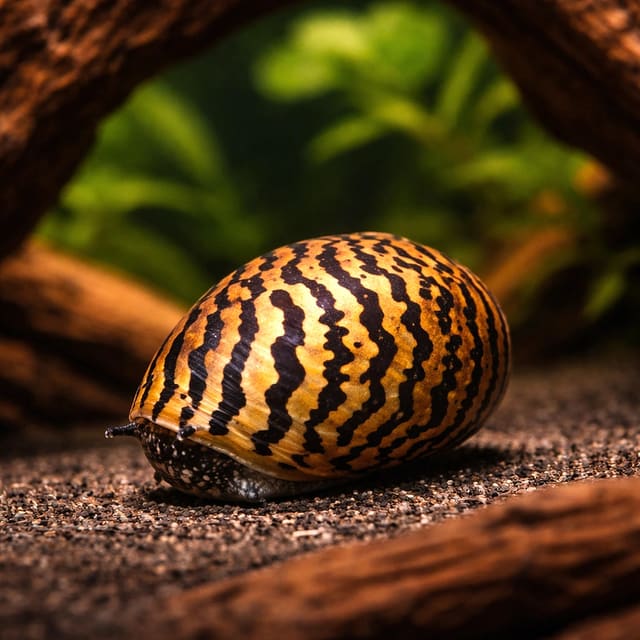
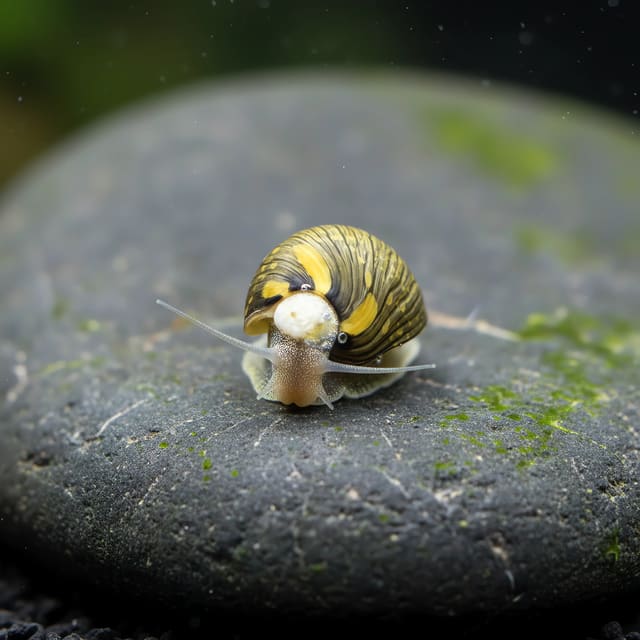
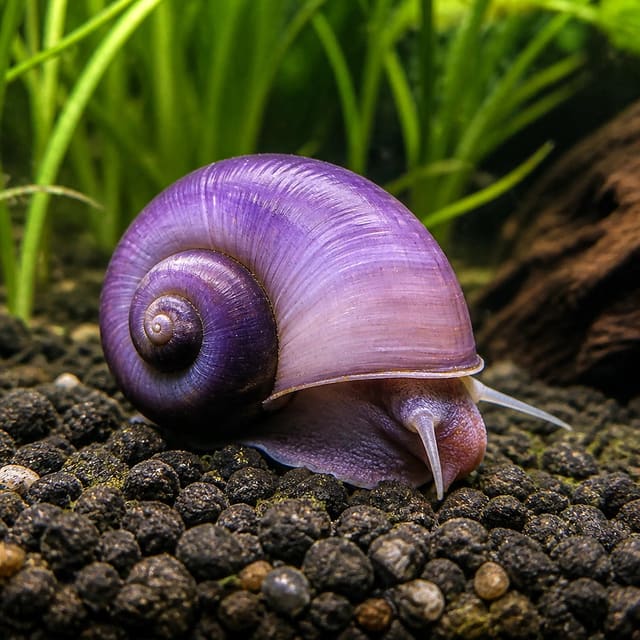
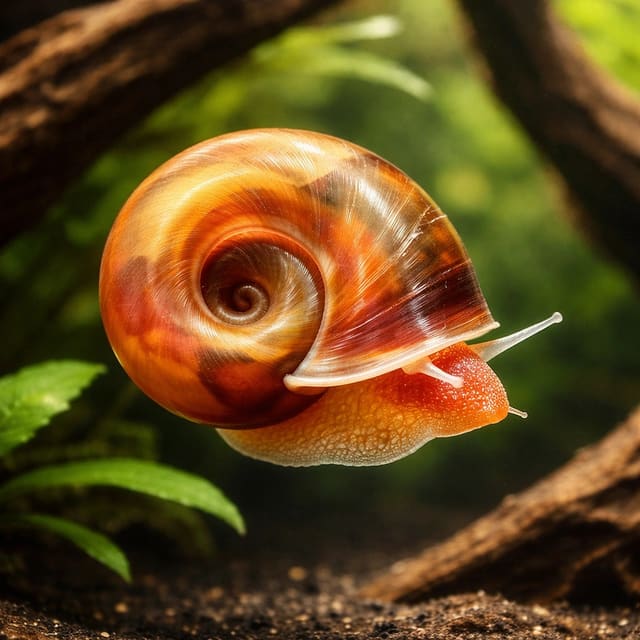
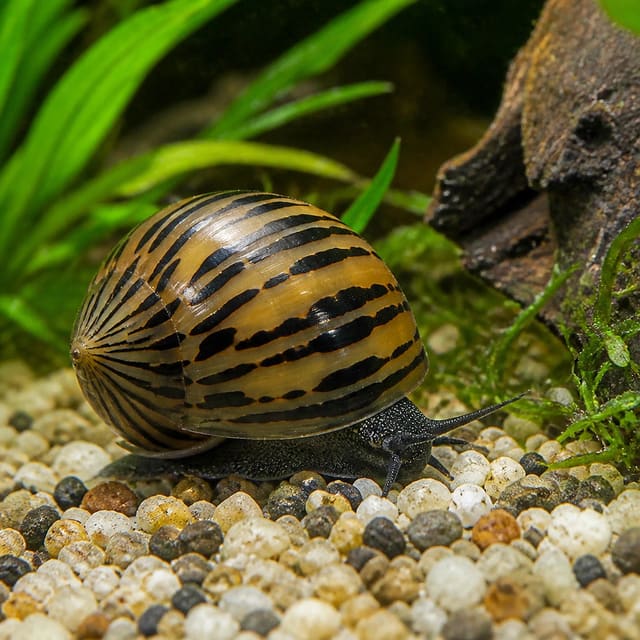
Batik Nerite Snail (Neritina sp.)
17–27°C · pH 6.5–8
£4.99

Assassin snails (Anentome helena) are banded Southeast Asian freshwater snails that hunt and eat other snails. Sold singly, they suit warm, mature tanks at 22 to 27 °C with sand to bury in, but they will also go after snails you want to keep and may take shrimp.
Anentome helena
Lives in groups: kept together they stay settled, active and show their best colour.
Assassin snails (Anentome helena) are banded Southeast Asian freshwater snails that hunt and eat other snails. Sold singly, they suit warm, mature tanks at 22 to 27 °C with sand to bury in, but they will also go after snails you want to keep and may take shrimp.
Maintain these water conditions for optimal health and vibrant colors
The assassin snail, Anentome helena, is a small freshwater snail from Southeast Asia with an unusual way of making a living: it eats other snails. That one habit is why most people come looking for it. When a planted tank fills up with tiny snails that arrived as hitch-hikers, a few assassins will work through them steadily, and once the easy meals run short they will take sinking foods instead. The same habit is also why some keepers are better off without one, and we would much rather say so at the top of the page than hear later that a prized nerite collection has been quietly eaten.
This listing is for single assassin snails. Each unit you add is one snail, so choose the number you want. They are not sold to a guaranteed size: snails go out at dispatch grade, which can be younger and smaller than the adult figures quoted further down, and they grow on in a settled aquarium. Males and females look identical from the outside, so we cannot sell sexed snails and we do not promise a breeding pair. If you would like to see eggs one day, keeping several snails gives you the best chance of having both sexes.
| Quick reference | Figure |
|---|---|
| Adult shell length | 18 to 32 mm in the wild, usually smaller in aquaria |
| Temperature we recommend | 22 to 27 °C |
| pH | 6.5 to 7.5 |
| General hardness | 5 to 15 °dGH |
| Smallest tank we suggest | 20 litres for a few snails |
| Diet | Snails, worms and carrion; takes sinking prepared foods |
| Sold as | One snail per unit, unsexed |
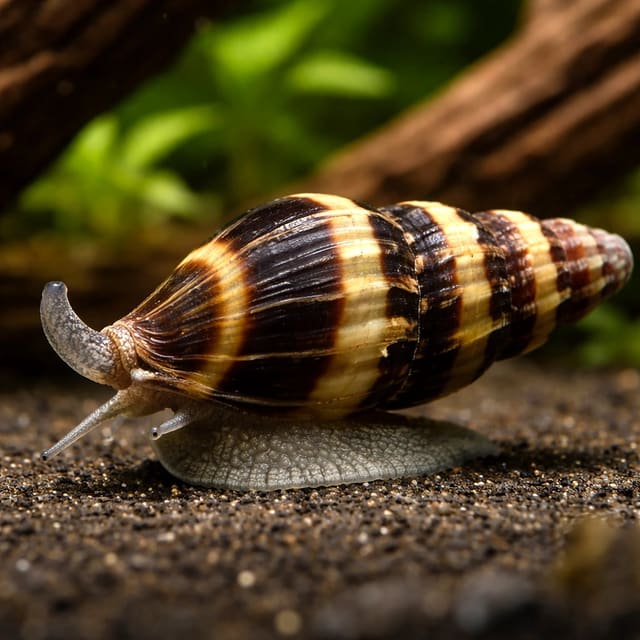
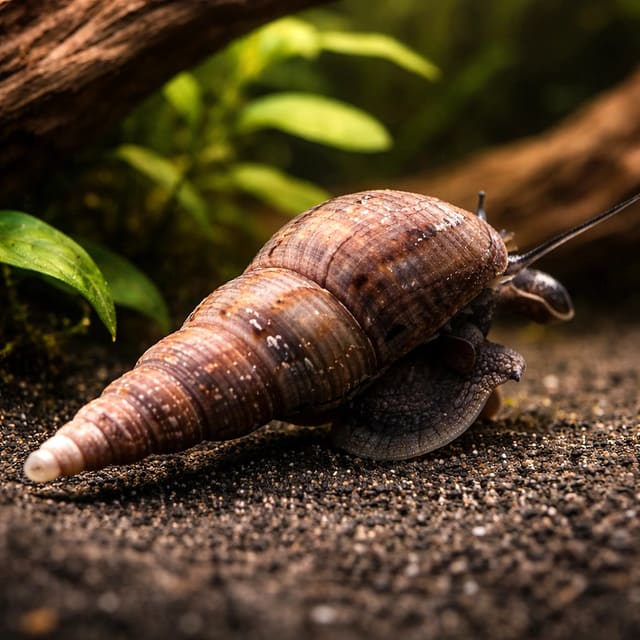
Once you have seen one, an assassin snail is hard to mistake. The shell is a tall, pointed cone, much taller than it is wide, and it is banded in alternating stripes of yellowish tan and dark chocolate brown that wind round each whorl. That striping is where the other shop name, bumblebee snail, comes from. Look closely and you will see strong, regularly spaced ribs running across the whorls from top to bottom, which give the shell a slightly corrugated feel. Wikipedia notes that some individuals have no banding at all and are brown all over.
The soft body is pale grey with fine darker speckling. Out in front of the head the snail carries a long, flexible tube held up like a snorkel. This is the siphon, and an assassin on the move usually has it raised and swinging from side to side. Two slender tentacles stick out beneath it. The photographs on this page show all of these features: the striped spire, the raised siphon, the twin tentacles and the long, mottled foot that the snail glides on.
Wikipedia gives an adult shell length of 18 to 32 mm for wild snails and notes that aquarium specimens are usually smaller. The Australian freshwater mollusc identification key, written by specialists for biosecurity work, quotes about 20 to 35 mm. We use the 3.2 cm upper figure on this listing as the adult maximum and treat the larger number as a wild record rather than something to expect in a home tank.
The name accepted by MolluscaBase, the world register for molluscs, is Anentome helena (von dem Busch, 1847), in the family Nassariidae. Many shops and older books still use Clea helena, which is the same animal under an earlier genus name. You may also see it sold as the assassin snail, bumblebee snail or snail-eating snail.
This is a fair question, and the honest answer is more interesting than most shop pages admit. In 2017 Strong, Galindo and Kantor compared assassin snails from across Southeast Asia using DNA and anatomy, and found that what had been called Clea helena is really a group of at least four separate species. The snail they examined from the aquarium trade matched populations from Thailand, which they labelled species A, and they doubted that any of their samples were the true helena described from Java in 1847. A 2023 study by James Dickey and colleagues confirmed that their pet-trade snails also belonged to that Thai lineage. Researchers in 2022 and 2023 still referred to the trade snail as Anentome sp. rather than giving it a formal name of its own, so Anentome helena remains the label the hobby uses, including us. Because both studies that checked pet-trade snails found the same Thai lineage, the striped snails in shops are probably one animal, even if the textbooks give it another name one day.
Assassin snails come from southern China and from the countries around the Sunda Shelf, the shallow sea floor that joins mainland Southeast Asia to Sumatra, Java and Borneo. Records cover Thailand, Vietnam, Malaysia, Sumatra and Java, and Wikipedia mentions Lake Toba in northern Sumatra among the places it is found. The 2017 study describes the group as living in the broad lower reaches of coastal rivers as well as in lakes and ponds, and notes its ability to cope with still water. The Australian identification key adds that it lives on sand and mud in the lower, freshwater parts of rivers.
That background explains almost everything about how the snail behaves in a tank. Soft sand and mud let it bury itself, and burying is how it hunts: Wikipedia describes it spending much of its time hidden in the substrate, often waiting to ambush prey. It is least active in the middle of the day but responds when food is about. Its recorded diet of snails, worms and carrion is exactly what a soft, muddy river bed offers.
Because it eats snails, this species is a real worry wherever it escapes. The 2017 study reported the trade lineage already established in the wild in Singapore, and warned that the aquarium trade is a significant threat to native snail faunas. Australian researchers point out that their country has no native freshwater snails that eat other snails, so an introduction there would be of major concern. Work published in 2023 found that cooler European summer water reduces how much an assassin eats, which suggests limited harm in the short term, but the same authors warned that warmer waters could change that.
The UK trade association, OATA, puts the rule simply: never release aquarium animals or plants into the wild, because it is illegal. If you ever end up with more assassin snails than you need, pass them on to another fishkeeper or ask a local aquatic shop for advice. Do not tip them into a pond, a stream or a drain.
Researchers describe these snails as non-selective predators and scavengers of a wide variety of other snails, including snails larger than themselves, and note that they may also feed on fish eggs and shrimp. The Australian key lists worms, snails and carrion. In other words, the assassin eats whatever small, slow, edible thing it can find on the bottom, with snails at the top of the menu.
Watching one at work is part of the fun. A hunting assassin moves across the sand with its siphon raised, often surfacing from the substrate when food is near. It eats the soft body, not the shell, so empty prey shells left lying on the sand are usually the first sign that the assassins have started work.
Dickey and colleagues (2023) offered assassin snails a small pulmonate snail, Physella acuta, at two temperatures: 22 °C, which they used as a recommended temperature for keeping the species, and 18 °C, a typical summer temperature for European lakes. The maximum feeding rate was significantly lower at 18 °C, and groups of two or three assassins also ate significantly less in total at the cooler temperature. The prey snails were just as active in both, so the drop came from the predators slowing down. For a fishkeeper, the lesson is straightforward: a warm tank gives faster results than a cool one.
We cannot tell you exactly how many snails your tank needs, and no published study gives a reliable ratio for home aquariums. It depends on the size of the infestation, the temperature and how much spare food there is. Our advice is to begin modestly, cut back on feeding, and add more only if after several weeks the pest population is clearly still rising.
The assassin snail is not demanding about tank size. We suggest at least 20 litres for a few snails, and they fit happily into an ordinary community aquarium. A larger volume of water is more stable, which matters for any snail because shells and soft tissue both suffer when conditions swing.
If there is one thing to get right, it is the floor of the tank. In the wild these snails live on sand and mud and spend much of their time buried, so sand or very fine, smooth gravel suits them best. Coarse, sharp gravel is much harder for a burrowing snail to work through. A bed deep enough for the whole shell to disappear under is ideal, and planted tanks with a capped soil or a sand foreground work well.
None of the published accounts of the assassin's diet mention plants, which makes it a sensible choice for planted aquascapes. Wood, smooth stone and plant bases all have a second use: females fix their egg capsules to solid surfaces and commonly at the base of plants, so if you are hoping for young it helps to have a few of these near the substrate. Leave some open sand in the foreground as well. That is where you are most likely to see the snails moving about and hunting.
Ordinary aquarium lighting suits them. Because they are least active in the middle of the day, you will usually see more of your snails in the evening, early morning and whenever food goes in, and less of them under full midday light.
We list the assassin snail at 22 to 27 °C, pH 6.5 to 7.5 and 5 to 15 °dGH. Those are comfortable working ranges for a tropical community tank, and they sit inside the general guidance OATA gives for aquarium snails: 17 to 27 °C, pH 6.5 to 8.0, general hardness 4 to 18 °dH and carbonate hardness 3 to 15 °dKH. Keep the water steady within those numbers and you have done most of the work.
The 2023 feeding study used 22 °C as a recommended keeping temperature and found feeding fell significantly at 18 °C. In practice a cool tank means sluggish snails that hunt less. We suggest keeping the heater set somewhere between 23 and 26 °C for a typical community tank, which is comfortable for the snails and the fish alike.
You may read elsewhere that assassin snails survive extraordinary temperatures. A 2022 study by Bodley and colleagues did find that snails acclimated at 25 °C only reached a coma-like state at about 11 °C on the cold side and 39.5 °C on the hot side. Those are laboratory limits measured to understand invasion risk. They are not a sign that the snail is happy at those temperatures, and they are not targets for an aquarium.
The same study found the snails tolerated salinity only up to about 5 parts per thousand, a little salt compared with sea water at roughly 35. Assassin snails belong in fresh water. Do not add aquarium salt as a routine tonic, and do not house them in brackish set-ups.
Invertebrates are very sensitive to copper. OATA warns that they will die if exposed even to low levels, so check every treatment, plant fertiliser and water conditioner before it goes into a tank with snails. If fish in the tank need a copper-based treatment, move the snails to a separate, mature set-up first.
A snail's shell is made of calcium carbonate, which acidic water slowly dissolves. That is one reason we suggest a pH of at least 6.5 and moderate hardness. Signs of shell trouble include a pitted, flaky or whitish surface and a shell lip that looks thin and ragged. If you see this, test pH, general hardness and carbonate hardness, and bring very soft or acidic water up gradually towards the middle of our ranges.
The natural diet of the assassin snail is other snails, worms and carrion. In an aquarium with a pest-snail population, that is exactly what it will eat first. The question most new owners ask is what happens next, once the snails it was bought to deal with have thinned out.
OATA notes that assassin snails will also feed on commercially made foods. A good sinking pellet or tablet, dropped where the snails can reach it, is the simplest staple. Because they scavenge in the wild, assassins also take meaty frozen foods once thawed, and frozen bloodworm is the one most keepers already have in the freezer. Because they respond to food, feeding time is often the best chance to see snails that have spent the day buried.
Fish usually get to sinking food before a snail does. If your assassins never seem to find anything, try dropping a pellet just after lights out, when the fish are settling and the snails are more active, or place it close to where you last saw them bury. The aim is a snail that is fed enough to stay healthy, not one so full that it stops hunting. A snail that has eaten well in the evening may stay buried the next day, and that is normal.
The single biggest factor in a pest-snail plague is spare food. If you have bought assassins to bring numbers down, look honestly at how much the fish are being given. Leftover flakes, pellets that roll under rocks and decaying plant leaves all feed the small snails you want to get rid of. Cutting back on these is as important as the assassins themselves, and together they work far better than either alone.
The assassin snail's reputation as a peaceful community animal is half true. Towards fish it is harmless in the published accounts, which describe a diet of snails, worms, carrion and possibly fish eggs and shrimp, with no mention of healthy fish. Towards other invertebrates it is a predator, and that should guide every stocking decision.
Peaceful tetras, rasboras, livebearers, small barbs, Corydoras-type catfish and similar community fish are fine to keep alongside assassins. The one caution concerns breeding: if your fish scatter eggs or spawn on the substrate, the snails may treat those eggs as food. The fish to avoid are those that eat snails. Dwarf (pea) pufferfish are the best-known example; Wikipedia describes them as one of the few aquarium fish that regularly eat small live snails, and an assassin is still a small live snail.
You will often read that assassins are shrimp-safe. We would put it more carefully. The 2017 study notes that they may feed on shrimp, so in a breeding colony full of tiny young and freshly moulted adults, an assassin is a risk we would not take. In a community tank with a few adult shrimp and plenty of cover the risk is lower, but you should accept that losses are possible.
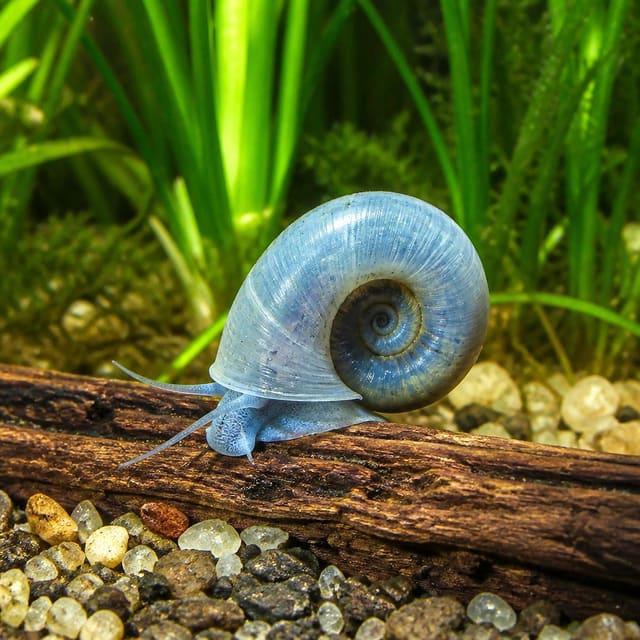
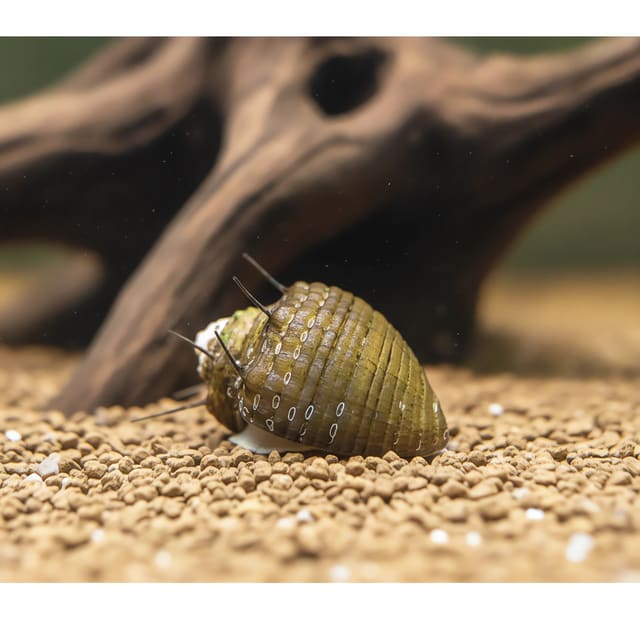
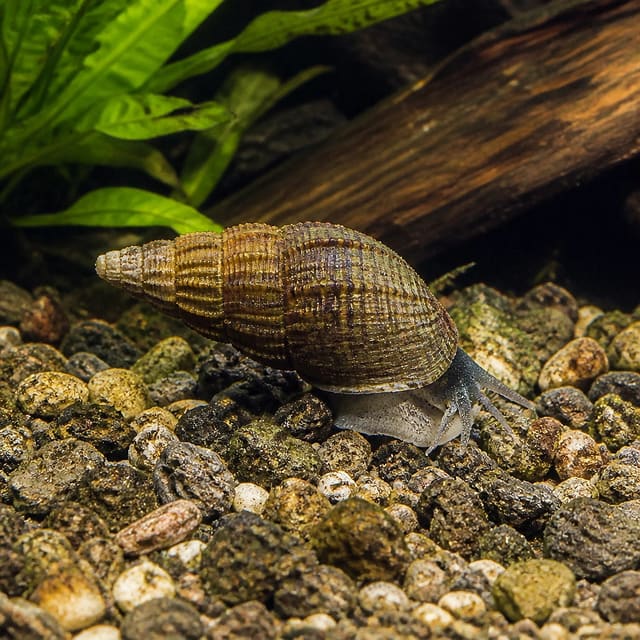
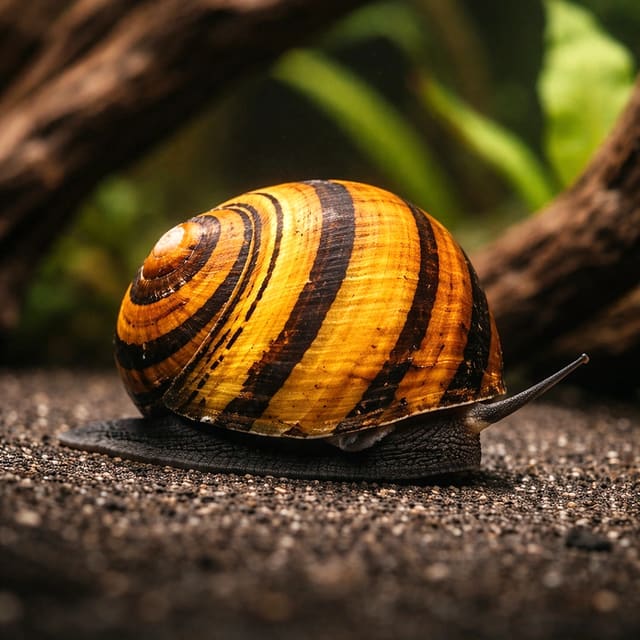
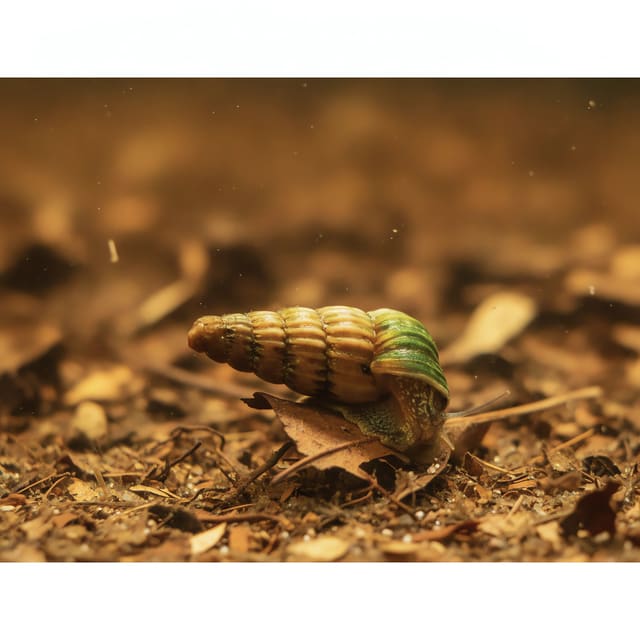
This is where most disappointments happen. Assassins eat a wide variety of snails, including snails larger than themselves. That covers the pest species you want gone, and it also covers the snails people buy deliberately. Algae-grazing nerites such as the Batik Nerite Snail, burrowing trumpet snails like the Malaysian Trumpet Snail and colourful ramshorns like the Blue Ramshorn Snail are all potential prey. If you want those snails, give them a tank of their own and keep the assassins elsewhere.
Assassins can be kept together. The 2023 study ran its trials with one, two and three snails sharing a container, and several in one aquarium is the usual way to keep them.
| Tank mate | Our verdict | Why |
|---|---|---|
| Peaceful community fish | Suitable | No record of the snail attacking healthy fish |
| Egg-scattering fish you hope to breed | Caution | Fish eggs are listed as possible food |
| A few adult shrimp in a community tank | Caution | Shrimp are listed as possible food; losses can happen |
| Shrimp breeding colonies | Avoid | Young and moulting shrimp are easy targets |
| Nerites, mystery, rabbit, ramshorn or trumpet snails | Avoid | Eats a wide range of snails, even larger ones |
| Dwarf pufferfish and other snail-eating fish | Avoid | They prey on small snails, including assassins |
Assassin snails have separate sexes. You need a male and a female for fertile eggs, and as males and females look identical there is no way to pick a pair by eye. If you would like a few young, keep a group of several snails and let them sort it out.
Each egg is laid in its own small, clear capsule that is roughly square, about 1.0 to 1.5 mm across, and each capsule holds a single small yellow egg. The Australian identification key notes that females lay several of these capsules on solid surfaces, commonly at the base of plants, so look on wood, stones, the aquarium glass close to the sand and around plant stems. They are easy to overlook at first. Once you know the shape, a neat little square with a yellow dot in the middle is unmistakable.
Wikipedia says fertile eggs usually hatch within a few weeks. You will read precise figures on hobby websites, but we have not found a published study we trust for typical aquarium temperatures, so treat a few weeks as the guide and be patient. Only fertile eggs hatch, so do not be discouraged if some capsules never do.
It is a common worry, and the biology is on your side. Each capsule contains only one egg, both sexes are needed, and a female lays several single capsules rather than a big clutch, all of which limits how fast numbers can grow. If you would still rather not have young, scrape capsules off the glass during routine maintenance.
A snail that hatches from a capsule barely more than a millimetre across is tiny and easy to miss. In a mature tank with small prey snails and the occasional sinking food, the best help you can give is stable water and an undisturbed substrate. Keep the filter intake covered with a sponge, avoid deep vacuuming of the sand while young are growing, and they will turn up on the surface once they are big enough to notice. Snails that grow up in your tank are a good sign that conditions suit the species well.
A little preparation before the parcel arrives makes the biggest difference to how quickly your snails settle. Please read our delivery and live-arrival information before ordering, and have the aquarium ready: filter running, water tested and the temperature where you want it. Someone must be at the delivery address to receive live animals, because they cannot be left on a doorstep.
Our livestock travels in oxygen-filled bags inside insulated packaging, with heat packs when conditions call for them, and goes with a tracked courier licensed to carry live animals. We email you the confirmed delivery date and the tracking details, so you know when to be in.
Please start a continuous video before you open the parcel, while it is still sealed, and keep filming in the same take until you have shown each animal in its still-sealed bag. If an animal arrives dead, dying or clearly compromised, email hello@tropicalfishco.co.uk on the day of delivery with your order number and that video. Photos on their own do not meet our policy. Where a claim is accepted, we resolve it by replacing the affected animal with your next order or refunding it, subject to our guarantee terms. Bear in mind that a snail withdrawn into its shell after a journey is not necessarily in trouble; give it time in the tank before judging.
New assassins often dig straight into the sand and disappear for a day or two, which is exactly what you would expect from a burrowing species and not a cause for alarm. Over the first week, watch for snails moving about in the evening, responding when food goes in and attaching firmly to surfaces. Offer a small amount of sinking food after a couple of days if there are no prey snails in the tank, and remove anything uneaten. If a snail stays motionless in the open for a long time, lies with its shell opening upward or gives off a bad smell when lifted out, take it out promptly and check your water readings.
These are the sources we used for the facts on this page. They are worth reading if you want to go further.
The 2017 study by Strong, Galindo and Kantor, which found that the name covers several species, was published in the open-access journal PeerJ under the title "Quid est Clea helena?". The 2022 thermal and salinity tolerance study by Bodley and colleagues appeared in Marine and Freshwater Research as "Assassins and apples".
No reviews for this item yet. Bought one? Honest reviews only, good or bad.
What customers say about ordering from us
I have a small group of long finned mountain minnows. So was delighted to be able to order ten of this variety to increase the genetics in my tank . The ones I recieved are healthy but it’s to early to give a verdict on wether they are of a long finned type since they are small currently.
Gordon Walker · 23 Sept 2026
100% success travel and "installation". Pleased with quality of purchase. The Siamese fighter a bit "shy" so have not yet seen him at his best yet but looking good. Happy customer. GG
George E Garratt · 21 Sept 2026
Reviews of our shop, collected by Judge.me, an independent third-party review collector. Newest first.