Easy
Parallel Nerite Snail (Neritina sp.)
17–27°C · pH 6.5–8
£4.99

The Ring Nerite Snail (Neritina sp.) is a freshwater aquarium gastropod in the nerite family, Neritidae. It suits a mature, filtered aquarium; OATA’s freshwater-snail guidance gives 17–27°C, pH 6.5–8.0 and 4–18°dH. Sold individually at an approximately 2 cm dispatch grade.
Neritina sp.
Lives in groups: kept together they stay settled, active and show their best colour.
The Ring Nerite Snail (Neritina sp.) is a freshwater aquarium gastropod in the nerite family, Neritidae. It suits a mature, filtered aquarium; OATA’s freshwater-snail guidance gives 17–27°C, pH 6.5–8.0 and 4–18°dH. Sold individually at an approximately 2 cm dispatch grade.
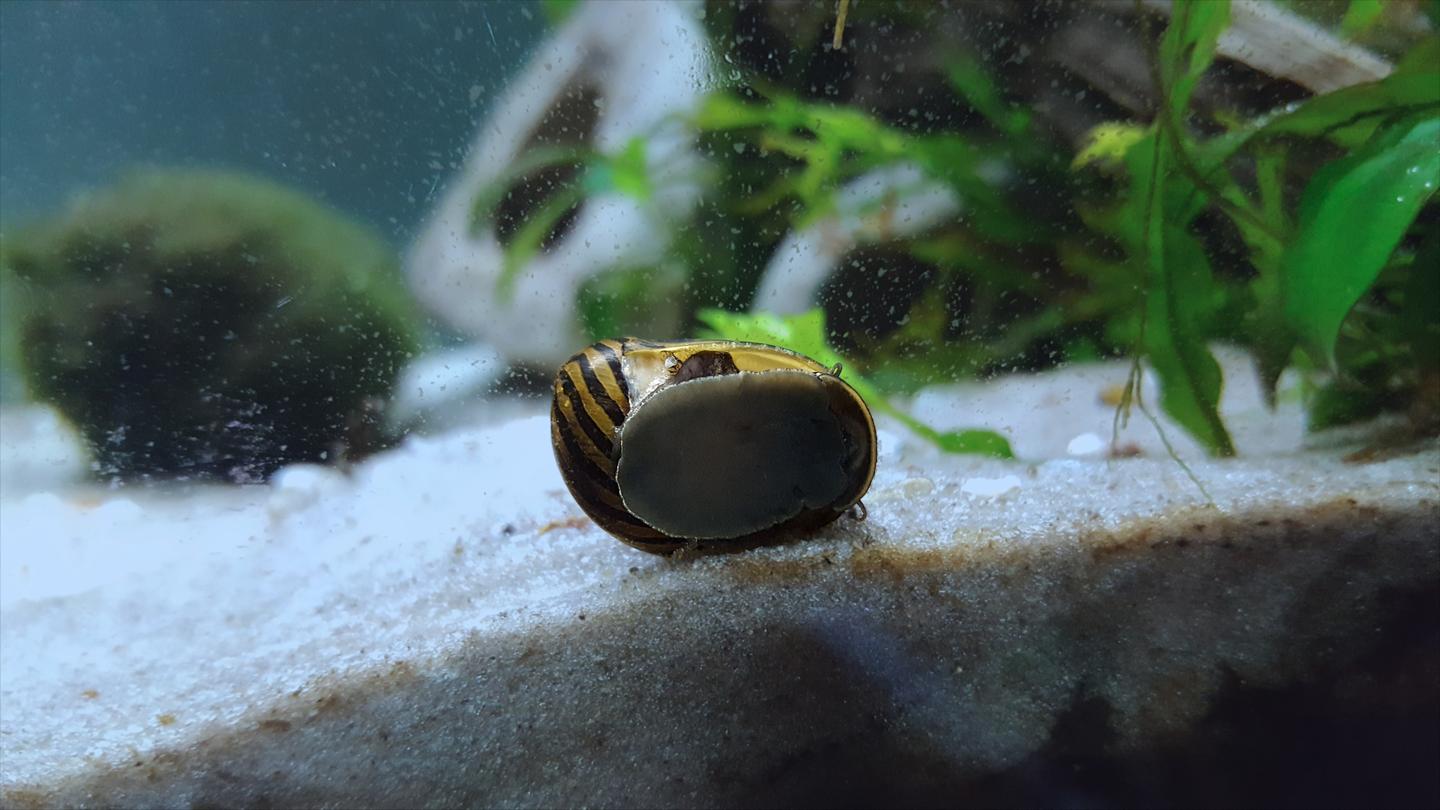
Nerite snail is a trade umbrella, not one species. Confirm the supplied taxon and holding water, use a mature covered aquarium with established grazing surfaces, stock from food availability rather than a litre formula, and treat egg capsules, medicines and tank mates as species-specific decisions.
Maintain these water conditions for optimal health and vibrant colors
The Ring Nerite Snail (Neritina sp.) is a small freshwater aquarium gastropod in the nerite family, Neritidae. WoRMS places Neritina in Neritidae, while the name used here identifies the genus without assigning a species. This animal suits a keeper who can provide a mature, filtered aquarium, measure the water regularly, offer supplementary food and exclude animals that eat snails.
The genus contains aquatic snails with an operculum, the firm structure used to close the shell opening. Wikipedia describes members of Neritina as gastropod molluscs found in marine, brackish and sometimes freshwater habitats. This offer is for a freshwater aquarium snail, but the genus-level identity should guide every care decision: do not attach the distribution, adult length or specialised biology of one named species to this animal.
Plan around stable husbandry rather than treating the snail as aquarium equipment. Freshwater snails graze algae, but their food still needs active management. A mature surface can carry edible growth that is difficult to see, while a visually clean aquarium can become short of grazing. Testing and filtration also remain essential after the animal begins moving across the glass or décor.
The exact species has not been identified, so the care advice here follows the genus Neritina and its care group.
One purchase supplies one live Ring Nerite Snail. The dispatch grade is approximately 2 cm, which describes the animal at dispatch rather than its eventual adult length. Plan the aquarium for a grown snail, not for the size it arrives at.
Sex is guaranteed only when the selected option explicitly states male or female. This Ring Nerite Snail listing has no sex-guaranteed option.
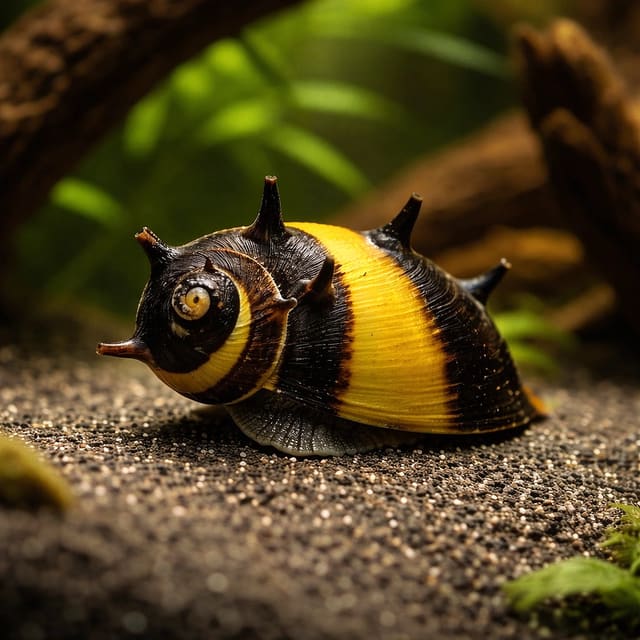
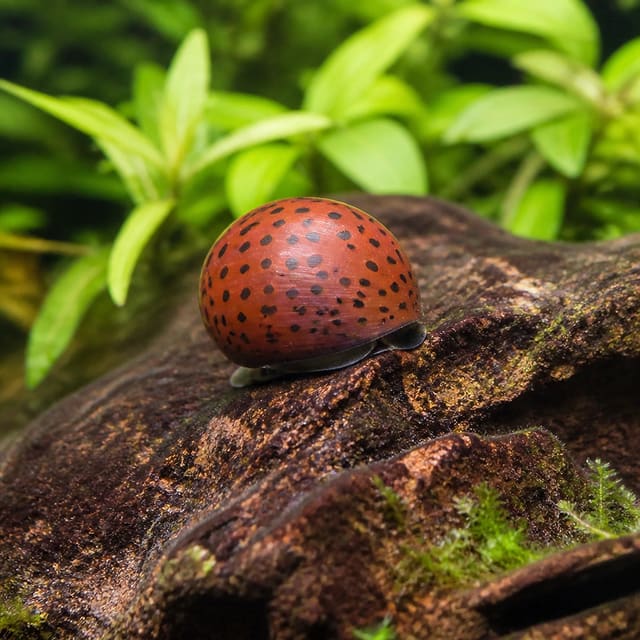
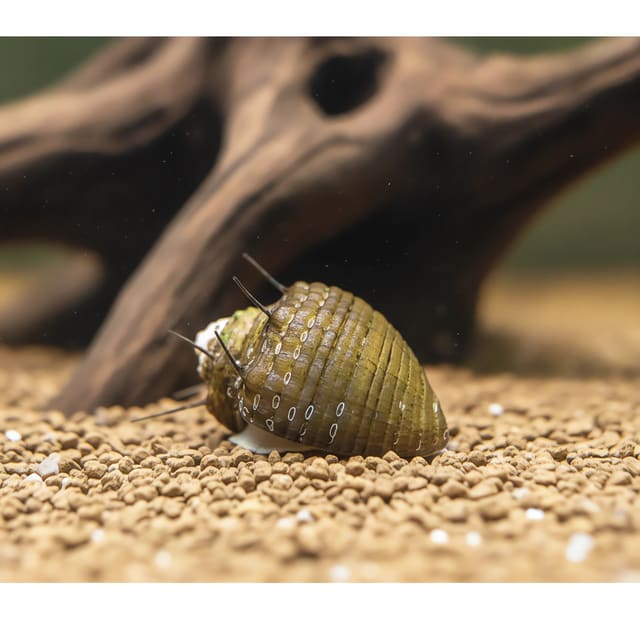
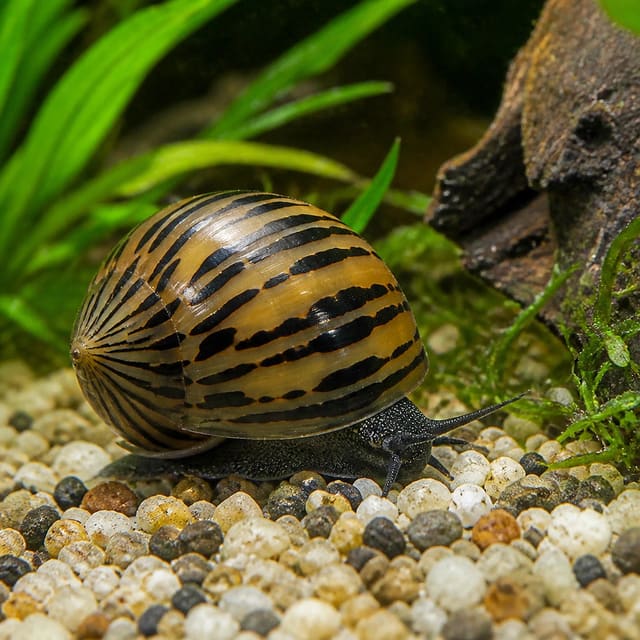
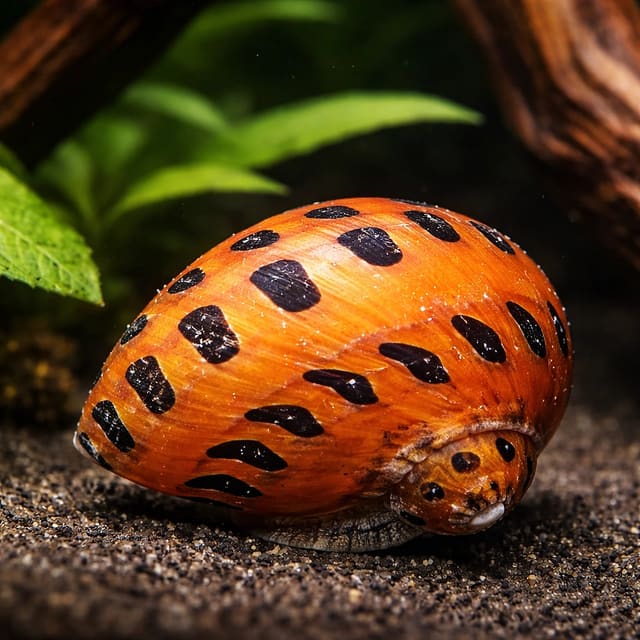
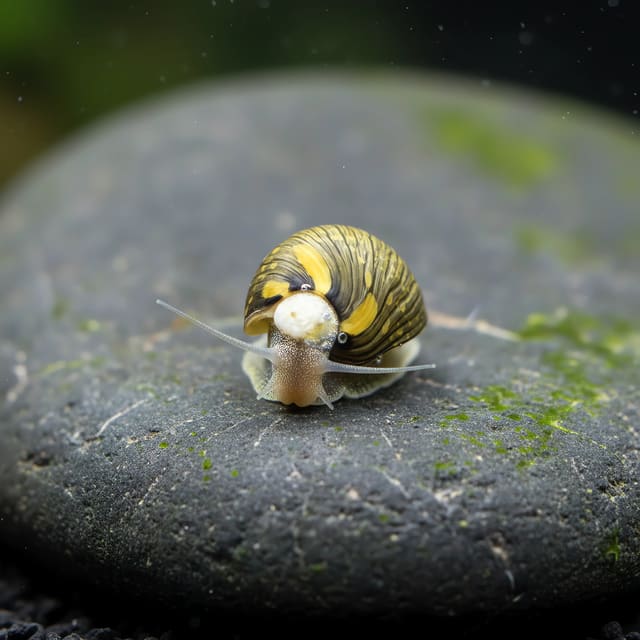
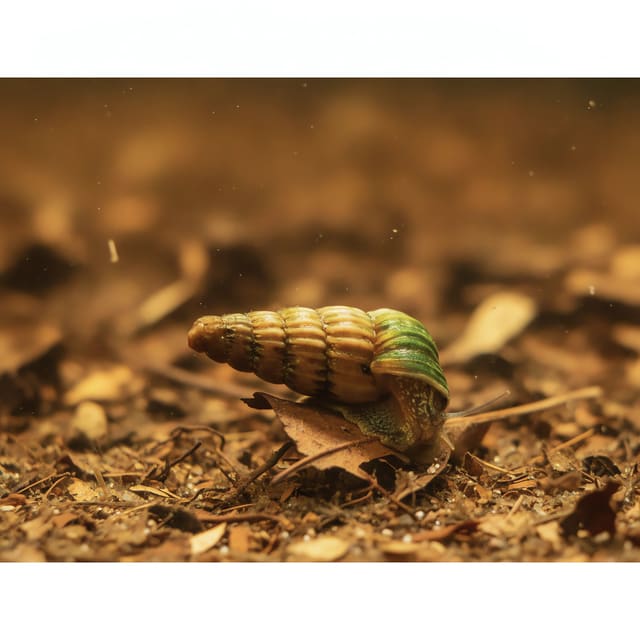
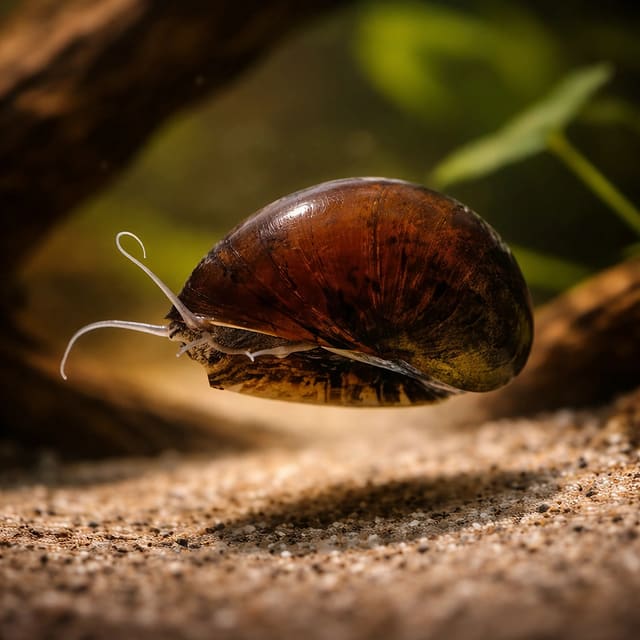
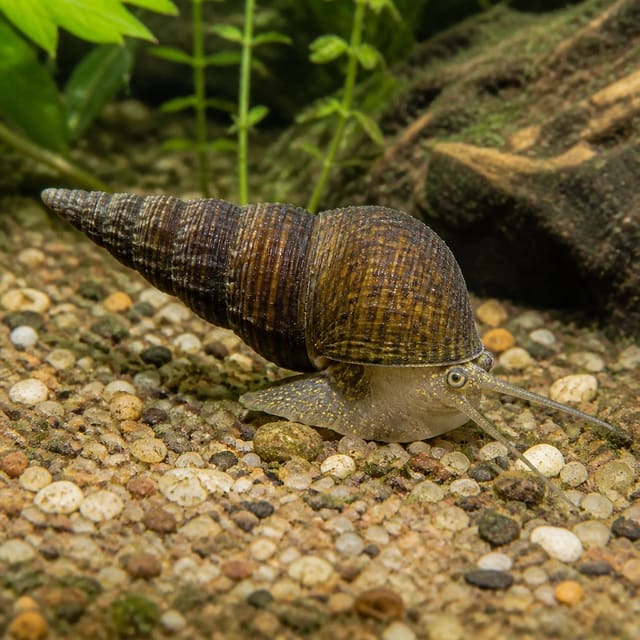
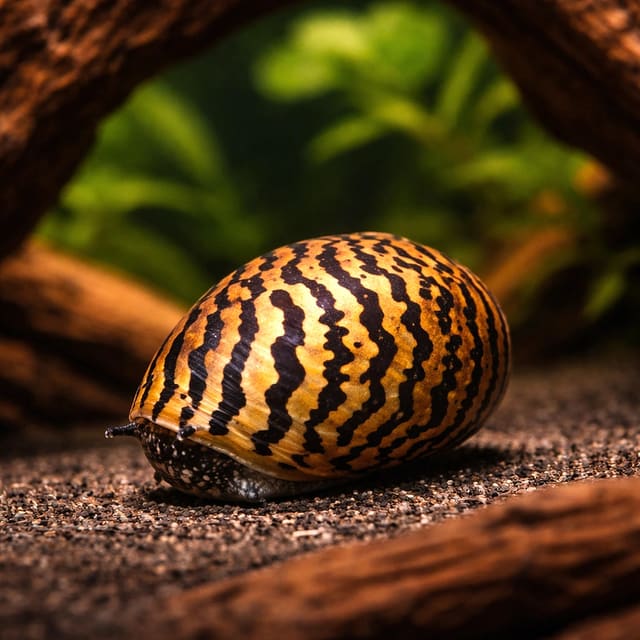
The gallery images are representative of this type of animal rather than photographs of the exact animal supplied, so colours can look slightly different from the live animal.
| Offer detail | What to plan for |
|---|---|
| Purchase unit | One live snail |
| Dispatch grade | Approximately 2 cm |
| Scientific label | A Neritina genus identity |
| Sex | No sex guarantee |
| Gallery | Representative animals, not the individual sent |
Prepare the aquarium for one additional living animal before ordering. Adding even a small inhabitant increases the load handled by the biological filter, and adding several animals too quickly can outpace the beneficial bacteria that process waste. If you intend to keep several snails, build the number gradually and make sure grazing and supplementary food remain accessible after each addition.
The approximately 2 cm grade should be used for receiving and handling expectations only. Do not use colour, shell pattern, the dispatch measurement or a gallery image to infer sex, age, origin or a named species.
Choose this snail for a mature freshwater aquarium with an established filter, measurable water chemistry and a feeding plan that does not depend on visible algae alone. OATA describes freshwater shrimp and snails as popular aquarium inhabitants that help control nuisance algae, while warning that common aquarium fish may eat them. The right setup therefore combines water quality, food and protection from predators.
A new or unstable aquarium is a poor match. Ammonia and nitrite must both remain at 0 mg/L, and the filter must already support the aquarium’s normal biological load. Mature plants, gravel or sand and aquarium-safe ornaments create usable surfaces and cover, but they do not replace filtration or regular testing.
| Suits | Not suited to |
|---|---|
| A mature, filtered freshwater aquarium | An aquarium with measurable ammonia or nitrite |
| A keeper who tests at least weekly | A setup relying on appearance instead of water tests |
| A planned algae-wafer feeding routine | A tank expected to provide unlimited algae |
| Communities screened for snail predation | Pufferfish or loaches |
| Invertebrate-safe treatment choices | Exposure to copper |
If you are comparing patterns and trade forms, browse the nerite snail collection. Compare each animal’s identity and care independently rather than assuming that every nerite trade name represents the same species.
Mature the aquarium before the snail arrives and have the weekly routine established first. Every part of that routine is needed: test the water, maintain the filter, control feeding and screen every companion for predatory behaviour.
Use an aquarium of at least 10 litres when planning for a group of small freshwater snails, and increase the volume when fish share the system. OATA’s freshwater shrimp and snail sheet gives that minimum for the care group and explains that larger aquaria provide more stable temperature and water quality. Treat 10 litres as a floor for the small-snail group, not as a formula for filling every aquarium to the same density.
Volume is only one part of the decision. The aquarium also needs a functioning filter, established beneficial bacteria, suitable substrate and enough usable surfaces for grazing. OATA says the tank should have aquarium gravel or sand and ideally live plants for cover. If live plants are not used, add plastic plants and suitable ornaments such as plant pots or model caves.
Increase the number of animals slowly. Beneficial bacteria need time to respond whenever livestock and feeding increase; moving too quickly can cause new tank syndrome, with ammonia or nitrite rising beyond the filter’s present capacity. Test after each addition and delay the next addition if either compound appears.
The guide to preparing and maturing a first invertebrate aquarium can help organise setup tasks before livestock arrives. Check temperature, pH, hardness, ammonia and nitrite against the freshwater-snail ranges before the snail is added.
If the aquarium is at least 10 litres but the filter is immature, wait. If it is mature but contains a fish that eats snails, choose a different community plan. If filtration, water, food and compatibility all pass, add the snail without making several other livestock changes at the same time.
Keep the aquarium at 17–27°C, pH 6.5–8.0 and 4–18°dH. These are OATA’s broad values for freshwater shrimp and snails and should be used as stable planning limits for this genus-level animal. Carbonate hardness for the group is 3–15°dKH.
Ammonia and nitrite must remain at 0 mg/L. Nitrate should not exceed 20 mg/L above the normal level in the tap water used for the aquarium. Record the tap-water result as well as the aquarium result so the nitrate limit can be interpreted correctly.
| Measure | Instruction |
|---|---|
| Temperature | Keep between 17°C and 27°C |
| pH | Keep between 6.5 and 8.0 |
| General hardness | Keep between 4°dH and 18°dH |
| Carbonate hardness | Keep between 3°dKH and 15°dKH |
| Ammonia | Maintain 0 mg/L |
| Nitrite | Maintain 0 mg/L |
| Nitrate | No more than 20 mg/L above the tap-water level |
Choose a stable point inside each range that also works for every other inhabitant. A value sitting inside the range today does not excuse a sudden change tomorrow. Test after livestock additions, unusual feeding, filter disruption or an unexpected change in behaviour, because each can coincide with deteriorating water quality.
Use the aquarium water chemistry guide to understand what the measurements mean, then enter the measured results in the Water Parameter Matcher to compare them with this range. A comparison is useful only when the aquarium and source water have actually been tested.
Run a filter continuously and keep it free from blockages. OATA states that a filter is always essential for freshwater shrimp and snails. The RSPCA also explains that biological filtration supports bacteria which convert toxic ammonia to nitrite and then to the safer nitrate stage.
A filter is more than a device moving water. Its mature media houses the bacterial population needed to process routine waste. Replacing or washing away too much of that population can reduce the aquarium’s capacity even when the water still looks clear.
Chlorine or chloramine in tap water may kill the beneficial bacteria living in the media. Treat replacement tap water with an appropriate conditioner before it enters the aquarium, and use removed aquarium water for the light media rinse.
Do not judge biological performance from flow alone. A filter may move water while ammonia or nitrite is present, so combine flow checks with at least weekly testing. Conversely, an unexpected reading should prompt a repeat test and a check of the filter, recent feeding and recent livestock additions.
| If you notice | Do this |
|---|---|
| Reduced filter flow | Check for a blockage and rinse media lightly in removed tank water |
| Ammonia above 0 mg/L | Stop adding livestock and restore safe water quality |
| Nitrite above 0 mg/L | Treat it as a filtration or stocking warning |
| A planned livestock increase | Add slowly and test as bacterial demand rises |
| Normal-looking clear water | Continue testing; clarity is not a chemical reading |
Keep the filter plan appropriate to the whole aquarium. Fish and extra invertebrates add waste and feeding demand, and OATA says the aquarium will need to be larger when snails are kept with any fish.
Let the snail graze algae in the aquarium and supplement that food with algae wafers. OATA describes freshwater shrimp and snails as generally herbivorous grazers, and commercial pellets made for freshwater shrimp can also be used for snails.
Feed only two or three times a week. Offer a modest amount that the animal can reach, leave pellets or wafers for at least 30 minutes, and watch whether they are being eaten. Avoid piling in extra food simply because the snail has not reached it immediately.
| Food | How to use it |
|---|---|
| Aquarium algae | Allow routine grazing on established surfaces |
| Algae wafer | Use as the main planned supplement |
| Commercial shrimp pellet | Use as an alternative commercial food suitable for snails |
| Uneaten food | Prevent it accumulating and breaking down in the aquarium |
Overfeeding creates a water-quality problem. Uneaten food breaks down and releases toxic waste into the water, increasing the burden on the biological filter. This is particularly important in a small aquarium, where a feeding mistake affects a smaller volume of water.
Visible algae should not be treated as a permanent ration. Grazing can reduce it, and other inhabitants may compete for the same material. Maintain the two-or-three-times-weekly feeding routine while using observation to adjust the portion, not the frequency stated for the group.
If the wafer remains untouched, first confirm that the snail can physically reach the feeding place and that fish are not removing the food. Check ammonia, nitrite and temperature before offering a larger portion. A change in food intake can be a health warning, while more uneaten food can worsen the water.
If food disappears rapidly, do not assume the snail ate all of it. Observe which inhabitants reach the feeding point. Where several animals compete, distribute an appropriate total amount so the snail has access without increasing waste.
Keep some established grazing surfaces during cleaning, but continue normal waste removal. The aim is a fed animal in clean, stable water, not an aquarium left dirty in the hope that every deposit is edible.
Change 25% of the aquarium water at least once every week. Test the water at least weekly as well, with particular attention to ammonia and nitrite remaining at 0 mg/L.
Treat replacement tap water with conditioner to remove harmful chlorine or chloramine before adding it. Keep the replacement water suitable for the aquarium’s established temperature and chemistry so routine maintenance does not push the system outside the 17–27°C, pH 6.5–8.0 and 4–18°dH ranges.
The nitrate reading needs context. OATA’s limit is no more than 20 mg/L above the normal tap-water level, so test the source water periodically rather than judging the aquarium result in isolation.
| Weekly checkpoint | Passing result |
|---|---|
| Ammonia | 0 mg/L |
| Nitrite | 0 mg/L |
| Nitrate | No more than 20 mg/L above tap water |
| Filter | Operating without blockage |
| Feeding | Food eaten without persistent accumulation |
| Snail | No concerning change in normal activity, colour, appearance or feeding |
Do not add several animals immediately after maintenance simply because the water has been changed. Stocking increases should remain gradual so the filter’s bacterial population can grow with the increased waste and feeding demand.
Prepare the aquarium before the parcel arrives: confirm that the filter is operating and that ammonia and nitrite are 0 mg/L.
Use the delivery and Live Arrival Guarantee policy for the arrival process. The animal is hand-bagged in oxygen and packed in an insulated box, with a heat pack when the weather calls for it. Someone must be at the delivery address to receive the parcel.
Film every delivery from the sealed parcel onward. The continuous sequence preserves the information needed if a Live Arrival Guarantee claim is required, while also ensuring that the condition inside the unopened bag is recorded before acclimatisation.
If there is an arrival problem, contact us the same day with the order number and the short continuous unboxing video. Keep the animal in the sealed bag until its condition has been filmed, then float the bag for 20–30 minutes before releasing it.
The 20–30 minute instruction concerns floating the bag before release. It does not replace the aquarium’s ongoing requirements for 17–27°C, zero ammonia, zero nitrite and a functioning biological filter. Complete those checks before the parcel is opened so the snail is not waiting while equipment or water problems are corrected.
Learn the animal’s normal pattern of activity and feeding, then respond when that pattern changes. OATA advises watching freshwater shrimp and snails for increased inactivity, restlessness, unusual behaviour, darker or paler colour, increased hiding, changes in breathing, lesions, discolouration, abnormal growths, swelling, weight change or reduced interest in food.
One observation should lead to checks rather than an improvised treatment. Test ammonia and nitrite first because both must be 0 mg/L. Confirm temperature, inspect filter flow, review recent feeding and check whether another inhabitant is disturbing or trying to eat the snail.
| If you see | First action |
|---|---|
| Unusual inactivity | Test ammonia, nitrite and temperature |
| Restlessness or unusual movement | Check water quality and tank-mate behaviour |
| Darker or paler colour | Compare with its normal appearance and test the water |
| More hiding | Look for predation pressure and environmental change |
| Lesions or discolouration | Review water, treatments and physical hazards |
| Reduced feeding | Check access to food before increasing the portion |
A failed ammonia or nitrite test requires immediate husbandry action. Pause additions, restore safe water through appropriate maintenance and confirm that the biological filter is operating. Do not mask the warning by adding more food or moving another animal into the aquarium.
Check that every proposed product is safe for invertebrates before it enters the aquarium. Freshwater snails are highly sensitive to copper and will die if exposed even to low levels. A product selected for fish must still be suitable for every invertebrate sharing the water.
When activity, appearance or feeding continues to deteriorate after the basic checks, contact us for help interpreting the change and the measured water results. Include the aquarium volume, temperature, pH, hardness, ammonia, nitrite, recent maintenance, food offered and the other animals present so the next decision is based on concrete conditions.
Avoid pufferfish and loaches. OATA states that snails should not be mixed with fish that can eat them and names pufferfish and loaches as examples. This exclusion belongs at the start of the compatibility decision, not after a trial introduction.
Freshwater shrimp and snails are generally compatible with many aquarium species, but common aquarium fish may eat them. Use that uncertainty as a screening rule: identify every proposed companion, check whether it eats snails and reject the combination when predation is part of its feeding behaviour.
| Companion category | Decision |
|---|---|
| Pufferfish | Avoid |
| Loaches | Avoid |
| Other snail-eating fish | Avoid |
| Other aquarium species | Screen for predation and matching care |
Do not approve a companion from a broad label such as community fish. The useful question is whether the exact animal eats freshwater snails and whether its water needs fit the aquarium. A fish may fit the temperature range while failing the predation check, and passing one part never overrides failure in the other.
Account for the larger aquarium needed when fish are included. OATA recommends at least 10 litres for a group of small freshwater shrimp or snails and says the aquarium needs to be larger when they are kept with fish. Use filtration capacity, total livestock and gradual introduction alongside litres when planning the final community.
For an unusual or mixed community, check every proposed companion by its exact name for snail predation and confirm that the aquarium volume and measured water values suit every animal.
Use only treatments that are safe for the invertebrates in the aquarium. OATA warns that freshwater shrimp and snails are very sensitive to copper and will die when exposed even to low levels. This makes treatment compatibility part of the stocking decision, not an issue to consider only after illness appears.
Check the instructions for the exact product before dosing. A medicine, algaecide or other aquarium treatment chosen for fish must also be suitable for the Ring Nerite Snail. If the label does not authorise use with the invertebrates present, do not add it to their water.
Changes in behaviour or appearance should begin with water tests and observation, not an automatic treatment. Ammonia, nitrite, temperature, filter flow, recent additions, feeding and predation pressure all provide immediate checks that do not expose the snail to a speculative chemical.
| Situation | Safe decision |
|---|---|
| Product contains copper | Do not expose freshwater snails |
| Invertebrate safety is clearly authorised | Follow the product instructions exactly |
| Ammonia or nitrite is detected | Correct husbandry and filtration rather than masking the reading |
| Fish treatment is planned | Check the effect on every invertebrate first |
Compatibility also includes the maintenance routine. Every inhabitant must tolerate the same conditioned replacement water, weekly 25% water change and stable chemistry. A community that requires conflicting water or treatment conditions needs a different stocking plan even when none of its fish is known to eat snails.
The Ring Nerite Snail is dispatched at approximately 2 cm. Plan the aquarium, filtration and companions for a grown snail rather than the size supplied.
OATA recommends an aquarium of at least 10 litres for a group of small freshwater snails and says it will need to be larger when fish are included. A mature biological filter, 0 mg/L ammonia and 0 mg/L nitrite are essential at every volume.
One can be kept alone because OATA describes freshwater snails as non-social animals. Add further snails slowly so the biological filter and feeding routine can adjust to the increased load.
Choose it only when the aquarium is already mature and filtered, you can test the water at least once a week and feed algae wafers only two or three times a week, and no fish that can eat snails will share the tank.
It grazes algae and should receive supplementary algae wafers or suitable commercial shrimp pellets. OATA says freshwater shrimp and snails should only be fed two or three times a week, with pellets or wafers left for at least 30 minutes.
OATA’s freshwater-snail guidance gives 17–27°C, pH 6.5–8.0 and general hardness of 4–18°dH. Keep ammonia and nitrite at 0 mg/L and avoid sudden changes within those ranges.
The risk runs the other way: common aquarium fish may eat freshwater snails. Screen every fish for snail predation instead of relying on a broad community label.
It may share an aquarium with species that do not eat snails and whose water and treatment needs overlap. Avoid pufferfish, loaches and any other fish that can eat snails.
The Ring Nerite Snail is hand-bagged in oxygen and packed in an insulated box, with a heat pack when the weather calls for it. Be present to receive it, film continuously from the sealed parcel, float the bag for 20–30 minutes and never pour the bag water into the aquarium.
No reviews for this item yet. Bought one? Honest reviews only, good or bad.
What customers say about ordering from us
I have a small group of long finned mountain minnows. So was delighted to be able to order ten of this variety to increase the genetics in my tank . The ones I recieved are healthy but it’s to early to give a verdict on wether they are of a long finned type since they are small currently.
Gordon Walker · 23 Sept 2026
100% success travel and "installation". Pleased with quality of purchase. The Siamese fighter a bit "shy" so have not yet seen him at his best yet but looking good. Happy customer. GG
George E Garratt · 21 Sept 2026
Reviews of our shop, collected by Judge.me, an independent third-party review collector. Newest first.