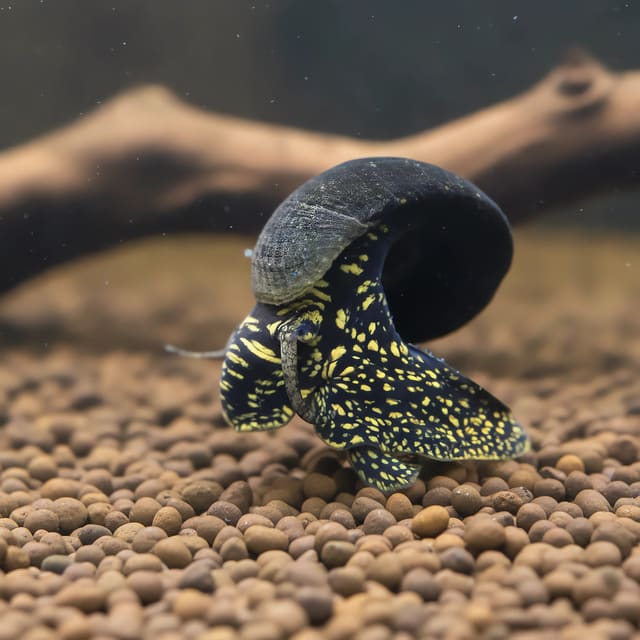
Yellow Spotted Rabbit Snail (Tylomelania sp.)
17–27°C · pH 6.5–8
£18.99

Add a Giant Tower Cap Snail to your tank for natural scavenging and extra interest. Moderate care and suited to peaceful freshwater setups. Order today.
Adult size is the maximum length this species reaches at full maturity (scientific sources). The livestock you receive will be younger and smaller — pick a size above for the actual shipping size. Product-photo provenance and any image-specific limitations are stated on the listing.
Brotia herculea
Lives in groups: kept together they stay settled, active and show their best colour.
Confirm your email, then we’ll send an availability message for this exact item if it returns within 180 days.
This request is only for this product—no newsletter or other promotions. A mail-provider retry may very rarely duplicate the same availability message. Unconfirmed addresses are removed after 48 hours. See our privacy policy.
Add a Giant Tower Cap Snail to your tank for natural scavenging and extra interest. Moderate care and suited to peaceful freshwater setups. Order today.
Adult size is the maximum length this species reaches at full maturity (scientific sources). The livestock you receive will be younger and smaller — pick a size above for the actual shipping size. Product-photo provenance and any image-specific limitations are stated on the listing.
Maintain these water conditions for optimal health and vibrant colors
The Giant Tower Cap Snail, Brotia herculea, is one of the most striking freshwater snails UK keepers can add to a display. With its tall, sculptural shell, calm nature, and useful grazing habits, this species stands out among aquarium snails UK as both a display animal and a practical clean-up helper. Native to Southeast Asia and reaching an impressive adult size of around 8 cm, this is a true giant compared with many other freshwater aquarium snails UK hobbyists keep. It is widely regarded as one of the best freshwater snails for aquarium setups where you want visible invertebrate activity without aggression. Because it is hardy and adaptable once established, it is also one of the more beginner friendly aquarium snails for medium to large tanks, provided you can supply stable, mineral-rich water.
If you are researching buy aquarium snails UK, buy aquarium snails online UK, or wondering where to buy aquarium snails UK, the Giant Tower Cap is a species worth serious attention. It is peaceful, long-lived, and especially appealing in planted aquariums with wood, stone, and open grazing surfaces. For aquarists looking for live snails for aquarium UK, aquarium snails UK for sale, or one of the best aquarium snails UK for natural algae control, this species offers size, character, and utility in one unusual package. It compares favourably with the more common types of aquarium snails UK precisely because of its scale and architecture.
Brotia herculea is a freshwater gastropod with an operculum, meaning it can close its shell opening for protection. In the aquarium hobby it sits apart from more common nerites, ramshorns, and mystery snails because of its tall turreted shell and larger adult size. It is a riverine species from Southeast Asia and has become popular with keepers who want unusual aquatic snails UK rather than the usual small clean-up crew species.
The Giant Tower Cap Snail comes from Southeast Asia, with records linked to Thailand and nearby regional river systems. In the wild, its tower cap snail habitat is typically mineral-rich flowing water with biofilm-covered surfaces and steady access to natural plant matter. Like most Brotia, it is a river snail rather than a still-water species, which shapes how it should be kept indoors.
This is one of the more unusual tropical snails UK keepers can maintain, and it is best suited to a heated, mature aquarium. Because it originates from warmer waters, stable conditions matter far more than seasonal change. It benefits from access to calcium and moderate hardness, reflecting the mineral support that riverine snails rely on in the wild. For aquarists browsing aquatic snails for sale UK, freshwater snails for sale UK, or freshwater aquarium snails for sale UK, understanding the natural origin helps explain why this species thrives best in a settled, well-established setup rather than a freshly filled tank.
In nature, these snails spend much of their time moving slowly over hard surfaces, wood, and substrate in search of algae films, soft decaying plant material, and edible detritus. Their shell form is adapted to life in freshwater habitats where cover and mineral access are important, which is why a tank with stones, wood, and a stable mineral balance suits them so well.
Mimicking natural habitat improves shell quality and activity. A mature tank with biofilm, mineral-rich water, smooth stones, wood, and a calm bottom zone will usually produce better grazing behaviour than a bare, over-sanitised setup.
The ideal Giant Tower Cap Snail tank requirements are simple but specific. Although the official minimum is 40 litres, that is best treated as the floor rather than the goal. Because this is a large snail with a substantial shell and noticeable waste output, a larger aquarium gives better stability and more grazing area. If you are researching tower cap snail tank size, a 60-90 litre aquarium is usually a more comfortable long-term choice, especially in a mixed community or planted display.
A single adult can live in 40 litres, but more space makes maintenance easier and gives the snail more room to forage. Because of its adult size, this is not the obvious answer for keepers searching freshwater snails for small tanks or a tower cap snail for nano tank, since it grows much larger than common ramshorns or nerites. It can technically fit a 10-gallon system, so the idea of freshwater snails for 10 gallon tank is not wrong for this species, but only with light stocking and excellent water quality.
The recommended Giant Tower Cap Snail water parameters are 22-28°C, pH 7.0-8.0, and hardness 5-15 dGH. The ideal Giant Tower Cap Snail water temperature for routine care is around 24-26°C. The preferred Giant Tower Cap Snail pH level is neutral to slightly alkaline, and tower cap snail water hardness should never be allowed to fall too low, as soft, acidic water leads to shell erosion over time.
These Giant Tower Cap Snail aquarium conditions are especially important for shell strength. The species has genuine tower cap snail calcium requirements, so regular access to calcium-rich foods, mineral supplements, or naturally hard water is strongly recommended. If shells look chalky, pitted, or thin at the tip, the first things to check are pH, hardness, and calcium availability.
People often ask do freshwater snails need a filter, and for this species the answer is yes. A sponge filter, hang-on-back filter with a guarded intake, or gentle internal filter all work well. The goal is not strong current but stable oxygenation and reliable waste processing. Snails are sensitive to poor water quality, so a fully cycled filter matters more than fancy technology.
The best tower cap snail substrate preference is fine gravel or smooth sand with some hardscape. They will move over most surfaces, but rough, sharp gravel can chip shell edges and irritate the foot. Dark substrate makes the shell stand out visually, while a natural sand-and-stone layout better reflects the species' wild environment.
The Giant Tower Cap Snail for planted tank question comes up often, and the answer is yes: this species is usually an excellent choice for planted aquariums. It does not behave like a plant-destroying apple snail. Instead, it spends most of its time browsing algae and films from glass, décor, and leaves. Pair it with hardy plants, wood, and smooth stones. If you enjoy snail-focused aquascapes, compare it with the similarly eye-catching Yellow Rabbit Snail - Tylomelania Sp. or create contrast with a patterned Batik Nerite Snail - Neritina Variegata.
For algae support species, many keepers also combine this snail with a Parallel Nerite Snail - Neritina Sp. or Hair Nerite Snail - Neritina Sp. in larger tanks, provided food competition is monitored. Browse our wider freshwater snails UK collection if you are comparing shapes, sizes, and algae-grazing roles.
Moderate aquarium lighting is ideal. Strong lighting encourages algae and biofilm growth, which can benefit grazing, but it should be balanced against plant needs and temperature control. A standard 7-9 hour photoperiod is usually enough. This species does not need special lighting, but it looks particularly impressive under natural-white LEDs that show its shell ridges and earthy tones clearly.
Always cycle the tank for 4-6 weeks before adding snails. Giant Tower Caps do much better in mature aquariums where biofilm is already established and ammonia or nitrite spikes are no longer a risk.
The Giant Tower Cap Snail diet is that of a grazer and detritivore. In a mature aquarium it spends much of the day working over algae films, soft green growth, decaying plant matter, and organic coatings on hardscape. That makes it attractive to hobbyists searching for the best algae eating snails, algae eating snails UK, and the best snails for algae control. It should not, however, be treated as a self-sufficient cleaner. Like most of the best freshwater snails for aquarium setups, it needs supplemental feeding to stay healthy and maintain shell condition.
A practical tower cap snail feeding guide includes algae wafers, spirulina wafers, quality sinking herbivore pellets, and vegetable-based invertebrate foods. These are the foundation of how to care for tower cap snail properly in captivity. In tanks with little natural algae, regular feeding becomes even more important.
If you are asking what do I feed freshwater snails, good options include blanched courgette, spinach, cucumber, green beans, and shelled peas in small amounts. Calcium-fortified foods are especially useful because of the species' size. Occasional leaf litter or botanicals can also support biofilm growth.
For extra variety, offer small portions of pumpkin, kale, or specialised snail foods. This species shows useful tower cap snail algae eating behaviour, but it is not a miracle cure for a serious algae outbreak. In balanced tanks it helps manage soft algae while adding interest at the same time.
| Time | Food | Amount |
|---|---|---|
| Morning | Natural grazing on algae and biofilm | As available in tank |
| Evening | 1 algae wafer or small portion of blanched veg | Remove leftovers after 12-24 hours |
In community tanks, feed after lights dim so slower snails have time to reach food before fish eat it. This is especially helpful if the snail is kept with active bottom feeders or shrimp. If you are comparing species, a Sun Nerite Snail - Neritina Sp. may be a stronger glass grazer, while a Giant Tower Cap is better for presence and mixed-surface browsing.
A useful companion grazer for larger aquariums where you want another algae-focused snail with a different feeding style.
Often chosen by aquarists comparing the best algae eating snails for hard surfaces and décor.
Overfeeding causes ammonia spikes, fouled substrate, and poor shell health. Offer only what the snail and tank mates can clear within a day, and remove uneaten vegetables before they break down.
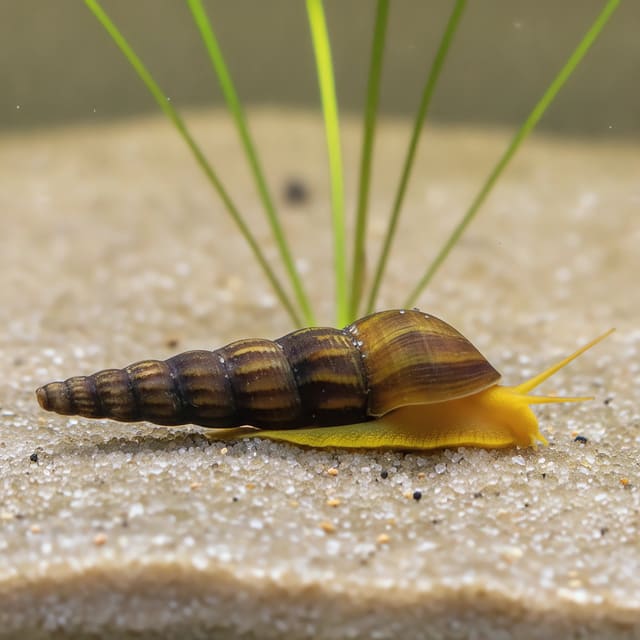
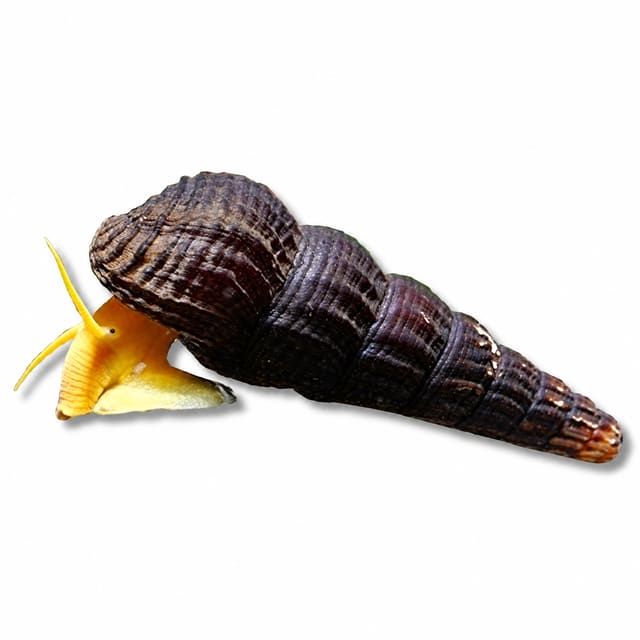
If you have ever asked how big do freshwater snails get or searched for the largest freshwater snail, this species shows why size matters when choosing an invertebrate. The Giant Tower Cap can reach around 8 cm, making it much larger than many common UK freshwater snails sold for clean-up crews. Its shell is tall, conical, and heavily turreted, giving it a dramatic vertical profile that stands out on substrate and hardscape.
Shell colour is usually earthy: brown, dark tan, olive-brown, or chocolate tones, often with visible ridges and texturing. The axial ribs can vary from one specimen to another, which means no two individuals look exactly the same. This helps customers comparing freshwater snail species UK or browsing a list of freshwater snails choose something more unusual than the standard options when looking at freshwater snails UK for sale.
The soft body is typically dark grey to brown, and the operculum allows the snail to seal itself inside the shell when stressed. Sexual dimorphism is limited and difficult for most hobbyists to confirm visually, so buying a small group is usually the only realistic route if breeding is your goal.
Because of its size, this is not the right choice for people wanting tiny snails that disappear into the background. It is a visible, architectural invertebrate that becomes a focal point. For contrast, compare it with the broad shell of the Giant Ramshorn Snail - Marisa Cornuarietis or the smaller, flatter shape of the Pink Ramshorn Snail - Planorbella Duryi.
The Giant Tower Cap Snail behaviour is calm, deliberate, and non-aggressive. It spends most of its time on the bottom, on hardscape, or slowly climbing the glass. That makes it a strong tower cap snail for community tank candidate alongside peaceful fish that ignore invertebrates. It is one of the more peaceful aquarium snails available, and in the right setup it can coexist with shrimp, small schooling fish, and other non-predatory snails.
Good Giant Tower Cap Snail tank mates include rasboras, small tetras, peaceful livebearers, Corydoras, Otocinclus, and dwarf shrimp. The species is also often successful as a tower cap snail with shrimp companion, provided the tank is stable and well fed. Many keepers building a mixed snail display pair it with a Yellow Rabbit Snail - Tylomelania Sp., a Batik Nerite Snail - Neritina Variegata, or a Sun Nerite Snail - Neritina Sp. for variety in shell shape and grazing behaviour.
Avoid puffers, large loaches, crayfish, and any fish known to nip antennae or attack snails. The shell offers some protection, but repeated harassment causes stress and feeding problems. This also answers the common buyer question of whether snails are bad for a freshwater tank: no, not when matched with suitable tank mates and proper care.
In a 60 litre aquarium, one Giant Tower Cap can work with a small group of rasboras and shrimp. In a 90 litre planted tank, you could keep one or two Giant Tower Caps with Corydoras, shrimp, and a few nerites. Because of its adult size, it is not an ideal routine tower cap snail for nano tank species, even though juveniles may look manageable at first.
| Species | Compatible? | Notes |
|---|---|---|
| Yellow Rabbit Snail - Tylomelania Sp. | ✅ Yes | Similar peaceful temperament and suited to mature tropical aquariums. |
| Parallel Nerite Snail - Neritina Sp. | ✅ Yes | Excellent mixed grazing team if food is supplemented. |
| Assassin Snail - Bumblebee Snail - | ❌ Avoid | Predatory toward other snails and not suitable with Brotia. |
When people compare tower cap snail vs nerite snail, the main difference is role: nerites are often chosen as specialist algae eaters, while Giant Tower Caps offer a larger presence and broader scavenging behaviour. In tower cap snail vs mystery snail comparisons, the Giant Tower Cap is usually a better fit for aquarists who want a more rugged, less plant-bothering species. In tower cap snail vs ramshorn snail discussions, the Giant Tower Cap wins on size and visual impact, while ramshorns are easier for very small tanks.
If you are actively looking to buy Giant Tower Cap Snail UK, buy tower cap snail UK, order Giant Tower Cap Snail online UK, or compare the Giant Tower Cap Snail price UK with other species, compatibility should be part of the decision. This is a display snail first and a clean-up helper second, so choose tank mates that let it behave naturally.
Always quarantine new arrivals for 2-4 weeks before adding them to a display tank. This is especially important when mixing snails from different sources, as it reduces the risk of parasites, hitchhikers, and sudden stress from mismatched water chemistry.
Giant Tower Cap Snail breeding is best described as slow and undemanding rather than prolific. Importantly, Brotia herculea is a livebearer: the female gives birth to small numbers of fully formed, tiny live young, typically only a few times a year, rather than laying clutches of eggs like nerites or mystery snails. This makes it appealing to people who want ornamental freshwater aquarium snails for sale UK without the fear of hundreds of babies appearing overnight.
Start with a mature aquarium of at least 60 litres, stable Giant Tower Cap Snail water parameters, and a strong calcium supply. Keep the temperature in the mid-range, around 24-26°C, and ensure the Giant Tower Cap Snail pH level stays at or above neutral. A varied grazing diet and low stress are essential. Because sexing is difficult, keeping more than one specimen improves your odds of having both sexes present.
As a slow livebearer, this species releases tiny, fully shelled juveniles directly into the tank. They are small and vulnerable at first, so stability is everything. Young snails need access to biofilm, soft algae, and finely available vegetable matter, plus reliable mineral support so their shells develop properly. Avoid deep cleaning that strips all natural food from the tank.
The biggest obstacles are poor mineral content, unstable water chemistry, and underfeeding. Hobbyists who keep this snail in soft water often see slow growth or shell wear rather than successful breeding. Stable, mineral-rich conditions are the single most important factor for both adult health and the survival of any young that appear.
For the best chance of breeding, maintain a mature species-focused setup with mineral-rich water, a deep reserve of biofilm on wood and stones, and minimal competition from aggressive feeders. Snails conditioned on varied vegetable foods and calcium-rich wafers often show stronger growth and better shell quality.
Choosing among aquarium snails for sale UK can be difficult because different snails solve different problems. Some are chosen mainly for algae control, some for colour, and some for unusual form. The Giant Tower Cap sits in a useful middle ground: it is decorative, peaceful, and helpful, but it needs more space than tiny species.
| Feature | Giant Tower Cap Snail | Parallel Nerite Snail |
|---|---|---|
| Max Size | About 8 cm | About 2.5-3 cm |
| Care Level | Moderate | Easy |
| Temperature | 22-28°C | 22-28°C |
| Best For | Feature snail in medium tanks | Specialist algae grazing |
| Feature | Giant Tower Cap Snail | Giant Ramshorn Snail |
|---|---|---|
| Shell Shape | Tall, turreted | Round, disc-like |
| Plant Safety | Usually plant safe | Can vary with diet and setup |
| Lifespan | Up to 5 years | Usually shorter |
| Best For | Architectural display and grazing | Bold shape and active movement |
In a best aquarium snails comparison, choose the Giant Tower Cap if you want a larger, more unusual snail that becomes part of the display rather than just a hidden cleaner. Choose a nerite if your main goal is targeted algae removal on glass and hardscape. Choose a ramshorn if you want a smaller, faster-breeding snail with a very different shell profile. For many hobbyists searching for the best aquarium snails UK or freshwater snails for sale UK, the Giant Tower Cap is the best option when visual impact matters as much as function.
A healthy Giant Tower Cap Snail is active, responsive, and carries a solid shell with no major pitting, cracking, or chalky erosion. The foot should look full and the snail should attach firmly to surfaces. If it spends long periods inactive, falls repeatedly, or seals up for days, review water quality first. This species is hardy, but like most live aquarium snails for sale UK it reacts badly to ammonia, nitrite, and mineral deficiency.
The most common issue is shell erosion caused by low pH, soft water, or insufficient calcium. Another is gradual starvation in spotless aquariums where the snail is expected to survive on traces of algae alone. Sudden inactivity can also follow exposure to copper, medications, or contaminated décor. Unexplained snail losses are usually tied to water chemistry or toxins rather than disease outbreaks, so always test the water before assuming illness.
Start with large partial water changes using dechlorinated water that matches temperature and hardness. Test pH and hardness, then correct any calcium deficiency with appropriate mineral support. Remove any suspect medication immediately. If the snail has been exposed to copper, move it to clean water and run carbon in the main system if suitable.
NEVER use copper-based medications with invertebrates. Copper is often lethal to snails and shrimp even at low doses, and residues can remain in décor, substrate, and filter media.
The Giant Tower Cap Snail behaviour is slow, methodical, and easy to observe. This species is most active when grazing across glass, stones, wood, and substrate, especially in the evening or after feeding. It is not social in the way schooling fish are, but it is tolerant of its own kind and of other peaceful invertebrates.
Because it is a bottom-oriented species, you will usually find it exploring the lower levels of the tank, though it may climb décor and glass with surprising confidence. The tower cap snail lifespan of up to 5 years means you have time to observe real patterns of routine and preference. In stable aquariums, many keepers notice favourite resting spots and regular feeding routes.
This species works well as a tower cap snail for community tank inhabitant because it does not harass fish, uproot plants, or race around the aquarium. To encourage natural behaviour, provide mature surfaces, calm tank mates, and enough food that it does not need to compete aggressively. If you want a display invertebrate with visible personality but low drama, this is one of the most rewarding freshwater snails UK options available.
When customers look for a Giant Tower Cap Snail for sale UK, a tower cap snail for sale UK, a live tower cap snail for sale UK, or general aquarium snails for sale UK, they usually want more than just availability. They want healthy animals with intact shells, proper identification, and realistic care advice. That matters with Brotia herculea because shell condition tells you a lot about how the snail was kept before sale.
Our Giant Tower Cap Snails are selected for strong shell form, active grazing response, and suitability for established tropical aquariums. Before dispatch, each snail is checked for mobility, operculum response, and visible shell integrity. We do not treat this species as a generic clean-up crew item; it is handled as a feature invertebrate for aquarists who value unusual tropical aquarium snails for sale UK and properly conditioned aquatic snails for sale UK.
For UK delivery, snails are packed in insulated boxes with weather-appropriate protection, including heat packs in colder conditions when needed. Orders are sent with tracked delivery and careful packing designed to minimise temperature swings and physical shock, which matters most for larger-shelled species. Ordering online also gives access to specialist species that local shops often do not stock, so if you have searched where can I buy freshwater snails or freshwater aquarium snails for sale near me without luck, an online specialist is often the answer.
We also include practical acclimation guidance, because the transition into UK home aquariums is where many snail losses happen. Slow acclimation, stable hardness, and immediate access to a mature tank make a huge difference. If you are ready to buy Giant Tower Cap Snail UK or order Giant Tower Cap Snail online UK, this is a species worth buying with a proper plan rather than as an impulse addition.
Building a snail-friendly aquarium is easier when you combine species with different strengths. For a similarly unusual display snail, consider the Yellow Rabbit Snail - Tylomelania Sp.. If your main goal is algae control, the Parallel Nerite Snail - Neritina Sp. and Hair Nerite Snail - Neritina Sp. are excellent additions to larger setups. For a bold contrasting shell shape, look at the Giant Ramshorn Snail - Marisa Cornuarietis or the colourful Pink Ramshorn Snail - Planorbella Duryi. If you want another patterned nerite for mixed grazing teams, the Batik Nerite Snail - Neritina Variegata and Sun Nerite Snail - Neritina Sp. are both worth comparing.
No reviews for this item yet. Bought one? Honest reviews only, good or bad.
What customers say about ordering from us
I have a small group of long finned mountain minnows. So was delighted to be able to order ten of this variety to increase the genetics in my tank . The ones I recieved are healthy but it’s to early to give a verdict on wether they are of a long finned type since they are small currently.
Gordon Walker · 23 Sept 2026
100% success travel and "installation". Pleased with quality of purchase. The Siamese fighter a bit "shy" so have not yet seen him at his best yet but looking good. Happy customer. GG
George E Garratt · 21 Sept 2026
Reviews of our shop, collected by Judge.me, an independent third-party review collector. Newest first.