Malaysian Trumpet Snail (Melanoides tuberculata)
17–27°C · pH 6.5–8
£2.99

The Devil's Thorn Snail (Faunus ater), also called the Lava Snail, is a striking long, dark, thorn-shaped freshwater snail from Southeast Asia. A peaceful algae grazer that reaches around 6 cm and lives up to 5 years, it is one of the most distinctive aquarium snails UK hobbyists can keep. Order yours today with UK delivery and our live arrival guarantee.
Adult size is the maximum length this species reaches at full maturity (scientific sources). The livestock you receive will be younger and smaller. Product-photo provenance and any image-specific limitations are stated on the listing.
Faunus ater
Lives in groups: kept together they stay settled, active and show their best colour.
Confirm your email, then we’ll send an availability message for this exact item if it returns within 180 days.
This request is only for this product—no newsletter or other promotions. A mail-provider retry may very rarely duplicate the same availability message. Unconfirmed addresses are removed after 48 hours. See our privacy policy.
The Devil's Thorn Snail (Faunus ater), also called the Lava Snail, is a striking long, dark, thorn-shaped freshwater snail from Southeast Asia. A peaceful algae grazer that reaches around 6 cm and lives up to 5 years, it is one of the most distinctive aquarium snails UK hobbyists can keep. Order yours today with UK delivery and our live arrival guarantee.
Adult size is the maximum length this species reaches at full maturity (scientific sources). The livestock you receive will be younger and smaller. Product-photo provenance and any image-specific limitations are stated on the listing.
Maintain these water conditions for optimal health and vibrant colors
If you want something more unusual than the typical cleanup snail, the Devil's Thorn Snail is one of the most striking freshwater snails UK hobbyists can keep. Known scientifically as Faunus ater and also sold as the Lava Snail, this long, dark, spike-shaped snail looks more like a polished volcanic thorn than a standard aquarium snail. It comes from Southeast Asia, stays peaceful, reaches around 6 cm as an adult, and can live for up to 5 years when kept in stable conditions. That combination of bold appearance, steady algae grazing, and calm temperament is why many keepers searching for aquarium snails UK, freshwater aquarium snails UK, and the best freshwater snails for aquarium displays end up choosing this species.
For aquarists comparing the different types of aquarium snails UK stores offer, the Devil's Thorn stands out because it is hardy, attractive, and far less likely to overrun a tank than many common snails. It is widely recommended among peaceful aquarium snails for community aquariums, planted layouts, and mixed invertebrate setups. It also suits people looking to buy aquarium snails UK or buy aquarium snails online UK, and those wanting live snails for aquarium UK stock that offers both function and visual interest. If you want a distinctive, low-drama grazer with real character, this is one of the best aquarium snails UK hobbyists can add to a well-maintained tropical setup.
Faunus ater is a freshwater gastropod that aquarists usually know as the Devil's Thorn Snail or Lava Snail. In the hobby it is valued for its elongated conical shell, calm nature, and ability to browse algae and detritus without the rapid population booms associated with some common pest snails. It sits in a group of snails that appeal to keepers who want something different from nerites, ramshorns, or mystery snails.
The Devil's Thorn Snail, also sold as the Lava Snail, originates from Southeast Asia, especially Indonesia and the Philippines. In the wild, Faunus ater is found in river mouths, lower streams, estuaries, and coastal drainage systems where freshwater and slightly brackish influences overlap. That natural background explains why this species is so adaptable, provided the water is clean, oxygenated, and mineral rich.
Its natural lava snail habitat usually includes sandy or silty bottoms mixed with stones, leaf litter, and biofilm-covered surfaces. Rather than racing around the aquarium, it spends much of its time moving slowly over substrate, wood, and décor while feeding on algae films, soft organic debris, and microscopic food trapped on surfaces. In the home aquarium, this makes it a useful member of the aquarium cleanup crew UK hobbyists often want for planted and community tanks.
Because these snails come from warm tropical environments, the Devil's Thorn Snail water temperature should stay stable within a tropical range rather than fluctuating sharply. Their wild waters also contain dissolved minerals, so lava snail water hardness and shell-supporting conditions matter more than many beginners expect. The key lesson from the wild for anyone learning how to care for a lava snail is simple: stable, alkaline-leaning, moderately hard water is far safer than soft, acidic water.
This is a tropical aquarium species, not a wild-collected pond snail. It is harmless to fish, shrimp, and humans — it is not a predator and does not attack healthy tank mates. For that reason it should not be confused with, or mixed with, wild-caught snails gathered outdoors, because uncontrolled wild stock can introduce parasites, hitchhikers, or pollutants. Always source aquarium snails from reared, observed stock.
Mimicking the natural habitat of Faunus ater improves shell quality and feeding behaviour. Use a mature tank with biofilm, stable tropical temperatures, and enough minerals for shell growth. Aquarists often see better grazing activity once the tank has aged for a few months rather than being newly set up.
Good husbandry starts with understanding the real Devil's Thorn Snail tank requirements. Although a single snail can live in a 30-litre aquarium, a larger setup is easier to keep stable and gives the snail more surfaces to graze. For a small group or a mixed invertebrate layout, 45-60 litres is a more forgiving starting point. When people ask about lava snail tank size, the practical answer is that bigger tanks support more stable water chemistry, more algae film, and better long-term shell health.
The official minimum is 30 litres, but treat that as the lower limit for one specimen. In a lava snail for nano tank setup, success depends on excellent maintenance and mature surfaces with natural grazing. For a community aquarium, a slightly larger footprint is better because these snails spend most of their time on the bottom and appreciate floor space more than height.
The ideal Devil's Thorn Snail water parameters are 22-28°C, pH 7.0-8.5, and hardness of 8-20 dGH. These values are not random. The Devil's Thorn Snail pH level should stay neutral to alkaline because acidic water slowly erodes the shell tip and weakens the operculum edge. The best Devil's Thorn Snail aquarium conditions keep ammonia and nitrite at 0 and nitrate low with regular water changes. If you are working through a best aquarium snails comparison, note that this species generally needs harder water than many hobbyists first assume.
Because shell growth depends on minerals, the lava snail calcium requirements should never be ignored. Hard water, calcium-rich foods, and occasional mineral support all help prevent pitting and shell thinning. Crushed coral in a filter bag, cuttlebone fragments, or mineral stones help in very soft water areas, though the goal is stability rather than constant adjustment.
A gentle to moderate filter is ideal. Sponge filters, internal filters with guarded intakes, and small external filters all work well. Strong flow is not necessary, but good oxygenation is useful because these snails come from moving-water environments. Avoid neglected tanks with mulm buildup and dead spots — clean water supports both grazing surfaces and a long lifespan.
The best lava snail substrate preference is smooth sand or fine rounded gravel. Sharp gravel can chip the shell or make movement awkward. Sand also looks natural with this species and lets the dark shell stand out, and a pale substrate creates the strongest visual contrast in display tanks.
A Devil's Thorn Snail for a planted tank is a very good choice because this species does not usually bulldoze healthy plants the way larger apple-type snails can. It works especially well with hardy leaves and wood-covered layouts. If you enjoy mixed snail tanks, you can compare it with the Yellow Rabbit Snail - Tylomelania Sp. for another bold bottom-dweller, or add contrast with a patterned grazer like the Parallel Nerite Snail - Neritina Sp.. For hobbyists exploring tropical aquarium snails UK, these combinations create a varied but peaceful display.
Use driftwood, rounded stones, and shaded areas where biofilm can develop. In many tanks the snail will spend hours on wood or glass. It also mixes well visually with the Hair Nerite Snail - Neritina Sp. and Batik Nerite Snail - Neritina Variegata if you want different shell shapes in the same aquarium.
Lighting should suit the aquarium rather than the snail specifically. Moderate lighting for 6-8 hours per day is usually enough to support a manageable level of algae and biofilm without triggering nuisance outbreaks. In planted aquariums, stronger light is fine if nutrients and maintenance are balanced.
Always cycle the aquarium for 4-6 weeks before adding snails. Newly set up tanks often look clean but lack the algae film, microorganisms, and chemical stability that make a Devil's Thorn Snail settle in quickly.
The Devil's Thorn Snail diet is mainly herbivorous and detritivorous. In practical terms, these snails spend much of the day grazing soft algae, biofilm, and decomposing organic matter. They are useful in established aquariums, but they are not miracle workers. If you are searching for the best algae eating snails or the best snails for algae control, the Devil's Thorn is a helpful grazer, especially on film algae and soft growth, but it still needs supplemental feeding in cleaner tanks.
A good lava snail feeding guide starts with natural grazing plus a quality sinking food. Offer algae wafers, spirulina pellets, and herbivore bottom-feeder foods several times a week. Lava snail algae eating behaviour is strongest in mature tanks where surfaces are already established, which is one reason many people choosing algae eating snails UK stock do better with older aquariums than fresh setups.
Blanched courgette, spinach, cucumber, green beans, and shelled peas are all useful additions. Rotate foods rather than relying on one vegetable every time. A varied diet helps shell growth and supports steady energy. In mixed invertebrate tanks, these snails will also browse leftover shrimp foods and soft detritus.
Occasional calcium-enriched foods are helpful, especially in soft water areas. Mineral sticks, invertebrate pellets, and shell-support foods can all be used in moderation. If you keep them with shrimp, make sure all invertebrate foods are copper free.
For one adult Devil's Thorn Snail, feed a small sinking portion every 1-2 days if the tank is mature and has visible grazing surfaces. In very clean tanks, daily feeding may be needed. Remove uneaten vegetables after 12-24 hours so they do not foul the water. The best rule is to feed enough that the snail has access to food overnight without leaving excess to decay.
| Time | Food | Amount |
|---|---|---|
| Morning | Natural algae/biofilm grazing | Available in tank |
| Evening | Algae wafer or blanched vegetable | Small piece or 1 wafer shared |
Avoid salty foods, oily kitchen scraps, and anything seasoned. Do not rely on fish flakes alone. Most importantly, avoid medications or foods containing copper. Many new keepers reading a Devil's Thorn Snail care guide are surprised that water treatments safe for fish can be lethal to snails.
Overfeeding causes ammonia spikes, bacterial blooms, and poor water quality. A Devil's Thorn Snail should help tidy the tank, not be forced to live in rotting leftovers. Feed lightly and remove uneaten vegetables promptly.
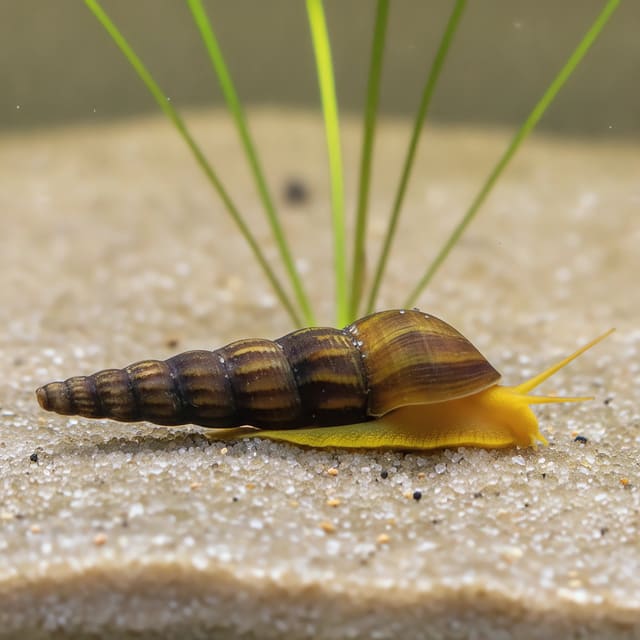
The Devil's Thorn Snail is named for good reason. Its shell is long, narrow, and sharply tapered, giving it a thorn-like silhouette that stands out immediately among UK freshwater snails. Adults usually reach around 5-6 cm, though shell length varies slightly with age, diet, and water chemistry. The shell is thicker and more solid in mineral-rich tanks, while poor conditions can leave the tip eroded or chalky.
Most specimens show dark brown to near-black shell tones, often with a subtle weathered texture that adds to the "lava" look. The body is usually deep grey to black, creating a dramatic, uniform appearance as the snail moves across pale sand or light stone. That intense dark coloration and elongated profile make this species popular among people looking for unusual aquarium snails for sale UK stock.
Unlike some snails, there are no widely established ornamental colour morphs in the hobby — the appeal here is shape and texture rather than bright patterning. If you want a stronger contrast between shell forms, pair this species visually with the rounded shell of the Giant Ramshorn Snail - Marisa Cornuarietis or the flatter coil of the Pink Ramshorn Snail - Planorbella Duryi. That creates a display with very different snail body plans in one aquarium.
Sexual dimorphism is minimal, so males and females cannot be reliably separated by casual visual inspection. This is one reason Devil's Thorn Snail breeding is rarely achieved by accident in freshwater tanks. Strong shell growth, however, can be encouraged with stable hard water, a calcium-rich diet, and clean conditions.
The right Devil's Thorn Snail tank mates are chosen for temperament rather than just water parameters. This is a calm, slow-moving species that does best with non-aggressive fish and peaceful invertebrates. As a lava snail for a community tank, it works very well with small tetras, rasboras, Corydoras, Otocinclus, peaceful livebearers, and many dwarf shrimp species. It is one of the safer peaceful aquarium snails for mixed setups because it does not harass fish or destroy healthy plants.
If you want a mixed snail display, the Devil's Thorn combines nicely with the Parallel Nerite Snail - Neritina Sp., Batik Nerite Snail - Neritina Variegata, and Hair Nerite Snail - Neritina Sp.. These species fill similar grazing roles but bring different shell patterns and sizes. For a larger, equally interesting bottom-dweller, the Giant Tower Cap Snail - Herculean is another eye-catching option.
Keeping a lava snail with shrimp is a common question, and the answer is yes in most peaceful setups. They coexist well because the snail grazes surfaces while shrimp pick at fine food particles, so there is little direct competition if the tank is mature and food is available. This makes the species a useful part of an aquarium cleanup crew UK setup.
Avoid puffers, many loaches, larger cichlids, and any known snail-eating fish. Even if the shell looks tough, repeated pecking causes stress and injury. Also avoid keeping them with the Assassin Snail - Bumblebee Snail - if your goal is to protect your Devil's Thorn population, because assassin snails are predators of other snails.
In a 60-litre aquarium, one to three Devil's Thorn Snails can be kept with a shoal of small peaceful fish and a shrimp colony. In a 90-litre planted community tank, they can be combined with nerites and bottom-dwelling fish as long as food is available. In a 30-litre species-focused invertebrate tank, one specimen works well as a feature snail.
These snails are suitable for mixed snail tanks and shrimp tanks. They are often chosen by people comparing lava snail vs nerite snail, lava snail vs mystery snail, and lava snail vs ramshorn snail. Compared with mystery snails, they are more streamlined and less likely to uproot décor. Compared with ramshorns, they are far less likely to multiply rapidly. Compared with nerites, they usually have a more dramatic shell shape but are less specialised as hard-surface algae grazers.
| Species | Compatible? | Notes |
|---|---|---|
| Yellow Rabbit Snail - Tylomelania Sp. | ✅ Yes | Peaceful, similar care needs, works in larger tanks |
| Parallel Nerite Snail - Neritina Sp. | ✅ Yes | Excellent algae grazer, good visual contrast |
| Puffers and snail-eating loaches | ❌ Avoid | Likely to attack or kill snails |
For this species, the real risk in a community tank runs the other way: aggressive fish are dangerous to the snail, not the snail to the tank. And although the name "lava snail" suggests something rugged, the Devil's Thorn is a tropical aquarium species and should not be treated as outdoor UK pond stock — it needs heated, mineral-rich aquarium conditions year round.
Always quarantine new arrivals for 2-4 weeks before adding them to a display tank. This reduces the chance of introducing parasites, hydra, leeches, or medication residues that can affect snails and shrimp.
Devil's Thorn Snail breeding is one of the most misunderstood topics around this species. Many keepers assume that because the snail is easy to maintain, it must also be easy to breed. In reality, breeding is difficult in standard freshwater aquariums. These snails are believed to require brackish conditions for larval development, which is why they do not usually reproduce successfully in ordinary tropical tanks.
If you are researching how to care for a lava snail with breeding in mind, separate care from reproduction. Basic care is straightforward, but breeding is advanced. Adults need excellent nutrition, stable warm water, and mineral-rich conditions — yet even healthy adults may not produce viable young in freshwater.
Because males and females are difficult to distinguish visually, pairing is not simple. Courtship is subtle, and hobbyists often do not notice breeding-related behaviour at all. This species does not behave like many common freshwater snails that leave obvious egg clutches around the tank.
Reports from aquarists suggest that successful development requires salinity changes not present in normal freshwater systems, so even if adults mate, larvae may not survive. This is one reason the Devil's Thorn is attractive to keepers who want beginner friendly aquarium snails without the risk of a population explosion.
There is little routine home-aquarium success with raising young in pure freshwater. For most hobbyists, breeding should be treated as a specialist project rather than a realistic expectation. If your goal is simply to keep attractive freshwater snails for sale UK stock without constant reproduction, this is actually an advantage.
The biggest challenges are identifying sexes, triggering spawning, and providing the correct larval environment. Anyone familiar with nerite snails UK will recognise a similar issue: adults may live happily in freshwater, but reproduction often requires different conditions. That makes the Devil's Thorn very different from ramshorns and other snails that breed readily in almost any tank.
If you want to experiment with breeding, condition a group of healthy adults in hard, alkaline water with abundant biofilm and supplemental calcium, then research estuarine larval development methods before attempting any salinity transition. This is an advanced invertebrate project, not a beginner breeding species.
Comparing snail species matters because different snails solve different problems. Some are stronger algae grazers, some are more decorative, and some reproduce much faster than others. If you are working through a best aquarium snails comparison or trying to decide among the various types of aquarium snails UK stores stock, the Devil's Thorn is best viewed as a feature grazer: attractive, peaceful, and low risk for overpopulation.
| Feature | Devil's Thorn Snail | Parallel Nerite Snail |
|---|---|---|
| Max Size | 6 cm | 2.5-3 cm |
| Care Level | Easy to moderate | Easy |
| Temperature | 22-28°C | 22-28°C |
| Best For | Feature snail, planted community tanks | Hard-surface algae control |
| Feature | Devil's Thorn Snail | Pink Ramshorn Snail |
|---|---|---|
| Shell Style | Long, conical, thorn-like | Flat spiral shell |
| Breeding in Freshwater | Very difficult | Easy |
| Water Hardness Need | Moderate to hard | Moderate preferred |
| Best For | Controlled snail population | Fast colony growth |
| Visual Impact | Bold silhouette | Bright colour accent |
Choose the Devil's Thorn if you want a larger, more unusual snail with a dramatic shape and a lower chance of accidental breeding. Choose a nerite if your main goal is stronger glass and hardscape algae grazing. Choose a ramshorn if you want colour and easy colony growth. The Parallel Nerite Snail - Neritina Sp., Pink Ramshorn Snail - Planorbella Duryi, and Yellow Rabbit Snail - Tylomelania Sp. all appeal to different styles of aquarist.
For hobbyists searching to buy Devil's Thorn Snail UK, find a Devil's Thorn Snail for sale UK, order Devil's Thorn Snail online UK, or compare the Devil's Thorn Snail price UK against other snails, the value lies in its unusual look, long lifespan, and calm behaviour rather than sheer algae-eating speed alone.
A healthy Devil's Thorn Snail should move steadily, attach firmly to surfaces, and show a solid shell without severe pitting or chalky erosion. The body should extend fully when active, and the operculum should close properly when disturbed. If a snail remains inactive for long periods, falls repeatedly, or shows shell damage, something in the environment usually needs attention.
Look for regular grazing, a responsive foot, and a shell that is dark, intact, and not flaking. New shell growth near the opening should look smoother than old shell. In good conditions the lava snail lifespan can reach around 5 years, so long-term shell maintenance matters.
The most common issue is shell erosion caused by low pH or insufficient minerals. Poor water quality can also lead to inactivity, stress, and tissue damage. Starvation is another hidden problem in spotless tanks with no algae or biofilm. Sudden deaths are often linked to copper exposure, unstable cycling, or aggressive tank mates rather than infectious disease.
Start with water testing. Correct ammonia, nitrite, pH, and hardness before trying any medication. Increase calcium availability, improve diet, and perform gentle water changes with matched parameters. If treatment is necessary for fish in the same aquarium, move the snail to a safe hospital tank because many medications are not invertebrate safe.
Maintain stable Devil's Thorn Snail water parameters, provide mineral support, avoid copper, and do not add wild snails from outdoor sources. The danger in a snail tank is rarely the snail itself; it is usually introducing uncontrolled wild stock or using unsuitable, copper-bearing medications.
NEVER use copper-based medications with invertebrates. Copper is highly toxic to snails and shrimp, even at levels that some fish treatments label as mild or routine.
Devil's Thorn Snail behaviour is calm, methodical, and mostly focused on grazing. This is not a hyperactive species. It spends much of the day moving over substrate, wood, rock, and glass in search of algae films and edible debris. Many aquarists enjoy the way it explores with a slow, deliberate rhythm, especially in tanks with open sand areas.
It is generally solitary but not territorial, so one specimen or several can be kept together if the tank is large enough and food is available. As a lava snail for a community tank, it ignores fish and other peaceful invertebrates, and in mixed snail tanks it usually keeps to itself and simply continues grazing.
These snails may be more active in the evening or after feeding, and they tend to show stronger natural behaviour in mature aquariums with wood, stones, and biofilm-rich surfaces. If a Devil's Thorn spends long periods buried or inactive, check food availability and water quality before assuming illness. In a well-run aquarium, it is one of the most dependable peaceful aquarium snails you can keep.
When customers look for freshwater snails UK, they are usually trying to avoid two common problems: weak imported snails with damaged shells, and poorly packed livestock that arrives cold or stressed. With Devil's Thorn Snails those issues matter even more, because shell condition tells you a lot about previous care. We select specimens with strong shape, active movement, and intact operculums, then hold and observe them before sale so they are feeding and stable before dispatch.
Each snail is checked for activity, shell integrity, and response before packing. We acclimate stock to stable aquarium conditions suitable for aquarium snails UK for sale and provide care guidance for hard water, feeding, and safe tank mates. For customers asking where to buy aquarium snails UK, wanting to buy aquarium snails online UK, or searching for freshwater aquarium snails for sale UK, the goal is not just to send a snail in a bag — it is to send a healthy specimen with the best chance of settling quickly into a home aquarium.
Devil's Thorn Snail delivery UK orders are packed in insulated boxes with professional bagging methods, and heat packs are used in cold weather when needed. Tracked delivery helps reduce transit time, and livestock is packed to minimise movement and temperature swings. If you have been comparing places to buy lava snail UK, find a lava snail for sale UK, or order a live lava snail for sale UK, careful holding and packing matter just as much as price.
Order your Devil's Thorn Snail today with confidence if you want a peaceful, unusual, long-lived grazer for a tropical setup. Whether you are building a planted display, a mixed snail collection, or a practical cleanup crew, this species offers real character as well as function.
If you are building a varied snail or invertebrate display, consider adding the Yellow Rabbit Snail - Tylomelania Sp. for another sculptural bottom-dweller with strong personality. For stronger glass and décor grazing, the Parallel Nerite Snail - Neritina Sp. and Batik Nerite Snail - Neritina Variegata are excellent companions. If you want contrast in shell shape, the Giant Ramshorn Snail - Marisa Cornuarietis offers a very different rounded form. For colour in a mixed snail setup, the Pink Ramshorn Snail - Planorbella Duryi adds a bright accent. You can also browse our wider freshwater snails UK collection to compare species for planted tanks, community aquariums, and dedicated invertebrate setups.
No reviews for this item yet. Bought one? Honest reviews only, good or bad.
What customers say about ordering from us
I have a small group of long finned mountain minnows. So was delighted to be able to order ten of this variety to increase the genetics in my tank . The ones I recieved are healthy but it’s to early to give a verdict on wether they are of a long finned type since they are small currently.
Gordon Walker · 23 Sept 2026
100% success travel and "installation". Pleased with quality of purchase. The Siamese fighter a bit "shy" so have not yet seen him at his best yet but looking good. Happy customer. GG
George E Garratt · 21 Sept 2026
Reviews of our shop, collected by Judge.me, an independent third-party review collector. Newest first.