Easy
Gold Mystery Snail (Pomacea diffusa)
18–28°C · pH 6.5–8
£5.19
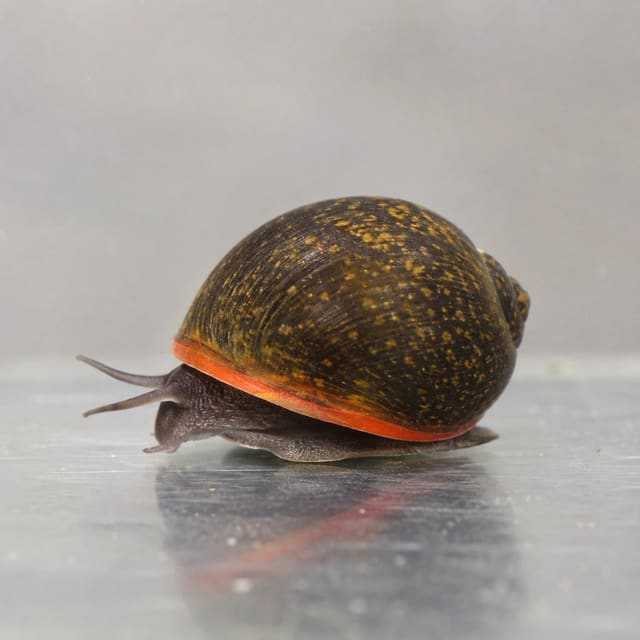
The Black Mystery Snail is a dark form of Pomacea diffusa, the spike-topped apple snail, with a deep brown to near-black shell and a dark body. It eats leftovers and dead plant matter and leaves healthy plants alone when fed. Keep it at 18–28°C in calcium-rich water above pH 7, under a lid with an air gap. Sold individually; not available to Northern Ireland.
Pomacea diffusa
Choose a quantity for your aquarium. Discount thresholds are pricing offers, not a stocking recommendation.
Minimum of 2 per order.
The Black Mystery Snail is a dark form of Pomacea diffusa, the spike-topped apple snail, with a deep brown to near-black shell and a dark body. It eats leftovers and dead plant matter and leaves healthy plants alone when fed. Keep it at 18–28°C in calcium-rich water above pH 7, under a lid with an air gap. Sold individually; not available to Northern Ireland.
Read the full care guidance when planning conditions for your aquarium.
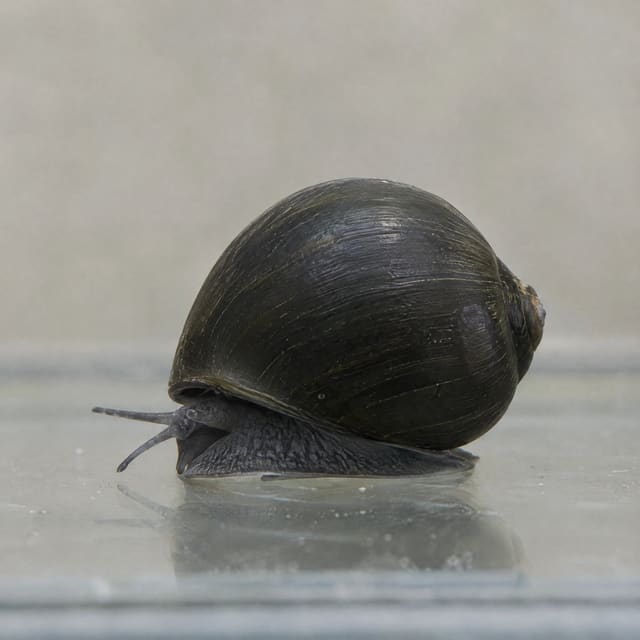
The Black Mystery Snail is a dark form of Pomacea diffusa, the spike-topped apple snail of the Amazon basin and the species sold in the UK as the mystery snail. It belongs to the apple snail family, Ampullariidae. A black mystery snail has a deep brown to near-black shell and a dark body, so it stands out clearly against pale sand and green plants, and it spends its time cleaning up leftover food and dead plant matter rather than eating healthy plants.
The names around this snail are confusing. It was first described in 1957 as a subspecies of Pomacea bridgesii, and for years the two were treated as one species until mitochondrial DNA showed they are distinct; applesnail.net notes that P. bridgesii is a rarer, larger snail from a small part of Bolivia. Older names include Ampullarius australis, and "Ampullarius" itself is an outdated name for Pomacea, so labels such as "black apple snail", "black mystery snail" and "Pomacea bridgesii black" usually describe this same species.
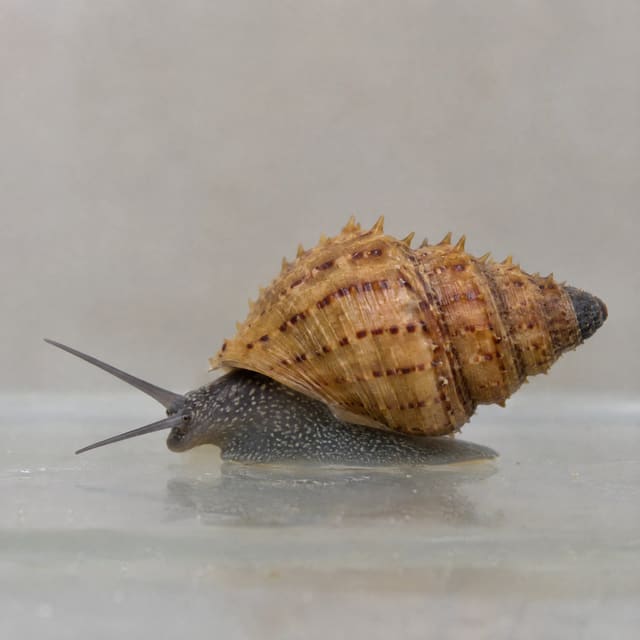
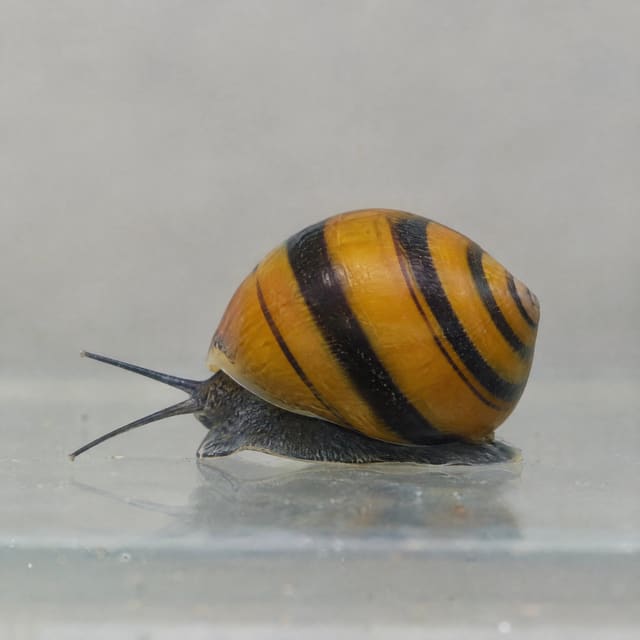
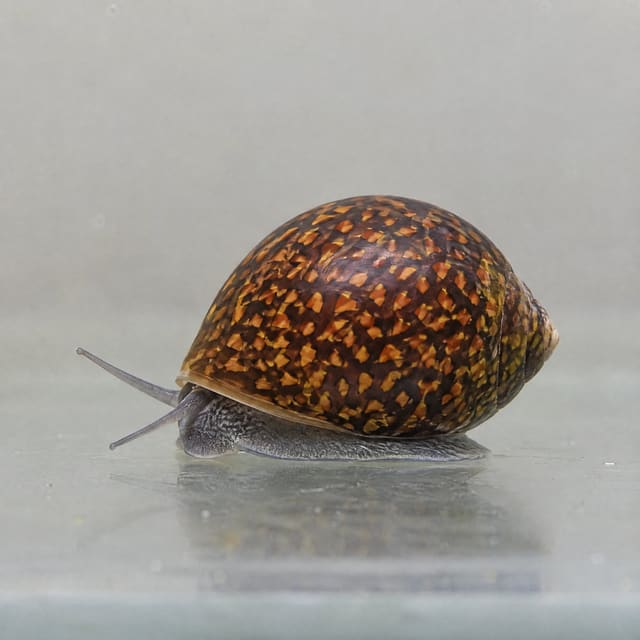
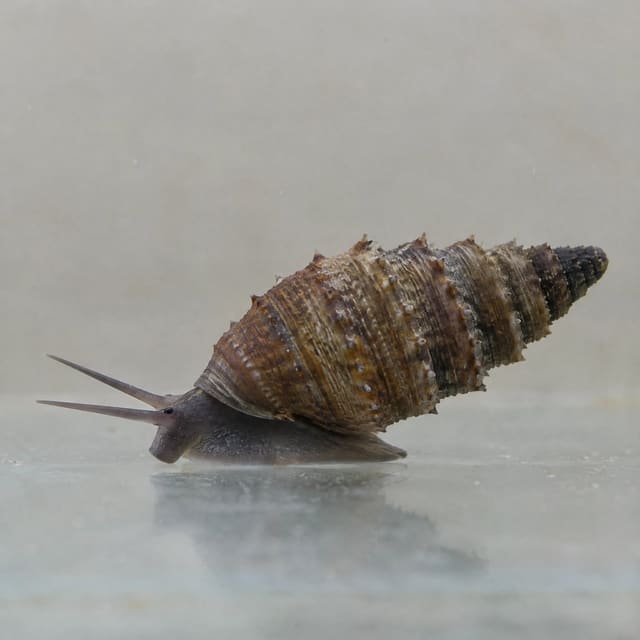
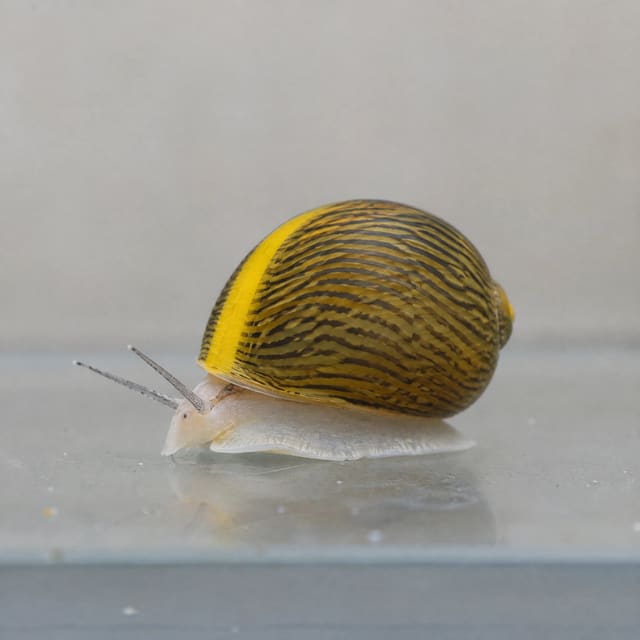
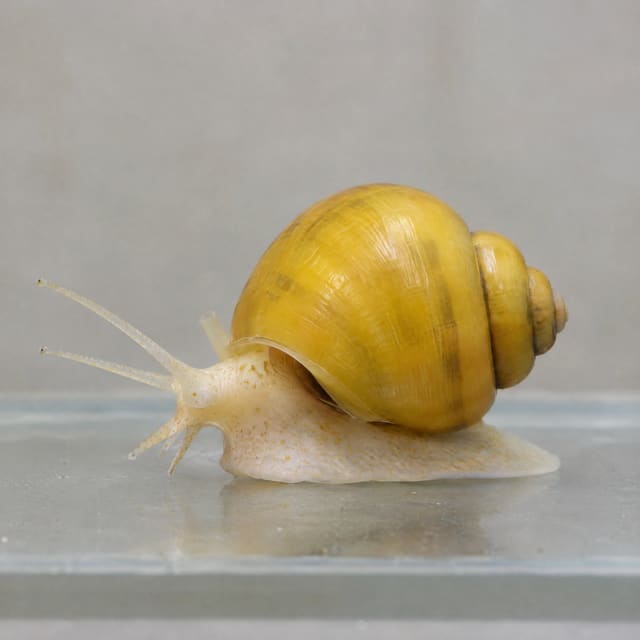
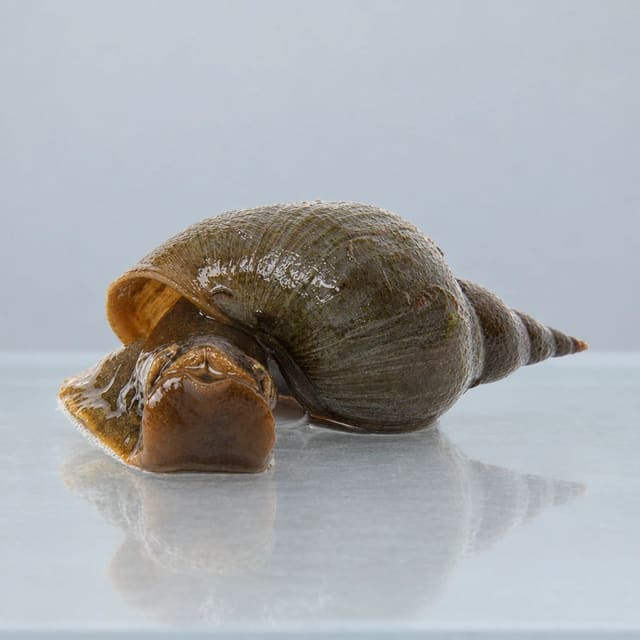
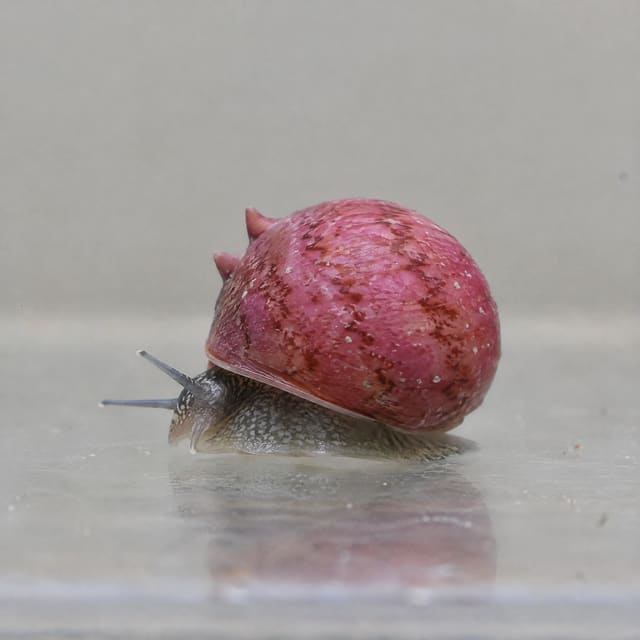
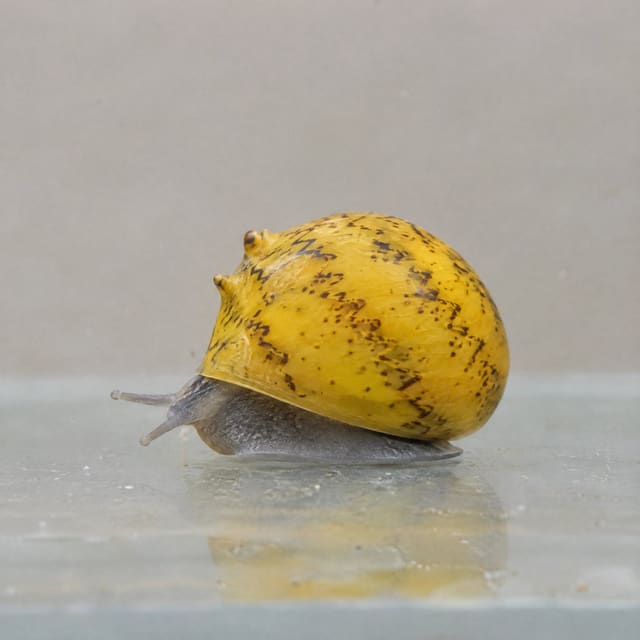
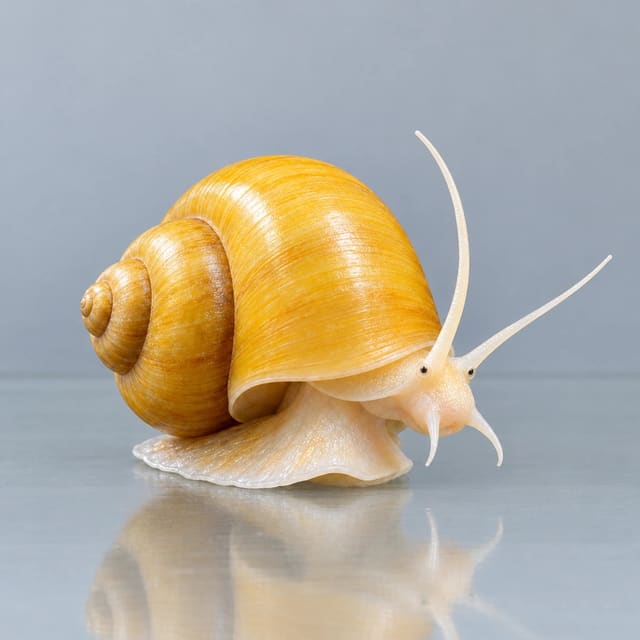
You can recognise Pomacea diffusa by its shell. Applesnail.net describes five to six whorls with flat, square shoulders that meet at almost right angles, a high, sharp spire (hence spike-topped), a large oval opening and a deep umbilicus. A horny trapdoor, the operculum, closes the opening when the snail withdraws. Body colour ranges from light yellow in cultivated forms to almost black with yellow spots on the mouth, and the shell varies from yellow and green to brown, with or without dark bands. "Black" is a trade name for the darkest of these, so expect a very dark brown shell rather than a jet-black one.
| Suits | Not suited to |
|---|---|
| A covered aquarium with an air gap under the lid | An open-topped tank filled to the brim |
| Calcium-rich water at pH 7 or above | Very soft or acidic water that pits the shell |
| Peaceful community fish, shrimp and planted tanks | Pufferfish, loaches and assassin snails |
| A warm tropical tank between 18 and 28°C | Unheated tanks and garden ponds |
| Keepers in England, Scotland and Wales | Addresses in Northern Ireland, where apple snails cannot be sent |
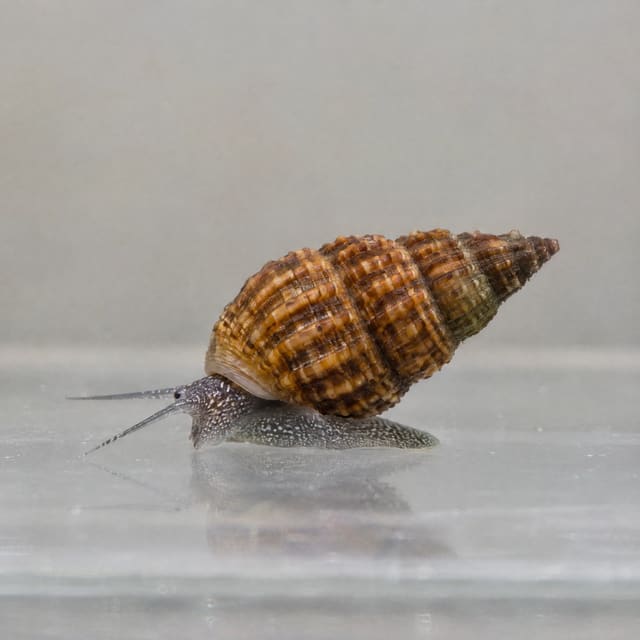
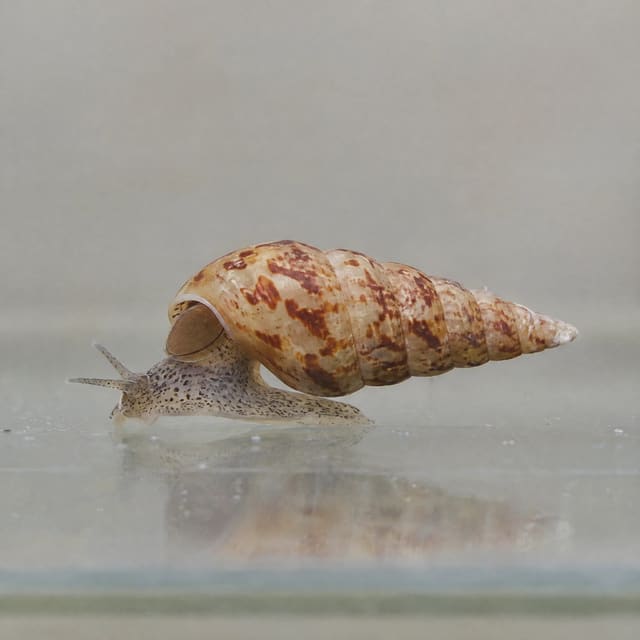
The gallery images are representative. They are made from a reference picture and do not show the snail supplied, so judge the species by the shell features above and expect shade, banding and body colour to vary from snail to snail. Compare it with the other species in our aquarium snails collection.
One purchase quantity supplies one live Black Mystery Snail of the Small grade. Small describes the size at dispatch, not the adult size: applesnail.net gives adult shells of 40–50 mm wide and 45–65 mm high, so plan the tank for a snail around the size of a golf ball. Applesnail.net notes that warmer water speeds up eating, movement and growth, so a well-fed snail in a warm tank does not stay small for long.
Apple snails have separate sexes, unlike many common aquarium snails, which means one snail on its own cannot produce fertile eggs. The sex of a young mystery snail cannot be seen from the outside, so it cannot be chosen. OATA notes that snails are not social animals, so a single snail does perfectly well alone.
Before you order, read our delivery and live arrival information. Snails travel with the same live-arrival cover as our fish.
Applesnail.net suggests about 10 litres of water for each mid-sized apple snail of around 5 cm, and to count each snail like a fish as long as its shell is wide. OATA's planning figure for apple snails is roughly 20 litres, more if you keep fish as well. In practice a mystery snail fits into an established community tank with room to spare, as long as its share is counted alongside the fish.
The lid matters more than the litres. Apple snails climb out of open tanks and can end up on the floor; applesnail.net notes they can survive out of water for more than a week, but it is not something to test. They also breathe air. Besides gills, an apple snail has a lung and a breathing tube, the siphon, which it stretches to the surface when the water is low in oxygen. Leave an air gap of 5–10 cm between the water and the lid, as applesnail.net's quick guide suggests, so the snail can breathe and, if you keep more than one, lay eggs above the water.
Apple snails build their shells from calcium, so the most important thing about their water is that it is not soft. Applesnail.net asks for calcium-rich water at pH 6.5–8, preferably above 7, and a temperature of 18–28°C. OATA's care sheet for freshwater snails and shrimp gives a broader group range. The two sources overlap well, and the table shows where they differ.
| Value | applesnail.net | OATA snails and shrimp |
|---|---|---|
| Temperature | 18–28°C, never below 18°C | 17–27°C |
| pH | 6.5–8, preferably above 7 | 6.5–8.0 |
| General hardness | Calcium-rich, not soft | 4–18°dH |
| Carbonate hardness | Not stated | 3–15°dKH |
| Ammonia and nitrite | Same rules as for fish | Zero |
| Nitrate | Same rules as for fish | No more than 20 mg/l above your tap water |
Much of the UK has hard tap water, which suits mystery snails well; if you are not sure, check your tap water's hardness with your water company's postcode tool, as OATA suggests, and plan for a harder, more alkaline tank. Our water matcher shows whether your water suits a species, and the water chemistry guide explains what dGH and dKH mean. Temperature also sets the pace of life: applesnail.net says apple snails live only 12–16 months at 25°C but can pass three years in cooler water, because warmth speeds up their metabolism. A tank in the lower half of the 18–28°C range gives a longer-lived snail.
The shell keeps a record of the snail's life. Applesnail.net explains that the coloured outer layer wears thin with age, and in calcium-poor water the exposed inner layer starts to dissolve into small pits it calls wormholes. New growth after a period of poor conditions, such as transport, often comes out lighter and rougher than the older shell; that is normal and evens out once the snail is growing steadily again. Deep pits or a crumbling lip are a sign to raise calcium and hardness.
Applesnail.net says Pomacea diffusa prefers dead and rotting plants and fish food, and does not eat healthy plants unless there is nothing else, which is why it is the apple snail of choice for planted aquariums. A 2007 review of apple snails in the United States by Rawlings and colleagues adds a caution: one study found the species feeds mainly on the film of algae and micro-organisms on surfaces, while another found it also eats water plants, dead animals, worms and the eggs of other snails. In a tank the honest answer is that a well-fed mystery snail is plant-safe in practice, and a hungry one may not be.
A busy community tank rarely leaves enough scraps to keep a snail fed, so give it food of its own. OATA suggests algae wafers or shrimp pellets two or three times a week, left in for at least 30 minutes, with care not to overfeed. Applesnail.net lists lettuce, cucumber, small pieces of carrot, green beans and fish pellets, and stresses washing vegetables well to remove any pesticide residue.
Snails are very sensitive to copper, and OATA warns that they die even at low levels. Before adding a snail, check that any plant fertiliser, algae treatment or fish medicine you use is safe for invertebrates, and treat new water with a tap water conditioner. Applesnail.net adds that snails turning completely inactive after a water change can be a sign of copper or other metals in the tap water.
Follow OATA's floating-bag method: switch off the tank lights, float the sealed bag for 10 minutes to match the temperature, then add small amounts of tank water over at least 30 minutes before lifting the snail into the tank. Place it upright on the substrate rather than dropping it, and add as little bag water as possible. Our guide on how to acclimatise new fish shows the same routine step by step.
| When | Check | Action if it fails |
|---|---|---|
| First hours | Snail has come out of its shell and is moving | Leave it alone; a closed snail is usually resting after the journey |
| Day 1–2 | Snail feeding on a wafer or vegetable | Place food beside it in the evening and remove leftovers next morning |
| Day 3–4 | Ammonia and nitrite at zero | Change 25% of the water, as OATA advises, and feed less |
| Day 7 | Snail active at night, trapdoor closing firmly when touched | Test pH and hardness, and check for copper-containing products |
New owners often worry about behaviour that is completely normal for an apple snail. Applesnail.net describes Pomacea diffusa as moderately amphibious, fairly inactive during the day and most active at night, often resting on the bottom. Apple snails can stay still for days, and a snail with a lot of air in its lung may float. Floating does not mean the snail is dead.
To check a still snail, lift it out and look at the trapdoor. Applesnail.net explains that a snail with its operculum shut tight is alive, because once a snail dies its muscles relax and the trapdoor stays at least partly open. A dead snail quickly fouls the water, so remove it at once. Snails at the surface with their siphon out are taking air, which is natural from time to time, but constant surfacing points to low oxygen.
| Observation | What it usually means | Action |
|---|---|---|
| Snail floating at the surface | Air in the lung; often harmless | Check the trapdoor; if it is shut, leave the snail alone |
| Siphon stretched to the surface many times an hour | Low oxygen | Increase surface movement and test for waste |
| Snail sealed in its shell for days | Cold water, copper or poor water quality | Check the heater, test the water and review recent treatments |
| White pits on old shell | Soft, calcium-poor water | Raise hardness and keep pH above 7 |
| Tentacles shortened | Nipping by fish | Watch at night; regrowth is normal, but move the snail if nipping continues |
Mystery snails do not breed in the water like ramshorn snails. Applesnail.net explains that the female climbs out of the water and lays a clutch of pale pink to reddish eggs above the waterline on the glass or lid. An average clutch holds 200–600 eggs, and females can store sperm for months, so a female bought with others may keep laying after she is separated. Clutches hatch in two to three weeks depending on temperature, and the tiny snails drop into the water.
Never put unwanted eggs or young snails in a pond, river or drain. OATA advises disposing of aquarium waste so that non-native animals cannot reach natural waters.
Apple snails went through a long legal ban. The European Union barred the whole genus Pomacea from being introduced into or spread within the Union by a decision dated 8 November 2012, after apple snails caused problems in southern Spain. In 2021 Great Britain removed Pomacea from its list of quarantine pests, and OATA reported on 28 May 2021 that apple snails could again be imported, sold and kept in England, Scotland and Wales. Defra judged that they are unlikely to establish outdoors in the British climate and are a pest of rice, which is not grown here.
The ban still applies in Northern Ireland, where EU plant health rules continue, so apple snails cannot be moved or sold there. For that reason we cannot send this snail to Northern Ireland addresses.
OATA describes snails as compatible with most aquarium species, with clear exceptions: fish that eat snails, such as pufferfish and loaches, and assassin snails, which prey on other snails. Applesnail.net adds that many fish nip at apple snail tentacles, and that larger fish with strong jaws, such as some cichlids, can damage the shell and eat the snail. Read our assassin snail guide before mixing the two, and leave snail-hunting loaches such as the YoYo Loach out of a tank with mystery snails.
The best companions share the snail's taste for harder water. Livebearers such as platies suit a calcium-rich community tank, and shrimp such as the Amano shrimp share the clean-up work. A nerite snail adds a dedicated algae grazer for glass and stones; our nerite snail care guide covers the overlap. Our fish for planted aquariums are a good starting list for a plant-friendly community.
| Suits | Caution | Avoid |
|---|---|---|
| Peaceful community fish in hard water | Fin-nipping fish, which may also nip tentacles | Pufferfish |
| Shrimp and other peaceful snails | Larger cichlids with strong jaws | Snail-eating loaches |
| Planted aquariums | Small shrimp-only tanks with very soft water | Assassin snails |
Our tank mates tool checks these points against the fish you already keep, and the freshwater molluscs category lists every snail we sell, including the Mystery Snail Colour Mix and the Red Apple Snail.
It is a dark form of Pomacea diffusa, the spike-topped apple snail from the Amazon basin, also sold as the black apple snail. It has a deep brown to near-black shell and a dark body; "black" is a trade name, so shades vary.
Applesnail.net gives adult shells of 40–50 mm wide and 45–65 mm high. The Small grade describes the size at dispatch, not the adult size.
Rarely. Pomacea diffusa prefers dead plant matter and fish food and only eats healthy plants when nothing else is available, so give it its own food two or three times a week.
Yes. Keep it between 18 and 28°C and never below 18°C. Applesnail.net says apple snails live 12–16 months at 25°C and longer in cooler water within that range.
Calcium-rich, hard water at pH 6.5–8, preferably above 7. OATA's snail range is 17–27°C, pH 6.5–8.0 and 4–18 dGH, with zero ammonia and nitrite and no copper.
Floating usually means air in its lung and is not a sign of death. A snail with its siphon stretched to the surface is breathing air; frequent surfacing means oxygen is low.
Not fertile ones. Apple snails have separate sexes, so you need a male and a female. Females can store sperm for months and lay pink clutches above the waterline.
No. Apple snails are legal in England, Scotland and Wales, but under EU plant health rules that still apply in Northern Ireland they cannot be moved or sold there.
Pufferfish, snail-eating loaches and assassin snails, as OATA advises, and larger fish with strong jaws. Fish that nip tentacles need watching.
No reviews for this item yet. Bought one? Honest reviews only, good or bad.
What customers say about ordering from us
Easy website plenty of info on fish your buying great to pick a time slot
TRACEY DURRANT · 7 Oct 2026
Got some lovely fish thank you
Kevin Mackie · 7 Oct 2026
Reviews of our shop, collected by Judge.me, an independent third-party review collector. Newest first.
Moved by UK carriers licensed to handle live animals
Hand-packed with oxygen bags, poly box, heat pack
Email photos the same day; an optional unboxing video helps us review problems faster — claim terms apply
Klarna & PayPal Pay in 3 at checkout