Moderate
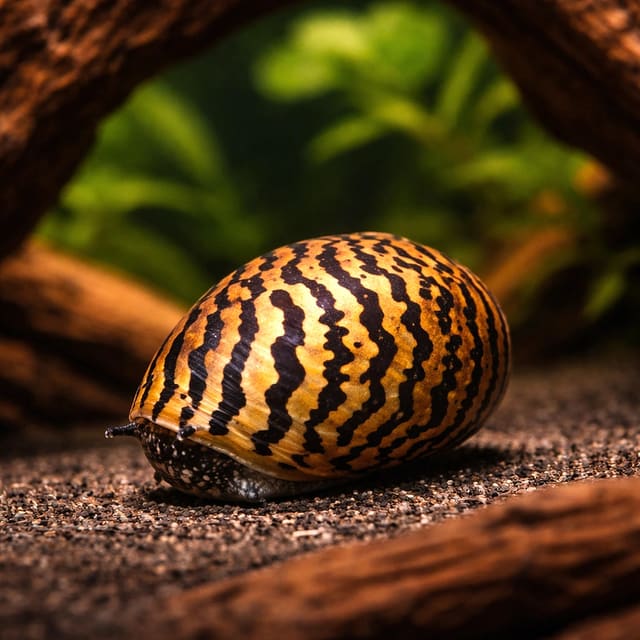
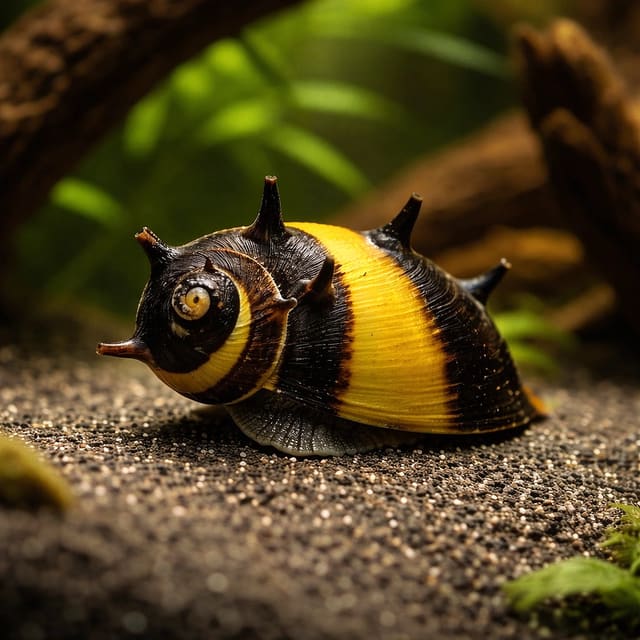
Zebra Horned Nerite Snail (Clithon sp.)
19–26°C
£3.99

King Nerite Snail is a striking freshwater snail ideal for algae control in community tanks. Moderate care and full of character. Buy online with UK delivery.
Adult size is the maximum length this species reaches at full maturity (scientific sources). The livestock you receive will be younger and smaller. Product-photo provenance and any image-specific limitations are stated on the listing.
Neritina sp.
Lives in groups: kept together they stay settled, active and show their best colour.
Minimum of 2 per order.
King Nerite Snail is a striking freshwater snail ideal for algae control in community tanks. Moderate care and full of character. Buy online with UK delivery.
Adult size is the maximum length this species reaches at full maturity (scientific sources). The livestock you receive will be younger and smaller. Product-photo provenance and any image-specific limitations are stated on the listing.
Maintain these water conditions for optimal health and vibrant colors
If you want an algae grazer with real character, the King Nerite Snail is one of the smartest choices in the hobby. Known in shops as Neritina sp., this striking nerite combines bold shell patterning, a calm nature, and an excellent snail lifespan for a small invertebrate. In a stable aquarium, the typical aquarium snail lifespan for this species is around 2-3 years, with many keepers reporting close to 3 years when Neritina King Snail water parameters stay consistent. That makes it a practical option for aquarists who want long-term algae control without the risk of a population explosion. See our detailed photos showing shell shape, colour contrast, and the large, impressive profile that makes this one of the most eye-catching aquarium snails UK hobbyists can keep.
The King Nerite is widely considered one of the best freshwater snails for aquarium use because it is hardy, tidy, and genuinely useful. It stays small at around 2.5 cm, suits a modest snail tank size of 10 litres or more, and is among the most peaceful aquarium snails for a planted community. If you are comparing beginner friendly aquarium snails, looking for a snail for community tank setups, or searching to buy aquarium snails online UK, this species stands out for reliable algae grazing, low waste, and simple care. It is also an excellent Neritina King Snail for planted tank option because it usually ignores healthy leaves and spends its day cleaning hardscape, glass, and décor rather than chewing through plants.
For aquarists researching freshwater snails UK stock, the King Nerite offers a rare mix of beauty and function. It helps reduce soft algae and biofilm, adds movement to the lower levels of the tank, and gives you the charm of a true live snails for aquarium UK display animal rather than just a “cleanup crew” label. If you want a useful, attractive grazer with a dependable snail lifespan in aquarium conditions, this nerite is a very strong choice.
The King Nerite belongs to the nerite family, a group of aquatic gastropods prized for their algae-eating ability and decorative shells. In the aquarium hobby, nerites sit among the most useful types of snail because they combine strong grazing behaviour with minimal risk of overbreeding in freshwater. Related nerites include zebra, batik, sun, hair, and parallel forms, all popular with keepers who want efficient algae control and a neat, patterned shell.
In the wild, King Nerites come from tropical regions linked to the Indo-Pacific, where nerite species are found in coastal streams, lower rivers, estuaries, and freshwater systems influenced by mineral-rich conditions. When aquarists ask where do snails live, the answer varies hugely by species, but for nerites the natural snail habitat often includes hard surfaces, steady water movement, and abundant algae or biofilm to graze. This matters because recreating a suitable freshwater snail habitat in the aquarium improves feeding response, shell quality, and overall longevity.
Wild nerites spend much of their time attached to rocks, driftwood, submerged roots, and river margins. Their natural diet answers a common question: what do snails eat in the wild? In this case, they mainly consume algae films, diatoms, and microorganisms growing on surfaces. That is similar to what do river snails eat, what do snails eat in a lake, and even what do snails eat in a pond when those habitats contain biofilm and soft algae. It is also why a mature tank works better than a sterile new setup for this species.
Many keepers compare aquarium species to outdoor snails and ask about snails habitat and food, what do pond snails eat UK, or what do snails eat in wild. While garden and pond species differ, the key lesson is the same: snails thrive where surfaces are alive with microscopic food. In the home aquarium, that means seasoned décor, moderate lighting, and stable water chemistry. If you are teaching children or planning a snail habitat for kids project, the King Nerite is best understood not as a land snail but as a specialised aquatic grazer adapted to hard, alkaline water and constant access to submerged surfaces.
For hobbyists searching how to make a snail habitat or even snail habitat diy ideas, the best approach is simple: create a mature, planted freshwater tank with rock, wood, and algae-friendly surfaces rather than a bare quarantine box. That is far closer to the natural environment this species evolved to use.
Mimicking the natural habitat of nerites improves health and brings out natural grazing behaviour. A tank with aged wood, stone, stable minerals, and a little natural algae growth will support a better feeding response than an ultra-clean setup scrubbed spotless every week.
A proper setup is the biggest factor behind good shell quality and a long snail lifespan. The minimum snail tank size is 10 litres for one specimen, but 20 litres or more is easier to keep stable. A larger tank gives more grazing area, steadier chemistry, and better oxygen levels. If you want a snail for nano tank, one King Nerite can work in a mature nano aquarium, but only if the tank is fully cycled and already producing enough algae and biofilm.
The official Neritina King Snail tank requirements are straightforward: 10 litres minimum, secure lid, mature surfaces to graze, and no copper contamination. For mixed setups with shrimp or peaceful fish, 25-60 litres is ideal. Although this species has a low bioload, more water volume protects against sudden swings in pH, ammonia, and hardness. That matters because shell erosion often starts when water becomes too soft or acidic.
The best Neritina King Snail water temperature is 22-28°C, with 24-26°C being a very safe everyday target. Recommended Neritina King Snail water parameters are pH 7.0-8.5 and hardness 8-20 dGH. These values reflect the species’ need for minerals and explain why snail water hardness is so important. Soft, acidic water can slowly pit the shell, while stable alkaline water supports growth and repair. In practice, the best Neritina King Snail aquarium conditions are clean, oxygen-rich water with measurable carbonate hardness and no ammonia or nitrite.
Use a gentle but effective filter that keeps oxygen high without blasting the snail around the tank. Sponge filters and small internal filters both work well. If you are building a planted setup, pair the snail with a mature filter and stable heater. For a broader selection of suitable species and sizes, browse our freshwater snails UK collection to compare tanks and stocking ideas around different nerites and ramshorns.
The ideal snail substrate preference is smooth sand or fine rounded gravel. Sharp gravel can chip the shell if the snail falls. Dark substrate often makes the shell pattern stand out more, but function matters more than colour. The base should stay clean, with uneaten food removed quickly so the tank does not foul.
The King Nerite is a superb Neritina King Snail for planted tank choice because it usually leaves healthy plants alone. This directly answers common searches such as what snails do not eat plants and what to do if snails are eating my plants. In a healthy aquarium, nerites are not the species most keepers blame for plant damage. If leaves are being eaten, the real cause is often decay, nutrient deficiency, or a different snail species. Add driftwood, rounded stones, and broad-leaved plants for grazing surfaces. If you like variety, compare this species with the Parallel Nerite Snail - Neritina Sp., Hair Nerite Snail - Neritina Sp., and Batik Nerite Snail - Neritina Variegata for different shell textures and patterns.
Moderate lighting for 6-8 hours daily encourages natural algae films without turning the aquarium into a green mess. This species benefits from some algae growth, so do not over-clean every surface. A fully polished tank can leave new arrivals short of food.
Always cycle the tank for 4-6 weeks before adding a King Nerite. New tanks often look clean but lack the algae and biofilm that make up the core diet of this species.
The short answer to what do snails eat for this species is algae, biofilm, and plant-based supplements. The natural Neritina King Snail diet is herbivorous, with most feeding time spent scraping soft algae and microscopic films from hard surfaces. If you have ever wondered how and what do snails eat, nerites use a radula, a rasping tongue-like structure covered in tiny teeth, to graze surfaces. That also explains popular PAA questions such as do snails have 14000 teeth and what snail has 14000 teeth: many snails and slugs have thousands of tiny teeth on the radula, though numbers vary by species.
A good snail feeding guide starts with natural grazing. In a mature tank, the snail will spend all day cleaning glass, rocks, and décor. If algae is limited, offer algae wafers, spirulina foods, and blanched vegetables. For keepers searching what can snails eat list, safe options include courgette, cucumber in moderation, spinach, kale, and green beans. Questions like which vegetables do snails eat, which leaves do snails eat, and which food do snails eat all point to the same rule: offer soft plant foods that break down slowly and remove leftovers within 12-24 hours.
Many people also search unusual queries such as what can snails eat watermelon, which fruits do snails eat, or what can snails not eat. For aquarium nerites, fruit is unnecessary and can foul water quickly. Avoid salty, seasoned, oily, or processed foods. Also avoid copper-containing foods or medications. If you are comparing species online and seeing searches like what do bladder snails eat, what do bumblebee snails eat, what do jade snails eat, or what do japanese snails eat, remember diets differ between species. The King Nerite is mainly an algae and biofilm specialist rather than a scavenger or predator.
Shell health depends on minerals as much as food. Strong snail calcium requirements mean you should maintain hard water and, if needed, add a calcium-rich invertebrate food or cuttlebone source designed for aquaria. This is similar to questions like what do garden snails eat for calcium, but in aquariums the best source is usually the water itself plus a balanced invertebrate diet.
| Time | Food | Amount |
|---|---|---|
| Morning | Natural algae and biofilm | Free grazing |
| Evening | Algae wafer or blanched courgette | Small piece, remove leftovers next day |
Overfeeding causes ammonia spikes and poor water quality. A King Nerite should not rely on large daily meals; it should spend most of its time grazing naturally, with supplements only when the tank is too clean to support it.
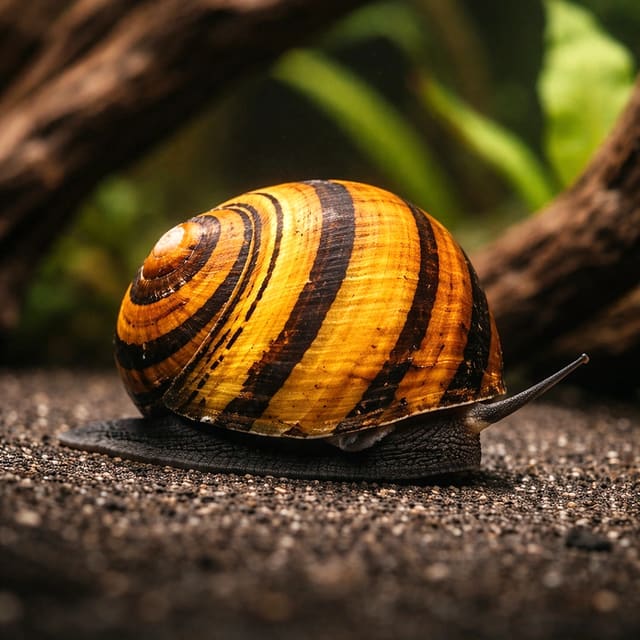
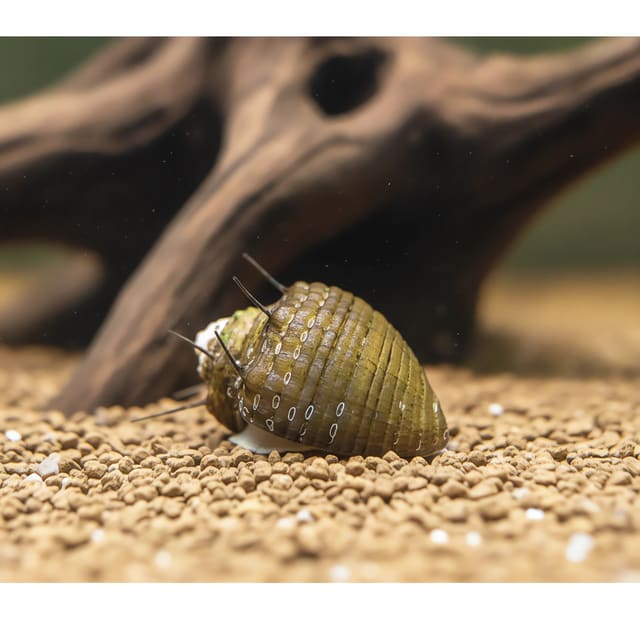
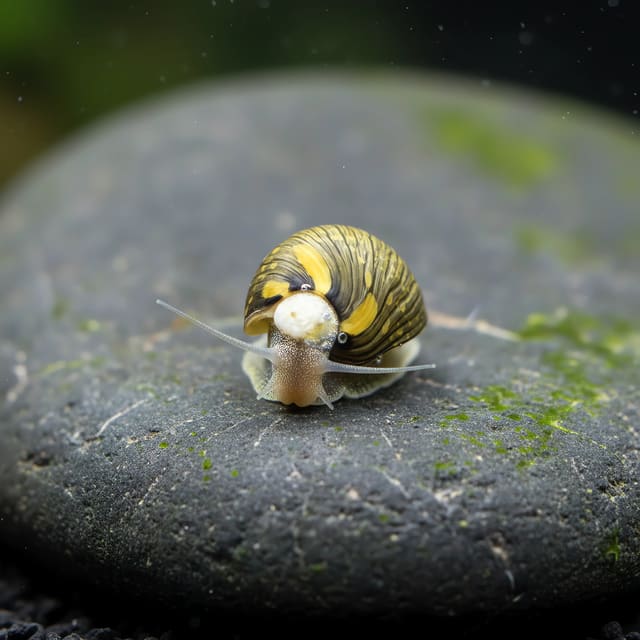
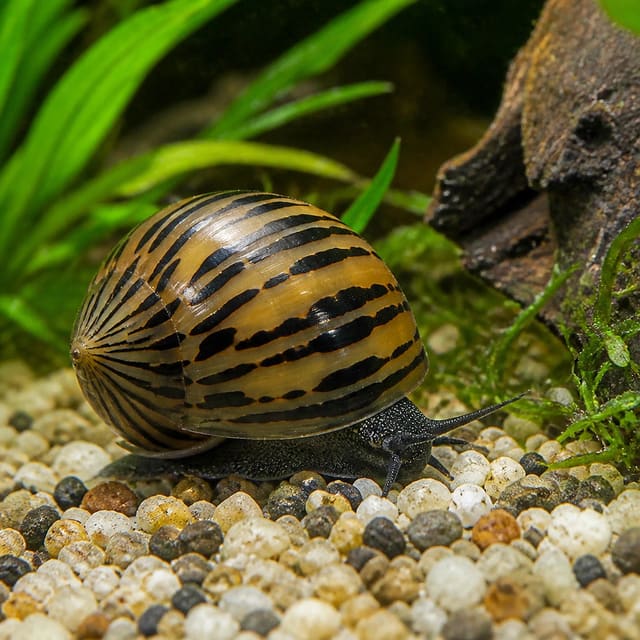
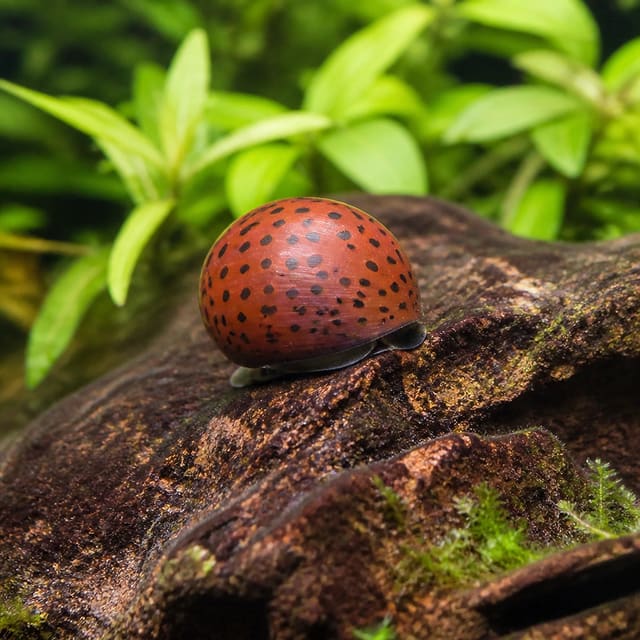
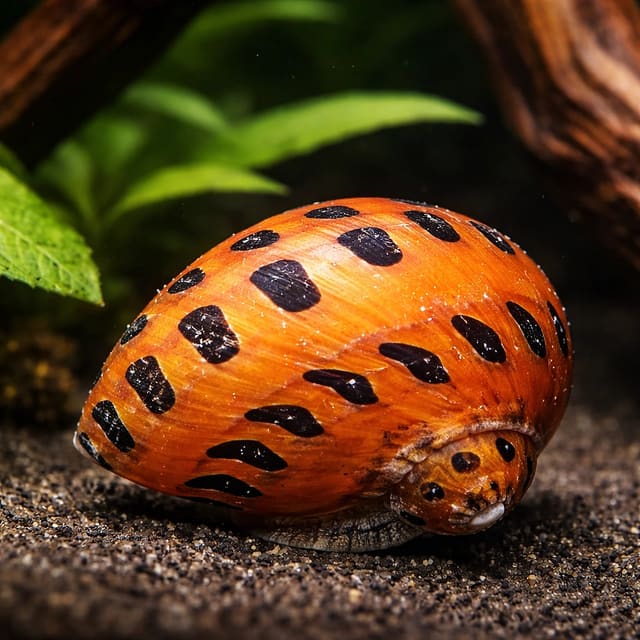
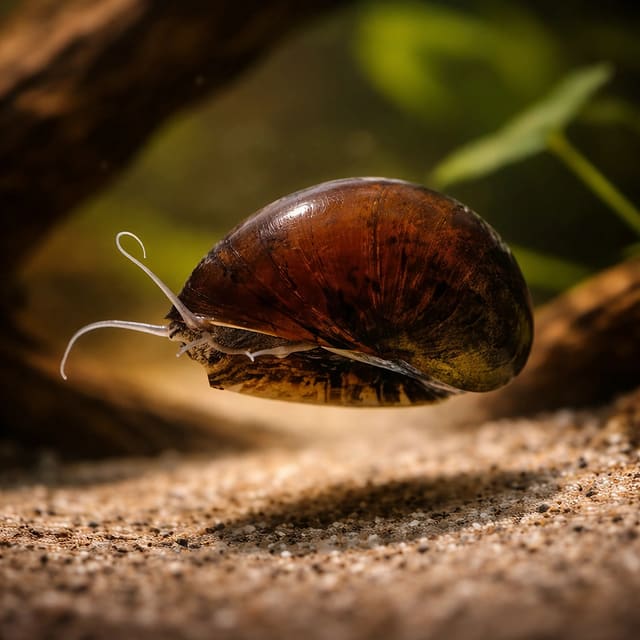
The King Nerite is prized for a bold, rounded shell with strong pattern contrast and a larger, more substantial look than many smaller nerites. Adult size is usually around 2.5 cm, making it noticeable without becoming bulky. Depending on the exact form imported, shells may show dark brown, black, tan, gold, or banded patterning. Some hobbyists compare shell interest across species using searches like how long do black snails live, how long do blue snails live, or how long do red spotted snails live, but for the King Nerite the real appeal is not colour morph hype alone; it is the combination of shell size, pattern, and active grazing behaviour.
Our photos show the rich contrast and sculpted shell profile that make this species stand out on dark substrate and driftwood. Good mineral levels, stable pH, and a varied plant-based diet help keep the shell smooth and well-defined over time. If you enjoy unusual nerites, the Sun Nerite Snail - Neritina Sp. and Hair Nerite Snail - Neritina Sp. offer very different shell textures for comparison.
The King Nerite is one of the safest choices for a mixed tropical aquarium. Its ideal Neritina King Snail tank mates are peaceful fish, dwarf shrimp, and other calm invertebrates. This makes it an excellent snail for community tank stocking, especially in planted aquariums where gentle algae control is useful. It also works very well as a snail with shrimp because it does not hunt, bully, or compete aggressively for food.
Good companions include small rasboras, tetras, Corydoras, Otocinclus, peaceful gouramis, and shrimp. Among snails, it can live alongside other non-predatory species if space and food are adequate. If you want to build a varied snail display, consider the Parallel Nerite Snail - Neritina Sp., Batik Nerite Snail - Neritina Variegata, Pink Ramshorn Snail - Planorbella Duryi, and Mieniplotia Scabra. Each adds a different shell shape and grazing style.
Some Google searches ask extreme survival questions such as how long can snails live without food, how long can snails live without eating, how long do snails live without food, how long do snails live without eating, how long do snails live without water, or how long can snails live without oxygen. In practical aquarium care, these are warning signs rather than care goals. Nerites should not be exposed to dry conditions, stagnant transport water, or starvation. They are aquatic animals and need stable access to oxygenated water, food films, and intact shells. Questions like how long can snails live without a shell or “what happens if a snail loses its shell” have a simple answer: a true snail cannot survive shell loss. A snail without shell is not a healthy snail; shell integrity is essential.
| Species | Compatible? | Notes |
|---|---|---|
| Pink Ramshorn Snail - Planorbella Duryi | ✅ Yes | Peaceful, but monitor food levels so both species get enough grazing and supplements. |
| Giant Ramshorn Snail - Marisa Cornuarietis | ⚠️ Caution | Larger and more likely to nibble plants than nerites; needs careful feeding and more space. |
| Assassin Snail - Bumblebee Snail - | ❌ Avoid | Predatory snail that may attack or stress nerites. |
If you are planning a small planted tank, one King Nerite with shrimp and micro fish is often a better choice than multiple large snails. That keeps the bioload low while still giving you visible activity and algae control.
Always quarantine new arrivals for 2-4 weeks before adding them to a community aquarium. This protects your fish, shrimp, and snails from hidden parasites, bacterial issues, and stress-related losses.
Neritina King Snail breeding is difficult in the home freshwater aquarium. Adults may mate and females may lay small white eggs on hard surfaces, so the answer to do aquarium snails lay eggs is yes, they often do. However, unlike ramshorns or many pond snails, nerite larvae usually require brackish conditions to develop. That means the eggs often remain visible in freshwater but do not hatch into surviving young.
If you want to attempt breeding, start with healthy adults in hard, alkaline water and excellent feeding. A separate system is usually required for larval development. This is one reason many hobbyists choose nerites: they provide algae control without overrunning the tank.
Females deposit tiny white capsules on glass, wood, rock, filters, and even other shells. This often prompts questions like how to take care of snail eggs, how long do snail eggs live, and how long can snail eggs survive in water. In freshwater, nerite eggs may persist for quite some time but usually do not produce viable juveniles. They are not the same as golden mystery snail eggs, which are laid above the waterline and follow a very different breeding pattern.
For most keepers, there is no practical need to intervene. If eggs bother you visually, they can be gently scraped from removable décor. Searches like how long can aquarium snail eggs live out of water, how long can snail eggs live out of water, and how long do snail eggs live out of water are less relevant here because nerite breeding success depends more on salinity and larval care than on dry incubation.
Because successful freshwater hatching is rare, questions such as what do snails eat baby, when do baby snails eat, what do baby snails eat and drink, and how long do baby snails live usually apply more to other snail species. If larvae are ever raised in specialist conditions, they need microscopic food and expert handling. This is advanced invertebrate breeding, not a beginner project.
One practical upside is that you avoid the overpopulation issues seen with some common pest snails. So while breeding is hard, ownership is simple.
If you want to experiment with nerite breeding, focus on larval rearing rather than just egg production. Adults may lay eggs in freshwater, but successful development usually requires a separate brackish rearing system with stable salinity, microscopic foods, and excellent water quality.
Choosing between snail species matters because not all “cleanup crew” snails behave the same way. Some are stronger algae grazers, some breed rapidly, and some are more likely to nibble plants. If you are researching the best aquarium snails comparison, the King Nerite usually ranks highly for algae control, shell beauty, and low breeding risk in freshwater.
| Feature | King Nerite Snail | Pink Ramshorn Snail |
|---|---|---|
| Max Size | 2.5 cm | 2-2.5 cm |
| Care Level | Easy | Easy |
| Temperature | 22-28°C | 20-28°C |
| Price | £3.87 | Varies |
| Best For | Algae control without overbreeding | Colourful scavenging and easy breeding |
| Feature | King Nerite Snail | Assassin Snail |
|---|---|---|
| Diet | Algae, biofilm, vegetable supplements | Predatory on other snails |
| Temperament | Peaceful | Predatory |
| Plant Safety | Usually plant-safe | Plant-safe but not snail-safe |
| Breeding Risk | Low in freshwater | Moderate |
| Best For | Planted community tanks | Pest snail control |
Choose the King Nerite if you want one of the best freshwater snails for aquarium algae control, especially in a display tank where shell appearance matters. Choose ramshorns if you want easy breeding and more scavenging behaviour. Choose assassin snails only if you specifically need snail predation. For visual alternatives, compare the Sun Nerite Snail - Neritina Sp. and Parallel Nerite Snail - Neritina Sp. with this species.
Many aquarists also compare lifespan across species using searches like how long do black devil snails live, how long do blueberry snails live, how long do white lipped snails live, and how long do yellow apple snails live. The King Nerite offers a dependable middle ground: not the largest snail, but a very respectable snail lifespan for a compact, useful algae grazer.
A healthy King Nerite is active, firmly attached to surfaces, responsive when touched, and shows a solid shell with no major pitting. The most common problems are shell erosion, starvation in overly clean tanks, and poisoning from copper or poor water quality. If your snail spends long periods inactive, falls repeatedly, or shows shell damage, review minerals, pH, and food availability first.
Healthy individuals graze steadily, seal themselves with the operculum when resting, and move with purpose over glass, wood, and stones. They may pause for long periods, which is normal. This also answers another PAA query: how long do snails sleep? Snails do not sleep like mammals, but they do have rest cycles and can remain inactive for extended periods between feeding and movement.
Shell pitting usually points to low minerals or acidic water. Starvation shows as reduced movement and weight loss over time in a spotless tank. Injuries can happen if the snail falls onto hard décor. Aquarists sometimes ask dramatic questions like do snails bleed or snail bite poison. Aquarium nerites are not venomous, and they do not bite people in any dangerous sense. Their radula is for scraping food, not attacking humans.
Plant damage is another misunderstood issue. Searches like which plants do snails eat, what do snails eat plants, what do snails eat from plants, and when do snails eat plants often come from keepers seeing holes in leaves. King Nerites usually graze algae and decaying tissue rather than healthy leaves. If plants are deteriorating, check nutrients, CO2 balance, and leaf age before blaming the snail.
Prevention is simple: maintain hard, alkaline water, feed lightly but consistently when algae is scarce, and never expose the tank to copper-based medications. Quarantine new livestock and décor if possible. If treatment is needed for fish in a mixed tank, move the snail to a safe hospital-free setup rather than medicating the display with invertebrates present.
NEVER use copper-based medications with invertebrates. Copper is highly toxic to snails and shrimp, even at levels tolerated by some fish.
The King Nerite is calm, methodical, and useful. Most of the day is spent grazing glass, rocks, wood, filter pipes, and plant leaves. It is not territorial and does not need a group, though multiple individuals can coexist if the tank provides enough food. This makes it one of the easiest answers to how to care for snail for new keepers.
One of the most common “snails facts” that surprises beginners is how active a healthy nerite can be. It may climb to the waterline, explore equipment, and occasionally appear to “disappear” for hours behind décor. People also ask do snails swim; nerites do not truly swim, but they can detach and drift briefly if dislodged. They are also famous escape artists, so a lid matters.
If you are wondering what is the home of a snail called, the shell is not simply a house it can leave behind; it is part of the animal’s body. That is why shell care is central to husbandry. In a good setup with stable minerals, the King Nerite shows natural, steady behaviour and becomes one of the most reliable members of the cleanup crew.
When you are looking for a snail for sale UK, the difference is not just price. With King Nerites, condition on arrival matters because shell quality, hydration, and feeding history all affect how quickly the snail settles in. We select active specimens with intact operculums and strong shell condition, then hold them under suitable Neritina King Snail aquarium conditions before dispatch so they reach you ready to graze rather than weakened from poor storage.
Each snail is checked for movement, shell integrity, and normal attachment behaviour before packing. For UK transit, snails are packed professionally in insulated boxes, with seasonal heat packs in colder weather and secure containment to reduce temperature swings. If you want to buy Neritina King Snail UK, order Neritina King Snail online UK, or compare Neritina King Snail price UK options, the real value is receiving a healthy animal that adapts quickly to your tank.
We also focus on practical aftercare. If you are searching buy aquarium snails UK, buy snail UK, freshwater snails for sale UK, live snail for sale UK, or tropical snails UK, you likely want clear guidance on acclimation and feeding. That is why we include species-specific advice on mineral-rich water, algae availability, and safe tank mates. For hobbyists comparing Neritina King Snail for sale UK listings, our aim is simple: healthy snails, sensible packing, and honest care information.
Tracked shipping, insulated packaging, and careful handling help protect this species during Neritina King Snail delivery UK. If you are building a mixed snail display, you can also explore our wider range of aquarium snails UK and freshwater snails UK options to create a balanced, useful cleanup crew.
Complete your setup with other useful and attractive snails from our collection. The Batik Nerite Snail - Neritina Variegata offers striking pattern contrast for planted tanks, while the Sun Nerite Snail - Neritina Sp. adds a different shell style with similar algae-grazing habits. If you want a brighter colour accent, the Pink Ramshorn Snail - Planorbella Duryi is a popular community option. For larger display snails, compare the Giant Ramshorn Snail - Marisa Cornuarietis. You can also browse the full aquarium snails UK collection to mix species carefully based on diet, breeding behaviour, and plant safety.
No reviews for this item yet. Bought one? Honest reviews only, good or bad.
What customers say about ordering from us
I have a small group of long finned mountain minnows. So was delighted to be able to order ten of this variety to increase the genetics in my tank . The ones I recieved are healthy but it’s to early to give a verdict on wether they are of a long finned type since they are small currently.
Gordon Walker · 23 Sept 2026
100% success travel and "installation". Pleased with quality of purchase. The Siamese fighter a bit "shy" so have not yet seen him at his best yet but looking good. Happy customer. GG
George E Garratt · 21 Sept 2026
Reviews of our shop, collected by Judge.me, an independent third-party review collector. Newest first.