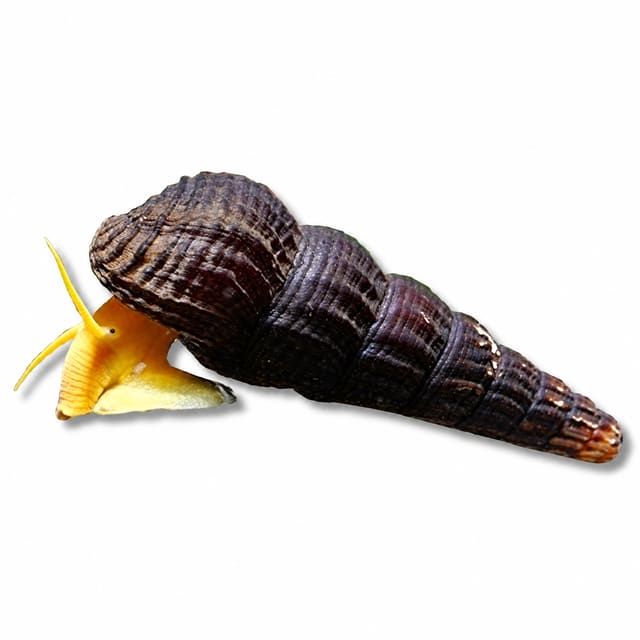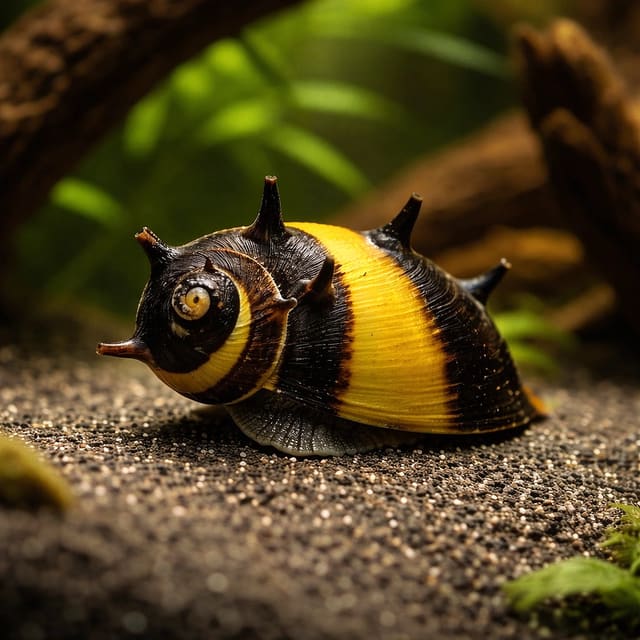
Moderate
Zebra Horned Nerite Snail (Clithon sp.)
19–26°C
£3.99

One live Green Ornamental Mussel supplied as Scabies crispata at approximately 4-5 cm. This peaceful unionid is a specialist filter feeder for mature 60 L+ aquariums and needs measured microfine food. Read the glochidia fish-host warning before ordering.
Scabies crispata
Save when buying more.
Confirm your email, then we’ll send an availability message for this exact item if it returns within 180 days.
This request is only for this product—no newsletter or other promotions. A mail-provider retry may very rarely duplicate the same availability message. Unconfirmed addresses are removed after 48 hours. See our privacy policy.
One live Green Ornamental Mussel supplied as Scabies crispata at approximately 4-5 cm. This peaceful unionid is a specialist filter feeder for mature 60 L+ aquariums and needs measured microfine food. Read the glochidia fish-host warning before ordering.
Maintain these water conditions for optimal health and vibrant colors
Green Ornamental Mussel (Scabies crispata) is a small Southeast Asian freshwater mussel with an unusually decorative shell. Yellow-gold to warm beige valves carry green or dark zig-zag markings, giving rise to trade names such as Green Grid Mussel, Ornamental Mussel and Avocado Clam. The animal supplied under this listing is approximately 4-5 cm. One quantity means one live mussel.
This is a genuine bivalve, not an aquarium snail and not the invasive Asian clam Corbicula fluminea. That distinction matters because S. crispata belongs to the Unionidae, a family with a specialised larval stage that can use fish as temporary hosts. It is also a demanding filter feeder that can slowly starve in an aquarium that looks clean and otherwise tests well. We therefore recommend it only to experienced keepers who can provide a mature aquarium, fine suspended food, stable mineral content and regular observation.
For the right aquarist, this is a fascinating animal. It can partly bury itself, extend its siphons and quietly process microscopic particles carried through the water. It should be chosen for its biology and shell pattern, not sold as a shortcut to clearer water or a substitute for filtration and maintenance. Read the feeding and glochidia sections before ordering; they contain the two most important parts of long-term care.
This is a specialist filter feeder. A cycled tank is not automatically a food-rich tank. Targeted micro-feeding is essential, and the unionid larval stage creates a potential fish-host risk that cannot be predicted precisely for this species. Do not add it to a new, sterile or heavily polished aquarium.
| Scientific name | Scabies crispata (A. A. Gould, 1843) |
|---|---|
| Common trade names | Green Ornamental Mussel, Green Grid Mussel, Avocado Clam, Ornamental Mussel |
| Animal type | Freshwater bivalve; family Unionidae |
| Supplied size | Approximately 4-5 cm |
| Typical reported adult size | Around 5-6 cm in aquarium-trade references |
| Care level | Specialist / advanced |
| Temperament | Peaceful and non-predatory, but larvae may use fish hosts |
| Recommended aquarium | Mature 60 L minimum for one; 75 L or larger is easier to keep stable |
| Temperature | 20-27°C; aim for a stable 22-25°C rather than the limits |
| pH | 6.5-8.0; neutral to mildly alkaline is a practical target |
| Hardness | Moderate to hard, mineral-bearing water; avoid very soft, acidic conditions |
| Diet | Suspended microscopic food, suitable phytoplankton and microfine filter-feeder food |
| Substrate | Fine, smooth sand deep enough for partial burial |
| Flow | Clean, oxygenated circulation with a gentle low-level feeding zone |
| Beginner suitable? | No; a nerite snail is usually a better first aquarium mollusc |
The ranges above combine published aquarium-trade experience rather than a controlled field-tolerance study. Stability is more important than pushing an animal to either edge. Use our water matcher to compare your aquarium with the recommended envelope, then make any adjustment gradually.
Scabies crispata is a freshwater mussel in the family Unionidae. Its scientific genus happens to share a word with a human skin condition, but the two are entirely unrelated. The genus name should never be turned into medical or treatment wording on an aquarium page. This listing concerns a mollusc: class Bivalvia, order Unionida, family Unionidae, subfamily Parreysiinae.
Modern taxonomy also calls for some care. A 2018 molecular and morphological revision separated several mussels that older references had grouped broadly under S. crispata. In that work, confirmed S. crispata samples came from the Mae Khlong and Chao Phraya drainages, while lookalikes such as Scabies mandarinus were treated separately. Shell pattern alone is not always enough for a non-specialist to distinguish close unionid species.
We therefore use the supplier identity Scabies crispata and retain the original trade name for traceability, while being transparent about the limits of retail shell identification. The practical care remains that of a small tropical unionid mussel: stable freshwater, a soft bottom, suspended nutrition and caution around fish during any larval-release event.
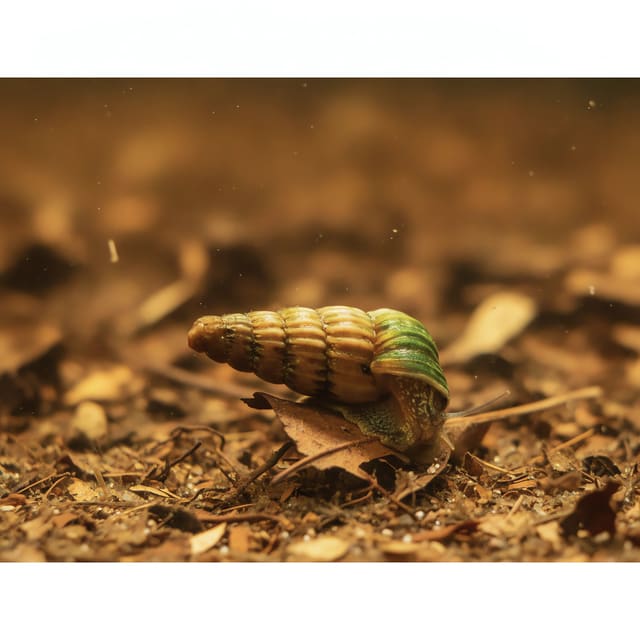
The shell is the attraction. Freshly imported specimens commonly show a warm yellow, orange-beige or golden ground marked with green to very dark V-shaped lines. Growth rings and corrugation create a textured surface rather than the smooth, rounded look of many Corbicula clams. Colour strength varies between individuals, with age, and under different aquarium lighting. A living mussel may also carry a light natural film after settling into the substrate.
The supplied animal is approximately 4-5 cm, already large enough for its pattern to be clear. Aquarium-trade sources usually place the species around 5-6 cm when grown, but there is limited species-specific captive growth research. We do not attach a guaranteed final size or lifespan to an individual animal.
Image accuracy note: the product gallery includes previously published illustrative aquarium scenes. The reference photograph is the gallery image showing two yellow-gold shells with green zig-zag markings; use that image to judge the animal's real shell form and pattern. Individual live animals naturally vary, and no photograph can promise an identical arrangement of markings.
Stock quantity, price and delivery availability are shown live on this page. The supplier code is retained in our operations records but is deliberately not placed in the customer title. For first orders, the current welcome offer is 10% off with code WELCOME10, subject to the terms shown on our special offers page.
Choose this animal only if you enjoy observing subtle invertebrate behaviour and are willing to feed something you may not see eating. It spends much of its time partly buried, and a healthy individual can remain in one place for long periods. That quietness makes slow decline easy to miss. The challenge is not aggression or a large waste load; it is maintaining enough appropriately sized suspended nutrition without damaging water quality.
A suitable keeper should already be comfortable testing ammonia, nitrite, nitrate, pH and hardness, and should understand how their filter moves water near the substrate. The aquarium must be fully cycled and biologically mature. Six months of stable operation is a safer benchmark than simply waiting for the first nitrogen cycle to finish, although age alone cannot prove there is enough food.
| Suitable | Not suitable |
|---|---|
| Established aquarium with stable chemistry | Newly cycled or frequently reset aquarium |
| Keeper prepared to target-feed microfine food | Keeper expecting leftovers or algae to be enough |
| Fine smooth sand and accessible floor space | Sharp gravel, compacted soil or bare sterile base |
| Gentle low-level circulation with good oxygen | Dead spot with stagnant water or blasting direct flow |
| Routine observation and prompt removal if dead | Tank where a buried animal cannot be checked |
| Awareness of unionid glochidia | Delicate fish collection where any host risk is unacceptable |
Use at least 60 litres for one mussel, with 75 litres or more preferred. The larger recommendation is not about swimming room. More water dilutes feeding mistakes, buffers temperature and pH changes, and gives you a broader area in which to create a useful feeding zone. A long aquarium with accessible substrate is generally more practical than a tall tank with the same volume.
Do not calculate stocking by a simple mussels-per-litre formula. Each additional filter feeder increases the demand for suspended food. In a small aquarium, adding several can produce the worst combination: insufficient nutrition between meals followed by excessive dissolved waste when the keeper tries to compensate. Start with one, document its response and water quality, and do not add more unless the system can support them.
A mature tank contains established microbial communities and more stable chemistry, but it can still be too clean. Fine filter floss, UV clarification, aggressive water polishing and very low-nutrient plant systems can remove much of the material a bivalve might otherwise intercept. The answer is measured feeding, not deliberately poor water quality. Ammonia and nitrite must always remain at zero.
Before ordering, identify a patch of smooth sand where you can see the shell, deliver food upstream and retrieve the animal if necessary. If every centimetre is covered by rockwork, dense roots or inaccessible decor, the aquarium is a poor match.
Published aquarium-care ranges differ slightly. A sensible shared envelope is 20-27°C and pH 6.5-8.0, with moderate to hard water. Rather than moving between those extremes, aim for a stable 22-25°C and neutral to mildly alkaline pH. Adequate calcium and carbonate availability support shell maintenance, while sufficient oxygen supports the animal and the bacteria processing its waste.
| Parameter | Working range | Practical target | Why it matters |
|---|---|---|---|
| Temperature | 20-27°C | 22-25°C, stable | Avoids rapid metabolic and oxygen swings |
| pH | 6.5-8.0 | About 7.0-7.8 | Supports shell condition and predictable chemistry |
| General hardness | Moderate to hard | Roughly 10 dGH or above if stable | Provides dissolved minerals for shell maintenance |
| Carbonate hardness | Measurable and stable | Enough to resist daily pH swings | Buffers the aquarium against sudden acidification |
| Ammonia | 0 | 0 | Any detectable amount requires immediate action |
| Nitrite | 0 | 0 | Indicates the biofilter is coping |
| Nitrate | Low and stable | Manage through measured feeding and water changes | Rising nitrate can reveal chronic overfeeding |
Test the aquarium and the arrival water rather than guessing. Large differences in temperature, pH, conductivity or hardness should be bridged gradually. Our water chemistry guide explains what each reading means, and the water matcher helps organise the comparison.
Avoid copper-based medication and algaecides unless the manufacturer explicitly confirms safety for freshwater bivalves at the intended dose. Many products labelled safe for fish are not suitable for molluscs. If treatment is essential, seek specialist advice before exposing the mussel.
Provide fine, smooth aquarium sand at least 3-5 cm deep in the chosen zone. The mussel uses its muscular foot to settle and reposition, often leaving the rear edge and siphons exposed. Coarse or sharp gravel can obstruct normal burial and damage soft tissue at the shell margin. Avoid compacted anaerobic pockets; gently maintain open areas around the animal without repeatedly digging it up.
Water movement must carry suspended particles past the inhalant siphon, but a direct jet can prevent the mussel from settling. A sponge filter, spray bar or carefully aimed return can create broad circulation. Check flow at substrate level with a tiny pinch of fine food in tank water: particles should drift through the intended zone, not shoot past instantly or fall in a heap.
Keep oxygenation dependable, especially overnight, in warm weather and after any micro-food dose. An air-driven sponge filter or air stone can provide useful gas exchange. Do not turn off biological filtration for long feeding periods. If a food manufacturer recommends briefly pausing mechanical filtration, keep aeration running and restart the filter promptly.
Plants are compatible where their roots do not fill every patch of sand. Open foreground areas beside rooted plants work well. Lighting is for the plants and viewing; the mussel has no special lighting requirement. Make sure hardscape cannot shift onto an animal that moves underneath it.
Feeding is the decisive care task. This mussel filters suspended microscopic particles from water drawn through its body. It does not scrape algae from glass, chew wafers, hunt detritus or reliably live on fish-food crumbs. A pellet lying beside the shell is not a meal unless it breaks down into particles small enough to remain suspended and be captured, and uncontrolled breakdown simply pollutes the substrate.
Use a reputable microfine food intended for freshwater filter feeders, a suitable phytoplankton suspension, or another product whose particle size and dosing instructions are appropriate. Aquarium Glaser reports target feeding a very dilute yeast suspension, but unmeasured household yeast can create bacterial blooms and oxygen loss. For most home aquariums, a formulated product with a repeatable dose is the safer choice.
Mix the selected food in a cup of aquarium water. Using a pipette or syringe without a needle, release a gentle cloud upstream of the inhalant opening rather than blasting the tissue. The cloud should pass the mussel and disperse. Do not inject food between the valves, force the shell open, or bury concentrated powder beside it.
Daily feeding is commonly recommended in specialist trade care because filtered aquariums contain little natural suspended food. Frequency must still be adjusted to the food, the aquarium and the number of filter feeders. Two tiny, well-diluted feeds can be safer than one large cloud. More food is not automatically better: excess material feeds bacteria, consumes oxygen and can kill the animal it was meant to support.
| Useful food approach | Avoid |
|---|---|
| Measured microfine filter-feeder food | Whole pellets, flakes or wafers beside the shell |
| Suitable live or preserved phytoplankton | Unmeasured household mixtures |
| Dilution in aquarium water before dosing | Dry powder dropped directly on the animal |
| Gentle upstream pipette delivery | Forcing food inside a closed or gaping shell |
| Small repeatable portions with testing | Clouding the full tank for hours |
| Good aeration throughout feeding | Switching off every filter and air source |
Filtering is how the animal eats; it is not free maintenance for the aquarium. In a clean display, the mussel can remove its available food and then starve. Keep normal filtration, water changes and substrate care, and feed the animal deliberately.
There is no single visible sign that proves adequate nutrition. A mussel can close, bury and look intact while gradually losing condition. Build a record instead: note its position, shell response, feeding schedule, water tests and any periods of unusual gaping. Photographing the same angle weekly can help reveal changes that are otherwise easy to overlook.
A settled animal may open slightly and expose its siphon area while filtering. It should close when firmly disturbed by nearby maintenance, although repeatedly touching it to test this response creates unnecessary stress. Occasional movement is normal. Persistent surface wandering can indicate unsuitable substrate, flow, oxygen or water chemistry, but behaviour alone cannot diagnose the cause.
| Observation | Possible meaning | First checks |
|---|---|---|
| Partly buried and filtering | Normal settled behaviour | Continue measured feeding and routine tests |
| Moves to a new patch once | Searching for a better position | Check low-level flow and substrate texture |
| Repeatedly surfaces or wanders | Environment may be unsuitable | Test oxygen, ammonia, pH, flow and substrate |
| Shell remains widely open | Severe stress or death possible | Check response, smell and water immediately |
| Fails to close when lifted gently | Critical condition or death | Remove to a container of tank water for assessment |
| Foul odour or decomposing tissue | Dead animal | Remove immediately; test ammonia and perform a water change |
| Fish show small white attachments | Possible glochidia, not necessarily white spot | Do not medicate blindly; isolate and seek specialist advice |
A dead bivalve can decompose out of sight and create a rapid ammonia problem. Place the mussel where it remains retrievable. If it is unresponsive, gaping and foul-smelling, remove it promptly, test the aquarium and perform an appropriate water change. Never leave a doubtful animal buried for days simply because the shell is still present.
Prepare the aquarium before delivery. Test it, clear the chosen sand patch and have a clean container, pipette and towel ready. On arrival, follow the livestock instructions supplied with your order and start the claim procedure immediately if there is a delivery problem. Our delivery and Live Arrival Guarantee page explains the evidence and timing requirements.
Do not quarantine this species in a newly filled, sterile box. If observation away from the display is needed, use a mature, heated, filtered and oxygenated system with the same feeding provision. Quarantine that removes all suspended nutrition can create a different welfare problem.
The adult mussel is peaceful and does not hunt or chase tank mates. That does not make every community suitable. Predatory or inquisitive animals may pick exposed tissue, turn the shell over, or repeatedly disturb the substrate. Avoid puffers, many loaches, large aggressive cichlids, crabs, crayfish and any known mollusc eater. Do not assume a fish is safe merely because it is small.
Shrimp and gentle snails are less likely to attack a healthy closed shell, but their presence does not remove the feeding problem. Fan shrimp are also filter feeders and may compete for the same suspended particles. Stock according to available nutrition, not just temperament.
Peaceful fish require a separate decision because of the glochidia lifecycle described below. A few larvae may not visibly harm a robust fish, while a heavy attachment can impair respiration. The host range and real aquarium risk for supplied S. crispata are not sufficiently known to promise safety. Keepers with rare, delicate, very young or already stressed fish should choose a different invertebrate.
| Tank mate | Adult compatibility | Important qualification |
|---|---|---|
| Peaceful robust community fish | Adult mussel is non-aggressive | Potential glochidia-host exposure remains |
| Dwarf shrimp | Usually low conflict | Observe for persistent picking at exposed tissue |
| Fan shrimp | Behaviourally peaceful | Compete for suspended micro-food |
| Nerite and other gentle snails | Usually low conflict | Different care and feeding niche |
| Puffers and mollusc-eating loaches | Unsafe | Can damage or consume the mussel |
| Crabs and crayfish | Unsafe | Powerful claws can open or break the shell |
| Large aggressive cichlids | Poor choice | Disturbance, excavation and predation risk |
Unionid freshwater mussels have an unusual reproductive cycle. Females brood larvae called glochidia in their gills before releasing them into the water. Scientific work on S. crispata records unhooked glochidia and brooding across all four demibranchs. Unhooked glochidia in this group are associated with attachment to fish, commonly at the gills, while they complete part of their development.
This stage is not the same as ich or a worm infection, and treating on appearance alone can make matters worse. Aquarium Glaser notes that light attachment may pass without obvious harm, whereas a mass release can be dangerous. Medication capable of killing an attached larva may also harm the fish or the mussel, and copper poses an additional risk to invertebrates.
The exact host species, timing and reproductive biology of the trade animal are poorly documented. It is unsafe to publish a list of guaranteed hosts or guaranteed non-hosts. It is also unsafe to promise that one mussel can never release larvae: sex may be unknown, prior fertilisation cannot be ruled out, and unionid reproductive strategies are complex.
This lifecycle is why we rate the species advanced despite the adult's peaceful nature. Customers who want a simple, visible mollusc without a fish-host stage should consider a suitable nerite snail instead.
Captive breeding is not a routine home-aquarium project. It requires correctly identified adults, successful fertilisation, a suitable fish host, safe larval attachment, transformation into juveniles and continuous microscopic food after detachment. The species-specific host relationship is not established well enough for us to recommend deliberate experiments in a community aquarium.
Do not purchase a group in the hope that visible eggs or free-swimming fry will appear. More adults increase food demand and may increase the chance of a larval release. Any breeding project should be undertaken only by an experienced keeper with separate mature systems, appropriate fish-welfare knowledge and a plan that prevents escape or release.
| Frequency | Task | What to record |
|---|---|---|
| Daily | Check shell position, gape, fish respiration and equipment | Any movement, unusual opening or fish spots |
| Once or twice daily | Deliver a tiny diluted micro-food dose as required | Product, dose and clearing time |
| Twice weekly at first | Test ammonia, nitrite and nitrate | Trend after feeding adjustments |
| Weekly | Check pH, GH/KH and temperature stability | Lowest and highest readings |
| Weekly | Inspect accessible sand and siphon excess waste nearby | Do not disturb the animal unnecessarily |
| As needed | Complete a measured water change with matched water | Volume and parameter difference |
| Monthly | Review photos, feeding record and filter flow | Long-term change that daily viewing may miss |
Normal water changes should continue. Match replacement water for temperature and mineral content, and avoid exposing a partly buried animal to sudden chemistry changes. Clean mechanical media in stages so that flow remains useful without stripping every suspended particle immediately after feeding. Never compromise oxygen or biological filtration to create a dirty tank.
It may have buried completely or moved under decor. Check the visible sand for a slight ridge and review the last known position. Do not rake the entire aquarium aggressively. Confirm ammonia remains zero; an unexplained rise can indicate hidden decomposition. Future layout should keep the animal retrievable.
One move can be normal. Repeated surfacing calls for a full review: substrate may be too coarse or compacted, bottom flow may be stagnant or excessive, oxygen may be low, or chemistry may be unsuitable. Test rather than pushing the animal back repeatedly.
The dose is too large, the particles are unsuitable, or circulation is not dispersing them. Increase aeration, test ammonia and reduce the next dose. A faint temporary cloud near the feeding zone is different from a tank-wide bacterial haze that lasts for hours.
A slight opening while filtering is normal. A broad persistent gape with no response is not. Use clean hands to lift the shell gently into a container of aquarium water and check for closure, tissue condition and odour. Remove a confirmed dead animal immediately.
Green coverage, line thickness, growth rings and base colour vary naturally. Light spectrum, water staining and a new surface film also change appearance. The reference image shows the typical yellow-green form, not an identical animal guarantee.
White marks have several possible causes. Because this is a unionid, glochidia must be considered alongside ich and other diagnoses. Do not medicate the display without identifying the problem. Photograph the fish, increase observation and oxygenation, and consult an aquatic-health professional.
| Choice | Visibility | Main diet | Care challenge | Best for |
|---|---|---|---|---|
| Green Ornamental Mussel, S. crispata | Often partly buried | Suspended micro-particles | Starvation and glochidia-host uncertainty | Experienced specialist keeper |
| Batman / Shark Fin Mussel | Large shell can be more visible | Suspended micro-particles | Specialist feeding and space | Larger dedicated setup |
| Freshwater White Clam | Frequently buried | Suspended micro-particles | Hidden starvation and identification | Experienced clam keeper |
| Purple Freshwater Clam | Frequently buried | Suspended micro-particles | Hidden starvation | Mature specialist aquarium |
| Small Freshwater Clam | Easy to lose in substrate | Suspended micro-particles | Monitoring a very small animal | Experienced keeper with accessible sand |
| Nerite Snail | Active and visible | Algae and biofilm grazer | Needs established grazing surfaces | Simpler first aquarium mollusc |
These animals are not interchangeable merely because shops may group them under clams, mussels or aquarium molluscs. Compare adult size, diet, reproduction and the exact supplier identity. Browse our broader UK aquarium livestock range only after matching each species to the aquarium you already maintain.
Never release this mussel, its larvae, aquarium plants, substrate or transport water into a pond, stream, drain or other natural waterway. GOV.UK guidance states that the Wildlife and Countryside Act 1981 prohibits release into the wild of animals that are not resident or regular visitors in Great Britain. Containment protects native wildlife even when a species is not one of the specifically listed invasive animals.
If you can no longer keep it, contact an experienced aquarium retailer, aquatic vet or suitable keeper. Do not use the animal as bait or food. Do not flush a living or dead specimen. A dead animal should be sealed and disposed of according to local waste guidance after you have protected the aquarium from ammonia.
Order only after the mature aquarium and feeding plan are ready. We pack eligible live-stock orders for UK delivery using season-aware methods, and qualifying orders are covered by the published Live Arrival Guarantee. The guarantee is not a substitute for correct acclimation or long-term care, so read the delivery terms before choosing a date when someone cannot receive the parcel promptly.
For a first purchase, use WELCOME10 for 10% off where the offer applies. If you are uncertain about tank age, water hardness, fish-host risk or delivery coverage, review our frequently asked questions or contact the team before ordering. Our livestock and returns policy explains the different rules that apply to live animals.
This care guide distinguishes established evidence from aquarium-trade experience. Key sources include the 2018 Journal of Molluscan Studies taxonomic revision, the MUSSEL Project species account, the Illinois Natural History Survey genus account, Aquarium Glaser husbandry observations and current GOV.UK non-native animal guidance.
Species-specific evidence remains limited. Where references disagree, we use a conservative shared care range and say so rather than presenting an uncertain claim as settled fact. Last evidence review: July 2026.
No. It is a freshwater bivalve with two hinged shell valves. Snails are gastropods with a different body plan, diet and life cycle.
No. This listing follows the supplier identity Scabies crispata, a unionid mussel. The former body incorrectly substituted C. fluminea; that identification and its associated care claims have been removed.
The supplied size is approximately 4-5 cm. One quantity means one mussel. Shell colour and green pattern vary naturally.
Aquarium-trade references commonly report around 5-6 cm. Because the taxonomy of similar Southeast Asian unionids has changed and captive data are limited, we do not promise an exact universal maximum.
Use at least 60 litres, with 75 litres or more preferred for stability and useful floor space. Tank maturity, feeding capacity and retrievability matter more than volume alone.
No. Completing the nitrogen cycle does not create the stable, food-supported environment this filter feeder requires. Use a mature aquarium and provide deliberate micro-feeding.
It filters microscopic suspended food. Use an appropriate microfine filter-feeder food or suitable phytoplankton suspension, diluted and delivered gently upstream with a pipette.
It filters in order to eat, but it is not a maintenance tool. It cannot replace filtration, water changes or substrate care, and it may starve after removing the limited food available in a very clean tank.
Specialist trade references commonly recommend one or two very small feeds daily. Start with the food manufacturer's minimum guidance, dilute it, monitor clearing time and test water. Adjust to the aquarium rather than following an unmeasured spoonful.
Not as whole foods. Large items are not captured like suspended microscopic particles and can rot beside the shell. Use food designed for filter feeders.
Partial burial is normal. The mussel uses its foot to find a position with suitable substrate and water movement. Repeated surfacing, however, should prompt checks of oxygen, chemistry, flow and substrate.
The adult is peaceful and usually has little direct conflict with dwarf shrimp. Watch for persistent picking at exposed tissue and remember that other filter feeders may compete for food.
The adult does not attack fish, but unionid larvae called glochidia can use fish as temporary hosts. The host range for this species is poorly known, and a heavy attachment can be harmful. Do not keep it with delicate fish if that risk is unacceptable.
Do not rely on a single-animal rule. Sex is not obvious, prior fertilisation may be possible, and species-specific reproduction is not sufficiently documented to promise that larvae cannot appear.
Do not assume ich and medicate blindly. Glochidia are one possibility, alongside several fish-health conditions. Increase oxygenation, document the marks and seek advice from an aquatic vet or experienced unionid specialist.
Do not expose the mussel to copper unless a qualified professional and the exact product instructions confirm safety. Many fish treatments can harm molluscs.
A broad gape, no closing response, decomposing tissue and a foul smell indicate death. Remove it immediately, test ammonia and perform an appropriate water change.
Reliable species-specific captive longevity evidence is not available, so this listing does not promise a lifespan. Long-term survival depends heavily on feeding, water stability and correct identification.
No. Never release a non-native aquarium animal or aquarium contents into natural waters. Rehome it through a responsible aquatic contact if you cannot continue its care.
Eligible livestock orders are covered when all published destination, delivery and evidence conditions are met. Read the Live Arrival Guarantee terms before ordering.
No reviews for this item yet. Bought one? Honest reviews only, good or bad.
What customers say about ordering from us
I have a small group of long finned mountain minnows. So was delighted to be able to order ten of this variety to increase the genetics in my tank . The ones I recieved are healthy but it’s to early to give a verdict on wether they are of a long finned type since they are small currently.
Gordon Walker · 23 Sept 2026
100% success travel and "installation". Pleased with quality of purchase. The Siamese fighter a bit "shy" so have not yet seen him at his best yet but looking good. Happy customer. GG
George E Garratt · 21 Sept 2026
Reviews of our shop, collected by Judge.me, an independent third-party review collector. Newest first.