Moderate
Zebra Horned Nerite Snail (Clithon sp.)
19–26°C
£3.99
Photo coming soon
The size, price and care details on this page are for this listing.
One live Yellow Lady horned nerite snail (Clithon sp.), sold unsexed. A small spined grazer that works algae and biofilm off rock, wood and glass in a mature tropical tank at 22-27 °C and pH 6.5-8.0. Its eggs cannot hatch in fresh water, so it will not overrun your aquarium.
Clithon sp.
Minimum of 2 per order.
One live Yellow Lady horned nerite snail (Clithon sp.), sold unsexed. A small spined grazer that works algae and biofilm off rock, wood and glass in a mature tropical tank at 22-27 °C and pH 6.5-8.0. Its eggs cannot hatch in fresh water, so it will not overrun your aquarium.
Nerite snail is a trade umbrella, not one species. Confirm the supplied taxon and holding water, use a mature covered aquarium with established grazing surfaces, stock from food availability rather than a litre formula, and treat egg capsules, medicines and tank mates as species-specific decisions.
Maintain these water conditions for optimal health and vibrant colors
The Yellow Lady horned nerite is a small freshwater snail from the genus Clithon, part of the nerite family, Neritidae. "Yellow Lady" is a trade name, not a scientific one, and that distinction matters. The snails sold under it have not been tied to one described species, so we list it as Clithon sp. rather than borrow an epithet that might be wrong. You may also come across it written as "Clithon yellow lady", which is how this page used to name it.
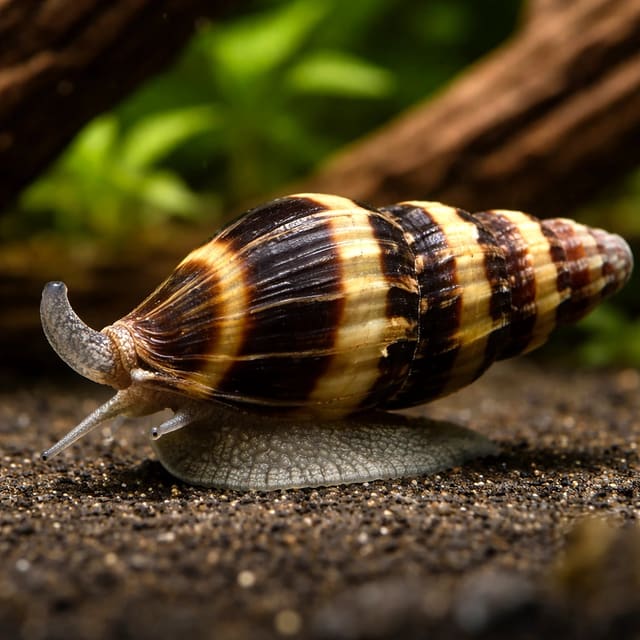
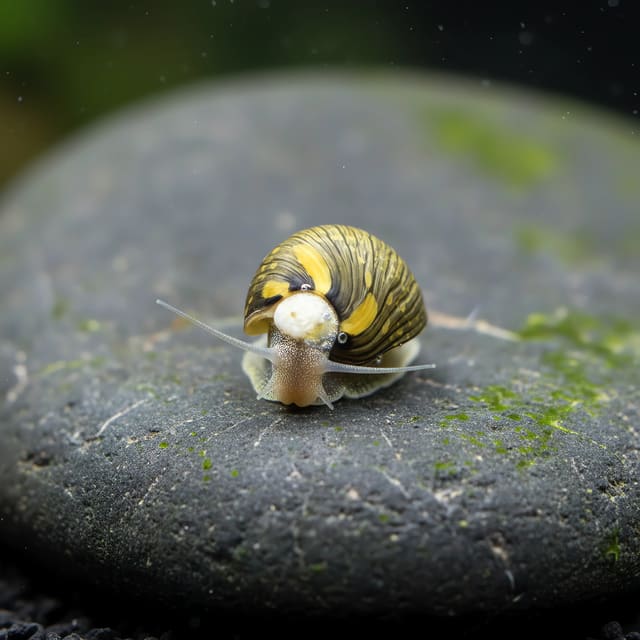
Each unit you add to your basket is one live snail. It is sold unsexed, and we do not promise a particular shell size. We have no photographs of this batch on the page, so we would rather be straight about what the name tells you and what it does not. As the trade name suggests, it is offered as a yellow-toned form of horned nerite. Shell colour and markings in this genus vary from animal to animal, so treat the name as a description of the line rather than a guarantee that every snail will match another.
Most people buy a horned nerite for one reason: it grazes. The best-documented species in the group, Clithon corona, scrapes algae from hard surfaces in fast streams and estuaries, and an aquarium gives it the same kind of work on rock, bogwood and glass. Horned nerites can also go into a freshwater tank without the risk of a population explosion, because their eggs need salt in the water before they will hatch. That is covered properly in the breeding section further down.
This guide sets out how to recognise a horned nerite, how its wild relatives live, the tank and water it needs, what to feed it when the algae runs thin, which tank mates and medicines to steer clear of, and what to do when the parcel arrives. Because the exact species behind this trade name is unresolved, some facts below come from closely related Clithon species. Where that is the case, we name the species so you can see exactly what the evidence covers.
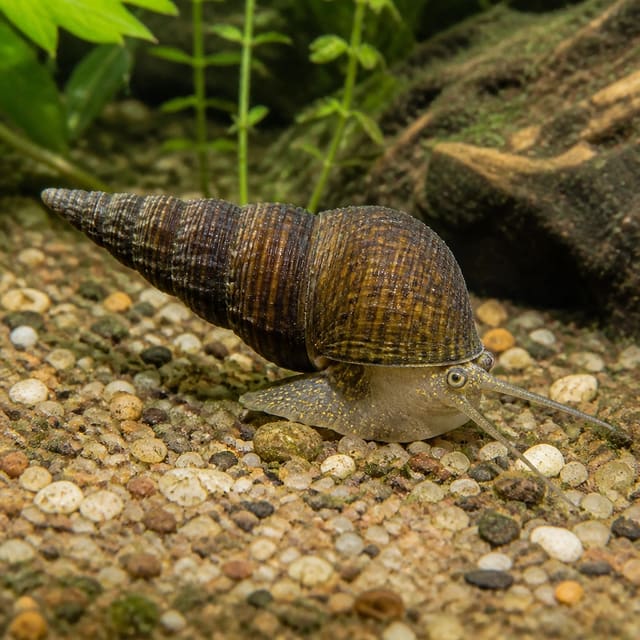
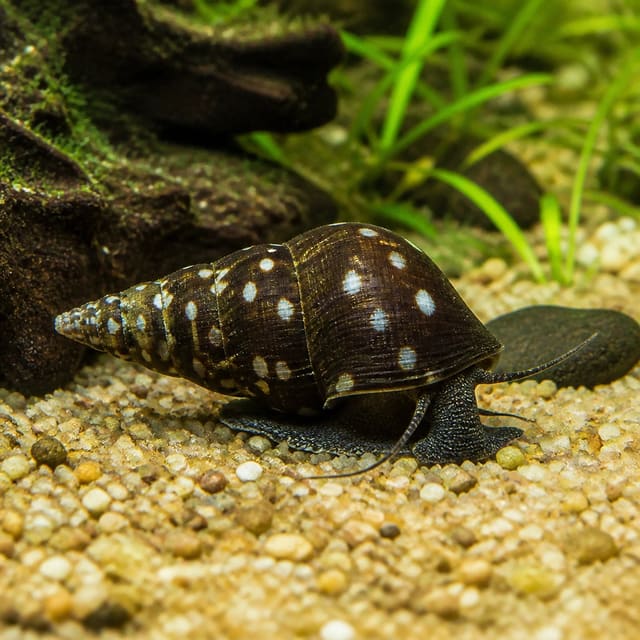
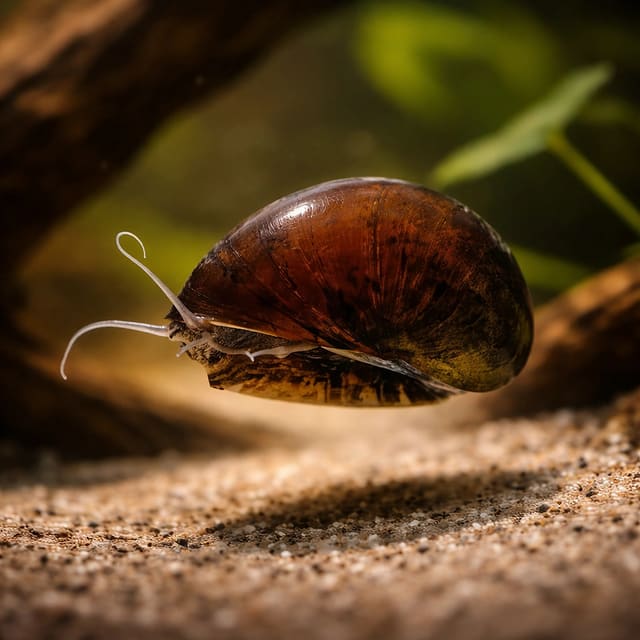
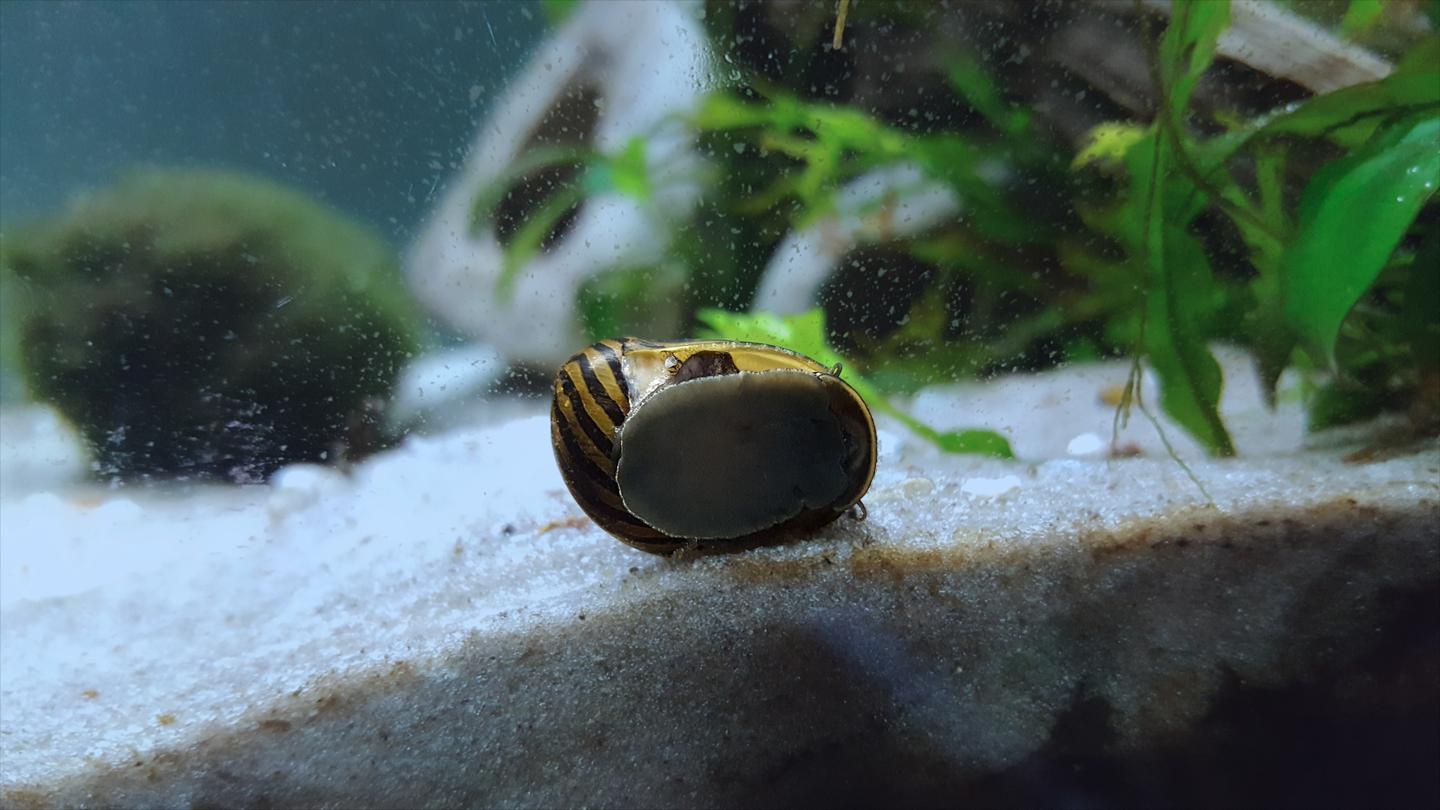
Nerites are aquatic snails with a gill and a hard lid called an operculum. When a nerite is disturbed it pulls its body inside and seals the shell opening with that lid, so a snail sitting tight with its trapdoor closed is behaving normally, not necessarily unwell. The shell is rounded with a very short spire, unlike the tall, pointed shells of trumpet or rabbit snails, which is the quickest way to tell them apart at a glance.
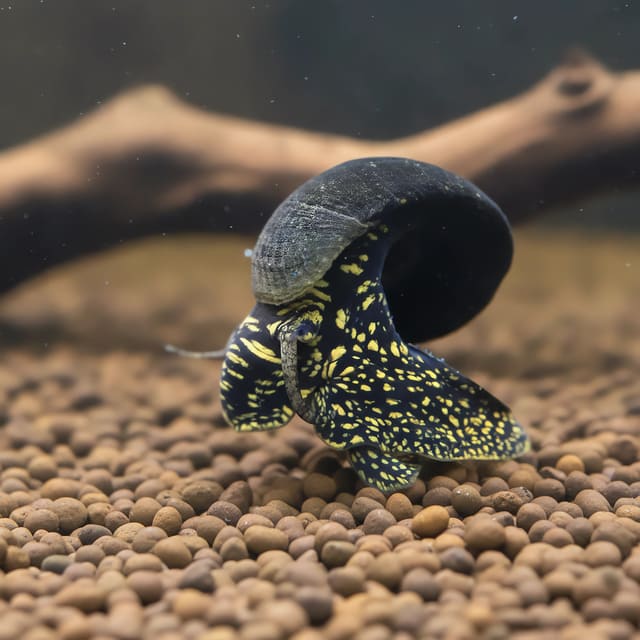
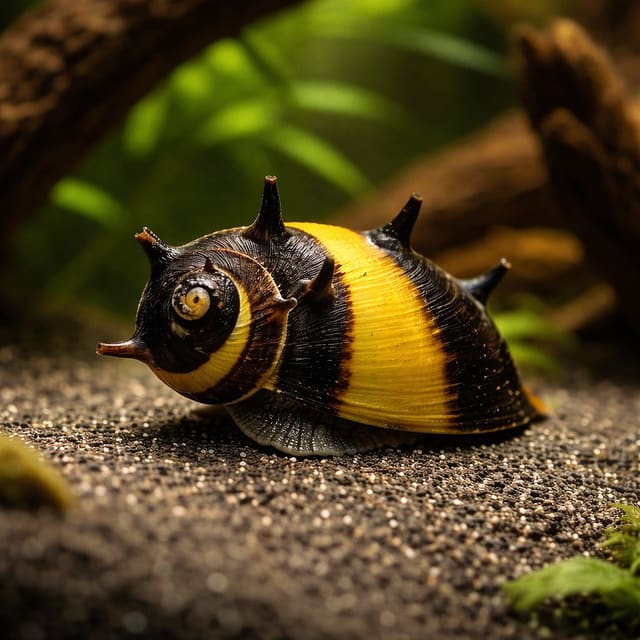
Horned nerites take their common name from the spines on the shell. Not every Clithon species carries them, but several do, and in some the spines are long and slender. Wikipedia describes the spines of Clithon spinosum as long, thin and directed towards the rear of the shell, and notes that this species always has them. A 2020 field study on Ovalau in Fiji looked at why. The researchers compared spined and smooth nerites living side by side in the same creek and found that the spined species dominated the creek entrance, where predators were most numerous, were smaller on average, and had shells about 25% thicker than the smooth ones. Their conclusion was that the spines of Clithon play a defensive role. In other words, the horns are armour, not decoration, even if they happen to look good on a piece of driftwood.
Horned nerites are small snails. Wikipedia gives a shell width of 15 to 20 mm for Clithon spinosum. In a 2024 Taiwanese breeding study the adult Clithon diadema used as broodstock averaged about 9 mm in shell length, and Japanese field work on Clithon retropictus found snails reaching maturity at roughly 9 mm. Because this trade form has not been pinned to a species, we do not quote a single adult size for it. A sensible expectation is a snail in the region of one to two centimetres across the shell, not counting the spines.
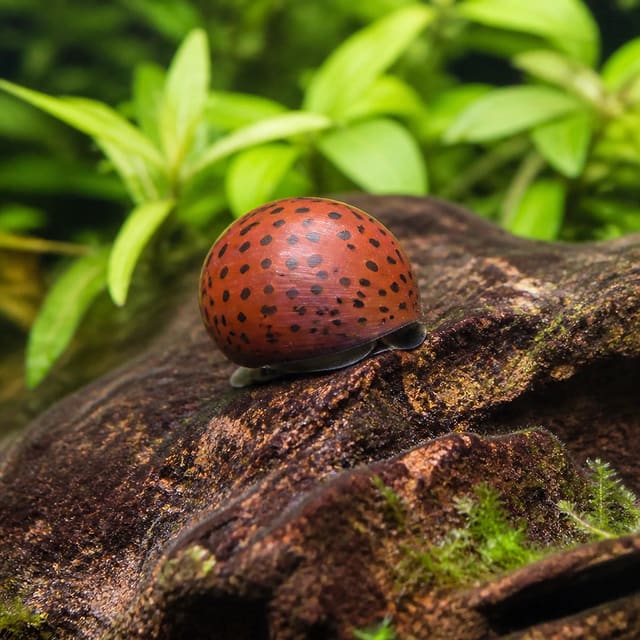
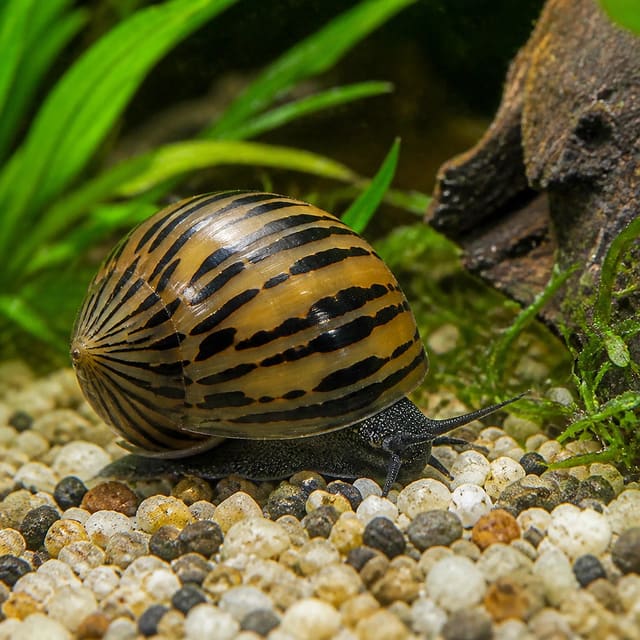
Shell colouring in Clithon can vary a great deal. Wikipedia notes that the colour pattern of Clithon oualaniense is "very variable", and trade names such as Yellow Lady, Pink Lady, Zebra and Thorn are the hobby's way of sorting that variety into recognisable lines. If you like the look of horned nerites in general, we also list the Pink Lady horned nerite and the Zebra horned nerite, both also sold as Clithon sp.
Nerites have separate sexes. Wikipedia records Clithon spinosum as dioecious, and SeaLifeBase describes the nerite order as mostly gonochoric, which means the same thing: every snail is either male or female. This listing sells unsexed snails, so we cannot choose a male or a female for you.
The genus Clithon was named by Montfort in 1810, with Nerita corona, now Clithon corona, as its type species. MolluscaBase lists the genus as accepted and places it in the subfamily Neritininae. It files 161 names directly under Clithon, about 90 of them accepted species, which gives you some idea why a trade form such as Yellow Lady is hard to match to one species without a specialist examining the animal.
Horned nerites are snails of the tropical Indo-West Pacific. Wikipedia gives the range of Clithon corona as stretching from the Philippines, Indonesia and Malaysia out to Micronesia, Papua New Guinea, the Solomon Islands, Vanuatu, New Caledonia and Samoa, and north to Taiwan and the Okinawa and Ryukyu Islands of Japan. Clithon spinosum covers a similar spread, from New Guinea and south-east Asia across to the Marquesas, including Fiji and Tahiti. SeaLifeBase records C. corona as a tropical, bottom-dwelling snail of brackish water.
The key word for these snails is amphidromous. Adults live and feed in fresh water, but their larvae spend their early life in the sea. Wikipedia sums up Clithon spinosum neatly: adults live in fresh water and the larvae are marine, drifting in the plankton for a long time and feeding as they go. Clithon corona is also amphidromous, living in freshwater rivers as well as brackish estuaries, usually in the intertidal zone or in fast-flowing streams. Adult C. spinosum can survive eight hours in seawater, and the species lives in streams no more than about ten metres above sea level.
The sources for the horned species describe the same kind of habitat: hard surfaces in moving water. Clithon corona uses hard substrates to graze on algae. Clithon spinosum prefers boulders and cobbles in streams close to sea level and has been counted at up to 57 snails per square metre in streams on Moorea. In the Kanzaki River estuary in Osaka, more than 90% of the Clithon retropictus population was found on stones throughout the year, mostly on the undersides of stones lying on open ground. The Fiji study above adds one more detail: the streams of the high, well-watered South Pacific islands support a rich community of nerites, several of them with extremely long spines.
Two details from that field work are worth holding on to. First, the Fiji researchers found the spined species clustered at the creek entrance, the stretch with the most predators, which fits the idea that horns are a defence. Second, the Japanese study recorded when young snails turn up: after the main breeding season in June, small juveniles appeared mainly in August and September, in the lower intertidal part of the adults' range.
For the aquarium, that picture translates simply. A horned nerite wants clean, well-oxygenated water, firm surfaces to cling to and graze, and a few hiding places under or between stones. It does not need brackish water as an adult, and it is sold for freshwater aquaria; the salt only matters for the larvae.
A horned nerite is not a demanding snail to house, but it does best in a tank that has been running for a while. A brand-new aquarium with spotless glass has very little for a grazer to eat, and a small snail with nothing to graze can go hungry long before you notice.
The Ornamental Aquatic Trade Association (OATA), the UK trade body, suggests a minimum of 10 litres for the smaller freshwater snail species, and a horned nerite sits comfortably in that group. It also fits into an established community or shrimp tank, where the snail is one small part of a larger system. OATA is also clear that a filter is always essential, and that a cover is a good idea to stop snails escaping. Take that seriously: snails do leave the water, and a gap at the back of the lid for cables is all an adventurous one needs.
Think about surfaces before plants. Smooth river stones, slate, bogwood and the tank glass all grow the thin film of algae and microorganisms that a nerite lives on. A few flat stones with a gap underneath copy the undersides of the cobbles where wild Clithon spend much of their time, and give a newly arrived snail somewhere to settle. OATA recommends sand or fine gravel as a substrate for snails generally; a horned nerite will cross either, but it spends most of its time on hard surfaces above the substrate, so the stones matter more than the gravel.
People often search for a per-litre figure, and the honest answer is that none of the sources we rely on gives a stocking figure per litre for nerites. What limits numbers in practice is food. A tank only grows so much algae and biofilm, and every grazer you add, whether snail, shrimp or algae-eating fish, takes a share. Our advice is to start with a few snails, watch whether the glass and stones stay grazed or begin to look bare, and add more only if algae keeps coming back. If you are buying several horned forms at once, remember they all eat the same food.
Steady, sensible lighting grows the soft green and brown films nerites graze, so a tank with a regular light routine suits them better than one that is kept dark. The sources we use describe horned nerites as grazers of algae and fine films on hard surfaces. One Japanese relative, C. retropictus, is also described as feeding on plant material, so in a planted tank keep an eye on very soft leaves, and remove melting or decaying leaves rather than leaving them for the snails.
Horned nerites are kept in ordinary tropical fresh water. The figures below combine OATA's general care sheet for freshwater snails with what is known about the genus. They are a working range for the aquarium, not a description of any single wild river.
| Parameter | Aim for | Notes |
|---|---|---|
| Temperature | 22 to 27 °C | Tropical genus; OATA's snail range tops out at 27 °C |
| pH | 6.5 to 8.0 | OATA range for freshwater snails |
| General hardness | 4 to 18 °dH | OATA range |
| Carbonate hardness | 3 to 15 °dKH | OATA range |
| Ammonia and nitrite | Zero | Any reading means the filter is not keeping up |
| Nitrate | No more than 20 mg/l above your tap water | OATA guideline |
OATA's snail sheet gives 17 to 27 °C, but that sheet covers a broad mix of freshwater snails. Clithon is a tropical genus from the warm Indo-West Pacific, and Wikipedia gives 22 to 26 °C as the preferred aquarium temperature for the zebra nerite, a related tropical nerite. We have therefore set the lower end at 22 °C, which also suits the tropical fish most people keep with horned nerites, and kept OATA's 27 °C as the ceiling. A tank heated to 24 or 25 °C sits comfortably in the middle.
A snail cannot replace its shell, and the spines of a horned nerite are part of that shell. Water that drifts below OATA's pH and hardness ranges, very soft and acidic, falls outside the conditions recommended for snails, so if your tap water is soft or you run peat or a lot of leaf litter, test both pH and hardness before you add one. If your water is already within the ranges above, there is nothing to add. Adult horned nerites do not need salt or brackish water; the brackish stage in their life belongs to the larvae.
OATA recommends regular testing with a proper kit, and we agree. A snail cannot tell you much about the water, so the test kit is your early warning. Regular partial water changes with tap water conditioned and matched for temperature keep nitrate down and conditions steady. Avoid scrubbing every surface clean at the same time; leaving the back glass or a few stones alone gives your nerite something to graze between feeds.
A horned nerite is a grazer. In the wild, Clithon corona grazes algae off hard surfaces, and Wikipedia records a related species, Clithon oualaniense, feeding on microalgae and detritus. The Taiwanese breeding study on Clithon diadema tested several foods on adult snails and found that diatoms, the brownish single-celled algae that often coat new tanks, gave better results than a commercial prawn feed or sea lettuce. That is a useful clue: the brown dusting on the glass of a young aquarium, which many people scrub off straight away, is likely to be good nerite food.
This is where a small nerite can come to grief. A tank kept very clean, a tank with plenty of competition from shrimp or algae-eating fish, or simply a snail that has grazed its patch bare can leave it short of food. OATA notes that although snails graze on algae, their diet needs supplementing. Its guidance is to feed algae wafers or commercial pellets two or three times a week, give the snails at least 30 minutes to find and eat the food, and avoid overfeeding because uneaten food fouls the water.
In practice we suggest:
For one or two horned nerites in a mature community tank, a routine that works well is this: leave the back glass and a couple of stones unscrubbed so a film can build up, offer a small piece of algae wafer on two or three evenings a week when the glass looks clean, and lift out anything uneaten next morning. In a heavily stocked shrimp tank, or one shared with algae-eating fish, lean towards the higher end of OATA's guidance, because the snail is competing for every scrap of film. In a tank that grows algae freely on the glass and stones, you may find you hardly need to feed at all.
A well-fed nerite moves regularly and leaves clean tracks through the film on the glass. If your snail stays in one place for long periods and the surfaces around it are bare, add a top-up feed before anything else, and check your water readings at the same time.
A horned nerite is a peaceful herbivore. It grazes, it does not hunt, and it gets on with fish and invertebrates that leave it alone. The question is less "what will the nerite bother?" and more "what will bother the nerite?"
OATA's rule is simple: do not keep snails with fish capable of eating them. Small, peaceful community fish that have no interest in snails make the best neighbours. OATA covers freshwater shrimp and snails on the same care sheet, with the same water ranges, and a grazing nerite does not prey on shrimp, so the two can share a tank. They will share the same algae and biofilm, though, so feed a little more in a busy shrimp tank. Different nerites also live side by side in the wild: the Fiji study found several spined and smooth nerite species sharing one creek. In an aquarium they all eat the same food; a mix of the Yellow Lady with the Thorn horned nerite or a Tiger nerite from the related genus Neritina gives a varied display, as long as there is enough algae for all of them.
This is the one that catches people out. OATA warns that freshwater snails and shrimp are very sensitive to copper and will die if exposed even to low levels. Some fish treatments contain copper or other ingredients that are not safe for invertebrates. Always check the label says it is safe for snails before you dose a tank containing nerites, and if in doubt, move the snail to another established tank while you treat.
This is the part of the nerite story that surprises many keepers, and it is good news for anyone who wants a tidy display tank.
Adult horned nerites mate and lay their eggs in small capsules. What hatches is not a tiny snail but a swimming larva, called a veliger, which drifts downstream to the sea and feeds in the plankton before settling and making its way back into rivers as a young snail. Wikipedia describes the larvae of Clithon spinosum as marine and long-lived, and Clithon corona is amphidromous in the same way. In the Kanzaki River estuary, young C. retropictus turned up mainly in August and September in the lower intertidal zone, after the main breeding season in June, and the snails reached maturity at around one year old.
The clearest evidence comes from a 2024 study published in Aquaculture Reports, in which researchers in Taiwan worked out how to breed Clithon diadema, a horned nerite sold in the aquarium hobby. They tested salinities from completely fresh water up to full seawater strength (0 to 35 parts per thousand). Their findings, in plain terms:
In a freshwater tank, a horned nerite cannot produce baby snails. If you keep both sexes together you may find small egg capsules stuck to stones, wood or glass, but in fresh water those embryos do not hatch, so there is no population explosion of the kind pest snails can cause. If the capsules bother you, scrape them off during maintenance. Breeding horned nerites at home means setting up brackish and marine water, culturing live marine algae and rearing larvae for two months or more. It is a project for the dedicated, not something that happens by accident.
The same paper explains why the authors bothered. They describe C. diadema as threatened with extinction by excessive collection from the wild and developed their method so that captive breeding could reduce the need for wild harvesting. It is a good reason to look after the snails you buy and give them a long, well-fed life.
There is no published lifespan for the Yellow Lady form itself, and we would rather not invent one. The wild records for a related species give some idea of what the genus is capable of. In the Kanzaki River study, the longevity of Clithon retropictus was estimated at at least 3.3 years, and Wikipedia cites a lifespan of up to 12 years for the same species, describing it as one of the longest-lived freshwater snails. Those are wild figures for a different species, recorded in a river where it grows and breeds naturally. They are not a promise for an aquarium snail, but they do show that a nerite is not a short-lived animal by nature, so an early death is worth investigating.
If you need to move a horned nerite, for example to keep it out of the way while you treat fish with a medicine that is not invertebrate-safe, treat the move like a small version of the arrival routine. Carry it in a cup of water from its own tank, let the cup float in the new tank until the temperature matches, and then lift the snail across without tipping the old water in. Moving it into a tank with very different pH or hardness is best avoided; if you have to, ask us how to do it gradually. Put it back the same way once the treatment course is finished and the water has been changed.
A nerite sitting still with its operculum shut is, on its own, not a reason to worry; that lid is how the snail shuts out the world. If a snail has not moved for several days, pick it up gently and check it. An empty shell, or a soft body hanging limp from the opening that does not draw back when touched, is a sign that it has died. Remove any dead snail promptly, as you would any dead animal, because decay adds to the load on the filter, particularly in a small tank.
Please have the aquarium ready before the parcel arrives: filter running, water tested and the temperature already where you want it. Someone needs to be at the delivery address to receive live animals, and we ask every customer to read our delivery and live-arrival information before ordering.
Your nerite travels in an oxygen-filled bag inside insulated packaging, with heat packs when the weather calls for them, via a tracked courier licensed to carry live animals. We email the confirmed delivery date and tracking details, so you know when to expect it.
To make a live-arrival claim, start a continuous unboxing video while the parcel is still sealed and keep filming as you open it, so the video shows the snail in its still-sealed bag. If the snail arrives dead, dying or clearly compromised, email hello@tropicalfishco.co.uk on the day of delivery with your order number and that video. Photographs alone do not meet the policy. Subject to the guarantee terms, we will replace the affected snail with your next order or refund it. With snails this deserves a word of caution: a nerite sealed inside its shell may simply be resting behind its operculum, so check gently before deciding.
Do not be alarmed if the snail stays shut or sits still for the first day or two. Over the first week, watch for normal behaviour: the snail moving around, clean grazing tracks on the glass, and the body extending readily from the shell. Offer a small piece of algae wafer near where it settles after a couple of days if the tank has little algae, and keep testing the water while it beds in.
These are the sources we used for the facts on this page. Where a fact applies to a related Clithon species rather than this trade form, the page above says which one.
No reviews for this item yet. Bought one? Honest reviews only, good or bad.
What customers say about ordering from us
Easy website plenty of info on fish your buying great to pick a time slot
TRACEY DURRANT · 7 Oct 2026
Got some lovely fish thank you
Kevin Mackie · 7 Oct 2026
Reviews of our shop, collected by Judge.me, an independent third-party review collector. Newest first.