Yellow Spotted Rabbit Snail (Tylomelania sp.)
Check species-specific water needs
£18.99
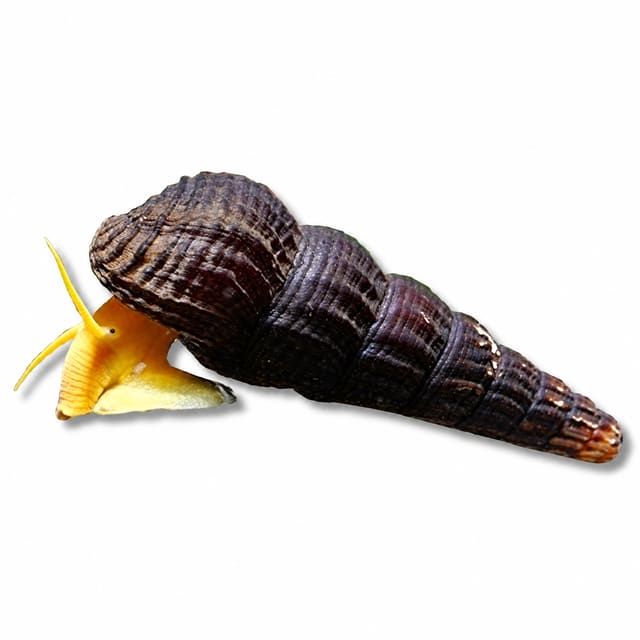
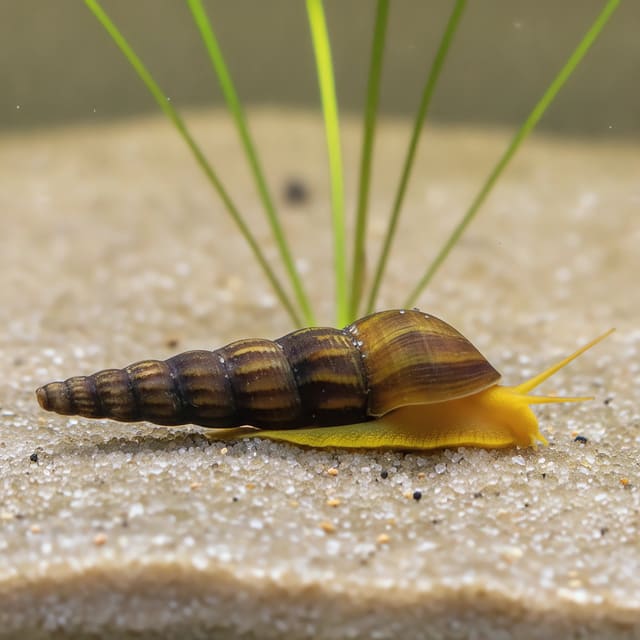
Yellow Rabbit Snail is a peaceful Sulawesi Tylomelania trade form for a mature warm aquarium with stable minerals, smooth grazing surfaces and regular sinking food.
Tylomelania sp. yellow
Lives in groups: kept together they stay settled, active and show their best colour.
Confirm your email, then we’ll send an availability message for this exact item if it returns within 180 days.
This request is only for this product—no newsletter or other promotions. A mail-provider retry may very rarely duplicate the same availability message. Unconfirmed addresses are removed after 48 hours. See our privacy policy.
Yellow Rabbit Snail is a peaceful Sulawesi Tylomelania trade form for a mature warm aquarium with stable minerals, smooth grazing surfaces and regular sinking food.
Maintain these water conditions for optimal health and vibrant colors
The Yellow Rabbit Snail is a large, characterful freshwater snail sold in the aquarium trade as Tylomelania sp. yellow. Its long, dark, turret-shaped shell contrasts with a yellow to golden body, while the extended snout and mobile tentacles give rabbit snails their familiar common name. It is a display animal as much as a grazer: slow, visible and interesting to watch as it works across sand, wood and rock.
This is a warm-water Sulawesi snail for a mature aquarium, not a cold-water pond snail and not a quick solution for every patch of algae. It needs stable mineral content, regular food and tank mates that will not peck at its body. When those needs are met, a rabbit snail can become one of the most distinctive animals in a peaceful community or invertebrate aquarium.
| Trade identification | Yellow Rabbit Snail, Tylomelania sp. yellow |
|---|---|
| Supplied size | Approximately 4-6 cm; natural variation is expected |
| Adult planning size | Allow for roughly 6-10 cm depending on the exact trade form |
| Care level | Moderate; best in a mature, stable aquarium |
| Temperament | Peaceful and non-predatory |
| Aquarium position | Substrate and hardscape surfaces |
| Diet | Biofilm, detritus and prepared sinking foods with plant matter |
| Water style | Warm, stable and mineral-bearing; avoid soft acidic extremes |
| Breeding | Separate sexes; slow uterine brooder producing developed young |
Tylomelania is a diverse genus of freshwater gastropods endemic to Sulawesi, Indonesia. Scientific work describes an extensive radiation across the island's ancient lake systems and surrounding waters. Aquarium names such as Yellow Rabbit Snail, Golden Rabbit Snail and Yellow Spotted Rabbit Snail are trade labels; they do not always map neatly to a formally identified species. For that reason this listing uses the cautious identification Tylomelania sp. yellow rather than inventing a species name from colour alone.
That distinction is useful for shoppers. A yellow-bodied rabbit snail may resemble named forms shown elsewhere online, but colour, shell wear and shell sculpture can vary. The animal supplied under this listing should be assessed as the photographed yellow trade form. The dark shell may show older marks or a weathered tip because shell already formed before arrival does not become new again. Healthy new growth, an active foot and a normal feeding response are more meaningful than a perfectly polished old shell.
Rabbit snails belong to the family Pachychilidae. They carry an operculum, a firm door-like structure that closes the shell opening when the animal withdraws. Their reproduction is especially unusual: peer-reviewed anatomical research found that Tylomelania retain eggs and developing embryos in a brood pouch and invest heavily in relatively large, shelled young. This slow reproductive strategy is very different from the clusters of eggs and rapid population growth associated with common bladder or ramshorn snails.
Sulawesi's ancient lakes are a major centre of freshwater endemism. Different Tylomelania lineages occupy different habitats and feeding niches, which is another reason not to treat every rabbit snail as identical. The practical lesson is to provide consistency and choice: warm water, oxygenation, a mature biological filter, smooth grazing surfaces and more than one appropriate food.
A new or aggressively cleaned aquarium can look attractive while offering very little biofilm. Rabbit snails continuously explore surfaces and benefit from the fine biological layer that develops on seasoned wood, stones and substrate. This does not mean allowing poor water quality. It means running a fully cycled aquarium and avoiding the habit of sterilising every surface at once.
These are tropical indoor animals. They are not suitable for an unheated UK pond, and they should not be released outdoors. Keeping an ornamental non-native snail responsibly means maintaining it in a secure aquarium and never introducing it to local waterways.
A practical starting point is a mature aquarium of at least 40 litres for one rabbit snail, with more floor area and water volume preferred for a group or community. A 60-litre or larger setup is easier to keep chemically stable and gives a full-sized animal more grazing room. Use our aquarium volume calculator when a tank's nominal size is unclear; internal dimensions give a better estimate than the model name on the box.
Choose smooth sand or rounded fine gravel. Rabbit snails often push through the upper substrate and may partially bury themselves. Sharp gravel can abrade the exposed foot, while unstable rockwork can trap a slow-moving snail. Rest heavy stones and wood securely before the animal is introduced. Leave open routes around the hardscape and check narrow gaps where a long shell might become wedged.
Filtration should provide dependable biological processing and oxygen exchange without turning the bottom into a high-current channel. A sponge filter, guarded internal filter or well-managed external filter can all work. Cover exposed intake gaps so the foot or tentacles cannot be drawn in. Keep a lid fitted and close cable openings; rabbit snails are mostly bottom-oriented, but any aquarium snail can explore beyond the expected area.
Plants are welcome, especially robust established plants, but the snail may rasp soft deteriorating leaves. That is usually scavenging rather than deliberate destruction of healthy growth. Very soft new plants may be investigated when food is scarce. Feed the snail directly instead of expecting the planted aquarium to supply everything.
Stability matters more than chasing a single perfect number. For this yellow trade form, a sensible aquarium target is approximately 24-29°C with neutral to alkaline water and measurable mineral hardness. Aim around pH 7.2-8.2 and avoid very soft water unless it is deliberately remineralised. The supplier identifies this as a warm-water Tylomelania form but provides no species-level water record, so gradual observation is safer than claiming one narrow lake value applies to every animal sold under the name.
| Parameter | Practical target | Why it matters |
|---|---|---|
| Temperature | About 24-29°C | Supports a tropical snail without pushing every community tank to an extreme |
| pH | About 7.2-8.2 | Reduces the risk of acidic shell erosion |
| Hardness | Moderate to hard, kept stable | Provides dissolved minerals associated with shell growth |
| Ammonia and nitrite | 0 mg/L | Both indicate unsafe or disrupted biological filtration |
| Nitrate | Kept controlled by maintenance | Helps maintain long-term water quality |
| Flow and oxygen | Gentle to moderate flow with good gas exchange | Supports respiration and prevents stagnant warm water |
Test the aquarium rather than relying on the local water supplier's average. The water matcher can help compare a measured aquarium with livestock needs, but changes should still be gradual. Large swings in pH, temperature or total dissolved solids are more stressful than a stable value near the edge of a sensible range.
Shell damage has several possible causes. Acidic water can dissolve exposed calcium carbonate, low mineral availability can compromise new growth, and poor nutrition can leave the animal unable to build well. Correct the environment and judge the new shell edge over time. Old pitting and a worn tip usually remain visible. Do not scrub, coat or glue a living snail's shell unless an experienced aquatic veterinarian has advised a specific repair.
Calcium-containing foods and an appropriate mineral source can support new growth, but more is not automatically better. Additions that raise hardness or alkalinity should be measured. A sudden chemical jump made in the name of shell health can be more dangerous than the original problem.
A Yellow Rabbit Snail grazes biofilm, soft growth and organic material, but it should not be purchased as a self-feeding cleaning tool. Mature aquariums provide useful background grazing; they rarely provide a complete diet indefinitely. Offer prepared sinking foods and vegetable matter after the main fish have been fed, then confirm the snail reaches the food.
| Food type | How to use it | Watch for |
|---|---|---|
| Quality algae or spirulina wafer | Use a small portion as a regular staple | Fish or shrimp taking the entire portion first |
| Sinking invertebrate food | Rotate with wafers for broader nutrition | Products that disintegrate before the snail arrives |
| Blanched courgette, green bean or leafy vegetable | Offer a small piece and remove uneaten remains | Rapid spoilage in warm water |
| Natural biofilm | Maintain mature wood, rock and substrate surfaces | A spotless new tank with little grazing material |
| Mineral-enriched food | Use as part of a varied diet | Assuming a supplement can correct unsuitable water |
Start with a small evening portion and inspect it the next morning. Adjust for the number of snails, competing animals and the amount of natural grazing available. Remove vegetables before they break down. Persistent leftovers raise the organic load; persistent absence of food can leave the snail slowly starving even when its shell still looks substantial.
Do not rely on cucumber alone. It is accepted readily but contains less nutrition than a varied rotation. Likewise, a rabbit snail may eat some algae while ignoring harder deposits. A Ring Nerite Snail is usually a more specialised hard-surface algae grazer, whereas the rabbit snail is chosen for display value, behaviour and steady scavenging.
Yellow Rabbit Snails are peaceful. They do not hunt fish, shrimp or healthy adult snails, and they do not defend a territory. Compatibility therefore depends mostly on whether the other animal will injure the snail and whether both can thrive in the same water.
Good candidates include calm small fish that accept warm neutral-to-alkaline conditions, peaceful shrimp where water requirements overlap, and other non-predatory snails. Use the tank-mate checker as a first filter, then compare temperature, hardness, adult size and feeding behaviour individually. A fish being labelled peaceful does not guarantee it will ignore long snail tentacles.
| Tank mate | General fit | Planning note |
|---|---|---|
| Peaceful livebearers | Often suitable | Match temperature and hardness; observe curious pecking |
| Calm rasboras and small rainbowfish | Can be suitable | Use species that accept the chosen warm-water range |
| Peaceful shrimp | Usually suitable | Provide several feeding points so the snail is not outcompeted |
| Other rabbit snails | Suitable | Increase tank volume and food with the group |
| Nerite and trumpet snails | Usually suitable | Monitor food competition and total stocking |
| Puffers and snail-eating loaches | Do not combine | Predation risk is intentional, not accidental |
| Large territorial cichlids | Avoid | May bite exposed tissue or repeatedly overturn the snail |
| Crayfish and large crabs | Avoid | Claws can reach the foot at the shell opening |
Before mixing snail varieties, compare the Black Antenna Rabbit Snail, Orange Rabbit Snail and Yellow-Spot Rabbit Snail. These links lead to distinct listings; similar common names should not be treated as proof that every form has identical adult size or origin.
Prepare the aquarium before dispatch. Confirm temperature, pH, ammonia, nitrite and hardness, and make sure no recent medication contains copper. Read the current live-animal delivery information so someone can receive the parcel promptly.
A newly transported snail may remain closed for many hours. Avoid repeatedly handling or pulling at the operculum. Check that it is upright and not being harassed. During the first week, look for gradual exploration, a feeding response and normal closure when disturbed. Record water tests if it remains inactive; guessing at the cause can lead to unnecessary chemical changes.
Rabbit snails are not hermaphrodites. Males and females are separate, but reliable external sexing is difficult for a customer choosing animals from ordinary stock. A single snail may also have mated before purchase. Keeping a group improves the chance of both sexes, but it does not guarantee a pair.
Their reproductive biology is one of the strongest scientifically documented parts of Tylomelania natural history. Females brood developing offspring internally and release relatively large shelled juveniles. Production is slow compared with egg-laying nuisance snails. That makes a rabbit snail group more manageable, but every juvenile still needs food, minerals and aquarium capacity.
Do not buy a group solely to force breeding. First establish stable adults and a dependable feeding routine. Young snails can be missed in coarse substrate and may lose food to shrimp or fish, so a mature species-focused aquarium offers the clearest way to observe reproduction. Never move unwanted snails into a pond or natural waterway; rehome them through a responsible aquarist or aquatic retailer.
Normal behaviour varies through the day. A healthy animal may pause for long periods, withdraw after disturbance and then resume grazing. Concern increases when inactivity is prolonged and accompanied by odour, a loose body, repeated falls, severe tissue damage or failure to respond over time.
| Observation | Possible explanation | Useful response |
|---|---|---|
| Worn shell tip but active new growth | Old environmental damage | Keep current water stable and monitor the new edge |
| Pale, pitted new shell | Acidic water, insufficient minerals or poor diet | Test pH and hardness; correct gradually and improve nutrition |
| Closed after delivery | Transport stress or water difference | Keep conditions quiet and stable; avoid repeated handling |
| Frequently overturned | Unsuitable layout, strong current or harassment | Provide open routes, gentle flow and safer tank mates |
| Not reaching food | Competition or poor placement | Feed after lights dim at more than one location |
| Sudden decline after treatment | Medication toxicity, especially copper | Check the label and seek specialist advice immediately |
Copper is highly hazardous to aquatic invertebrates. Never assume a medicine, algaecide, plant treatment or tap-water additive is snail-safe. Read the active ingredients and use a separate hospital aquarium for fish treatment where appropriate. Also avoid salt dosing unless a qualified aquatic professional has confirmed the exact product, concentration and reason.
Quarantine is useful when adding snails to an established collection. A simple cycled observation tank lets you confirm feeding and shell condition without exposing the main aquarium to hitchhikers or treatment residues. Match the quarantine water to the intended long-term conditions; quarantine in unsuitable water defeats the purpose.
| Feature | Yellow Rabbit Snail | Nerite Snail | Malaysian Trumpet Snail |
|---|---|---|---|
| Main appeal | Large display snail with visible behaviour | Compact hard-surface algae grazer | Substrate movement and scavenging |
| Typical reproduction in freshwater | Slow release of developed young | Eggs do not normally complete development in ordinary freshwater | Can reproduce readily |
| Adult scale | Large; allow roughly 6-10 cm by trade form | Usually much smaller | Slender and smaller |
| Water preference | Warm and mineral-bearing | Varies by species; generally protect the shell from acidic water | Adaptable, but stable water remains important |
| Best choice when | You want a centrepiece invertebrate | You prioritise algae grazing | You want a discreet burrowing snail |
See the Malaysian Trumpet Snail for a smaller substrate-oriented alternative, or browse the full aquarium snail range. Stocking several species is not automatically better: choose roles that suit the tank and count every snail in the feeding and waste budget.
A Yellow Rabbit Snail is a strong choice when the aquarium is fully cycled, warm, mineral-bearing and free from snail predators. It suits someone who enjoys observing natural grazing behaviour and is willing to provide direct food. It is less suitable for very soft acidic aquariums, new nano tanks, cold-water setups or communities containing puffers, snail-eating loaches, crayfish or aggressive cichlids.
| Choose this snail if... | Choose a different animal if... |
|---|---|
| Your tank is mature and chemically stable | The aquarium is still cycling |
| You can maintain warm neutral-to-alkaline water | Your livestock requires consistently soft acidic water |
| You want a peaceful display invertebrate | You only want a specialist glass-algae cleaner |
| You will provide sinking food and vegetables | You expect it to survive only on scraps |
| Your tank mates ignore snails | Your fish naturally crush or extract snails |
Use the cycle tracker if you are still confirming biological maturity. A zero ammonia and zero nitrite result on one day is useful, but a stable record plus normal nitrate production gives more confidence that the filter can support new livestock.
Before ordering, test the actual aquarium and compare the result with the practical range above. Check the weather, arrange to receive the parcel and make sure acclimation equipment is ready. Live animals vary naturally in shell tone, body colour, markings and size; the listing name describes the trade form rather than promising an identical shell.
Every eligible live-animal order is covered by our Live Arrival Guarantee when its terms are followed. The WELCOME5 offer gives 5% off eligible first orders. Promotions do not replace good preparation: the best time to order is when the aquarium is ready, the keeper is available and suitable food is already in the cupboard.
Rabbit snail care is easier when observations are built into a regular routine. A single dramatic intervention is rarely as useful as noticing a small change early. Watch the snail before feeding: note where it rests, whether the foot extends normally and whether recent shell growth looks even. Then check that it reaches food instead of assuming an empty wafer was eaten by the snail.
| Frequency | Task | What the result tells you |
|---|---|---|
| Daily | Check position, extension, tank-mate behaviour and temperature | Highlights falls, harassment, heater faults and unusual withdrawal |
| At feeding | Place a measured sinking portion within reach | Confirms appetite and reveals competition from fish or shrimp |
| Next morning | Remove spoiled vegetables and inspect leftovers | Prevents avoidable waste while helping refine portion size |
| Weekly | Test pH, ammonia, nitrite, nitrate and hardness as needed | Shows whether the aquarium remains stable between water changes |
| Weekly | Change an appropriate portion of water and clean only part of the filter if required | Controls waste without stripping every mature surface at once |
| Monthly | Compare new shell-edge photographs under similar lighting | Makes gradual improvement or deterioration easier to judge |
Match replacement water for temperature and mineral content before it enters the aquarium. Very large corrections can shock invertebrates even when the final test number looks better. Never rinse biological filter media under untreated chlorinated tap water, and avoid cleaning the filter, substrate and all hardscape on the same day. Preserving part of the established microbial community supports both filtration and grazing.
If the snail appears well but disappears for a period, inspect safe hiding places before dismantling the aquarium. Rabbit snails may rest behind wood or partially beneath sand. Move décor carefully and lift rather than drag heavy pieces. A long shell can be damaged when a stone is rolled across it.
The most common mistake is adding a rabbit snail to a tank simply because algae is visible. Algae does not prove the aquarium is cycled, warm enough or mineral-bearing, and some algae types are not useful food. Test first and choose the animal for the whole setup.
Another mistake is combining incompatible water requirements. A fish may be peaceful yet require soft acidic conditions that gradually erode a snail's shell. Compatibility means matching chemistry and temperature as well as temperament. Conversely, pushing hardness or pH upward without measuring can stress fish already in the aquarium.
Do not mistake slow movement for low food demand. Rabbit snails can take a long time to reach a wafer, particularly when fish gather around it. Feed after lights dim, place food near the snail and use multiple locations in mixed invertebrate tanks. Check the result rather than adding larger and larger portions.
A final mistake is trying to make old shell damage disappear. Abrasive cleaning, cosmetic coatings and unmeasured mineral dosing can harm the animal. Improve the conditions that create new shell, photograph the growing edge and allow time. Seek specialist aquatic veterinary advice when the body is injured, the operculum cannot close or the snail shows a rapid unexplained decline.
The supplied animal is approximately 4-6 cm. Because Yellow Rabbit Snail is a trade name covering an incompletely identified Tylomelania form, plan space for roughly 6-10 cm rather than promising one exact adult measurement.
No. It grazes biofilm, soft growth and organic material, but it is not a complete algae-control method. Control light and nutrients, maintain the aquarium and feed the snail directly.
They are peaceful and usually compatible where temperature and mineral requirements overlap. Provide several feeding points because active shrimp can take prepared food before a slow snail reaches it.
It usually prefers biofilm, prepared food and deteriorating plant material. Very soft leaves may be rasped, especially when the snail is underfed. Keep the diet varied and remove decaying foliage.
One can be kept alone, but a suitably sized aquarium can hold a small group. Increase floor space, feeding and filtration capacity with every additional animal.
Slowly compared with common egg-laying aquarium snails. Females brood developed young internally and usually release a well-developed juvenile rather than a large egg clutch.
The oldest shell may record earlier acidic water, transport wear or natural ageing. It does not regrow. Focus on activity and the quality of new shell growth while keeping pH, minerals and diet stable.
Only when the product explicitly states that it is safe for the exact invertebrates and the intended dose. Copper is dangerous to snails. Treat fish separately when there is any uncertainty.
The scientific papers establish genus-level origin, diversity and reproductive biology. Aquarium ranges are conservative husbandry guidance for the yellow trade form and should be adjusted gradually to the measured water in which the individual is thriving.
No reviews for this item yet. Bought one? Honest reviews only, good or bad.
What customers say about ordering from us
Easy website plenty of info on fish your buying great to pick a time slot
TRACEY DURRANT · 7 Oct 2026
Got some lovely fish thank you
Kevin Mackie · 7 Oct 2026
Reviews of our shop, collected by Judge.me, an independent third-party review collector. Newest first.