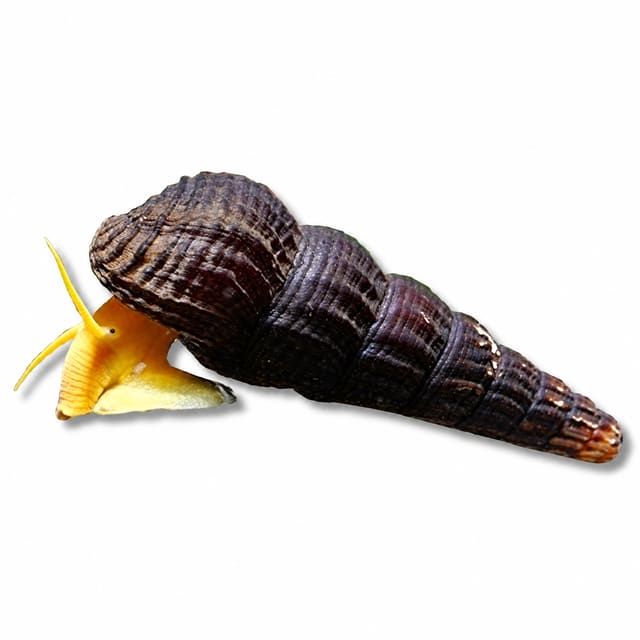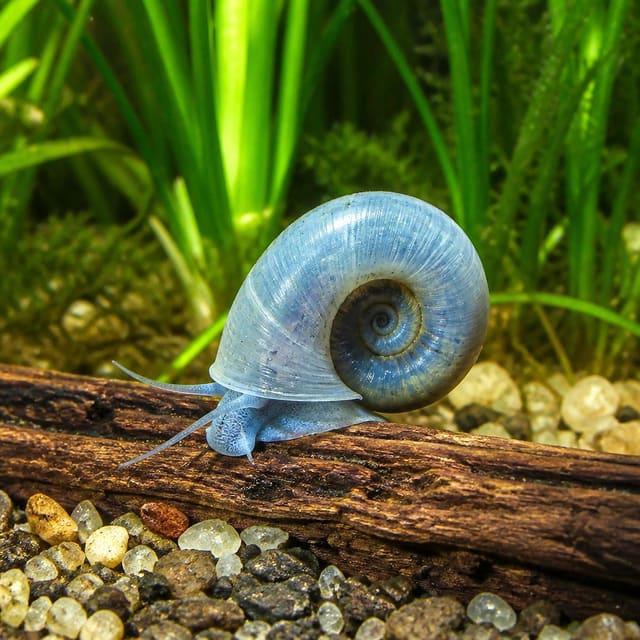
Blue Ramshorn Snail (Planorbella duryi)
17–27°C · pH 6.5–8
£8.99

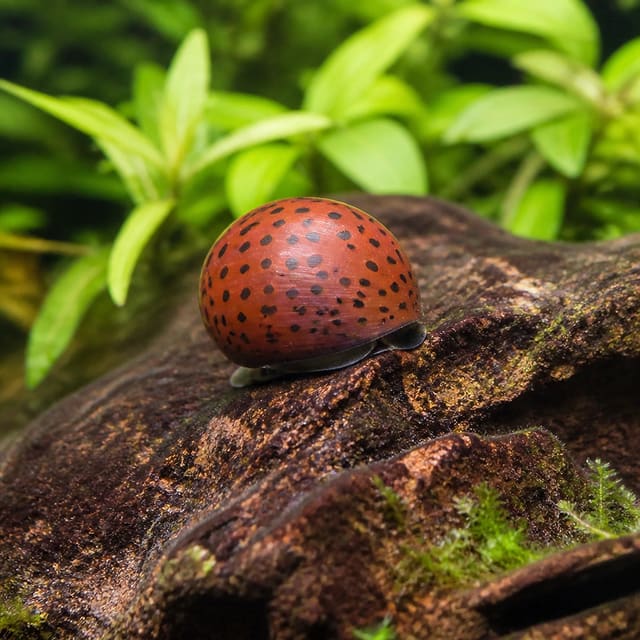
A large red apple snail (Marisa cornuarietis) sold in the UK as the Giant Ramshorn. One snail per quantity, dispatched at 1-2cm and growing to 3.5-5cm. Grazes algae and leftovers but eats soft plants, so it is not for planted tanks. Easy care and peaceful with fish. 21-27C, pH 6.0-8.0, 8-20 dGH.
Adult size is the maximum length this species reaches at full maturity (scientific sources). The livestock you receive will be younger and smaller. Product-photo provenance and any image-specific limitations are stated on the listing.
Marisa cornuarietis
Lives in groups: kept together they stay settled, active and show their best colour.
Confirm your email, then we’ll send an availability message for this exact item if it returns within 180 days.
This request is only for this product—no newsletter or other promotions. A mail-provider retry may very rarely duplicate the same availability message. Unconfirmed addresses are removed after 48 hours. See our privacy policy.
A large red apple snail (Marisa cornuarietis) sold in the UK as the Giant Ramshorn. One snail per quantity, dispatched at 1-2cm and growing to 3.5-5cm. Grazes algae and leftovers but eats soft plants, so it is not for planted tanks. Easy care and peaceful with fish. 21-27C, pH 6.0-8.0, 8-20 dGH.
Adult size is the maximum length this species reaches at full maturity (scientific sources). The livestock you receive will be younger and smaller. Product-photo provenance and any image-specific limitations are stated on the listing.
Maintain these water conditions for optimal health and vibrant colors
Marisa cornuarietis (Linnaeus, 1758) is sold in the UK as the Giant Ramshorn Snail or Colombian Ramshorn, and this is the deep red colour form. Despite the trade name it is not a true ramshorn: it belongs to the family Ampullariidae — the apple snails — and its biology follows apple-snail rules, not ramshorn rules. It is a large, hardy, powerfully built grazer that will strip algae and biofilm from glass, rocks and wood, and it will also eat soft aquarium plants. That last point is not a minor caveat; it is the single most important thing to know before buying one.
What one quantity buys: one snail. Snails are dispatched at approximately 1–2 cm shell diameter — these are young, growing animals, not adults. A mature Giant Ramshorn reaches roughly 3.5–5 cm across the shell, so the snail you receive has a great deal of growing still to do. Snails are not sexed, so a single purchase cannot be supplied as a male, a female or a breeding pair. Shell pattern and the exact depth of red vary from snail to snail; the product photographs are representative images of the red colour form rather than photographs of the individual snail you will receive.
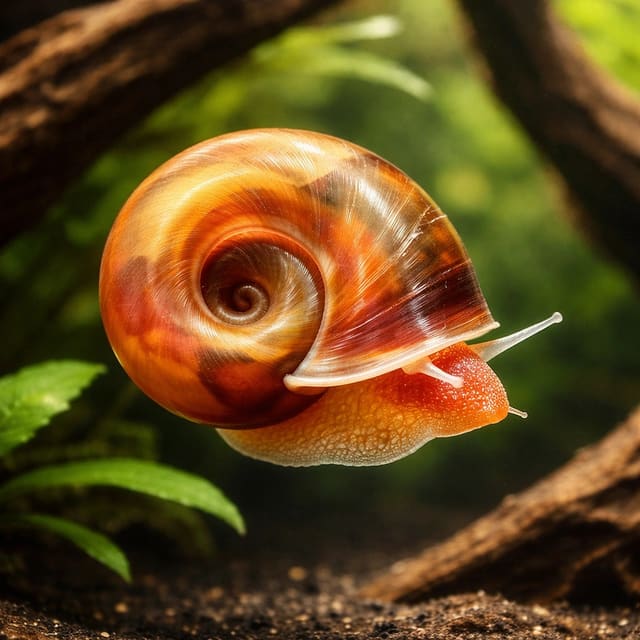
The confusion is old and it is understandable. This snail's shell is planispiral — coiled flat in a single plane, like a coil of rope, rather than drawn out into a cone — and that is exactly the shell shape that gives true ramshorn snails their name. Early naturalists made the same connection: the species was described by Linnaeus in 1758 as Helix cornuarietis, and in 1774 O. F. Müller published it again as Planorbis contrarius, placing it squarely in the ramshorn genus. That name is now recorded as a historical synonym, alongside a dozen others such as Ampullaria cornuarietis and Marisa rotula.
Modern taxonomy is settled. MolluscaBase and GBIF both list the accepted name as Marisa cornuarietis (Linnaeus, 1758), in the family Ampullariidae, order Architaenioglossa. True ramshorn snails — the small red, pink, blue and brown ones sold for planted tanks — are in a completely different family, Planorbidae. If you actually want one of those, our Blue Ramshorn Snail (Planorbella duryi) is a genuine ramshorn and a very different animal: far smaller, hermaphroditic, and much less destructive to planting.
The difference matters practically, not just pedantically. Because this is an apple snail it has separate sexes rather than being a hermaphrodite, it carries an operculum (a hinged "trapdoor" it seals itself behind), it has both a gill and a lung, and it lays its eggs in a way no true ramshorn does. Care advice written for Planorbidae simply does not transfer.
The shell is flat, circular and smooth, with clear growth striations, three to four whorls and, in wild-type animals, three to six dark spiral bands. Natural shell colour in this species ranges widely, from dark yellow through to dark brick-red tints, usually with black or brown spiral striping. The red form offered here sits at the deep red end of that natural range; expect a rich red to orange-red shell, often with a darker olive or brown centre where the earliest whorls sit, and banding that varies in strength between individuals.
The body is typically pale pink to reddish, and the head carries two long, slender, whip-like tentacles — a good field mark, because true ramshorns have short, blunt tentacles by comparison. The species is also sexually dimorphic once mature: males tend to have a rounder shell aperture and a thicker shell, females a more oval aperture and a thinner one. At the 1–2 cm dispatch size these differences are not yet reliable, which is why we do not sex or pair these snails.
Marisa cornuarietis is native to northern South America and several southern Caribbean islands, with records from Colombia, Venezuela, Trinidad and Tobago, Guyana, Suriname, French Guiana, Panama, Costa Rica, Brazil and Bolivia. It lives in still and slow-moving fresh water — ponds, river margins, lakes, swamps and irrigation channels — usually in less than a metre of water and always close to vegetation. It is strikingly pollution-tolerant, surviving months at very low oxygen levels, and it tolerates brackish conditions up to around a quarter the salinity of seawater.
Its appetite made it briefly famous. From the 1950s onwards, Marisa cornuarietis was deliberately released in Puerto Rico and Guadeloupe as a biological control agent against Biomphalaria glabrata, the freshwater snail that carries the human parasite Schistosoma mansoni. The idea was that Marisa would out-compete the vector snails for food and eat their egg masses and hatchlings — and it worked well enough that the approach was studied for decades. Florida and Puerto Rico also stocked it to clear nuisance aquatic weeds, and it proved capable of clearing water hyacinth, water lettuce, coontail and pondweed from canals. It has been in the aquarium trade since the 1930s, fell out of fashion in the 1950s, and has been steadily rediscovered since.
That same history is a warning label. A snail chosen by scientists specifically because it eats plants and other snails' eggs faster than anything else available is not a snail to put in a prized planted aquarium.
A 40-litre aquarium is a sensible minimum for one adult, and more is better if you intend to keep several — these are bulky animals that produce a real waste load. Substrate choice is open: sand, gravel and planted-tank substrates all work, and the snail spends most of its time on hard surfaces rather than in the substrate.
Planting is where the decisions get made. Realistically you have three options: run the tank with artificial plants, restrict yourself to tough, thick-leaved species such as Anubias and Java fern (and accept that even these may be grazed if the snail is underfed), or keep this species out of a planted display altogether. Soft-leaved stem plants, Vallisneria, Ludwigia and similar will be eaten — laboratory feeding trials on this species found a clear preference for exactly that kind of soft, palatable growth.
Because Marisa has both a gill and a lung, it will periodically come to the surface to take air. Leave a small air gap between the water surface and the cover, and keep the aquarium lidded — a snail that climbs above the waterline and finds a gap can end up on the floor. Filtration should be enough to keep ammonia and nitrite at zero, and moderate flow suits it better than a torrent.
Keep the aquarium at 21–27°C. This is a warm-water species restricted in the wild to tropical and thermally stable habitats, and cold kills it: prolonged exposure below about 8°C is fatal, with laboratory work recording death after roughly eight hours at that temperature. That is why it must never be treated as a pond or coldwater snail, whatever a marketplace listing elsewhere may claim, and it is why an unheated room-temperature tank is not suitable in a British winter.
pH between 6.0 and 8.0 is workable, with neutral to slightly alkaline water preferred. Hardness matters more than most keepers expect: in the wild this species is associated with calcium-rich, spring-fed systems, and it builds a large shell that needs minerals to do it. Aim for 8–20 dGH and supplement with a cuttlebone or a calcium-rich snail food if your tap water is soft. Persistently soft, acidic water pits and erodes the shell from the outer whorls inwards, and the damage does not reverse.
Ammonia and nitrite must be zero; keep nitrate below about 20 ppm with regular water changes. Copper is lethal to snails, and a great many fish medications and some plant fertilisers contain it — read the label of anything you dose before it goes in the tank.
It is usually described as a herbivore, but the accurate description is omnivore with a strong plant bias. Marisa cornuarietis eats living and decaying plant matter, algae and biofilm, and also fish eggs, the egg masses of other snails, and small juvenile snails. In one study of a threatened North American fish, this species consumed a markedly higher proportion of the fish's eggs than either native or other introduced snails present.
In the aquarium, offer blanched vegetables (courgette, cucumber, spinach, lettuce) weighted so they sink, algae wafers, and spirulina-based foods two or three times a week, plus a calcium source for shell growth. Remove uneaten vegetable matter within about 24 hours. Do not assume a "cleanup crew" animal will feed itself: an underfed Giant Ramshorn turns to your plants immediately.
These are steady, methodical grazers, active in daylight and after dark, working across surfaces with the radula and using the large muscular foot to hold position. They climb glass and hardscape readily. The operculum lets the snail seal itself in when disturbed or when conditions turn poor, and a healthy snail should reopen and resume moving within a few minutes of being left alone. A snail that stays sealed for days, floats persistently, or hangs limply out of the shell needs its water parameters checked immediately.
This is where the apple-snail distinction becomes concrete. Unlike true ramshorns, which are hermaphrodites and can populate a tank from a single individual, Marisa cornuarietis has separate males and females and must have both to reproduce. Females can store sperm for months after mating, so a female bought from a mixed tank may produce fertile clutches long after she arrives.
Eggs are laid in clear, gelatinous masses of roughly 20–80 eggs, each egg 2–3 mm across, deposited on the surface of objects under the water — not above the waterline. This is the opposite of the familiar Pomacea apple snails, whose bright pink clutches are laid on glass and plant stems in the air, and it is a reliable way to tell what you are actually looking at. Over about ten days the eggs swell to around 4 mm and become clear enough to see the developing snail moving inside. Hatchlings emerge as miniature adults and grow quickly where food and calcium are plentiful.
Population control is straightforward if you act early: remove clutches as you see them, and keep only one snail if you do not want any risk at all. Under warm, food-rich conditions the species can complete a generation in under three months, so a neglected tank can go from two snails to a great many in a season.
Towards fish, this snail is entirely peaceful, and its size and thick shell mean casual nippers generally leave it alone. Suitable company includes peaceful community fish such as tetras, rasboras, livebearers and peaceful barbs.
The incompatibilities run in both directions. Avoid dedicated snail predators — loaches (particularly Botia species), pufferfish, large aggressive cichlids, crayfish and assassin snails will attack or kill it. Equally, do not add it to a tank where you are trying to breed shrimp, breed other snails, or raise the eggs of egg-scattering or egg-depositing fish, because it will eat eggs and hatchling snails given the opportunity. Keepers who want an algae grazer that leaves healthy plants and eggs alone are better served by a nerite: our nerite snails graze algae hard, will not touch healthy plants, and cannot breed in fresh water at all.
This is worth stating plainly, because the position changed recently. In England, Scotland and Wales, Marisa cornuarietis may be kept and sold: it does not appear on the Great Britain list of invasive alien species of special concern, which is the retained and separately amended version of the EU list.
In Northern Ireland the position is different. On 17 July 2025 the European Commission added this species to the EU list of invasive alien species of Union concern, in force from 7 August 2025, and that list continues to apply in Northern Ireland. There it may not be kept, bred, transported, placed on the market, exchanged, allowed to reproduce or released. We do not dispatch live stock to Northern Ireland in any case, for live-animal transit-time reasons.
Wherever you are, never release an aquarium snail, or any aquarium animal, into a pond, stream, ditch or any other open water, and never tip aquarium water or plant trimmings into a drain that reaches a watercourse. Under the Wildlife and Countryside Act 1981 it is an offence in England and Wales to release, or allow to escape into the wild, an animal of a kind that is not ordinarily resident in Great Britain, and Scotland has an equivalent provision covering release outside an animal's native range. Unwanted snails should go back to a retailer or another keeper.
Each quantity supplies one Red Giant Ramshorn Apple Snail at approximately 1–2 cm shell diameter. Snails travel in insulated, water-tight packaging with a licensed live-animal courier, and every live order is covered by our Live Arrival Guarantee. Our team can help you work out whether this species suits your tank before you order — and if you have a planted display, we will tell you honestly that it does not. We work only with responsible suppliers who prioritise invertebrate welfare. You can also browse the rest of our aquarium invertebrates for shrimp, other snails and freshwater crabs.
No. Despite the shared name and the similar flat-coiled shell, the Giant Ramshorn Snail is an apple snail in the family Ampullariidae, while ordinary ramshorn snails belong to Planorbidae. The practical differences are large: this species has separate sexes, an operculum, a lung as well as a gill, reaches 3.5–5 cm, and eats plants far more aggressively.
Shell diameter at maturity is usually 35–50 mm, occasionally larger, with an adult weighing roughly 500–650 mg. Snails are dispatched at about 1–2 cm and grow into that size over time, given warmth, food and calcium.
Around two years is the usual figure under ordinary aquarium conditions. Lifespan in this species is strongly tied to temperature and food supply: kept very warm with abundant food the whole life cycle accelerates and generations turn over in under three months, while cooler, more stable conditions stretch it out.
Not by itself — unlike true ramshorns, this species has separate males and females, so reproduction needs both. However, a female can store sperm for months, so a single snail bought from a mixed tank may still lay fertile clutches after arriving.
Clear, jelly-like masses of about 20–80 eggs, each 2–3 mm across, attached to hard surfaces beneath the water. After around ten days they swell to roughly 4 mm and turn transparent enough to see the young snails moving. If you are looking for pink clutches above the waterline you are thinking of Pomacea apple snails, which are a different genus.
For the right tank, yes — they are hardy, long-active, visually striking and genuinely effective on algae and leftover food. For a planted aquarium they are a poor choice, and for a shrimp or snail breeding project they are a bad one, because they eat eggs and hatchlings.
No. This species is a well-documented consumer of aquatic plants — it has been used deliberately to clear weed from canals. Tough species such as Anubias and Java fern often survive; soft-leaved plants generally do not.
No. Prolonged exposure below about 8°C is fatal, so a British pond would kill it, and releasing it to open water would be both harmful and unlawful. It needs a heated indoor aquarium at 21–27°C.
No reviews for this item yet. Bought one? Honest reviews only, good or bad.
What customers say about ordering from us
I have a small group of long finned mountain minnows. So was delighted to be able to order ten of this variety to increase the genetics in my tank . The ones I recieved are healthy but it’s to early to give a verdict on wether they are of a long finned type since they are small currently.
Gordon Walker · 23 Sept 2026
100% success travel and "installation". Pleased with quality of purchase. The Siamese fighter a bit "shy" so have not yet seen him at his best yet but looking good. Happy customer. GG
George E Garratt · 21 Sept 2026
Reviews of our shop, collected by Judge.me, an independent third-party review collector. Newest first.