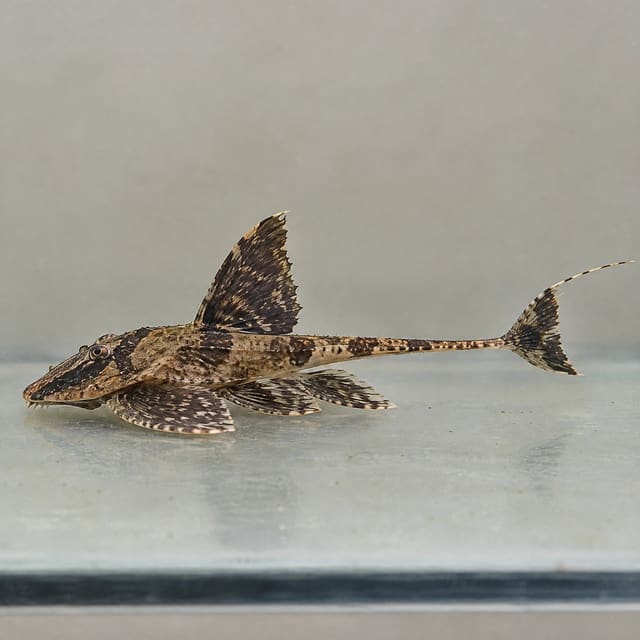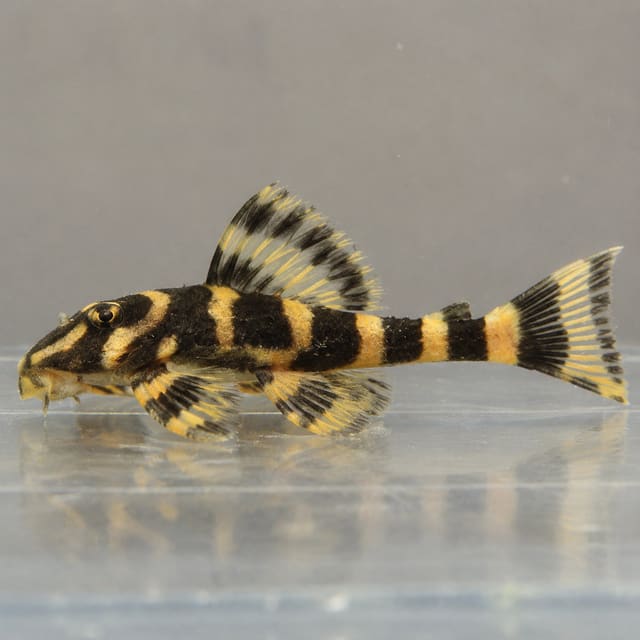
L168 Butterfly Pleco (Zonancistrus pulcher)
22–27°C · pH 6–8
£59.99
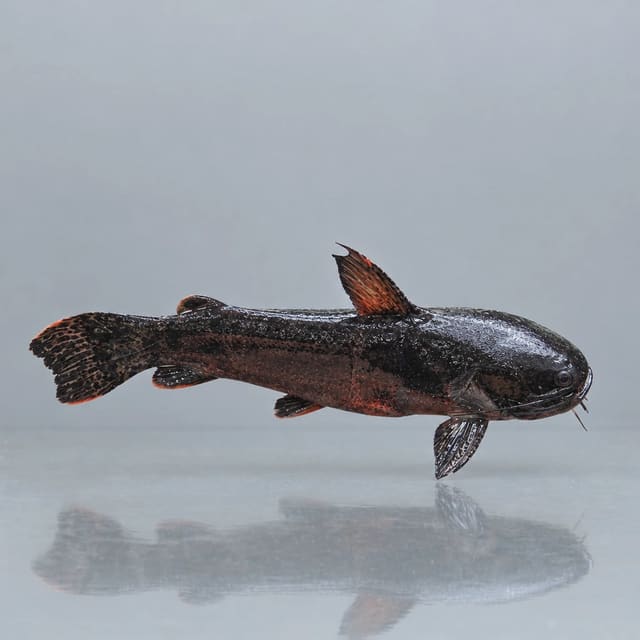
This Driftwood Catfish (Trachelyopterus sp.) is a stocky, mottled, nocturnal woodcat from South America that hides in wood by day and grows to about 22 cm. It is hardy and not aggressive, but it eats small fish, so it needs a tank of 90 cm or more with caves and larger companions. Sold individually as one live fish.
Trachelyopterus sp.
This Driftwood Catfish (Trachelyopterus sp.) is a stocky, mottled, nocturnal woodcat from South America that hides in wood by day and grows to about 22 cm. It is hardy and not aggressive, but it eats small fish, so it needs a tank of 90 cm or more with caves and larger companions. Sold individually as one live fish.
Read the full care guidance when planning conditions for your aquarium.
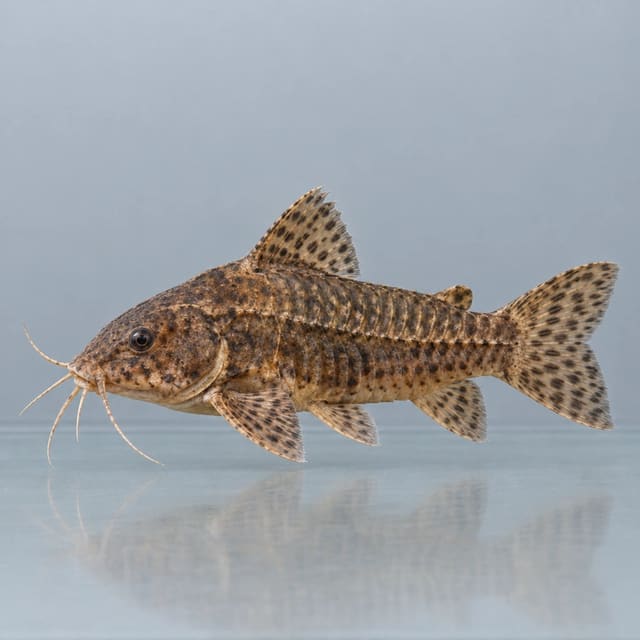
This Driftwood Catfish (Trachelyopterus sp.) is a stocky, mottled South American catfish that spends the day jammed into wood or a cave and comes out at dusk to feed. "Driftwood catfishes" is the name FishBase uses for the whole family Auchenipteridae, and the colour of these fish copies a piece of waterlogged wood remarkably well. They are hardy, characterful and easy to feed, provided they are kept with fish too large to swallow.
The label "sp." means the exact species has not been identified. Several Trachelyopterus reach the aquarium trade. The best documented is the common woodcat, Trachelyopterus galeatus, which FishBase describes as widespread in northern South America, and the care below uses its published values. ScotCat notes that in the 1970s and 80s, under its old name Parauchenipterus galeatus, it was one of the few woodcats you could buy in the UK.
| Name | What it means |
|---|---|
| Driftwood catfish, woodcat | Common names for the family Auchenipteridae |
| Trachelyopterus sp. | A species of this genus, not yet identified |
| Common woodcat, T. galeatus | The best-known species, used here for care values |
| Parauchenipterus galeatus | An old name for T. galeatus still seen in books |
The genus name comes from Greek words for neck and fin. Planet Catfish explains that the long bony shield on the head makes the dorsal fin look as if it starts at the neck. FishBase describes T. galeatus as stocky, with a slightly flattened head, a slightly projecting lower jaw and a skin-covered head shield. ScotCat adds a dark blotch on the gill cover and below the dorsal fin, over a brown, mottled body.
One purchase supplies one live Driftwood Catfish. The size option is "Standard": the fish is sent at the size currently available, which is smaller than the adult. Sex is not chosen or guaranteed.
The photographs show the type of fish, not the individual you will receive. Planet Catfish stresses that pattern and colour vary a great deal between individuals, with water and lighting, and between regions, so expect your fish to look different from the pictures.
Because the species is not named, plan for the upper size and check our delivery information before ordering.
ScotCat recommends a tank over 90 cm (3 ft) long for a pair and says the larger the tank, the better, so the fish can reach its full size. For a single fish with a few large companions, treat 90 cm as the minimum length and add width for caves and wood.
Fit a secure lid. OATA advises a heater all year round and a position away from draughts, direct sun and heat sources to keep the temperature steady.
Planet Catfish says juveniles under about 5 cm need tangles of bogwood to hide in, and that floating plants or clumps of Java moss also help. Larger fish need a cave each, and black PVC drain pipe is the easiest way to provide one. ScotCat adds that they jam themselves into pipework until dusk, and that a dimly lit tank lets you see them more often.
| Element | Purpose |
|---|---|
| A cave or pipe for each catfish | A tight daytime refuge |
| Tangled bogwood | Cover, especially for young fish |
| Floating plants | Shade that makes the fish bolder |
| Sand or small, round gravel | A floor that protects its barbels |
| Open water in front | Space for night-time feeding |
ScotCat suggests either small round gravel or sand, and OATA's catfish care sheet explains that soft substrates protect sensitive barbels. Choose a pipe or cave just wide enough for the fish to wedge in, and replace it with a larger one as it grows.
FishBase, Planet Catfish and ScotCat agree on 20–24°C and pH 6.0–7.5 for T. galeatus, and FishBase gives hardness up to 18 dH. Planet Catfish says slightly soft water is preferable but not essential, because this is a hardy fish. FishBase notes that in the wild it lives in swamps and copes with oxygen-poor water, but that is no reason to accept poor water at home.
| Reading | Target |
|---|---|
| Temperature | 20–24°C |
| pH | 6.0–7.5 |
| Hardness | Up to 18 dH |
| Ammonia | 0 mg/l |
| Nitrite | 0 mg/l |
| Nitrate | No more than 20 mg/l above your tap water |
The waste limits come from OATA's catfish guidance. A range of 20–24°C is cooler than many tropical community tanks are run, so choose companions that also suit it. If your tap water already sits inside the pH and hardness range, use it as it is with a dechlorinating conditioner. Our water chemistry guide and guide to pH for tropical fish explain the readings.
ScotCat calls it an easy catfish with no special demands, but stresses that regular water changes are best kept up. A greedy fish that eats large meals produces plenty of waste, so filter for the adult fish and its companions from the start.
OATA warns that adding fish too quickly causes "new tank syndrome", with rising ammonia and nitrite, so stock gradually and test after each addition.
In the wild, FishBase records adults eating small fishes, arthropods, worms and sometimes fruit. In the aquarium Planet Catfish says most prepared foods are taken; live or frozen foods speed growth but are not needed to keep it in good condition. ScotCat lists tablets, pellets and frozen bloodworm, and says it will even take food from your hand in a dimly lit tank.
Planet Catfish gives one important warning: this fish is a glutton and eats all the food present. Dry foods that swell in water can expand inside it and cause internal injury, so presoak them before feeding.
Remove anything left by the next morning. A swollen belly after feeding means the portion was too big.
Add it only to a cycled aquarium with zero ammonia and nitrite and its cave already in place. OATA notes that catfish are double-bagged because their spines can pierce a bag, and that most catfish carry spines on the pectoral fins, so handle it carefully; FishBase describes the spiny pectoral fins of T. galeatus.
Use OATA's floating method with the lights off: about 10 minutes floating, then small amounts of tank water over up to 20 minutes, and release with as little bag water as possible. Our guide to acclimatising new fish shows each step.
| Checkpoint | What to do |
|---|---|
| Before arrival | Test the water and fit a cave sized for the fish |
| Arrival | Acclimatise in the dark and leave the lights off |
| First night | Offer a small presoaked portion near the cave |
| Days 2–7 | Check breathing and appetite, and that small fish are not disappearing |
| End of week | Full water test and the normal change |
Planet Catfish describes it as boisterous rather than aggressive, but says smaller fish are at risk because of its large mouth and its prowling at night. ScotCat agrees that it is not greatly aggressive yet cannot be trusted with small fish, and is better housed with species larger than itself.
| Suits | Avoid |
|---|---|
| Robust fish larger than the catfish | Any fish it can swallow, including tetras and small rasboras |
| Fish that use the middle and upper water | Small bottom dwellers that share its caves |
| Species that suit 20–24°C | Shrimp and other small invertebrates |
| Calm fish that are not bothered by night activity | Very slow fish that cannot get out of its way |
Our Perugia's Woodcat is a much smaller member of the same family; it shows the family's habits but should not share a tank with this fish. The Spotted Raphael Talking Catfish and Striped Raphael Catfish belong to the closely related thorny catfish family and share the same hide-by-day lifestyle. Check any mix with our tank mates tool, and browse more bottom dwellers, catfish and plecos or the full South American catfish range.
| If you see | Do this |
|---|---|
| A swollen belly after feeding | Feed smaller portions and presoak dry food |
| Small fish disappearing | Rehome the small fish; this is normal predatory behaviour |
| Rapid breathing or hanging at the surface | Test ammonia, nitrite and temperature at once |
| Out in the open all day, looking pale | Check the cave is tight enough and that tank mates are not harassing it |
| White spots, fluffy patches or ulcers | Test the water and seek fish-health advice before treating |
OATA describes a healthy fish as having clear eyes, intact fins, no ulcers or bumps, normal swimming and steady breathing. Check it after dark with a dim torch, when it behaves normally.
Driftwood catfishes breed by internal fertilisation. FishBase explains that the spiny pectoral fins let the male hold the female during mating, and that sperm can be stored in the female for several months; Planet Catfish puts this at up to four months. FishBase reports adhesive eggs of 3 mm. The young are 1.5 cm nine days after hatching and start hiding under branches and rocks at around 11 days.
Planet Catfish lists breeding as not recorded in the aquarium. It also describes two females in a UK public aquarium laying huge numbers of jelly-coated eggs without a male present, so a female may lay infertile eggs in a home tank too.
Driftwood catfish is the common name for the family Auchenipteridae. This listing is a Trachelyopterus species, a stocky, mottled, nocturnal catfish from South America that hides in wood by day. The exact species is not named.
The fish is sold as Trachelyopterus sp., so the species is not identified. The care on this page uses the published values for the common woodcat, Trachelyopterus galeatus, the best-documented member of the genus.
Planet Catfish and ScotCat give 22 cm standard length for T. galeatus, and FishBase records up to 30 cm total length. ScotCat notes that it grows slowly and takes several years to reach adult size.
ScotCat recommends a tank over 90 cm (3 ft) long for a pair, and says the larger the tank, the better. Give each fish its own cave.
No. Planet Catfish says it is boisterous rather than aggressive, but its large mouth and night-time prowling put small fish at risk. Keep it with fish larger than itself.
FishBase, Planet Catfish and ScotCat agree on 20–24°C and pH 6.0–7.5, with hardness up to 18 dH. It is a hardy fish, but keep ammonia and nitrite at zero.
Sinking pellets, tablets and frozen foods such as bloodworm. Planet Catfish warns that it is a glutton, so presoak dry foods that swell in water before feeding them.
One live fish of the standard size currently available.
No reviews for this item yet. Bought one? Honest reviews only, good or bad.
What customers say about ordering from us
Easy website plenty of info on fish your buying great to pick a time slot
TRACEY DURRANT · 7 Oct 2026
Got some lovely fish thank you
Kevin Mackie · 7 Oct 2026
Reviews of our shop, collected by Judge.me, an independent third-party review collector. Newest first.
Moved by UK carriers licensed to handle live animals
Hand-packed with oxygen bags, poly box, heat pack
Email photos the same day; an optional unboxing video helps us review problems faster — claim terms apply
Klarna & PayPal Pay in 3 at checkout