Expert
Cardinal Sulawesi Shrimp (Caridina dennerli)
24–28°C · pH 7.8–8.5 · 30L
£29.99
The Blue Tiger Golden Eye Shrimp is a line-bred tiger shrimp (Caridina) with a pale blue body, broken black stripes and orange-gold eyes, also sold as the orange eye blue tiger. Keep five or more in a mature tank with soft, steady water at about 18–23°C, away from bee shrimp. Sold singly as one live shrimp.
Caridina sp.
Choose a quantity for your aquarium. Discount thresholds are pricing offers, not a stocking recommendation.
The Blue Tiger Golden Eye Shrimp is a line-bred tiger shrimp (Caridina) with a pale blue body, broken black stripes and orange-gold eyes, also sold as the orange eye blue tiger. Keep five or more in a mature tank with soft, steady water at about 18–23°C, away from bee shrimp. Sold singly as one live shrimp.
Read the full care guidance when planning conditions for your aquarium.
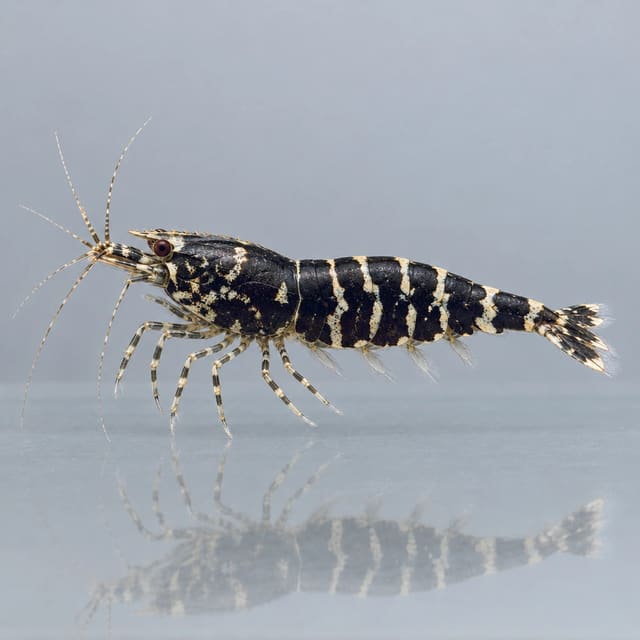
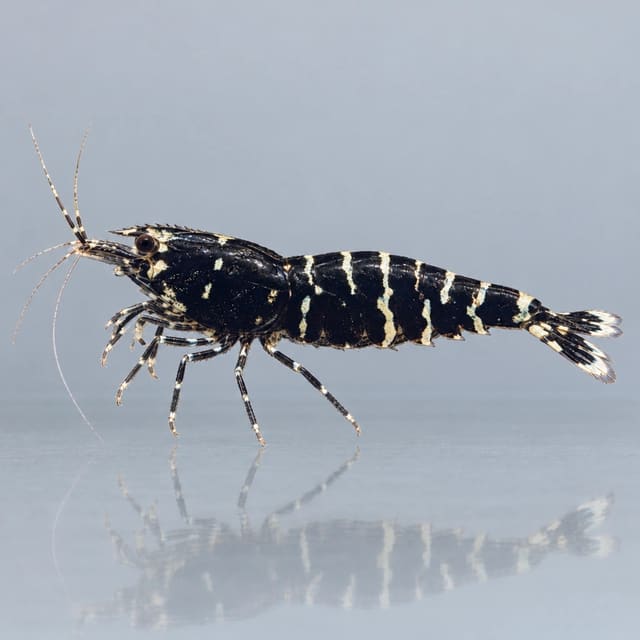
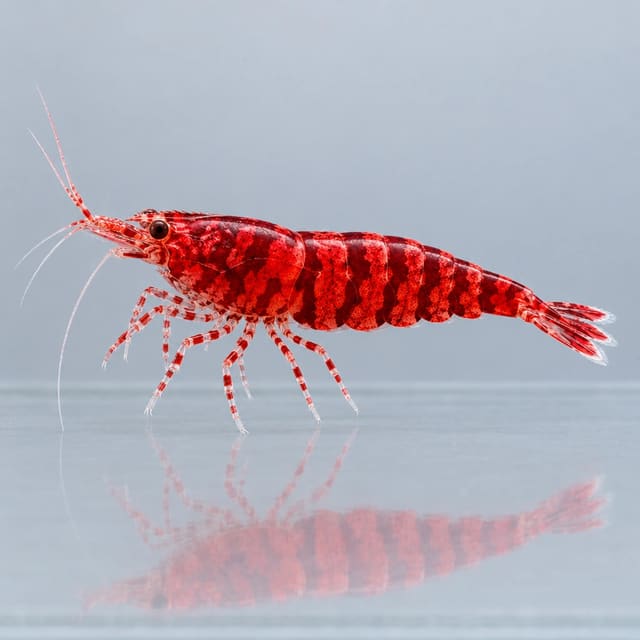
The Blue Tiger Golden Eye Shrimp is a selectively bred tiger shrimp with a pale, powder-blue body crossed by broken black tiger stripes, blue legs banded in black and, its trademark, bright orange-gold eyes. It is the shrimp many keepers know as the orange eye blue tiger. A small group grazing over moss is easy to pick out in a planted tank, and the eye colour shows clearly even at a distance. It is a soft-water Caridina that needs a mature aquarium with steady, slightly acidic water, and it should not share a tank with bee shrimp if you want to keep either line true.
This page sets out where the blue tiger comes from, what you receive, and how to keep and breed a colony, with the published figures and the points where sources disagree.
The wild tiger shrimp was formally described in 2014 as Caridina mariae by Werner Klotz and Thomas von Rintelen, in a Zootaxa paper on ornamental shrimp from Guangdong and Hong Kong. Seriously Fish’s summary describes the wild animal as semi-transparent with a dark brown to blackish blotch on the carapace and stripes, and gives two known sites in Yingde and Conghua counties, Guangdong: a small hill stream and a swampy area near Conghua City, where the water measured pH 7.0 and 40 µS. Wikipedia adds Hong Kong to the range and notes that some variants have orange eyes and orange highlights in the tail fins.
Aquarium breeders have turned that wild shrimp into several colour lines. Lukhaup and Pekny’s Aquarium Invertebrates files the Blue Tiger under Caridina mariae, lists a Blue Tiger “Orange Eye” separately, and also lists C. mariae x logemanni crosses. TFH Magazine names the orange-eyed blue tiger, with a blue body, among the tiger forms, and Seriously Fish reports a red colour mutation that appeared in an aquarium population of C. mariae. Because a line-bred tiger may carry other ancestry, we list this shrimp as Caridina sp., the name used on our other tiger shrimp.
| Tiger shrimp form | Look | Source |
|---|---|---|
| Wild tiger shrimp, Caridina mariae | Semi-transparent body, dark blotch on the carapace, dark stripes | Klotz and von Rintelen 2014; Seriously Fish |
| Blue Tiger Golden Eye (this listing) | Pale blue body, broken black stripes, orange-gold eyes | TFH Magazine (orange-eyed blue tiger); Lukhaup and Pekny (Blue Tiger “Orange Eye”) |
| Black diamond or black tiger | Dark blue body with heavier black striping | TFH Magazine |
| Red tiger | Red-bodied mutation | Seriously Fish; TFH Magazine |
| Tibee | Tiger x bee cross, very variable | Practical Fishkeeping; TFH Magazine |
If you like striped Caridina, compare it with our Tiger Shrimp, the Raccoon Tiger Shrimp and the Fancy Tiger Pinto Shrimp; each is a different look.
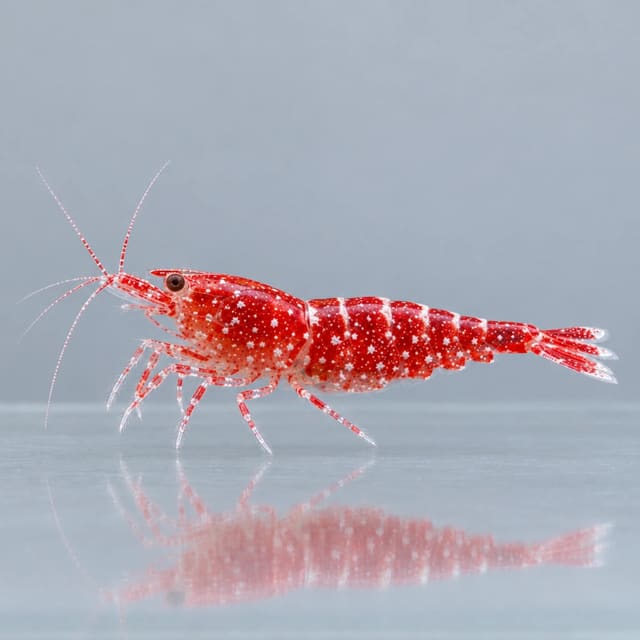
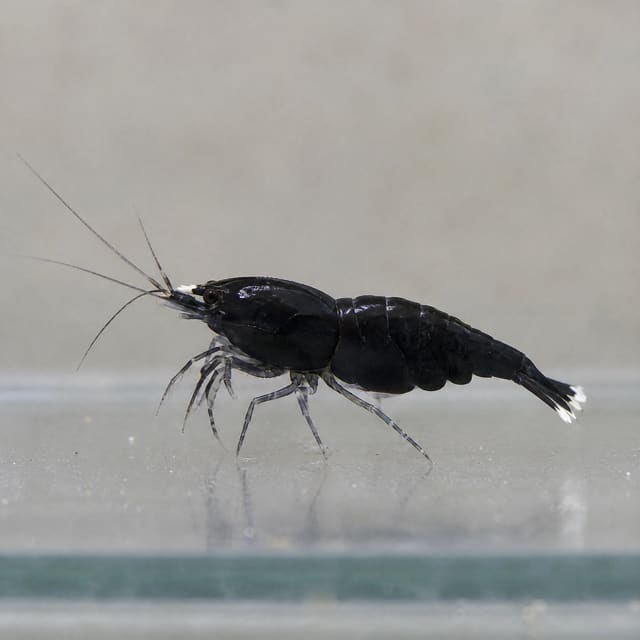
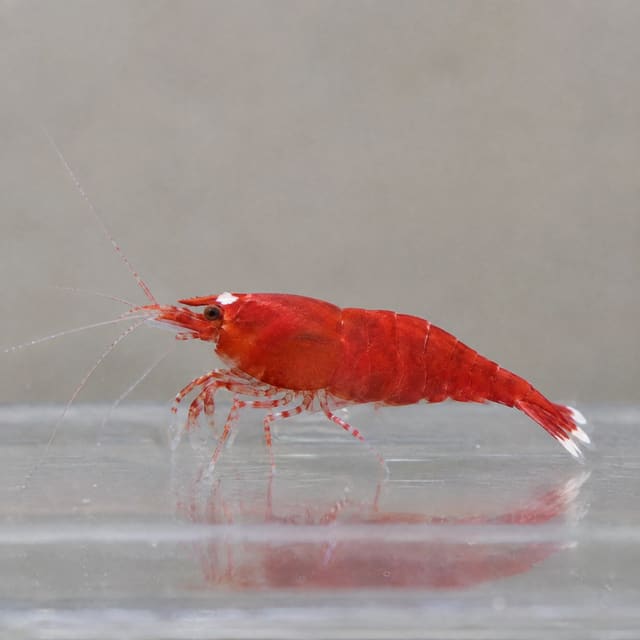
Each purchase is one live Blue Tiger Golden Eye Shrimp; choose how many you want in the basket. The photographs show the colour form. Living shrimp vary: the blue can be paler or deeper, the stripes heavier or finer, and the eyes from orange to gold. A shrimp that has just travelled may look washed out for a few days; OATA lists colour change among the things to watch, so note whether it recovers within the first week. No size grade is recorded for this line, so we do not promise a size at dispatch. For the adult, Wikipedia gives about 25–38 mm for C. mariae, with females larger than males. Dispatch days and our live-arrival terms are on the delivery page.
OATA recommends keeping shrimp in groups of at least five, and Neale Monks in Practical Fishkeeping suggests six to twelve adults as a starting colony. Females are larger and have a curved underbelly (Wikipedia), and in a semi-translucent shrimp such as this you may see the saddle of developing eggs behind the head, which TFH Magazine describes in non-opaque varieties. A group of five or more is the simple way to make sure both sexes are present. If small fish will share the tank, check the total with our stocking calculator.
Tiger shrimp come from soft water, though the wild swamp site described in 2014 was close to neutral at pH 7.0. In the aquarium, what matters most is low hardness, a slightly acidic to neutral pH and, above all, stable values from one water change to the next.
| Source | Temperature | pH | GH | KH |
|---|---|---|---|---|
| Practical Fishkeeping, introduction to shrimp (bee and tiger) | 18–23°C | 6–6.8 | 5 | 0–2 |
| Wikipedia, Caridina mariae | 18–24°C | 6–7.5, about 6.5 preferred | Not given | Not given |
| Wild swamp site near Conghua (Seriously Fish) | Not given | 7.0 | Conductivity 40 µS: very soft | |
| OATA, all freshwater shrimp and snails | 17–27°C | 6.5–8.0 | 4–18 | 3–15 |
| Our planning range | 18–23°C | 6.5–7.0 | 4–6 | 0–2 |
The planning range sits where the tiger shrimp figures overlap. OATA’s care sheet covers every common freshwater shrimp and snail together, so its upper hardness and pH values are wider than a tiger shrimp colony needs.
OATA’s minimum for a group of small shrimp is 10 litres. A larger volume gives more stable water, a point Practical Fishkeeping makes for shrimp tanks generally, so for a breeding colony of blue tigers we suggest 20 litres or more. Measure your tank with our tank volume calculator.
Use an air-driven sponge filter, or cover a power filter’s intake. Practical Fishkeeping prefers sponge filters because they cannot swallow young shrimp and give them a grazing surface, and Wikipedia also advises guarding filter intakes because young tiger shrimp are small enough to be drawn in. Caridina do not need a heater at room temperature (Practical Fishkeeping); keep the tank out of direct sun, because a hot spell pushes the water above the planning range.
| Job | How often | Target or method |
|---|---|---|
| Water tests | Weekly (OATA) | Ammonia and nitrite zero; nitrate no more than 20 mg/l above tap; pH and GH in range |
| Partial water change | At least weekly (OATA) | About 25%, using prepared water matched in hardness and temperature |
| Siphon debris | At each change | Lift uneaten food before it rots |
| Evaporation top-up | As needed | Plain RO water, because minerals stay behind as water evaporates |
| Filter care | When flow drops | Rinse the sponge in removed tank water only |
Wikipedia describes Caridina mariae as an omnivore. In a mature tank it spends the day picking at biofilm, algae and detritus, so extra food should be modest. OATA recommends feeding two or three times a week; the Practical Fishkeeping author feeds every other day.
A slow drip protects shrimp from sudden changes in hardness and pH. Practical Fishkeeping’s method: dim the lights, put the shrimp and their water in a small container, and run airline from the tank with a clamp or flow controller at one to two drops a second for about an hour, until the volume has tripled or quadrupled. Then net the shrimp into the tank and discard the transport water. OATA’s floating-bag method (float for 10 minutes, then add tank water over at least 30 minutes) is the minimum. Our acclimatisation guide shows the set-up.
| When | Good sign | If not |
|---|---|---|
| First hours | Shrimp exploring and grazing | Check temperature; test ammonia and nitrite |
| Days 1–3 | Blue colour returning after transport | Recheck GH and pH |
| Days 1–7 | All shrimp seen each evening | OATA advises close monitoring for the first week |
| Any day | A clear empty shell | A moult, not a death; a moult is never coloured (Practical Fishkeeping) |
Practical Fishkeeping identifies a failed moult as a major cause of unexplained deaths, usually linked to water with the wrong hardness or too little mineral and calcium. OATA’s general signs of ill health include changes in movement, colour, behaviour, breathing, appearance and appetite.
| Sign | Possible cause | Action |
|---|---|---|
| Shrimp trapped in its old shell | Failed moult | Test GH; keep remineralising consistent |
| Fluffy growths on head or gills | Vorticella | Clean up waste; potassium permanganate is described as semi-reliable (Practical Fishkeeping) |
| White growths between the eyes or on the rostrum | Scutariella | Treatment success varies; do not add shrimp showing white growths |
| Sudden losses after new plants or sprays | Insecticides, smoke, air fresheners, flea spray | Water change with prepared water; remove the source |
| Losses after a medication | Copper (OATA) | Never use copper-based products with shrimp |
Tiger and bee shrimp cross. Practical Fishkeeping lists the resulting Tibee (tiger x bee) and TaiTibee (Tibee x Taiwan bee) forms, and TFH Magazine notes that crossing crystal black with tigers produces a tibee. Practical Fishkeeping adds that Caridina crosses do not revert to a wild type but go on producing new patterns, so a mixed tank changes for good.
OATA advises avoiding any fish that can fit a shrimp in its mouth and any predatory species. TFH Magazine, writing about Caridina, suggests only very small fish such as Otocinclus and least killifish, and a shrimp-only tank for breeding, because young shrimp are easy prey. Wikipedia describes C. mariae as peaceful, so the risk is always to the shrimp, not from it. Use our tank mates checker before you add anything.
| Usually suits | Use caution | Avoid |
|---|---|---|
| Golden Otocinclus and other Otocinclus | Any fish in a breeding tank | Fish large enough to eat shrimp (OATA) |
| Amano shrimp and Paracaridina (TFH Magazine) | Cherry shrimp: different water needs | Bee and Taiwan bee shrimp: Tibee crosses |
| Sun Nerite Snail and other small snails | Other tiger forms if you want a pure line | Predatory species (OATA) |
Tiger shrimp breed readily in a settled tank. Wikipedia describes direct development: females carry the eggs under the abdomen for about 30 days, and the young hatch no more than 3 mm long, looking like small adults and grazing straight away. Practical Fishkeeping gives about three weeks for eggs to hatch in dwarf shrimp generally and says shrimp breed from around six months old, so allow three to four weeks between berried female and young. Wikipedia also notes, without a citation, that young tiger shrimp can show blue, orange or yellow colouring that darkens with age.
| Stage | Published figure | What to do |
|---|---|---|
| Maturity | About six months (Practical Fishkeeping) | Give a new group time to settle |
| Eggs carried | About 30 days (Wikipedia); about three weeks (Practical Fishkeeping) | Keep water changes small and matched |
| Hatching | Young no more than 3 mm (Wikipedia) | Guard filter intakes; keep fish out |
| Colour of the young | Not published for this line | Keep the best orange-eyed blue shrimp together and judge young once their colour settles |
| Lifespan | 1–2 years (Wikipedia, uncited); up to about two years for dwarf shrimp (Practical Fishkeeping) | Let the colony renew itself |
For more help, read our shrimp-keeping care guide and the freshwater shrimp guide for UK keepers, or browse Caridina tiger and bee shrimp, the whole freshwater shrimp category and our shrimps and crustaceans shop.
Yes, the names describe the same look: a blue tiger shrimp with orange to gold eyes. TFH Magazine calls it the orange-eyed blue tiger, and Lukhaup and Pekny list a Blue Tiger “Orange Eye” among their tiger shrimp forms.
It is a line-bred form of the tiger shrimp group. The wild tiger shrimp was described as Caridina mariae by Klotz and von Rintelen in 2014, and Lukhaup and Pekny file the Blue Tiger under that name. Because aquarium lines can carry other ancestry, we list it as Caridina sp.
A little more tolerant on paper: Wikipedia gives Caridina mariae pH 6–7.5 and 18–24°C. Practical Fishkeeping, though, gives tiger and bee shrimp the same targets (18–23°C, pH 6–6.8, GH 5, KH 0–2), so plan for soft, steady water either way.
Wikipedia gives about 25–38 mm for adult Caridina mariae, with females larger than males and deeper-bodied underneath. OATA’s general figure for small shrimp such as bee shrimp is about 3 cm.
Not if you want to keep either line pure. Tiger and bee shrimp cross to give “Tibee” young (Practical Fishkeeping; TFH Magazine). Give the blue tigers their own tank.
To keep the look, keep orange-eyed blue tigers together and apart from other tiger forms. No source we checked publishes how reliably the blue body and orange eye pass on. Wikipedia notes that young tiger shrimp can show blue, orange or yellow colour that darkens with age, so wait before judging a youngster.
Two or three times a week, as OATA advises, or every other day as the Practical Fishkeeping author does, with an amount the group finishes. They graze biofilm and algae between meals.
Five or more, the minimum group OATA recommends. Neale Monks suggests starting a colony with six to twelve adults, which also makes it likely you have both sexes.
No reviews for this item yet. Bought one? Honest reviews only, good or bad.
What customers say about ordering from us
Easy website plenty of info on fish your buying great to pick a time slot
TRACEY DURRANT · 7 Oct 2026
Got some lovely fish thank you
Kevin Mackie · 7 Oct 2026
Reviews of our shop, collected by Judge.me, an independent third-party review collector. Newest first.
Moved by UK carriers licensed to handle live animals
Hand-packed with oxygen bags, poly box, heat pack
Email photos the same day; an optional unboxing video helps us review problems faster — claim terms apply
Klarna & PayPal Pay in 3 at checkout