Moderate
King Kong Taiwan Bee Shrimp (Caridina sp.)
20–24°C · pH 6–6.8
£40.99
The high grade Black Tiger Shrimp is a selectively bred tiger shrimp picked for a deep, near-solid black shell and clean cream-white stripes. More forgiving than bee shrimp, it still wants steady water at about 20–24°C, pH 6.5–7.5 and GH 4–10 in a mature, planted tank. Sold individually as one live shrimp.
Adult size is the maximum length this species reaches at full maturity (scientific sources). The livestock you receive will be younger and smaller. Product-photo provenance and any image-specific limitations are stated on the listing.
Caridina sp.
Choose a quantity for your aquarium. Discount thresholds are pricing offers, not a stocking recommendation.
The high grade Black Tiger Shrimp is a selectively bred tiger shrimp picked for a deep, near-solid black shell and clean cream-white stripes. More forgiving than bee shrimp, it still wants steady water at about 20–24°C, pH 6.5–7.5 and GH 4–10 in a mature, planted tank. Sold individually as one live shrimp.
Adult size is the maximum length this species reaches at full maturity (scientific sources). The livestock you receive will be younger and smaller. Product-photo provenance and any image-specific limitations are stated on the listing.
Read the full care guidance when planning conditions for your aquarium.
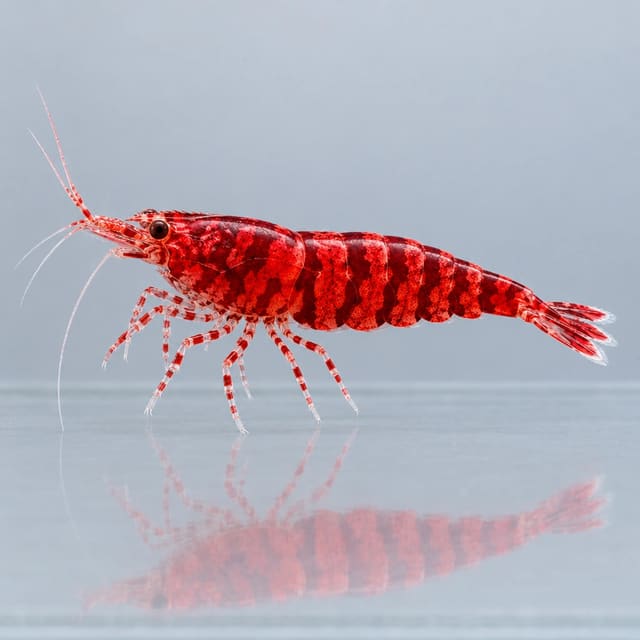
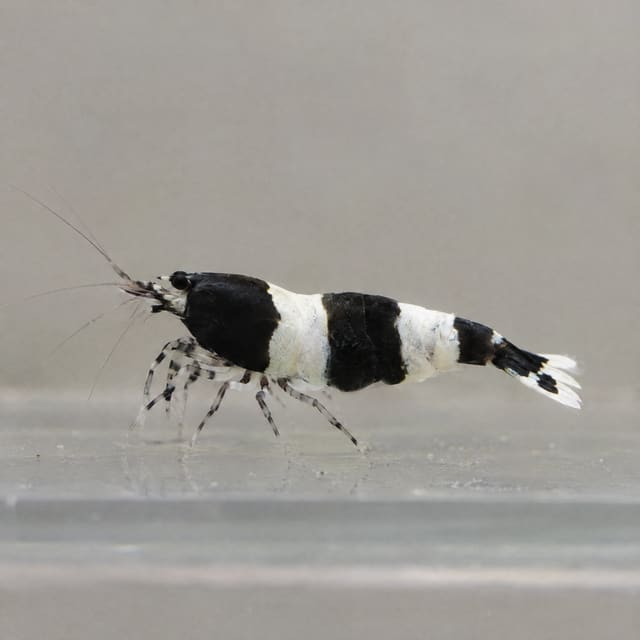
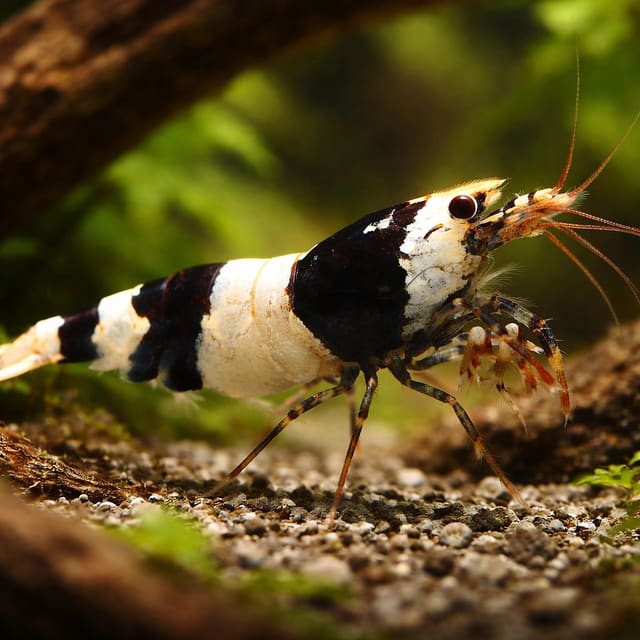
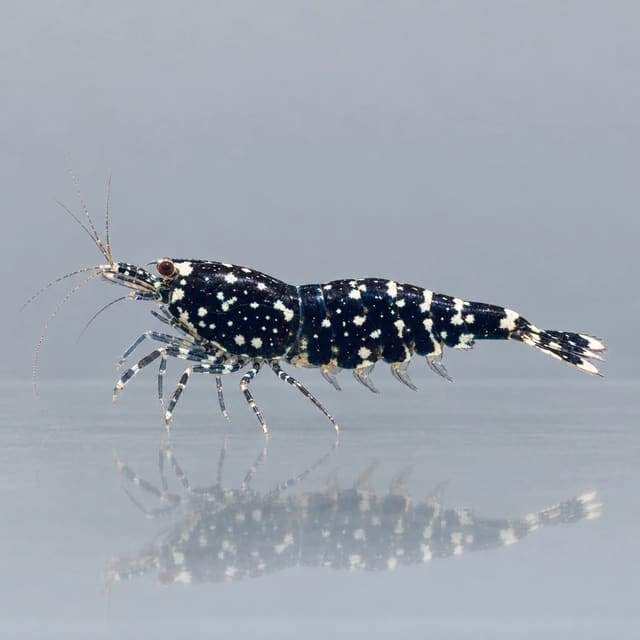
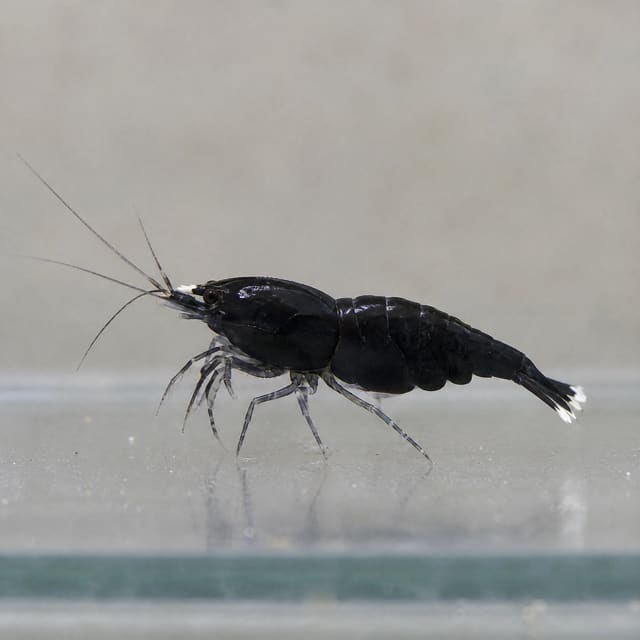
The high grade Black Tiger Shrimp is a selectively bred tiger shrimp chosen for an inky, near-solid black shell crossed by neat cream-white stripes. The stripes run across the body segments from behind the head to the tail, the tail fan is tipped in pale cream, and the long legs and antennae are banded black and white. It is the black tiger at its most polished: deep colour, clean edges and very little of the translucence seen in ordinary tiger shrimp.
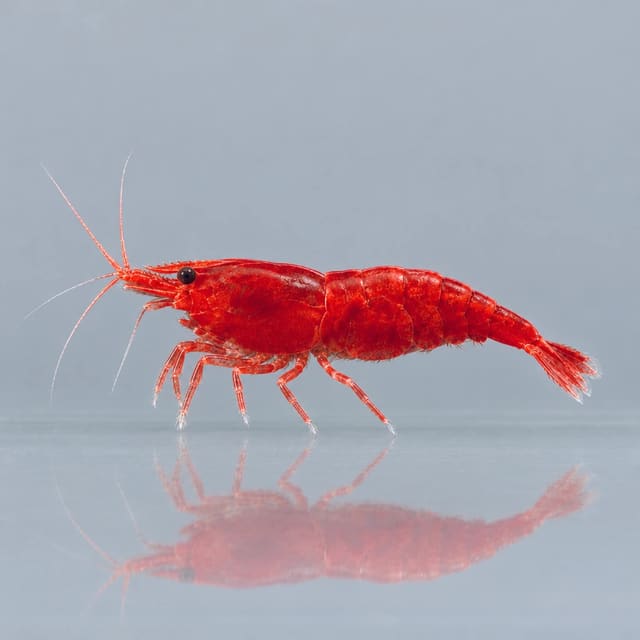
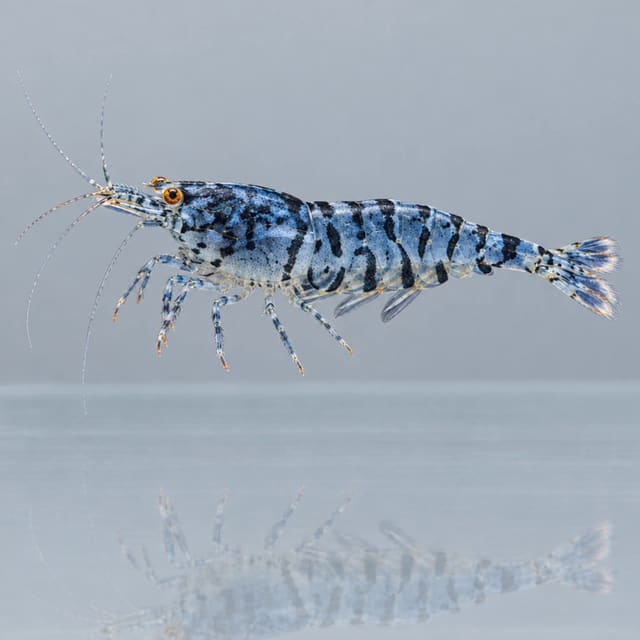
Wild tiger shrimp look very different. Seriously Fish’s summary of Klotz and von Rintelen’s 2014 study describes the tiger shrimp, now named Caridina mariae, as a semi-transparent shrimp with dark stripes on the head shield and the first six body segments. Breeders have selected that stripe pattern into blue, orange-eyed, red and black lines. Shrimp Science describes the black tiger as very similar to the orange-eyed blue tiger but much darker, essentially a blue tiger bred over generations for black colour.
| Suits | Not suited to |
|---|---|
| A mature, planted tank of about 38 litres or more | A tank that has not finished cycling |
| Steady water at 20–24°C, pH 6.5–7.5, GH 4–10 | Hard, alkaline water or a tank that swings in temperature |
| A group of five or more of the same line | A single shrimp kept alone |
| A shrimp tank, or one shared with Neocaridina, Amano shrimp or nerite snails | Bee shrimp, other tiger colours or fish that can eat shrimp |
No society or breeders’ club publishes a grading standard for black tigers, so “high grade” is a selection made by eye. The clearest public description comes from Shrimp Science, which separates the grades like this.
| Feature | High grade | Lower grade |
|---|---|---|
| Body colour | Very deep black, fairly solid | More translucent or patchy; can look dark blue |
| Stripes | Clean, even, clearly separated | Broken or blurred into marbling |
| Eyes, where orange | Bright, glowing orange | Closer to brown |
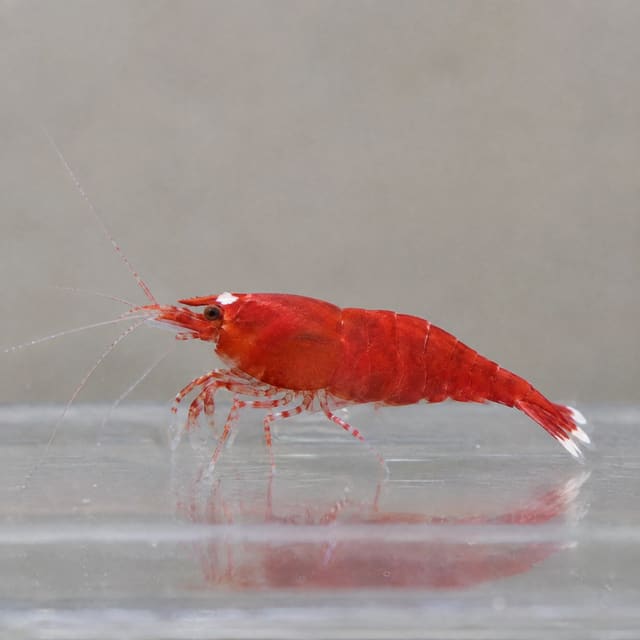
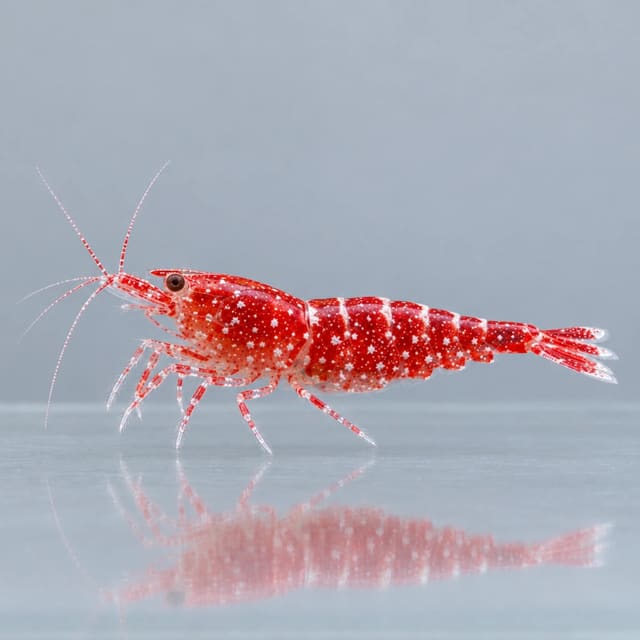
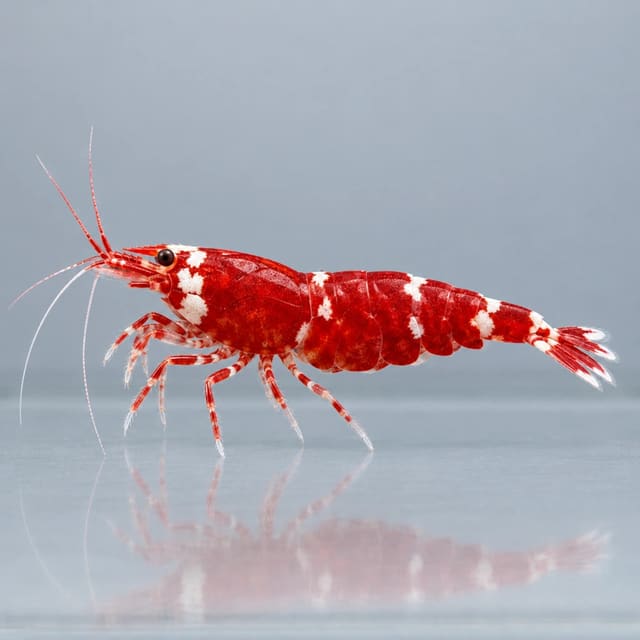
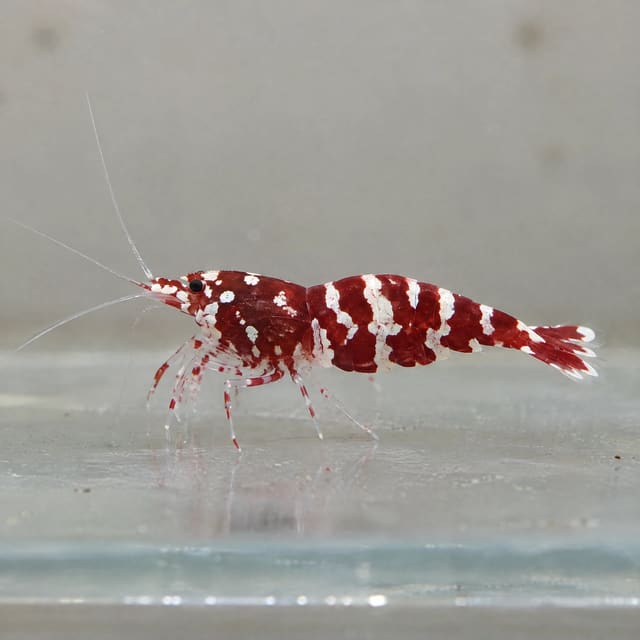
Our photographs show the look we select for. They are representative images rather than portraits of individual shrimp, and every shrimp differs slightly in stripe width and in how solid the black is. The photo shows a dark-eyed shrimp; because eye colour varies within black tiger stock we do not promise orange eyes.
Black shrimp can look more solid in a dim tank than they really are. Gensou’s guidance for grading black Caridina is to look under strong light, where thin or translucent patches show. Colour also changes with conditions: OATA lists colour turning paler or darker among the signs of stress, so judge a shrimp only once it has settled. The Shrimp Farm adds a useful reminder that colour on its own says nothing about a shrimp’s health or quality.
One purchase is one live high grade Black Tiger Shrimp. Set the quantity to the number you want. There is one standard option because the shrimp are not graded by length before dispatch, so a group can include shrimp at slightly different stages of growth. See our delivery page for the days we send livestock and how it is packed.
OATA recommends groups of at least five because smaller groups cause stress, and Fishipedia gives the same minimum for the tiger shrimp. A group also gives you both sexes. The Shrimp Farm’s blue tiger care sheet describes females as larger, with a curved underside and a dark “saddle” of developing eggs behind the head, so a mix is easy to confirm once the shrimp are adult.
Tiger shrimp come from Guangdong in southern China. The 2014 description records them from Yingde and Conghua counties, and in one swampy area near Conghua the researchers found tiger shrimp living alongside bee shrimp in water of pH 7.0 and a conductivity of 40 µS. For years both were sold as Caridina cantonensis, and some shops and care sites, Shrimp Science among them, still use that name for black tigers; The Shrimp Farm uses Caridina mariae. Because aquarium lines are not always pure, we list this shrimp as Caridina sp.
Black tigers have a long history with serious breeders. Writing in Practical Fishkeeping in 2009, the shrimp specialist Chris Lukhaup reported that the German-bred Black Tiger was rated far higher in Japan than the then-new Taiwanese Red Ruby, King Kong, Panda and Blue Bolt. Shrimp Science places the line’s modern stock in Taiwan. Either way, it is a shrimp bred for colour over many generations, not a wild form.
Tiger shrimp and bee shrimp are close relatives and will cross in an aquarium. The Shrimp Farm warns against keeping tigers with bee shrimp for that reason, and Fishipedia advises against mixing species of the same genus. Other tiger colours are the same species, so they interbreed too and blur the black. Keep this line on its own if you want its young to stay black.
Shrimp Science gives an adult size of about 3 cm, Fishipedia 2–3 cm, and The Shrimp Farm a maximum of 1.5 inches, about 3.8 cm, for tiger shrimp. They are small, but a breeding group soon multiplies, so plan for a colony rather than a handful.
For tank size Shrimp Science sets a minimum of 5 US gallons, about 19 litres, and recommends 10 gallons, about 38 litres, or more. The Shrimp Farm calls 38 litres a good starting point and Fishipedia gives 20 litres as its minimum. A larger volume changes temperature and chemistry more slowly, which protects high-value shrimp from the swings that cause failed moults.
Tiger shrimp are more forgiving than bee shrimp, but the black line still does best in steady, softish water. The table below shows where the sources overlap and what each one says.
| Reading | Aim for | What the sources say |
|---|---|---|
| Temperature | 20–24°C | Shrimp Science 20–25°C; The Shrimp Farm 65–75°F (about 18–24°C); Fishipedia 15–26°C |
| pH | 6.5–7.5 | Shrimp Science 6.5–8.0; The Shrimp Farm 6–7.5; Fishipedia 6–7.5 |
| GH | 4–10 | Shrimp Science and The Shrimp Farm 4–10; Fishipedia 3–12 in the wild |
| KH | 2–6 | The Shrimp Farm 2–6; Shrimp Science 1–8 |
| TDS | 150–250 ppm | The Shrimp Farm 150–250; Shrimp Science 130–250 |
| Ammonia and nitrite | Zero | OATA |
| Nitrate | Low | OATA: no more than 20 mg/L above tap water; Fishipedia: below 50 mg/L |
The difficulty ratings differ as much as the numbers. Shrimp Science calls the black tiger easy, while The Shrimp Farm rates the blue tiger moderate and the red tiger intermediate. We treat the line as moderate: forgiving of small differences, but not of sudden changes.
Test your tap water before you decide how to fill the tank. Where your supply is soft to moderately hard and falls inside these values once conditioned, it can be used as it is. Where it is harder, The Shrimp Farm advises using reverse osmosis water, which in practice means blending RO with tap water, or remineralising pure RO, until GH, KH and TDS sit in range. Always treat tap water with a conditioner that removes chlorine and chloramine, as OATA advises. Our water matcher compares your readings with the shrimp, and the water chemistry guide explains what each reading means.
The Shrimp Farm suggests a sponge filter, or any filter with a cover over its intake, and warns against a flow strong enough to push shrimp around. The same guide recommends a heater with a thermostat to prevent sudden temperature changes.
The sources suggest different routines. OATA recommends changing 25 percent at least weekly, The Shrimp Farm suggests 20 percent a week as a starting point, matched for temperature, and Fishipedia’s focus is keeping nitrate under 50 mg/L. Any of these works if the replacement water matches the tank closely and goes in slowly.
New to cycling a tank? Our guide to the fish tank nitrogen cycle explains why ammonia and nitrite must read zero before shrimp go in.
Tiger shrimp are omnivores that spend most of the day grazing algae and biofilm. Shrimp Science notes that a mature, heavily planted tank may supply most of what a group needs, with algae wafers, shrimp pellets and blanched vegetables as supplements. The Shrimp Farm adds nettle leaves and an occasional frozen food such as mosquito larvae, and stresses that uneaten food must come out within a few hours because overfeeding is a major cause of shrimp deaths.
How often to feed is a matter of degree. OATA suggests two or three times a week for shrimp, leaving food for at least 30 minutes before removing leftovers. In a young tank with little biofilm, small daily portions may be needed; in an old, mossy tank, less is more.
| Item | How much | Why |
|---|---|---|
| Shrimp sticks such as our Caridina nano sticks | A pinch the group clears within a few hours | Core nutrition |
| A piece of green algae wafer | One small piece, in place of sticks on some days | Plant matter for grazers |
| Blanched spinach or nettle | A small leaf, occasionally | Variety and minerals |
| Frozen mosquito larvae | Rarely, a few pieces | An occasional treat, per The Shrimp Farm |
A sudden change in water is the biggest risk on arrival. Follow OATA’s floating-bag method as a minimum: lights off, float the sealed bag for 10 minutes, then add tank water slowly over at least 30 minutes before netting the shrimp out with as little bag water as possible. If your tank is much softer or harder than ours, a slow drip over an hour or more is gentler still. Our guide to acclimatising new arrivals shows both methods.
| When | What to do |
|---|---|
| Before arrival | Ammonia and nitrite at zero, temperature steady at 20–24°C |
| On arrival | Lights off, float, add tank water slowly for 30 minutes or more |
| Days one to three | Leave the shrimp to settle; feed very lightly once they are grazing |
| Days four to seven | Normal small meals; remove leftovers; check temperature daily |
| End of week one | Full water test; judge colour now that the shrimp have settled |
Shrimp moult often, and OATA notes that a cast skin in the tank is normal; leave it, as the shrimp eat it back. Trouble shows as changes in behaviour or appearance. OATA lists unusual inactivity or restlessness, colour turning darker or paler, extra hiding, laboured breathing, white spots, shell damage, lost legs and reduced feeding. Shrimp are very sensitive to copper, which kills them at low levels, and Fishipedia warns against copper in fertilisers and foods as well as medicines.
| If you see | Do this |
|---|---|
| A shrimp stuck part-way out of its old shell | Check GH and look for a recent sudden change in water |
| Shrimp crowding the surface or the filter outlet | Test ammonia and nitrite and check temperature at once |
| Colour fading across the whole group | Check for stress: temperature, nitrate and recent water changes |
| Several losses in a short time | Test everything, change water with matched water and review any new treatment or plant |
A high grade line is only as good as its next generation. Keep black tigers in their own tank, away from bee shrimp and from other tiger colours such as the clear-bodied Tiger Shrimp or the Raccoon Tiger Shrimp; mixed young are usually lighter and patchier than either parent.
The Shrimp Farm lists Neocaridina such as cherry shrimp, Babaulti and Amano shrimp, nerite snails and Thai micro crabs as companions that will not cross with tigers, and notes that a few keepers succeed with very small, mellow fish such as pygmy corydoras or otocinclus. For breeding, both The Shrimp Farm and Shrimp Science recommend a shrimp-only tank, because fish take young shrimp.
| Suits | Avoid |
|---|---|
| Other high grade black tigers | Bee shrimp, crystal red, Taiwan bee and pinto lines |
| Neocaridina, such as the Blue Velvet Shrimp for colour contrast | Other tiger colours, if you want black young |
| Amano Shrimp | Fish large enough to fit a shrimp in their mouth |
| Nerite snails such as the Sun Nerite Snail | Crayfish, crabs other than Thai micro crabs, and copper treatments |
Our tank mates tool checks any combination before you buy.
Tiger shrimp breed entirely in fresh water. The female carries her eggs under her tail for around 30 days and the young hatch as tiny copies of the adults, according to The Shrimp Farm, which counts 20 or more young per clutch in red tigers. No special tank is needed if there are no fish and plenty of moss for the young to hide and graze in.
The colour of the young varies. The Shrimp Farm says that in tiger lines the orange eyes breed true but body colour is not always passed on, and Shrimp Science describes black tigers as a good base for breeders creating new orange-eyed lines, and notes that crosses give unpredictable results. Expect some young to be paler or patchier than their parents.
Find more Caridina in our Caridina shrimp category, compare all freshwater shrimp, browse the shrimp and crustacean shop, and read our shrimp care guide for set-up basics.
Shrimp selected for the deepest, most solid black shell and clean, even stripes. Shrimp Science describes lower grades as more translucent or patchy, sometimes looking dark blue. There is no official grading standard, so the grade is our selection, not a certificate.
We do not promise eye colour. Shrimp Science describes black tigers with orange eyes, brighter in the best shrimp, but our photograph shows a dark-eyed shrimp and eye colour can vary within the line.
One live shrimp. Choose the quantity you need; OATA and Fishipedia both recommend a group of at least five.
About 3 cm, according to Shrimp Science and Fishipedia (2–3 cm). The Shrimp Farm gives a maximum of 1.5 inches, about 3.8 cm, for tiger shrimp.
Steady, soft to moderately soft water: about 20–24°C, pH 6.5–7.5, GH 4–10, KH 2–6 and TDS 150–250 ppm, the values where the tiger shrimp sources overlap.
No. Grade describes colour, not care. Both need the same water, and The Shrimp Farm notes that colour on its own does not indicate quality or health.
Not if you want to keep the line pure. The Shrimp Farm says bee shrimp can cross with tiger shrimp and produce hybrids. Keep them with Neocaridina or Amano shrimp instead.
Not reliably. The Shrimp Farm says the orange eyes of tiger lines breed true but the body colour is not always passed on, so expect some lighter young and select the darkest for breeding.
No reviews for this item yet. Bought one? Honest reviews only, good or bad.
What customers say about ordering from us
Easy website plenty of info on fish your buying great to pick a time slot
TRACEY DURRANT · 7 Oct 2026
Got some lovely fish thank you
Kevin Mackie · 7 Oct 2026
Reviews of our shop, collected by Judge.me, an independent third-party review collector. Newest first.
Moved by UK carriers licensed to handle live animals
Hand-packed with oxygen bags, poly box, heat pack
Email photos the same day; an optional unboxing video helps us review problems faster — claim terms apply
Klarna & PayPal Pay in 3 at checkout