Ring-Necked Shrimp (Macrobrachium assamense)
17–27°C · pH 6.5–8
£19.99
One unsexed Red Pinto Taiwan Bee shrimp at approximately 1-1.3 cm. A specialist Caridina trade line for mature, stable soft-water aquariums; pattern, sex and grade vary and are not guaranteed.
Caridina sp.
Choose a quantity for your aquarium. Discount thresholds are pricing offers, not a stocking recommendation.
One unsexed Red Pinto Taiwan Bee shrimp at approximately 1-1.3 cm. A specialist Caridina trade line for mature, stable soft-water aquariums; pattern, sex and grade vary and are not guaranteed.
Maintain these water conditions for optimal health and vibrant colors
Red Pinto Taiwan Bee Shrimp are selectively bred red-and-white ornamental Caridina for mature, stable soft-water aquariums. This listing supplies one unsexed shrimp at approximately 1-1.3 cm. Pattern, red coverage, white coverage, spot count, sex and future breeding quality vary between individuals and are not graded or guaranteed by the supplier.
This is a specialist shrimp for keepers who can measure and control pH, GH, KH, temperature and total dissolved solids. A practical starting envelope is 20-24 C, pH about 5.8-6.6, GH 4-6 dGH, KH 0-1 dKH and roughly 100-150 ppm TDS, but the water in which the shrimp arrives must be measured before acclimation. Stability and a close match to the incoming water are safer than chasing a published number quickly.
| Listing detail | Dispatch specification |
|---|---|
| Quantity | One live shrimp per unit selected |
| Trade line | Red Taiwan Bee Pinto |
| Supplied size | Approximately 1-1.3 cm |
| Sex | Unsexed |
| Grade | No supplier grade specified |
| Pattern | Variable red-and-white Pinto expression |
| Breeding status | Not sold as a proven breeder, pair or colony |
If the product page offers quantity-based pricing, each quantity still represents an individual shrimp. Selecting six means six unsexed shrimp; it does not create a guaranteed sex ratio, matched breeding group or uniform pattern set. Live inventory can be low because each animal is tracked as stock.
Red Pinto is a selectively bred colour and pattern line within the ornamental bee-shrimp and Taiwan Bee hobby. It is not a wild species collected in a naturally occurring Red Pinto habitat. Breeders have developed Pinto-type red-and-white patterns through complex selection and crossing histories, and individual lines may not share one documented pedigree.
The aquarium trade often labels these shrimp Caridina cantonensis, while other specialists use Caridina logemanni, Caridina cf. cantonensis or simply Caridina sp. for bee-shrimp breeding lines. The supplier calls this stock "Caridina Taiwan bee pinto red" but supplies no genetic, locality or breeder-line certificate. For that reason, this page uses Red Pinto Taiwan Bee Caridina as the primary identity and treats species-level naming as established hobby usage rather than proven lineage.
No breeder, generation, wild locality, genetic test, Taiwan farm origin or German Pinto ancestry is documented for this retail line. Those details must not be inferred from the trade name or illustration.
Pinto shrimp are valued for irregular blocks, bands, patches or spots of colour against white. One animal may show a broad red head patch and narrow body markings; another may have more red across the abdomen, fewer white breaks or a different spot arrangement. Juvenile pattern and opacity can also develop as the shrimp grows and moults.
This listing does not promise a named pattern such as spotted head, zebra, fishbone, Mosura or galaxy. It also does not promise a number of spots, a percentage of red or white, opaque legs, full facial coverage or show-grade shell colour. Those traits require individual grading and usually individual photographs. The supplier has provided a trade line and size only.
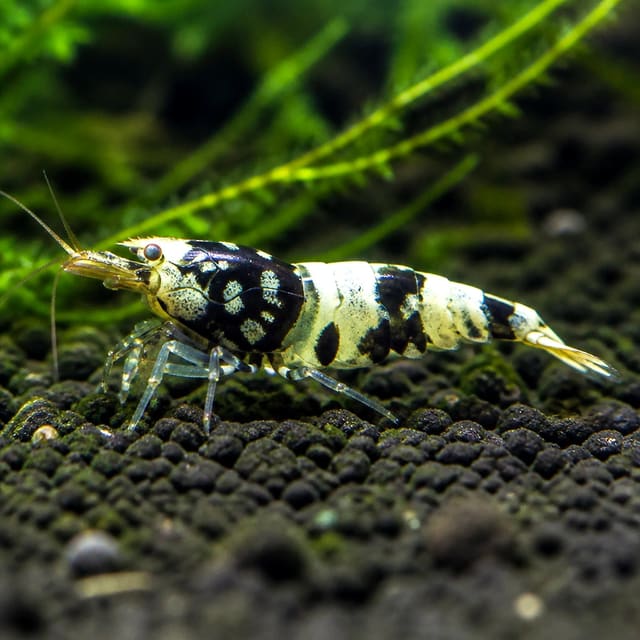
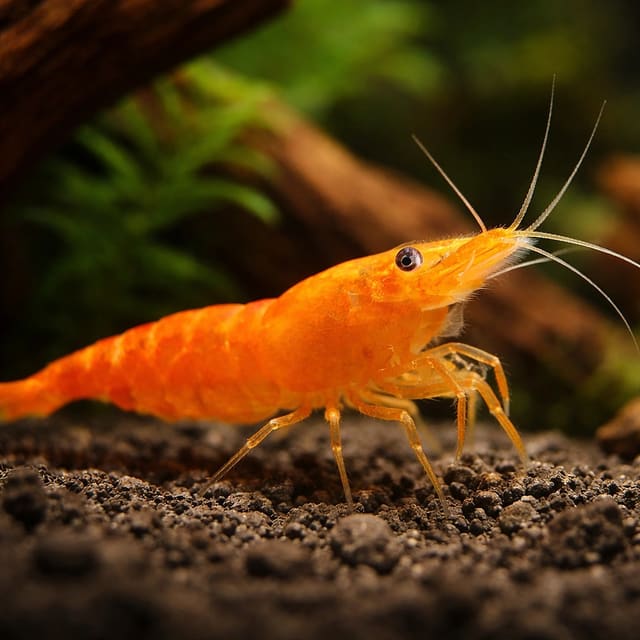
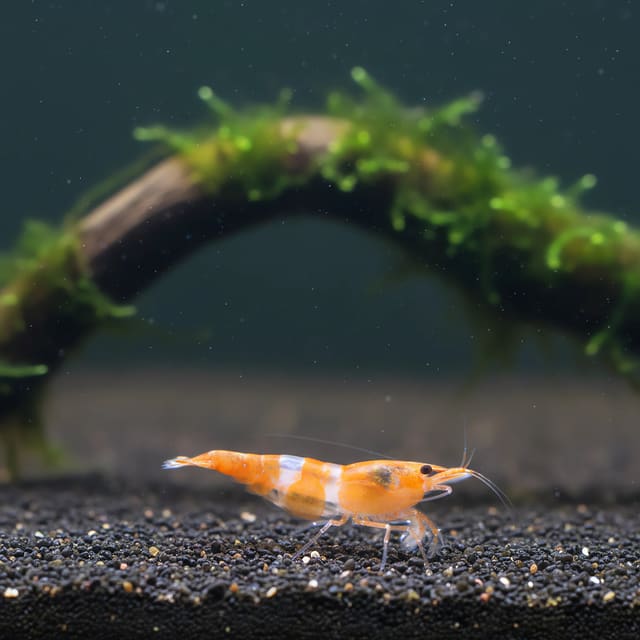
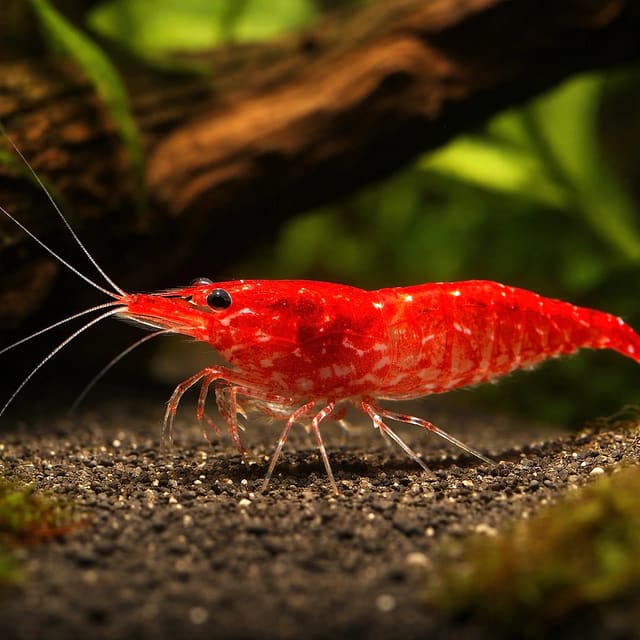
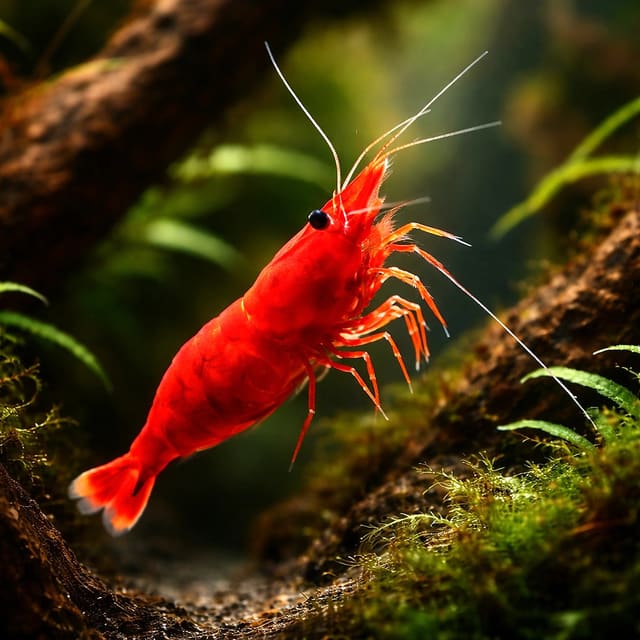
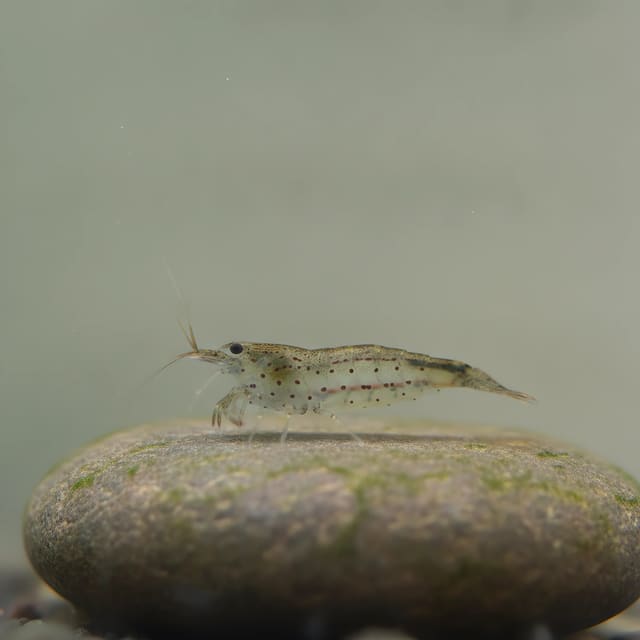
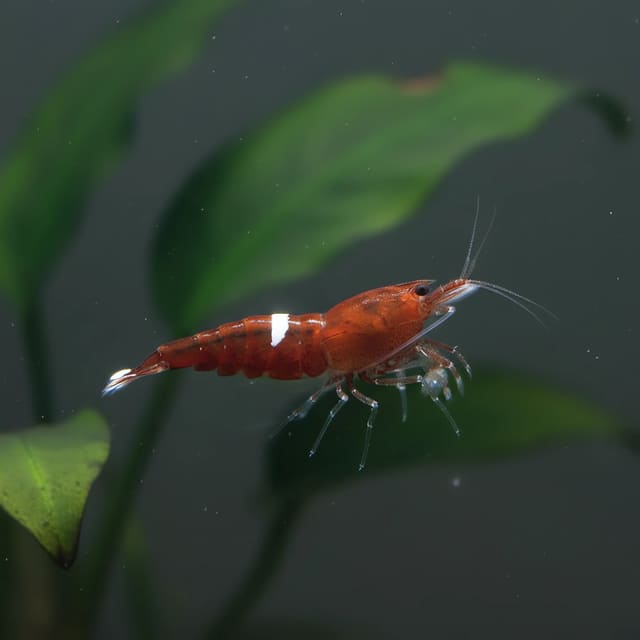
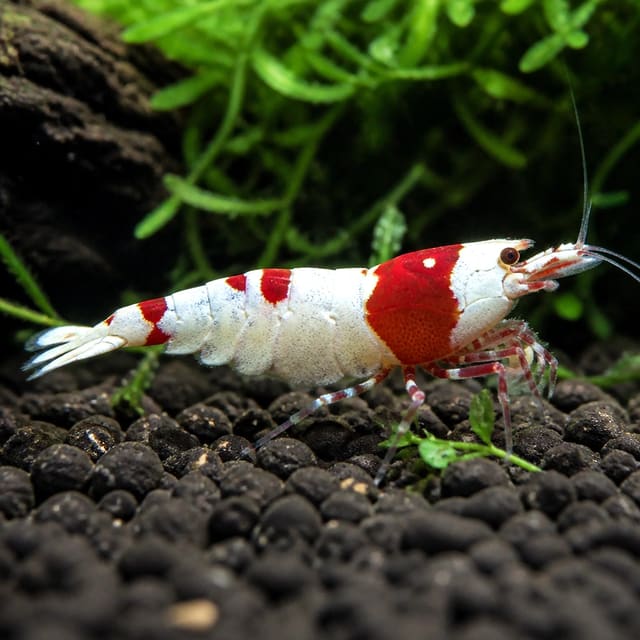
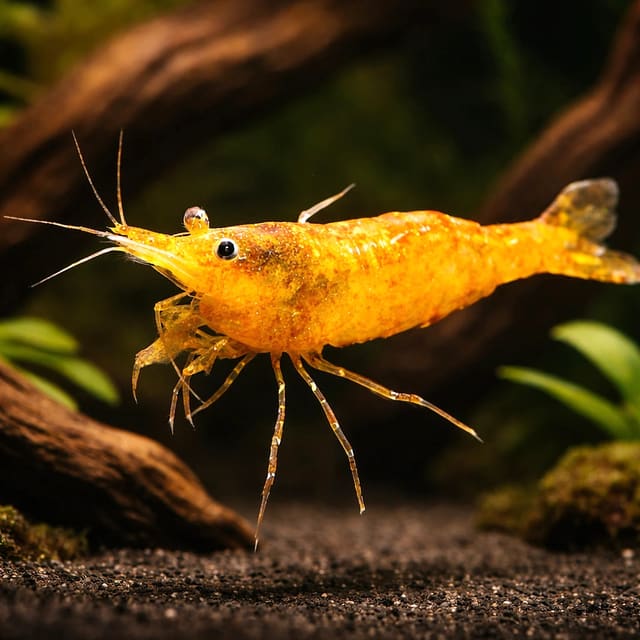
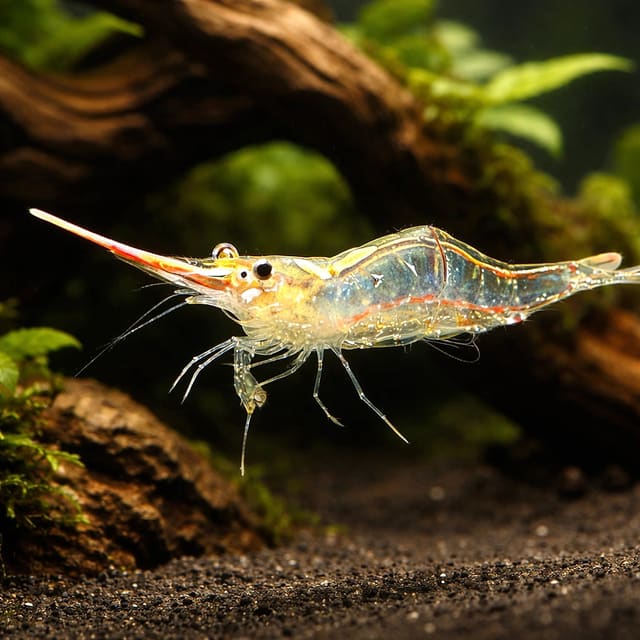
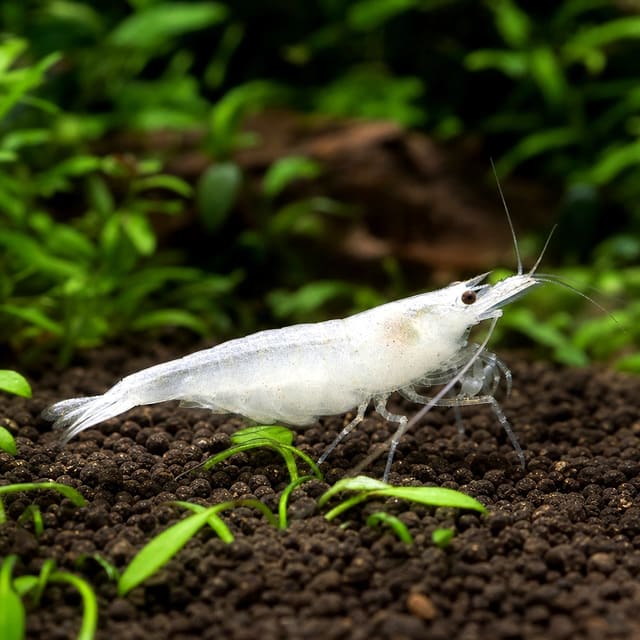
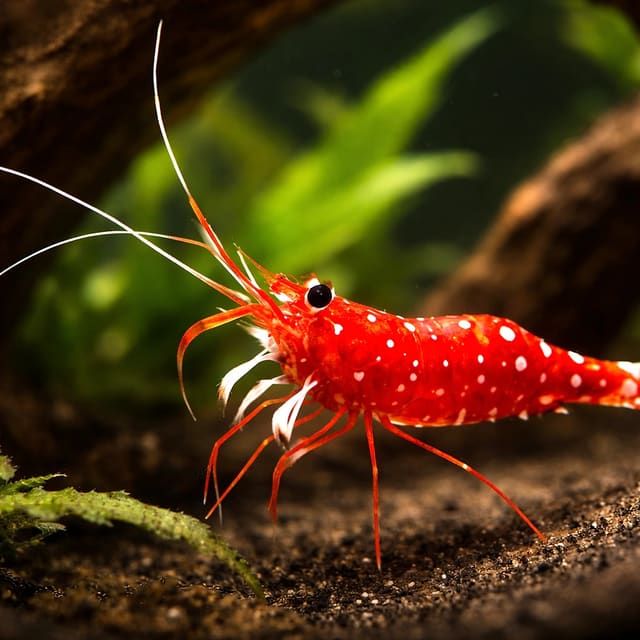
The sole gallery image shows a plausible red-and-white bee-shrimp style in a planted aquarium, but it is not a photograph of the shrimp dispatched, a breeder's parent stock or a grading reference.
Use the image only to understand the general visual category. It cannot establish exact pattern, body proportions, sex, grade, age, lineage, adult colour or shell quality. This disclosure makes the image's limitation explicit.
Red Pinto Taiwan Bee shrimp suit experienced keepers who already understand nitrogen cycling, shrimp-safe filtration, remineralised water, buffering substrate, TDS measurement and slow acclimation. They are a good choice when the aquarium is mature and the keeper can maintain stable soft water without making reactive adjustments.
They are not the easiest first shrimp. A new keeper can succeed after careful preparation, but a hardy Neocaridina colony is usually more forgiving of wider water conditions. Red Pintos should not be bought simply as algae cleaners for a recently set-up community aquarium.
| Keeper or aquarium | Fit | Why |
|---|---|---|
| Mature specialist soft-water shrimp tank | Strong fit | Parameters and feeding can be controlled for Caridina |
| Experienced planted-tank keeper moving into Taiwan Bees | Possible with preparation | Requires RO/remineralisation and stability skills |
| New uncycled aquarium | Not suitable | Biofilm and biological filtration are not established |
| Hard alkaline tap-water Neocaridina tank | Usually poor fit | Preferred chemistry is materially different |
| Busy fish community | High risk | Adults can be stressed and shrimplets preyed upon |
| Outdoor UK pond | Not suitable | Temperature and chemistry are uncontrolled |
| Parameter | Cautious starting range | Practical meaning |
|---|---|---|
| Temperature | 20-24 C | Cool, oxygen-rich conditions; avoid sustained overheating |
| pH | About 5.8-6.6 | Acidic range often maintained with active soil |
| GH | 4-6 dGH | Minerals present for normal moulting without hard water |
| KH | 0-1 dKH | Allows buffering substrate to hold an acidic pH |
| TDS | About 100-150 ppm | Useful monitoring value, not a complete water analysis |
| Ammonia / nitrite | Undetectable on a reliable test | Any measurable amount requires investigation |
| Nitrate | Kept low and stable | Trend and stability matter; avoid accumulation |
These numbers are not a recipe to impose in one day. Different established breeder lines can be maintained at slightly different values. Ask for current holding-water information where available, test the transport water on arrival and decide how slowly the animal needs to transition.
Shrimp regulate salts and water across their body surfaces. A sudden change in dissolved minerals can create osmotic stress even when both the old and new values look acceptable in isolation. Rapidly moving a shrimp from 150 ppm to 110 ppm TDS, for example, can be riskier than maintaining it temporarily at a stable intermediate value.
Do not add acids, alkaline buffers or mineral powders directly to an occupied aquarium to chase a chart. Prepare replacement water separately, measure it and adjust gradually. Record trends so a falling GH, exhausted substrate or creeping TDS is noticed before livestock reacts.
Many Taiwan Bee keepers use reverse-osmosis water remineralised with a GH-only shrimp mineral. This gives control over calcium, magnesium and total dissolved solids while keeping carbonate hardness low. The exact product and dose must be measured rather than copied from another aquarium.
Active buffering substrate helps maintain acidic pH by exchanging ions and reducing carbonate influence. It has a finite life and can become exhausted, so pH and KH should be tracked over time. Replacing all substrate at once in an established colony can destabilise the biological system; plan maintenance before buffering is lost.
Remineralise and temperature-match new water in a separate container. Confirm GH and TDS before a change, then add it slowly. Never guess mineral dose over live shrimp.
There is no universal evidence-based minimum that guarantees success. Very small aquariums can house shrimp but change temperature, TDS and waste concentration quickly. A larger water volume gives more margin for error, while floor area, mature grazing surface and filtration capacity can matter more than height.
For a planned colony, many keepers choose roughly 30-40 litres or more because it is easier to keep stable than an ultra-small jar. A mature 20-litre specialist aquarium can work under experienced management, but it should not be described as automatically suitable simply because it meets a number.
Yes. A completed nitrogen cycle is only the first gate. Shrimp also benefit from established biofilm, microorganisms, seasoned filtration and surfaces that provide food between meals. A tank can test zero ammonia and nitrite yet still be too sterile or unstable for sensitive juvenile Caridina.
No fixed four-week or six-week waiting period proves maturity. Cycling speed depends on inoculation, temperature, ammonia input, filtration and husbandry. Use repeated test results, visible biofilm and system stability rather than the calendar alone.
Use a mature sponge filter or another gentle filter with every intake fully protected. The filter should provide biological capacity and oxygenation without trapping juveniles or forcing adults to fight strong current. Check guards regularly because small shrimplets can enter gaps that appear secure.
Warm water carries less oxygen and accelerates metabolism. Good surface movement is useful, particularly in summer, but avoid sudden cooling or strong aeration changes. A stable 21-23 C system is often easier to manage than one held at the top of the range.
Mosses, fine-leaved plants, aged wood, leaf litter and porous surfaces increase grazing area and refuge. Moss is especially helpful for shrimplets because it traps fine particles and supports microorganisms. Choose botanicals that are aquarium-safe and introduce them gradually because decomposing material affects water chemistry.
Plants can arrive with pesticides, planaria, hydra, snails or medication residues. Quarantine and rinse them according to risk. Never use a plant treatment around shrimp unless it is confirmed invertebrate-safe at the intended dose.
Use small, regular changes with water matched closely for temperature, GH and TDS. The correct percentage depends on stocking, feeding, nitrate, substrate and plant growth. A routine that works in one colony can shock another if the replacement water differs materially.
Add water slowly and watch the trend after the change. A rising TDS despite changes can indicate evaporation top-ups with mineralised water, excess food, fertiliser or substrate accumulation. Top up evaporation with appropriate low-mineral water because minerals remain behind when water evaporates.
A short aquarium log is more useful than relying on memory after a problem appears. Record temperature, pH, GH, KH and TDS before the shrimp arrives, then note the incoming-water measurements and acclimation method. After that, log water changes, replacement-water values, feeding, moults, livestock additions and any treatment used in the room. The aim is not to test constantly, but to make gradual drift and cause-and-effect visible.
Observe the aquarium at roughly the same time of day. Healthy animals commonly alternate between grazing, walking, resting under cover and exploring after a water change or moult. A single hidden shrimp is not automatically ill, particularly after transport. A useful concern is a change from that individual's established behaviour combined with evidence such as loss of balance, repeated escape attempts, rapid losses, failed moults or measurable ammonia or nitrite.
When a reading is unexpected, repeat the test before correcting the water. Check the reagent date, rinse the vessel with sample water and confirm that a TDS meter has been calibrated. Compare the result with the aquarium log and test prepared replacement water separately. Several small, measured corrections are usually easier for sensitive invertebrates to tolerate than one large intervention.
Write down the bag and aquarium temperature and TDS before mixing water. Keep the entry with the order date and supplied size. If support is needed later, this provides a much clearer starting point than an estimate made after the event.
Open the outer packaging promptly and inspect the bag before changing it. Follow the current live-arrival reporting procedure if there is a problem. Keep the bag out of bright light and large temperature swings while preparing the aquarium and testing water.
Measure bag temperature and, where practical, TDS or conductivity. Compare these with the destination aquarium. A close match may need a shorter controlled transition; a large difference needs a slower plan. There is no honest universal drip-acclimation duration. Excessively long acclimation in deteriorating bag water can also create risk.
| Acclimation step | Action | Reason |
|---|---|---|
| 1. Inspect | Check the unopened bag and record any arrival issue | Protects live-arrival evidence |
| 2. Measure | Compare temperature and TDS/conductivity where possible | Shows the size of the transition |
| 3. Plan | Choose a controlled acclimation based on the measured difference | Avoids one fixed-time rule |
| 4. Transfer | Move the shrimp without adding shipping water to the aquarium | Limits introduction of waste or contaminants |
| 5. Dim lights | Give cover and avoid feeding immediately | Reduces stress while the shrimp settles |
| 6. Observe | Watch posture, movement and the first moult | Early stress may indicate a parameter mismatch |
A mature aquarium should provide biofilm, algae, microorganisms and decaying botanical material for continuous grazing. Supplemental food can include a balanced shrimp staple, mineral-support food, fine juvenile food and occasional species-appropriate plant or protein ingredients.
Feed according to colony size and how quickly food disappears. One juvenile shrimp in a mature tank needs very little additional food. A large breeding colony with many shrimplets has different demand. Remove uneaten food before it decomposes and reduce the next portion when leftovers remain.
| Food source | Role | Caution |
|---|---|---|
| Mature biofilm | Continuous natural grazing | Requires a genuinely mature aquarium |
| Complete shrimp food | Controlled staple supplementation | Use a very small portion |
| Leaf litter / botanicals | Grazing surface and slow organic input | Introduce gradually and use safe sources |
| Fine juvenile food | Distributed access for shrimplets | Easy to overdose and pollute water |
| Occasional protein-rich food | Diet variety and conditioning | Excess can foul soft water quickly |
| Blanched vegetable | Optional variety | Remove before it breaks down |
No fixed three-times-weekly, daily or every-other-day schedule fits every aquarium. In a mature lightly stocked tank, natural grazing can supply much of the diet. A dense colony or bare breeder tank may need small supplemental feeds more often.
Use observation: active grazing, body condition, juvenile growth, food disappearance and water quality. A shrimp rushing to food does not prove it needs a large portion. Overfeeding is a common cause of bacterial pressure, detritus and pest outbreaks.
They graze soft algae and biofilm, but should not be sold as a solution to a major algae problem. Their small size and specialist care make them display and breeding shrimp first. Algae control comes from balanced light, nutrients, plants and maintenance.
Do not place Red Pintos into unsuitable hard water or a fish community solely for cleanup work. A shrimp's welfare is more important than its utility.
No fish is guaranteed shrimp-safe. Even small peaceful fish can eat shrimplets, pick at moulting animals or keep adults hidden. Otocinclus are often considered lower risk than predatory fish, but they are not a universal recommendation and add feeding, quarantine and water-quality requirements.
A species-only shrimp aquarium is safest for survival, observation and breeding. If fish are included, accept reduced juvenile survival and provide dense refuge. Avoid cichlids, loaches, gouramis, barbs, larger tetras and any fish able to swallow the shrimp.
Other Taiwan Bee and bee-shrimp lines often tolerate similar soft water, but shared water does not mean the breeding outcome is desirable. Compatible Caridina lines can cross and produce mixed or unpredictable pattern genetics. Keep lines separate when maintaining a defined breeding project.
Caridina and Neocaridina are not expected to hybridise. The reason to avoid casually mixing them is their different preferred water chemistry and the difficulty of optimising one aquarium for both, not a Neocaridina hybridisation risk.
| Companion | General risk | Key point |
|---|---|---|
| Same Red Pinto line | Lowest genetic conflict | Still no guaranteed sex ratio or pattern outcome |
| Other Taiwan Bee Caridina | Husbandry may align | Lines may cross and alter breeding results |
| Neocaridina | No expected hybridisation | Preferred chemistry differs |
| Small snails | Usually low predation risk | Quarantine and avoid overstocking |
| Otocinclus | Lower fish risk, not zero | Needs a mature tank and its own group/care |
| Most community fish | Predation or stress risk | Shrimplets are especially vulnerable |
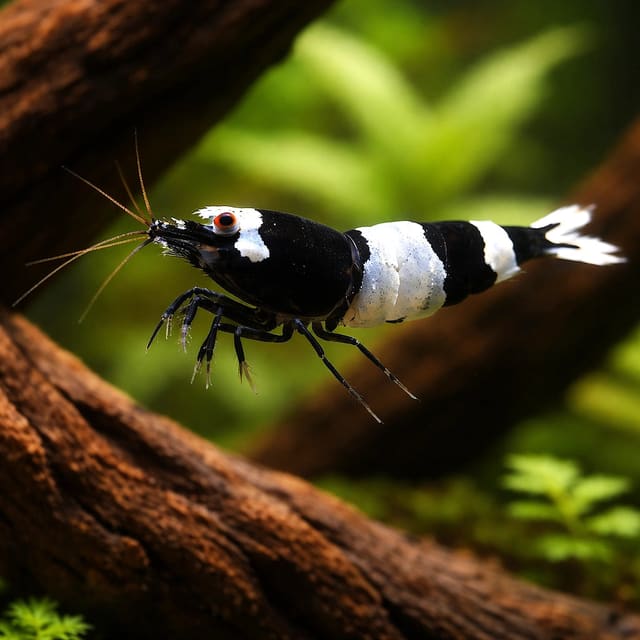
For a darker Pinto expression, compare the Black Pinto Taiwan Bee shrimp. The Red Bolt Taiwan Bee shrimp and Blue Bolt Taiwan Bee shrimp are different selectively bred lines with their own variable colour and pattern.
Related listings are comparisons, not automatic tank-mate recommendations. Mixing them can change a breeding project's genetics. Check each supplier size, current care information and image disclosure separately.
Mature females carry eggs beneath the abdomen and fan them until direct-developing shrimplets hatch. There is no free-swimming brackish larval stage. Incubation time varies with temperature, female condition and line; it should not be promised as exactly 28 days.
The supplied 1-1.3 cm shrimp is unsexed and not guaranteed mature. One shrimp cannot establish a breeding colony. A breeding group requires multiple compatible individuals and enough time for sex and maturity to become apparent.
Pinto pattern inheritance is complex and can be influenced by mixed Taiwan Bee, bee and tiger-related ancestry in some hobby lines. Without a documented pedigree, offspring should not be advertised in advance as a specific grade or pattern. Red parents can produce varied coverage and markings.
Selective breeding means choosing future breeders based on health, fertility and the keeper's pattern goal. Humane separation of off-pattern shrimp is preferable to treating healthy animals as waste. Maintain accurate records if line development matters.
Newly hatched shrimplets need mature biofilm and safe refuge immediately. Moss, leaf litter and seasoned filter surfaces provide distributed grazing. Powdered food can supplement this but can also pollute water quickly, so use minute amounts.
Protect every intake and avoid large parameter changes. Juvenile survival often reflects tank maturity and food distribution more than adult feeding response. Do not clean every surface at once or replace all filter media during a hatch period.
Shrimp shed the exoskeleton as they grow. A completed moult is influenced by mineral balance, osmoregulation, nutrition and stable water. GH that is too low can mean insufficient minerals, while abrupt mineral or TDS changes can create stress.
Leave a clean shed exoskeleton in the aquarium unless there is a specific reason to remove it; shrimp often graze it. Do not diagnose every failed moult as calcium deficiency or add minerals without tests. Check GH, TDS, recent water changes and the total system.
Normal new-arrival behaviour can include hiding and reduced feeding. Persistent loss of balance, repeated failed moults, widespread inactivity, unexplained deaths, unusual opacity or external growths require investigation. Test water first and review recent changes before adding medication.
Many fish medicines, algaecides and plant treatments can harm invertebrates. Copper is especially dangerous. Never assume a product is shrimp-safe because the aquarium dose looks small; check the active ingredient and manufacturer warning.
Do not use copper-based medication around shrimp. Prevent pesticide, aerosol, soap, hand cream, cleaning spray and untreated plant residues from entering the aquarium.
New shrimp, snails, plants, tools and water can carry planaria, hydra, scutariella-like epibionts or other unwanted organisms. A separate mature quarantine system allows observation without exposing an established colony. The quarantine water still needs to match Caridina requirements.
Do not impose a fixed two-week or four-week quarantine as a guarantee. Duration depends on the risk and what is observed. Use separate nets and siphons, and avoid transferring shop or shipping water between aquariums.
The dispatched shrimp is approximately 1-1.3 cm and therefore may have substantial growth ahead. Hobby sources commonly describe adult bee shrimp around 2-3 cm, with females often larger and deeper-bodied. Individual size varies by sex, line, nutrition and conditions.
A Taiwan fisheries review reports an approximate 18-month lifespan for bee shrimp, while hobby profiles may state longer. This supplier provides no age or lifespan guarantee, and the shrimp's age at dispatch is unknown. Husbandry can influence survival but cannot promise a fixed two-year outcome.
Caridina cantonensis remains a searchable and widely recognised hobby label, and it is the name currently associated with many Taiwan Bee products. However, ornamental bee-shrimp taxonomy and breeding ancestry are not always resolved by a retail trade name. A scientifically cautious product title should not overstate certainty that the supplier has not documented.
The support data can record the hobby synonym and taxonomy note for discoverability while the customer-facing title stays accurate: Red Pinto Taiwan Bee Shrimp, 1-1.3 cm.
Read the current live-animal delivery information before choosing a date. Someone should be available to receive the parcel and move it to a temperature-stable indoor space promptly. Weather, carrier restrictions and dispatch days can change.
If an animal arrives in difficulty, follow the evidence and timing requirements in the returns and live-arrival policy before opening or discarding packaging. For questions about your water, use the contact page before ordering and include pH, GH, KH, TDS, temperature, tank age and current livestock.
The buy box shows live price, inventory and any quantity pricing. Each unit is one unsexed shrimp. Eligible first orders can use WELCOME5 for 5% off, subject to current terms.
Browse the freshwater shrimp category for other lines, but choose according to water chemistry and experience rather than colour alone. Our shrimp-keeping guide provides broader setup context.
Trade-line history and bee-shrimp context were checked against the Taiwan Fisheries Research Institute's ornamental crystal-shrimp review. The accepted Caridina cantonensis taxon is recorded by the NCBI taxonomy browser, while the retail-line naming remains cautious because the supplier provides no genetic identification.
Water ranges were cross-checked across specialist Red Pinto and Taiwan Bee husbandry sources. They are starting envelopes, not veterinary advice or a promise that every breeder maintains the same values. Supplier facts are limited to the trade line and 1-1.3 cm dispatch size.
One unsexed live shrimp per unit selected. It is not a pair, group or colony.
Approximately 1-1.3 cm at dispatch. Adult size varies, commonly reaching roughly 2-3 cm across bee-shrimp lines.
No. The supplier gives no grade, spot count or coverage classification. Pattern and opacity vary between individuals.
No. The sole image is an illustrative aquarium view, not the dispatched shrimp or a grade reference.
That name is common hobby usage for Taiwan Bee lines, but ornamental taxonomy and mixed breeding ancestry are complex. The most certain supplied identity is Red Pinto Taiwan Bee Caridina.
A cautious starting range is 20-24 C, pH about 5.8-6.6, GH 4-6, KH 0-1 and roughly 100-150 ppm TDS. Measure the incoming water and prioritise a stable transition.
Only if its chemistry is consistently suitable and contaminants are controlled. Many keepers use remineralised RO water for predictable low-KH conditions.
An experienced keeper can maintain a stable specialist tank around that size, but larger volumes are usually more forgiving. Maturity, floor area, filtration and stability matter more than a number alone.
No fixed number of weeks proves readiness. Confirm repeated ammonia/nitrite processing, stable parameters, seasoned filtration and mature biofilm.
No fish is guaranteed safe. A species-only shrimp tank gives adults and shrimplets the best protection.
They do not normally hybridise, but their preferred water chemistry differs. A compromise aquarium may suit neither group well.
Water requirements may align, but compatible Caridina lines can cross and alter pattern genetics. Keep lines separate when preserving a breeding project.
There is no fixed schedule. In a mature tank, one juvenile may obtain much of its diet from biofilm. Supplement very lightly and remove leftovers.
They graze soft algae and biofilm but are not a solution to a major algae problem.
Incubation varies with temperature, line and female condition. Do not rely on a guaranteed 28-day period.
No. One unsexed shrimp cannot establish a colony. Multiple mature compatible shrimp are needed, with no guaranteed sex ratio.
Published bee-shrimp guidance often mentions around 18 months, but age at dispatch and individual lifespan are unknown and not guaranteed.
Follow the current returns and live-arrival policy immediately, including its timing and photo/video evidence requirements.
No reviews for this item yet. Bought one? Honest reviews only, good or bad.
What customers say about ordering from us
Easy website plenty of info on fish your buying great to pick a time slot
TRACEY DURRANT · 7 Oct 2026
Got some lovely fish thank you
Kevin Mackie · 7 Oct 2026
Reviews of our shop, collected by Judge.me, an independent third-party review collector. Newest first.