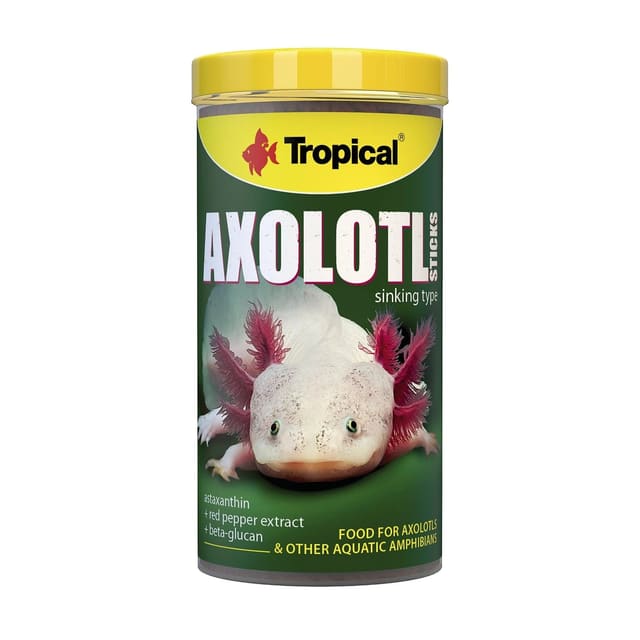
Tropical Axolotl Sticks 250ml/135g – 2mm Sinking Amphibian Food
£20.99

Sinking micro-sticks for daily feeding of dwarf shrimp and other aquatic crustaceans. A 10g resealable sachet with 6% spirulina and increased calcium; full ingredients and analysis are shown below.
Lives in groups: kept together they stay settled, active and show their best colour.
Sinking micro-sticks for daily feeding of dwarf shrimp and other aquatic crustaceans. A 10g resealable sachet with 6% spirulina and increased calcium; full ingredients and analysis are shown below.
Tropical Caridina Nano Sticks 10g are sinking micro-sticks made for the daily feeding of dwarf shrimp and other aquatic crustaceans. This is a specialist shrimp food, not a relabelled community fish pellet: the manufacturer describes a multi-ingredient formula with increased calcium, 6% Spirulina platensis and high hydrostability so the food remains accessible while small crustaceans feed.
The 10g resealable sachet is useful when you want small, observable portions rather than a large wafer. The full manufacturer composition, analytical constituents, additives and feeding direction are set out below. That matters because a food should be judged from its current label and how it performs in your aquarium, not from vague promises about colour, moulting or breeding.
Caridina Nano Sticks are a basic, multi-ingredient aquarium feed in a small sinking format. The name highlights Caridina, but Tropical's own product information describes the intended group more broadly as dwarf shrimp and other aquatic crustaceans, including marine crustaceans. That makes the product name more specific than the manufacturer's stated feeding scope.
The word "nano" describes the food format, not a minimum aquarium size. These are small sticks intended to reach the feeding zone of small crustaceans. They sink rather than remaining at the surface, allowing shrimp to approach, hold and graze the food. The manufacturer also describes the sticks as highly hydrostable. In practical terms, that is useful when you want to see where a portion lands and remove any food that is not eaten.
This is prepared animal feed. It can form the manufactured-food part of a shrimp-keeping routine, while established biofilm, algae films and other natural grazing surfaces remain important parts of a mature aquarium. No prepared food removes the need for stable water, suitable minerals, filtration and sensible stocking.
| Product fact | Verified detail | Why it matters |
|---|---|---|
| Net weight | 10g | A compact pack suited to small portions |
| Pack type | Resealable sachet | Close the original pack between feeds |
| Food form | Sinking micro-sticks | Places food where shrimp and other crustaceans can reach it |
| Feeding role | Basic food for daily feeding | Follow the label rather than treating it as an occasional treat |
| Manufacturer article | 63351 | Identifies this exact Tropical formulation and pack |
| EAN-13 | 5900469633519 | Helps distinguish the genuine 10g product |
The current official Tropical listing declares fish and fish products; molluscs and crustaceans; products of vegetable origin; algae, including Spirulina platensis at a minimum of 6%; cereals; yeasts; oils and fats; and mineral feed materials. The order is useful because it shows that this is a mixed animal-and-plant formula rather than a spirulina-only food.
| Declared ingredient group | What the label tells you |
|---|---|
| Fish and fish products | The formula contains aquatic animal material; it is not vegetarian. |
| Molluscs and crustaceans | The food contains invertebrate-derived material. |
| Products of vegetable origin | Plant-derived ingredients form part of the mixed recipe. |
| Algae | Includes Spirulina platensis at a declared minimum of 6%. |
| Cereals | Cereal ingredients are present and should not be omitted from ingredient summaries. |
| Yeasts | Yeast ingredients are part of the manufacturer declaration. |
| Oils and fats | Contribute to the declared 5.6% crude oils and fats. |
| Mineral feed materials | Consistent with the manufacturer's increased-calcium positioning. |
This product contains fish, mollusc/crustacean and cereal ingredients. It is feed for ornamental aquatic animals and is not for human consumption. Formulas can change, so the ingredient panel printed on the sachet you receive takes priority over any online description.
Guaranteed analysis is a declaration of the product's composition by weight; it is not a promise that every shrimp will consume the same amount. The current official listing gives the following values.
| Analytical constituent | Declared amount | How to read it |
|---|---|---|
| Crude protein | 34.5% | The measured protein fraction of the dry food |
| Crude oils and fats | 5.6% | The measured lipid fraction |
| Crude fibre | 2.3% | The declared fibre fraction |
| Moisture | 10.0% | The declared water content of the packaged food |
These figures are more useful than broad phrases such as "rich" or "premium" because they allow a direct comparison with another feed's label. They do not, on their own, establish the perfect diet for every species or aquarium. Colony density, natural grazing, water chemistry, life stage and the amount actually eaten all affect how a prepared food fits into husbandry.
Tropical's current official shop specification also lists nutritional additives per kilogram of food. The values below are label-level concentrations, not a recommended dose for an individual shrimp.
| Vitamin additive | Declared amount per kg |
|---|---|
| Vitamin A | 36,000 IU |
| Vitamin D3 | 2,200 IU |
| Vitamin E | 135 mg |
| Vitamin C | 280 mg |
| Trace element | Declared amount per kg |
|---|---|
| Iron | 40.0 mg |
| Zinc | 11.2 mg |
| Manganese | 8.4 mg |
| Copper | 2.0 mg |
| Iodine | 0.24 mg |
| Selenium | 0.24 mg |
| Molybdenum | 0.05 mg |
| Cobalt | 0.013 mg |
The presence of copper on an invertebrate-food label can surprise shrimp keepers. Trace elements are not the same as adding an uncontrolled aquarium medication or copper treatment. The manufacturer declares 2.0 mg/kg in the food. Use the product only as directed, avoid excessive feeding and never infer a water-column copper concentration from a feed-label value.
The manufacturer's direction is clear: feed several times daily in small portions that the animals consume within 2-3 minutes. This is much shorter than leaving a large meal in the aquarium for hours. Start with a genuinely small amount, watch the full feeding response, and only increase a later portion if the previous one was consumed promptly.
A colony of the same headcount can have very different needs depending on animal size, juvenile numbers, tank maturity, biofilm, competing tank mates and how much food is already present. Observation against the manufacturer's 2-3 minute direction is more reliable than a made-up dose.
| What you observe | What it may mean | Practical response |
|---|---|---|
| Food remains after the feeding window | The portion was too large, animals were not ready to feed, or access was poor | Remove leftovers and reduce the next portion |
| Only dominant animals reach the food | One feeding point is creating competition | Split the same small total amount across more than one visible spot |
| Fish take the food first | The shrimp are being outcompeted | Target a sheltered shrimp area or feed when fish activity is lower |
| Food disappears immediately | The portion was accepted, but this alone does not prove the colony needs much more | Hold the routine steady before making a small adjustment |
| Mulm or uneaten fragments accumulate | Feeding and maintenance are out of balance | Reduce food, clean the feeding area and check water quality |
Tropical specifies dwarf shrimp and other aquatic crustaceans, including marine crustaceans. Crystal-type Caridina fit that description directly. Neocaridina are also dwarf freshwater shrimp, so the manufacturer's broad intended group reasonably includes them even though the product name says Caridina. That is an inference from the stated animal group, not a claim that every species or individual will respond identically.
For larger crustaceans, the micro-stick format may be less convenient than a larger food even when the ingredient profile is suitable. For mixed tanks, the main question is access: active fish, snails or larger invertebrates may reach the portion before small shrimp. A feeding dish or more than one sheltered feeding point can make uptake easier to observe.
Do not use a product name as a substitute for species-specific husbandry. Freshwater Caridina, Neocaridina and marine crustaceans can require very different salinity, hardness, temperature and aquarium conditions. The food's stated scope does not make their environmental requirements interchangeable.
Food format changes where a feed goes and how easily you can monitor it. A sinking micro-stick reaches substrate-level feeders without first floating around the aquarium. The small pieces can be distributed between feeding points, while the manufacturer's high-hydrostability description means the sticks are intended to hold together in water during the short feeding window.
Hydrostability should not be read as permission to leave uneaten food indefinitely. Even a stable feed adds organic material to the system. The practical advantage is visibility and control: you can see the portion, see the animals feeding and remove what is not consumed.
| Food format | Useful when | Main control point |
|---|---|---|
| Micro-sticks | You want a sinking, visible portion for small crustaceans | Still easy to overfeed if several pieces are added repeatedly |
| Larger wafer | A larger colony can gather around one feeding item | One wafer may exceed the needs of a small colony |
| Fine powder | Very small juveniles need dispersed particles | Harder to see and remove once distributed |
| Flake | Surface or mid-water feeders are the target | May be taken by fish before it reaches shrimp |
No format is automatically clean or dirty. Water impact depends on the amount offered, what is consumed, how quickly leftovers are removed and how well the aquarium processes waste. The micro-stick format simply makes measured, localised feeding easier than an invisible or widely dispersed feed.
Tropical positions this formula as having increased calcium and states that it supports shell formation and moulting. That is a manufacturer product claim, not a guarantee that a feeding change will solve moulting problems. Crustaceans also depend on suitable water chemistry, mineral availability, stable conditions and freedom from acute stress.
If moulting failures occur, review the whole system rather than adding more food. Check species-appropriate hardness and other water parameters, confirm temperature stability, look for abrupt changes, and consider whether the aquarium has accumulated excess organic waste. Feeding extra sticks to chase a calcium claim can worsen water quality and work against the outcome you want.
The label-level calcium positioning is still useful when comparing feeds. It tells you the intended role of this product and distinguishes it from a generic fish flake. It does not provide a measured aquarium calcium dose, and the food should never be used to correct water chemistry.
The formula contains a declared minimum of 6% Spirulina platensis. Tropical associates the formulation with colour, condition and health benefits. Those statements should be understood as manufacturer claims about the food's intended nutritional role. Genetics, maturity, background colour, lighting, stress, water quality and the rest of the diet all influence visible shrimp colour.
No genuine aquarium food can guarantee a particular red, black, blue or white pattern. Use colour as one observation among many, not as the only test of a diet. Normal activity, consistent feeding, successful moults and stable water measurements provide a broader picture of husbandry.
Shrimp spend much of the day grazing biofilm and fine material from plants, wood, leaves, rock and filter surfaces. Prepared food is easier to manage when those natural grazing areas are already established. A new or over-cleaned tank can have far less background food than an old planted aquarium, while a mature tank may need surprisingly little prepared feed.
This is why another keeper's schedule may not suit your colony. Follow the product direction, but make each portion responsive to the aquarium in front of you. If food is not eaten promptly, the correct response is less food, not a stronger sales claim about how often shrimp "must" be fed.
For a broader overview of cycling, biofilm, water stability and moulting, read our shrimp-keeping care guide. You can also browse the freshwater shrimp collection and husbandry hub before matching a feed to the animals you keep.
Uneaten feed is organic waste. As it breaks down, it adds to the biological load and can contribute to ammonia or nitrite risk in an immature or unstable system. In a small aquarium, a portion that looks insignificant can still be large relative to the water volume and colony biomass.
Use a feeding dish if it helps you see and remove leftovers, but remember that the dish does not prevent dissolved material entering the water. Siphon accumulated debris, maintain the filter without destroying all biological media at once, and test water when animal behaviour changes. A sudden drop in feeding response is a reason to investigate, not a reason to add more food.
If shrimp become inactive, gather unusually at the surface or filter outlet, or stop feeding, remove uneaten food and check temperature, oxygenation, ammonia and nitrite. A product description cannot diagnose an aquarium emergency.
A breeding tank can contain adults, berried females and tiny juveniles with very different access to a single feeding point. Micro-sticks are easy to split between visible areas, but they are not the same as a specialised fine juvenile feed. Observe whether the smallest animals can physically reach food particles and continue to protect natural grazing surfaces.
There is no verified evidence for the old claim that a particular number of these sticks guarantees better breeding performance. Reproduction depends on mature animals, suitable sex ratios, species-appropriate water, low stress and stable nutrition over time. Use the food as labelled and judge it by uptake and system stability.
For berried females, consistency is usually safer than sudden heavy feeding. Do not make large diet or water-chemistry changes simply because eggs are visible. If you add an additional food to the rotation, change one thing at a time so you can see how the colony and water respond.
Small fish and snails may also investigate sinking food. That does not turn Caridina Nano Sticks into a general fish food, and it does not prove the shrimp received their share. In a community aquarium, place the portion close to shrimp cover, divide it across more than one spot, or feed when competing animals are less active.
Watch the full 2-3 minute feeding window. If fish remove every piece immediately, adding a larger pile can simply feed the fish more. A sheltered dish, narrow feeding tube or hardscape opening may provide better access without increasing the total amount.
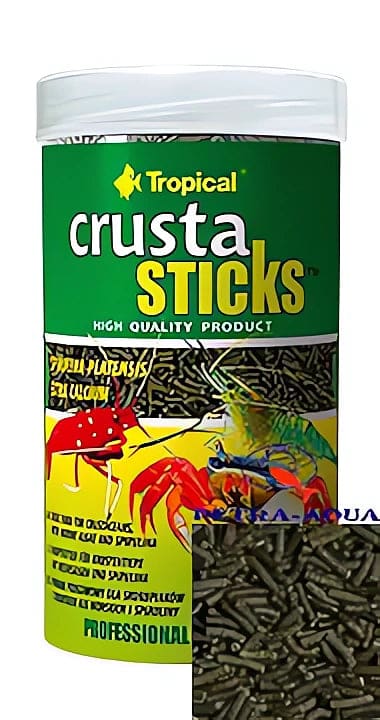
If you need a physically larger companion format for bigger crustaceans, compare the current label and pack size of Tropical Crusta Sticks. It is a separate product and should not be treated as an identical substitute. The Tropical dried-food category lets you compare available formats.
Start with observable criteria rather than marketing language. Do the intended animals reach it? Is the portion eaten within the manufacturer's time window? Can you remove leftovers? Does the aquarium remain stable? A food that works well in one system may need a different portion or feeding point in another.
| Check | Useful sign | Reason to adjust or investigate |
|---|---|---|
| Access | Dwarf shrimp can reach the sticks without being excluded | Fish or larger animals take every piece |
| Uptake | The small portion is consumed within 2-3 minutes | Food remains or is repeatedly ignored |
| Water | Ammonia and nitrite remain at zero in a cycled freshwater system | Waste rises, odour changes or animals show distress |
| Routine | Portions are repeatable and easy to observe | Food is added by habit without checking leftovers |
| Condition | Animals remain active with normal species-appropriate behaviour | Sudden inactivity, failed feeding response or recurrent moulting problems |
The supplied pack is a 10g zip sachet. Close it after use and keep the original label available so you retain the batch, best-before, ingredient and manufacturer information. Follow any storage direction printed on the pack you receive; we do not invent a temperature or shelf-life that the verified online specification does not state.
Keep all aquarium feeds away from children and human food. Avoid transferring the sticks into an unlabelled container. If the seal is damaged, the contents are damp, or the appearance or smell is unexpectedly different, do not feed the product until you have checked it.
The content is based on Tropical's current manufacturer product sheet and official shop specification, with practical husbandry boundaries clearly separated from manufacturer claims.
You can review the official Tropical product sheet and the official Tropical shop specification. The printed sachet remains the final authority if a later batch or formulation differs.
The current listing is for one 10g sachet. Price and stock are shown live in the buy box. New customers can use WELCOME10 for 10% off their first order, subject to the current checkout terms. Delivery options and the final order total are shown at checkout; live-animal arrival cover does not apply to this dry food.
No reviews for this item yet. Bought one? Honest reviews only, good or bad.
What customers say about ordering from us
I have a small group of long finned mountain minnows. So was delighted to be able to order ten of this variety to increase the genetics in my tank . The ones I recieved are healthy but it’s to early to give a verdict on wether they are of a long finned type since they are small currently.
Gordon Walker · 23 Sept 2026
100% success travel and "installation". Pleased with quality of purchase. The Siamese fighter a bit "shy" so have not yet seen him at his best yet but looking good. Happy customer. GG
George E Garratt · 21 Sept 2026
Reviews of our shop, collected by Judge.me, an independent third-party review collector. Newest first.