Moderate
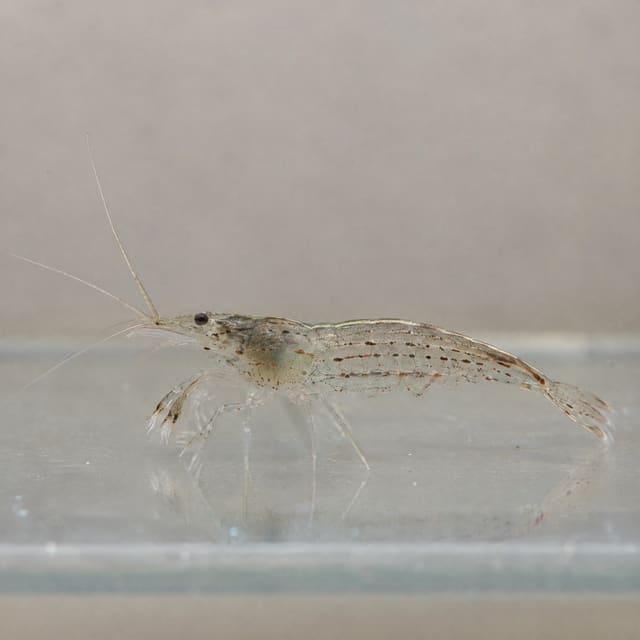
Amano Shrimp (Caridina multidentata)
From £3.49Some sizes on sale
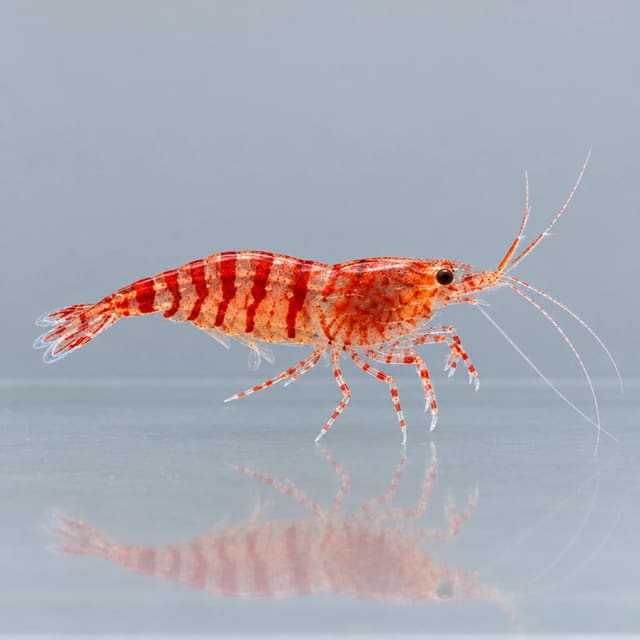
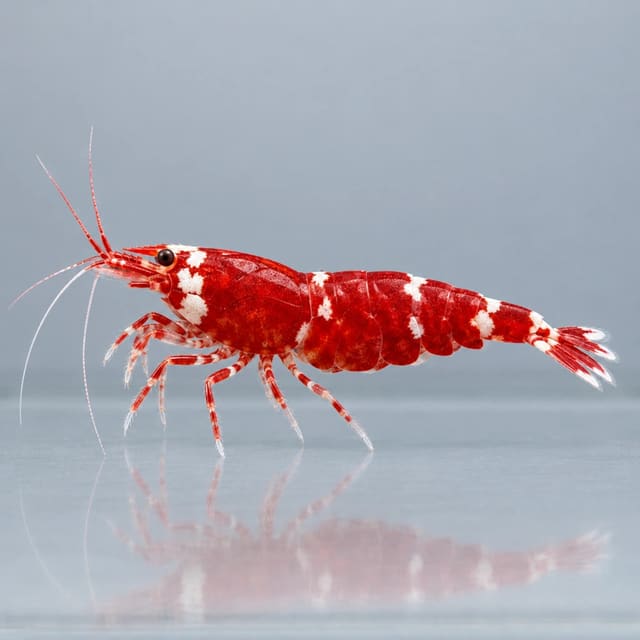
The Red Zebra Stardust Shrimp is a line-bred Caridina with a deep red body covered in fine white speckles and faint zebra banding. It needs a mature, soil-based tank of soft, acidic water held steady at 22–24°C, GH 4–6, KH 0–1 and TDS 100–150. Sold individually as one live shrimp.
Adult size is the maximum length this species reaches at full maturity (scientific sources). The livestock you receive will be younger and smaller. Product-photo provenance and any image-specific limitations are stated on the listing.
Caridina sp.
Choose a quantity for your aquarium. Discount thresholds are pricing offers, not a stocking recommendation.
The Red Zebra Stardust Shrimp is a line-bred Caridina with a deep red body covered in fine white speckles and faint zebra banding. It needs a mature, soil-based tank of soft, acidic water held steady at 22–24°C, GH 4–6, KH 0–1 and TDS 100–150. Sold individually as one live shrimp.
Adult size is the maximum length this species reaches at full maturity (scientific sources). The livestock you receive will be younger and smaller. Product-photo provenance and any image-specific limitations are stated on the listing.
Read the full care guidance when planning conditions for your aquarium.
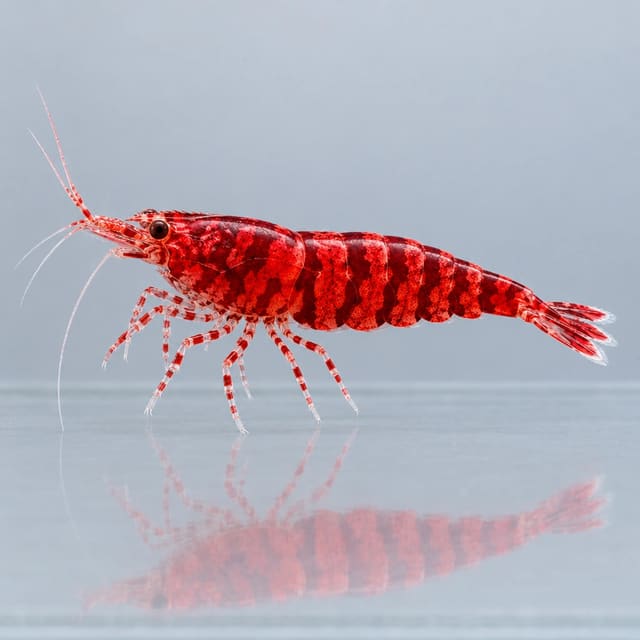
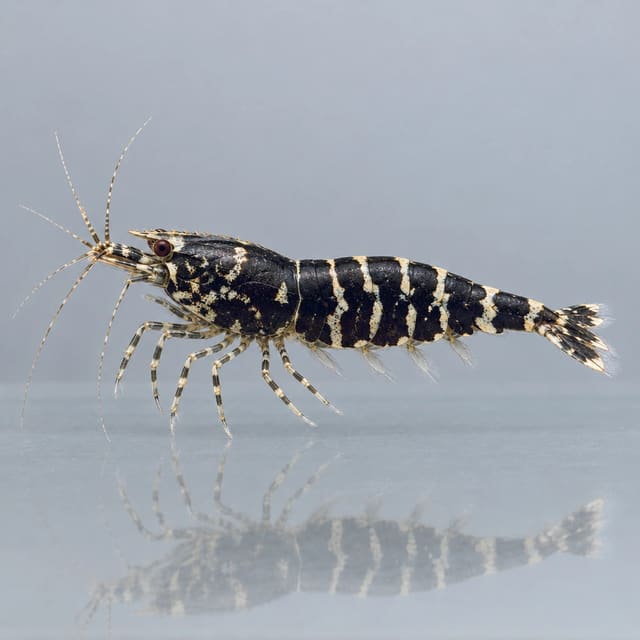
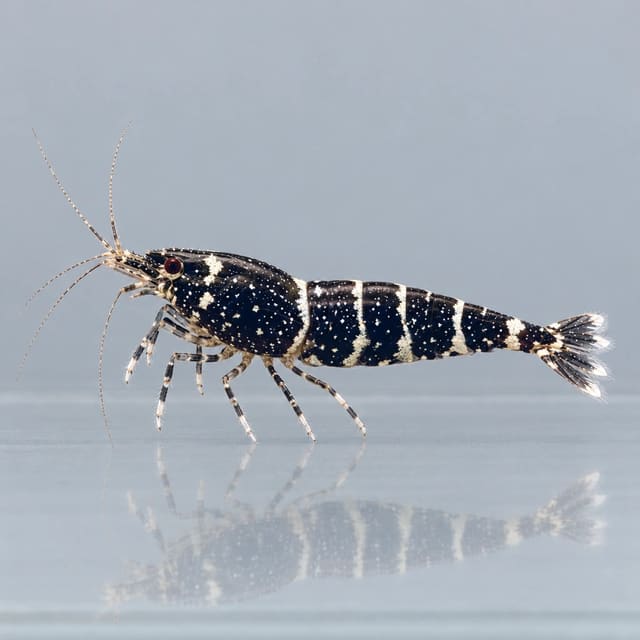
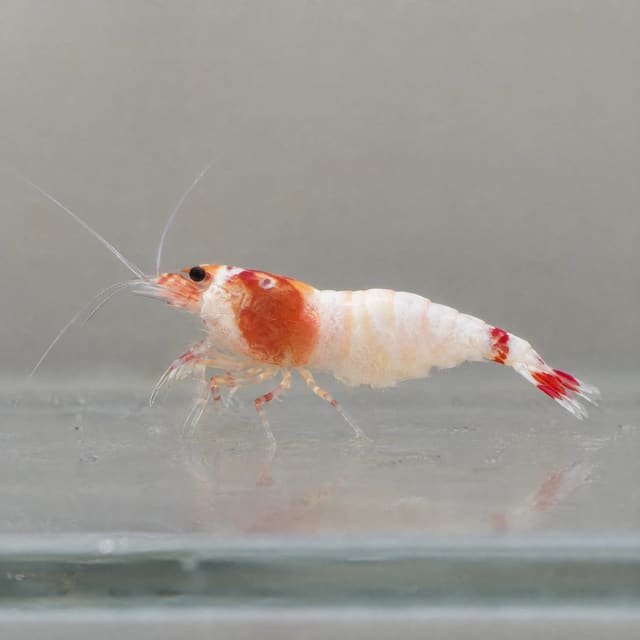
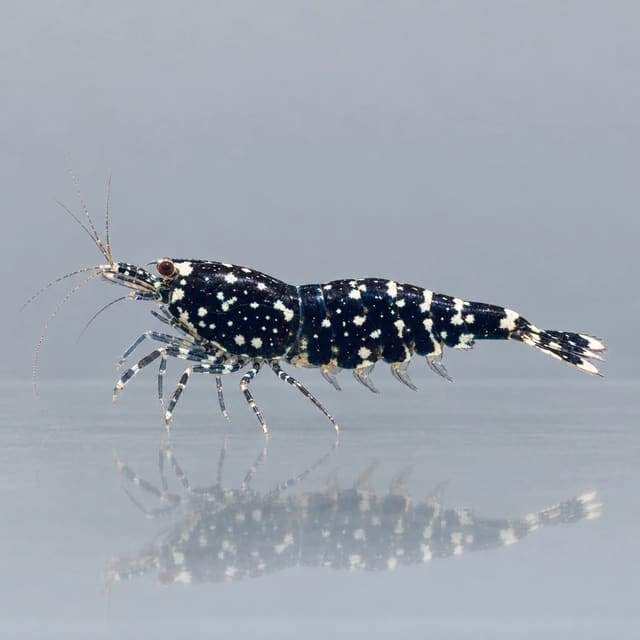
The Red Zebra Stardust Shrimp is a line-bred dwarf Caridina shrimp with a deep red body dusted all over with tiny white speckles. The speckling runs from the head to the tail like a scatter of stars, which gives the line its “stardust” name, and faint paler bands at the joints of the body segments supply the “zebra”. The legs and antennae are banded red and white, the tail fan is edged in white, and the eyes are dark. Up close it is one of the most intricate patterns in freshwater shrimp.
It belongs to the family Atyidae and to the soft-water group of Caridina that includes the crystal red, Taiwan bee and tiger shrimp. Speckled lines like this one are bred from crosses within that group, and the exact parentage of the Red Zebra Stardust has not been published, so we sell it as Caridina sp. What matters for care is the group it comes from: these shrimp need soft, acidic, very stable water, and they are not a first shrimp for a new keeper.
| Suits | Not suited to |
|---|---|
| A mature shrimp tank of 20 litres or more, set up on buffering soil | A newly set-up tank, or one on plain gravel with hard water |
| Keepers who can supply soft water, usually remineralised reverse osmosis water | Untreated hard tap water |
| A shrimp-only tank, or one shared with Neocaridina and snails | Any fish, which will take young shrimp |
| A group of five or more of the same line | Mixing with crystal red, Taiwan bee or tiger shrimp if you want the pattern to stay |
| A keeper who tests TDS, GH and pH regularly | Large or sudden changes in water chemistry |
Browse our wider range of shrimps and crustaceans, the freshwater shrimp category or the Caridina shrimp range to compare lines.
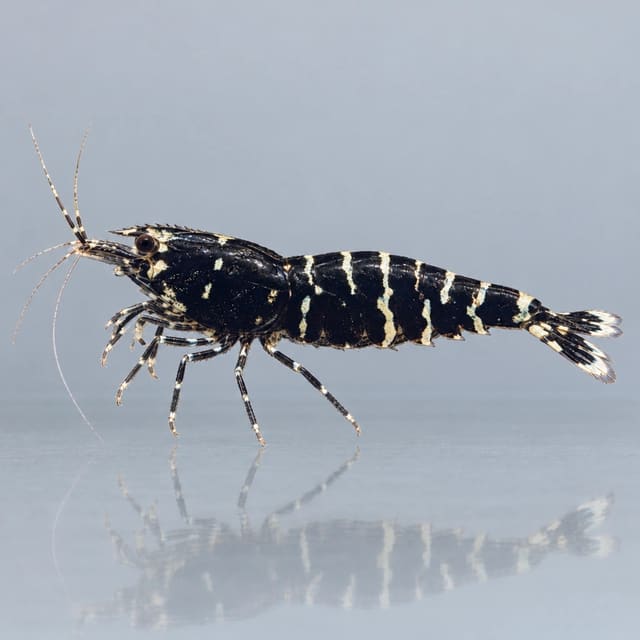
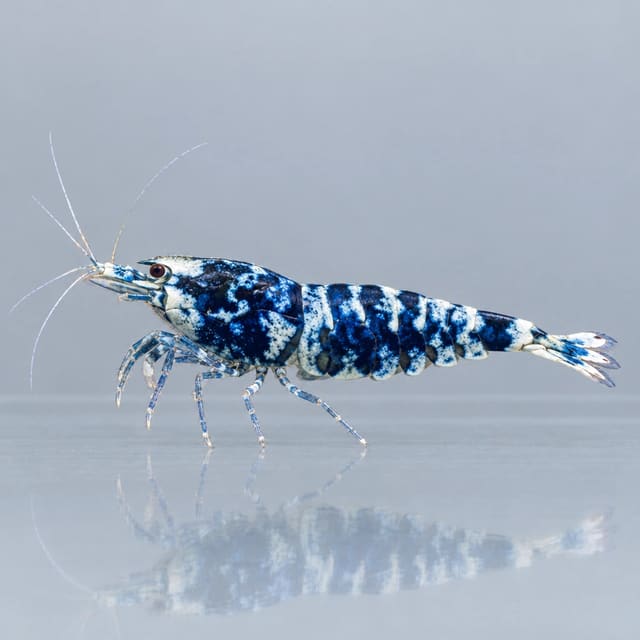
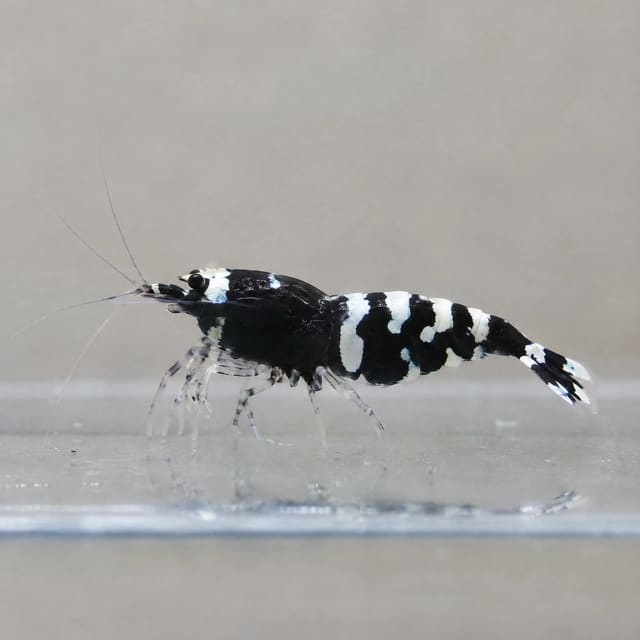
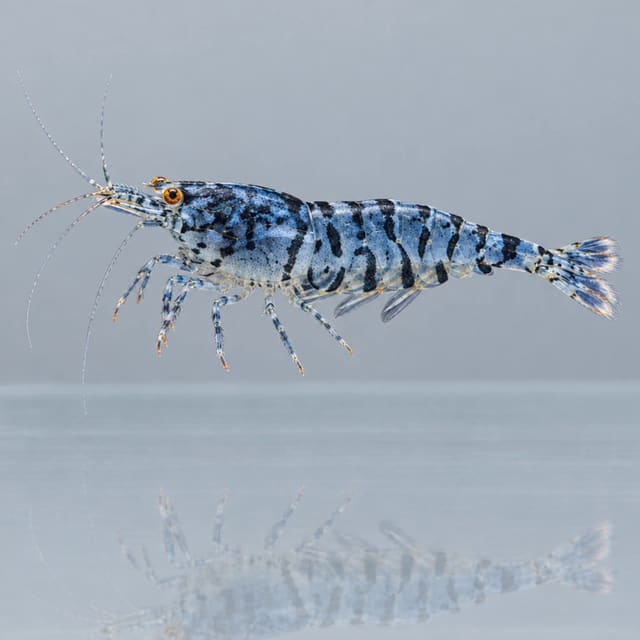
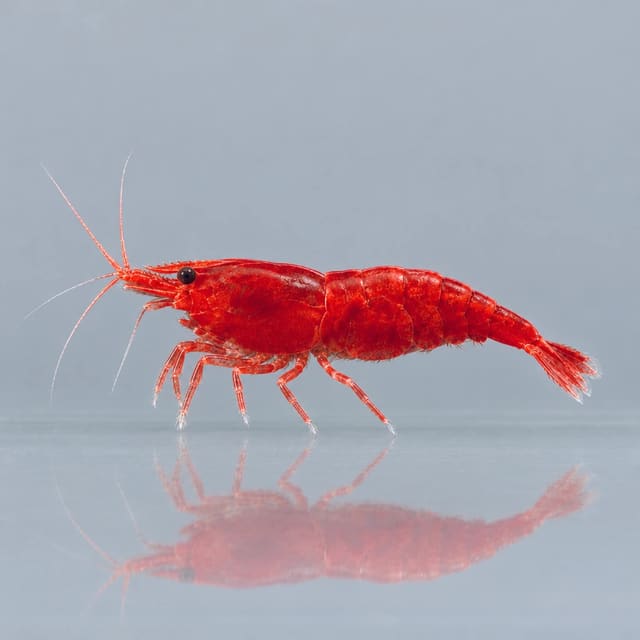
One purchase quantity supplies one live Red Zebra Stardust Shrimp. The only option is “Standard”: the line is not graded into sizes, so shrimp are sent at the size available on the day, usually young adults. Sex is not specified. The photographs show the colour line, not the individual shrimp; the density of the speckles and the depth of the red vary from shrimp to shrimp, and young shrimp usually colour up as they mature.
Please read our delivery and live arrival information before ordering, and have the tank cycled, tested and stable before the shrimp arrive.
Bee and tiger shrimp were long treated in the hobby as forms of one species. A 2014 revision by Klotz and von Rintelen, summarised by Seriously Fish, found that ornamental bee strains such as crystal red, King Kong and blue bolt all group genetically with Caridina cantonensis, and described the tiger shrimp as a separate species, Caridina mariae. The authors added that hybridisation between captive lines cannot be ruled out.
Many of the most patterned modern lines come from Taiwan. Writing in Practical Fishkeeping, Chris Lukhaup traced the Taiwan colour forms to a spontaneous mutation in a Taiwanese breeder’s tanks. The Shrimp Farm describes “galaxy” shrimp, the best-documented speckled lines, as the result of selective breeding of Taiwan bee and tiger shrimp, with white mottling on a coloured body and star-like spots on the cheeks. “Stardust” and “zebra” are trade names rather than formal standards, so expect some variation in how breeders apply them.
| Name | What it usually describes |
|---|---|
| Bee shrimp, crystal red | Red-and-white or black-and-white banded Caridina cantonensis lines |
| Taiwan bee | Solid or banded lines from Taiwan, such as King Kong, Panda and Red Wine |
| Tiger shrimp | Caridina mariae and its striped colour lines |
| Galaxy | Speckled lines from bee × tiger crosses, with star-like cheek spots |
| Stardust | A trade name for fine white speckling over a coloured body |
| Zebra | Banding across the body segments |
OATA gives 10 litres as the minimum for a small group of shrimp, but soft-water lines need more stability than that. Gensou’s Taiwan bee guide sets 20 litres as the minimum and notes that 40–60 litres holds its chemistry more steadily, and Practical Fishkeeping reports that the Taiwanese breeding tanks Lukhaup visited were none smaller than 80 litres. A filter is essential, and a lid stops shrimp jumping out.
Use an active, buffering aquarium soil 3–5 cm deep, as Gensou recommends: it pulls the pH down and keeps the water soft, which plain gravel cannot do. Cycle the tank fully before any shrimp go in. Gensou advises at least six weeks, ideally eight, and adding shrimp only after ammonia and nitrite have read zero for two weeks in a row. Our guide to the aquarium nitrogen cycle explains what is happening during that time.
| Zone | What it gives the shrimp |
|---|---|
| Moss on wood or stone | Biofilm to graze and cover for young shrimp |
| Open soil at the front | A feeding spot where you can count the group and lift out leftovers |
| Dried leaves, such as Indian almond leaves | A slow, steady surface for biofilm, as The Shrimp Farm suggests |
| A sponge filter or a sponge-covered intake | Gentle flow that young shrimp cannot be drawn into |
| A secure lid | No escapes, and less evaporation to concentrate the water |
The red and white of the Red Zebra Stardust Shrimp shows best over dark soil with bright green moss behind it.
Sources agree that this group needs soft, acidic water, although their exact numbers differ. The Shrimp Farm gives pH 5.5–6.8, 20–24°C, GH 3–6, KH 0–1 and TDS 80–150 for galaxy shrimp. Gensou gives 22–25°C, pH 5.4–6.2, GH 4–6, KH 0–1 and TDS 100–150 ppm for Taiwan bees. Practical Fishkeeping reports Taiwanese breeders working at about 200 µS/cm and pH 6.4–6.9, at 22–24°C for breeding. OATA’s much broader planning range for all freshwater shrimp (17–27°C, pH 6.5–8.0, 4–18 dGH) covers hardier species too; for a bee-type line, follow the specialist values.
Tap water across the UK ranges from soft to very hard, and most of it is harder than these shrimp want. Test yours, and compare it with the targets using our water matcher. If GH or KH is above range, do what most keepers do: use reverse osmosis water and remineralise it with a shrimp mineral that raises GH without adding KH. Top up evaporation with plain reverse osmosis water, because evaporation leaves the minerals behind and pushes TDS up.
| Reading | Aim for | What the sources say |
|---|---|---|
| Temperature | 22–24°C, steady | The Shrimp Farm 20–24°C; Gensou 22–25°C; Practical Fishkeeping 22–24°C for breeding |
| pH | Below 7, held steady | Gensou 5.4–6.2; The Shrimp Farm 5.5–6.8; Practical Fishkeeping 6.4–6.9 |
| General hardness | 4–6 dGH | Gensou 4–6; The Shrimp Farm 3–6 |
| Carbonate hardness | 0–1 dKH | Gensou and The Shrimp Farm |
| TDS | 100–150 ppm | Gensou 100–150; The Shrimp Farm 80–150 |
| Ammonia and nitrite | Zero mg/l | OATA |
| Nitrate | No more than 20 mg/l above your source water | OATA |
| Copper | None | OATA: invertebrates are very sensitive to copper |
Wikipedia notes that Caridina cantonensis shows its strongest colours at 24–25°C and that high temperatures increase the death rate of young and adults and reduce egg survival, so avoid letting the tank overheat in summer. Our water chemistry guide explains GH, KH and TDS testing.
These shrimp graze biofilm, algae and decaying plant matter all day; Wikipedia describes the bee shrimp species as a scavenger of small pieces of decayed vegetation and algae. Extra food is a supplement, not the main source. Feeding advice varies: OATA suggests two or three feeds a week, left for at least 30 minutes, Gensou also suggests two or three times a week, and The Shrimp Farm suggests one or two pieces of shrimp food a day with leftovers removed within a few hours. In a soil tank, overfeeding fouls the water quickly, so start at the lower end.
Soft-water shrimp react badly to sudden changes in mineral content. OATA’s floating-bag method sets the minimum: switch off the light, float the sealed bag for 10 minutes, then add small amounts of tank water over at least 30 minutes before releasing the shrimp with as little bag water as possible. Gensou goes further for Taiwan bees and recommends a drip acclimatisation of at least two hours, until the TDS in the container is within 10 ppm of the tank.
| When | What to do |
|---|---|
| Before arrival | Test ammonia, nitrite, nitrate, pH, GH, KH and TDS; confirm a steady temperature |
| Day one | Keep the light low and do not feed; a mature tank has biofilm |
| Days two to seven | Offer a very small portion and check it is found |
| Every day | Count the shrimp you can see and note any lying still |
| End of the week | Retest everything and do the first small water change |
OATA recommends weekly testing and a 25% water change at least once a week, using conditioned water and rinsing filter media in removed tank water rather than under the tap. For a soft-water line the replacement water must match the tank’s temperature, GH and TDS before it goes in; Gensou notes that sudden losses of several shrimp at once usually point to a shift in water parameters.
Shrimp grow by moulting, and a shed skin that looks like a dead shrimp is normal, OATA notes. Gensou describes a “white ring” across the back as a sign of a moult going wrong, often from low GH or a mineral imbalance. OATA lists the other changes that point to a problem.
| If you see | Do this |
|---|---|
| A white band across the back, or a shrimp stuck in its old shell | Check GH and TDS against the targets; correct slowly |
| Several shrimp lost within a day or two | Test pH, TDS, ammonia and nitrite at once; think about anything new in the tank |
| Shrimp restless and swimming hard around the tank | Test the water and check the temperature |
| Colour much paler than usual | Compare readings with last week’s and check for stress from tank mates |
| White spots, lesions or lost legs | Test the water and ask us before using any treatment |
| A female dropping her eggs | Look for stress: water changes that were too large, heat or disturbance |
Like all bee and tiger shrimp, the Red Zebra Stardust breeds in fresh water with no larval stage. Females carry their eggs under the abdomen and fan them with their swimming legs, and the young hatch as tiny copies of the adults. Wikipedia gives 28 days to hatching at 22°C for Caridina cantonensis; Gensou gives 15–30 eggs carried for about 28–30 days, with young around 2 mm long that feed on biofilm straight away. The Shrimp Farm notes that galaxy-type shrimp breed more slowly than cherry shrimp and that berried females are hard to spot.
Expect a life of around a year and a half to two years: Wikipedia gives about 18 months for the bee shrimp species, and OATA says shrimp live a couple of years in a well-matured tank.
OATA’s rule is not to keep shrimp with fish that can fit them in their mouth or with predatory species. The Shrimp Farm goes further and advises against fish altogether for galaxy shrimp, and warns that ramshorn snails may struggle in soft, acidic water. It also notes that Neocaridina can share the tank, because they belong to a different genus and do not interbreed with Caridina.
| Usually suits | Avoid or think twice |
|---|---|
| More Red Zebra Stardust Shrimp of the same line | Crystal red, Taiwan bee and tiger shrimp, which interbreed with it |
| Neocaridina shrimp, if their water needs can be met | Any fish, which will take young shrimp |
| A shrimp-only planted tank | Snails that need hard water |
| Moss, almond leaves and biofilm surfaces | Copper-based medicines and fertilisers |
If you like patterned soft-water shrimp, compare the Fancy Tiger Pinto Shrimp, another bee × tiger line, with the Red Pinto Taiwan Bee Shrimp, the deep red Red Wine Taiwan Bee Shrimp and the classic Crystal Red Bee Shrimp. Each needs the same soft water, but keep each line in its own tank if you want it to breed true. Our shrimp-keeping guide and freshwater shrimp UK guide cover the wider choice.
OATA reminds keepers that releasing aquarium animals or plants into the wild harms both the animals and native habitats. Dispose of old soil, plants and water through household waste or the drain, never into ponds, streams or gardens.
A line-bred dwarf Caridina shrimp with a deep red body covered in fine white speckles, the “stardust”, plus faint banding. It belongs to the soft-water bee and tiger shrimp group; its exact parentage is not published, so it is sold as Caridina sp.
One live shrimp of the Standard option, sex not specified. Order at least five to start a group, as OATA recommends for freshwater shrimp.
Not as a first shrimp. It needs soft, acidic water held steady, which usually means reverse osmosis water and a buffering soil. Start with cherry shrimp if you are new to shrimp keeping.
Soft, acidic water: GH 4–6, KH 0–1, TDS 100–150 ppm and pH below 7, at 22–24°C. Specialist sources give pH figures between 5.4 and 6.9, so keep your tank steady wherever it settles in that band.
Only if your tap water tests within the values above, which is uncommon. Most keepers use reverse osmosis water remineralised with a shrimp mineral that raises GH but not KH.
Biofilm and algae in a mature tank, plus a small amount of shrimp food. Sources range from two or three feeds a week to a small feed daily; give only what the group clears within a few hours and lift out the rest.
It will interbreed with other bee and tiger shrimp, and the young will be a mix of patterns. Keep it on its own, or with Neocaridina shrimp, which belong to a different genus and do not cross with it.
Yes, in a mature, stable tank. Females carry their eggs for about four weeks and the young hatch as tiny, fully formed shrimp. Patterns vary among the young, so select the best for the next generation.
No reviews for this item yet. Bought one? Honest reviews only, good or bad.
What customers say about ordering from us
Easy website plenty of info on fish your buying great to pick a time slot
TRACEY DURRANT · 7 Oct 2026
Got some lovely fish thank you
Kevin Mackie · 7 Oct 2026
Reviews of our shop, collected by Judge.me, an independent third-party review collector. Newest first.
Moved by UK carriers licensed to handle live animals
Hand-packed with oxygen bags, poly box, heat pack
Email photos the same day; an optional unboxing video helps us review problems faster — claim terms apply
Klarna & PayPal Pay in 3 at checkout