Moderate
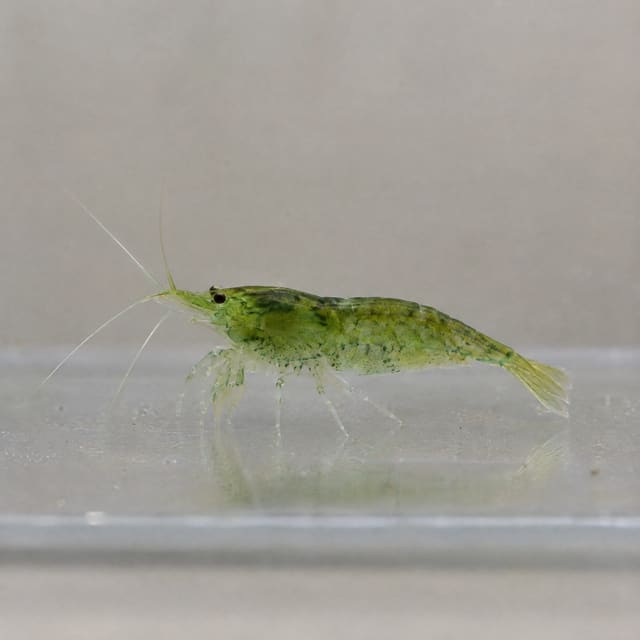
Green Jade Shrimp (Neocaridina davidi)
17–27°C · pH 6.5–8
£5.99
The Blood Red Shrimp is a deep, dark crimson line of Neocaridina davidi, the cherry shrimp. Keep six or more in a mature, planted tank of 20 litres or more at 21–26°C and pH 6.5–8.0, with low nitrate, no copper and no other cherry colours. Sold singly as one live shrimp.
Adult size is the maximum length this species reaches at full maturity (scientific sources). The livestock you receive will be younger and smaller. Product-photo provenance and any image-specific limitations are stated on the listing.
Neocaridina davidi
Choose a quantity for your aquarium. Discount thresholds are pricing offers, not a stocking recommendation.
The Blood Red Shrimp is a deep, dark crimson line of Neocaridina davidi, the cherry shrimp. Keep six or more in a mature, planted tank of 20 litres or more at 21–26°C and pH 6.5–8.0, with low nitrate, no copper and no other cherry colours. Sold singly as one live shrimp.
Adult size is the maximum length this species reaches at full maturity (scientific sources). The livestock you receive will be younger and smaller. Product-photo provenance and any image-specific limitations are stated on the listing.
Use a mature, filtered aquarium and measured water—not a shrimp-per-litre rule. Tropical Fish Co uses 20 litres as a cautious starting policy for a small Cherry Shrimp group, above OATA's general 10-litre screen for small shrimp. Provide established grazing surfaces, cover and a protected filter inlet. No fish is guaranteed shrimplet-safe, and breeding should never be promised.
Read the full care guidance when planning conditions for your aquarium.
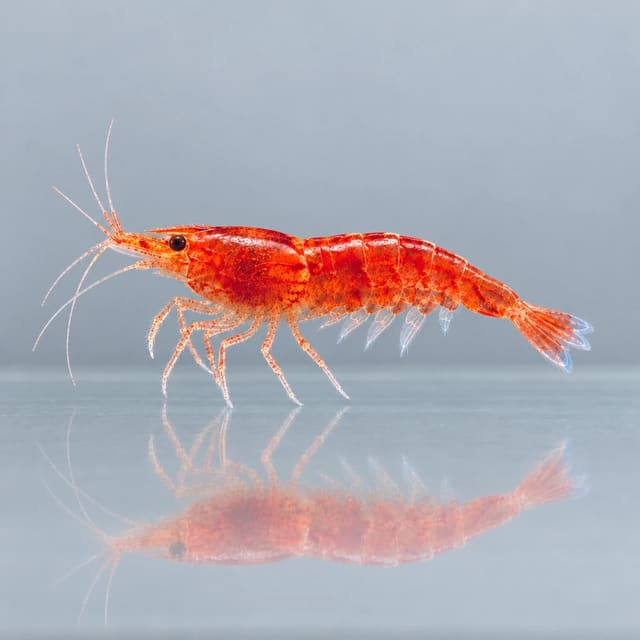
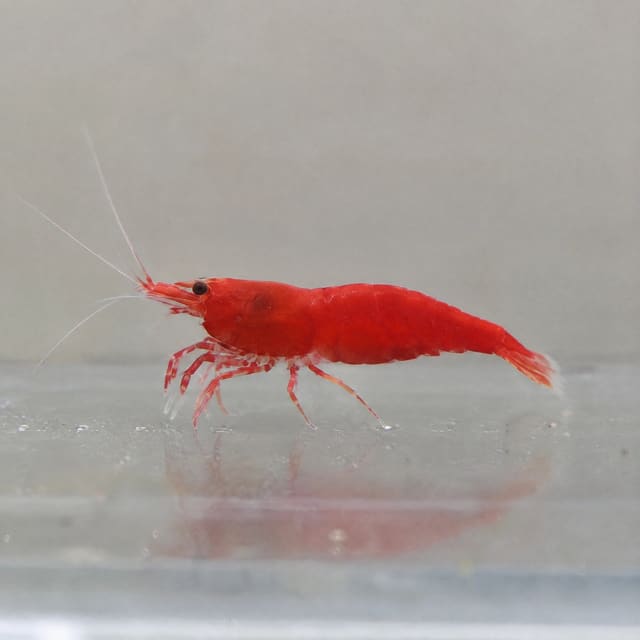
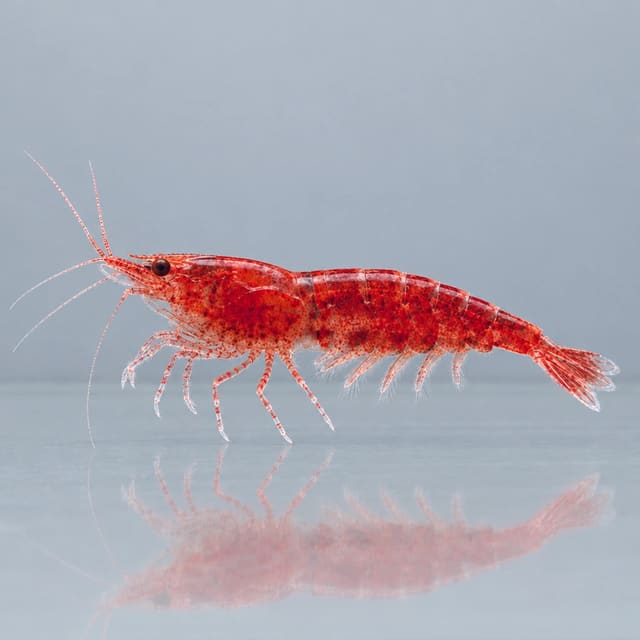
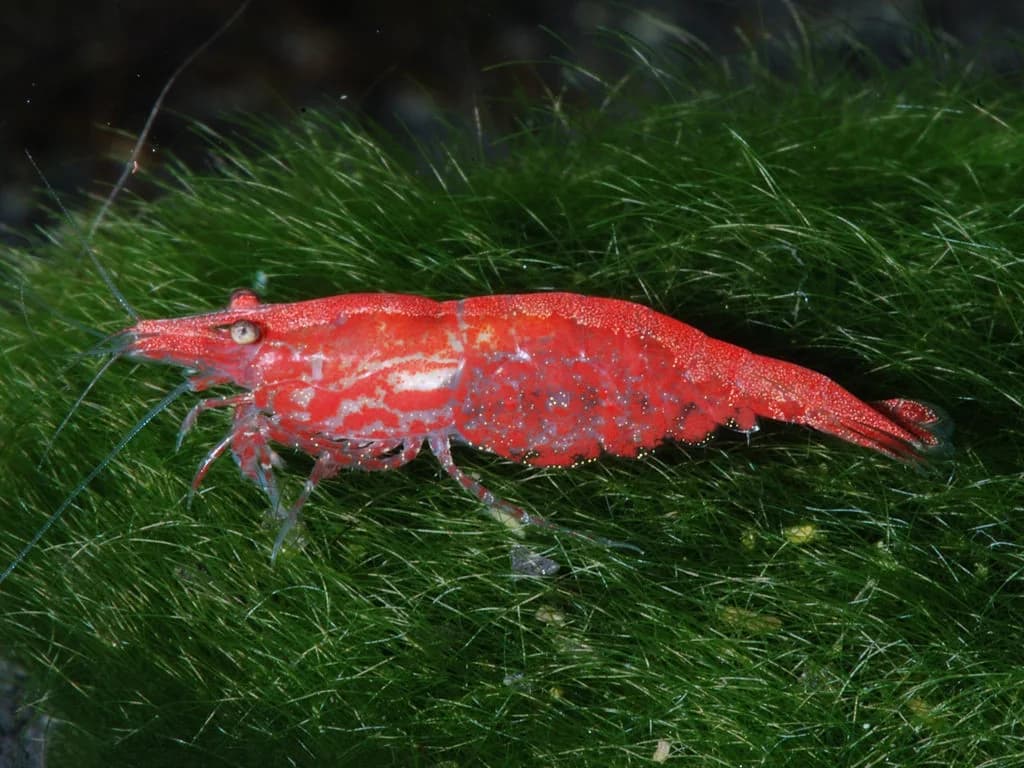
The Blood Red Shrimp is a dark red line of Neocaridina davidi, the small freshwater shrimp sold as the cherry shrimp. Where an ordinary cherry shrimp is a light, see-through red, this line is a dense, deep crimson from the head shield to the tail, with a slightly mottled texture to the colour, red-banded legs, a red tail fan with pale tips and black eyes. Seen against bright green plants and dark wood, it is one of the boldest-coloured shrimp in the hobby.
Its care is as straightforward as any cherry shrimp. It lives happily in the medium-hard water found across much of the UK, it spends its day grazing biofilm and algae, and a settled group breeds without any special effort. For a keeper who wants maximum colour with minimum fuss, a colony of Blood Red Shrimp in a planted nano tank is hard to beat.
| Ideal | Not ideal |
|---|---|
| An established, planted tank of 20 litres or more | A newly filled tank that has not finished cycling |
| Stable water of moderate hardness with low nitrate | Big swings in temperature or chemistry |
| A shrimp-only tank, or one with otocinclus and snails | Fish large enough to catch and eat shrimp |
| A group of six or more of this line | A tank already home to other cherry shrimp colours |
| Keepers who feed lightly and test regularly | Copper-containing treatments |
Look through our cherry shrimp shop, the Neocaridina shrimp listings and the full freshwater shrimp catalogue to compare reds.
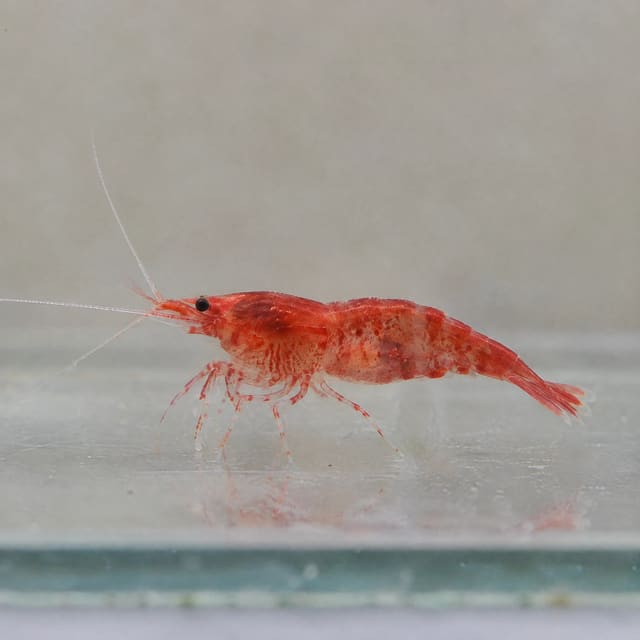
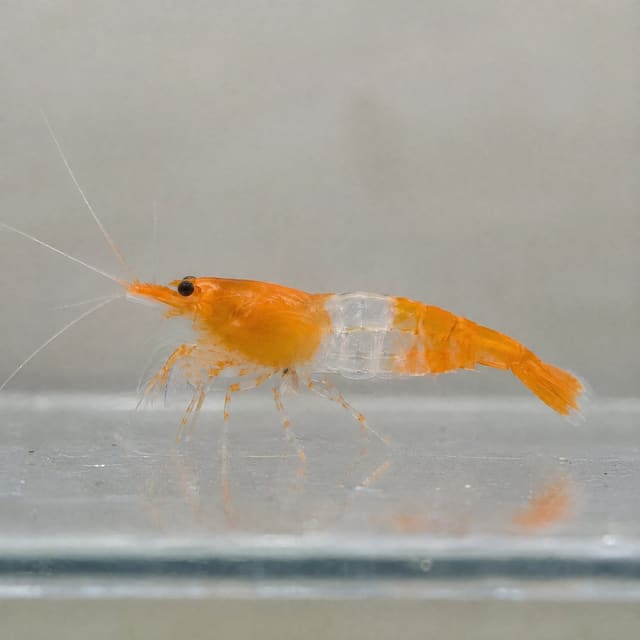
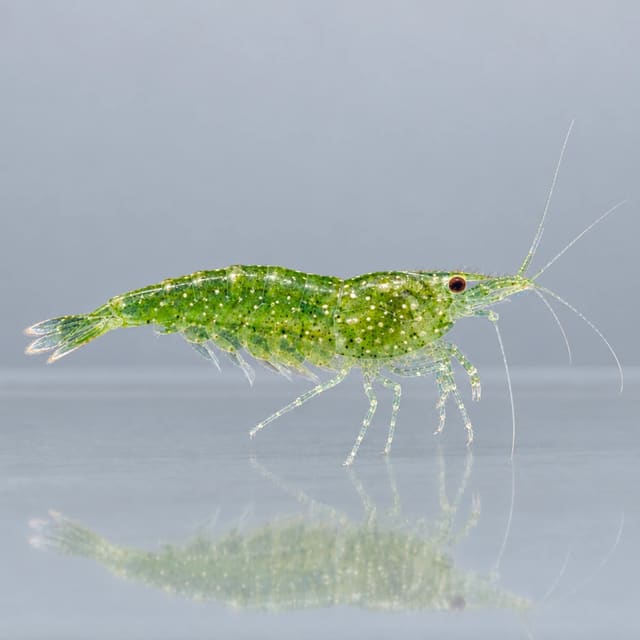
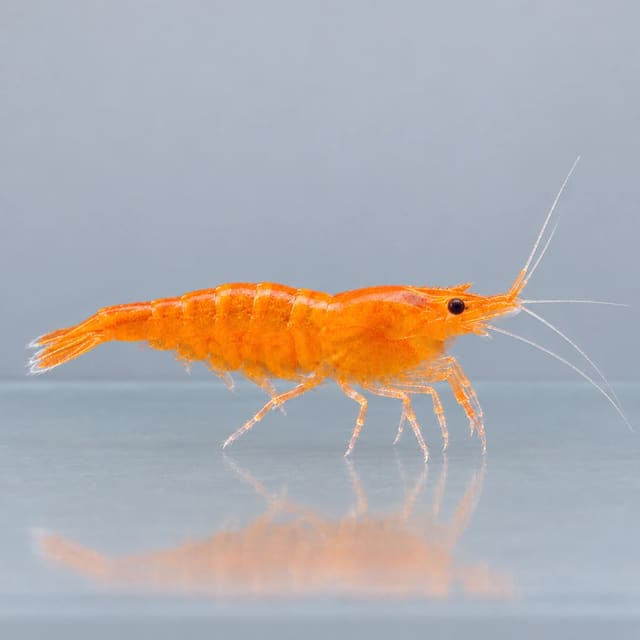
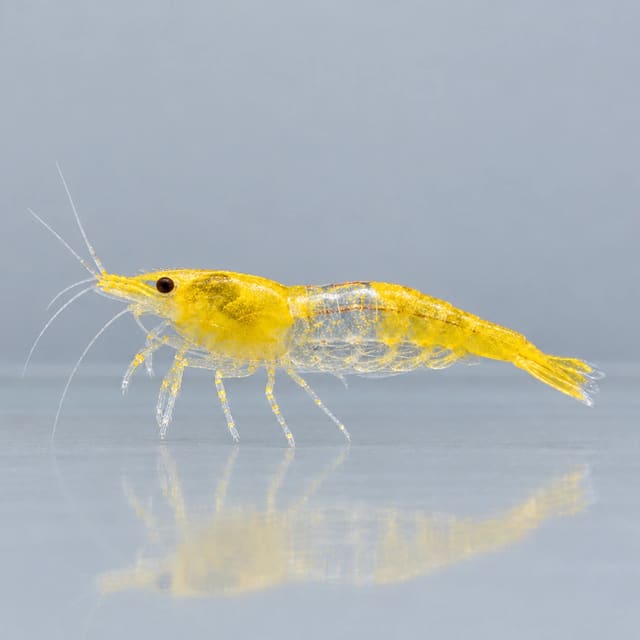
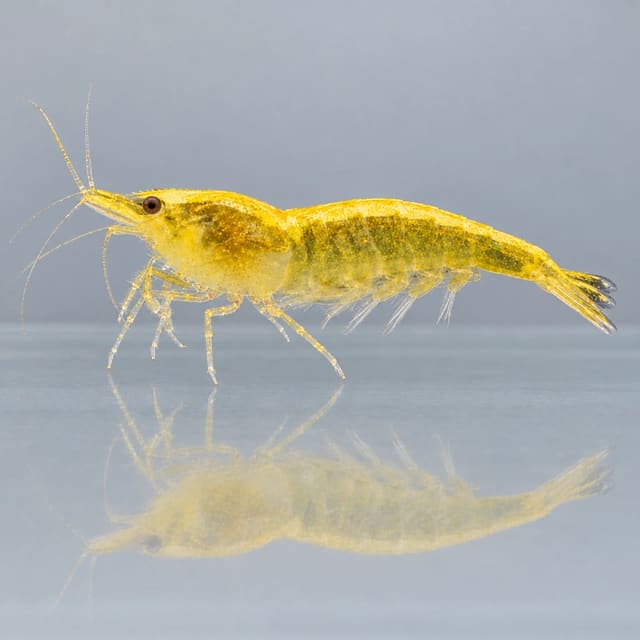
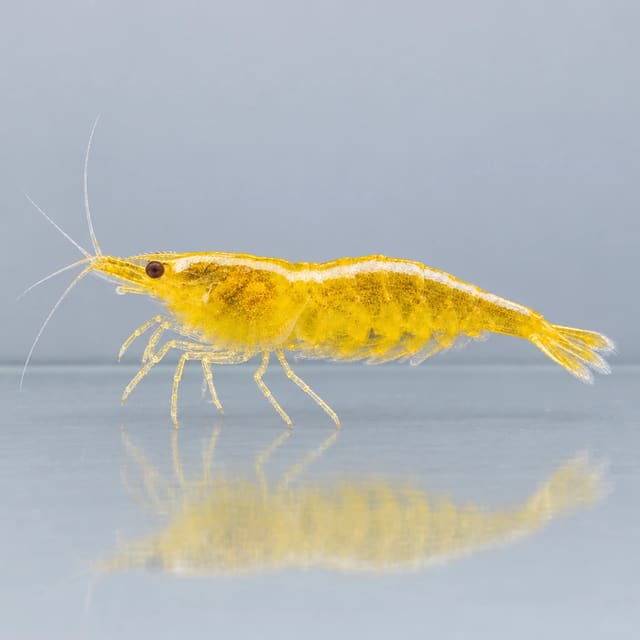
One purchase quantity is one live Blood Red Shrimp. It is sold as a single “Standard” option because the line is not graded by size: we send shrimp at the size available on the day, and their sex is not selected. The photographs show the colour line; your shrimp will differ a little in how dark and how even the red is. Young shrimp and males usually look lighter than mature females, and colour deepens as new arrivals settle.
Our livestock delivery guide explains packing and arrival. If you plan fish as well, check numbers in the stocking calculator first.
The species is naturally plain. Wikipedia describes wild Neocaridina davidi, from Taiwan, eastern China, the Korean Peninsula and Vietnam, as greenish-brown to mottled brown, and Practical Fishkeeping notes that red was the first colour bred from it. Red is produced by pigment cells called erythrophores, and Wikipedia explains that what we see is a combination of the colour of the shell and the colour of the flesh, or “blood”, beneath it. Older labels may call the species Neocaridina heteropoda or Neocaridina denticulata sinensis.
Breeders grade red shrimp by depth and opacity of colour. The Shrimp Farm’s grading guide runs from Cherry through Sakura and Fire Red to Painted Fire Red and Bloody Mary, the darkest. Its Bloody Mary care page reports a breeder’s account that the line came from crossing wild Taiwanese shrimp with Fire Red to make a chocolate line and then selecting the reddest chocolates; it says the story should be taken with a grain of salt, and that the red sits in the body tissue rather than the shell. “Blood Red” is a seller’s name for shrimp at the dark end of this ladder. We have found no published standard that defines it or ties it to one particular line, so judge the colour by the photographs.
| Name | Typical look |
|---|---|
| Cherry | Mostly translucent with pinkish-red spots |
| Sakura | Redder and darker, still blotchy |
| Fire Red | Almost fully opaque, even legs |
| Painted Fire Red | Intense colour that looks painted on |
| Bloody Mary | Deepest red; even males vividly coloured; shorter rostrum (The Shrimp Farm) |
| Blood Red, as sold here | Deep, dark crimson with slight mottling, as in our photographs |
Colour also depends on the individual. The Shrimp Farm notes that males are smaller and usually less bright than females, and that young of the deepest red lines take a few weeks to colour up.
Tank-size advice varies by source. OATA gives about 10 litres for a group of small shrimp; Practical Fishkeeping says 15 litres can work if heavily planted and well filtered; The Shrimp Farm sets a minimum of 5 US gallons (about 19 litres) and recommends 10 gallons (about 38 litres) for beginners. We suggest 20 litres or more, and larger if you can: Practical Fishkeeping points out that a larger volume gives a bigger safety margin against temperature and water-quality swings.
The tank has to be fully mature. Practical Fishkeeping warns that even a trace of ammonia is fatal and that young shrimp fail in new tanks that have not yet grown the microscopic life they eat. Read our fish tank nitrogen cycle article before setting up.
| Area | Job |
|---|---|
| Moss-covered wood | Biofilm pasture and shelter for young |
| Dense green planting | Hiding places after moulting and a backdrop that makes red stand out |
| Shallow dark sand | Easy cleaning; Practical Fishkeeping advises no more than about 2 cm |
| An open feeding patch | Lets you see every shrimp at mealtimes |
| A secure lid | Stops wandering shrimp and limits evaporation |
Practical Fishkeeping suggests sand for Neocaridina and cautions against builders’ sand that may contain limestone. Green plants behind a dark floor give a deep red shrimp the strongest contrast.
Each source gives slightly different numbers. OATA lists 17–27°C, pH 6.5–8.0, 4–18 dGH and 3–15 dKH. The Shrimp Farm’s Bloody Mary page gives pH 6.2–8.0, 65–80°F (about 18–27°C), hardness 5–12, TDS 150–250 and nitrate ideally below 10, and stresses that stability matters more than ideal values. Practical Fishkeeping gives pH 6.5–8, 8–18 dGH, 5–15 dKH and 18–26°C for Neocaridina, and Neale Monks 5–15 dGH with middling values best for breeding.
| Parameter | Keep it at | Source notes |
|---|---|---|
| Temperature | 21–26°C | Practical Fishkeeping: best for life and breeding; 18–28°C tolerated |
| pH | 6.5–8.0 | OATA and Practical Fishkeeping; The Shrimp Farm 6.2–8.0 |
| General hardness | Moderate and unchanging | The Shrimp Farm 5–12; Monks 5–15; OATA 4–18; Practical Fishkeeping 8–18 |
| Carbonate hardness | 3–15 dKH | OATA; Practical Fishkeeping 5–15 |
| TDS | 150–250 ppm | The Shrimp Farm |
| Ammonia and nitrite | 0 | OATA; The Shrimp Farm |
| Nitrate | As low as practical | The Shrimp Farm: ideally below 10; OATA: no more than 20 mg/l above tap water |
| Copper | Never | OATA and Practical Fishkeeping |
Once dechlorinated, most UK tap water suits this species; Practical Fishkeeping notes tap water low in nitrate and phosphate is fine for Neocaridina. Hardness varies widely across the country, so test your supply and compare it in our water matcher tool. Very soft water may need a calcium supplement for moulting, and water from the hot tap should never be used because of copper. Our water chemistry guide shows how to test each value.
Practical Fishkeeping notes that warmer water speeds growth and breeding but shortens life and may need extra aeration, so there is no benefit in running at the top of the range.
Practical Fishkeeping recommends air-driven sponge filters or Hamburg mat filters for shrimp and advises covering any power-filter intake with fine foam or a stocking held by an elastic band; with strong suction, turn the flow down. OATA’s routine is weekly testing and a partial change of 25% at least once a week, using conditioned water, with filter media rinsed in removed tank water only.
Wikipedia describes cherry shrimp as omnivores of biofilm, algae and detritus that do not eat vascular plants. In a mature tank that is most of the diet. Advice on extra food varies. OATA suggests two or three feeds a week, left in for at least 30 minutes. The Shrimp Farm says large, established tanks often need no extra feeding, while small or very clean tanks benefit from one or two pieces of shrimp food a day, with a quality shrimp food as the staple for the calcium and minerals that moulting needs and blanched vegetables, frozen foods, nori and Indian almond leaves for variety. Start low, and feed more only if the shrimp clear it quickly.
Wikipedia notes that carotenoids from food are thought to supply pigment, so algae- and spirulina-rich foods such as our spirulina mini granules belong in the rotation.
Shrimp need longer to adjust than most fish. OATA’s floating-bag method is the baseline: switch off the light, float the sealed bag for 10 minutes, add small amounts of tank water over at least 30 minutes, and release the shrimp with as little of the bag water as possible. Practical Fishkeeping prefers a drip of tank water through airline at one to two drops per second for about an hour, until the water has tripled or quadrupled in volume.
| Time | What to do |
|---|---|
| Before arrival | Confirm zero ammonia and nitrite and a stable temperature |
| Day one | Low light, no food |
| Days two to seven | A very small meal every other day |
| Daily | Count the shrimp; note any that are inactive |
| Day seven | Test fully and change a small amount of water |
OATA reminds keepers that a cast shell can look like a dead shrimp. With a red line the difference is clear: Practical Fishkeeping notes that a dead shrimp is never transparent and a moult is never coloured. Failed moults point to hardness or mineral problems. Practical Fishkeeping also lists copper, high CO2 or low oxygen, ammonia spikes after cleaning the filter, harassment by fish and old age among the causes of sudden losses.
| Warning sign | Next step |
|---|---|
| Shrimp trapped in a half-shed shell | Check GH; offer mineral-rich food; adjust hardness gradually |
| Shrimp near the surface or in the filter flow | Increase surface agitation; reduce CO2 |
| Deaths after new plants, fertiliser or medicine | Suspect copper; change water and remove the source |
| Darker or paler colour, hiding or poor appetite | OATA lists these as stress signs: test the water and check tank mates |
| White spots, lesions or lost legs | Test water and contact us before treating |
Cherry shrimp are short-lived: Practical Fishkeeping gives 12–18 months, Wikipedia one to two years, and OATA a couple of years in a well-matured tank.
Healthy shrimp in a stable tank breed without help. Females release pheromones after moulting, the males search them out, and the eggs are fertilised as they are laid and carried under the female’s tail. Wikipedia gives 20–30 eggs a batch and two to three weeks to hatching; The Shrimp Farm’s Bloody Mary page says about 30 days, and Practical Fishkeeping three weeks to a month. The young hatch as 1 mm miniature shrimp and are independent from the start. The Shrimp Farm puts first breeding at two to three months old.
Because the colour is so dense, the saddle of developing eggs can be hard to see; look instead for eggs under the tail.
OATA’s rule is not to mix shrimp with fish that can fit them in their mouth or with predatory species. Practical Fishkeeping names otocinclus as completely shrimp-safe and smaller Corydoras species and small plecs as generally safe; dwarf gouramis, small tetras and rasboras, cherry barbs and kuhli loaches only in densely planted tanks, accepting some losses of young. Neale Monks notes that Neocaridina and Caridina shrimp should not hybridise, so an Amano shrimp will not affect the line.
| Usually suits | Avoid or think twice |
|---|---|
| More Blood Red Shrimp | Other red lines and any other cherry shrimp colour |
| Golden Otocinclus | Any fish able to swallow a shrimp |
| Batik Nerite Snails | Crayfish, large crabs and bigger predatory shrimp |
| Amano Shrimp | Copper in any form |
Check combinations in our tank mates tool before buying.
Our live red lines cover the whole grading ladder. The Cherry Shrimp is the classic, the Super Red Sakura Shrimp sits in the middle, the Fire Red Shrimp is an even, opaque red, and the Bloody Mary Shrimp is the line The Shrimp Farm places at the very top. The Chocolate Cherry Shrimp shows the darker colouring that, by the breeder’s account, Bloody Mary was selected from. All interbreed, so keep one line per tank. Our cherry shrimp care guide and cherry shrimp buyer’s guide help you choose.
Released cherry shrimp can survive: Wikipedia records wild populations in thermally polluted waterways in Japan, the United States, Poland and Germany. OATA warns that releasing aquarium animals or plants is illegal, usually fatal to the animals and a danger to native wildlife. Rehome surplus shrimp through a shop or another keeper, and dispose of old water, substrate and plant cuttings in the drain or household waste.
A deep, dark red colour line of Neocaridina davidi, the cherry shrimp. “Blood Red” is a trade name for shrimp selected for a darker, richer red than ordinary cherry or Sakura grades; it is not a formally defined grade.
They look alike and are the same species, but we have found no published standard that makes the names identical. The Shrimp Farm describes Bloody Mary as a specific line with its red in the body tissue and strongly coloured males. Compare our photographs, and keep only one of the two lines in a tank, as they interbreed.
One live shrimp of the Standard option, sex not selected. Start with at least six: OATA recommends five or more and Practical Fishkeeping six or more.
Yes. The Shrimp Farm rates the deepest red Neocaridina lines as easy, and Practical Fishkeeping counts red cherry shrimp among the easiest shrimp of all. A mature tank, stable water and no copper are the essentials.
Colour takes time. The Shrimp Farm notes that young of the deepest red lines take a few weeks to colour up, and males stay smaller and usually less intense than females.
Aim for 21–26°C, pH 6.5–8.0, moderate hardness, zero ammonia and nitrite and low nitrate. The Shrimp Farm suggests keeping nitrate below 10 for its deepest red line; OATA’s limit is 20 mg/l above your tap water.
Sources differ: OATA suggests two or three feeds a week, and The Shrimp Farm says large established tanks may need no extra food while small or very clean tanks benefit from one or two pieces of shrimp food a day. Feed lightly and remove leftovers.
Only with fish too small to eat them. Otocinclus are the safest; small Corydoras are usually fine. Most other small fish will take young shrimp, so a shrimp-only tank keeps the most offspring.
No reviews for this item yet. Bought one? Honest reviews only, good or bad.
What customers say about ordering from us
Easy website plenty of info on fish your buying great to pick a time slot
TRACEY DURRANT · 7 Oct 2026
Got some lovely fish thank you
Kevin Mackie · 7 Oct 2026
Reviews of our shop, collected by Judge.me, an independent third-party review collector. Newest first.
Moved by UK carriers licensed to handle live animals
Hand-packed with oxygen bags, poly box, heat pack
Email photos the same day; an optional unboxing video helps us review problems faster — claim terms apply
Klarna & PayPal Pay in 3 at checkout