Moderate
Mixed Neocaridina Shrimp (Neocaridina davidi)
17–27°C · pH 6.5–8
£5.99
The Blood Orange Shrimp is a deep red-orange colour form of Neocaridina davidi, the cherry shrimp. Keep six or more in a mature, filtered tank of 20 litres or more at 21–26°C and pH 6.5–8.0, with no copper and no other cherry shrimp colours. Sold singly as one live shrimp.
Adult size is the maximum length this species reaches at full maturity (scientific sources). The livestock you receive will be younger and smaller. Product-photo provenance and any image-specific limitations are stated on the listing.
Neocaridina davidi
Choose a quantity for your aquarium. Discount thresholds are pricing offers, not a stocking recommendation.
The Blood Orange Shrimp is a deep red-orange colour form of Neocaridina davidi, the cherry shrimp. Keep six or more in a mature, filtered tank of 20 litres or more at 21–26°C and pH 6.5–8.0, with no copper and no other cherry shrimp colours. Sold singly as one live shrimp.
Adult size is the maximum length this species reaches at full maturity (scientific sources). The livestock you receive will be younger and smaller. Product-photo provenance and any image-specific limitations are stated on the listing.
Use a mature, filtered aquarium and measured water—not a shrimp-per-litre rule. Tropical Fish Co uses 20 litres as a cautious starting policy for a small Cherry Shrimp group, above OATA's general 10-litre screen for small shrimp. Provide established grazing surfaces, cover and a protected filter inlet. No fish is guaranteed shrimplet-safe, and breeding should never be promised.
Read the full care guidance when planning conditions for your aquarium.
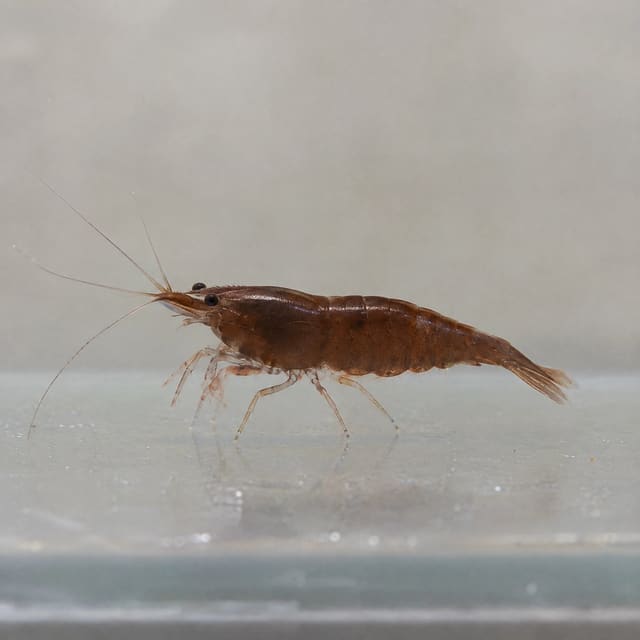
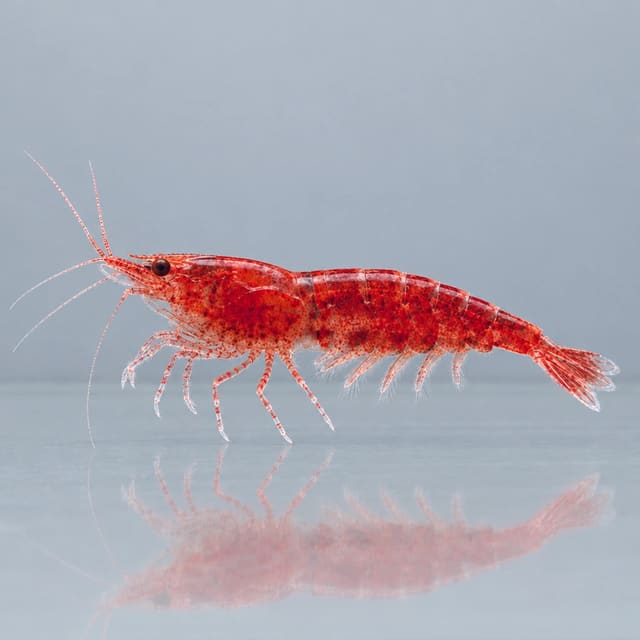
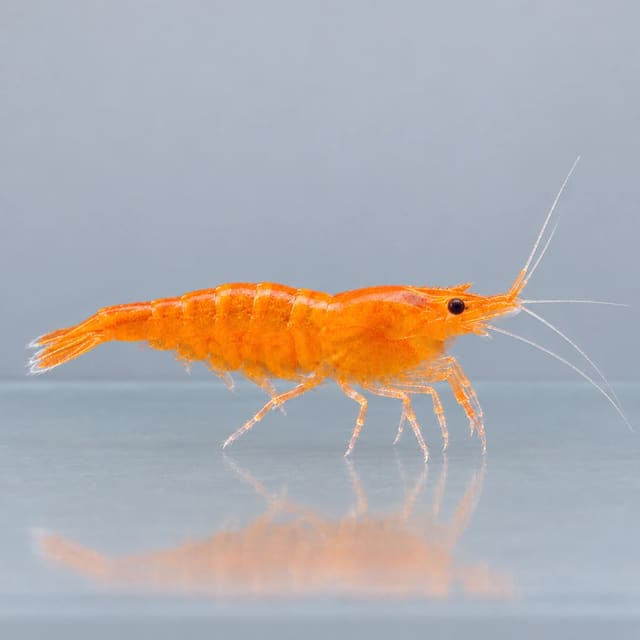
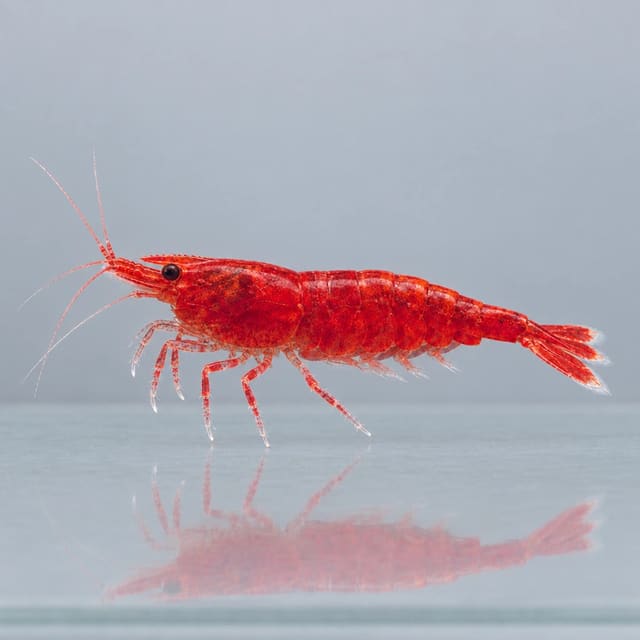
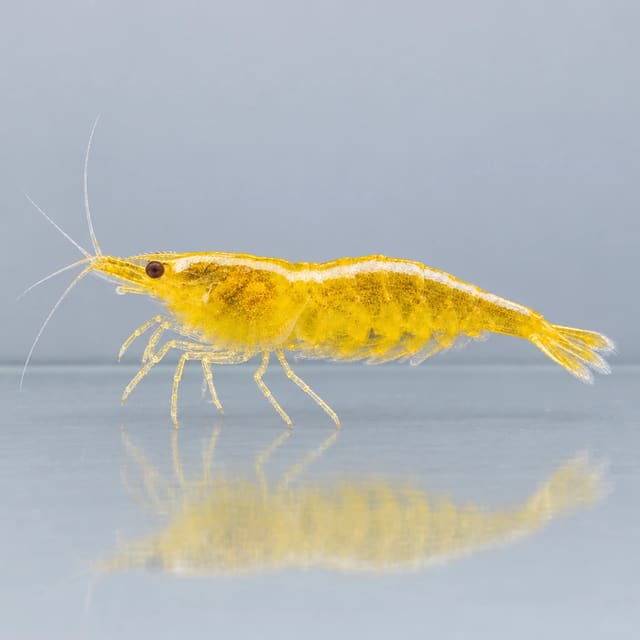
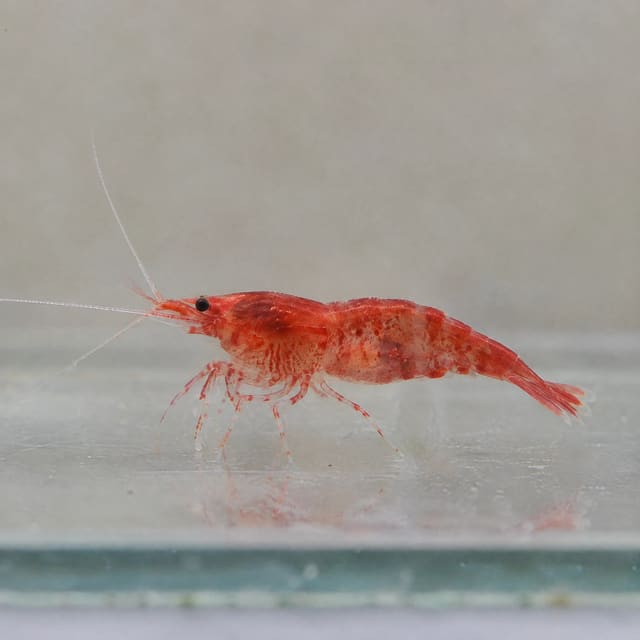
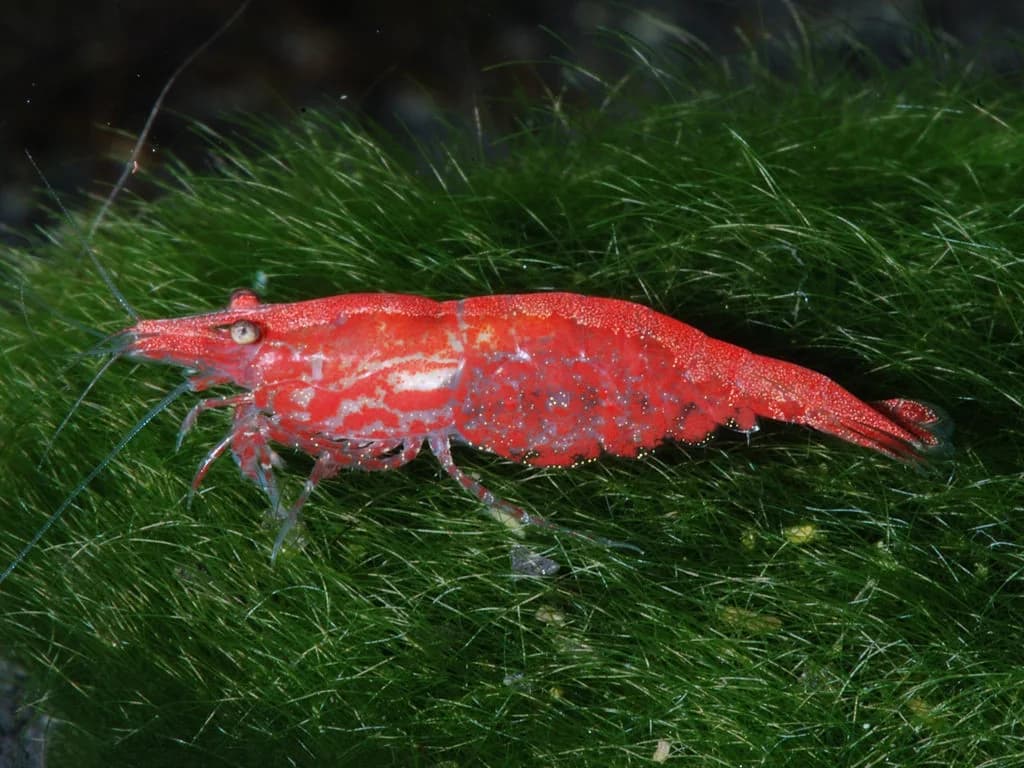
The Blood Orange Shrimp is a selectively bred colour form of Neocaridina davidi, the small freshwater shrimp sold in the UK as the cherry shrimp. The shrimp in our photographs is a rich red-orange from head to tail fan, flecked with darker red, with semi-transparent orange legs, clear-edged swimming legs and long pale antennae. It sits between a bright orange shrimp and a true red, which is where the trade name comes from. Like every cherry shrimp it is peaceful, busy all day and breeds without special effort in a settled planted tank.
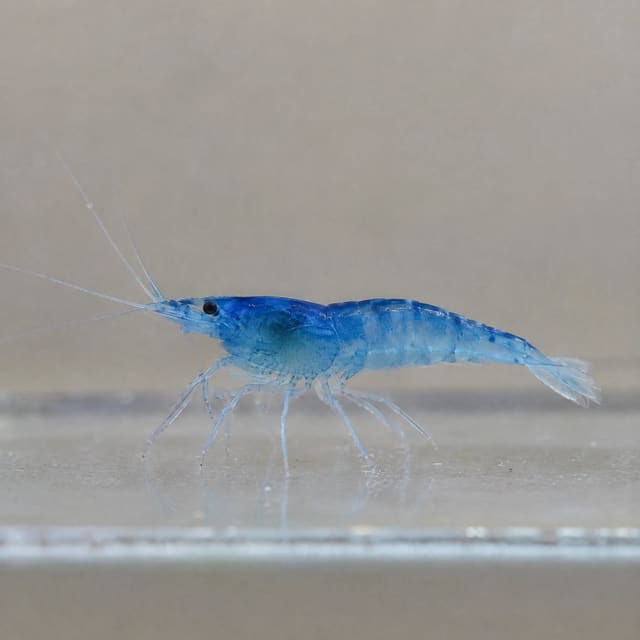
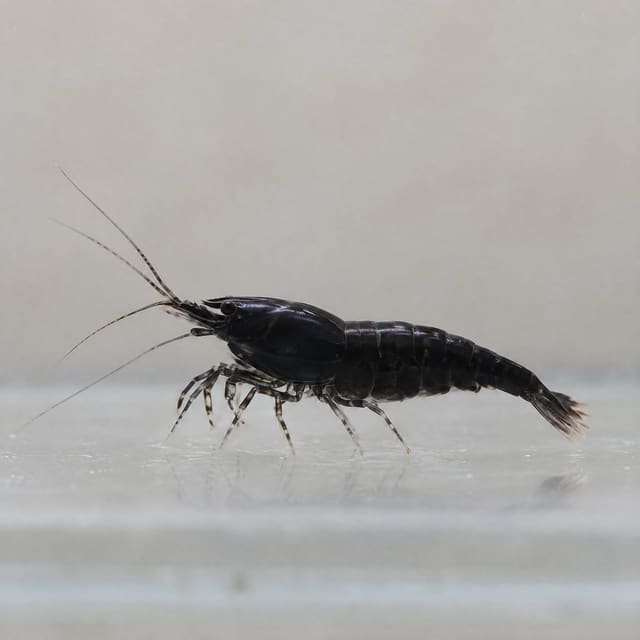
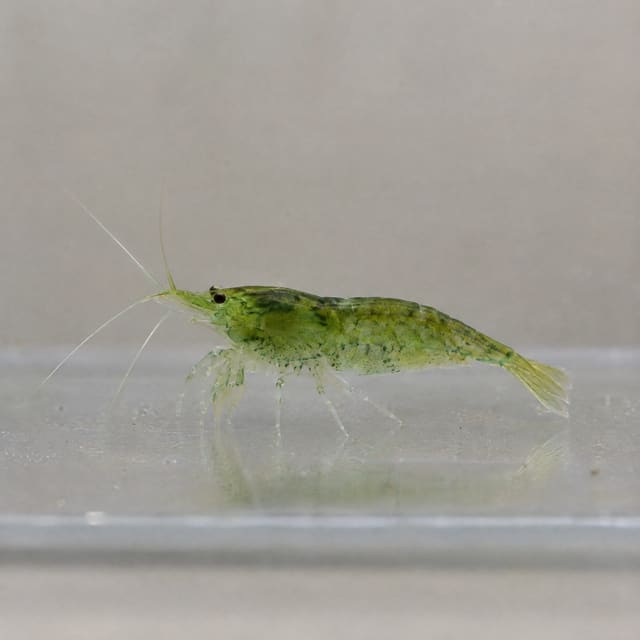
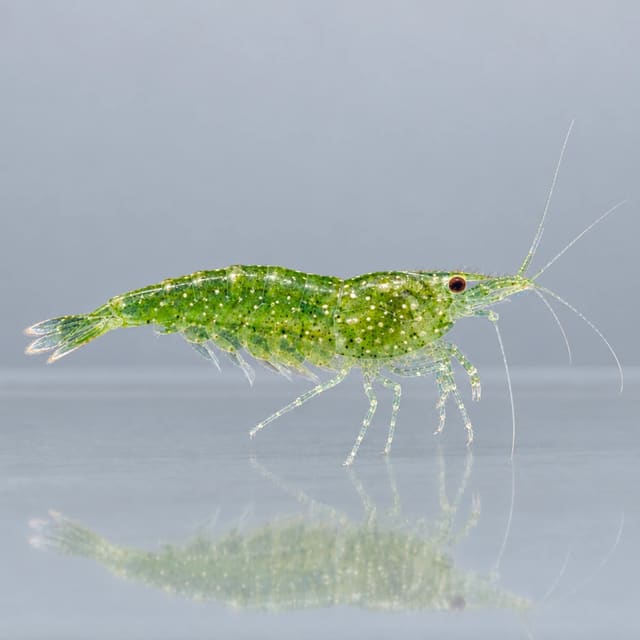
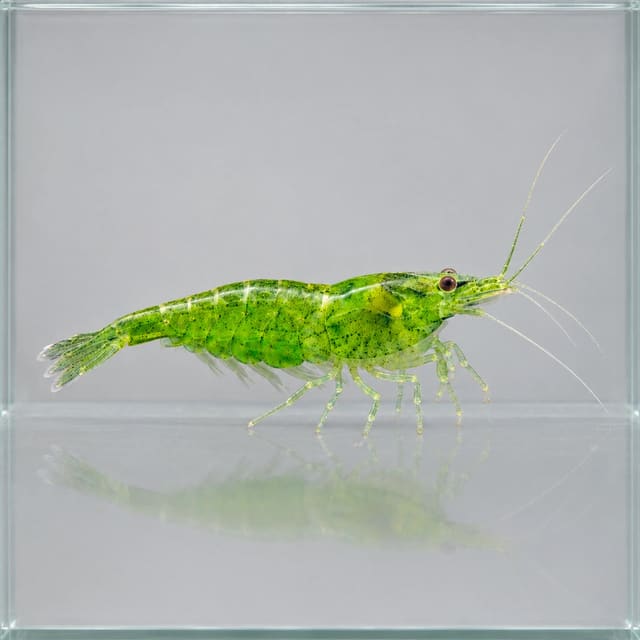
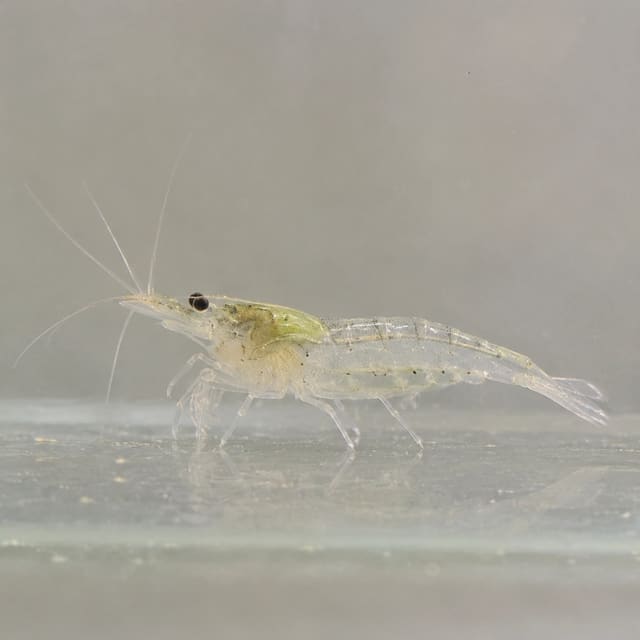
Wild Neocaridina davidi look very different. Wikipedia's species account describes a mottled brown or greenish-brown shrimp from Taiwan, eastern China, the Korean Peninsula and Vietnam, and lists red, yellow, blue, green, violet, chocolate, black and white among the colours breeders have since fixed. Older labels may read Neocaridina heteropoda or Neocaridina denticulata sinensis; both are synonyms of the same species. You can compare every colour we keep in our cherry shrimp collection.
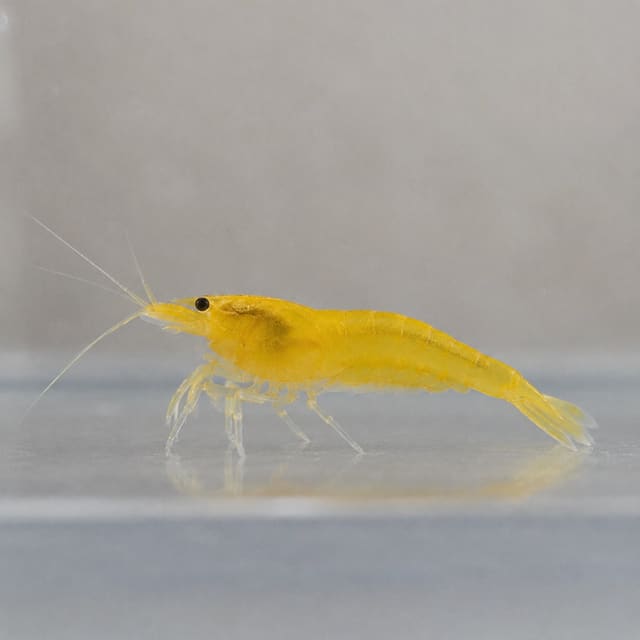
"Blood Orange" is a trade name rather than a scientific grade. No society publishes a standard for it, and sellers apply it, along with names such as Bloody Orange, to deep reddish-orange shrimp. We describe the animals in our photographs rather than relying on the label. The table shows how this shrimp sits beside the closest colours we already sell, all of which belong to the same species.
| Shrimp | Colour as sold |
|---|---|
| Blood Orange Shrimp (this page) | Deep red-orange, flecked with darker red |
| Orange Sakura Shrimp | Bright, clear orange |
| Orange Rili Shrimp | Orange head and tail separated by a clear band |
| Fire Red Shrimp | Solid red |
| Bloody Mary Shrimp | Very deep red |
Because they are one species, all of these interbreed. If you want to keep the blood-orange look over several generations, make it the only Neocaridina colour in its tank. The section on colour lines below explains why.
One purchase quantity is one live Blood Orange Shrimp. There is a single size option, Standard: shrimp are sent at the size available on the day and are not sexed, so order the number of shrimp you want in the basket. The photographs show the colour form; each shrimp is an individual, and its colour, size and pattern will vary slightly from the pictures.
Expect variety inside any group. According to Wikipedia, males are smaller and less colourful, while females are larger, have a wider tail for carrying eggs and show richer, more opaque colour. A group will therefore contain some paler animals, and that is normal. Colour also fades for a few days after a journey or any upset, then returns as the shrimp settle. Adults reach about 3–4 cm according to Wikipedia; OATA gives about 3 cm for cherry-type shrimp. Lifespan estimates differ: Wikipedia gives 1–2 years, OATA "a couple of years" in a well-matured tank, and Practical Fishkeeping says they rarely live beyond 12–18 months. A colony outlives its founders because it keeps breeding.
One shrimp on its own is not a sensible purchase. Both main UK sources ask for a group, and a group of six or more is very likely to contain both sexes, which a colony needs.
| Source | Minimum group | Note |
|---|---|---|
| OATA | At least five | Smaller groups can cause stress |
| Practical Fishkeeping | At least six | Also warns that six can soon become a hundred |
| Our advice | Six or more | Confident grazing and both sexes present |
Tank size advice varies by source. OATA gives a minimum of 10 litres for a group of small shrimp, and more if fish share the tank. Practical Fishkeeping suggests at least 15 litres for a nano tank that is well planted and properly filtered. We recommend 20 litres or more, because a larger volume holds temperature and water quality steadier, and colonies grow quickly: Practical Fishkeeping warns that six shrimp can soon become a hundred. If you are not sure how many litres your tank holds, our tank volume calculator will work it out from the dimensions.
Maturity matters more than size. Practical Fishkeeping notes that even traces of ammonia can kill these shrimp and that nitrite is not tolerated, so add them only to a fully cycled tank. A tank that has run for some weeks with plants, wood and stones also grows the film of bacteria, algae and microorganisms that the shrimp graze between meals. A brand-new, spotless tank leaves them hungry, however well you feed.
| Feature | Why it helps |
|---|---|
| Fine sand, less than 2 cm deep | Practical Fishkeeping finds Neocaridina do best on sand and keeps beds shallow to limit gas build-up. Avoid builders' sand, which may contain limestone. |
| Moss, fine-leaved plants and leaf litter | Grazing surface, plus cover for freshly moulted adults and newly hatched young |
| Wood and stones | More surface for biofilm to grow on |
| Air-driven sponge filter, or a guarded intake | Young shrimp cannot be drawn in, and the sponge doubles as a grazing pad |
| New plants rinsed and soaked first | Some plants arrive treated with copper-based snail killers, which are deadly to shrimp |
Practical Fishkeeping's writer prefers a dark sand, which he finds enhances shrimp colour; red and orange shrimp stand out well against it.
Blood Orange Shrimp keep the forgiving water needs of the wild species, which is a large part of their appeal. The two UK sources below overlap closely. Our planning targets sit inside both, so a tank kept there satisfies each source.
| Value | OATA | Practical Fishkeeping | Planning target |
|---|---|---|---|
| Temperature | 17–27°C | 18–26°C; tolerates about 18–28°C, lives longest and breeds best at 21–26°C | 21–26°C |
| pH | 6.5–8.0 | 6.5–8.0 | 6.5–8.0, held steady |
| General hardness (GH) | 4–18 °dH | 8–18 °H | 8–18 |
| Carbonate hardness (KH) | 3–15 °dKH | 5–15 °KH | 5–15 |
| Ammonia and nitrite | Zero | Not tolerated | Zero |
| Nitrate | No more than 20 mg/l above your tap water | Not given | As low as practical |
Practical Fishkeeping adds a trade-off for temperature: warmer water speeds growth and breeding but shortens life, and may call for extra aeration. The middle of the range is a sensible place to sit.
Treat every drop of new water with a tap water conditioner, as OATA advises. Medium to hard tap water, common across much of England, usually falls inside the ranges above without any adjustment. In very soft water Practical Fishkeeping suggests a calcium supplement, because shrimp need calcium to build each new shell. Never fill from the hot tap: Practical Fishkeeping lists hot tap water among the causes of copper poisoning. Our water matcher compares your own readings with the shrimp's needs, and our water chemistry guide explains GH, KH and pH in plain terms.
Shrimp produce little waste, but they react badly to sudden change. A gentle, mature filter and an unhurried routine prevent most losses. Practical Fishkeeping's writer prefers air-driven sponge filters, which shrimplets also graze, and covers the intake of any power filter with a piece of stocking so that young shrimp are not drawn in. Shrimp-safe internal, external and corner filters all work once the intake is guarded.
| Step | What to do |
|---|---|
| 1. Test | Check ammonia, nitrite and nitrate at least weekly, with pH and hardness (OATA). |
| 2. Change water | Replace about 25% each week with conditioned water at the same temperature (OATA). Pour slowly so shrimp are not swept about. |
| 3. Look before you remove | An empty shell is a moult, not a death. Practical Fishkeeping's rule: a corpse is never transparent and a moult is never coloured. The shrimp eat their own moults, so they can stay. |
| 4. Rinse media gently | Squeeze sponges in removed tank water, never under the tap (OATA), and never clean the filter on the same day as a big water change. |
Blood Orange Shrimp spend most of the day picking at surfaces. Wikipedia records the species eating biofilm, algae and detritus and leaving healthy vascular plants alone, which makes it safe in a planted tank. Extra food should top up that grazing rather than replace it. The sources differ slightly on how often to feed: OATA suggests two or three times a week, while Practical Fishkeeping's writer feeds every other day in lightly stocked tanks. Both approaches work; a busy colony in a young tank needs the higher end.
For moulting, Practical Fishkeeping recommends shrimp foods containing calcium and iodine, often supplied by seaweed. It also suggests blanched leaves such as stinging nettle, dandelion and spinach, and vegetables such as courgette and cucumber, as occasional extras. Our green algae wafers, Caridina nano sticks and spirulina mini granules all sink and suit small shrimp.
New shrimp are at their most vulnerable in the first hours. Both UK sources favour slow acclimatisation in dim light. OATA describes the floating bag method: turn the lights off, float the sealed bag for 10 minutes to equalise temperature, then add small amounts of tank water to the bag over at least 30 minutes. Practical Fishkeeping prefers a drip: move the shrimp into a small container and run a slow siphon from the tank at about one or two drops a second for roughly an hour, until the water volume has tripled or quadrupled. Either way, net the shrimp across and discard the travel water rather than pouring it into the tank.
| When | Check |
|---|---|
| Arrival | Lights off, acclimatise slowly, net the shrimp across, discard the bag water. |
| First evening | Leave the lights off and skip food; a mature tank has plenty to graze. |
| Days 2–3 | Shrimp should be exploring and grazing. Test ammonia and nitrite, as the extra animals add load. |
| Days 4–7 | Begin light feeding. Look for moults, which are a good sign, and for any shrimp that stay at the surface. |
OATA advises watching new arrivals closely for the whole first week.
OATA lists the general signs of ill health in shrimp: unusual inactivity or restlessness, colour darker or paler than normal, more hiding, faster or laboured breathing, time spent near high-oxygen areas, white spots, lesions, damaged shells or lost limbs, weight change and loss of appetite. Practical Fishkeeping's list of causes of unexplained deaths helps turn those signs into action.
| What you see | Likely cause | What to check or do |
|---|---|---|
| Several deaths after new plants, fertiliser or a water change | Copper poisoning | Change water with conditioned cold tap water; check every product label for copper |
| Shrimp at the surface or riding the filter outflow | Too little oxygen or too much CO2 | Increase surface movement and add an airstone |
| Deaths after cleaning the filter or adding stock | Ammonia spike | Test at once and change water; clean filters little and often |
| Shrimp dying mid-moult | Failed moult | Check GH and KH; add a mineral-rich shrimp food |
| Missing legs, constant hiding | Harassment by fish or larger shrimp | Rehome the culprit or move the shrimp |
| Occasional single deaths in an older colony | Old age | Normal if the colony is still breeding |
Practical Fishkeeping notes that disease is rare when conditions are good and hard to identify without a microscope, so water quality is the first thing to check. Never treat a shrimp tank with a medicine unless the label says it is safe for invertebrates; OATA warns that even low levels of copper can kill shrimp.
Every cherry shrimp colour is the same species. Practical Fishkeeping explains that Neocaridina colour forms crossbreed freely, and that mixed varieties drift back to plain brownish shrimp within a few generations. To keep Blood Orange colour from one generation to the next, keep one Neocaridina colour per tank and remove any young that come out pale or brown.
| Shrimp | Share the tank? | Why |
|---|---|---|
| Other N. davidi colours, such as Super Red Sakura | Not if you want to keep the colour | They interbreed and the young revert |
| Amano Shrimp | Yes | A larger, peaceful shrimp of another genus, about 5 cm according to OATA, kept under the same OATA care advice |
| Bee and Taiwan bee shrimp | Not recommended | They cannot hybridise with cherry shrimp (Practical Fishkeeping), but prefer cooler, softer, more acidic water: 18–23°C, about 5 GH, 0–2 KH, pH 6–6.8 |
| Small snails such as the Malaysian Trumpet Snail and Batik Nerite | Yes | Peaceful grazers kept under the same care advice by OATA |
OATA's rule is simple: avoid any fish that can fit a shrimp in its mouth, and avoid predatory species. Even a fish too small to tackle an adult will eat newly hatched young and freshly moulted adults. Practical Fishkeeping's writer keeps his Neocaridina with snails and other dwarf shrimp only, and names small Otocinclus as the safest fish of all, even with newborn shrimp.
| Suits | Use with care in a densely planted tank | Avoid |
|---|---|---|
| Golden Otocinclus and other small Otocinclus | Small Corydoras such as Pygmy Corydoras, and small plecos that stay small | Any fish able to swallow a shrimp |
| Snails and other dwarf shrimp of a different genus | Small tetras and rasboras, cherry barbs, dwarf gouramis and Kuhli Loaches | Predatory fish, crayfish and large crabs |
Fish in the middle column have lived with Neocaridina in Practical Fishkeeping's experience, but expect fewer young to survive. For a quick check of a particular mix, try our tank mates checker.
Practical Fishkeeping says no special steps are needed to breed Neocaridina: give them stable water, cover and food, and they get on with it. A female ready to breed shows a coloured "saddle" of developing eggs behind the head. After she moults she releases pheromones, males search her out, and the fertilised eggs are carried under her abdomen, fanned by her swimming legs. Wikipedia gives 20–30 eggs per clutch.
| Stage | What the sources say |
|---|---|
| Maturity | Sources differ: Wikipedia says sexual maturity at about two months; Practical Fishkeeping says shrimp typically begin breeding at about six months. |
| Eggs carried | About three weeks to a month (Practical Fishkeeping); two to three weeks (Wikipedia) |
| Hatching | Young hatch at roughly 1 mm as miniature adults, with no larval stage |
| Care of young | None from the parents; mosses and a mature tank supply food and shelter |
| Frequency | Females can breed monthly (Practical Fishkeeping) |
Never release surplus shrimp, live plants or tank water into a pond, stream or drain. Wikipedia records N. davidi as invasive in thermally polluted waters in Japan, the United States, Poland and Germany, and Klotz and colleagues (2013) reported it in a warm-water stream system in western Germany. Pass extra shrimp to another keeper or a shop instead. For more on colony keeping, read our cherry shrimp care guide and our wider shrimp-keeping guide, or browse all our Neocaridina shrimp and the full freshwater shrimp range. Delivery details are on our delivery page.
No. It is a colour form of Neocaridina davidi, the same species as every cherry, Sakura, Fire Red and Rili shrimp. Blood Orange is a trade name for the deep red-orange colour, not a separate species or an official grade.
Six or more. OATA asks for groups of at least five and Practical Fishkeeping suggests at least six, because small groups stay nervous. A group of six or more is also very likely to include both sexes, so the colony can breed.
No. The photographs show the colour form, but each shrimp is an individual. Females are larger and more strongly coloured than males, and colour fades for a few days after the journey, returning as the shrimp settle.
Only if you are happy to lose the colour line. All of these are the same species and interbreed freely, and Practical Fishkeeping notes that mixed colonies drift back towards plain brownish shrimp within a few generations.
Not always. Practical Fishkeeping says room temperature suits most Neocaridina, and they tolerate about 18–28°C, but they live longest and breed best at 21–26°C. In a cool room, a small heater set in that range helps.
Usually, once it has been treated with a tap water conditioner. Medium to hard water suits them. In very soft water a calcium supplement may be needed for clean moults, and hot tap water should never be used because it can carry copper.
They graze biofilm, algae and detritus all day, and do not eat healthy aquarium plants. Add a small portion of shrimp food or algae wafer two or three times a week, plus occasional blanched vegetables, and remove anything left uneaten.
Shrimp travel as live animals with our fish. Read our delivery page for dispatch days, the areas we cover and what to do when the box arrives, and have a mature, cycled tank ready before you order.
Every care figure on this page comes from these sources, checked in November 2026. Where they disagree, the page says so.
No reviews for this item yet. Bought one? Honest reviews only, good or bad.
What customers say about ordering from us
Easy website plenty of info on fish your buying great to pick a time slot
TRACEY DURRANT · 7 Oct 2026
Got some lovely fish thank you
Kevin Mackie · 7 Oct 2026
Reviews of our shop, collected by Judge.me, an independent third-party review collector. Newest first.
Moved by UK carriers licensed to handle live animals
Hand-packed with oxygen bags, poly box, heat pack
Email photos the same day; an optional unboxing video helps us review problems faster — claim terms apply
Klarna & PayPal Pay in 3 at checkout