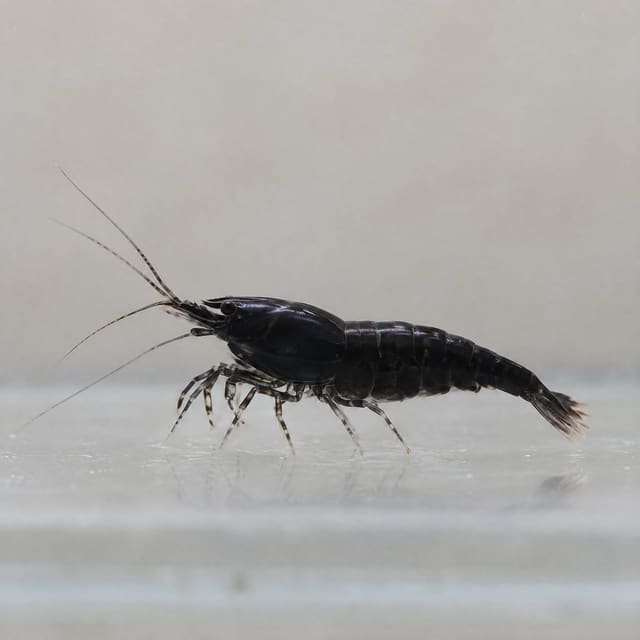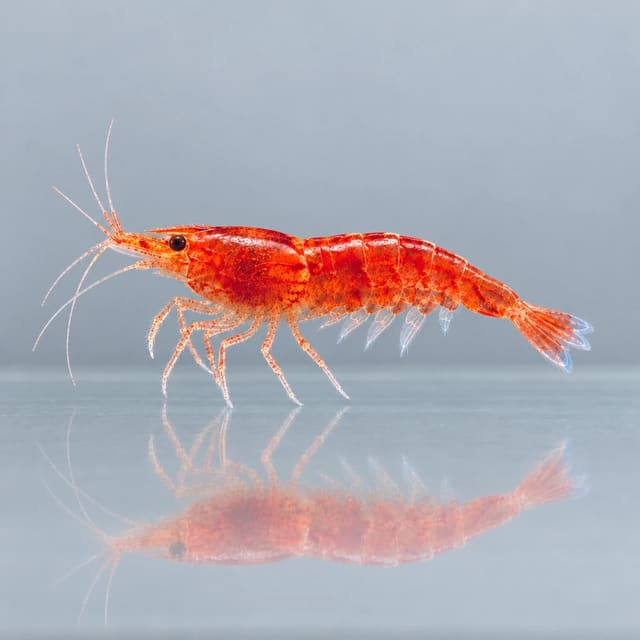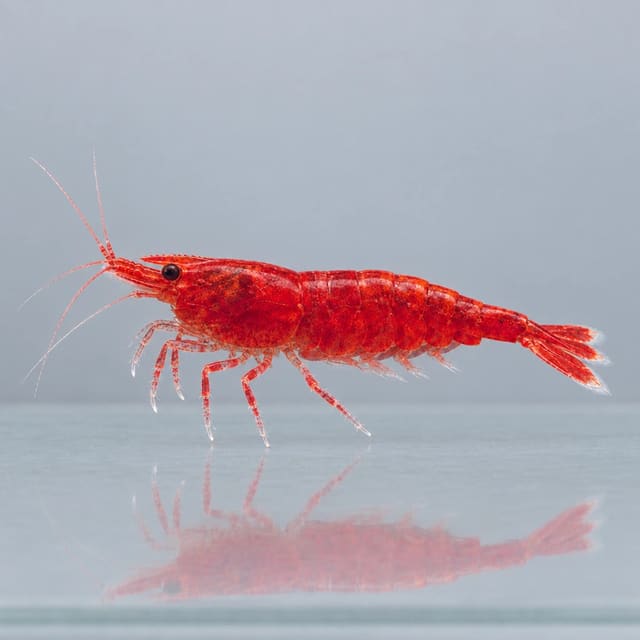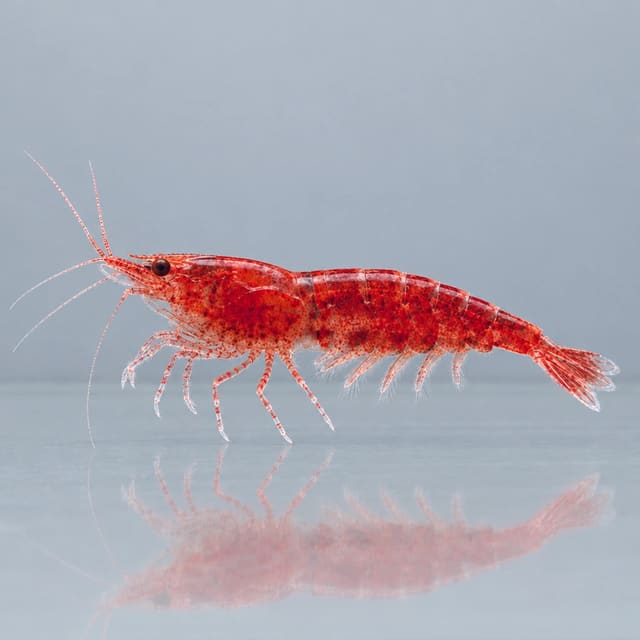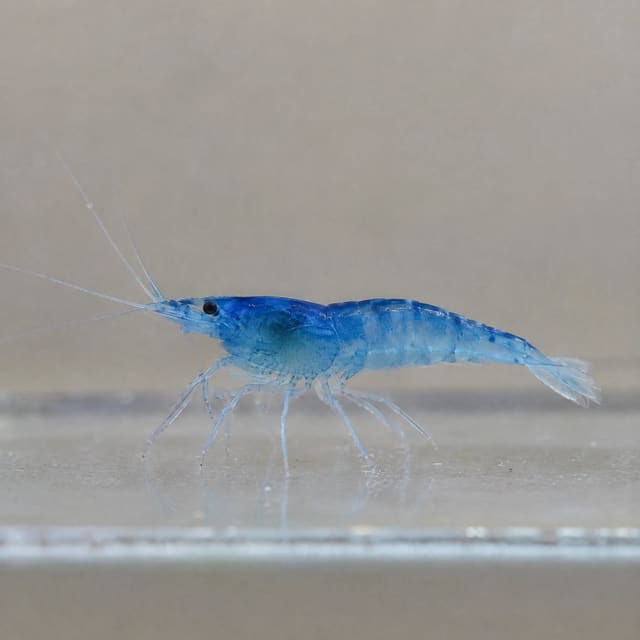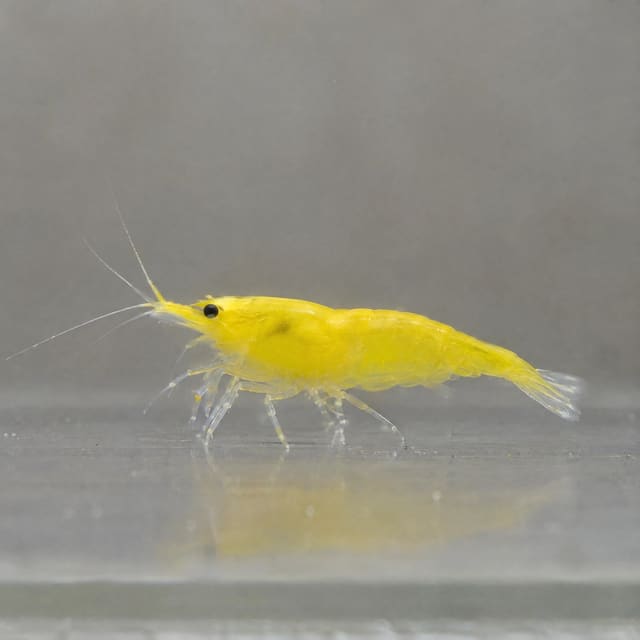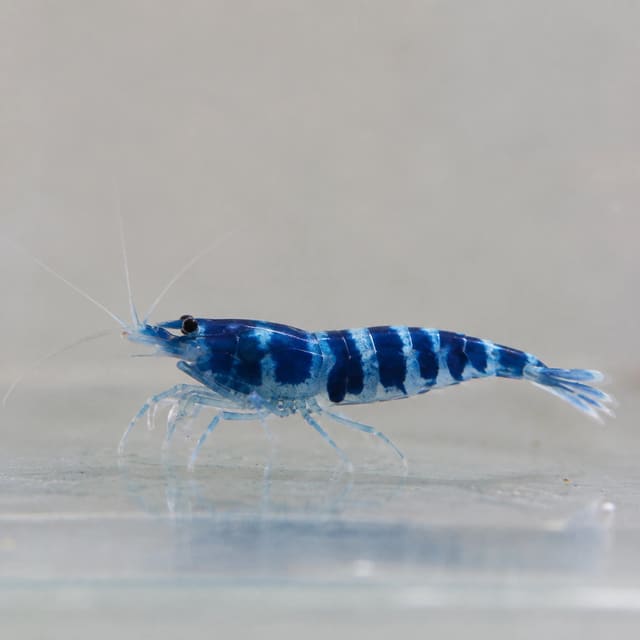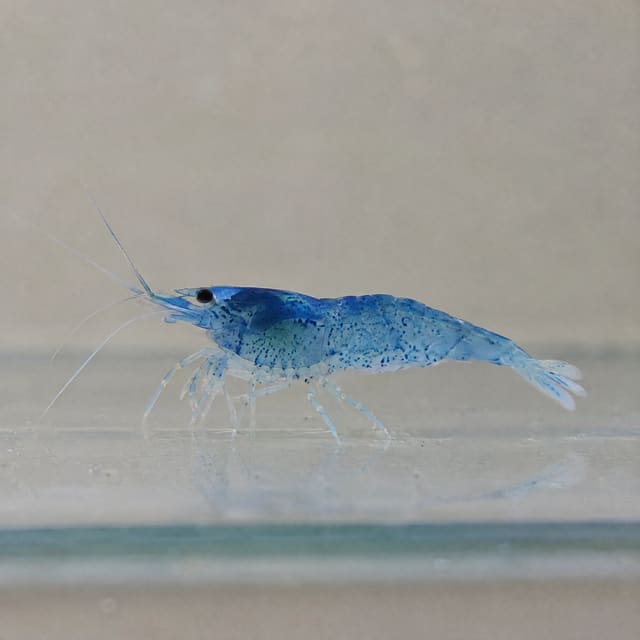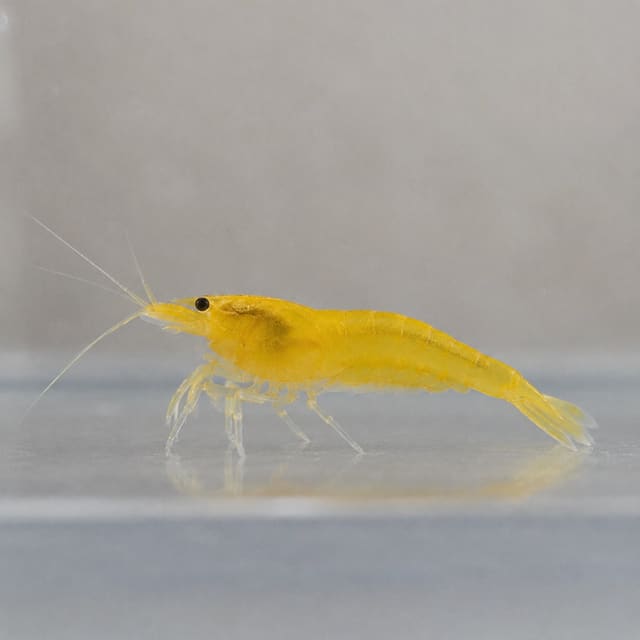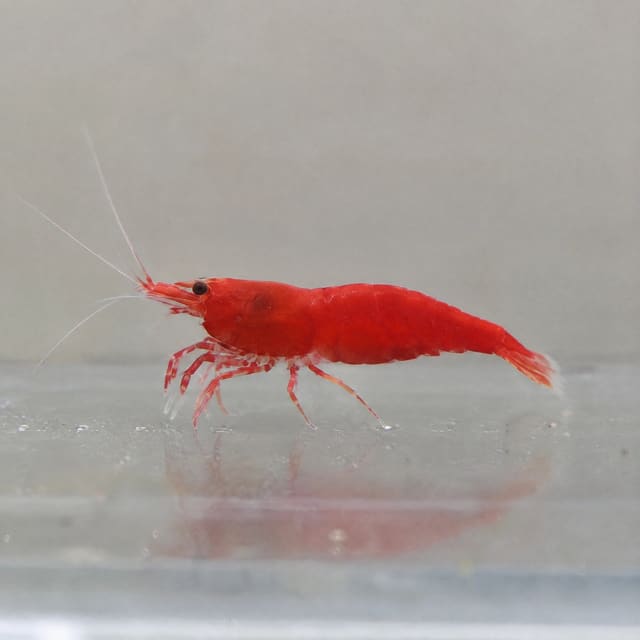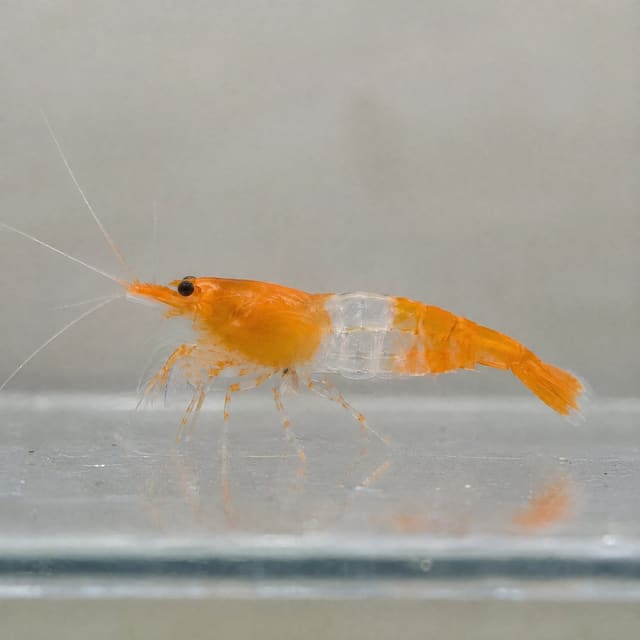
Moderate
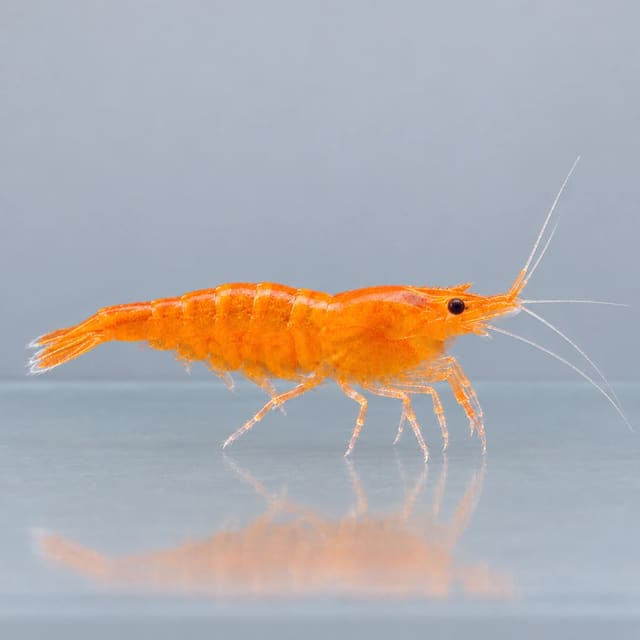
Orange Rili Shrimp (Neocaridina davidi)
17–27°C · pH 6.5–8 · 20L
£12.99
The Green Fire Shrimp is a bright green colour line of Neocaridina davidi, the cherry shrimp. Keep a group of at least five in a mature, filtered aquarium of 20 litres or more at 21–26°C, pH 6.5–8.0 and 8–18 dGH, with no copper and only one Neocaridina colour per tank. Sold individually as one live shrimp.
Adult size is the maximum length this species reaches at full maturity (scientific sources). The livestock you receive will be younger and smaller. Product-photo provenance and any image-specific limitations are stated on the listing.
Neocaridina davidi
Choose a quantity for your aquarium. Discount thresholds are pricing offers, not a stocking recommendation.
The Green Fire Shrimp is a bright green colour line of Neocaridina davidi, the cherry shrimp. Keep a group of at least five in a mature, filtered aquarium of 20 litres or more at 21–26°C, pH 6.5–8.0 and 8–18 dGH, with no copper and only one Neocaridina colour per tank. Sold individually as one live shrimp.
Adult size is the maximum length this species reaches at full maturity (scientific sources). The livestock you receive will be younger and smaller. Product-photo provenance and any image-specific limitations are stated on the listing.
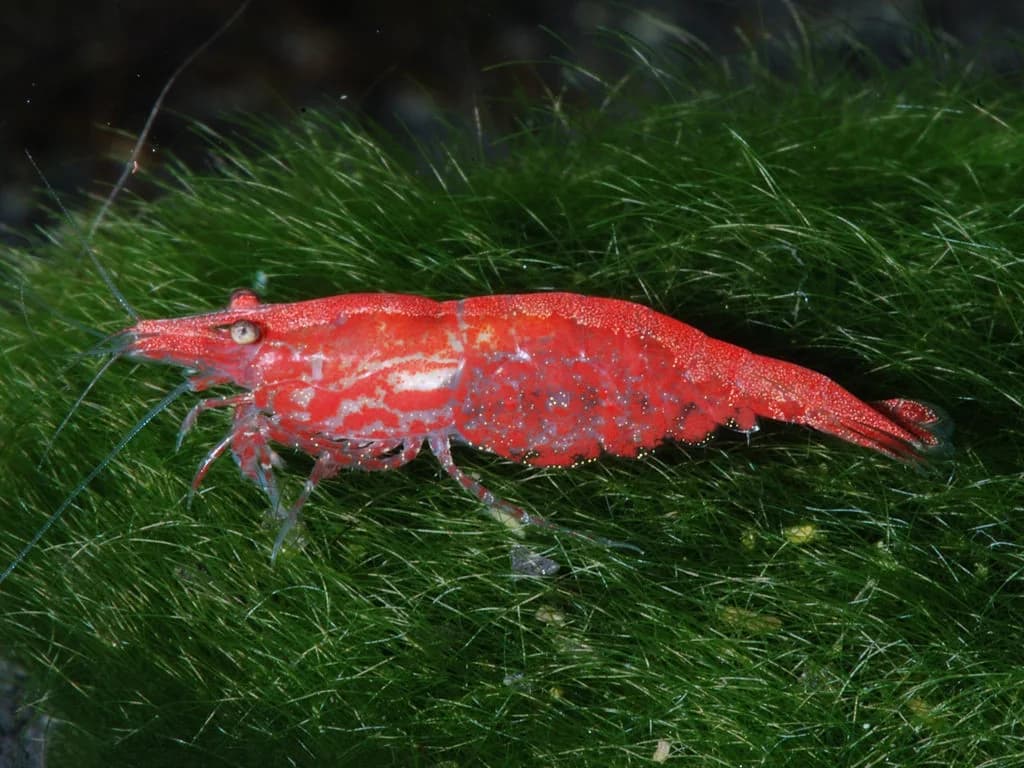
Use a mature, filtered aquarium and measured water—not a shrimp-per-litre rule. Tropical Fish Co uses 20 litres as a cautious starting policy for a small Cherry Shrimp group, above OATA's general 10-litre screen for small shrimp. Provide established grazing surfaces, cover and a protected filter inlet. No fish is guaranteed shrimplet-safe, and breeding should never be promised.
Read the full care guidance when planning conditions for your aquarium.
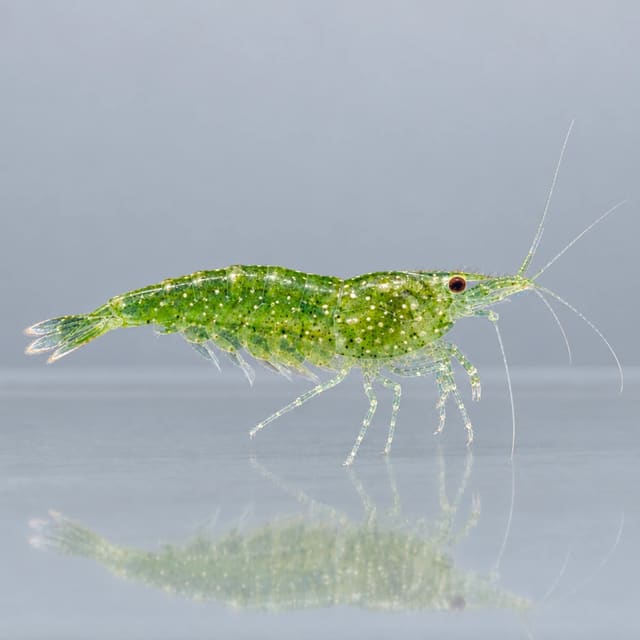
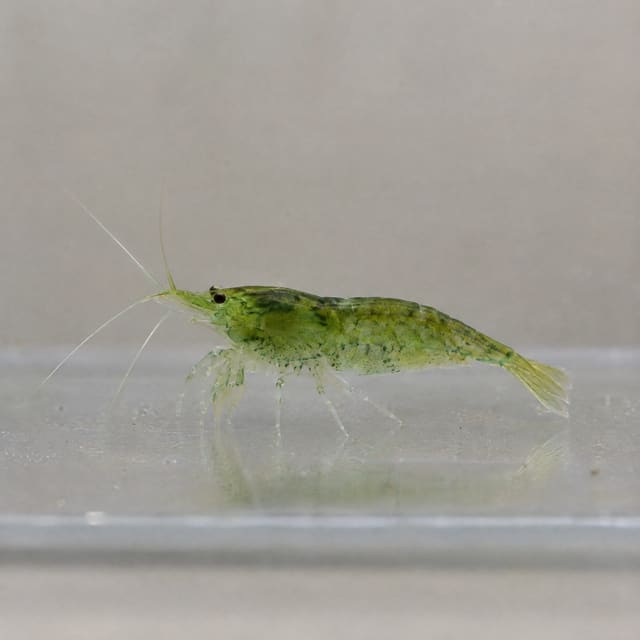
The Green Fire Shrimp is a selectively bred green colour line of Neocaridina davidi, the small freshwater shrimp the hobby calls the cherry shrimp. The shrimp in our photographs is a bright lime green with a slightly translucent body, fine dark speckling and clear legs and antennae. It is the same species as the red, yellow and blue cherry shrimp, so it shares their easy care, their appetite for biofilm and their readiness to breed in a mature aquarium.
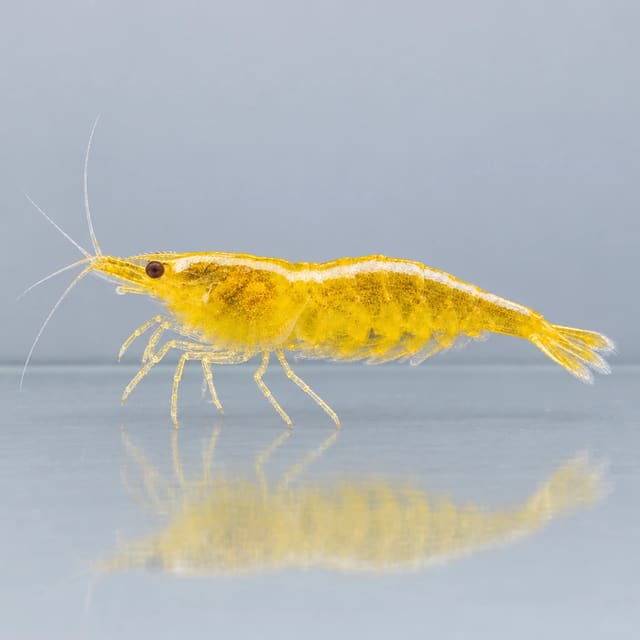
According to Wikipedia's species account, Neocaridina davidi is native to Taiwan, eastern China, the Korean Peninsula and Vietnam, and the wild form is a mottled brown. Practical Fishkeeping explains that the common name "cherry shrimp" comes from the first coloured variant bred in aquaria, the red cherry, and that breeders have since produced yellow, blue, brown, black, orange and green forms.
| Name | What it tells you |
|---|---|
| Neocaridina davidi | The species, in the family Atyidae; first described in 1904 as Caridina davidi |
| Neocaridina heteropoda, N. denticulata sinensis | Older names for the same species that still appear on some labels |
| Cherry shrimp | The common name for every colour form of the species |
| Green Fire or Fire Green | Trade names for a green colour line; other sellers use Green Jade for green lines too, and the shades overlap |
Because green trade names are used loosely, we describe exactly what the photographs show rather than relying on the name. If you already keep our Green Jade Shrimp, treat the two as the same species that will interbreed.
One purchase quantity supplies one live Green Fire Shrimp. Shrimp are not sexed at this size. Colour strength varies with age, diet, stress and the colour of the substrate, so a newly arrived shrimp is often paler than it will be once settled; the photographs show the colour form, not the individual you will receive.
Set the aquarium up and let it mature before ordering, then check our delivery and live arrival information so the shrimp go straight into a ready tank.
OATA's shrimp and snail care sheet gives a minimum of 10 litres for a small group, with more space needed if fish share the tank. Practical Fishkeeping's Neocaridina FAQ says tanks as small as 15 litres can work if they are well planted and filtered. We recommend 20 litres or more as a starting point, because larger volumes hold their temperature and water quality more steadily, and a successful group will keep growing.
Fill, filter and mature the aquarium before any shrimp go in. OATA asks for zero ammonia and nitrite before introducing livestock, and adding animals too quickly to an immature filter causes "new tank syndrome".
Green Fire Shrimp spend the day picking at surfaces. Wikipedia describes the species as an omnivore that feeds on biofilm, algae and detritus and does not eat vascular plants, so plants are safe and useful. Practical Fishkeeping recommends sand as the best substrate, because the shrimp love sifting through it for food.
| Feature | Why it helps |
|---|---|
| Fine-leaved plants and moss | Grazing surface, shelter after moulting and a refuge for young shrimp |
| Sand or fine gravel | Shrimp sift it for food; OATA notes it helps them forage |
| Wood and smooth stones | More surface for biofilm to grow on |
| A darker substrate | Colour tends to look stronger against a dark background |
| A well-fitting lid | OATA recommends one to stop shrimp jumping out |
Keep the aquarium away from draughts, radiators and direct sunlight, as OATA advises, and run the lights on a regular day and night cycle.
Neocaridina are forgiving, but they do best in stable, medium-hard water. The two UK sources below agree closely, and Practical Fishkeeping adds that although most tolerate about 18°C and up to 28°C, they live longest and breed best at 21–26°C.
| Source | Temperature | pH | General hardness | Carbonate hardness |
|---|---|---|---|---|
| OATA shrimp and snails (group guidance) | 17–27°C | 6.5–8.0 | 4–18 dGH | 3–15 dKH |
| Practical Fishkeeping (Neocaridina) | 18–26°C | 6.5–8.0 | 8–18 dGH | 5–15 dKH |
| Our planning range | 21–26°C | 6.5–8.0 | 8–18 dGH | 5–15 dKH |
The planning range uses Practical Fishkeeping's best-breeding temperatures and the hardness band where both sources agree. A heater is not always needed: Practical Fishkeeping notes that room temperature is fine for these shrimp, but if your room drops below about 18°C in winter, a small heater keeps them steady.
Very soft water is the most common mismatch. Practical Fishkeeping warns that shrimp in soft water may need calcium supplements, because calcium is needed for moulting. Compare your tap water with our water matcher before you buy.
OATA describes shrimp as very sensitive to copper, dying even at low levels. Check every medicine, plant fertiliser and water treatment for copper and for an invertebrate-safe label before it goes into the tank. Practical Fishkeeping adds that trace amounts in foods and fertilisers are usually harmless unless other sources add to them, so avoid stacking products.
Shrimp need clean water but not strong currents. Practical Fishkeeping's author prefers air-driven sponge filters because they make a perfect grazing ground for the young shrimp. If you use a power filter, cover the intake with a fine sponge so baby shrimp cannot be drawn in.
Our shrimp-keeping guide covers filter choice and water changes for every kind of dwarf shrimp.
A mature tank feeds shrimp all day through biofilm and soft algae, so added food is a supplement. OATA describes shrimp as mainly herbivorous grazers and suggests algae wafers or shrimp pellets two or three times a week, leaving the food in for at least 30 minutes and avoiding overfeeding. Our green algae wafers break down into pieces small shrimp can share.
Leave shed skins in the tank. Wikipedia explains that the shrimp eat their old exoskeletons to recover nutrients, so moults should not be removed.
Shrimp react badly to sudden changes in water chemistry, so take longer over acclimatisation than you would for most fish. OATA's method is to turn the lights off, float the sealed bag for 10 minutes, then add tank water to the bag gradually over at least 30 minutes before releasing the shrimp.
| Checkpoint | What to do |
|---|---|
| Before arrival | Confirm zero ammonia and nitrite and a stable temperature |
| Release | Net the shrimp across and leave the bag water behind |
| First day | No food; let them settle and graze the surfaces |
| Days two to seven | Small feeds only, and a daily look for normal grazing |
| End of week | Full water test and your first routine water change |
OATA advises monitoring closely for the first week. A few shrimp hiding is normal; shrimp swimming frantically or lying on their sides is a reason to test immediately.
Shrimp grow by shedding their exoskeleton. OATA notes that shrimp moult frequently and that a shed skin can look like a dead shrimp, and Wikipedia adds that juveniles moult more often than adults. A healthy colony grazes steadily, carries eggs regularly and shows good colour.
| If you see | Do this first |
|---|---|
| Several deaths soon after a water change | Check the new water's temperature, conditioner and hardness |
| Shrimp stuck part-way through a moult | Test hardness; very soft water may lack the minerals they need |
| Frantic swimming or shrimp on their sides | Test ammonia and nitrite and look for any recent copper source |
| Faded colour | Review diet, stress and substrate colour before worrying |
| Females dropping eggs | Wikipedia notes stressed or first-time females may abandon eggs; keep conditions stable |
OATA lists exoskeleton damage, white spots, lesions, changes in colour and feeding, and unusual swimming as signs to watch. Test the water before anything else.
Every cherry shrimp colour is the same species. Practical Fishkeeping is direct about it: the different forms all crossbreed, so never keep several Neocaridina varieties together. Mixed colonies produce off-colour young and revert to plain brownish shrimp after a few generations.
Browse every colour in our cherry shrimp range or the Neocaridina shrimp category to plan one colour per tank.
OATA's rule is simple: do not keep shrimp with fish that can fit them in their mouths, or with predatory species. Practical Fishkeeping adds that shrimp fare, and breed, better in a dedicated shrimp tank, but names snails, other dwarf shrimp and small Otocinclus, Corydoras and plecs as relatively safe companions.
| Suits | Avoid |
|---|---|
| Snails such as our Sun Nerite Snail | Any fish large enough to swallow an adult shrimp |
| Larger shrimp that do not interbreed, such as the Amano Shrimp | Other Neocaridina davidi colours, which interbreed |
| Small Otocinclus and Corydoras | Predatory fish, crayfish and large crabs |
| A shrimp-only tank for the most young | Medicines or fertilisers containing copper |
Even small fish will pick off newborn shrimp, so dense moss and plants decide how many young survive in a community tank. See all shrimps and crustaceans for more invertebrate companions.
Green Fire Shrimp breed readily in fresh water with no special set-up. Wikipedia describes a visible "saddle", the developing ovary on the female's back, as a sign that she is ready to mate. After mating, she carries about 20–30 eggs on the swimmerets under her tail until they hatch.
| Stage | What the sources say |
|---|---|
| Eggs carried | About three weeks (Wikipedia gives 2–3 weeks; Practical Fishkeeping three weeks to a month) |
| Hatching | No larval stage: the young are about 1 mm and look like tiny adults |
| Early care | Practical Fishkeeping notes they need no special care if there is enough biofilm |
| Maturity | Wikipedia gives approximately two months, though its own figures vary |
| Lifespan | Wikipedia gives 1–2 years; Practical Fishkeeping says rarely longer than 12–18 months |
Never release shrimp or their young into ponds, rivers or drains. Wikipedia records Neocaridina davidi as invasive in warmed waterways in Germany, Poland, Japan and the United States, from released aquarium shrimp. Our cherry shrimp care guide and cherry shrimp buying guide cover colony management in more depth, and the wider freshwater shrimp category lists every species we keep.
Start with at least five, as OATA recommends, or six as Practical Fishkeeping suggests. A group of that size almost always contains both sexes and settles faster.
Not if you want green young. All cherry shrimp colours are the same species and interbreed, and mixed colonies drift back to brownish shrimp within a few generations.
Not if your room stays above about 18°C. They tolerate 18–28°C, but Practical Fishkeeping says they live longest and breed best at 21–26°C, so a small heater helps in a cold room.
OATA's minimum is 10 litres for a small group, and Practical Fishkeeping says 15 litres can work if well planted. We recommend 20 litres or more for a stable start.
Biofilm and algae in a mature tank, plus algae wafers or shrimp food two or three times a week, removed if not eaten. Leave their shed skins in the tank.
Both are green colour lines of Neocaridina davidi, and trade names for green lines overlap. They will interbreed, so keep them in the same tank only if you are happy with mixed green offspring.
Colour varies with age, diet, stress and substrate colour. Newly moved shrimp are often paler and usually colour up once settled in stable water.
OATA says avoid any fish that can fit a shrimp in its mouth. Practical Fishkeeping names snails, other dwarf shrimp and small Otocinclus, Corydoras and plecs as relatively safe, but a shrimp-only tank raises the most young.
No reviews for this item yet. Bought one? Honest reviews only, good or bad.
What customers say about ordering from us
Easy website plenty of info on fish your buying great to pick a time slot
TRACEY DURRANT · 7 Oct 2026
Got some lovely fish thank you
Kevin Mackie · 7 Oct 2026
Reviews of our shop, collected by Judge.me, an independent third-party review collector. Newest first.
Moved by UK carriers licensed to handle live animals
Hand-packed with oxygen bags, poly box, heat pack
Email photos the same day; an optional unboxing video helps us review problems faster — claim terms apply
Klarna & PayPal Pay in 3 at checkout