Moderate
Blue Velvet Shrimp (Neocaridina davidi)
17–27°C · pH 6.5–8
£14.99

Blue Dream Shrimp are a deep blue, selectively bred colour form of Neocaridina davidi. Each unit is one shrimp at 1-1.5 cm or 2-2.5 cm, sex not chosen; start with six or more. Peaceful grazers for a mature planted tank at 18-28 C and pH 6.5-8.0, kept well away from copper.
Adult size is the maximum length this species reaches at full maturity (scientific sources). The livestock you receive will be younger and smaller — pick a size above for the actual shipping size. Product-photo provenance and any image-specific limitations are stated on the listing.
Neocaridina davidi
Lives in groups: kept together they stay settled, active and show their best colour.
Blue Dream Shrimp are a deep blue, selectively bred colour form of Neocaridina davidi. Each unit is one shrimp at 1-1.5 cm or 2-2.5 cm, sex not chosen; start with six or more. Peaceful grazers for a mature planted tank at 18-28 C and pH 6.5-8.0, kept well away from copper.
Adult size is the maximum length this species reaches at full maturity (scientific sources). The livestock you receive will be younger and smaller — pick a size above for the actual shipping size. Product-photo provenance and any image-specific limitations are stated on the listing.
Use a mature, filtered aquarium and measured water—not a shrimp-per-litre rule. Tropical Fish Co uses 20 litres as a cautious starting policy for a small Cherry Shrimp group, above OATA's general 10-litre screen for small shrimp. Provide established grazing surfaces, cover and a protected filter inlet. No fish is guaranteed shrimplet-safe, and breeding should never be promised.
Maintain these water conditions for optimal health and vibrant colors
Blue Dream is a deep blue colour form of Neocaridina davidi, the small freshwater shrimp most keepers know as the cherry shrimp. Each unit on this listing is one shrimp, and you choose between two size grades: 1–1.5 cm or 2–2.5 cm. Those are the sizes at dispatch, not adult sizes. The shrimp are not sexed, so we do not promise males or females in any order.
Because these are social animals, please do not buy just one. The UK trade association OATA advises keeping freshwater shrimp in groups of at least five and warns that shrimp kept singly or in very small numbers often become stressed. We suggest starting with six or more. That also gives you the best chance of both sexes being present, which is what you need if you hope the group will breed.
An adult Blue Dream is around 3 cm long, so the larger 2–2.5 cm grade is close to full size, with the differences between males and females easier to see. The 1–1.5 cm grade has more growing ahead of it. Both grades are the same animal with the same care; the choice is mostly about whether you want a fuller-looking group straight away.
The species was first described by the French zoologist E.-L. Bouvier in 1904, originally under the genus Caridina. Neocaridina was split off as its own genus in 1938, and since then the shrimp has been sold under a string of names, including Neocaridina heteropoda, Neocaridina denticulata sinensis and Caridina davidi. The World Register of Marine Species, which also catalogues freshwater animals, lists Neocaridina davidi (Bouvier, 1904) as the accepted name and treats N. heteropoda as a junior synonym. Older books and some care sheets still use those earlier names, and OATA’s sheet files cherry shrimp under Caridina cantonensis. If you see “heteropoda” on an older label, it is the same shrimp.
Wild Neocaridina davidi are nothing like this. Their natural colouring is a mottled brown to greenish-brown, which is thought to work as camouflage against predators and possibly as a signal of health to potential mates. Every colour form of this species, from red and yellow to green, violet, black and blue, has been produced by selective breeding from that wild stock.
The shrimp body is semi-translucent, so what you see is a combination of colour in the flesh underneath and colour in the shell itself. The colour cells in the shell are of several kinds: some carry yellow or orange pigment, some red, some black or brown, some white, and some, called iridophores, reflect blue light. According to Wikipedia’s account, blue shrimp owe their colour either to iridophores reflecting blue or to a lack of black-pigment cells combined with bluish flesh. Pigment in the diet is thought to feed some of these colour cells, which is one reason a varied diet matters for a colour form.
The same set of colour cells explains the rest of the Neocaridina rainbow. Yellow comes from xanthophores, red from erythrophores, black and brown from melanophores and white from leucophores. Green shrimp combine blue-reflecting iridophores with yellow xanthophores, and violet ones pair iridophores with red erythrophores. The cells hold different substances, too: melanophores make melanin, xanthophores and erythrophores carry pteridines and carotenoids, and iridophores and leucophores contain purines. A Blue Dream is a shrimp in which the blue-reflecting cells, or bluish flesh showing through a shell without dark pigment, do most of the work.
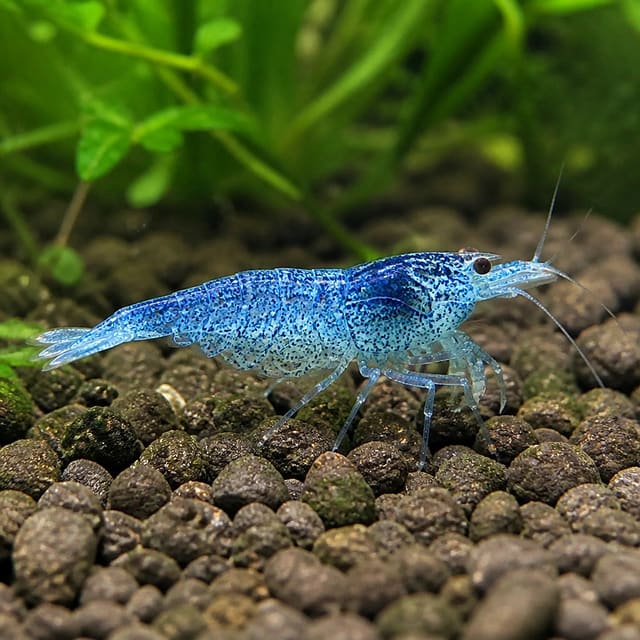
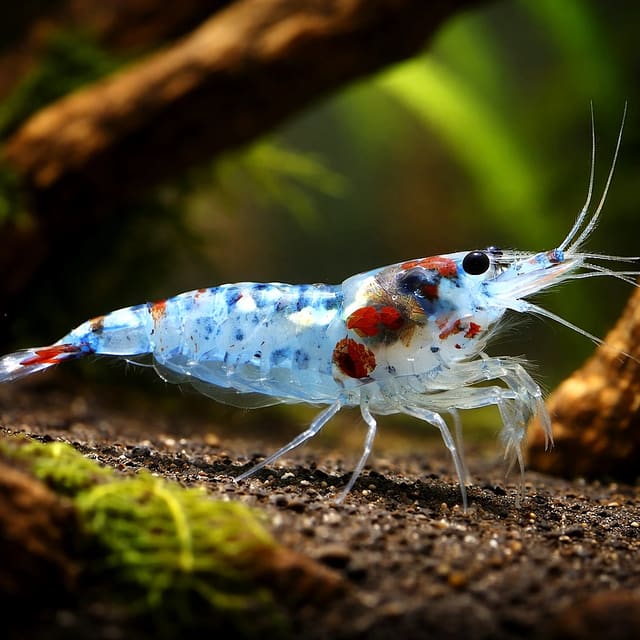
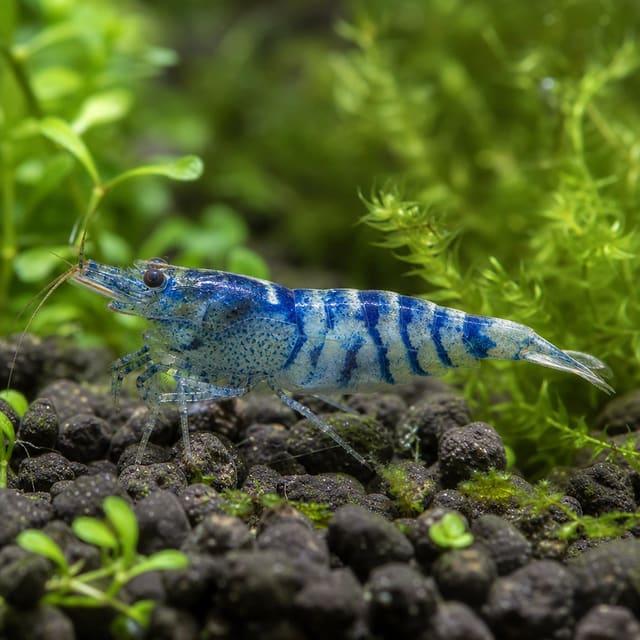
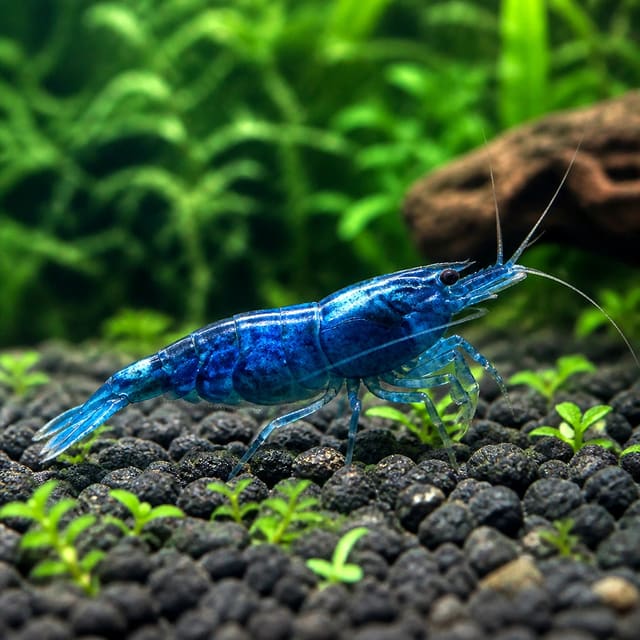
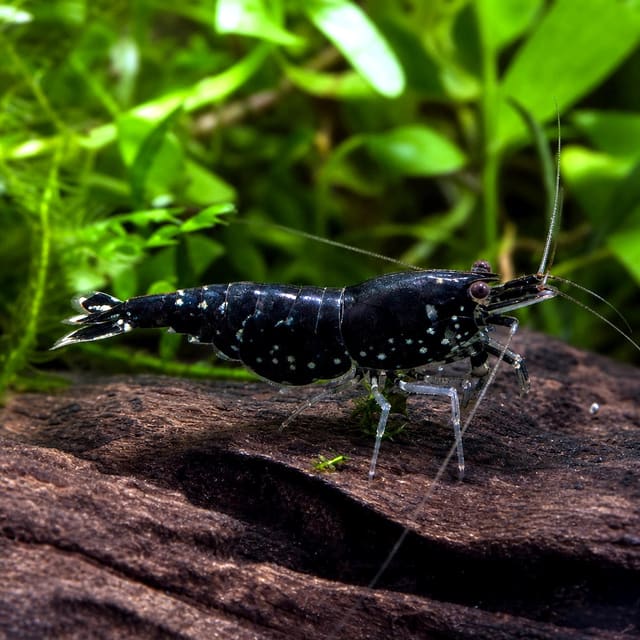
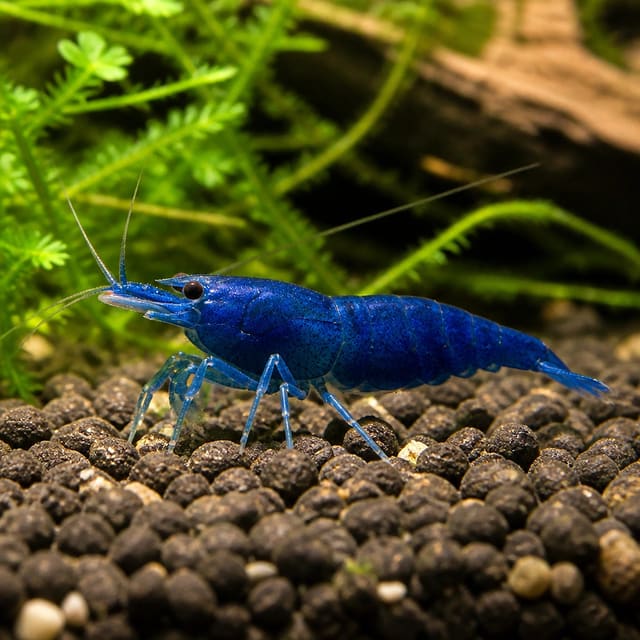
In our photograph, the shrimp shows the look Blue Dream keepers are after: a solid, deep blue from the head to the tail fan, with fine darker speckling across the body, blue legs and long antennae, standing out clearly against dark aquarium soil. Females typically carry richer, more opaque colour than males, which are smaller and often paler, so a mixed group will always show some variation.
All of these colour forms are one species, and Wikipedia notes there is limited public information on how the colours are inherited. In practice that means a Blue Dream colony kept alongside red, yellow or other blue lines will cross with them, and you cannot predict what the young will look like. If you want a tank of blue shrimp in a few generations’ time, keep one colour line per aquarium. We list several other blue Neocaridina lines too, such as Blue Velvet Shrimp, Blue Diamond Shrimp and the patterned Blue Rili Shrimp; they suit the same water, but each is best kept as its own colony if you plan to breed.
Neocaridina davidi is native to Taiwan, eastern China, the Korean Peninsula and Vietnam, where it lives in inland waters of every kind: lakes, ponds, rivers and streams. The native range is fairly small. The species is now kept around the world, and its population is thought to run into the billions, most of them in aquariums and in places it has been introduced.
That last point is the important one for any keeper. The species tolerates a wide range of conditions, and shrimp released from captivity have established themselves in thermally polluted, artificially warmed waterways in Japan, the United States, Poland and Germany. Please never tip unwanted shrimp, or the water from their tank, into a pond, stream or garden. If you have more shrimp than you can house, a local aquatic shop or fellow keeper is the answer.
A shrimp that lives in ponds, streams and lakes across that range is not a specialist of one narrow water type, which is part of why the species is so forgiving in the aquarium. It still needs clean, well-oxygenated water, plenty of surfaces to graze and cover to hide in. The researchers behind the 2015 temperature study described the species as popular with aquarists for its red, yellow and blue colour forms, yet noted how little hard data existed on its growth and breeding, which is why their figures are quoted so often on this page.
We recommend at least 20 litres for a Blue Dream group. OATA gives 10 litres as the minimum for a small group of shrimp, but more water holds its temperature and chemistry more steadily, and stability is what a breeding colony needs. Larger tanks are better still, and a colony will spread to fill the space.
OATA recommends aquarium gravel or sand with live plants for cover, or plastic plants and suitable ornaments if live plants are not an option. Live plants are the better choice for these shrimp for two reasons. First, they give cover to timid adults and to newborn shrimp. Second, the shrimp do not eat healthy plants: Wikipedia’s account says they feed on biofilm, algae and detritus and do not eat vascular plants. Moss is especially useful. The researchers in a 2015 study on this species gave each breeding tank a small clump of Java moss as shelter, and in a home aquarium moss collects the fine film of microbes and debris that shrimp spend their days picking over.
Dark substrates and dark backgrounds make blue shrimp stand out, as the photograph on this page shows, but the colour of the gravel is a matter of taste rather than welfare.
OATA describes a filter as always essential. For shrimp, the main concern is the intake. A baby Neocaridina is roughly 1 mm long when it hatches, small enough to be drawn into an open filter intake, so use a sponge filter or cover the intake of any other filter with a fine sponge. A sponge also grows the same biofilm the shrimp graze on, so it doubles as a feeding surface.
Set the aquarium up, plant it and let the filter cycle fully before the shrimp arrive. A mature tank has the surface films and algae that make up a large part of a Neocaridina’s natural diet, and it is far more stable than a new one. A heater is useful in a cool room, and a lid helps to keep the temperature steady.
| Element | Our recommendation |
|---|---|
| Tank size | 20 litres or more, fully cycled |
| Substrate | Gravel or sand; dark colours show blue shrimp well |
| Plants | Live plants and moss for cover and grazing |
| Filter | Sponge filter, or any filter with a sponge-covered intake |
| Group | Six or more shrimp of one colour line |
Our care range for Blue Dream shrimp is 18–28 °C, pH 6.5–8.0 and a general hardness of 4–15 °dGH. That sits within the broad guidance OATA gives for freshwater shrimp in the home aquarium:
| Measure | OATA guidance for freshwater shrimp |
|---|---|
| Temperature | 17–27 °C |
| pH | 6.5–8.0 |
| General hardness | 4–18 °dH |
| Carbonate hardness | 3–15 °dKH |
| Ammonia | zero |
| Nitrite | zero |
| Nitrate | no more than 20 mg per litre above your tap water level |
OATA’s figures cover shrimp as a group rather than this species alone, so treat them as a sensible frame and our species range as the target.
The most useful research on this question is a 2015 study by Tropea, Stumpf and López Greco, published in PLOS ONE, which kept cherry shrimp at 24, 28 and 32 °C. Survival and growth were good at all three temperatures over 90 days, and the young shrimp grew up, matured and mated within that time. A few findings are worth knowing:
Survival was highest at 28 °C in both of the study’s experiments, and the authors saw a hint that 24 °C was slightly less comfortable in one of them, though growth caught up. For a home colony that translates simply: a stable temperature in the low to mid twenties suits these shrimp, warmer water speeds breeding up a little, and water above 28 °C is best avoided. A summer heatwave that pushes a tank past 30 °C is worth guarding against with shade and good ventilation. If your room stays within our range all year, a heater is optional; if it drops below 18 °C in winter, fit one.
GH and KH both appear in OATA’s guidance, and shrimp keepers talk about them a lot. General hardness (GH) measures dissolved calcium and magnesium; carbonate hardness (KH) measures carbonates and bicarbonates, which buffer the water against swings in pH. A liquid test kit for each is inexpensive and takes minutes. Test your tap water as well as the tank. OATA sets its nitrate limit relative to your tap supply, no more than 20 mg per litre above it, so you need to know the starting figure. Ammonia and nitrite, by contrast, should read zero in the tank. Keep a simple note of each result; a slow drift is far easier to spot on paper than by memory.
Wikipedia’s account notes that breeding needs only a sexed pair, food and stable water parameters, and that females may drop their eggs when stressed. Sudden swings in temperature, pH or hardness are more harmful than a value that is simply at one end of the range. OATA recommends a partial water change of 25% at least once a week to stop ammonia and nitrite building up. Match the temperature of the new water, treat tap water with a dechlorinator, and take the same amount each week rather than making occasional large changes.
If there is one rule to remember with any shrimp, it is this one. OATA puts it plainly: being invertebrates, freshwater shrimp are very sensitive to copper and will die if exposed even to low levels. Copper turns up in more places than most fish keepers realise.
A shrimp tank that has been kept free of copper from the start is far easier to manage than one you are trying to clear after a mistake. When you set up, use new equipment where you can, or equipment that has only ever been used for shrimp.
Blue Dream shrimp grow by moulting, shedding the old shell periodically as they get bigger. Young shrimp moult more often than adults. A cast-off shell is translucent, sometimes whitish, and is a near-perfect empty copy of the shrimp, which is why OATA warns that moults can look like dead shrimp. Look for a body inside before you worry. Leave the moult in the tank, too: the shrimp eat their shed shells to recover the nutrients they contain, so removing them takes food away from the colony.
A moult is an empty shell; a dead shrimp still has its body inside. Remove any dead shrimp promptly, test the water, and if more follow, look first at ammonia, nitrite and anything new that has gone into the tank.
OATA suggests watching swimming behaviour, colour, temperament, breathing, appearance, condition and feeding for any change from normal. Healthy Blue Dream shrimp are busy: once settled they spend most of their time picking at surfaces with their front legs, and they come readily to food. Shrimp that sit still and stop feeding, lose colour suddenly, or swim restlessly at the surface are telling you to test the water.
Watch a Blue Dream for a minute and you will see how it eats. The first two pairs of legs end in tiny claws, called chelae, which the shrimp uses to pick up food and pass it to the mouth, working almost without pause. Wikipedia describes the species as an omnivore that feeds on biofilm, algae and detritus. In a mature, planted tank a group will find much of its own food on plant leaves, moss, stones and the filter sponge.
OATA advises supplementing grazing with algae wafers and commercial pellets, fed two or three times a week, and leaving pellets or wafers in place for at least 30 minutes so the shrimp have time to find them. The research colony in the 2015 temperature study was fed a commercial tropical-fish flake every day, as much as the shrimp would take, which shows how unfussy the species is. A sensible home routine is a small amount of a sinking shrimp or algae food a few times a week, with blanched vegetables now and then for variety.
Leave food in place for at least the 30 minutes OATA suggests, then remove whatever is still there after a few hours. Uneaten food in a small tank is the quickest way to push ammonia and nitrite above zero, and both should stay at zero for shrimp. In a mature tank full of biofilm and algae, a light hand with supplementary food is the safer habit.
OATA describes freshwater shrimp in general as mostly herbivorous algae grazers, while Wikipedia’s species account calls N. davidi an omnivore that also eats detritus. Both point the same way in practice: build the diet on algae and biofilm and add prepared food on top. The 2015 research colony showed good survival and growth on a tropical-fish flake of about 47.5% protein, so a protein-rich prepared food is clearly fine in moderation.
Pigments taken in with food are thought to supply some of the colour cells in the shell, so a varied diet that includes algae-based foods is a good habit for a colour form like Blue Dream.
OATA’s rule for shrimp tank mates is short and clear: freshwater shrimp should not be mixed with any fish that can fit them in its mouth, or with any species known to be predatory. With adults around 3 cm and newborns about 1 mm, that rules out most fish for anyone who wants the colony to grow, because almost any fish can fit a 1 mm baby in its mouth.
Avoid large fish, predatory species and anything known to eat invertebrates.
Neocaridina are non-aggressive. Wikipedia describes them as timid shrimp that spend most of their time scavenging for food, and they leave healthy plants alone. Because they are timid, expect new arrivals to stay in cover at first; plants and moss give them somewhere to feel safe while they settle. OATA notes that shrimp kept singly or in very small groups often become stressed, which is the best reason of all to start with six or more.
Neocaridina davidi breeds readily in an aquarium. According to Wikipedia’s account, all it needs is a sexed pair, stable water and a source of food. In the 2015 temperature study, shrimp hatched in the laboratory grew up, matured and mated within 90 days.
The babies need nothing special beyond what a mature, planted tank already offers: biofilm, algae, a little finely powdered food, plenty of moss to hide in, and a sponge-covered filter intake. Sources differ slightly on how fast they grow up: Wikipedia’s account says maturity at around 30 days in one place and about two months in another, and in the 2015 study shrimp hatched in the laboratory matured and mated within 90 days. Plan on a couple of months before the new generation breeds.
| Stage | What the sources report |
|---|---|
| Eggs per brood | 20–30 (Wikipedia); about 24 babies hatched per female in the 2015 study |
| Time to hatch | 2–3 weeks; about 21 days at 24 °C, about 12 days at 32 °C |
| Size at hatching | Roughly 1 mm, fully formed, no larval stage |
| Age at first breeding | About two months (Wikipedia); mated within 90 days in the 2015 study |
| Lifespan | About one to two years |
A few details from the 2015 study help with expectations. The number of babies a female produced did not depend on her size across the range they weighed, roughly 50 to 120 mg, so a small female is not necessarily a poor breeder. In the groups the researchers raised from hatching, females slightly outnumbered males in every case, at between about 52% and 61% female. And their breeding stock lived in modest conditions: 8-litre tanks of dechlorinated tap water at 27 °C, pH 7.5 and a hardness of 80 mg per litre as calcium carbonate (about 4.5 °dGH), with a small clump of Java moss each and a daily feed of tropical flake. Nothing exotic is needed to breed these shrimp.
That sex ratio is also why we suggest starting with six. If the sexes come out roughly even, as they did in that study, the chance of six unsexed shrimp all being the same sex is only about 3 in 100, so a group of six will very rarely be all one sex. That is a matter of odds rather than a promise, and a larger starting group improves them further.
Females may abandon their eggs if they are stressed or carrying eggs for the first time. That is normal and is no reason to change everything at once. If it keeps happening, look at temperature (remember that females at 32 °C lost all their eggs in the study above), water stability and disturbance. The lifespan of these shrimp is short, about one to two years, so a steady colony depends on regular breeding rather than on individual shrimp living a long time.
Before the parcel arrives, have the aquarium completely ready: cycled, filter running, water tested and the temperature within the range on this page. Someone must be at the delivery address to receive live animals. Please read our delivery and live-arrival information before you order. Your shrimp travel in oxygen-filled bags inside insulated packaging, with heat packs when conditions call for them, carried by a tracked courier licensed to transport live animals. We email you the confirmed delivery date and the tracking details.
Start a continuous unboxing video while the parcel is still sealed. Open it in the same take and show the shrimp in the still-sealed bag. If any arrive dead, dying or clearly in poor condition, email hello@tropicalfishco.co.uk on the day of delivery with your order number and that video. Photos alone do not meet our live-arrival policy. Where a claim is accepted under the guarantee terms, we replace the affected shrimp with your next order or refund them.
One shrimp-specific point when filming: an empty moult in the bag is not a dead shrimp. Shrimp moult frequently and the cast shell looks very like a whole animal, so check for a body inside before you count.
Keep the lights low for the rest of the first day. Expect the shrimp to hide among plants or moss at first; that is normal for a timid species in a new tank. Over the following week watch their breathing, appetite and behaviour. Offer a small amount of food after a day or two and remove what is left. Once settled, they will spend most of their time picking over plants and other surfaces. If several sit motionless, refuse food or swim frantically, test the water and contact us.
The facts on this page are drawn from these sources:
No reviews for this item yet. Bought one? Honest reviews only, good or bad.
What customers say about ordering from us
I have a small group of long finned mountain minnows. So was delighted to be able to order ten of this variety to increase the genetics in my tank . The ones I recieved are healthy but it’s to early to give a verdict on wether they are of a long finned type since they are small currently.
Gordon Walker · 23 Sept 2026
100% success travel and "installation". Pleased with quality of purchase. The Siamese fighter a bit "shy" so have not yet seen him at his best yet but looking good. Happy customer. GG
George E Garratt · 21 Sept 2026
Reviews of our shop, collected by Judge.me, an independent third-party review collector. Newest first.