Moderate
Matadi Violet Ocellated Kribensis (Pelvicachromis subocellatus)
22–27°C · pH 6–7.5 · 80L
£10.99
The Lucanusi Krib (Enigmatochromis lucanusi), first sold as Pelvicachromis sp. "Blue Fin", is a small, peaceful West African dwarf cichlid from a single stream in Guinea. Females wear a bright blue dorsal fin and a crimson belly, and pairs spawn in caves and guard their young together. It suits a planted 60–80 litre aquarium with caves and wood. Sold individually as one live fish.
Adult size is the maximum length this species reaches at full maturity (scientific sources). The livestock you receive will be younger and smaller. Product-photo provenance and any image-specific limitations are stated on the listing.
Enigmatochromis lucanusi
Save when buying multiple fish. Each quantity is one fish; sex and pair formation are not guaranteed unless the selected variant explicitly states them.
The Lucanusi Krib (Enigmatochromis lucanusi), first sold as Pelvicachromis sp. "Blue Fin", is a small, peaceful West African dwarf cichlid from a single stream in Guinea. Females wear a bright blue dorsal fin and a crimson belly, and pairs spawn in caves and guard their young together. It suits a planted 60–80 litre aquarium with caves and wood. Sold individually as one live fish.
Adult size is the maximum length this species reaches at full maturity (scientific sources). The livestock you receive will be younger and smaller. Product-photo provenance and any image-specific limitations are stated on the listing.
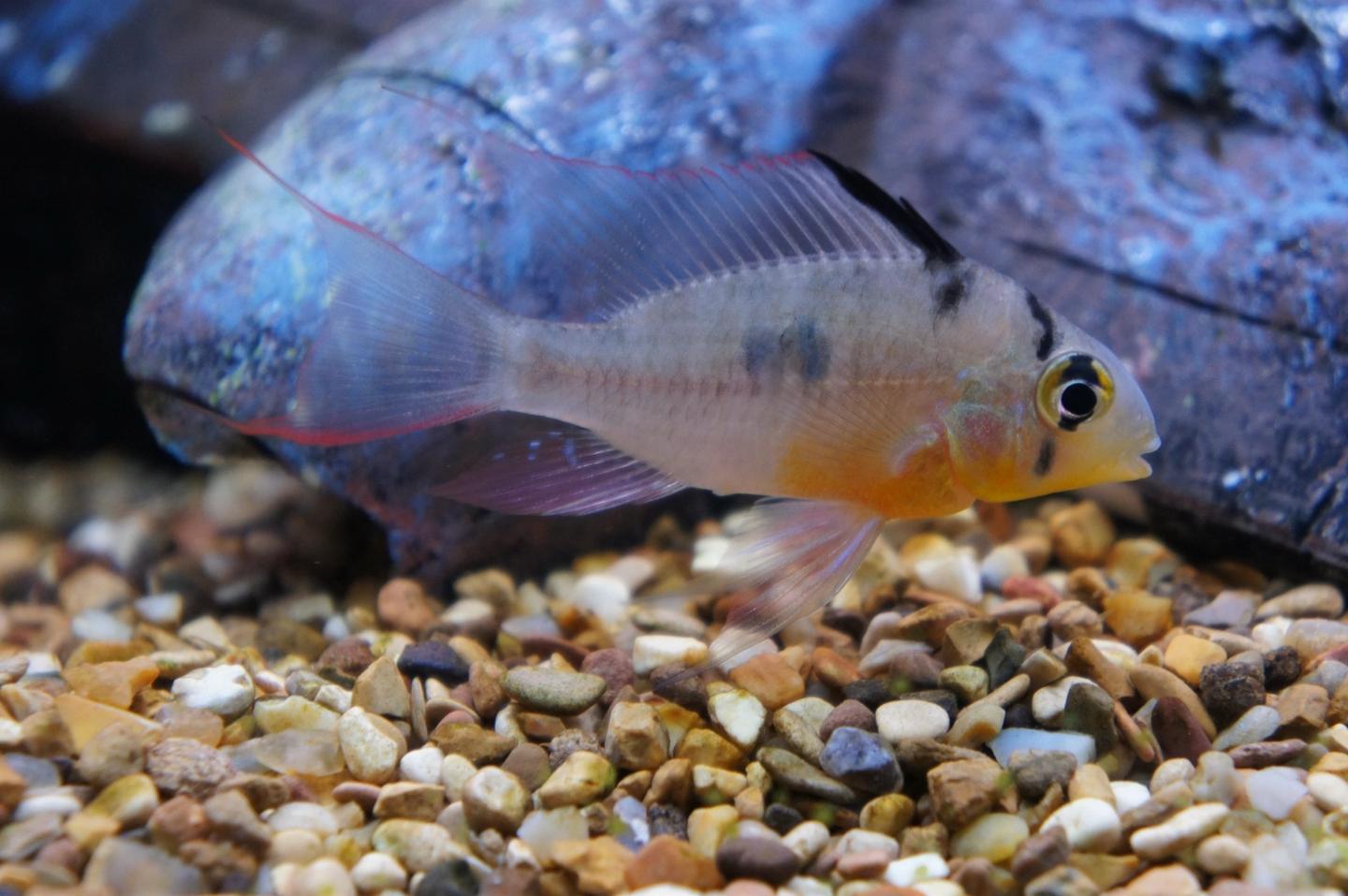
Cichlids are a family of roughly 1,800 accepted species, not one care type. Before buying, identify the exact species and source, then compare adult measurement, usable tank dimensions, social system, territory, tested water, diet and an exit plan. No family-wide minimum tank, water range or tank-mate list is safe.
The Lucanusi Krib (Enigmatochromis lucanusi) is a small West African cave-spawning cichlid that looks like a kribensis at first glance. Aquarists first knew it as Pelvicachromis sp. "Blue Fin", and shops still list it as "Pelvicachromis lucanusi", but it belongs to a genus of its own. It is known from one place only: the Foto River, a small savannah stream that joins the Konkouré River near Fria in coastal Guinea. For a planted aquarium it is one of the most peaceful dwarf cichlids you can keep.
Its names tell its story. According to Wikipedia, Enigmatochromis refers to an enigma: the colours resemble many Pelvicachromis, while the body shape is closer to Parananochromis. The species name honours Oliver Lucanus, the collector and aquarist who told Anton Lamboj where to find it. The fish reached the USA, Canada and Europe in 2004, where most keepers assumed it was a Pelvicachromis.
| Name | Status |
|---|---|
| Enigmatochromis lucanusi Lamboj, 2009 | The scientific name; the only species in its genus |
| Pelvicachromis sp. "Blue Fin", "Blue Fin Roloffi" | Trade names used before the description |
| Lucanusi Krib | UK trade name, used for this listing |
| "Pelvicachromis lucanusi" | Seen on labels, but never a valid scientific name |
Lamboj described the genus and species in 2009 in the journal Zootaxa, as reported by Practical Fishkeeping. One clear difference from the true kribs is a count of 12 scales around the tail stem, where Pelvicachromis has 16. Aquarium Glaser adds that the female's neon-blue dorsal fin is unique among the West African "king cichlids". Compare it with our Pelvicachromis kribs.
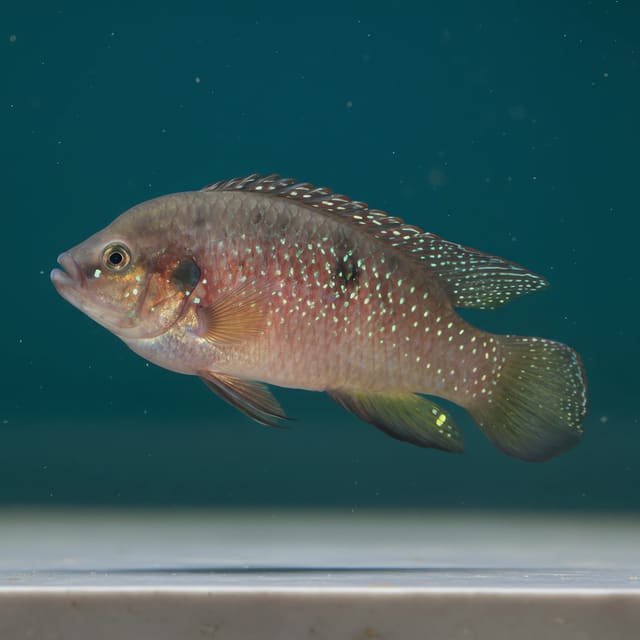
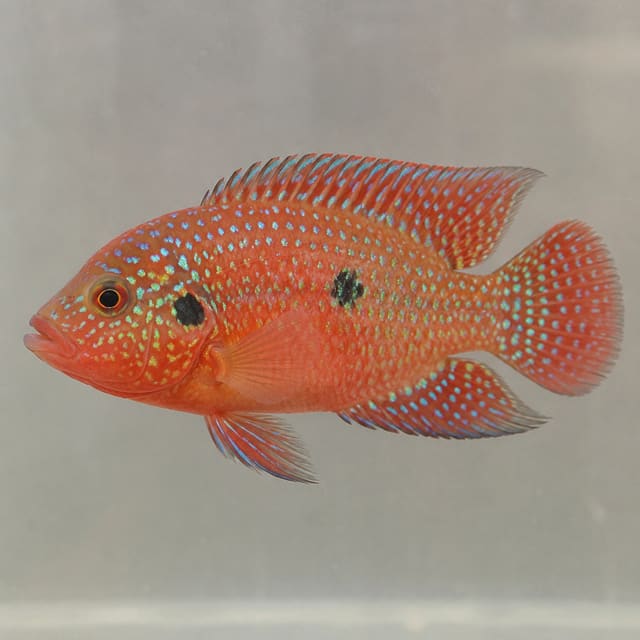
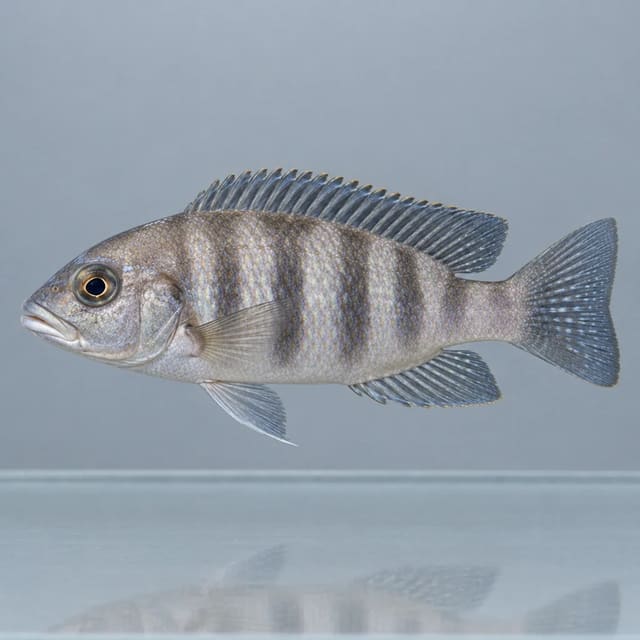
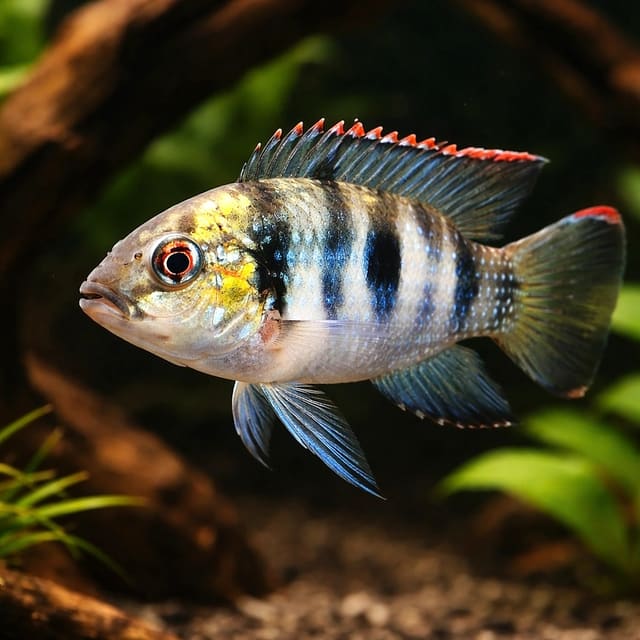
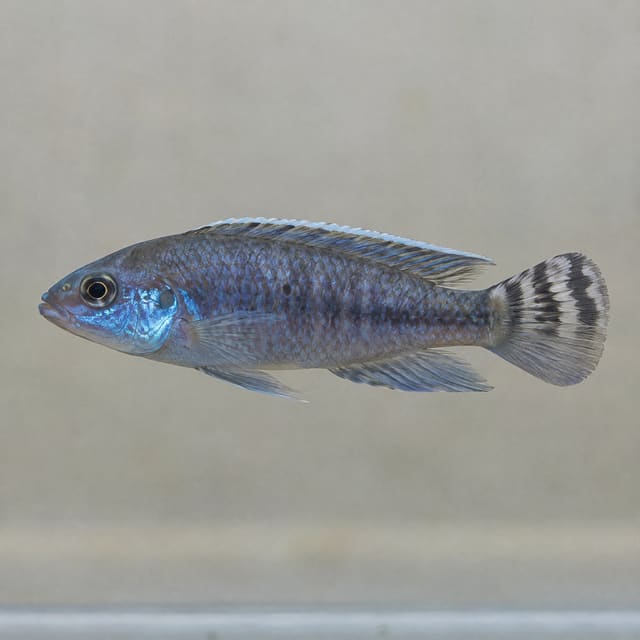
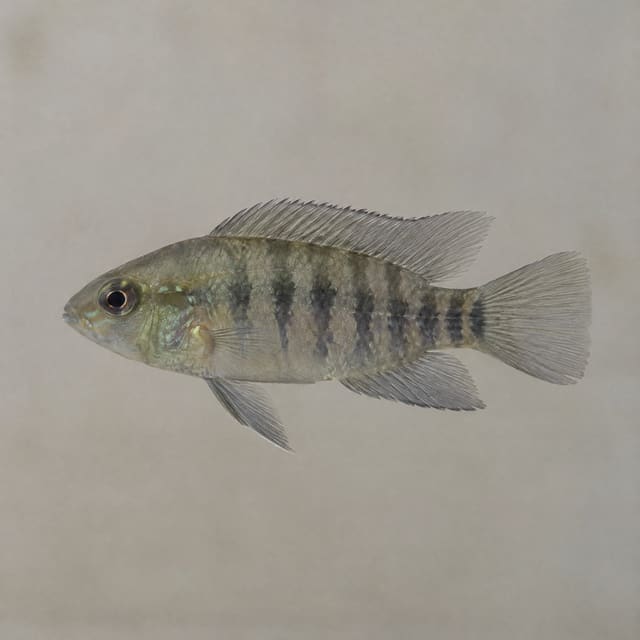
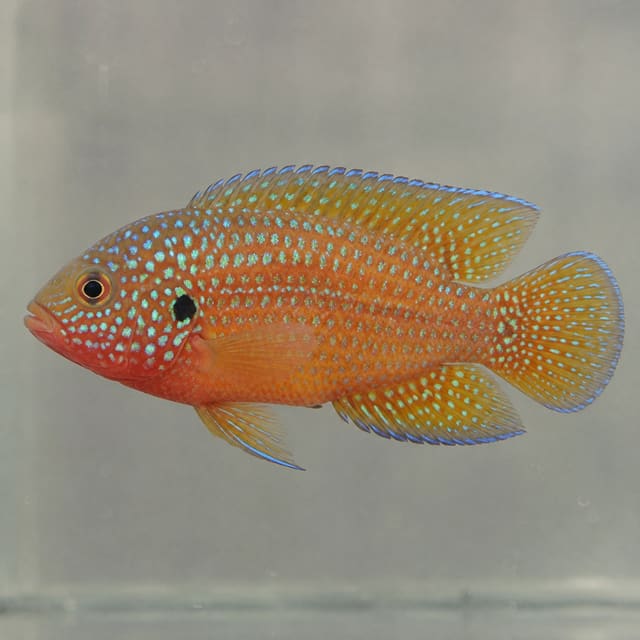
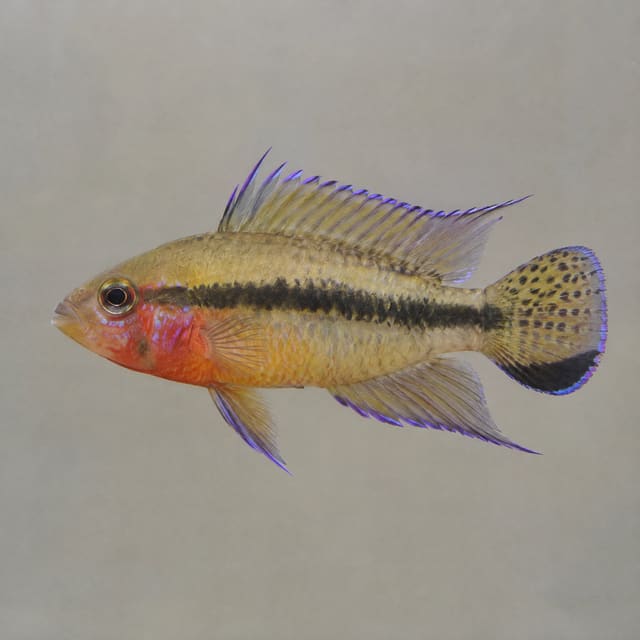
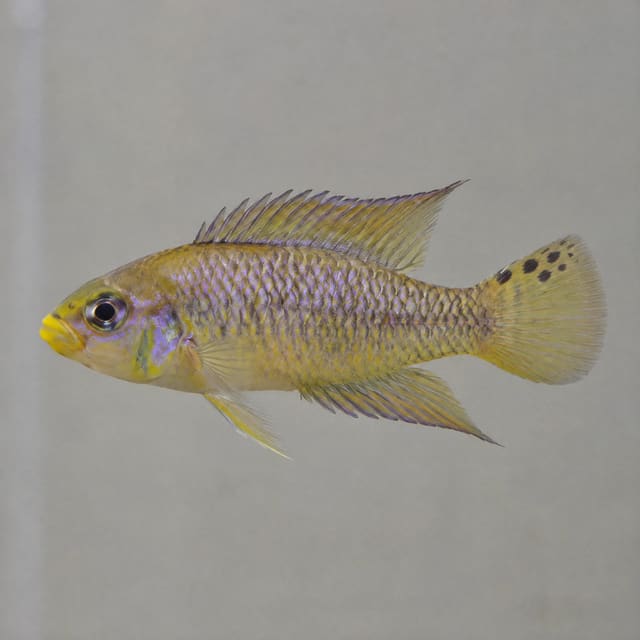
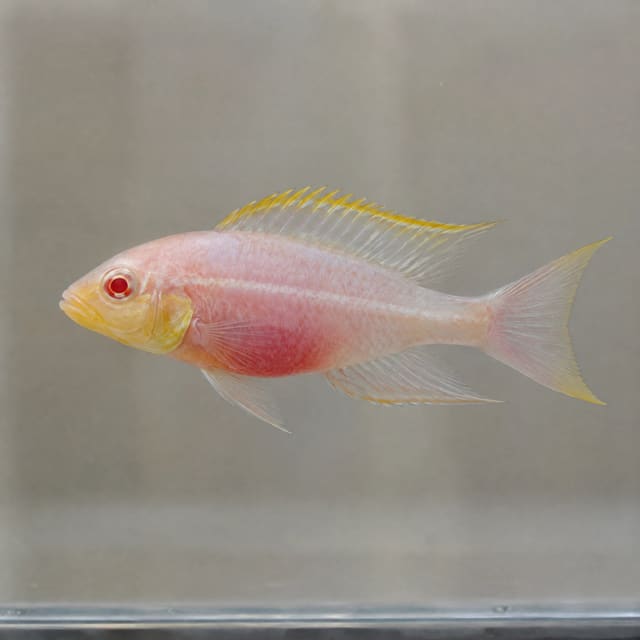
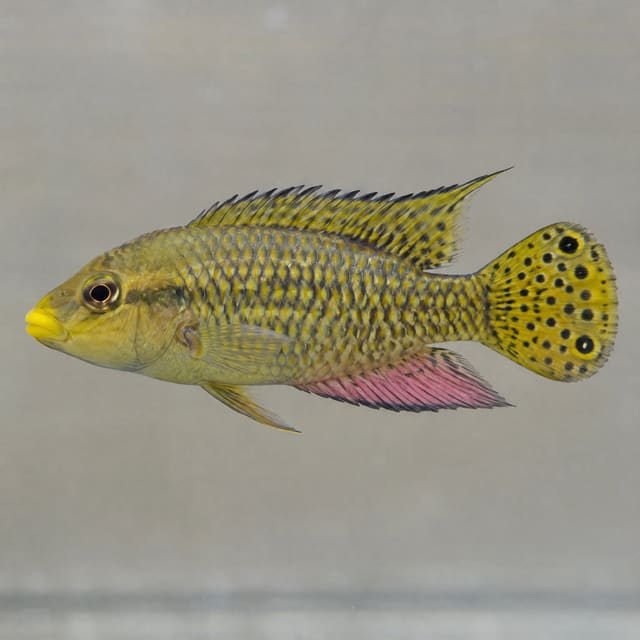
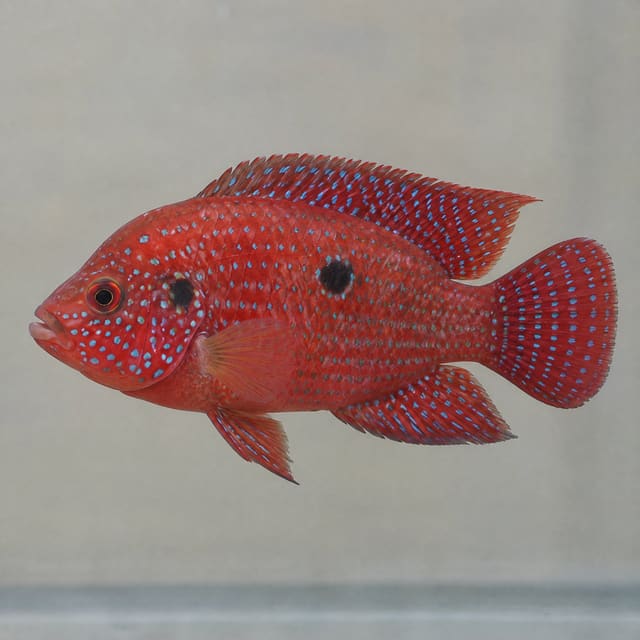
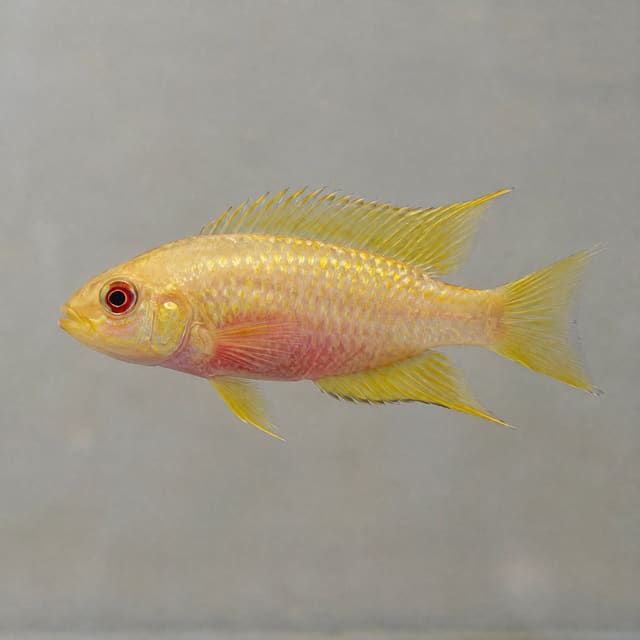
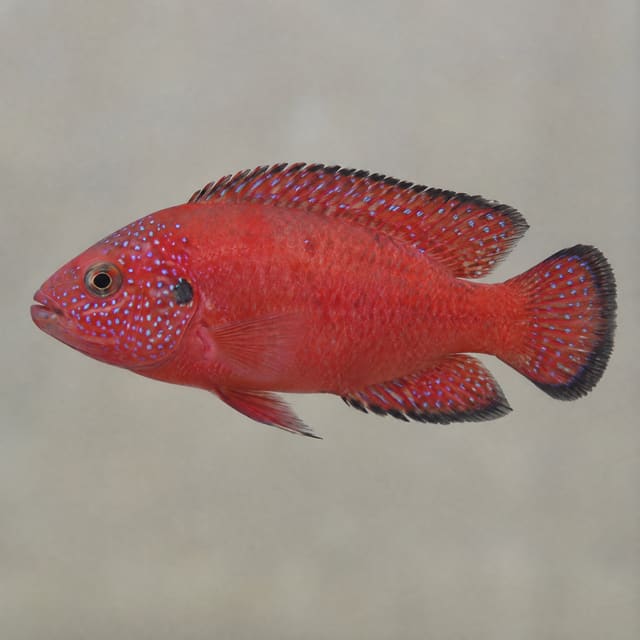
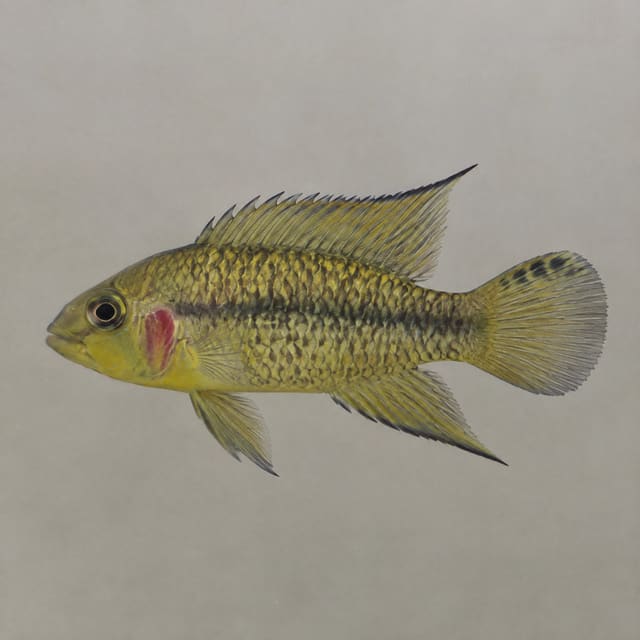
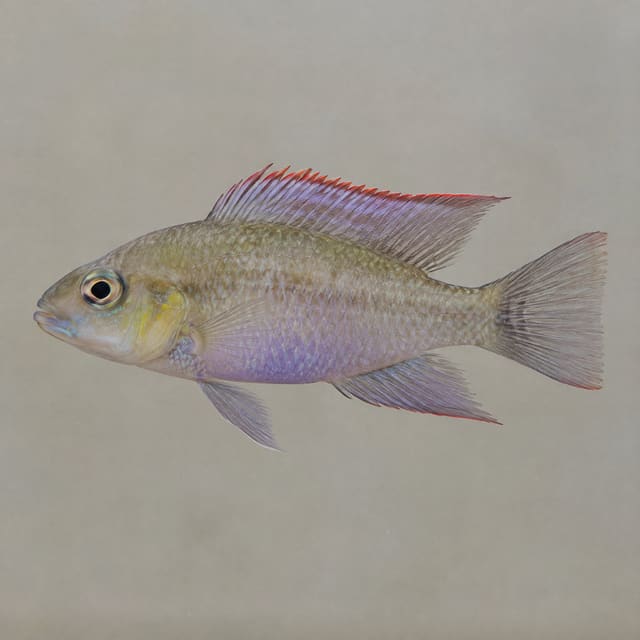
One purchase supplies one live Lucanusi Krib. The size option is "Standard": the fish is sent at the size currently available. Sex is not chosen or guaranteed, and because males and females are coloured very differently, the fish you receive may not match the photograph. The photographs show the type of fish, not the individual you will receive.
| Feature | Male | Female |
|---|---|---|
| Size | Larger; up to 8 cm (Aquarium Glaser) | Smaller; up to 6 cm |
| Dorsal fin | Many dark dots on the soft rear part | Bright, iridescent blue, with at most two dark dots |
| Tail | Many dots on the upper half | Completely clear |
| Body | Yellowish back | Crimson belly when defending a territory or spawning |
| Both sexes | Usually a dark band along the body and red margins near the top of the dorsal fin | |
Read our delivery and Live Arrival Guarantee information before ordering.
FishBase gives a maximum of 4.5 cm standard length, measured without the tail. Aquarium Glaser reports males up to 8 cm and females up to 6 cm, without saying whether the tail is included. The sources do not agree, so plan for a small fish in which the male is clearly the larger sex when mature.
For dwarf cichlids OATA advises at least 60 litres for a pair and at least 80 litres if other fish are added, noting that bigger tanks give more stable conditions. For ideas on stocking that size of tank, see our guide to the best fish for a 60 litre tank.
Practical Fishkeeping describes the home stream as a small river with fine gravel, a few larger rocks and boulders, banks densely overgrown with Anubias lanceolata, clumps of Vallisneria, and ferns such as Bolbitis heudelotii growing on boulders and fallen trees. FishBase notes that it was found alongside the krib Pelvicachromis humilis.
Aquarium Glaser recommends a sandy bottom, at least in places, a well-planted tank and plenty of dead wood and dead leaves. That makes it a natural choice for a planted aquarium, which is exactly the setup Aquarium Glaser recommends. Browse more fish for planted tanks.
| Area | Purpose |
|---|---|
| Small caves of stone, wood or upturned pots | Spawning sites and refuges |
| Fine sand or smooth fine gravel | Foraging ground near each cave |
| Anubias, Bolbitis and Vallisneria | Cover and broken sight lines, as in the wild stream |
| Dead leaves and wood | Shade, places to hide and natural tannins |
| Open water above | Space for small dither fish |
Practical Fishkeeping and FishBase report dry-season readings at the type locality of GH 0, KH 0, pH 5.8 and 24°C: extremely soft, acidic water. Aquarium Glaser says such water is needed for breeding but not for normal care. OATA's general range for dwarf cichlids is 22–27°C, pH 6.0–8.0 and soft to medium hardness of 4–12°dH. We suggest the targets below.
| Reading | Everyday keeping | For breeding |
|---|---|---|
| Temperature | 24–26°C | 24–26°C |
| pH | 6.0–7.0 | Slightly acidic, towards the wild 5.8 |
| Hardness | Soft to medium, within OATA's 4–12°dH | As soft as you can keep stable |
| Ammonia and nitrite | 0 mg/l | 0 mg/l |
| Nitrate | No more than 20 mg/l above tap water | As low as possible |
Soft supplies in Scotland, Wales and parts of northern and south-west England suit this fish once treated with a conditioner. In hard-water areas of southern and eastern England, mix tap water with reverse-osmosis water to soften it, and change the mix gradually. Our water matcher compares your readings with the targets, and our guide to aquarium pH explains how to lower pH safely, without sudden swings.
OATA stresses that a filter is essential at any tank size. For a small cichlid from a stream, choose a sponge or small external filter with a gentle outlet that does not blow fry around, and keep the surface moving for oxygen.
No feeding study exists for this species. OATA describes dwarf cichlids as omnivores that do well on a good-quality flake or granule with occasional small live or frozen foods such as daphnia and brine shrimp, fed once a day and only as much as they eat within a few minutes.
Add the fish to a mature, planted aquarium with ammonia and nitrite at zero. OATA's method is to switch off the lights, float the sealed bag for 10 minutes, then add small amounts of tank water over up to 20 minutes before releasing the fish with as little bag water as possible. Our guide on how to acclimatise new fish covers each step.
| Checkpoint | What to do |
|---|---|
| Before arrival | Test the water, place caves and keep the lighting soft |
| Arrival day | Acclimatise with lights off; let it find a cave |
| Days 2–3 | Offer a small portion of frozen food near its chosen cave |
| Days 4–7 | Check that it feeds and is not chased by tank mates |
| End of week | Retest the water and make the usual 25% change |
Aquarium Glaser calls it one of the most peaceful dwarf cichlids and suggests smaller tetras, barbs, killifish and catfish from the region as companions. OATA notes that dwarf cichlids can still become territorial, especially when breeding, and benefit from a shoal of dither fish for security. If you plan to breed, avoid tank mates that disturb the cave or eat fry.
| Suits | Avoid |
|---|---|
| West African killifish such as the Red Aphyosemion and Gery's Killie | Larger or boisterous cichlids |
| Small barbs such as the Slender Black-Striped Barb | Fast, greedy feeders that leave the cichlids hungry |
| Small peaceful tetras as dither fish | Several cave-spawning dwarf cichlids crowded together |
| Small peaceful catfish | Fish that eat eggs and fry, if you want to breed |
If you like kribs, compare it with the Kribensis Cichlid, Roloff's Kribensis and the Nigerian Green Kribensis; our kribensis care guide covers setups that suit this fish too. Check any mix with our tank mates tool, and browse all African cichlids or the African dwarf cichlids category.
OATA describes a healthy fish as having clear, bright eyes, undamaged fins, intact scales, no ulcers or bumps, normal swimming and steady breathing. Clamped fins, flicking against decor and shimmying are warning signs, as are changes in colour, breathing, appetite and hiding. Our cichlid care guide covers the common problems.
| If you see | Do this |
|---|---|
| Pale colours and constant hiding | Add cover and dither fish; check for a bully |
| Rapid breathing | Test ammonia and nitrite at once and increase surface movement |
| Hollow belly | Feed closer to its cave and offer small live or frozen foods |
| Torn fins on a female | Add caves and plants, or separate a pushy male |
| White spots or fluffy patches | Test the water and seek advice before treating |
FishBase describes a monogamous, pair-bonding cave spawner in which both parents guard the eggs, the female more intensively. Aquarium Glaser adds that the female mainly tends the eggs and larvae while the male defends the territory, and that once the young leave the cave both parents care for them equally. Soft, slightly acidic water helps. Small juveniles show three or four rows of irregular dark dots, a feature Lamboj used in the description.
| Stage | What happens |
|---|---|
| Courtship | The female's belly turns crimson and the pair chooses a cave |
| About 3 days after spawning | The eggs hatch inside the cave |
| 8–9 days after hatching | The fry swim freely; offer newly hatched brine shrimp or fine fry food |
| Next 5–6 weeks | Both parents guard the shoal; OATA notes that dwarf cichlid parents carry straying fry back in their mouths |
No, although it was first sold as one. Aquarists knew it as Pelvicachromis sp. "Blue Fin" until Anton Lamboj described it in 2009 as Enigmatochromis lucanusi, the only species in its own genus. It has 12 scales around the tail stem where Pelvicachromis has 16. "Pelvicachromis lucanusi" is not a valid scientific name.
It is known only from the Foto River, a small savannah stream that flows into the Konkouré River near Fria in coastal Guinea, West Africa.
FishBase gives 4.5 cm standard length, measured without the tail. Aquarium Glaser reports males up to 8 cm and females up to 6 cm. Males are the larger sex.
Females have a bright, iridescent blue dorsal fin with no more than two dark dots on it, a clear tail and a crimson belly when they defend a territory or spawn. Males have a yellowish back and many dark dots on the dorsal fin and the upper half of the tail.
Only for breeding. Aquarium Glaser says soft, acidic water is not necessary for normal care. The wild stream measured GH 0, KH 0 and pH 5.8 in the dry season; for everyday keeping we suggest 24–26°C, pH 6.0–7.0 and soft to medium water.
Yes. Aquarium Glaser calls it one of the most peaceful dwarf cichlids and suggests small tetras, barbs, killifish and catfish as companions. A breeding pair still defends its cave, so give it space.
OATA advises at least 60 litres for a pair of dwarf cichlids and at least 80 litres if other fish are added. A 60–80 cm aquarium with caves, plants and wood suits it well.
One live fish of the standard size currently available. Sex is not chosen or guaranteed; buy two or more if you want a pair to form.
No reviews for this item yet. Bought one? Honest reviews only, good or bad.
What customers say about ordering from us
Easy website plenty of info on fish your buying great to pick a time slot
TRACEY DURRANT · 7 Oct 2026
Got some lovely fish thank you
Kevin Mackie · 7 Oct 2026
Reviews of our shop, collected by Judge.me, an independent third-party review collector. Newest first.
Moved by UK carriers licensed to handle live animals
Hand-packed with oxygen bags, poly box, heat pack
Email photos the same day; an optional unboxing video helps us review problems faster — claim terms apply
Klarna & PayPal Pay in 3 at checkout