Moderate
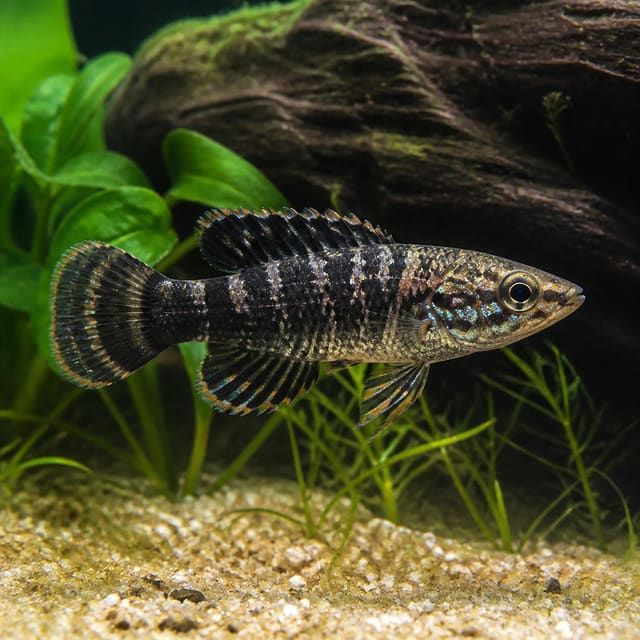
Chameleon Fish (Badis badis)
18–24°C · pH 6–8
£7.99
The Florida Gar (Lepisosteus platyrhincus) is an armoured, spotted, air-breathing ambush predator from Florida and Georgia that commonly reaches about 60 cm and can pass a metre. It needs a very large, dimly lit aquarium or indoor heated pond, a heavy lid with an air gap and meaty foods. Sold individually as one live fish for experienced keepers.
Lepisosteus platyrhincus
The Florida Gar (Lepisosteus platyrhincus) is an armoured, spotted, air-breathing ambush predator from Florida and Georgia that commonly reaches about 60 cm and can pass a metre. It needs a very large, dimly lit aquarium or indoor heated pond, a heavy lid with an air gap and meaty foods. Sold individually as one live fish for experienced keepers.
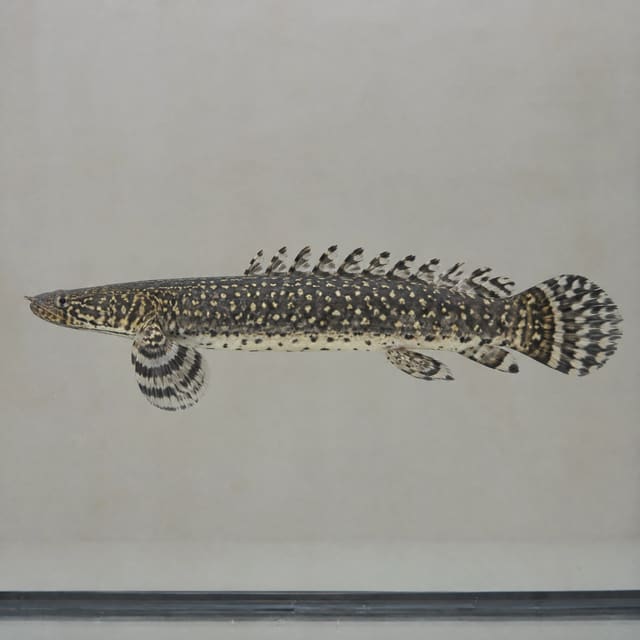
The Florida gar (Lepisosteus platyrhincus) is one of the most primitive fish still alive. Its long body is clad in diamond-shaped, interlocking ganoid scales, its jaws carry a row of sharp teeth, and it can gulp air at the surface through a lung-like swim bladder. Olive-brown above and pale below, it is covered in bold round black spots from head to tail. In the wild it hangs motionless near the surface like a floating stick, then snaps sideways at passing fish. For the right keeper, with the right tank, it is an extraordinary centrepiece.
This page is deliberately honest about size. The Florida gar is a large predator that grows quickly, and the Florida Museum of Natural History calls it unsuitable for home aquaria because of its size and tank needs, although it is often displayed in public aquaria. Please read the section below on what it needs before you buy, and browse our oddball fish or the other freshwater fish category if you want something with the same prehistoric look in a smaller package.
| Name | Where you will see it |
|---|---|
| Florida gar, Florida garfish | Common and UK trade names |
| Lepisosteus platyrhincus DeKay, 1842 | The scientific name |
| Cylindrosteus megalops | An older synonym in books and catalogues |
| Lepisosteus platyrhyncus | A common misspelling on stock lists |
According to FishBase, the genus name comes from the Greek for "scale" and "bone", a description of its armour. The species lives from the Savannah River drainage in Georgia to the Ochlockonee River drainage in Florida and Georgia, and throughout peninsular Florida. FishBase lists it as Least Concern on the IUCN Red List.
The Florida gar is very like the spotted gar (L. oculatus). FishBase and Wikipedia note that the Florida gar has no bony scales on the throat. The Florida Museum gives a measuring rule: in the Florida gar the distance from the front of the eye to the back of the gill cover is less than two-thirds of the snout length, while in the spotted gar it is more. Both have spots on the head, body and fins, and young fish may also show dark stripes along the back and sides.
Every source we checked says the same thing in different words. The Fishkeeper profile calls the Florida gar a peaceful predator for very large aquaria and says it must be housed in a tank of vast proportions. Seriously Fish, writing about the closely related spotted gar, says it needs a tank at least 2 m long, suits only very large public installations and can live for several decades. OATA's guide to very large fish notes that tanks for such species are often over 500 litres, advises buying the tank for the adult size because these fish grow quickly, and suggests indoor heated ponds as an alternative.
If the answer to any of these is no, please choose a smaller oddball. Never release a gar or any aquarium fish: OATA points out that release into the wild is illegal and usually ends in a lingering death for the fish.
One purchase supplies one live Florida gar at the standard size we currently send, which is a juvenile far below adult size. Sex cannot be chosen; the Fishkeeper profile notes that males and females cannot be told apart by appearance, although the Florida Museum says females grow larger. Young gars can look different from adults: the Florida Museum describes dark stripes on the back and sides and a delicate filament on the tail that vibrates constantly and is lost in the first year. The photographs show the species, not the individual.
Published sizes vary because some sources describe record fish and others typical adults. Plan for the middle of the range and hope for less.
| Source | Size given |
|---|---|
| FishBase | Common length 59.5 cm; maximum 132 cm total length and 9.6 kg |
| Wikipedia | Adults 51.7–132.2 cm, typically 1.36–4.36 kg |
| Florida Museum | Average about 86 cm; adults 33–86 cm; record 1.33 m; females larger than males |
| Fishkeeper profile | Up to 120 cm recorded in the wild; most reach about half that |
Use the largest tank you can house. For a fish that commonly reaches about 60 cm, Seriously Fish's 2 m minimum length for the spotted gar and OATA's "often over 500 litres" are the starting points, and the front-to-back depth must exceed the fish's length. Our tank volume calculator converts your measurements into litres, and the stocking calculator shows how much of that a large predator really uses.
FishBase describes the adult habitat as sluggish, mud- or sand-bottomed pools of quiet lowland streams and lakes, usually near vegetation, and Wikipedia adds that the fish often hide in weed beds 4–10 feet (about 1.2–3 m) deep. The Florida Museum notes that they gather in spring-fed rivers. In the aquarium the Fishkeeper profile recommends dim lighting, sand or gravel, and floating plants or wood near the surface, where the fish spends most of its time.
| Area | Purpose |
|---|---|
| Long open water along the front | Room to cruise and turn without touching the glass |
| Floating plants and branches at the surface | Cover for an ambush hunter that hangs near the top |
| Smooth sand or rounded gravel | OATA advises substrate without sharp edges |
| Securely fixed wood and rock | A big fish can knock loose decor over |
| Guarded heater, or heating in a sump | OATA advises securing heaters; the Fishkeeper profile suggests a sump |
The Florida Museum explains that the gar's air bladder is richly supplied with blood and connected to the throat, letting it breathe air and survive hot, stagnant, low-oxygen water. Wikipedia adds that in the dry season it can burrow into marsh sediment and lower its metabolic rate. In the aquarium this means the fish must always be able to reach the surface to gulp air. The Fishkeeper profile advises leaving a small gap between the water and the cover slides, running the tank with a slightly lowered waterline, and fitting tight, weighted cover slides because gars are expert jumpers.
FishBase describes the species only as subtropical. The Fishkeeper profile gives 20–28°C, pH 6.0–8.0 and a hardness of up to 20 dH, and warns that the fish does not tolerate elevated nitrate. Note that Seriously Fish gives much cooler values (12–20°C) for the spotted gar, a different species, so do not borrow those. We suggest the targets below, all inside the Fishkeeper ranges.
| Reading | Our target | Why |
|---|---|---|
| Temperature | 22–26°C | The middle of the Fishkeeper range of 20–28°C |
| pH | 6.5–7.5 | Inside the Fishkeeper range of 6.0–8.0 |
| Hardness | Up to 20 dGH | Fishkeeper upper limit |
| Ammonia and nitrite | 0 mg/l | OATA water-quality limit |
| Nitrate | No more than 20 mg/l above tap water | OATA limit; the Fishkeeper profile warns against high nitrate |
The wide pH and hardness ranges mean most UK tap water suits once it is treated with a conditioner, from the hard, alkaline supplies of southern and eastern England to the softer water of Scotland, Wales and parts of the north and south-west. In a very large tank the real challenge is keeping replacement water at the right temperature and dechlorinated in bulk. Our water chemistry guide explains each reading.
A gar eats whole fish and prawns and produces a lot of waste. The Fishkeeper profile calls for powerful, oversized filtration and well-oxygenated water, ideally with a sump. OATA notes that several large filters or a pond filter may be needed to handle the solid waste of very large fish. Read our guide to aquarium filtration and our nitrogen cycle guide before you set up.
Wikipedia describes adult Florida gars as ambush predators of fish, shrimp and crayfish that strike in 25–40 milliseconds, while young fish eat zooplankton and insect larvae. The Florida Museum describes the hunt: the gar floats motionless, approaches with slow flicks of its fins, snaps its head sideways to seize the prey and swallows it head first.
In captivity the Fishkeeper profile recommends a varied mix of meaty foods, such as earthworms, mealworms, prawns, cockles, mussels, crab, crayfish, lancefish, silversides and whitebait, on a base of good pellets and foodsticks. Seriously Fish, writing about the spotted gar, advises feeding juveniles daily and reducing to one or two meals a week at most for adults, and warns never to feed mammal meat such as beef heart or chicken. It adds that newly imported fish may refuse dead food until they have gone without for a short time, and that live fish should be used only in extreme cases, after at least two weeks in quarantine. OATA's general advice for very large fish is to feed only what is eaten within a few minutes.
| Stage | What to feed | How often |
|---|---|---|
| Juvenile | Small prawns, lancefish, whitebait, earthworms; try sticks or pellets | Daily, what is eaten in a few minutes |
| Growing fish | Larger prawns, mussels, cockles, lancefish and silversides | Gradually fewer meals |
| Adult | Whole fish such as sprats, crayfish and large prawns | One or two meals a week at most (Seriously Fish, spotted gar) |
Only add a gar to a filtered aquarium that has been running long enough to process waste, with ammonia and nitrite at zero. OATA describes two methods. For a fish in a bag, switch off the lights, float the bag for about 10 minutes, add small amounts of tank water over up to 20 minutes, then release the fish with as little bag water as possible. For a fish in a box or bucket, drip tank water in slowly through an airline and make sure the temperature does not drop. Our guide on how to acclimatise new fish shows each step.
| Checkpoint | What to do |
|---|---|
| Before arrival | Test the water, set 22–26°C, fit the lid and leave the air gap |
| Arrival day | Acclimatise in dim light; do not feed |
| Days 2–4 | Offer one small prawn or lancefish; remove it if ignored |
| Days 5–7 | Expect it to start feeding; it may refuse dead food at first |
| End of week | Retest ammonia, nitrite and nitrate and make a partial change |
The Fishkeeper profile calls the Florida gar a voracious ambush predator that is usually peaceful towards fish too large to swallow whole. It advises choosing companions big enough not to become prey, remembering that young gars grow quickly, and calm enough not to bully the gar. Seriously Fish says gars are best kept alone or with similarly sized, non-aggressive fish they cannot fit into their mouths, and OATA warns against mixing very large fish with much smaller ones.
| Possible, once already large | Avoid |
|---|---|
| Large bichirs such as the Ornate Bichir and the Saddled Bichir, air-breathers that keep to the floor | Any fish small enough to swallow, including tetras, danios, livebearers and small cichlids |
| Big, calm shoaling fish such as the Albino Tinfoil Barb, added at a size the gar cannot take | Aggressive fish that bully a slow, surface-hanging predator |
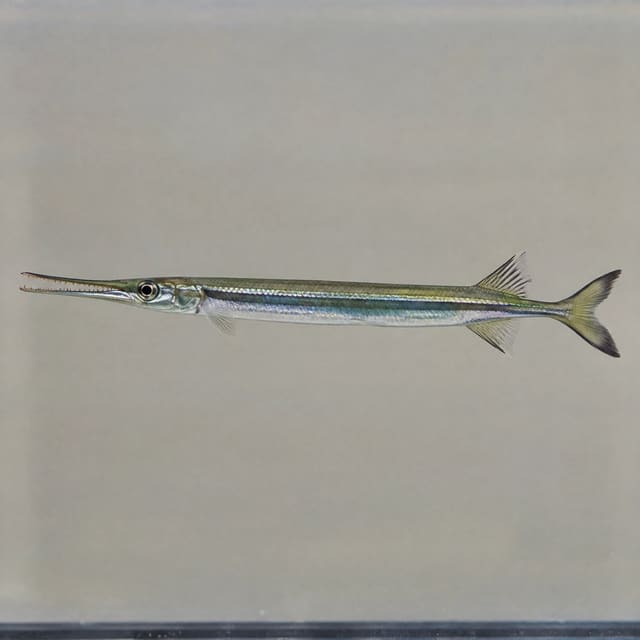
If you love the look but lack the space, compare smaller beaked predators such as the Silver Needlefish and the Gar Characin, or other big-tank centrepieces such as the Silver Arowana. Browse our centrepiece fish, rare and collector fish and the oddball fish category, and check every mix with our tank mates tool.
The Fishkeeper profile states that the Florida gar has not been bred in home aquaria. In the wild it spawns in spring in shallow water, scattering adhesive eggs over vegetation with no parental care; a mature female can lay up to 20,000 eggs, typically about 13,000. Accounts of the season differ: Wikipedia gives February to March, while the Florida Museum gives mainly April and May, possibly continuing into October. FishBase notes that females may spawn more than once in a season.
| Stage | What happens |
|---|---|
| Spawning | A female scatters greenish adhesive eggs, fertilised by two or more males (Florida Museum) |
| Eggs | Highly toxic to people and animals, including birds |
| Larvae | Cling to gravel or plants with an adhesive disc on the snout until about 2 cm long |
| Juveniles | Eat zooplankton, insect larvae and small fish; the vibrating tail filament is lost in the first year |
OATA describes a healthy fish as having clear, bright eyes, undamaged fins, intact scales and steady breathing, and lists hanging at the surface or sitting on the bottom, colour change, altered breathing, white spots or fluffy growths, weight change and loss of appetite as warning signs. A gar naturally hangs near the surface and gulps air, so learn its normal rhythm in the first weeks.
| If you see | Do this |
|---|---|
| Gulping air far more often than usual | Test ammonia, nitrite and nitrate; increase aeration and check the filter |
| Snout damage or scrapes | Check the lid, glass corners and decor; the fish may be hitting them |
| Refusing food for more than a week | Check water quality and temperature, then offer a different food |
| Bloated belly after a big meal | Skip the next feed and reduce portion size |
| White spots or fluffy patches | Test the water and get fish-health advice before treating |
Large. FishBase gives a common length of 59.5 cm and a maximum of 132 cm, and the Florida Museum gives an average of 86 cm. The Fishkeeper profile says most fish reach about half of the 120 cm recorded in the wild. Plan for 60 cm or more.
A very big one. Seriously Fish says the closely related spotted gar needs a tank at least 2 m long and suits only very large public installations, and OATA notes that tanks for such fish are often over 500 litres. An indoor heated pond is the alternative OATA suggests.
FishBase lists it as harmless. Its eggs are another matter: the Florida Museum and Wikipedia both say gar roe is highly toxic to people and animals, including birds.
Not outdoors in the UK. It needs 20–28°C all year, and GOV.UK guidance requires a licence to keep many non-native fish outdoors. OATA suggests indoor heated ponds for very large fish.
No. It takes prawns, lancefish, whitebait, mussels and similar foods, and many also take pellets or sticks. Seriously Fish advises live fish only in extreme cases, after at least two weeks in quarantine, and never mammal meat such as beef heart or chicken.
The Florida gar has no bony scales on the throat. The Florida Museum gives a measuring rule: in the Florida gar the distance from the front of the eye to the back of the gill cover is less than two-thirds of the snout length, and in the spotted gar it is more.
Only fish too big to fit in its mouth and calm enough not to bully it, such as large bichirs once they are already big. Seriously Fish suggests that gars are best kept alone or with similarly sized, non-aggressive fish.
The Fishkeeper profile gives 15 years or more, and Seriously Fish says the related spotted gar can live for several decades. Plan for a long commitment.
One live Florida gar at the standard size we currently send, which is a juvenile. Sex cannot be chosen; the Fishkeeper profile notes that the sexes cannot be told apart by appearance.
No reviews for this item yet. Bought one? Honest reviews only, good or bad.
What customers say about ordering from us
Easy website plenty of info on fish your buying great to pick a time slot
TRACEY DURRANT · 7 Oct 2026
Got some lovely fish thank you
Kevin Mackie · 7 Oct 2026
Reviews of our shop, collected by Judge.me, an independent third-party review collector. Newest first.
Moved by UK carriers licensed to handle live animals
Hand-packed with oxygen bags, poly box, heat pack
Email photos the same day; an optional unboxing video helps us review problems faster — claim terms apply
Klarna & PayPal Pay in 3 at checkout