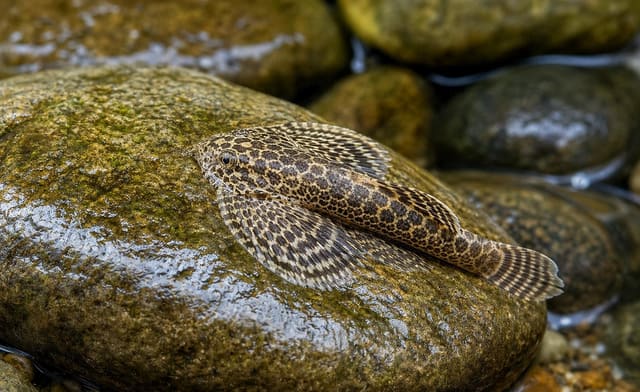
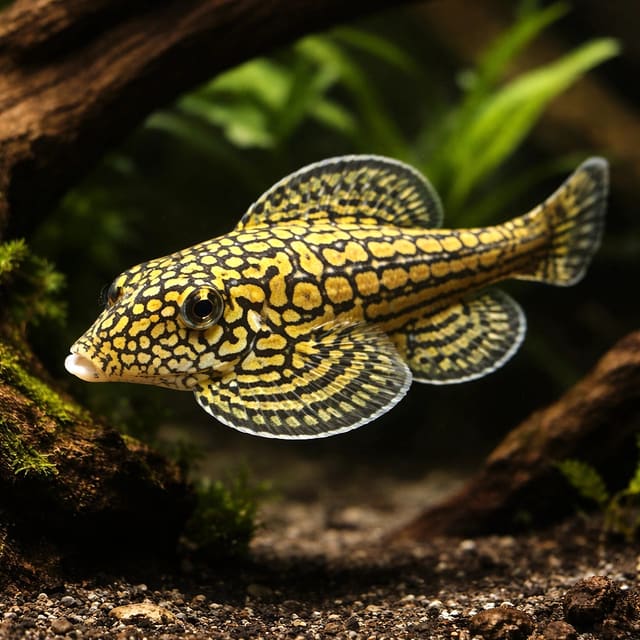
Reticulated Hillstream Loach (Sewellia lineolata)
20–24°C · pH 6–7.5 · 68L
£11.99

The Saddled Bichir (Polypterus endlicherii) is an air-breathing freshwater fish in the Polypteridae family from African river basins that reaches 65.5 cm standard length. It suits advanced keepers planning exceptional filtered housing; OATA's broad very-large-fish guidance says aquariums often exceed 500 litres and sets ammonia and nitrite at 0 mg/l. Sold individually in 5–6 cm, 6–8 cm, 8–12 cm or 20–25 cm dispatch sizes.
Adult size is the maximum length this species reaches at full maturity (scientific sources). The livestock you receive will be younger and smaller — pick a size above for the actual shipping size. Product-photo provenance and any image-specific limitations are stated on the listing.
Polypterus endlicherii
The Saddled Bichir (Polypterus endlicherii) is an air-breathing freshwater fish in the Polypteridae family from African river basins that reaches 65.5 cm standard length. It suits advanced keepers planning exceptional filtered housing; OATA's broad very-large-fish guidance says aquariums often exceed 500 litres and sets ammonia and nitrite at 0 mg/l. Sold individually in 5–6 cm, 6–8 cm, 8–12 cm or 20–25 cm dispatch sizes.
Adult size is the maximum length this species reaches at full maturity (scientific sources). The livestock you receive will be younger and smaller — pick a size above for the actual shipping size. Product-photo provenance and any image-specific limitations are stated on the listing.
The Saddled Bichir (Polypterus endlicherii) is a large, demersal and facultative air-breathing freshwater fish in the Polypteridae family. It inhabits swamps and rivers across African drainage systems including the Nile, Chad, Niger, Volta, Bandama, Comoé and Ouémé basins. FishBase records a maximum of 65.5 cm standard length for a male/unsexed record. This fish suits an advanced keeper who can plan exceptional long-term housing, substantial waste control, unobstructed surface access and carefully screened companions.
Treat 65.5 cm standard length as a planning reference rather than a promised final size for an individual fish. Even so, it is decisive: a juvenile that looks manageable at dispatch can become a very large animal requiring an exceptional commitment of space, filtration capacity and maintenance.
| Suits | Not suited to |
|---|---|
| Advanced keepers planning around a recorded maximum of 65.5 cm standard length | Small community aquariums |
| Exceptionally large, mature and fully filtered freshwater systems | Housing chosen only around the dispatch size |
| Aquariums with clear access to the water surface | Systems without established biological filtration |
| Plans that avoid much smaller fish | Mixing with much smaller fish |
This fish suits a keeper who can commit space, filtration capacity, weekly maintenance and daily feeding for a large predator. It is not a substitute for a smaller community fish, and an ordinary off-the-shelf aquarium should not be assumed to meet its adult needs. The aquarium must remain workable when the fish is no longer the size shown in the selector.
If the required scale is beyond your present plan, browse the loaches and oddballs collection and compare animals by adult size, feeding biology and housing needs before deciding.
Use the live size selector to choose 5–6 cm, 6–8 cm, 8–12 cm or 20–25 cm. One purchase supplies one animal in the selected dispatch size. The label describes the fish at dispatch; it does not identify sex, life stage, eventual size or origin. The size you select is the size supplied, not the adult size.
Build the permanent plan around the recorded maximum of 65.5 cm standard length rather than treating the largest selector label as an adult measurement. Confirm that the prepared aquarium can receive the chosen fish without a sudden increase in waste overwhelming the biological filter, then confirm that the long-term housing plan can accommodate its adult scale.
Sex is guaranteed only when the selected option explicitly states male or female. This Saddled Bichir listing has no sex-guaranteed option.
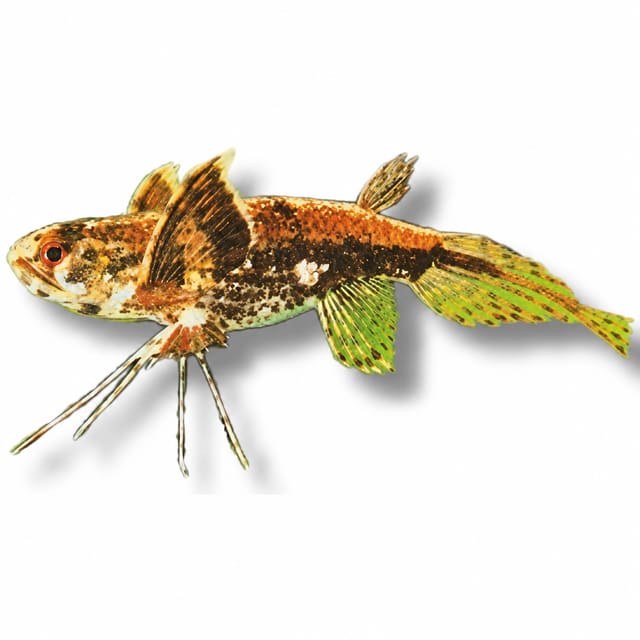
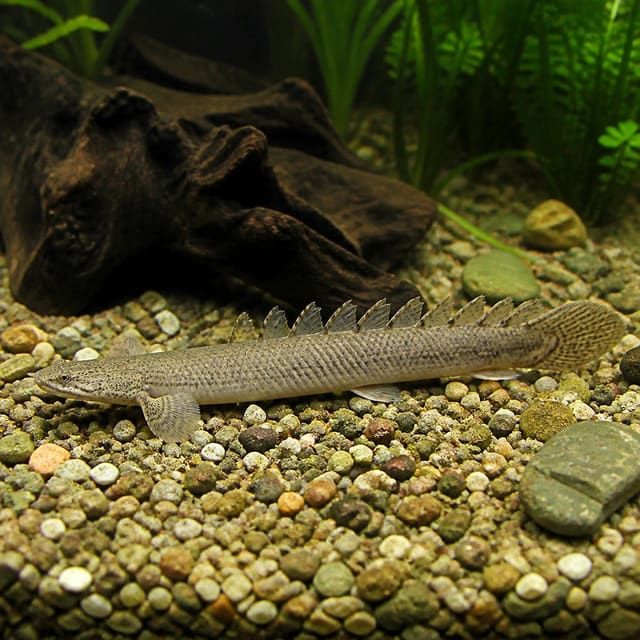
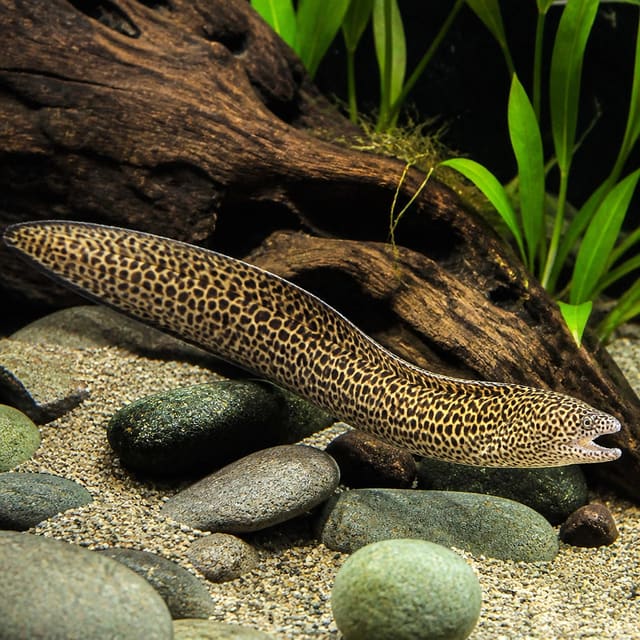
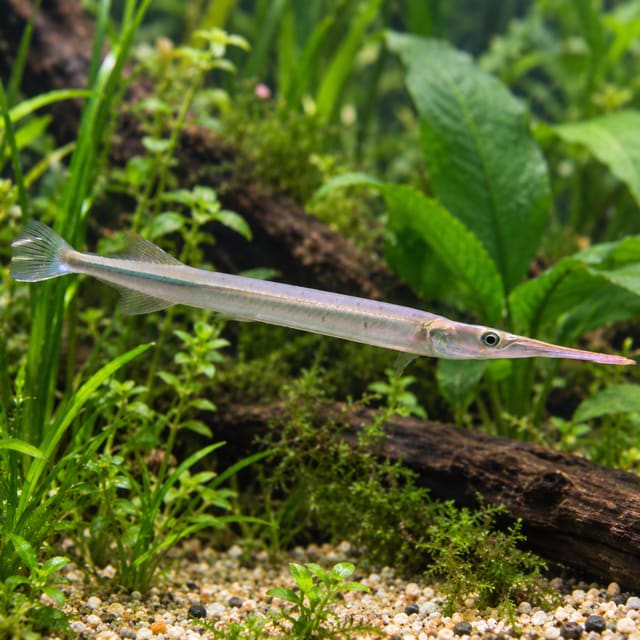
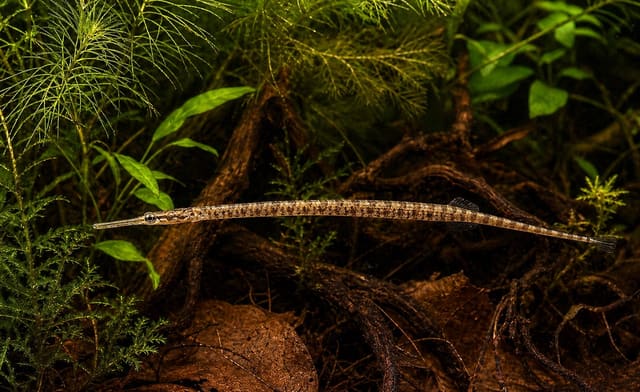
The gallery images are representative, based on reference photographs of this species, so colours can look slightly different from the live animal.
Polypterus endlicherii belongs to the Polypteridae family. Wikipedia explains that the name Polypterus roughly refers to “many finned”, while the common name comes from the saddle-like pattern along the fish's dorsal side. The animal is also sometimes nicknamed dragonfin or dinosaur bichir because of its prehistoric appearance.
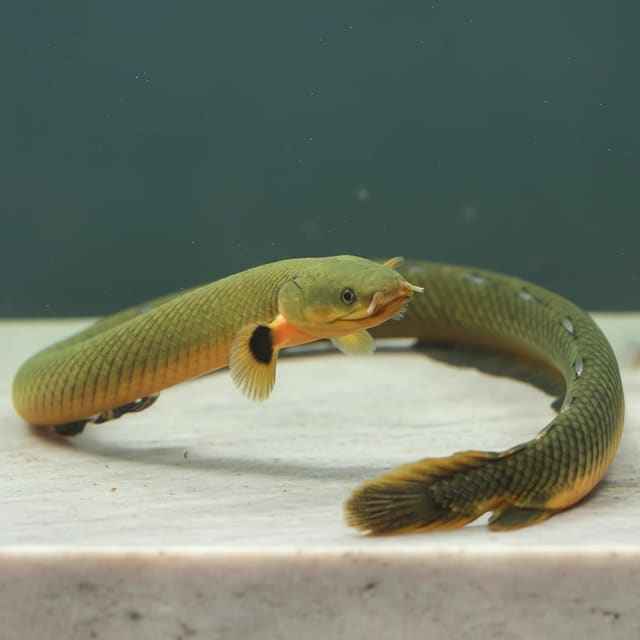
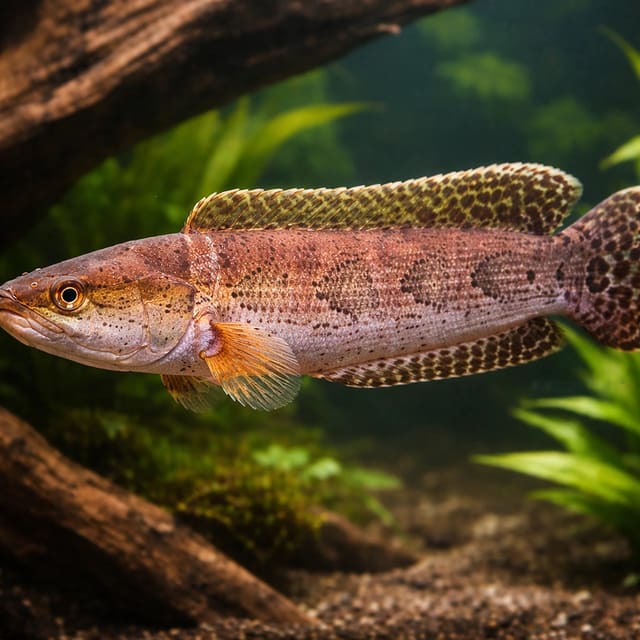
The gallery depicts the broad, flattened head, elongated body, separate dorsal finlets and dark saddle-like bands associated with the Saddled Bichir. Those features help explain the common name, but colour intensity and pattern presentation should not be used to infer sex, age or origin.
In nature this bichir inhabits swamps and rivers across several African drainage systems. It spends its time in the lower part of the water column but can breathe air, so the aquarium must combine usable lower-level space with uninterrupted access to the surface. Do not let equipment or decor turn the surface into an inaccessible zone.
Wild feeding is essentially piscivorous and also includes snails and crustaceans. That predatory biology sets the compatibility screen: much smaller fish should be avoided. It also explains why feeding should use appropriately sized carnivorous foods rather than relying on foods intended for small community fish.
The fish's recognised maximum, breathing biology and feeding mode matter more to the housing decision than any single gallery pose. Use the images for recognition and the adult-scale figures for planning.
OATA's very-large-fish guidance says these animals often require aquariums in excess of 500 litres and that an off-the-shelf aquarium is unlikely to be large enough for long-term care. Use this broad group planning figure as a starting point, then choose the final system around the bichir's 65.5 cm standard-length planning reference, usable dimensions, filtration demand and surface access.
OATA also notes that activity level changes how volume is used: some less active large fish still need substantial stable water volume even when they do not use it like constant open-water swimmers. For this demersal bichir, judge the system by its adult capacity, accessible lower zone, surface access, water stability and serviceability together.
A smaller specimen may begin in smaller housing, but that is a temporary stage rather than the final welfare plan. Write down where the adult system will stand, how it will be filtered and how routine water changes will be performed before purchasing. If those decisions depend on a future move or an uncertain upgrade, resolve them first.
An indoor heated pond can be considered for very large fish where a conventional aquarium cannot meet the required scale. Whichever format you choose, it still needs biological filtration, measurable water quality and safe access for maintenance.
A large predator must enter an aquarium with an established biological filter. The RSPCA explains why aquarium filtration is vital: fish release toxic ammonia, beneficial bacteria convert it to nitrite, and another stage converts nitrite to the safer nitrate. A filter must therefore be established, maintained and matched to the waste load rather than merely circulating water.
Our first tropical aquarium guide explains how to prepare and mature a filter before livestock arrives. For this fish, maturation is only the starting point: the filter must also be large enough for an animal that can become a very substantial waste producer.
Check filters for blockages as part of the weekly routine. If media needs cleaning, rinse it lightly in aquarium water removed during a partial water change. Do not rinse it under the tap because chlorine or chloramine may kill part of the beneficial bacterial population.
Several large aquarium filters, or even pond filtration, may be required as the bichir grows. Review capacity whenever feeding increases, the animal moves to larger housing or tests become harder to hold at target. More flow alone is not the goal; the system needs dependable biological processing and effective removal of solid waste.
OATA's targets for the very-large-fish group are ammonia at 0 mg/l, nitrite at 0 mg/l and nitrate no more than 20 mg/l above the normal tap-water level. Use these as group-level waste-control targets, alongside stable freshwater conditions chosen for the complete aquarium.
| Weekly task | Decision it supports |
|---|---|
| Test ammonia | It must remain at 0 mg/l. |
| Test nitrite | It must remain at 0 mg/l. |
| Compare nitrate | Keep it within 20 mg/l above the normal tap-water level. |
| Change water | Change 25% at least once a week. |
| Siphon the bottom | Remove trapped solid waste and uneaten food. |
| Inspect filters | Find blockages before filtration performance declines. |
Use tap-water conditioner on replacement water before it enters the aquarium so chlorine or chloramine does not harm the fish or filter bacteria. Match routine replacement water to the aquarium's established operating conditions and avoid abrupt changes.
A zero ammonia result is good only when nitrite is also zero and nitrate remains controlled. If ammonia or nitrite rises, stop treating the usual feeding and stocking routine as safe. Test again, inspect filtration for blockages, remove uneaten food and review whether the biological filter has been asked to process a sudden increase in waste.
Our water chemistry guide explains what the principal readings mean. Record the results rather than relying on the aquarium's appearance, then use the water matcher when comparing measured aquarium conditions with the targets chosen for the system.
Test at least once each week and perform a 25% partial water change at least once a week. Large fish can create substantial solid waste, so siphoning and filter inspection must accompany the water change. A larger aquarium dilutes waste, but it does not remove the need for testing, filtration and maintenance.
The Saddled Bichir is essentially piscivorous in nature, and its wild diet also includes snails and crustaceans. In aquarium care, choose appropriately sized foods for a carnivorous very large fish rather than expecting it to rely on foods made for small fish.
OATA recommends large pellets where suitable and larger frozen items such as frozen mussel, shrimp or lance fish for carnivorous tankbusters. Feed only what the fish can consume within a few minutes, once a day. This schedule controls the portion while limiting the uneaten material that would otherwise break down and release toxic waste.
| Feeding decision | Action |
|---|---|
| Food type | Use appropriately sized carnivorous food. |
| Supported examples | Large pellets, frozen mussel, shrimp or lance fish. |
| Frequency | Feed once a day. |
| Portion | Offer only what is eaten within a few minutes. |
| Leftovers | Remove them before they decay and add to the waste load. |
Start with a modest amount and watch the entire feeding period. If food remains after a few minutes, reduce the next portion and remove the excess. If the fish loses interest in food, do not compensate by repeatedly adding more; check its behaviour, appearance and water quality first.
As the animal grows, change the size of each food item rather than abandoning portion control. A larger mouth does not make unlimited feeding safe. Every increase in food becomes an increase in waste, so compare feeding changes with weekly ammonia, nitrite and nitrate results.
Piscivorous behaviour means that much smaller fish can be treated as prey. Feeding the bichir regularly does not remove that biological risk. Keep the diet decision and the companion decision separate: provide suitable carnivorous food, but still avoid fish that could fit into the predator's mouth.
Complete the aquarium checks before the delivery window. Ammonia and nitrite must both be 0 mg/l, filtration should be operating normally, and the chosen dispatch size must have appropriate space with clear access to the surface. Do not use the arrival day to finish maturing the filter or decide where a very large adult will eventually live.
The store policy describes hand-bagging in pure oxygen, an insulated poly box and a heat pack when weather calls for it. Delivery uses a tracked courier licensed to carry live animals, with the confirmed date communicated by email. Use the date and tracking details to ensure a person is present rather than relying on the parcel waiting unattended.
Adding one large-fish specimen still increases the work required from the filter bacteria. Feed according to the once-daily, few-minutes rule and continue testing at least weekly. If ammonia or nitrite moves above 0 mg/l after introduction, treat that as a water-quality problem requiring immediate checking of feeding, waste and filtration.
After release, observe swimming, breathing and general appearance without adding several more fish at the same time.
Learn the individual fish's normal swimming, colour, breathing, feeding and body condition. Small changes are easier to recognise when you have a clear baseline from the first days. Observation does not replace testing: behaviour and appearance tell you that something may be wrong, while ammonia, nitrite and nitrate results help identify whether water quality is contributing.
| If you see this | What to do first |
|---|---|
| Hanging at the surface | Compare it with normal air-breathing behaviour and test water quality. |
| Persistent bottom sitting or erratic swimming | Test ammonia and nitrite and inspect filtration. |
| Darker or paler colour | Check for other behavioural, breathing or feeding changes. |
| More aggression or hiding | Review recent stocking changes and compatibility. |
| Faster or slower gill movement | Test the water and observe whether the change persists. |
| White spots, fluffy growths or lost scales or fins | Record the appearance and check water quality promptly. |
| Weight or condition change | Review actual food intake and the once-daily portion. |
| Reduced feeding response | Remove uneaten food and test the aquarium. |
During the first week, record whether the fish swims and rests consistently, reaches the surface, accepts an appropriate portion and retains a steady appearance. Test the aquarium rather than assuming unusual behaviour is simply part of settling in. Check the filter for normal operation and remove any uneaten food after the feeding window.
Compare current behaviour and body condition with the earlier baseline. Growth may require larger food items, more filtration capacity or a housing transition, but it should not lead to larger uncontrolled portions. Keep the weekly water-change and testing rhythm in place as the fish becomes larger.
If a health change persists, test water quality and contact us for further guidance. Avoid beginning a treatment solely from a general symptom because several different problems can produce changes in swimming, breathing, colour or appetite.
The firm compatibility rule is to avoid mixing a Saddled Bichir with much smaller fish. FishBase describes it as essentially piscivorous, while OATA warns that large fish with large mouths should not be mixed with much smaller animals. A companion that can be swallowed remains at risk even when the bichir has been fed.
| Candidate | Decision |
|---|---|
| Much smaller fish | Avoid because of predatory and mouth-size risk. |
| Fish that may become much smaller by comparison | Assess against the bichir's adult scale, not today's dispatch size. |
| Similar-sized or larger fish | Size alone does not settle compatibility; assess behaviour and space. |
| Another large predator | Assess the complete waste load, aggression risk and feeding arrangement. |
| Any fish already being chased or injured | Do not leave the combination unchanged while damage continues. |
Do not turn “too large to swallow” into a universal recommendation. OATA notes that some very large fish can be aggressive or predatory and may not mix successfully with other species. Individual behaviour, aquarium dimensions, filtration capacity and the adult scale of every fish therefore remain part of the decision.
A combination can look workable when all fish are juveniles and fail later as their relative sizes change. Compare the adult planning size of every candidate with the bichir's recorded maximum of 65.5 cm standard length. Recheck whether one fish could eventually fit into the other's mouth and whether the system can process the combined feeding and waste load.
Compatibility has to be assessed case by case. No named species should be treated as automatically safe simply because it is another oddball, another bichir or a large fish.
Plan the aquarium around one Saddled Bichir first. Any multi-bichir or mixed-species arrangement needs an individual assessment of adult size, mouth size, predatory behaviour, space and filtration. The fact that two animals share a family or broad body shape does not settle how they will interact.
Do not solve uncertainty by adding several fish together. OATA warns that stocking too quickly can cause new tank syndrome because the established bacteria may not cope with the increased waste. A slow sequence gives you time to measure the filtration response and observe the animals before the next change.
For a stocking and compatibility assessment, ask us with the aquarium's usable dimensions and volume, current occupants and their sizes, planned adult sizes, recent ammonia, nitrite and nitrate readings, filtration and the Saddled Bichir grade being considered. Those details allow a more meaningful screen than a simple species-name pairing.
Keep the adult housing decision separate from the compatibility decision. A companion may pass the mouth-size screen while the combined adult animals still exceed the space or filtration capacity of the system. Both questions must be answered before fish are combined.
FishBase records Polypterus endlicherii at up to 65.5 cm standard length. Use that as the adult planning reference rather than a promised final size for an individual fish.
Plan an exceptionally large, mature and fully filtered freshwater system around its 65.5 cm standard-length planning reference. OATA's broad very-large-fish guidance says these animals often need aquariums in excess of 500 litres, but usable dimensions, waste capacity and clear surface access must also suit the fish.
Plan around one fish first. Any multi-bichir or mixed-species arrangement needs an individual assessment of adult size, mouth size, predatory behaviour, aquarium space and filtration capacity before fish are combined.
This fish suits advanced keepers who can provide exceptional long-term housing, established biological filtration, controlled feeding, weekly testing and carefully screened companions.
Feed appropriately sized carnivorous food such as suitable large pellets, frozen mussel, shrimp or lance fish. Offer only what it can consume within a few minutes once a day, then remove leftovers.
Keep temperature and pH stable at values chosen for the complete freshwater aquarium and avoid abrupt adjustments. OATA's broad very-large-fish guidance sets ammonia and nitrite at 0 mg/l and nitrate no more than 20 mg/l above the normal tap-water level.
Predatory risk is the decisive concern: this fish is essentially piscivorous, and much smaller fish should be avoided. Assess aggression, chasing, hiding and injury in every other combination rather than treating similar-sized fish as automatically compatible.
Do not treat any named fish or invertebrate as universally suitable. Avoid much smaller fish, then assess every other candidate against adult size, mouth size, behaviour, aquarium space and the combined filtration load.
Before opening anything, film every delivery continuously from the sealed parcel as it is opened, with the fish still inside the sealed bag. Someone must be present to receive it; float the bag for 20–30 minutes before release, and never pour the bag water into the aquarium.
No reviews for this item yet. Bought one? Honest reviews only, good or bad.
What customers say about ordering from us
I have a small group of long finned mountain minnows. So was delighted to be able to order ten of this variety to increase the genetics in my tank . The ones I recieved are healthy but it’s to early to give a verdict on wether they are of a long finned type since they are small currently.
Gordon Walker · 23 Sept 2026
100% success travel and "installation". Pleased with quality of purchase. The Siamese fighter a bit "shy" so have not yet seen him at his best yet but looking good. Happy customer. GG
George E Garratt · 21 Sept 2026
Reviews of our shop, collected by Judge.me, an independent third-party review collector. Newest first.