Delhezi Bichir (Polypterus delhezi)
24–30°C · pH 6–8 · 205L
£22.99

Cross River Bichir sold as a 5-7 cm juvenile. Moderate care with large-fish planning: allow up to 46.7 cm total length, a secure lid, surface access and robust filtration.
Adult size is the maximum length this species reaches at full maturity (scientific sources). The livestock you receive will be younger and smaller. Product-photo provenance and any image-specific limitations are stated on the listing.
Polypterus teugelsi
Confirm your email, then we’ll send an availability message for this exact item if it returns within 180 days.
This request is only for this product—no newsletter or other promotions. A mail-provider retry may very rarely duplicate the same availability message. Unconfirmed addresses are removed after 48 hours. See our privacy policy.
Cross River Bichir sold as a 5-7 cm juvenile. Moderate care with large-fish planning: allow up to 46.7 cm total length, a secure lid, surface access and robust filtration.
Adult size is the maximum length this species reaches at full maturity (scientific sources). The livestock you receive will be younger and smaller. Product-photo provenance and any image-specific limitations are stated on the listing.
Maintain these water conditions for optimal health and vibrant colors
Teugelsi Bichir is the aquarium name for Polypterus teugelsi, a valid species from the upper Cross River system in Cameroon. It is an elongated, bottom-oriented bichir with separate dorsal finlets, heavy ganoid scales and a reticulated dark pattern over the upper body. The species was formally described in 2004 and remains one of the more recently named members of the family Polypteridae.
The current trade specification is for a 5-7 cm juvenile. One cart quantity means one fish unless the selected option explicitly says otherwise; sex, a pair and an exact colour pattern are not guaranteed. A small sale size must not be mistaken for a small adult. The 2019 family revision records 415 mm standard length and 467 mm total length, so this is a long-term large-aquarium commitment rather than a routine community-fish purchase.
Plan around adult footprint, a completely secure lid, dependable biological filtration, surface access and tank mates that cannot be swallowed. The fish may rest quietly in cover for much of the day and become more active in lower light, but calm behaviour does not make it suitable for small companions. Check the live buy box for current price and availability.
| Accepted name | Polypterus teugelsi Britz, 2004 |
|---|---|
| Common names | Teugelsi Bichir; Cross River Bichir |
| Family | Polypteridae |
| Verified range | Upper Cross River system in Cameroon |
| Current sale size | 5-7 cm juvenile, according to the current trade specification |
| Recorded adult size | 415 mm standard length; 467 mm total length in the 2019 revision |
| Adult aquarium plan | about 600 litres is a practical starting floor for one fish; prioritise a footprint around 200 x 60 cm or larger and plan more space for a full adult or mixed display |
| Captive temperature target | 24-28°C, kept stable |
| Captive pH target | 6.5-7.5, with stability more important than chasing a single value |
| General hardness target | About 5-12 dGH as a practical aquarium range |
| Diet type | Carnivore; use varied sinking prepared and suitable frozen foods |
| Activity zone | Mostly the lower aquarium, with regular access to the surface for air |
| Care level | Moderate: routine feeding is manageable, but adult size, escape risk and predation require careful long-term planning |
| Purchase unit | One unsexed fish per cart quantity unless an option explicitly states otherwise |
The locality, identity, sale size and recorded maximum are source-backed. The temperature, pH, hardness and aquarium dimensions are conservative captive-planning targets, not claims that every part of the Cross River has identical chemistry or that litres alone determine welfare. Floor area, turning room, filtration and lid security remain decisive.
Polypterus teugelsi was described by Ralf Britz from the upper Cross River system in Cameroon. Earlier Cross River material had been compared with Polypterus retropinnis, but the 2004 description established a separate species. The comprehensive 2019 revision of living polypterids retains P. teugelsi as one of thirteen valid species of Polypterus.
“Cross River Bichir” is useful because it points to the verified drainage rather than inventing a wider African range. The Lower Guinea freshwater-fish handbook describes the species as endemic to the upper Cross system in Cameroon. A retail fish cannot be assigned to a precise collecting point from its photograph, so this listing uses the scientifically supported drainage-level origin and does not claim a locality that the supplier has not supplied.
Bichirs are actinopterygian, or ray-finned, fishes in the family Polypteridae. They are unusual within living fishes because they combine separate dorsal finlets, ganoid scales, spiracles and paired lungs. Calling them “prehistoric-looking” describes their appearance; it should not be confused with saying an aquarium fish is unchanged from a fossil ancestor. The living species has its own modern evolutionary history.
| Identity point | What the evidence supports | What not to promise |
|---|---|---|
| Species | Polypterus teugelsi, valid in the 2019 revision | A generic or unidentified bichir |
| Range | Upper Cross River system, Cameroon | All of West or Central Africa |
| Retail form | 5-7 cm juvenile from the current trade specification | Sex, collection point or bonded pair |
| Adult size | Up to 415 mm SL and 467 mm TL in examined records | A guaranteed stopping size of exactly 40 cm |
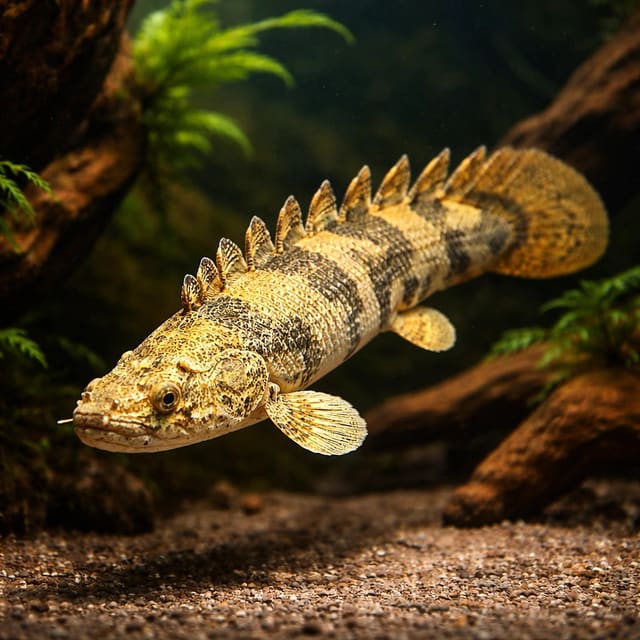
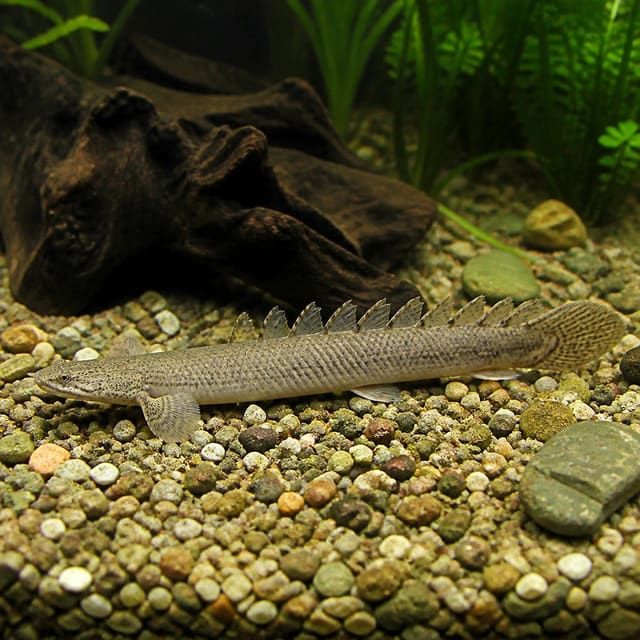
The original species description highlights a network of irregular black marks across the dorsal and dorsolateral body, orange ventral colour and very dark pectoral fins. The later revision describes a beige to brown-orange upper body with irregular dark anastomosing marks, a lighter lower body and seven to nine dorsal-fin spines or finlets. Pattern contrast changes with age, lighting, stress and the individual fish.
The body is notably elongated compared with many other bichirs, with the upper jaw projecting slightly beyond the lower jaw. A row of separate dorsal finlets creates the familiar serrated outline, while the rounded tail and muscular body support short bursts rather than continuous open-water cruising. Thick scales do not make the skin immune to sharp decor, poor water or rough handling.
The gallery image is a representative aquarium scene and must not be used as proof of sex, exact locality, maturity or the precise markings of the fish supplied. Juveniles can look less strongly patterned than mature examples, and transport can temporarily mute colour. Use the photograph to understand the general form only; every fish can differ naturally in colour and pattern.
A 5-7 cm juvenile is easy to underestimate. The largest measured specimen in the modern revision reached 415 mm standard length and 467 mm total length. Standard length excludes the caudal fin, so the two figures are not contradictory. Use the larger total-length figure when checking turning room, lid clearances and whether a proposed companion may eventually fit in the bichir’s mouth.
Growth rate cannot be guaranteed from sale size. Temperature, feeding, genetics, health and previous conditions all affect development. A juvenile can begin in a well-managed grow-on aquarium, but buying one without an adult enclosure already planned risks a costly and stressful move later. The final system should have a long, wide base rather than gaining most of its volume through extra height.
| Planning stage | Priority | Common mistake |
|---|---|---|
| 5-7 cm juvenile | Protected intake, accessible food and escape-proof cover | Assuming the current aquarium is a permanent home |
| Growing fish | Increase footprint before turning room becomes restricted | Waiting until the fish is visibly cramped |
| Adult plan | Large base area, robust filtration and manageable decor | Using litres without checking length and width |
| Mixed display | More space, separate retreats and controlled feeding | Stocking several large predators to the minimum footprint |
For one fish, about 600 litres and a base around 200 x 60 cm are a practical starting floor, not an invitation to stop planning. A full adult, a mixed bichir group or other large fish benefits from a longer and wider aquarium. A tall narrow tank may meet a volume figure while still providing poor turning space. Measure the usable base after decor, not only the external glass dimensions.
A completely secure lid is essential. Seal gaps around cables, filter pipes and feeding hatches without blocking ventilation. Bichirs can use surprisingly small openings, especially at night or during disturbance. They also need unobstructed access to the water surface because polypterids possess paired lungs and take atmospheric air. Leave a suitable humid air space beneath the cover and never trap the fish below a sealed internal shelf.
Use a mature biological filter sized for a carnivorous fish and the total stocking load. Current should circulate waste and maintain oxygen without forcing the fish to fight a torrent across every resting place. Keep ammonia and nitrite at zero, manage nitrate with appropriate maintenance and remove uneaten food before it decays. Air breathing is an adaptation, not permission for polluted water.
A stable captive target of 24-28°C, pH 6.5-7.5 and roughly 5-12 dGH preserves the established aquarium guidance for this listing. These figures are practical operating ranges rather than measurements attached to the supplier’s exact stock locality. Keep the fish toward the stable middle of the chosen range instead of repeatedly adjusting water to hit an arbitrary decimal.
The aquarium must be biologically mature before arrival. Test ammonia, nitrite, nitrate, pH and temperature with dependable methods, and confirm that the filter can process the existing feeding load. A large empty-looking predator tank can still be immature. Do not rely on elapsed calendar time alone; cycling is proved by water results and filter performance.
On delivery, follow the current livestock instructions supplied with the order. Minimise sudden temperature or chemistry changes, keep lights low and provide immediate access to a dark retreat. Do not add shop water to the display unnecessarily. A newly moved juvenile may refuse the first meal, so observe breathing, balance and body condition before responding with repeated food.
| Check | Target | Action if wrong |
|---|---|---|
| Ammonia | 0 | Stop feeding, investigate filtration and take appropriate water action |
| Nitrite | 0 | Increase oxygenation and correct the biological-filter problem |
| Temperature | Stable within the chosen 24-28°C range | Correct gradually; avoid abrupt swings |
| Surface route | Open | Remove obstructions while keeping the lid secure |
| Food remains | Removed promptly | Reduce portions and review feeding access |
Use fine sand or smooth rounded gravel that will not abrade the belly as the fish rests and moves across the base. Provide broad caves, stable wood and shaded routes, but preserve enough open floor for turning and feeding. Secure every heavy object directly so digging or pushing cannot undermine it. Avoid narrow ornaments in which a growing fish could become trapped.
Hardy plants can work when attached to wood or stone, and floating cover can soften bright light. The layout should be designed for the fish and for maintenance, not only for a photograph. Leave clear routes for a siphon, visual checks and retrieval of uneaten food. A densely packed hardscape that hides waste or prevents inspection is poor long-term design for a large carnivore.
Subdued to moderate lighting usually makes lower-level activity easier to observe. Use a predictable day/night cycle and avoid sudden bright light when the fish is resting. Dim transitions and several dark retreats are more useful than a permanently unlit tank. The keeper still needs enough visibility to judge body condition, injuries and feeding.
| Feature | Recommended approach | Avoid |
|---|---|---|
| Substrate | Fine sand or smooth rounded gravel | Sharp chips and abrasive edges |
| Cover | Wide stable caves and wood with more than one route | Tight tubes and unstable rock piles |
| Plants | Robust attached species and optional floating shade | Fragile stems across feeding routes |
| Lighting | Moderate, predictable and softened by cover | Sudden intense light with no refuge |
This is a carnivorous fish. Build the aquarium diet around complete sinking carnivore pellets plus varied suitable frozen or fresh aquatic foods such as prawn, mussel and other appropriately sized items. Earthworms from a safe source can add variety. Cut food to a size the fish can swallow safely and place it where a shy juvenile can find it without competing with faster surface feeders.
Feed according to body condition, age, water temperature and the energy density of the food rather than a rigid universal schedule. Juveniles usually need smaller, more regular meals than adults. Mature fish should not be stuffed simply because they respond strongly. Remove uneaten remains, and adjust the next portion if food is left or the body becomes excessively heavy.
Do not use feeder fish as the default diet. They can introduce pathogens, make nutrition inconsistent and encourage purchases that are difficult to quarantine. Avoid mammalian or poultry meat as routine food. A varied aquatic-protein diet and a quality complete pellet are easier to balance and keep cleaner than one repeated ingredient.
| Food type | Role | Practical note |
|---|---|---|
| Complete sinking carnivore pellet | Nutritional foundation | Choose an appropriate diameter and confirm it reaches the fish |
| Prawn or mussel | Variety | Offer plain, appropriately sized pieces rather than seasoned food |
| Safe-source earthworm | Occasional whole-prey variety | Avoid chemically treated collection areas |
| Unquarantined feeder fish | Not recommended | Pathogen and nutritional risk |
| Uneaten leftovers | Waste, not a later meal | Remove before water quality deteriorates |
Expect a bottom-oriented fish that often rests beneath wood or beside a cave and becomes more exploratory under subdued light. Bichirs use smell and close-range senses effectively when locating food. A settled individual may learn the feeding routine, but “recognising” a routine should not be turned into claims about human-like intelligence or guaranteed hand feeding.
Occasional surface visits are normal because the fish breathes atmospheric air as well as using its gills. Repeated frantic surfacing, loss of balance or inability to stay submerged is not normal simply because it is an air-breathing species. Check temperature, ammonia, nitrite, oxygenation, obstruction and physical condition immediately.
Quiet daytime behaviour is not proof that companions are safe. Opportunistic predation often occurs when lights are low. A fish that has coexisted with a small companion for weeks may still swallow it after growth or a chance encounter. Compatibility must be judged against the largest likely mouth size and the smallest body depth in the aquarium.
The safest default is a species-focused aquarium. In a genuinely large mixed display, companions must be robust, non-nipping, able to feed without harassment and too deep-bodied to be swallowed. Similar length alone is not enough: a long slender fish may fit in the mouth more easily than a shorter deep-bodied fish. Provide separate retreats and watch every animal at feeding time.
Other bichirs can sometimes coexist when sizes are compatible and floor space is generous, but that is not a guarantee of harmony. Avoid crowding several bottom predators into the minimum aquarium. Large catfish, cichlids or gouramis are not automatically suitable; aggression, adult size, water needs and feeding competition must be assessed for the exact species.
Small tetras, rasboras, livebearers, shrimp and similarly sized fish should be treated as prey-risk choices, not community companions. Ropefish are relatives, but their slender body and different social needs make them a comparison species rather than an automatic tank mate. Lungfish should never be suggested as a casual companion simply because both groups breathe air.
| Candidate | Assessment | Reason |
|---|---|---|
| Small fish or shrimp | Avoid | High predation risk |
| Slender fish near mouth size | Avoid | Body shape increases swallow risk |
| Similar-sized bichir | Case by case | Needs large footprint, separate cover and controlled feeding |
| Large non-nipping midwater fish | Case by case | Check adult size, aggression and water requirements |
| Fin-nipping or highly aggressive fish | Avoid | Risk of injury and chronic stress |
The 5-7 cm fish is not sold as sexed. Mature male bichirs generally develop a broader anal fin, but juvenile sexing is uncertain and two fish ordered together are not a guaranteed male-female or compatible pair. Do not buy multiple juveniles on the assumption that they can remain indefinitely in the same minimum-sized aquarium.
The sources used here do not provide a detailed species-specific breeding protocol. Do not rely on exact water-change triggers, hatching times or parental-role claims for this stock. Treat any breeding attempt as an advanced project and consult direct species-specific evidence before proceeding.
If reproductive behaviour is suspected, prioritise welfare and observation. Ensure both fish can retreat and feed, keep water stable and have a separation plan. Eggs or fry should not be expected merely because two fish coexist. Any future breeding section should be expanded only when a direct, reliable P. teugelsi source supports the details.
Good prevention starts with mature filtration, a secure low-stress layout, suitable food and observation before tank mates are introduced. Quarantine new fish and equipment where practical, but do not use an arbitrary number of days as proof that an animal is disease-free. Watch appetite, waste, breathing, balance, skin, eyes and fins over time.
Abrasions can follow rough decor or attempted escapes. Poor water can cause lethargy, excess mucus, heavy breathing and secondary infection. Refusal of one meal after transport may be settling behaviour; persistent refusal combined with weight loss or abnormal breathing needs investigation. Test the environment before assuming every symptom requires medication.
Do not guess drug doses or combine treatments. Bichirs have unusual anatomy, and products vary in concentration and safety. Use a qualified aquatic veterinarian or an experienced aquatic-health professional for diagnosis where illness is persistent, severe or unclear. Keep the product label, water-test results and a timeline of symptoms available.
| Observation | First check | Escalate when |
|---|---|---|
| Repeated frantic surfacing | Temperature, ammonia, nitrite, surface access and oxygenation | It continues after environmental problems are addressed |
| New abrasion | Lid gaps, sharp decor and tank-mate aggression | Redness, swelling or tissue loss progresses |
| Missed meal | Settling stress, food size, competition and water quality | Body condition declines or other symptoms appear |
| Loss of balance | Immediate water tests and physical obstruction | Always seek prompt specialist advice |
Choosing between bichir species should begin with verified adult size and the aquarium you can maintain, not colour alone. Teugelsi is notable for its elongated body, Cross River origin and reticulated pattern. Senegal Bichir is often presented as a more familiar starting comparison, while Saddled and Ornate bichirs demand their own large-fish planning. Check each linked product page for its current size and availability.
| Listing | Useful comparison | Planning question |
|---|---|---|
| Delhezi Bichir | Strong vertical/barred pattern and similar bottom-oriented behaviour | Is the adult footprint sufficient for the exact species? |
| Senegal Bichir | Familiar species-group comparison with several size options | Which active variant matches the planned aquarium? |
| Saddled Bichir | Heavier-bodied large bichir comparison | Can the system support the greater body mass and waste load? |
| Lapradei Bichir | Another large West African bichir listing | Are current taxonomy and adult dimensions understood? |
| Ornate Bichir | Bold pattern and multiple size variants | Is the selected option genuinely available and suitable? |
| Reedfish / Ropefish | A related polypterid with a much more slender body | Does the social and feeding plan suit ropefish rather than a bichir? |
The first month should be treated as an observation period rather than a race to increase feeding or add tank mates. A newly moved juvenile has already experienced packing, transport, new water chemistry and a different day-night routine. Give it a quiet, secure system with established biological filtration, subdued areas and easy access to the surface. Keep the lid fully closed from the moment the fish is introduced; temporary gaps for airline, heater or filter cables are still escape routes.
| Period | Main priority | What to observe | Avoid |
|---|---|---|---|
| Arrival day | Calm acclimation and secure cover | Upright posture, controlled breathing and ability to reach the surface | Bright lighting, handling and an immediate large meal |
| Days 2-7 | Small, suitable feeds and stable water | Interest in food, resting position, skin condition and waste | Repeatedly changing foods, decor or water targets |
| Week 2 | Establish a predictable routine | Whether food is swallowed, whether the abdomen fills evenly and where the fish chooses to rest | Adding vulnerable tank mates before behaviour is understood |
| Weeks 3-4 | Review growth, body condition and system fit | Steady condition, normal movement and consistently acceptable water-test results | Increasing portions simply because the fish begs or becomes active at feeding time |
Offer food only when you can observe the response. Remove uneaten pieces promptly, because a carnivore meal can deteriorate water quality faster than a small flake feed. A fish that ignores one meal after transport is not automatically ill; look at the whole pattern, including posture, breathing, skin, buoyancy and the next feeding response. Persistent refusal, repeated regurgitation, loss of condition, redness, sores or abnormal breathing deserves investigation rather than random treatment.
If quarantine is available, keep equipment separate and use it as a period of calm observation. Record the date, feed offered, approximate amount eaten and any visible change. A short written log is more reliable than memory and makes it easier to explain the timeline to an aquatic veterinarian or experienced fish-health professional if help is needed.
Good filtration is not only about the filter's advertised aquarium volume. The complete system must capture solid food fragments, support stable biological processing and remain easy enough to service that maintenance actually happens. Choose equipment with capacity in reserve, but avoid turning the whole aquarium into a high-velocity channel. The fish should have calmer resting zones as well as well-oxygenated water.
| System task | Practical approach | Reason |
|---|---|---|
| Mechanical capture | Use accessible pre-filter or mechanical media and inspect it after heavier feeds | Stops food debris breaking down unseen in the system |
| Biological stability | Protect mature biomedia from untreated tap water and clean sections in rotation | Reduces the risk of removing too much established filtration at once |
| Oxygen exchange | Maintain surface movement without blocking the fish's route to breathe atmospheric air | Supports the aquarium community while preserving essential surface access |
| Water changes | Base frequency and volume on measured waste load, stocking and source-water consistency | A fixed calendar cannot account for every aquarium |
| Equipment safety | Guard powerful intakes and route cables through tightly closed openings | Protects fins and prevents an escape gap |
Test ammonia and nitrite whenever a system is new, disturbed or behaving unexpectedly, and monitor nitrate as a trend rather than waiting for a single alarming reading. Compare results with feeding, maintenance and stocking notes. Sudden changes often reveal a missed meal, clogged mechanical stage, dead tank mate or reduced flow before the aquarium looks visibly dirty.
During each service, account for the fish before lifting the lid and prepare tools in advance so the cover is open for the shortest practical time. Siphon around shelters without collapsing them, inspect hidden corners for food, and verify that heaters, intakes and return pipes remain firmly secured. Recheck every lid panel and cable opening when maintenance is finished.
Feeding advice works best when it is tied to the individual fish rather than a rigid number of meals. View the animal from above and from the side under normal lighting. The body should not look sharply pinched behind the head, but a permanently distended abdomen is not the goal either. Compare condition over several weeks using photographs taken from a similar angle; daily impressions can be misleading.
| Observation | Possible interpretation | Sensible response |
|---|---|---|
| Food remains after the fish loses interest | Portion may be too large or the item may be unsuitable | Remove it, reduce the next portion and review food size |
| Steady appetite with a leaner outline | Growth demand, competition or an underlying problem may be involved | Check access to food, water quality and the longer condition trend |
| Repeated bloating or regurgitation | Overfeeding, inappropriate pieces or a health issue is possible | Pause experimentation and seek qualified advice if it recurs |
| One missed meal after a move | Short-term stress is common | Keep conditions stable and reassess the next scheduled feed |
Use varied, appropriately sized sinking carnivore foods and suitable frozen or fresh aquatic foods rather than relying on mammal or bird meat. Do not use feeder fish as a routine shortcut: they can introduce disease, make nutrition difficult to balance and encourage unnecessary predation in a community. If several bottom-feeding fish share the aquarium, place food where each individual can be observed and remove leftovers after the feeding window.
The practical baseline in this guide is about 600 litres with a footprint around 200 x 60 cm, but litres alone do not prove suitability. A tall, narrow aquarium may hold the same volume while providing less turning room and bottom area. Prioritise length and width, then check that decor does not reduce the usable footprint to a corridor.
Plan the lid, filtration, cabinet access and maintenance route before purchase. The adult system should permit the fish to turn without bending around hard structures, reach the surface directly and retreat into more than one stable shelter. Leave a clear route for siphoning and equipment removal. If the intended aquarium cannot meet those conditions at the species' documented adult scale, choose a smaller species rather than relying on a future upgrade with no date or space assigned.
One order quantity is one unsexed fish. The supplier sale size is 5-7 cm, but natural variation and measurement method mean an individual may not be identical to a photograph or an exact ruler mark. Check the live buy box and current delivery terms, and contact the store before purchase if a specific sale or dispatch detail is essential.
| Mistake | Why it fails | Better approach |
|---|---|---|
| Buying for the juvenile size | The species reaches more than 40 cm in verified records | Plan the adult aquarium before ordering |
| Using litres alone | A tall tank can have too little turning space | Check length, width and usable base area |
| Leaving a cable gap | Bichirs can exploit small openings | Seal every opening and secure the lid |
| Adding small companions | Quiet daytime behaviour hides predation risk | Use a species tank or carefully sized companions |
| Overfeeding meaty food | Waste quickly burdens the filter | Use measured varied meals and remove leftovers |
| Copying a generic breeding recipe | Species-specific evidence may be absent | Separate verified facts from hobby inference |
| Treating lungs as pollution tolerance | Air breathing does not prevent ammonia or nitrite harm | Maintain mature filtration and tested water |
The sold fish is identified as Polypterus teugelsi at 5-7 cm. Scientific descriptions support the accepted name, Cross River distribution, diagnostic appearance and recorded adult measurements. The water and aquarium figures below are practical captive targets informed by specialist care summaries rather than collection-site measurements. Published recommendations vary, so this guide uses a conservative adult footprint and treats the figures as planning ranges, not guarantees.
Sources checked 27 July 2026. Scientific sources describe the species; they do not certify the sex, collection point, pair status, exact colour or future adult size of one retail fish. Read the current product interface and delivery page for live price, availability and dispatch terms.
No reviews for this item yet. Bought one? Honest reviews only, good or bad.
What customers say about ordering from us
I have a small group of long finned mountain minnows. So was delighted to be able to order ten of this variety to increase the genetics in my tank . The ones I recieved are healthy but it’s to early to give a verdict on wether they are of a long finned type since they are small currently.
Gordon Walker · 23 Sept 2026
100% success travel and "installation". Pleased with quality of purchase. The Siamese fighter a bit "shy" so have not yet seen him at his best yet but looking good. Happy customer. GG
George E Garratt · 21 Sept 2026
Reviews of our shop, collected by Judge.me, an independent third-party review collector. Newest first.