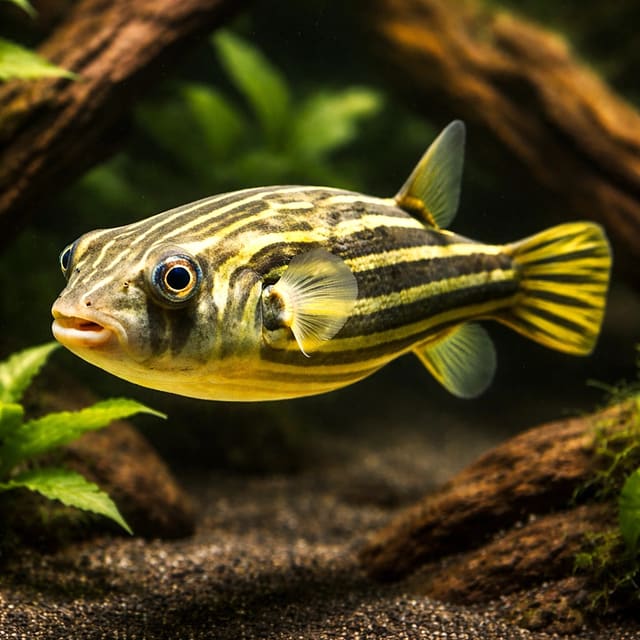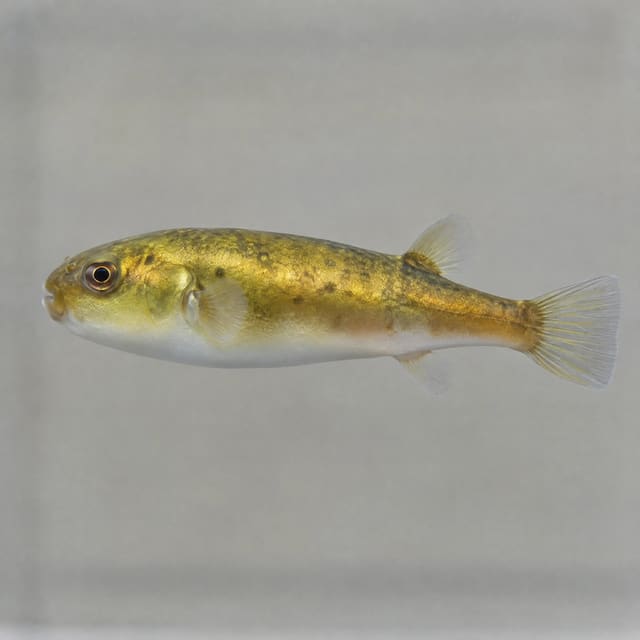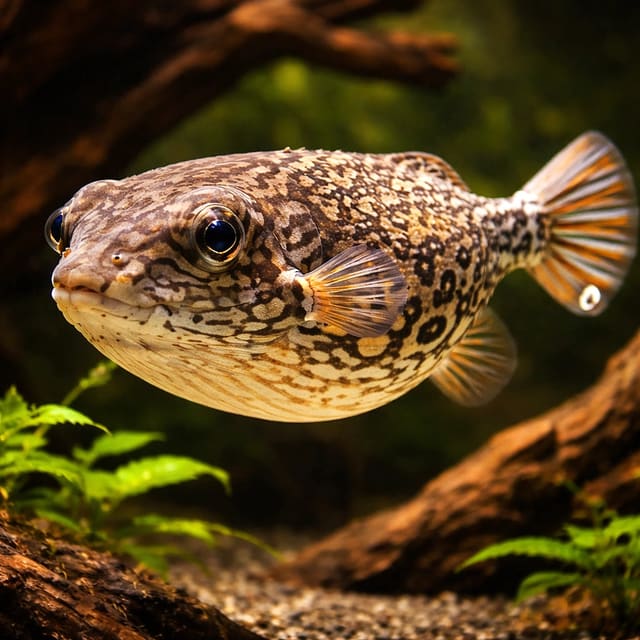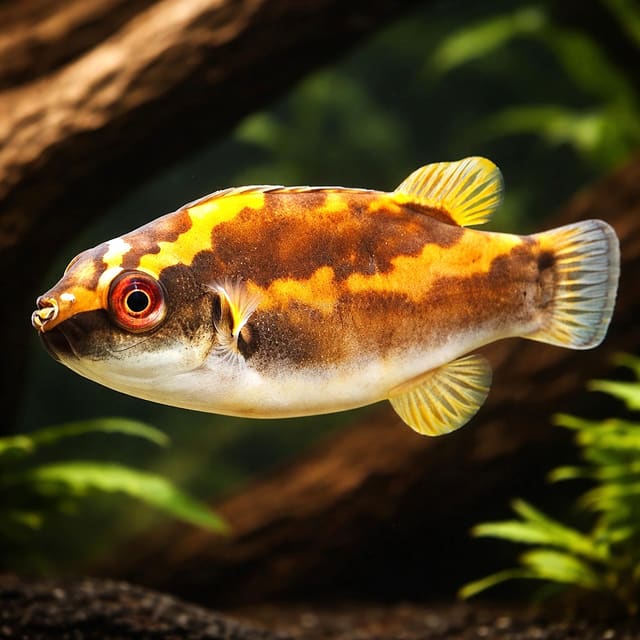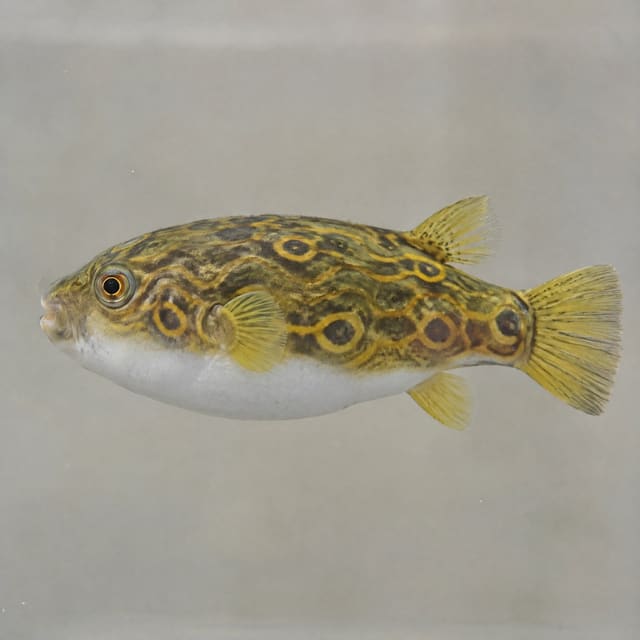
Figure Eight Puffer (Tetraodon biocellatus)
22–26°C · pH 6.5–7.5 · 68L
£14.99
The Schoutedeni Puffer, also sold as the spotted Congo puffer or leopard puffer (Tetraodon schoutedeni), is a small, pure-freshwater pufferfish from the Congo basin that grows to about 9–10 cm. Keep one fish alone, or a group of at least six, in a sandy aquarium of at least 80 × 35 cm at 24–26°C, and feed snails to keep its ever-growing beak trimmed. Sold individually as one live fish.
Adult size is the maximum length this species reaches at full maturity (scientific sources). The livestock you receive will be younger and smaller. Product-photo provenance and any image-specific limitations are stated on the listing.
Tetraodon schoutedeni
The Schoutedeni Puffer, also sold as the spotted Congo puffer or leopard puffer (Tetraodon schoutedeni), is a small, pure-freshwater pufferfish from the Congo basin that grows to about 9–10 cm. Keep one fish alone, or a group of at least six, in a sandy aquarium of at least 80 × 35 cm at 24–26°C, and feed snails to keep its ever-growing beak trimmed. Sold individually as one live fish.
Adult size is the maximum length this species reaches at full maturity (scientific sources). The livestock you receive will be younger and smaller. Product-photo provenance and any image-specific limitations are stated on the listing.
Read the full care guidance when planning conditions for your aquarium.
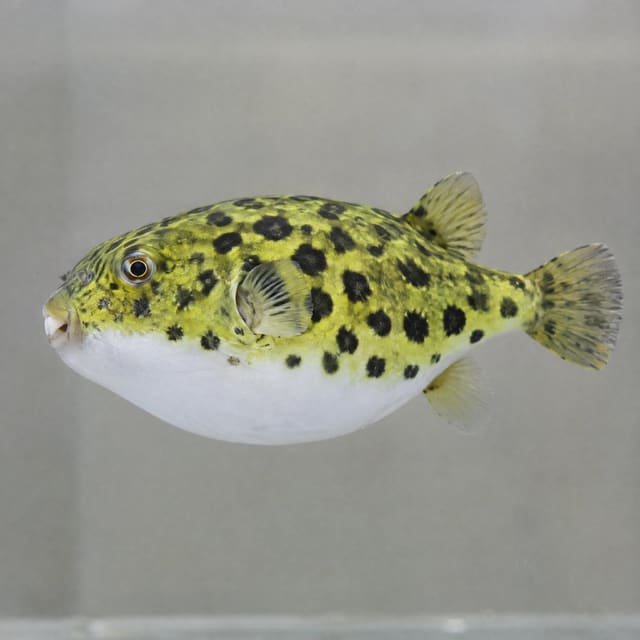
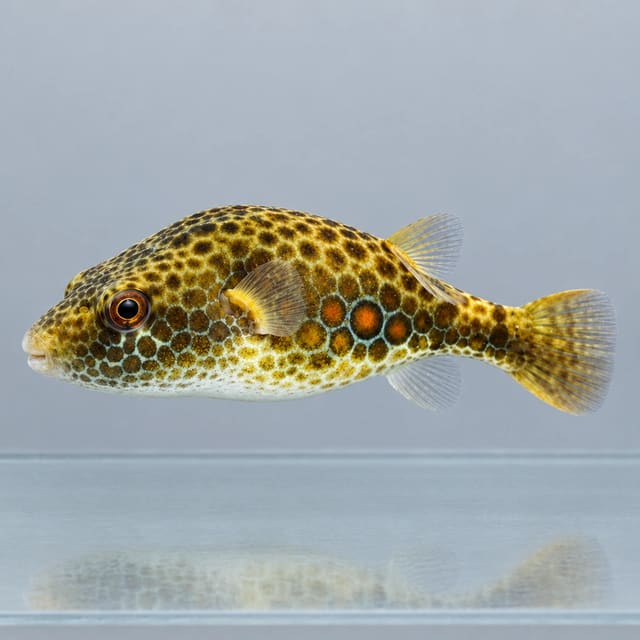
The Schoutedeni Puffer (Tetraodon schoutedeni) is a small freshwater pufferfish from the Congo basin in Central Africa, also sold as the spotted Congo puffer and the leopard puffer. Its rounded, golden body is covered in dark spots, its eyes swivel independently, and it hunts snails across the sand with obvious curiosity. It lives entirely in fresh water and stays under about 10 cm, which makes it a realistic puffer for a dedicated aquarium of modest length.
FishBase reports the species from large rivers in the Congo basin, but apparently limited to Pool Malebo, the wide, lake-like stretch of the Congo River between Kinshasa and Brazzaville. It lives near the bottom and feeds on snails, worms and other small animals. FishBase gives a maximum length of 9.0 cm and lists it as Data Deficient on the IUCN Red List (assessed 2009), which means there is too little survey data to judge its status.
The Schoutedeni Puffer has an unusual history in the hobby. Aquarium Glaser records that in the 1960s it was one of the most common freshwater puffers in the trade and was bred regularly, before civil war in the Congo cut off supplies. The Pufferfish Enthusiasts Worldwide care sheet by Macauley Sykes dates the near-disappearance to the mid-1990s and early 2000s and the return of exports to around 2017–2018. It is still an uncommon fish, which is reflected in its price.
| Name | What it means |
|---|---|
| Schoutedeni puffer | The trade name on this listing, taken from the species name |
| Spotted Congo puffer | A common English name describing the spots and the river basin |
| Leopard puffer | The name Aquarium Glaser uses, after the leopard-like spotting |
| Tetraodon schoutedeni Pellegrin, 1926 | The scientific name; the fish was named after the Belgian zoologist Henri Schouteden |
| Tetraodontidae | The pufferfish family, which also includes marine puffers |
All of these names describe one fish. Compare it with the other species in our freshwater puffer fish range, browse more unusual species in loaches and oddball fish, or see our rare and collector fish.
One purchase quantity supplies one live Schoutedeni Puffer. The only option is "Standard": the fish is not graded into sizes, so it is sent at the size available on the day, normally a young fish that has not reached adult size. Sex is not chosen or guaranteed.
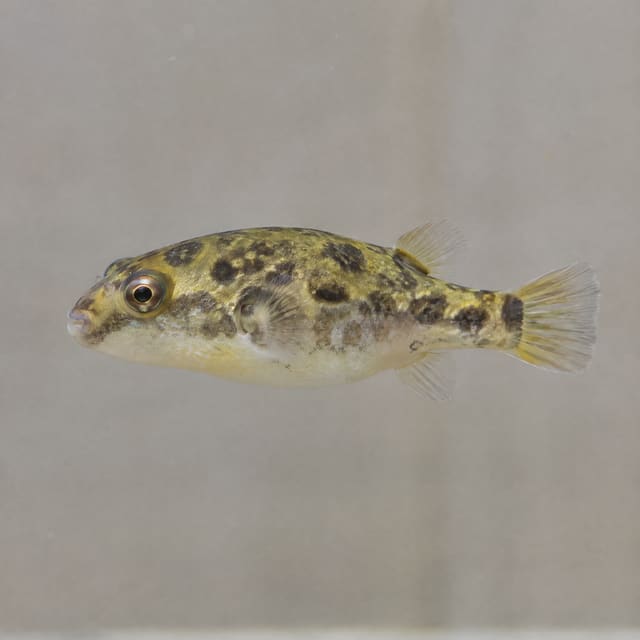
Each fish has its own spot pattern, and the photographs show the type of fish rather than the individual you will receive. The Pufferfish Enthusiasts Worldwide care sheet notes that colour shifts with mood, health and activity: a settled, healthy fish shows a golden base colour with crisp dark spots, while a stressed fish can show darker arched bars across the back that partly hide the spots. Expect some of that during the first days after travel.
Sexing is not easy. Aquarium Glaser says males often stay smaller, look more contrasting and have longer snouts. The Pufferfish Enthusiasts Worldwide care sheet describes females as larger, broader and rounder in the belly, and males as slimmer with a more tapered head and pointed snout, and warns that colour and pattern are not reliable sexing cues. No formal study has compared the sexes, so treat these as guides only.
Adult size is small for a puffer, though sources differ a little. FishBase gives 9.0 cm, Aquarium Glaser 7–10 cm, and the Pufferfish Enthusiasts Worldwide care sheet 8–10 cm, with females reaching about 9–10 cm and males about 7–8 cm. The care sheet stresses that floor area and length matter more than total volume, because tall, narrow tanks increase conflict between puffers. Our tank volume calculator turns any set of dimensions into litres.
| Planning point | Figure | Source |
|---|---|---|
| Adult size | 9.0 cm total length; 7–10 cm; 8–10 cm | FishBase; Aquarium Glaser; Pufferfish Enthusiasts Worldwide |
| One adult | At least 80 × 35 cm footprint, about 40 cm of water, roughly 112 litres | Pufferfish Enthusiasts Worldwide |
| Group of six | At least 120 × 45 cm footprint, about 50 cm of water, roughly 270 litres | Pufferfish Enthusiasts Worldwide |
| Larger groups or mixed tanks | 150 cm long or more strongly advised | Pufferfish Enthusiasts Worldwide |
| Water movement | Slow to moderate; some puffers are not strong swimmers | Pufferfish Enthusiasts Worldwide; OATA |
| Lid | A secure lid is recommended | OATA |
Use fine, soft, inert sand. The care sheet describes two habits that make this important: the fish "wallow", partly burying themselves in the sand, and when startled they may nose-dive into the substrate head first, which can injure the snout on sharp gravel. Build cover with driftwood, roots, stones and caves so each fish has places to rest out of sight, and leave open sand at the front for feeding.
Plants need to survive being nipped and dug around. The care sheet lists Anubias, Java fern, Bolbitis and Amazon swords as hardy choices, and warns that delicate plants such as tiger lotus, Crinum calamistratum and Cryptocoryne balansae are usually destroyed. Tie epiphytes such as Anubias and Java fern to wood or rock rather than planting them in the sand. Browse our hardy aquarium plants to furnish the tank.
The sources do not agree on temperature or hardness, so the table shows each one. FishBase gives one range, the Pufferfish Enthusiasts Worldwide care sheet a warmer and softer one, and OATA, the UK ornamental fish trade association, a general range for freshwater puffers as a group. The care sheet also quotes surveys of Pool Malebo at 26–30°C, pH 6.4–7.7 and a conductivity of about 30 µS/cm, which is very soft water.
| Value | FishBase | Pufferfish Enthusiasts Worldwide | OATA (freshwater puffers) | Our suggested target |
|---|---|---|---|---|
| Temperature | 22–26°C | 26–27.5°C | 22–27°C | 24–26°C, held steady |
| pH | 6.5–7.5 | 6.5–7.5 | 6.5–8.0 | 6.5–7.5 |
| Hardness | 10–20 dH | 4–10 dGH | 4–18 dGH | About 5–12 dGH, held steady |
| Ammonia and nitrite | Not given | Zero | Zero | Zero |
| Nitrate | Not given | Below 15 ppm, as close to zero as possible | No more than 20 mg per litre above tap water | As low as you can keep it |
This is a pure freshwater fish. FishBase states that it is not a brackish-water species and Aquarium Glaser calls it a pure freshwater dweller. OATA warns that some puffers sold as freshwater fish need brackish water as they mature, but the Schoutedeni Puffer is not one of them, so do not add salt. A Japanese public aquarium bred the species at a stable 24–25°C, which supports the middle of the temperature ranges above.
OATA points out that tap water varies a great deal from one area to another in hardness and mineral content, so test yours rather than assume. Treat it with a dechlorinator or conditioner, test pH and general hardness, and enter the numbers into our water matcher. If your tap water is much harder than the target, OATA notes that reverse osmosis water gives more control but must be remineralised before use; our water chemistry guide explains how to blend the two. Make changes gradually: a steady value inside the range matters more than chasing a perfect number.
OATA says freshwater puffers can be stressed by even the smallest amounts of ammonia and nitrite, so the aquarium must be fully cycled, with ammonia and nitrite at zero, before the fish arrives. Puffers are messy eaters, and the care sheet calls for strong mechanical and biological filtration while keeping the flow slow to moderate. It suggests an external canister filter returning through a spray bar angled at the surface, and guards on pump and filter intakes. Our aquarium filtration guide explains how to size and maintain a filter.
A puffer's teeth are fused into a beak that grows throughout its life. OATA explains that it must be worn down by hard food, and FishBase records that wild Schoutedeni Puffers feed on snails and worms. The Pufferfish Enthusiasts Worldwide care sheet therefore makes snails the bulk of the diet, suggesting roughly the balance below.
| Food | Share of the diet suggested | Why |
|---|---|---|
| Small snails such as ramshorns and bladder snails, for example live Great Ramshorn feeder snails | About 50% | Natural prey; the shells wear the beak down |
| Chopped earthworm, for example live earthworms cut into bite-sized pieces | About 15% | Rich, natural food that most puffers take readily |
| Insects and larvae such as mosquito and midge larvae | About 10% | Part of the wild diet |
| Insect-based prepared foods (gel food and pellets) | About 20% | Convenient variety; a supplement, not a replacement |
| Variety: bloodworm, blackworm, live daphnia and similar | About 5% | Interest and balance |
OATA singles out cockle in the shell as a good puffer food, because breaking the shell grinds the teeth; shell-free frozen cockle meat adds variety but does not trim the beak. The care sheet warns against Malaysian trumpet snails, whose shells are too hard and can injure the fish. Many keepers breed their own feeder snails in a spare tank; Ramshorn Snails are an easy starting stock.
OATA advises feeding freshwater puffers once a day, only as much as they eat within a few minutes, because uneaten meaty food quickly fouls the water. Offer a few snails or one small portion, watch it eaten, and remove leftovers. The belly should look gently rounded, never hollow or swollen. In a group, the care sheet recommends training the fish to take food from feeding tongs so each one gets its share.
OATA recommends that puffers travel double-bagged, because a sharp beak can puncture a single bag. Read our delivery and live arrival information before ordering, and have the aquarium running, matured and tested before the fish arrives. Our guide on how to acclimatise new fish covers the method in more detail.
During the first week, test the water every few days and expect the fish to spend time in cover. Never tap the glass or chase it with a net: OATA explains that puffing up is a stress response and should not be provoked. The care sheet adds that a brief "practice puff" in a relaxed fish is normal, but repeated or prolonged inflation, or the dark stress bars across the back, means something in the tank needs checking.
The sources disagree on temperament. FishBase describes the species as solitary and aggressive towards its own kind. Aquarium Glaser calls it one of the most peaceful pufferfishes, while noting that individual fish differ. The Pufferfish Enthusiasts Worldwide care sheet takes a middle line: more sociable than many puffers, but still capable of unprovoked chasing and nipping, and not a safe choice for a typical community tank. OATA adds that freshwater puffers are notorious fin nippers and that most should be kept in single-species aquariums.
If you want more than one, the care sheet is clear that pairs and trios become unstable as the fish mature, with targeted bullying. Its two sustainable options are one fish on its own, or a group of at least six with about two females to each male, introduced together as juveniles into a well-structured tank. Adding a new adult to an established group often triggers fighting.
| Suits | Avoid |
|---|---|
| Living alone in a species aquarium (the simplest choice) | Shrimp, ornamental snails and other invertebrates, which are food |
| A group of six or more in at least 120 × 45 cm | Pairs or trios of this puffer |
| In tanks of 150 cm or more: robust Congo fish such as Congo Tetras, a Kribensis pair or Synodontis schoutedeni, with the risk accepted | Slow, long-finned or very small fish |
| Fish introduced at the same time as the puffers | Other puffer species |
For a biotope-style Congo tank, the care sheet names Congo Tetras, which compete hard at feeding time, a breeding pair of Kribensis holding a territory on the floor (our Kribensis guide explains their needs), and the Vermiculated Synodontis (Synodontis schoutedeni), a catfish named after the same zoologist that shares the puffer's home waters. Watch closely and be ready to separate fish. Our tank mates checker helps you test other ideas. OATA also warns that stressed puffers can release a poison from the mouth that kills other fish, one more reason to keep the tank calm.
OATA's checklist applies well to this species. Look each day, and especially at feeding time, for changes in:
If anything changes, test the water first, because most puffer problems begin with water quality, then contact us for advice. The care sheet also notes that the eyes can roll back briefly as normal behaviour, but holding them rolled back for long periods suggests stress or harassment.
Because the teeth grow continually, a puffer that is not fed enough hard-shelled food can develop an overgrown beak. A fish that tries to eat but cannot bite or swallow, or whose beak looks long and protruding, needs more snails at once; seek advice from an aquatic vet if it still cannot feed.
Unlike many puffers, the Schoutedeni Puffer has been bred in aquariums, both in the 1960s and more recently. A study published in Zoo Biology in 2023 recorded eight spawning sessions at Osaka Aquarium NIFREL between May 2016 and November 2017, at a stable 24–25°C with lights on from 07:00 to 19:00. Before each spawning, the pair swam in tandem for 65–150 minutes, with the male biting and clinging to the female's belly. They then scattered 3–50 round, weakly sticky eggs onto the sand or water plants.
The authors found two things essential for success: removing other fish that might eat the eggs, and offering very small first foods, such as small rotifers, to the larvae. Sources disagree on parental care: FishBase says eggs are laid on leaves and sometimes guarded by the male, while Aquarium Glaser describes free spawners without brood care, which matches the scattered eggs seen in the 2023 study.
OATA's hazardous aquatic animals guidance lists pufferfish among poisonous animals, meaning their tissues are toxic if eaten, and advises good hygiene around poisonous species. The Pufferfish Enthusiasts Worldwide care sheet notes that wild fish accumulate tetrodotoxin from their diet, mainly in the skin, liver and ovaries, but that the toxicity of this species has not been studied in detail and it is not considered dangerous in the aquarium; FishBase lists it as harmless to people. Never eat a puffer, move it with a net rather than your hands because of the sharp beak, and wash your hands after aquarium work.
For a different puffer with similar needs, compare the Figure Eight Puffer, or, for a very large aquarium, the Fahaka Puffer, another African Tetraodon that grows far bigger.
Yes. Schoutedeni puffer, spotted Congo puffer and leopard puffer are all names used for Tetraodon schoutedeni, the species described by Jacques Pellegrin in 1926 and named after the Belgian zoologist Henri Schouteden.
FishBase gives a maximum of 9.0 cm total length. Aquarium Glaser says fully grown fish are 7–10 cm, and the Pufferfish Enthusiasts Worldwide care sheet gives 8–10 cm, with females reaching about 9–10 cm and males about 7–8 cm.
The Pufferfish Enthusiasts Worldwide care sheet suggests a footprint of at least 80 × 35 cm with about 40 cm of water, roughly 112 litres, for one adult, and at least 120 × 45 cm with 50 cm of water, roughly 270 litres, for a group of six. Floor area matters more than height.
No. FishBase states that it is not a brackish-water species, and Aquarium Glaser calls it a pure freshwater fish. Keep it in fresh water at a steady 24–26°C and pH 6.5–7.5, and do not add salt.
Sources disagree. FishBase calls it solitary and aggressive towards its own kind, while Aquarium Glaser calls it one of the most peaceful puffers. The Pufferfish Enthusiasts Worldwide care sheet says pairs and trios become unstable, and recommends either one fish alone or a group of at least six, about two females to each male, in a large tank.
Snails should form the main part of the diet, because hard shells wear down the beak, which grows throughout life. Add earthworm pieces, insect larvae, bloodworm, daphnia and shell-on cockles for variety. Feed once a day, only what it eats within a few minutes.
Not a typical one. It nips fins and eats snails and shrimp. In tanks of 150 cm or more, some keepers house it with robust Congo fish such as Congo Tetras, a Kribensis pair or Synodontis schoutedeni, but compatibility is never guaranteed and you should be ready to separate fish.
Yes. It bred regularly in the 1960s, according to Aquarium Glaser, and a public aquarium in Japan recorded eight spawnings at 24–25°C between 2016 and 2017. Pairs swim in tandem with the male biting the female, then scatter 3–50 weakly sticky eggs over sand or plants.
Pufferfish can carry tetrodotoxin and must never be eaten. Its toxicity has not been studied in detail and it is not considered dangerous in the aquarium, but use a net rather than your hands and wash your hands after aquarium work.
No reviews for this item yet. Bought one? Honest reviews only, good or bad.
What customers say about ordering from us
Easy website plenty of info on fish your buying great to pick a time slot
TRACEY DURRANT · 7 Oct 2026
Got some lovely fish thank you
Kevin Mackie · 7 Oct 2026
Reviews of our shop, collected by Judge.me, an independent third-party review collector. Newest first.
Moved by UK carriers licensed to handle live animals
Hand-packed with oxygen bags, poly box, heat pack
Email photos the same day; an optional unboxing video helps us review problems faster — claim terms apply
Klarna & PayPal Pay in 3 at checkout