Chocolate Cherry Shrimp (Neocaridina davidi)
18–26°C · pH 6.5–8 · 30L

Green Spotted Puffer is an intelligent, territorial Dichotomyctere nigroviridis for experienced keepers with a hard, alkaline brackish species-style aquarium.
Dichotomyctere nigroviridis
Green Spotted Puffer is an intelligent, territorial Dichotomyctere nigroviridis for experienced keepers with a hard, alkaline brackish species-style aquarium.
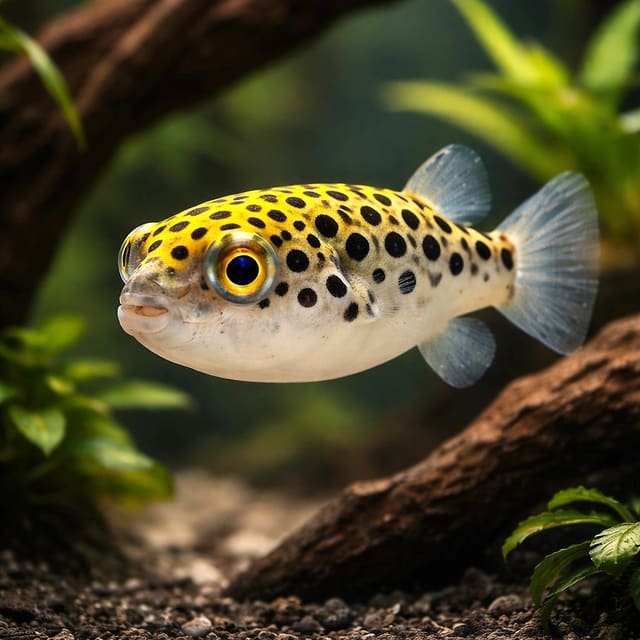
The Green Spotted Puffer, Dichotomyctere nigroviridis, is one of the most recognisable brackish puffers in the aquarium trade: bright yellow-green above, bold black spots across the back, a pale belly and a curious face that seems to watch everything in the room. It is also one of the most commonly misunderstood. This is not a peaceful planted community fish and it should not be planned as an easy first puffer.
This repaired listing corrects the older page problem. The previous live Shopify body was only a short warning and some hidden fields still carried confusing wording around freshwater community use, urgent buying language and the wrong species bridge. The product is now described as Green Spotted Puffer / Dichotomyctere nigroviridis, with the older trade and supplier context kept only where it helps customers understand what they are looking at.
Best match: an experienced aquarist who can build a hard, alkaline brackish system around one puffer or a carefully planned expert setup. This fish is intelligent, messy, toothy and often aggressive. It can be very rewarding, but it is not a casual add-on to a community aquarium.
| Scientific name | Dichotomyctere nigroviridis |
|---|---|
| Older trade names | Green Spotted Puffer, Spotted Green Pufferfish, Leopard Puffer, formerly sold under Tetraodon nigroviridis |
| Adult size | Commonly planned around 15-17 cm, with large adult body mass and heavy waste output |
| Water style | Hard, alkaline brackish water for long-term care; do not treat as a soft-water community fish |
| Temperature | About 24-28°C |
| pH | Alkaline, usually around 7.5-8.5 |
| Minimum planning | At least 120 litres for a young individual; around 200 litres or more is better for an adult |
| Temperament | Territorial, predatory, fin-nipping and best treated as species-style livestock |
| Diet | Crunchy meaty foods: snails, mussel, cockle, prawn, crab, clam and other invertebrate foods |
| Current stock note | All current Shopify variants for this product are out of stock, so this page is written for planning and care rather than urgent purchase pressure |
Green Spotted Puffer is best matched to Dichotomyctere nigroviridis. FishBase lists D. nigroviridis as the Spotted Green Pufferfish and records its use in the aquarium trade, its aggressive behaviour with tank mates, and its need for salt in aquarium care. USGS also lists Dichotomyctere nigroviridis with older synonyms including Tetraodon nigroviridis. This is why older supplier names, filenames and aquarium discussions may still use Tetraodon or spelling/capitalisation variants.
The old live title used Dichotomyctere fluviatilis. That name can appear around green puffer trade listings, but the product identity, original name and media file names for SKU 9048 point to D. nigroviridis. The page has therefore been corrected around D. nigroviridis while keeping the indexed handle for search continuity. The customer-facing copy now explains the fish instead of repeating old buyer phrases.
Do not confuse this fish with the much smaller pea puffer, Amazon puffer, figure-eight puffer or marine Canthigaster puffers. All are puffers, but their salinity, adult size, behaviour and tank planning are different.
Green Spotted Puffers are associated with coastal South and Southeast Asian waters, including freshwater, floodplain, estuary and mangrove-influenced habitats. The important aquarium lesson is not that they should be kept in soft freshwater forever. The safe long-term plan is a hard, alkaline brackish aquarium, with salinity chosen and adjusted by an experienced keeper using proper marine salt and a refractometer.
Juveniles may arrive from trade systems that are not strongly brackish, but this does not make them ordinary community fish. Many long-term failures happen because young puffers survive for a while in the wrong water and then decline as they mature. Plan the adult system from the start.
Avoid aquarium tonic salt, guesswork by tablespoons, and sudden salinity jumps. Brackish systems need measured specific gravity, stable filtration and gradual changes. If you are not comfortable mixing marine saltwater, testing salinity and maintaining high mineral content, choose an easier species before ordering this fish.
| Parameter | Practical target | Why it matters |
|---|---|---|
| Salinity | Brackish, raised gradually as the fish grows and the keeper's system requires | Long-term care is not a soft freshwater setup |
| pH | Alkaline, around 7.5-8.5 | Supports brackish hard-water conditions |
| Temperature | 24-28°C | Keeps metabolism steady without overheating the system |
| Filtration | Oversized biological and mechanical filtration | Puffers are messy eaters with heavy waste output |
| Water changes | Regular brackish water changes with matched salinity and temperature | Prevents instability, nitrate creep and osmotic stress |
| Testing | Ammonia, nitrite, nitrate, pH and salinity checked routinely | Problems can develop quickly in messy predator tanks |
Small shop-size puffers are tempting, but the aquarium should be planned for the adult fish. A 2 cm puffer does not stay a 2 cm puffer. It becomes a thick-bodied, territorial animal that produces a surprising amount of waste and explores every corner of the aquarium. For a young individual, 120 litres is a cautious minimum. For long-term adult care, more water volume is better because it gives you stable salinity, dilution and layout space.
Use a sand or smooth fine substrate, robust hardscape, open swimming room and visual breaks. Do not use delicate aquascaping as the main plan. Many rooted plants dislike brackish conditions, and puffers can investigate or disturb soft planting. Hardy brackish-tolerant plants may work at lower salinity, but the layout should still function if plants fail or need to be replaced with wood, rock and artificial cover.
The puffer needs enrichment. A bare box can produce pacing, glass-surfing and constant begging. Break up sight lines, provide caves or overhangs, and change small pieces of decor occasionally without crashing the biological filter. Keep the lid secure. Puffers are powerful, curious fish and can launch themselves during feeding or maintenance.
| Substrate | Sand or smooth fine gravel that is easy to clean |
|---|---|
| Hardscape | Rocks, wood, caves and durable hiding points arranged with open swimming lanes |
| Plants | Optional and salinity-dependent; do not rely on a soft planted-tank approach |
| Filtration | Oversized, mature and protected from messy food debris |
| Cover | Secure lid with no escape gaps |
| Maintenance access | Easy siphoning route for shells, food fragments and waste |
FishBase records molluscs, crustaceans and other invertebrates in the natural diet, and also notes scale and fin eating. In aquariums, that means two things. First, this is a predator that needs meaty foods. Second, the beak-like teeth must be considered. Soft food alone is not a complete husbandry plan for a puffer.
Offer pest snails, ramshorn-type snails from a safe source, cockle, mussel, prawn, clam, crab pieces and other appropriate shell-on foods. Frozen bloodworm or similar soft foods can be useful for small juveniles or transition feeding, but they should not be the only long-term diet. Crunchy foods help wear the teeth and provide natural foraging.
Feed deliberately, then remove uneaten food. Puffers can shred food and leave fragments that pollute the tank. Heavy feeding without heavy filtration and water changes is one of the fastest ways to make these fish sick. A puffer that begs at the glass is not always hungry; they are intelligent and quickly learn routines.
Plan this as a species-style fish. Green Spotted Puffers can nip fins, crush invertebrates, harass slower tank mates and become more territorial as they mature. FishBase specifically notes aggressive behaviour with tank mates in the aquarium trade, which matches the experience of many puffer keepers.
Do not add them to peaceful community tanks, soft-water aquariums, shrimp tanks, snail displays, long-finned fish, small tetras, guppies, gouramis, bettas, Corydoras, loaches, angelfish or delicate bottom dwellers. Most of those fish either need different water, move differently, or become targets.
Expert keepers sometimes attempt robust brackish companions in very large aquariums, but this is not a beginner route and it is not guaranteed. Even similarly tough fish can be bitten if the puffer decides they are food or competition. If you are unsure, keep one puffer in a system built around it.
| Choice | Verdict | Reason |
|---|---|---|
| Species-only aquarium | Best plan | Lets you control diet, salinity and aggression risk |
| Snails | Food, not tank mates | Useful for tooth wear but will be hunted |
| Shrimp and crabs | Unsafe | Likely to be eaten or damaged |
| Long-finned fish | Avoid | High fin-nipping risk |
| Soft-water community fish | Avoid | Wrong water and vulnerable behaviour |
| Robust brackish fish | Expert-only | Needs a much larger system and constant observation |
This Shopify product has four size variants: 2 cm, 3-3.5 cm, 4-5 cm and 6-8 cm. At the time of this repair all four variants read as out of stock in Shopify. That is why the page avoids pressure wording and focuses on preparation. If you are waiting for stock, use the time to prepare the correct brackish aquarium, not to plan a quick community addition.
The smallest variants require particular care because they may be less tolerant of transport stress, sudden salinity changes and missed meals. The larger variants need more immediate space and stronger filtration. In every case, buy the aquarium for the adult fish, not the arrival size.
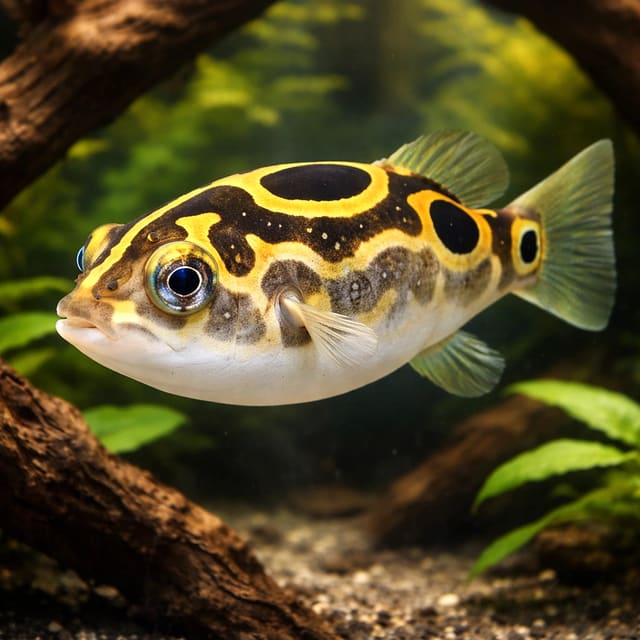
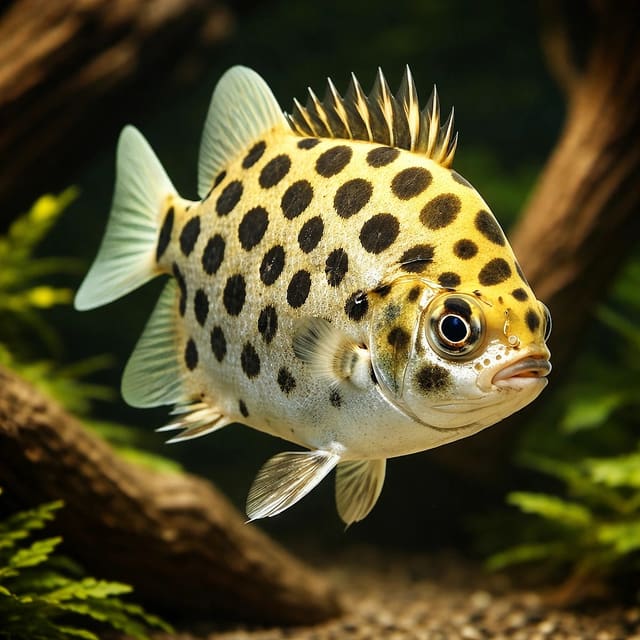
All four existing Shopify images were preserved. They show a green spotted puffer with a rounded body, yellow-green dorsal colour, bold black spotting, a pale belly and clear puffer facial shape. They are useful for identifying the fish and seeing the pattern, but the planted backgrounds should not be read as a soft planted community recommendation. This product needs specialist brackish care.
No separate Petra/source original exists in the local image map for SKU 9048, so no borrowed photo from another puffer SKU has been added. The media rule remains one image per SKU. That keeps the catalogue more trustworthy and prevents similar-looking puffers from sharing misleading photos.
Prepare the system before the fish arrives. A puffer should not arrive to an uncycled aquarium, a soft community tank, or a rushed bucket of unmeasured saltwater. Match salinity and temperature carefully, dim the lights, and give the fish time to settle. Do not chase it with a net for photos on the first day.
Offer small suitable foods once it has settled. Some newly arrived puffers ignore prepared food but respond to snails or small pieces of shellfish. Watch the belly shape and remove uneaten food quickly. Keep water testing close during the first week because puffer feeding can create a lot of waste.
Quarantine and observation are strongly recommended. A dedicated observation tank lets you check feeding, breathing, belly shape, skin condition and teeth without exposing an established brackish system to problems.
Common problems include poor water quality, wrong salinity, refusal of unsuitable foods, overgrown teeth, fin damage from tank-mate conflict, and stress from cramped or exposed tanks. The first fix is almost always husbandry: test the water, check salinity with a refractometer, review diet and remove risky companions.
A healthy puffer should be alert, responsive and rounded without being bloated. The belly may change after feeding, but it should not stay sunken. The eyes should be clear, breathing should be steady and the fish should be able to swim normally without drifting or clamping.
Puffers are sensitive to careless medication and poor water. If treatment is needed, use a quarantine setup and confirm that the medication is appropriate for brackish puffers. Do not treat the display tank blindly while leaving the underlying water or diet problem unchanged.
| Symptom | Likely causes | First checks |
|---|---|---|
| Sunken belly | Not eating enough, wrong food size, stress or internal issue | Offer suitable small shellfish/snails, check water and observe feeding |
| Glass pacing | Boredom, hunger routine, cramped layout or stress | Add visual breaks, review feeding schedule and tank size |
| Fin damage on tank mates | Puffer nipping or hunting | Separate immediately and rethink compatibility |
| Cloudy water | Messy food and weak filtration | Remove debris, test ammonia/nitrite and improve maintenance |
| Long-looking teeth | Too much soft food | Increase safe crunchy foods and seek expert help if trimming is required |
Choose the Green Spotted Puffer if you want an interactive specialist fish and you are ready to build the aquarium around its needs. You should be comfortable with brackish water, salinity measurement, heavy filtration, crunchy foods and the possibility that it must live alone.
Do not choose it if you want a peaceful community centrepiece, a planted soft-water aquarium fish, a shrimp-safe oddball, or a simple beginner puffer. Those expectations lead to poor welfare and unhappy customers. This fish is excellent only when the setup is honest.
When stock returns, the Tropical Fish Co Live Arrival Guarantee applies under the current livestock delivery terms. The care responsibility after arrival is the keeper's: measured salinity, mature filtration, correct diet, secure cover and no unsuitable companions.

18–26°C · pH 6.5–8 · 30L

23–27°C · pH 7.4–8.4 · 500L

20–27°C · pH 6–7 · 54L

23–27°C · pH 7.4–8.4 · 150L

24–28°C · pH 6.5–7.8 · 300L

20–24°C · pH 7–8 · 45L

24–28°C · pH 6.5–7.5 · 2000L

24–28°C · pH 7.5–8.5 · 200L

24–28°C · pH 5.5–7 · 60L

18–25°C · pH 6–8 · 100L

24–28°C · pH 7–8 · 120L

18–28°C · pH 6.5–8 · 20L

24–27°C · pH 7.5–8.8 · 150L

22–26°C · pH 6–7.5 · 60L

24–28°C · pH 7.5–8.5 · 40L

24–28°C · pH 7.5–8.5 · 500L