Advanced
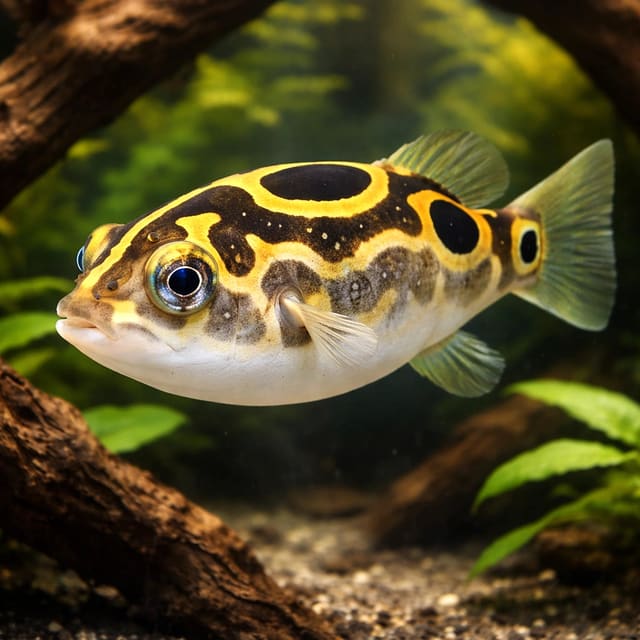
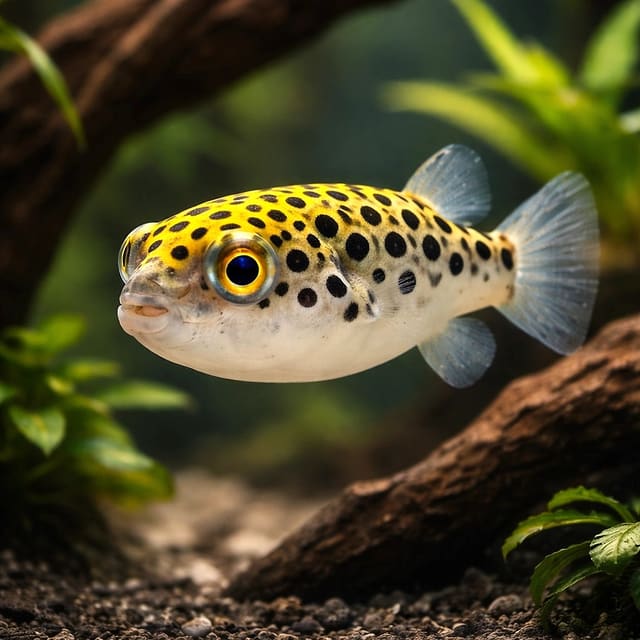
Green Spotted Pufferfish (Dichotomyctere nigroviridis)
24–28°C · pH 7.5–8.5
£8.99
Photo coming soon
The size, price and care details on this page are for this listing.
The golden puffer, also called the bronze puffer, is a true freshwater pufferfish from the rivers of Borneo and Sumatra that reaches 10.6 cm. It eats insects, shrimps and seeds, plus fins and scales of other fish, so it is best kept alone. Each unit is one unsexed fish; it needs clean fresh water at 23-28 °C and some hard food for its teeth.
Auriglobus modestus
The golden puffer, also called the bronze puffer, is a true freshwater pufferfish from the rivers of Borneo and Sumatra that reaches 10.6 cm. It eats insects, shrimps and seeds, plus fins and scales of other fish, so it is best kept alone. Each unit is one unsexed fish; it needs clean fresh water at 23-28 °C and some hard food for its teeth.
Maintain these water conditions for optimal health and vibrant colors
The golden puffer, Auriglobus modestus, is a small true pufferfish from the rivers of Southeast Asia, also known as the bronze puffer. Unlike several puffers that turn up in aquarium shops, it is a freshwater fish through and through. FishBase lists it as a freshwater species, and Tyson Roberts, in his 1982 revision of the group, wrote that the genus (then called Chonerhinos) is known only from fresh water. It reaches 10.6 cm standard length. In the wild it eats mainly insects, shrimps and seeds, and to a lesser extent fish scales, fin rays and the odd small whole fish.
True freshwater puffers are a small minority. Roberts noted that of roughly 140 pufferfish species described at the time, only about 25 lived exclusively in fresh water, and that the golden puffer's genus and Carinotetraodon, both from Southeast Asia, were the only puffer genera restricted entirely to fresh water. He also observed that freshwater puffers occur only in the tropics, even though their marine relatives reach cold seas far to the north and south.
That last dietary detail shapes everything about keeping one. This is a puffer for a keeper who wants an unusual, characterful fish and is ready to give it a tank of its own. It is not a fish for a community aquarium, and it would be unfair to the puffer and to its would-be tank mates to pretend otherwise.
Before you order, it is worth being honest with yourself on four points. Do you have, or can you set up, a mature tank of its own for this fish? Are you happy to feed frozen and live foods, plus some hard, shell-on food, rather than flakes? Can you accept that it will not share its tank with other fish or shrimps? And will you keep up a weekly water change and test routine? If the answer to all four is yes, a golden puffer is a rewarding fish to keep.
The listing has a single option, and each one you add to your basket is one fish. It is not sold as male or female: Roberts found no external differences between the sexes in this group of puffers, so nobody can sex them by eye. The listing does not state a dispatch size, so if size matters for your plans, ask us before you order.
| Quick facts | Golden puffer |
|---|---|
| Scientific name | Auriglobus modestus (Bleeker, 1850) |
| Other names | Bronze puffer; formerly Chonerhinos modestus |
| Family | Tetraodontidae, the pufferfishes |
| Maximum size | 10.6 cm standard length (FishBase; Roberts 1982) |
| Water | Freshwater; no salt needed |
| Temperature | 23–28 °C (FishBase) |
| Wild diet | Mainly terrestrial insects, shrimps and seeds; also scales, fin rays and small fish |
| Temperament | Bites fins and scales; plan a tank of its own |
| Conservation | Least Concern on the IUCN Red List (assessed 2019) |
Pieter Bleeker described this fish in 1850 as Tetraodon (Arothron) modestus, from rivers at Banjarmasin in southern Borneo (Bleeker spelled it "Banjermassing"). Bleeker moved it to Chonerhinos in 1854, and for well over a century it was known as Chonerhinos modestus and treated as a single species found across much of Southeast Asia.
Roberts's 1982 study changed that picture. Working through museum collections and the fish caught on the 1976 Kapuas Ichthyological Survey in western Borneo, he showed that "modestus" actually covered five species, and he described four of them as new: amabilis, nefastus, remotus and silus. He also noted that most records of modestus in the older literature refer, in whole or in part, to these other species. In 1999 Maurice Kottelat moved all five into a new genus, Auriglobus, which is the name FishBase and Wikipedia use today. Wikipedia notes that Auriglobus is more strongly associated with fresh water than its relative Chonerhinos.
The revision also tidied up an odd record. A puffer named Chonerhinos africanus in 1909, from a single specimen supposedly collected in the Congo basin, turned out on examination to be a golden puffer with incorrect locality data. It does not occur in Africa.
Here is how Roberts summarised the five species, with their present genus name:
| Species | Range in Roberts (1982) | Main food in the wild |
|---|---|---|
| A. modestus, golden or bronze puffer | Western Borneo and Sumatra | Most varied diet: mainly insects, shrimps and seeds; less often whole fish, fin rays or scales |
| A. nefastus, greenbottle pufferfish | Widest range: Borneo, the Malay Peninsula, Thailand, Vietnam, Cambodia and Laos | Mainly fin rays and scales of other fish |
| A. amabilis | Western Borneo and Sumatra | Almost entirely large aquatic insects |
| A. silus | Northern and north-eastern Borneo | Varied, including insects |
| A. remotus | Northern and north-eastern Borneo | Varied, including insects |
Two practical lessons follow for anyone reading up before buying.
We sell this fish as Auriglobus modestus, which is how our stock records name it. Telling the five species apart relies on details such as the depth of the tail stalk, the number of dorsal and anal fin rays and the direction of the tiny spines on the scales, which are measured on preserved specimens rather than seen in a shop tank. The care advice on this page is written so that it holds for the genus as a whole, and it errs on the side of caution where the species differ.
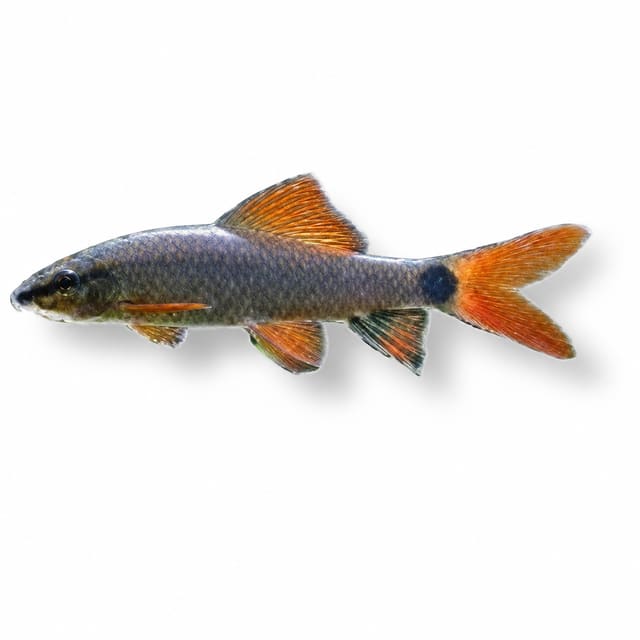
The word "golden" turns up on plenty of unrelated fish too. The Golden Barb (Barbodes semifasciolatus) and the Golden Whiptail Catfish (Sturisomatichthys aureus) are completely different animals with their own care pages. Nothing here applies to them, and we would not house either with this puffer.
Roberts's diagnosis gives the scientist's view of the species. Roberts considered A. modestus the largest of its close relatives, reaching at least 106 mm, and it has the deepest tail stalk of the group. Its scales are relatively large and set close together, and each ends in a small spine. Normally the spines lie partly or wholly hidden under the skin, but they stand straight out when the fish inflates itself. On the lower body just in front of the pectoral fin, the spines on this species point upwards. The upper and lower lips project about equally, or the lower lip sticks out a little; the visible part of the eye is round; the snout slopes gently; and the dorsal fin has 25–28 rays and the anal fin 20–22, generally more than in the other species.
Here the sources do not tell one simple story, and it is better to know that before you buy. The names golden puffer and bronze puffer, and Wikipedia's description of the fish as bronze or golden in colour, suggest a warm, metallic fish. Roberts, on the other hand, recorded the colours of a freshly caught 106 mm specimen in his field notes as pale blue on the back, white on the sides and belly, with a reddish eye, and thought the three smaller fish from the same survey were coloured similarly. An earlier account of puffers from the Mekong in Laos described a back and upper head of "olivaceous golden", but Roberts considered those fish to be A. nefastus. Expect a fish with a white or pale belly and a back that different observers have described as anything from pale blue to bronze or gold, and do not be surprised if the shade in your aquarium differs from photographs you have seen online.
Roberts examined ripe males and ripening or egg-carrying females of all five species and found no secondary sexual differences at all. That means there is no reliable way to sex a golden puffer from the outside. The largest female he measured, at 106 mm, carried around 800 eggs of 1.5–2.1 mm in one ovary alone. None of the sources we use describes this species breeding in an aquarium, so we have no breeding advice to give.
Like other puffers it can inflate itself, which is when those scale spines stand proud of the skin. OATA, the UK ornamental fish trade association, describes puffing as a stress response and asks keepers not to encourage it. A golden puffer that inflates is frightened, not performing.
The firmest record of where this fish lives comes from the specimens Roberts examined. Besides Bleeker's original locality at Banjarmasin, they came from several places in the Kapuas basin of western Borneo (Sanggau, Sintang, Silat and a stretch of the Kapuas about 23 km west-south-west of Putussibau) and from Sumatra, at Lahat and in the Indragiri. His summary places A. modestus in western Borneo and Sumatra.
Roberts pointed out that the golden puffer's range lies within the limits of an ancient river system, the Central Sundaland River basin, which has since been broken up by the Java and South China seas. In other words, the rivers of western Borneo and Sumatra where it lives once belonged to the same drainage. He also suspected that the species occurs in Thailand, although he had not examined specimens from there.
Other references cast the net wider. FishBase gives the distribution as Thailand, Malaysia and Indonesia, and notes that it has been reported from the Mekong. Wikipedia lists Cambodia, Laos, Thailand, Vietnam, Malaysia and Indonesia. Those wider lists should be read alongside Roberts's warning that most older modestus records belong in part to other species; he identified the Mekong fish described under this name in Cambodia and Laos as A. nefastus.
FishBase describes the species as living in medium to large-sized rivers. Wikipedia describes the range as running from the middle parts of rivers down to their estuaries. Roberts, however, recorded the whole group only from fresh water, and FishBase lists it as a freshwater fish, so we read the estuary mention as the lower, still-fresh reaches of those rivers rather than salty water.
One of Roberts's specimens gives a vivid glimpse of the fish's world. The 106 mm female was caught in a gill net set overnight in the Kapuas near Putussibau, alongside an 80 cm Pangasius catfish that had much of its belly wall and parts of its fins bitten away. Roberts suspected the puffer at first, but found nothing from the catfish in its gut, and thought another predator, possibly A. nefastus, more likely. Either way, the picture is of a warm, flowing river shared with big fish and with puffers that are not shy about biting.
For the aquarium, that translates into fresh, clean, well-oxygenated water at tropical temperatures, room to swim, and a keeper who takes the biting seriously.
This is the first question to settle with any puffer, so here is the plain answer: the golden puffer is a freshwater fish. FishBase lists it as freshwater, and Roberts found the genus only in fresh water. Of our main sources, only Wikipedia's mention of estuaries points the other way. We do not recommend adding salt to its tank, either as a permanent measure or "just in case". OATA's general puffer care sheet notes that some puffers need brackish water as they mature; this is not one of them.
FishBase gives 23–28 °C, and OATA's general guide to freshwater puffers gives 22–27 °C. A steady 24–26 °C sits comfortably inside both. Use a reliable heater all year round, and keep the tank out of direct sunlight and away from radiators and draughts, as OATA advises.
None of the sources gives a pH or hardness range for this particular species. In that situation we fall back on OATA's general figures for freshwater puffers:
| Parameter | OATA general freshwater puffer guide |
|---|---|
| pH | 6.5–8.0 |
| General hardness (GH) | 4–18 °dH |
| Carbonate hardness (KH) | 3–15 °dKH |
| Ammonia | 0 mg/l |
| Nitrite | 0 mg/l |
| Nitrate | No more than 20 mg/l above your tap water level |
Those are broad ranges, and stability matters more than hitting a particular number within them. Test your tap water before the fish arrives and set the tank up to match what comes out of your tap, rather than planning to adjust the chemistry afterwards.
Puffers are fed meaty foods, and meaty foods foul water quickly. OATA asks for at least a 25% water change every week, with water tests at least weekly for ammonia, nitrite, nitrate, pH and hardness, and calls test kits "a necessity not an optional extra". Siphon uneaten food and waste from the substrate at each change, use dechlorinated water at the tank's temperature, and clean filter media only by rinsing it lightly in water taken out of the tank, so the bacteria that keep the water safe survive.
No source we use gives a minimum tank size for this species. OATA's puffer guide simply points out that the right size varies enormously between species, from small tanks for pygmy puffers to very long tanks for the giant mbu puffer, and asks keepers to check before buying. So the figure here is our own advice, not a published number. For a single fish that reaches about 10.6 cm standard length and comes from medium to large rivers, we would not plan on anything shorter than about 90 cm, with plenty of open water along the front for swimming. More length is always better.
A filter is essential, and with a messy, meat-eating fish it pays to oversize it. Choose a filter rated for a larger tank than yours, keep the outflow creating gentle movement across the whole aquarium, and make sure the surface is broken enough to keep the water well oxygenated at tropical temperatures.
OATA says gravel or sand both work for freshwater puffers and suggests plants or ornaments for shelter, adding that larger species prefer a less cluttered tank. For a golden puffer, that means a few solid pieces of wood or rock and some planting to break up sight lines along the back and sides, with the front and middle of the tank left open. Avoid sharp-edged decor that could damage the skin of a fish that may inflate when frightened.
OATA recommends a lid on a puffer tank. Fit a heater sized for the volume, and consider a heater guard so the fish cannot rest against the glass tube. An ordinary overhead aquarium light on a regular daily cycle is all it needs; OATA notes that overhead lighting keeps a proper day and night rhythm.
Set the tank up and let the filter mature fully before the puffer arrives, so that ammonia and nitrite both read zero in your tests. A puffer fed on frozen foods puts a real load on a filter from the first day, so there is no room for a tank that is still cycling.
The best evidence for this fish's diet comes from Roberts, who examined the gut contents of ten wild A. modestus. Half had empty guts. Of the five with food in them, four held moderate to large amounts of insects, mainly land insects; two held prawns; two held seeds; two held fish scales; one held fish fin rays; and one held the remains of a small whole loach. FishBase summarises the diet the same way: mainly terrestrial insects, shrimps and seeds, and to a lesser extent whole fish, fin rays or scales. Wikipedia's version is small invertebrates, seeds, fish scales and small fish.
Many puffer guides insist that every puffer needs snails. The evidence for this species does not say that. Across all five species Roberts examined, molluscs turned up only in several A. silus (clam flesh) and a single A. nefastus (small whole clams); none of the golden puffers in his admittedly small sample had eaten snails or shellfish. On the other hand, OATA's general puffer guide explains that puffers have continually growing teeth that must be worn down by their diet, and suggests cockle in the shell as a good food for freshwater puffers for exactly that reason. Our approach combines the two: feed the diet the species actually eats, and include some hard, shell-on food regularly to keep the teeth in trim, without pretending this is a snail specialist.
We do not recommend live feeder fish. The golden puffer takes the occasional small fish in the wild, but there is nothing in its diet that a varied frozen and live-invertebrate menu cannot cover.
OATA advises feeding once a day and giving only what the fish eats within a few minutes, so that leftovers do not pollute the water. Watch your puffer feed: a healthy fish should feed readily. If it starts to struggle to bite or pick up food it used to manage, look closely at its teeth, because overgrowth is a likely result of a diet that is too soft.
Here is what the evidence says, with no softening. Wild golden puffers eat fish scales, fin rays and small fish as part of their diet. Roberts found that wild A. modestus showed high frequencies of bite marks on the flanks and bitten fins, and could not tell whether those wounds came from their own kind, from the fin-eating A. nefastus that shares their rivers, or both. He also wrote that biting between members of the same species probably occurs in many pufferfishes. OATA's general advice on freshwater puffers is blunt: they are notorious for nipping fins, may prey on smaller species, can be highly aggressive, and most need single-species tanks, with some of the larger species solitary and aggressive.
Keep one golden puffer on its own. That is the safe reading of the sources, and it is the set-up we would choose ourselves. We have not found a published account of how this species behaves when several are kept together in an aquarium, and given the bite marks Roberts recorded on wild fish, we would not assume they get along.
Puffers vary a great deal in their needs. We also list the Valentini Puffer (Canthigaster valentini), which is a completely different animal with its own care page; do not assume anything on this page applies to it, or that the two could share a tank.
Kept alone in a well-run tank, a golden puffer has everything it needs, and you get to keep an unusual river puffer without worrying about what it is doing to its neighbours.
OATA's puffer care sheet lists the changes worth watching for: colour changes, erratic swimming, a change in breathing rate, white spots, fluffy growths, loss of fins or scales, and any change in feeding. It also makes a point we agree with: every fish has its own small quirks of behaviour and appearance, and the keeper who knows what normal looks like for their fish spots problems earliest.
Puffer teeth keep growing throughout life, OATA explains, and the diet is what wears them down. A puffer fed only soft food can develop overgrown teeth that make eating difficult. Regular hard, shell-on food is the prevention. If you suspect overgrowth, ask an aquatic vet for advice rather than attempting anything yourself.
FishBase lists the golden puffer as harmless to people. Even so, OATA points out that most puffers have sharp teeth and some are poisonous, and asks for care when handling them. Move the fish with a net or a container, never with bare hands, and wash your hands after any work in the tank.
Since inflation is a stress response, try to keep it rare. Net the fish gently and calmly, avoid chasing it around the tank, and where possible guide it into a container underwater rather than lifting it into the air in a net. Never tap the glass or provoke it to see it puff.
OATA notes that puffers can live for several years in a well-kept aquarium. The routine that gets you there is simple, if not effortless: one fish in a mature, well-filtered tank, a varied meaty diet with some hard food, a weekly water change, and weekly tests. Keep a simple log of your test results and what you feed; it makes slow changes much easier to spot.
Get the aquarium fully ready before you order: filter running, water tested, and the temperature matched to what the fish needs. Live animals need someone at the delivery address to take them in, so plan the delivery day around that. Take a few minutes to read our delivery and live-arrival information before placing the order.
Your puffer is packed in an oxygen-filled bag inside insulated packaging, with heat packs added when conditions call for them, and it travels with a tracked courier licensed to carry live animals. You will receive an email with the confirmed delivery date and the tracking details.
Start filming before you break the seal on the parcel, and keep recording in one continuous take as you open it, so that the fish can be seen inside its still-sealed bag. If a fish arrives dead, dying or clearly compromised, send an email to hello@tropicalfishco.co.uk on the day of delivery, quoting your order number and attaching that video. Photographs on their own do not meet the policy. Subject to the guarantee terms, we will then replace the affected fish with your next order or refund it.
Offer a small first meal of frozen food the following day rather than straight away, and lift out anything left uneaten after a few minutes. A puffer that is swimming calmly and taking food within a few days is settling in well.
These are the sources behind the facts on this page.
No reviews for this item yet. Bought one? Honest reviews only, good or bad.
What customers say about ordering from us
Easy website plenty of info on fish your buying great to pick a time slot
TRACEY DURRANT · 7 Oct 2026
Got some lovely fish thank you
Kevin Mackie · 7 Oct 2026
Reviews of our shop, collected by Judge.me, an independent third-party review collector. Newest first.