Moderate
Lawu Snakehead (Channa cf. limbata 'Lawu')
22–26°C · pH 6–7.5
£24.09
The Granite Snakehead is a dwarf snakehead sold as Channa cf. limbata 'Granite', named for its speckled, stone-like pattern of dark brown and orange-gold. It is an air-breathing predator of about 20 cm that needs a covered tank of about 240 litres to itself, meaty foods and steady water, and may be kept indoors in England and Wales. One live fish.
Adult size is the maximum length this species reaches at full maturity (scientific sources). The livestock you receive will be younger and smaller. Product-photo provenance and any image-specific limitations are stated on the listing.
Channa cf. limbata 'Granite'
The Granite Snakehead is a dwarf snakehead sold as Channa cf. limbata 'Granite', named for its speckled, stone-like pattern of dark brown and orange-gold. It is an air-breathing predator of about 20 cm that needs a covered tank of about 240 litres to itself, meaty foods and steady water, and may be kept indoors in England and Wales. One live fish.
Adult size is the maximum length this species reaches at full maturity (scientific sources). The livestock you receive will be younger and smaller. Product-photo provenance and any image-specific limitations are stated on the listing.
Read the full care guidance when planning conditions for your aquarium.
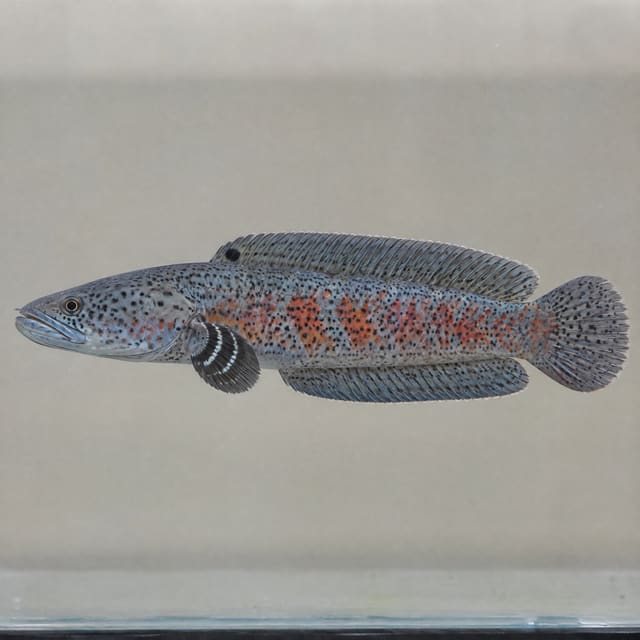
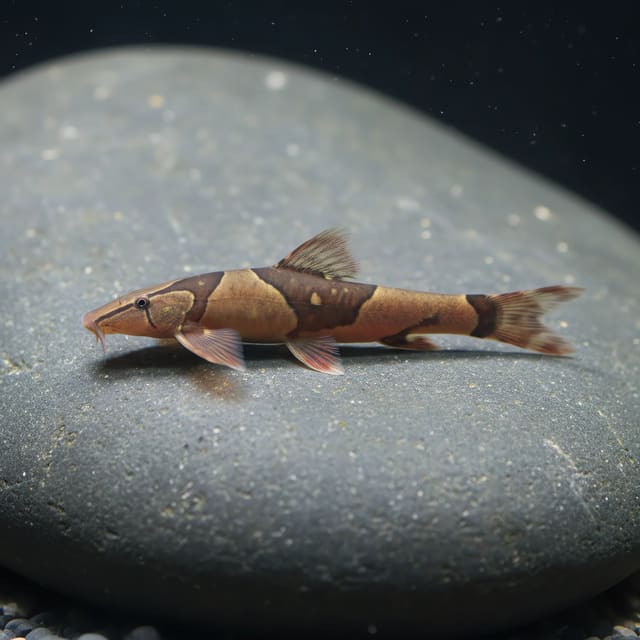
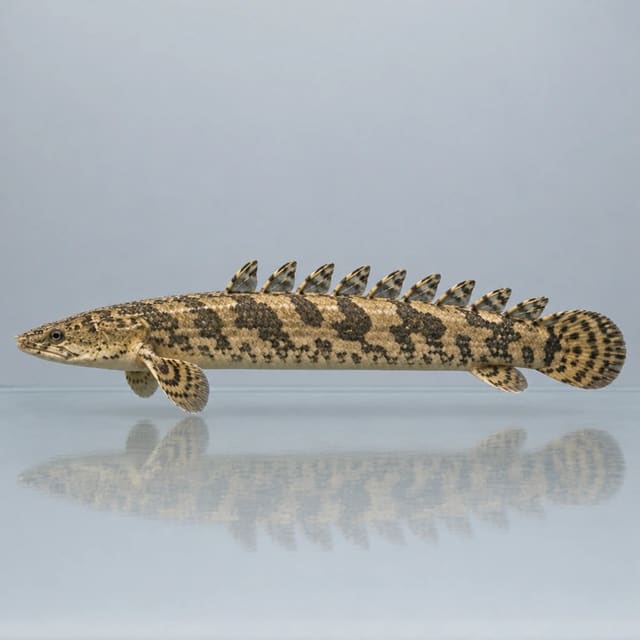
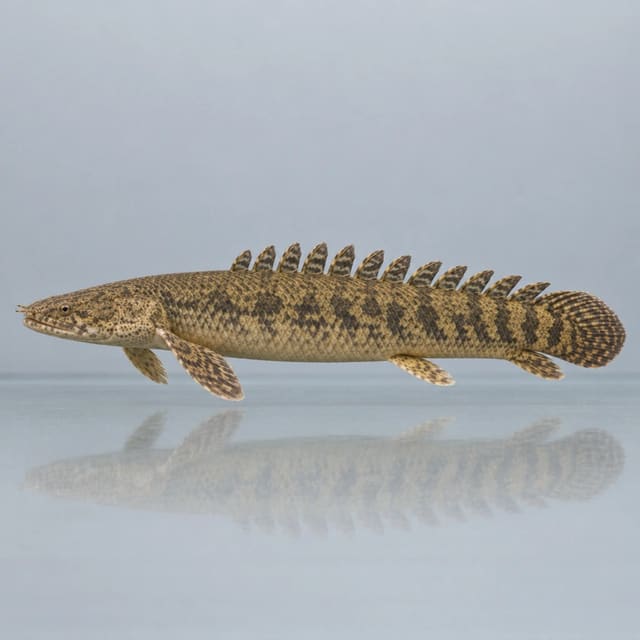
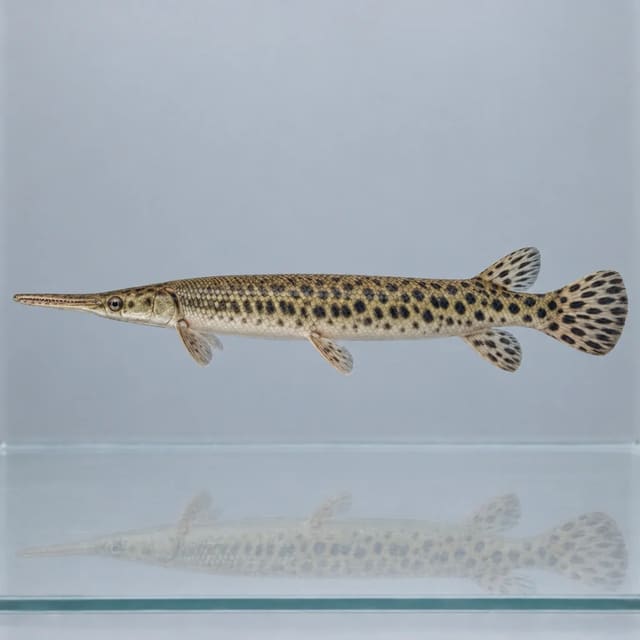
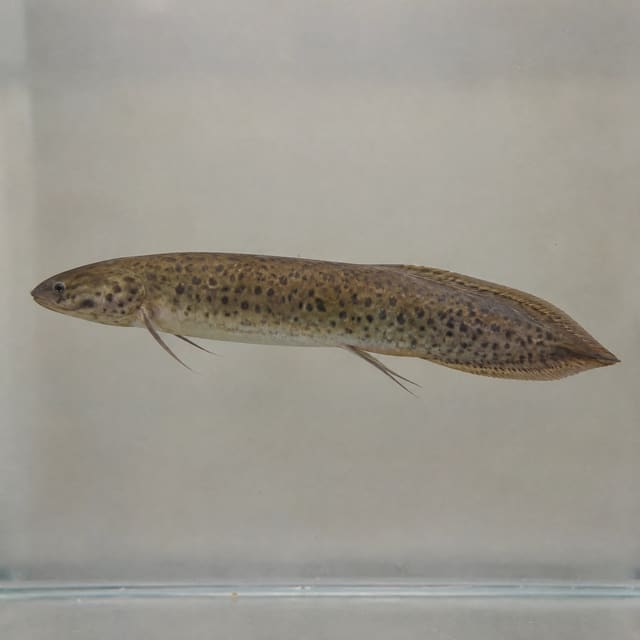
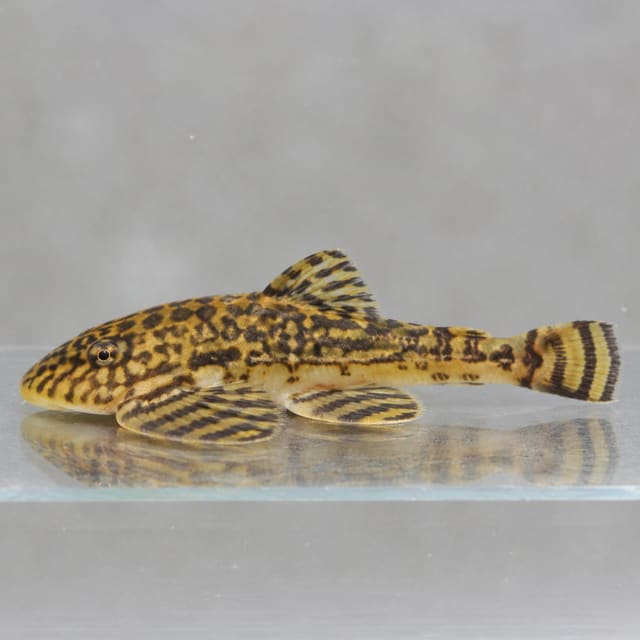
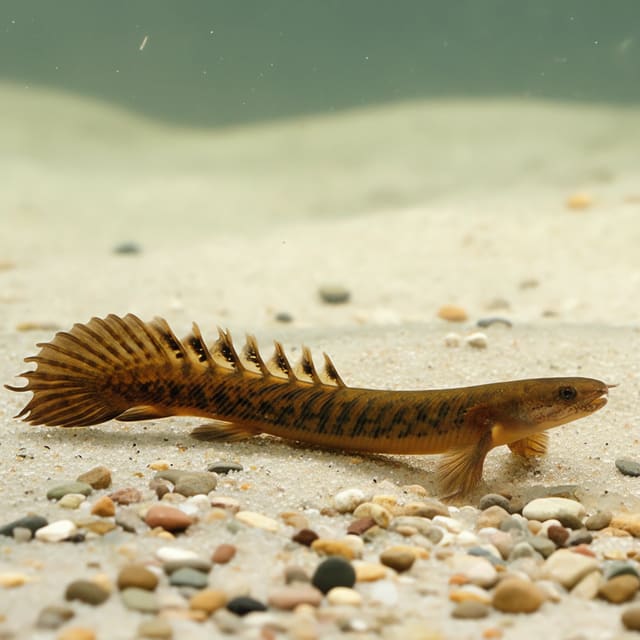
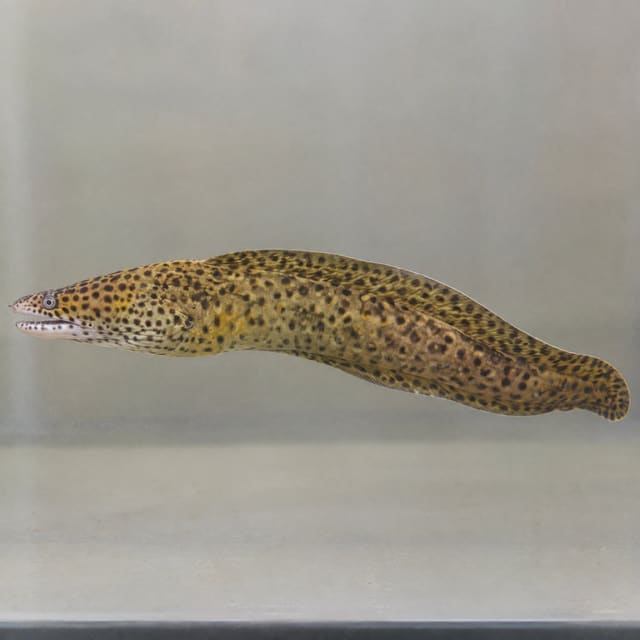
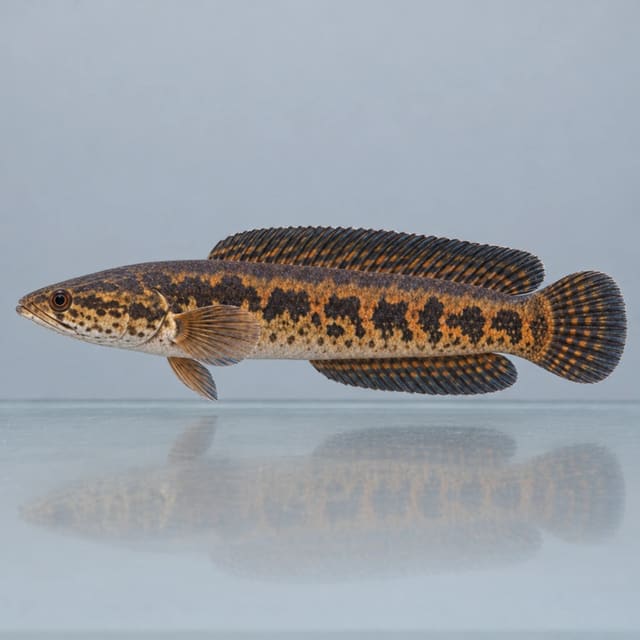
The granite snakehead takes its name from its coat: an irregular, speckled pattern of dark brown and orange-gold blotches that looks like a slab of polished stone. The long dorsal and anal fins carry rows of orange dots, and the rounded tail is spotted orange on a dark ground. Underneath the pattern is a classic snakehead: a long, cylindrical body, a broad head with a wide mouth, and the habit of hanging still among cover before striking at food. It is sold as Channa cf. limbata 'Granite', a dwarf snakehead, and it is a predator from first to last.
Buy one if you want a single, interactive fish that learns its keeper and its feeding routine, and you are happy for it to have the tank to itself. Do not buy one for a community tank of small fish: anything that fits in its mouth will be eaten.
| Part of the name | Meaning |
|---|---|
| Granite | A trade name for the speckled, stone-like pattern |
| Channa | The Asian snakeheads, family Channidae |
| cf. limbata | Compares with Channa limbata; exact identity not confirmed |
| Channa gachua complex | The group of look-alike dwarf snakeheads that limbata belongs to |
Why the uncertainty? Seriously Fish treats C. gachua as a probable complex of similar species and still lists limbata as a synonym, and FishBase files it the same way. A 2017 DNA study by Conte-Grand and colleagues found an eastern lineage, running from Myanmar to Vietnam, southern China, Malaysia and Indonesia, and proposed Channa limbata as its name for now. Granite is one of several trade forms sold under that name; its exact origin is not published.
"Snakehead" covers fish from palm-sized dwarfs to river giants, and choosing the wrong one is the commonest mistake. The figures below come from Seriously Fish and Practical Fishkeeping's quick guide to snakeheads.
| Snakehead | Adult size in the sources | Note |
|---|---|---|
| Granite or Lawu (C. cf. limbata) | 200 mm SL (Seriously Fish, gachua group); 20 cm (Practical Fishkeeping) | Dwarf; one fish for a 120 cm tank |
| Channa andrao | 110 mm SL (Seriously Fish) | Smaller; needs a cool winter |
| Rainbow snakehead, C. bleheri | 170 mm SL (Seriously Fish); about 20 cm (Practical Fishkeeping) | Needs a cool winter period |
| Ocellated snakehead, C. pleurophthalma | 45 cm (Practical Fishkeeping) | Large; relatively peaceful with robust fish |
| African snakehead, Parachanna obscura | 45 cm (Practical Fishkeeping) | Large; reportedly more docile |
| Red snakehead, C. micropeltes | 1 m or more (Practical Fishkeeping) | Very aggressive; Practical Fishkeeping advises avoiding it |
In our range, the Blue Rainbow Snakehead, the Rainbow Snakehead and the Assam Dwarf Snakehead sit at the small end with this fish, while the Ocellated Snakehead and Dusky Snakehead need far bigger tanks. Browse every snakehead for sale, our Channa range, the other fish category and the oddball fish collection, which also includes the Malabar Snakehead.
One purchase supplies one live granite snakehead in the standard size we stock, sold young rather than as an adult. Its sex is not known: snakeheads are hard to sex, and Seriously Fish notes only that males of this group tend to have longer dorsal and anal fins while females grow larger and deeper-bodied.
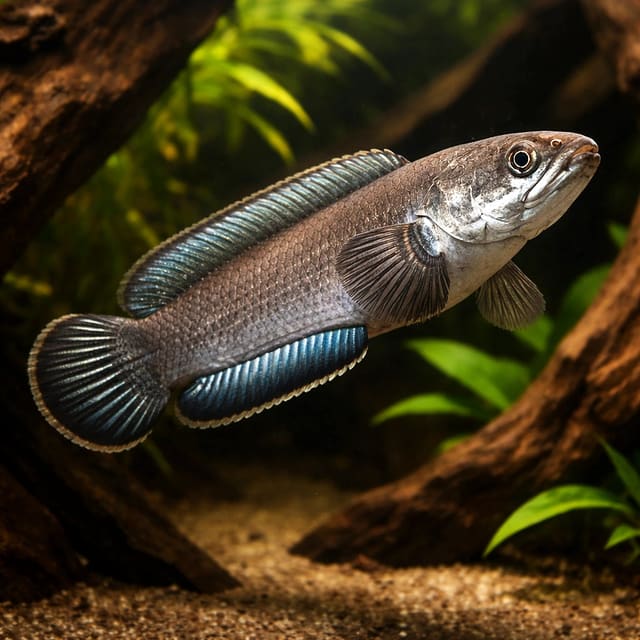
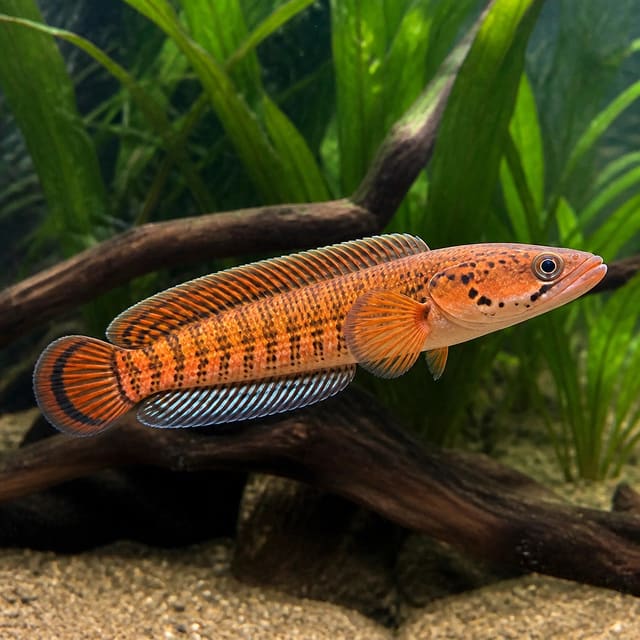
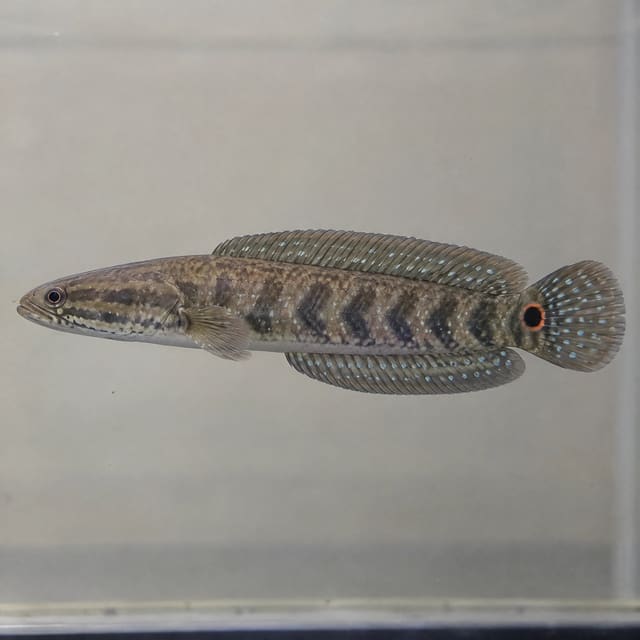
The pictures show the pattern type, not the individual. No two granite patterns are the same, and the contrast changes with mood, lighting and age; a fish that has just travelled is often darker or paler than it will be once settled. Expect the speckled granite look, not a match for every blotch in the photograph.
Our delivery information explains dispatch days and the Live Arrival Guarantee.
Before you order any snakehead, check where you live. In England and Wales, the government guidance on keeping non-native fish links to a checklist of freshwater fish that may be kept for ornamental purposes under a general licence (version 7, last updated 13 October 2026). The checklist includes the genus Channa, except Channa argus (the northern snakehead) and its subspecies. A granite snakehead can therefore be kept without applying for an individual licence.
The same checklist says these fish may be kept in indoor aquaria only. A pond, a patio tank or a conservatory pool open to the outside is not covered, and releasing any aquarium animal is illegal. Scotland and Northern Ireland set their own rules: OATA reported in 2017 that every Channa is restricted in Scotland and needs a licence, so customers there should check the current position before buying.
Plan for a fish of about 20 cm. Seriously Fish gives a maximum of 200 mm standard length for the gachua group, Practical Fishkeeping gives 20 cm for the dwarf snakehead, and Ecology Asia describes adult limbata in Singapore at about 20 cm total length. FishBase records the largest fish of the complex at 32.9 cm total length, a reminder that some individuals outgrow the average.
Seriously Fish recommends a base of 120 x 45 cm, about 243 litres, with at least 30 cm of water. Floor space matters more than height for a fish that spends its day lying in cover and patrolling the bottom. Use the tank volume calculator to check real litres and the stocking calculator if you are thinking of adding anything else.
| Measurement | Target |
|---|---|
| Base | 120 x 45 cm or larger |
| Water depth | 30 cm or more, with an air gap under the lid |
| Adult fish | About 20 cm, sometimes more |
Snakeheads feel safe in shade. Seriously Fish advises dim lighting, live plants, driftwood, terracotta pipes and pots, and floating plants such as Ceratopteris to cut down the light and reduce hiding. Practical Fishkeeping recommends gravel over very fine sand, which can clog filters. A granite snakehead given a den and overhead cover will often sit at the mouth of it in full view; one kept in a bright, bare tank tends to hide all day.
Two things are essential. First, a tight lid: Practical Fishkeeping calls it vital because snakeheads leap well, and Seriously Fish calls the genus escape artists. Second, access to air: these fish breathe through chambers above the gills lined with breathing tissue, and Practical Fishkeeping warns they can drown if kept from the surface. Leave a few centimetres between the water and the lid.
| Feature | Why it helps |
|---|---|
| One large pipe or cave | A home base the fish can back into |
| Driftwood and tall plants | Broken sight lines and ambush cover |
| Floating plants on part of the surface | Shade and a quiet place to breathe |
| Gravel floor | Easy to clean; kinder to the filter than fine sand |
This group tolerates a wide range, so stability matters more than chasing a figure. Seriously Fish gives 18-28°C, pH 5.0-8.0 and 1-20 dGH for C. gachua in the broad sense; FishBase gives 22-26°C and pH 6.0-7.0. Practical Fishkeeping notes that many snakeheads come from soft water up to 8 GH at pH 5.0 to 7.0, and that northern Indian populations of the dwarf snakehead need a cold winter while tropical ones do not.
| Reading | Keep it at | Why |
|---|---|---|
| Temperature | 22-26°C | Inside both the Seriously Fish and FishBase ranges |
| pH | 6.0-7.5 | The overlap of the published figures |
| Hardness | Soft to medium | Matches Practical Fishkeeping's note on snakehead waters |
| Ammonia and nitrite | Zero | OATA's standard for all fish |
| Nitrate | No more than 20 mg/l above tap water | OATA's standard; meaty foods push it up fast |
UK tap water can be anything from soft to very hard. Test yours first, then keep every water change the same. Our guide to water chemistry explains the readings, and the water matcher checks your tap water against this fish's range.
Predators fed on prawn and mussel produce heavy waste, and a mature filter is the only thing between that waste and the fish. Seriously Fish suggests a filter turning over four to five times the tank volume an hour, about 970 to 1,215 litres an hour for a 243-litre tank, and a heater of around 150 to 250 watts in a room near 20°C. Read our nitrogen cycle guide before the fish arrives, and our filtration guide to choose equipment.
OATA's care sheet for aggressive fish asks for at least a 25% water change every week and weekly tests of ammonia, nitrite, nitrate, pH and hardness. Practical Fishkeeping cautions that many snakeheads react badly to large or sudden water changes. Stick to steady weekly changes of about a quarter, matched for temperature, rather than occasional big ones.
Wild fish of this group feed at night on small fish, insects and crustaceans, according to FishBase. Captive fish learn dead foods readily. Seriously Fish suggests bloodworm, small earthworms and chopped prawn for juveniles, and fish strips, whole prawns, mussels, live river shrimp and larger earthworms for adults, with dry food as an extra rather than the staple. Practical Fishkeeping lists meaty frozen foods, chunks of fish, mussels, shrimp, sinking pellets, earthworms, mealworms and crickets.
OATA's rules for predatory fish are short: use food sized for the fish, feed no more than once a day, and never use live fish as food. Seriously Fish also advises against feeder fish, because of disease risk and poor nutrition, and against mammal and bird meat.
| Day | Food |
|---|---|
| Most days | Thawed large frozen krill or frozen sand shrimp |
| Twice a week | A few Cichlid Carnivore Medium Pellets, once the fish takes them |
| Once a week | An earthworm or a few mealworms as a treat |
| One day | No food; adult predators do not need feeding every day |
That last line follows Seriously Fish's advice for the related C. andrao, whose adults do not need daily meals. Give only what is taken within a few minutes and remove the rest.
Turn the aquarium light off before you open the box. OATA's floating-bag method works well: float the sealed bag for 10 minutes, add tank water to it gradually over up to 20 minutes, then net the fish into the tank with as little bag water as possible. For fish packed in boxes, OATA describes dripping tank water slowly into the container through airline tubing instead. Keep the lid closed the whole time; a stressed snakehead may jump.
| When | What to do |
|---|---|
| Arrival day | Lights off, no food, lid shut |
| Day 2 or 3 | A small meaty meal in the evening |
| First week | Check daily that it rises to breathe normally |
| Days 3 and 7 | Test ammonia and nitrite |
Expect it to hide for several days. Our acclimatisation guide covers the full process.
Be clear about what you are buying. This is a predator, and the sources only differ on how strict to be. OATA's care sheet for aggressive fish says snakeheads are aggressive towards any other fish and should be kept alone. Seriously Fish recommends a species tank as the usual choice, while allowing peaceful, non-territorial fish too large to eat. Practical Fishkeeping describes dwarf snakeheads as docile with fish they cannot eat, and says small to medium snakeheads do well with medium to large cyprinids, similar-sized catfish and non-aggressive cichlids, but suffer with large, aggressive cichlids.
| Suits | Avoid |
|---|---|
| A tank to itself, the safest choice | Fish small enough to swallow |
| Calm fish far too big to eat, after research | Shrimp, snails and other small invertebrates |
| A bonded pair in a large tank | Any other snakehead, including the Lawu form |
| Large, aggressive cichlids |
Our tank mates tool helps with the first two questions. Young snakeheads can be kept together, but Seriously Fish warns they often turn aggressive as they mature.
A healthy granite snakehead has clear eyes, whole fins, unbroken skin and a fast feeding strike, and rises calmly to breathe. OATA lists clamped fins, flicking against objects and shimmying as warning signs, and advises gloves, careful netting and double bags for toothy predators.
| Sign | First step |
|---|---|
| White spots | Check for a recent temperature swing, then treat for white spot |
| Fast breathing, constant gulping | Test ammonia and nitrite; service the filter |
| Not eating for a week | Check the water and cover; try another meaty food in the evening |
| Swollen belly | Feed less often |
| Fin or skin damage | Check for sharp decor and gaps it has tried to squeeze through |
The gachua group are mouthbrooders: FishBase says the male carries the eggs and fry in his mouth, and Seriously Fish notes that in some populations the female lays extra, infertile eggs that feed the fry once they are free-swimming. Practical Fishkeeping's advice for pairing snakeheads is to let several young fish pair naturally in a large tank with plenty of hiding places; both parents then guard the fry in a tight school. Seriously Fish warns that different populations can hybridise, so keep granite with granite.
Granite is a trade name for the pattern: an irregular, speckled mix of dark brown and orange-gold blotches that looks like polished stone. The fish is sold as Channa cf. limbata 'Granite', a dwarf snakehead of the Channa gachua complex.
Yes, in an indoor aquarium. The government checklist for the ILFA general licence (V7, 13 October 2026) covers every Channa species except the northern snakehead, Channa argus, and its subspecies. It must never go in a pond or be released. Scotland and Northern Ireland have their own rules; OATA reported in 2017 that Channa need a licence in Scotland.
Plan for a fish of about 20 cm. Seriously Fish gives 200 mm standard length and Practical Fishkeeping 20 cm for the dwarf snakehead group, while FishBase records 32.9 cm total length as the largest fish of the complex.
A base of at least 120 x 45 cm, about 243 litres, with water at least 30 cm deep, as Seriously Fish recommends, and a tight lid that leaves an air gap above the water.
It is a predator that will eat any fish it can swallow. OATA treats snakeheads as aggressive and advises keeping them alone; Practical Fishkeeping calls dwarf snakeheads docile with fish too big to eat. Plan for a species tank.
Meaty foods such as prawn, krill, mussel, earthworms and carnivore pellets, once a day at most. Never feed live fish, and avoid beef heart, chicken and other mammal or bird meat.
Clean, steady water at about 22 to 26 degrees C and pH 6.0 to 7.5, soft to medium hardness, with zero ammonia and nitrite. Seriously Fish gives a wider 18-28 degrees C and pH 5.0-8.0 for the group.
Not in the same tank. Snakeheads of the same group are hostile to each other as adults, and Seriously Fish warns that different populations may hybridise, so keep each form on its own.
No reviews for this item yet. Bought one? Honest reviews only, good or bad.
What customers say about ordering from us
Easy website plenty of info on fish your buying great to pick a time slot
TRACEY DURRANT · 7 Oct 2026
Got some lovely fish thank you
Kevin Mackie · 7 Oct 2026
Reviews of our shop, collected by Judge.me, an independent third-party review collector. Newest first.
Moved by UK carriers licensed to handle live animals
Hand-packed with oxygen bags, poly box, heat pack
Email photos the same day; an optional unboxing video helps us review problems faster — claim terms apply
Klarna & PayPal Pay in 3 at checkout