Advanced
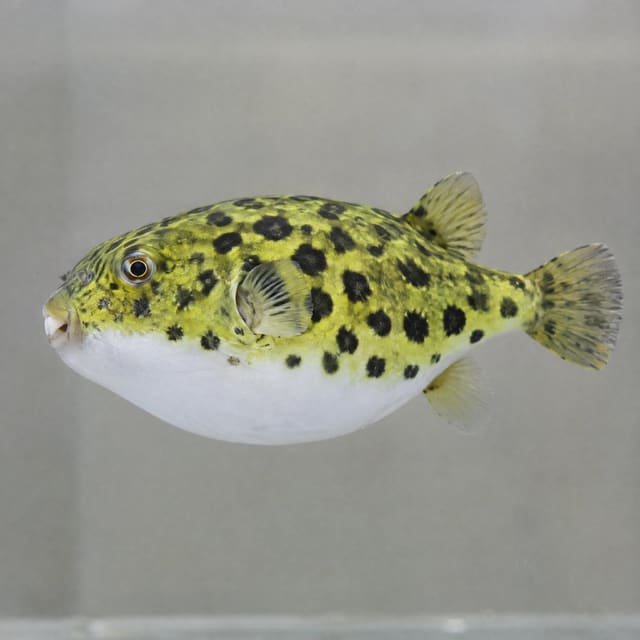
Golden Puffer (Auriglobus modestus)
23–28°C
£42.99
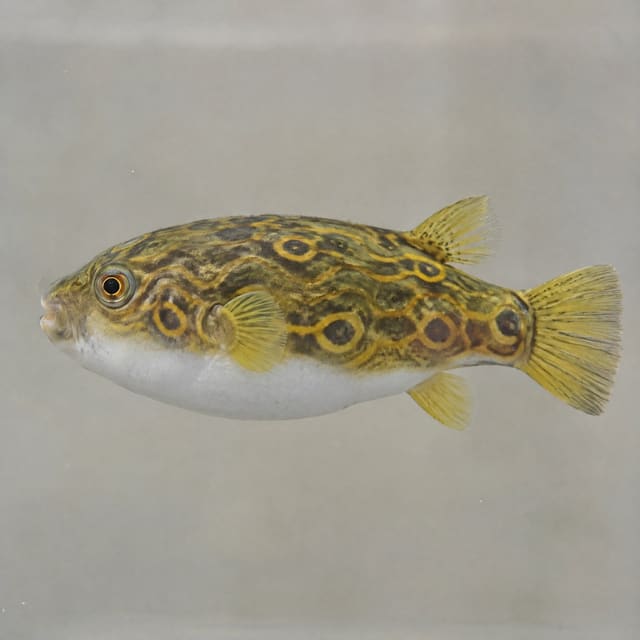
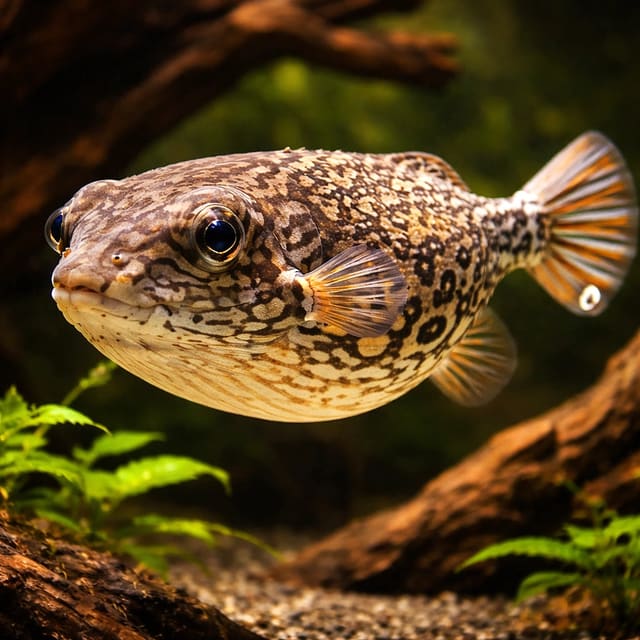
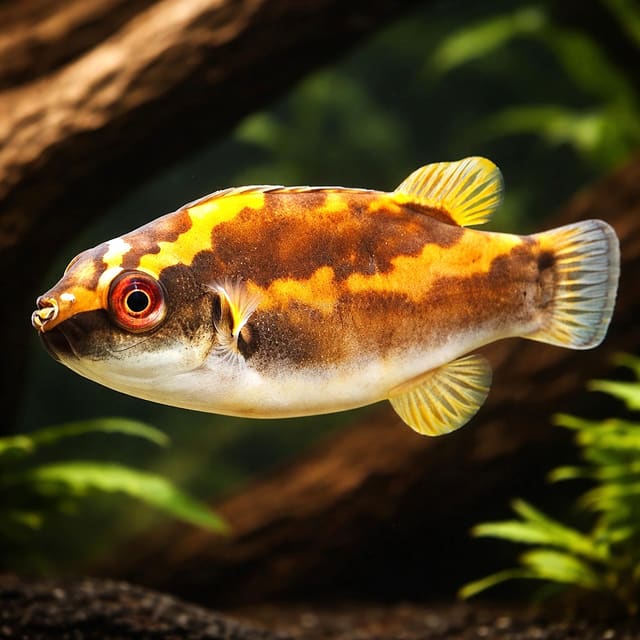
The Abei Puffer (Pao abei) is a small freshwater pufferfish from the Mekong, Chao Phraya and Meklong river basins of South-East Asia, dark brown with orange or yellow spots and eye-spots that brighten with mood. It grows to about 10 cm, needs fresh water at 24–27°C, a snail-based diet to wear down its beak and, in most cases, an aquarium of its own. Sold individually as one live fish, 5–6 cm.
Pao abei
The Abei Puffer (Pao abei) is a small freshwater pufferfish from the Mekong, Chao Phraya and Meklong river basins of South-East Asia, dark brown with orange or yellow spots and eye-spots that brighten with mood. It grows to about 10 cm, needs fresh water at 24–27°C, a snail-based diet to wear down its beak and, in most cases, an aquarium of its own. Sold individually as one live fish, 5–6 cm.
Read the full care guidance when planning conditions for your aquarium.
The Abei Puffer (Pao abei) is a compact freshwater pufferfish from the great river systems of mainland South-East Asia. Its dark body is covered with small pale-to-orange spots, and young fish carry bright red eye-spots ringed with black along the flank. OATA notes that freshwater puffers are popular for their personalities and intelligence, and a puffer soon learns who feeds it and when. At about 10 cm long, it gives that puffer character in a far smaller aquarium than the big predatory species need.
It is still a specialist fish. Its teeth are fused into a beak that grows for life and must be worn down by snails and shellfish, it hunts shrimp and snails, and OATA warns that puffers are notorious for nipping fins. Choose it if you want one puffer in a tank set up around it, with a steady supply of snails.
| Name | What it means |
|---|---|
| Abei puffer | The common trade name, from the species name |
| Pao abei (Roberts, 1998) | The current scientific name, as given by FishBase |
| Tetraodon abei | The name it was described under, still used by many shops |
| abei | Named after Professor Tokiharu Abe (1911–1996), a Japanese ichthyologist at the University Museum, University of Tokyo |
The species was described in 1998 by T. R. Roberts in a study of the freshwater puffers of the Mekong basin, and moved with most Asian freshwater puffers into the genus Pao in 2013. FishBase lists it as Least Concern on the IUCN Red List (assessed 2011). Compare it with the other puffers in our freshwater puffer fish range, or browse our loaches and oddball fish.
Sources describe its range differently, so both views are given here. FishBase records Pao abei from the Meklong, Chao Phraya and Mekong basins. Aquarium Glaser, the German importer, in a 2022 profile written by Frank Schäfer, gives the type locality as the Xe Bangfai River in Laos, part of the Mekong system, and treats the species as endemic to that river. The fish used in a 2022 Japanese breeding study were wild-caught in Thailand.
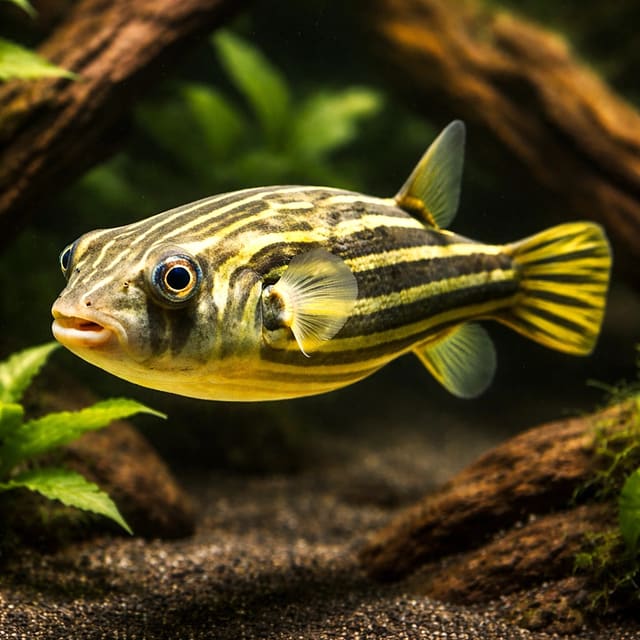
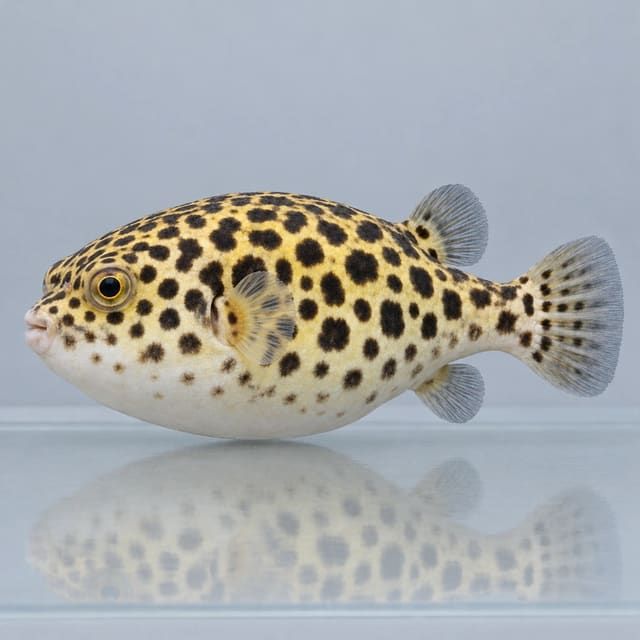
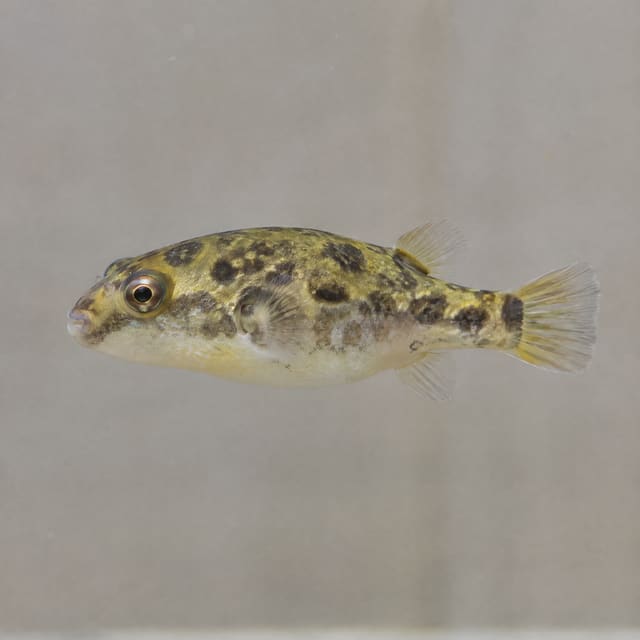
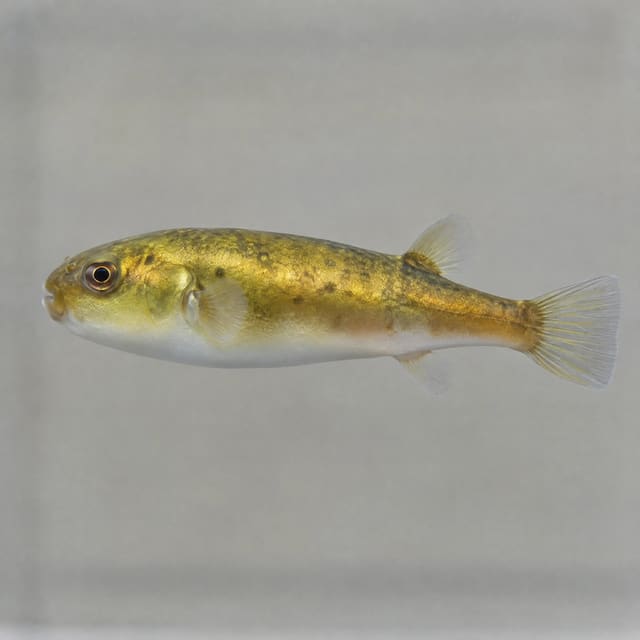
Aquarium Glaser warns that, out of its excited colours, Pao abei looks very like Pao cochinchinensis, which shares its river, and that identifications of these fish in the trade are often uncertain. One useful feature it gives is a large eye-spot below the dorsal fin, which Pao turgidus, a species with even-sized spots, lacks. The photographs on this page show the type of fish, not the individual you will receive.
One purchase quantity supplies one live Abei Puffer of 5–6 cm. Sex is not specified. A fish of this size is young and still growing, and its pattern will change as it matures: the 2022 Japanese study recorded that young Pao abei develop a net-like pattern and red eye-spots ringed with black and white, and that the white rings fade as the fish approaches adult colour. Have the aquarium ready and tested before you order, and check our delivery days and live arrival guarantee.
No species-specific aquarium size is published by Seriously Fish or FishBase. The best real-world reference is the 2022 study by Doi and colleagues at Osaka Aquarium NIFREL, in which a pair was kept, and bred repeatedly, in a 95-litre aquarium with a one-third water change each week. On that basis we suggest at least about 100 litres for a single fish, which also allows room for snails and cover; an 80 × 35 × 35 cm tank holds about 98 litres. Our tank volume calculator works out the volume of any other size.
| Planning point | Figure | Source |
|---|---|---|
| Adult size | 10.3 cm standard length; about 10 cm | FishBase; Aquarium Glaser |
| Largest captive adults recorded | Female 13.3 cm, male 10.6 cm standard length | Doi et al. 2022 |
| Tank used for a breeding pair | 95 litres | Doi et al. 2022 |
| Our suggestion for one fish | About 100 litres or more, with a lid | Tropical Fish Co, from the above |
In the Japanese study the puffers usually rested motionless beside sunken driftwood, and the pair spawned in the hole of a concrete block. Copy that idea with smooth driftwood, rounded stones and one or two caves such as clay pots, so the fish has several resting places out of the light. OATA recommends sand or aquarium gravel, live or artificial plants for cover, a filter, a heater and a secure lid, and notes that many puffers are not strong swimmers, so keep the flow moderate. Sturdy plants on wood or rock survive best; leave the front open for feeding and easy siphoning.
Aquarium Glaser describes Pao abei as undemanding about water: any tap water within pH 6–8 at around 24°C. The Japanese pair bred at 26°C and pH 6.7–7.5. OATA gives a planning range for freshwater puffers as a group, and its ammonia, nitrite and nitrate limits apply to every puffer.
| Value | What the sources say | Our suggested target |
|---|---|---|
| Temperature | About 24°C (Glaser); 25–27°C in the breeding study; 22–27°C (OATA) | 24–27°C, held steady |
| pH | 6–8 (Glaser); 6.7–7.5 (breeding study); 6.5–8.0 (OATA) | 6.7–7.5 |
| General hardness | 4–18 dGH (OATA) | 4–18 dGH |
| Carbonate hardness | 3–15 dKH (OATA) | 3–15 dKH |
| Ammonia and nitrite | Zero (OATA) | Zero |
| Nitrate | No more than 20 mg per litre above your tap water (OATA) | As low as you can keep it |
This is a freshwater puffer: the 2022 study found that all six Pao species it compared lived and bred in fresh water. Do not add salt. Treat tap water with a dechlorinator, test pH and hardness, and see our water chemistry guide if your readings fall outside the targets.
OATA says puffers can be stressed by even small amounts of ammonia and nitrite, and that stress opens the way to disease. Fully cycle the aquarium before the fish arrives (our guide to the aquarium nitrogen cycle explains how), then follow a simple routine: about 25% of the water changed every week, waste siphoned from under the decor, filter media rinsed only in old aquarium water, and a weekly test of ammonia, nitrite, nitrate, pH and hardness.
OATA explains that a puffer's teeth grow throughout its life and must be ground down by shellfish in their shells; cockle in the shell is its example. Snails do the same job and are the food puffers hunt by instinct. Build the diet around them and add meaty frozen foods for variety.
| Food | Why |
|---|---|
| Small live snails, such as live Great Ramshorn snails | The shells keep the beak worn down; hunting them is natural behaviour |
| Shell-on cockles or mussels | Hard food for the beak and a larger meal for an adult |
| Shrimp, frozen cockle meat and bloodworm | Variety and condition; shell-free, so they do not trim the beak |
The Japanese breeding pair was fed shrimp meat, fish meat and a prepared catfish food once a day, which shows that some fish learn to take prepared food even though OATA says most puffers are unlikely to. A small colony of Blue Ramshorn Snails breeding in a spare tank gives you a steady supply of feeder snails.
OATA advises feeding puffers once a day, and only as much as they eat within a few minutes. Offer one small portion, watch it disappear, and lift out anything left after a few minutes, because rotting shellfish quickly fouls the water. The belly should look gently rounded, never sunken and never bloated. Check the beak every few weeks: if it starts to look long or the fish struggles to bite, increase the snails and shell-on food.
OATA recommends that puffers travel double-bagged, because the beak and skin spines can damage a single bag. Open the box in a dim room and use the floating-bag method:
Expect the fish to hide for a day or two. Do not chase it with a net or tap the glass: OATA explains that puffing up is a stress response and should never be provoked.
This is where the sources disagree most. Aquarium Glaser describes Pao abei as relatively peaceful for its genus and says a permanent group is possible, unlike the aggressive Pao cochinchinensis. In the 2022 Japanese study, however, young Pao abei started biting each other's tails from 13 days after hatching, and OATA's guidance is that puffers are notorious fin-nippers, may eat smaller fish, can be highly aggressive, and should mostly be kept in single-species aquariums. Our advice is one Abei Puffer per tank. If you want to try a pair, use a much larger aquarium with several caves and broken sight lines, and keep a second tank ready.
| Suits | Avoid |
|---|---|
| Living alone in its own aquarium | Shrimp and ornamental snails, which it eats |
| A pair only in a large, well-divided tank, watched closely | Small fish it can catch |
| Feeder snails added as food | Long-finned or slow fish that invite nipping |
OATA also notes that snails should never be kept with pufferfish if you want the snails to survive. If you are planning a mixed tank anyway, run your list through our tank mates tool first. For a larger single-specimen puffer, see the Humpback Puffer; for others of a similar scale, the Twin-Spot Puffer, another Pao, and the Red-Eye Puffer. More unusual species are in our rare and collector fish.
Most freshwater puffers in the trade are wild-caught, the Japanese study notes, so the first weeks matter. OATA lists the changes to look for:
Test the water first whenever something looks wrong, then contact us for advice. An overgrown beak shows up as a fish that wants to eat but cannot bite; more snails usually solve it, and an aquatic vet can help if not.
Breeding has been recorded in detail. In the 2022 study a wild pair spawned five times in a year. Three days before spawning the male's red spots on the head, back and sides became vivid while the rest of his body darkened, and the female turned paler. The pair then shared the cave in a concrete block, the female left after spawning, and the male guarded the eggs. Each batch held 49–268 eggs, not counting those the male ate; the eggs were sticky, 2.26 mm across, and hatched after 8 days into larvae about 4.9 mm long.
The young were fed Artemia from two days after hatching, then bloodworm-type midge larvae, and later a prepared catfish food. They grew slowly, to about 9 cm total length in just under a year, and began nipping each other at 13 days, so a breeder needs plenty of space and cover for the young. Aquarium Glaser likewise describes Pao abei as a substrate spawner whose male guards the clutch.
Pufferfish are known for poisonous flesh and internal organs, as the 2022 study notes of the whole family. This is not a hazard in normal fishkeeping as long as the fish is never eaten. OATA advises care when handling puffers because most have sharp teeth and some are poisonous: use a net rather than your hands, and wash your hands after aquarium work.
It is Pao abei (Roberts, 1998), a small freshwater pufferfish from the Mekong basin and neighbouring rivers of South-East Asia, formerly called Tetraodon abei. It is named after the Japanese ichthyologist Professor Tokiharu Abe.
FishBase gives 10.3 cm standard length and Aquarium Glaser about 10 cm. In a 2022 Japanese breeding study, the spawning female measured 13.3 cm and the male 10.6 cm standard length, so plan for a fish of 10–13 cm.
Sources disagree. Aquarium Glaser calls it relatively peaceful for its genus and says a group is possible, but the young fish in the 2022 study bit each other's tails, and OATA advises single-species tanks for most puffers. The safe plan is one fish per tank; a pair or group needs a large tank, many hiding places and a back-up tank.
No species minimum is published by Seriously Fish or FishBase. A Japanese public aquarium kept and bred a pair in 95 litres. For one fish we suggest at least about 100 litres, for example 80 × 35 × 35 cm, with a secure lid.
Meaty foods: snails, shell-on shellfish, shrimp and bloodworm. Its beak keeps growing, so give snails or shellfish in their shells regularly to wear it down. Feed once a day, only as much as it eats in a few minutes.
No. FishBase lists it as a freshwater fish, Aquarium Glaser says any tap water within pH 6–8 suits it, and the 2022 study bred it in fresh water at 26°C. Do not add salt.
No. Snails and shrimp are its natural food. OATA says snails should not be kept with pufferfish, and any shrimp in the tank will be hunted.
Its colours change with mood. Aquarium Glaser says the bright yellow or orange dots show most during excitement and courtship, and the 2022 study saw the male develop red spots before spawning while the female turned paler. A fish that stays dark and stops eating, though, should be checked along with the water.
No reviews for this item yet. Bought one? Honest reviews only, good or bad.
What customers say about ordering from us
Easy website plenty of info on fish your buying great to pick a time slot
TRACEY DURRANT · 7 Oct 2026
Got some lovely fish thank you
Kevin Mackie · 7 Oct 2026
Reviews of our shop, collected by Judge.me, an independent third-party review collector. Newest first.
Moved by UK carriers licensed to handle live animals
Hand-packed with oxygen bags, poly box, heat pack
Email photos the same day; an optional unboxing video helps us review problems faster — claim terms apply
Klarna & PayPal Pay in 3 at checkout