Moderate
Dwarf Puffer (Carinotetraodon travancoricus)
22–28°C · pH 6.8–8 · 20L
£9.49

A striking, intelligent dwarf puffer with vivid red eyes and a bold personality, best kept in a carefully maintained species-only aquarium. Difficult care, aggressive. 24-28C, pH 6.5-7.5.
Adult size is the maximum length this species reaches at full maturity (scientific sources). The livestock you receive will be younger and smaller. Product-photo provenance and any image-specific limitations are stated on the listing.
Carinotetraodon lorteti
Confirm your email, then we’ll send an availability message for this exact item if it returns within 180 days.
This request is only for this product—no newsletter or other promotions. A mail-provider retry may very rarely duplicate the same availability message. Unconfirmed addresses are removed after 48 hours. See our privacy policy.
A striking, intelligent dwarf puffer with vivid red eyes and a bold personality, best kept in a carefully maintained species-only aquarium. Difficult care, aggressive. 24-28C, pH 6.5-7.5.
Adult size is the maximum length this species reaches at full maturity (scientific sources). The livestock you receive will be younger and smaller. Product-photo provenance and any image-specific limitations are stated on the listing.
Maintain these water conditions for optimal health and vibrant colors
The freshwater fish UK aquarist seeking a unique, intelligent species will find Carinotetraodon lorteti, commonly known as the red-eye puffer, a striking, bold addition to carefully maintained species-only aquariums. Native to mainland Southeast Asia, especially Thailand, Cambodia, and Vietnam, this dwarf puffer displays vivid red eyes, intricate patterning, and a charismatic personality that has made it a favourite among specialist fishkeepers. Available for sale UK hobbyists must be prepared for the red-eye puffer's aggressive temperament, specialized diet, and exacting care requirements, as this is not a community fish and demands expert-level attention to thrive. At just over 2.5cm juveniles are already displaying their characteristic bold behaviour and striking appearance.
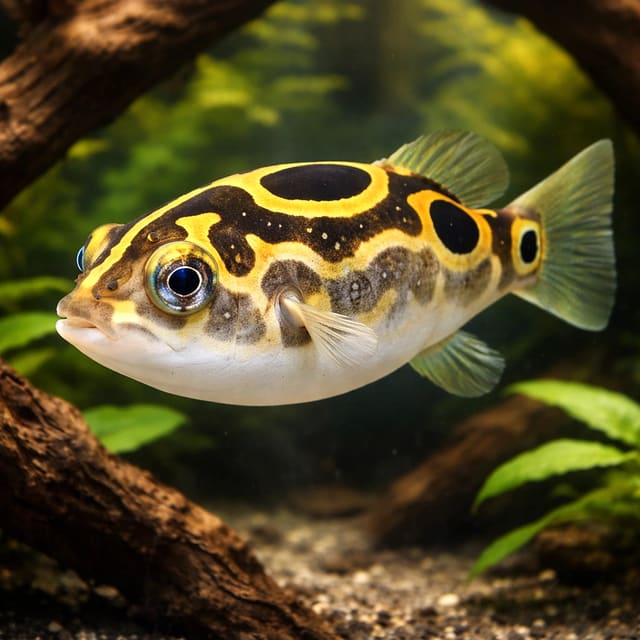
Carinotetraodon lorteti is instantly recognisable by its vivid red to orange-red eyes, which give the species its common name. The body is olive-green to brown on the dorsal surface with intricate dark mottling and patterning, fading to cream or pale yellow on the ventral side. A distinctive raised ridge or crest runs along the back, particularly visible in males. The fins are translucent with subtle patterning. At 2.5cm juveniles already display the adult colouration, and at full maturity they reach approximately 3.5cm. Males tend to show more intense colouration and more pronounced crests than females, especially during breeding condition.
Native to slow-moving canals, rivers, ditches, and occasionally brackish coastal habitats throughout mainland Southeast Asia, Carinotetraodon lorteti inhabits shallow, warm waters with dense vegetation, submerged wood, and soft substrates. These environments feature slightly acidic to neutral water with low to moderate flow and abundant hiding places among aquatic plants and roots. In the wild, red-eye puffers are solitary, territorial predators that hunt small invertebrates, snails, and crustaceans. Recreating these conditions with dense planting, hiding places, and stable water chemistry supports natural behaviour and reduces stress.
Provide a minimum of 60 litres for a single specimen or breeding pair, with significantly more space if attempting to house multiple individuals. Use a fine sand or smooth gravel substrate and furnish the aquarium heavily with live plants such as Java fern, Anubias, Java moss, and Vallisneria to create hiding places and visual barriers. Include driftwood, rocks, and caves to provide additional shelter and break lines of sight. Maintain efficient filtration with gentle to moderate water flow and perform frequent partial water changes to maintain pristine water quality. Provide subdued lighting or floating plants to reduce stress. Ensure excellent oxygenation.
Carinotetraodon lorteti is a specialised carnivore that requires live and frozen meaty foods. Offer snails, bloodworms, blackworms, brine shrimp, daphnia, and other small crustaceans and invertebrates. Hard-shelled prey such as ramshorn or pest snails are essential to help wear down the continuously growing beak-like teeth. Avoid prepared flakes or pellets, as puffers often refuse these. Feed once or twice daily, providing only what can be consumed within a few minutes. Monitor body condition closely, as both underfeeding and overfeeding can lead to health issues. A varied carnivorous diet promotes vibrant colouration and overall health.
Red-eye puffers are aggressive, territorial, and highly intelligent. They are active during the day, constantly exploring the aquarium, investigating objects, and hunting for prey. They display curiosity and often interact with their keeper, following movements outside the glass. However, they are not community fish and will nip fins, harass, or attack most tankmates. They are solitary and territorial, and even conspecifics may engage in aggressive behaviour if space and hiding places are insufficient. During breeding, males may become even more aggressive. Provide plenty of visual barriers and hiding places to reduce stress and territoriality.
Best kept in a species-only setup due to aggressive and predatory behaviour. Fast, robust fish in very large, heavily planted aquaria may sometimes coexist, but compatibility is unreliable and close monitoring is essential. Avoid small fish, shrimp, snails (unless intended as food), slow or long-finned fish such as bettas or angelfish, and other puffers. Even supposedly compatible tankmates may be harassed or injured. For the best welfare and least stress, house red-eye puffers alone or with a carefully selected mate in a breeding setup. Attempting community housing is not recommended.
Breeding can be achieved in captivity under excellent conditions in a species-only tank with dense cover and conditioned live foods. Males display stronger colouration and more pronounced crests, and they court females among plants or caves. Females lay adhesive eggs on plant leaves or hard surfaces, and males may guard the eggs. Remove the female after spawning if aggression occurs. Eggs hatch in several days, and fry require microscopic live foods such as infusoria before graduating to newly hatched brine shrimp. Breeding success requires pristine water quality, stable parameters, and careful observation.
Not a community fish and best kept alone or in carefully managed breeding pairs. Provide excellent filtration and frequent water changes, as puffers produce significant waste and are sensitive to poor water quality. Regularly offer hard-shelled snails to wear down the continuously growing teeth; overgrown teeth can prevent feeding and lead to starvation. Monitor for signs of stress, illness, or aggression. Puffers are intelligent and benefit from environmental enrichment such as varied décor and feeding routines. This species is best suited to experienced aquarists committed to specialized, species-specific care.
Tropical Fish Co is a leading UK supplier of healthy, vibrant freshwater puffers including Carinotetraodon lorteti red-eye puffers. Each fish is carefully selected for striking colouration, active behaviour, and robust health. Our livestock is quarantined and health-checked before dispatch, ensuring you receive only the finest specimens. We provide expert care advice, detailed species information, and ongoing support to help you succeed with specialist fish. With fast, secure delivery across the UK and a commitment to sustainable, responsible fishkeeping practices, Tropical Fish Co is your trusted partner for premium tropical fish and aquatic livestock.
No reviews for this item yet. Bought one? Honest reviews only, good or bad.
What customers say about ordering from us
I have a small group of long finned mountain minnows. So was delighted to be able to order ten of this variety to increase the genetics in my tank . The ones I recieved are healthy but it’s to early to give a verdict on wether they are of a long finned type since they are small currently.
Gordon Walker · 23 Sept 2026
100% success travel and "installation". Pleased with quality of purchase. The Siamese fighter a bit "shy" so have not yet seen him at his best yet but looking good. Happy customer. GG
George E Garratt · 21 Sept 2026
Reviews of our shop, collected by Judge.me, an independent third-party review collector. Newest first.