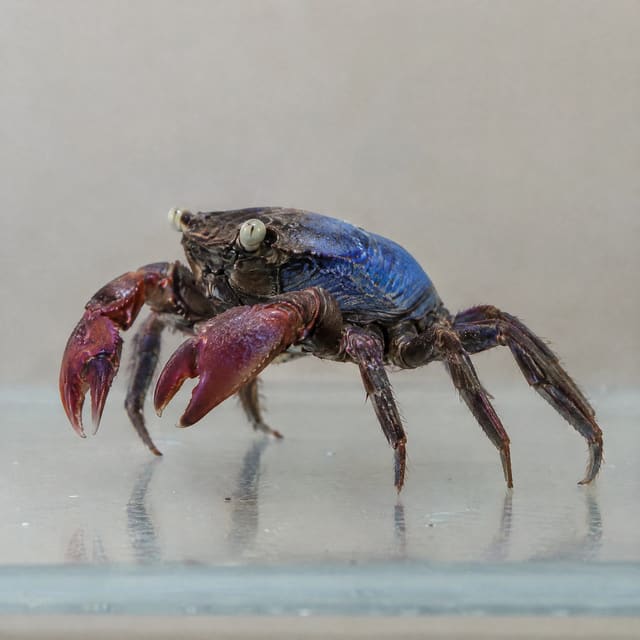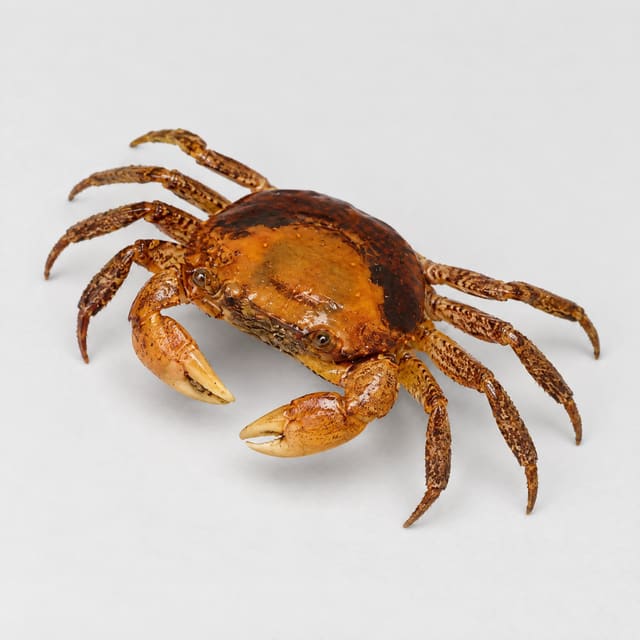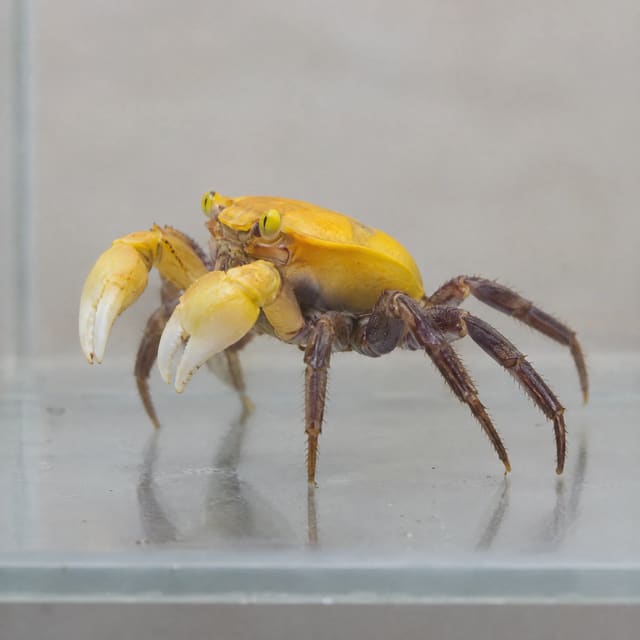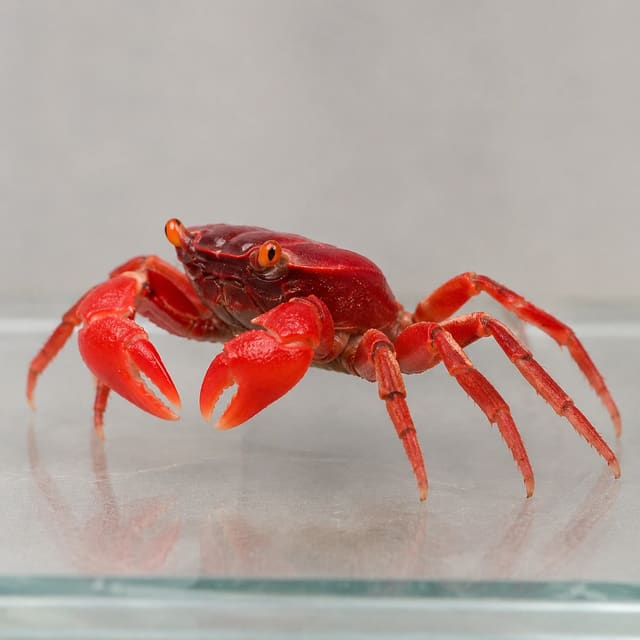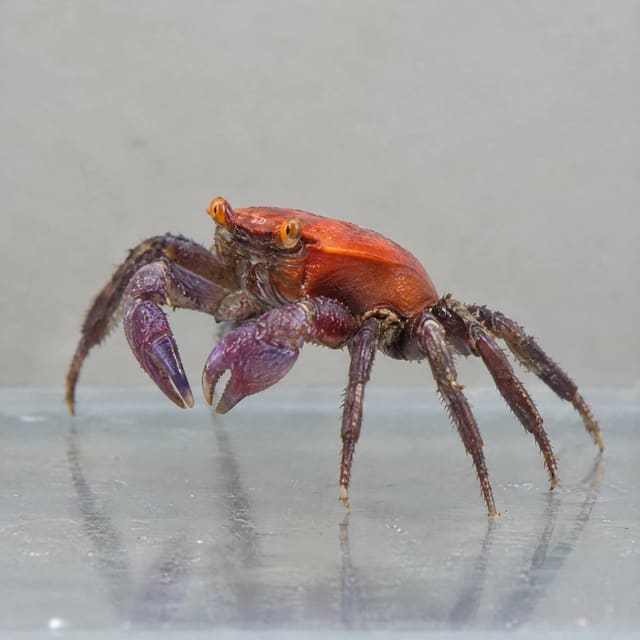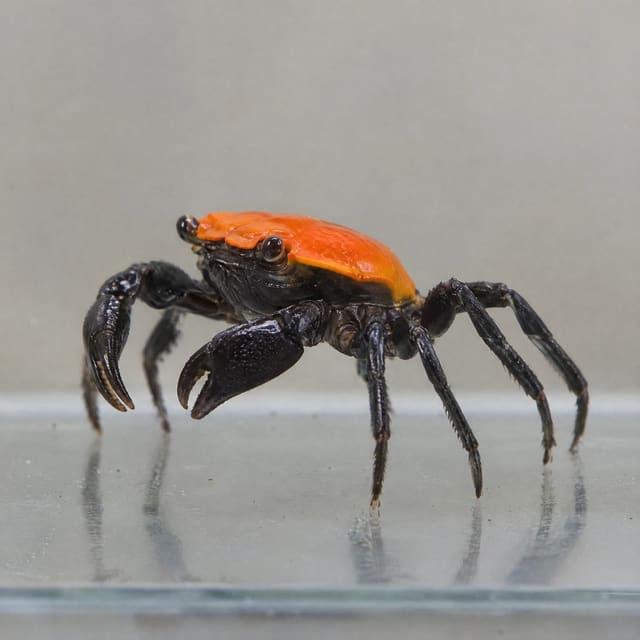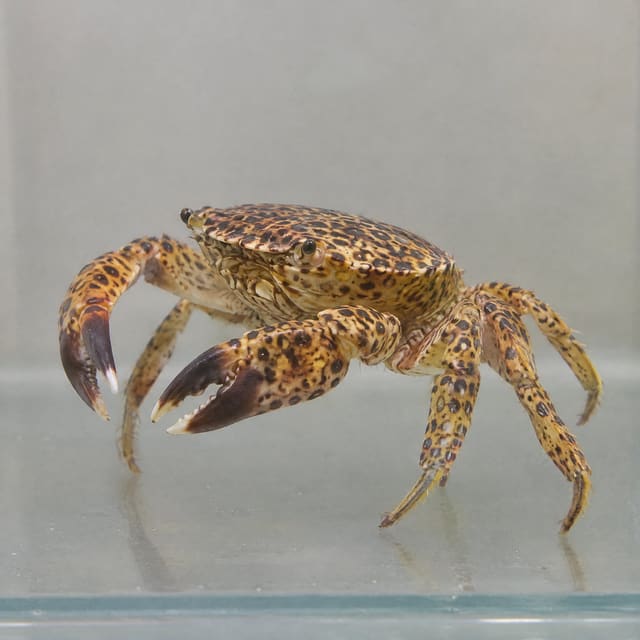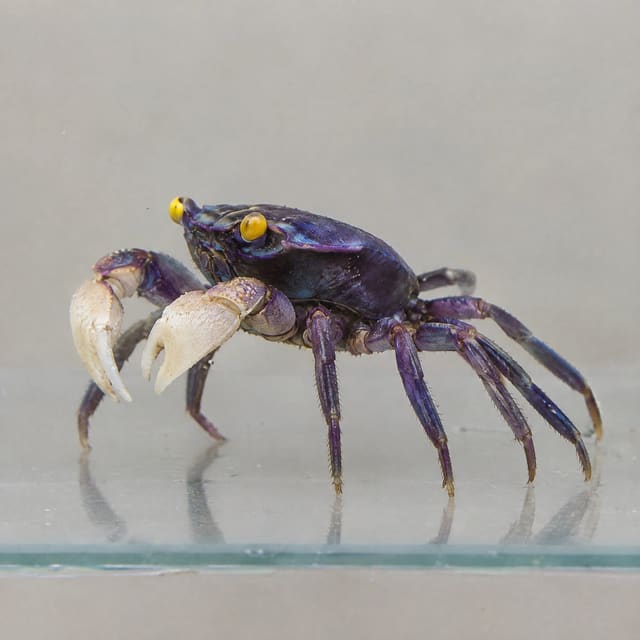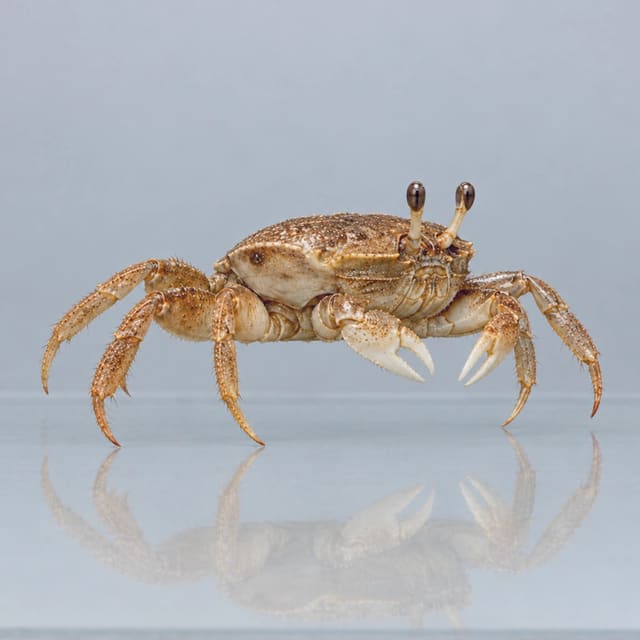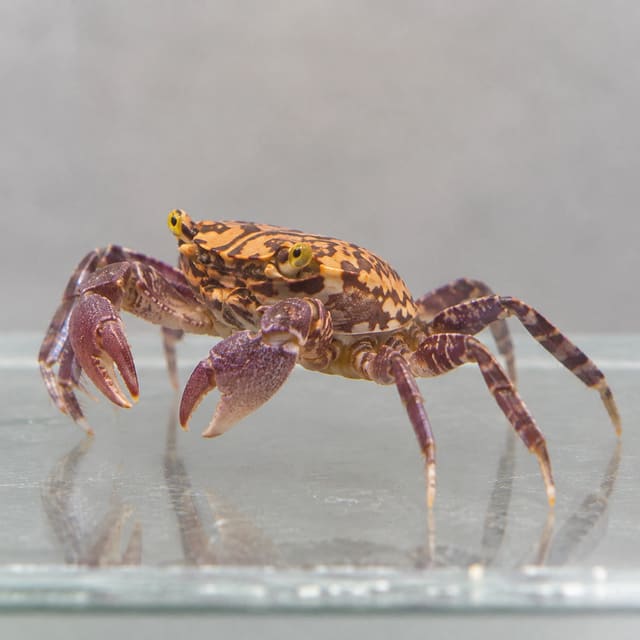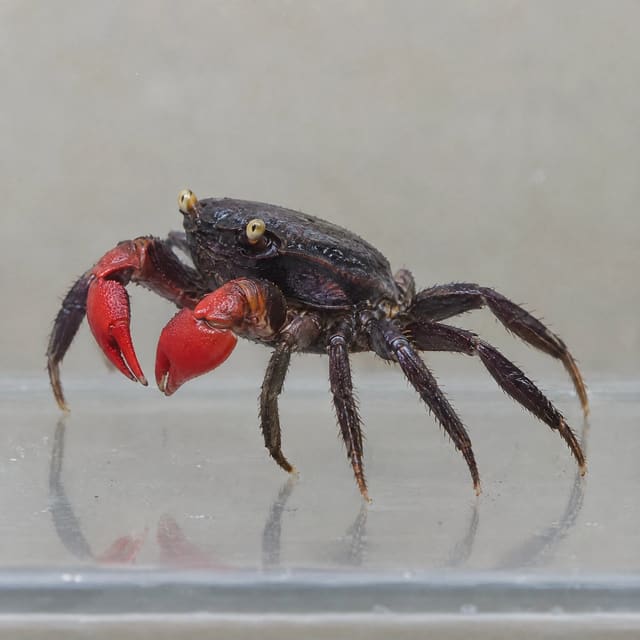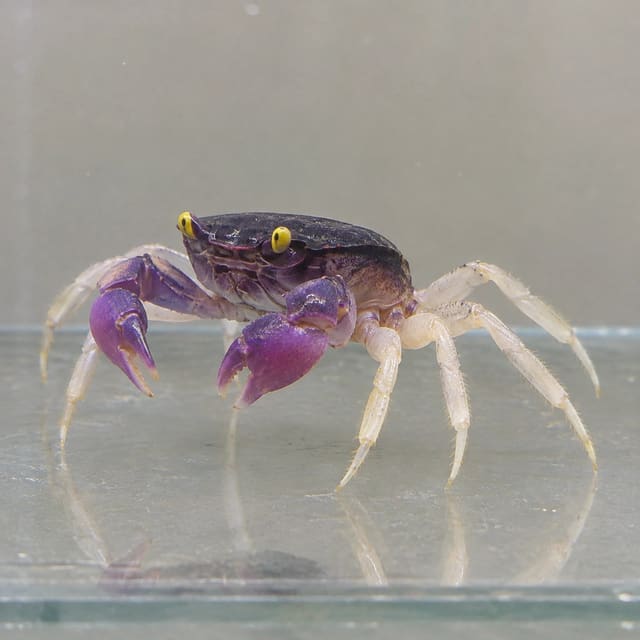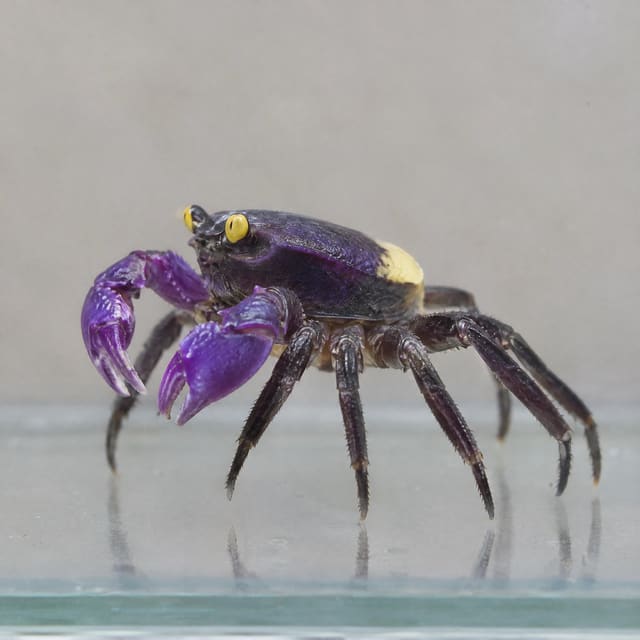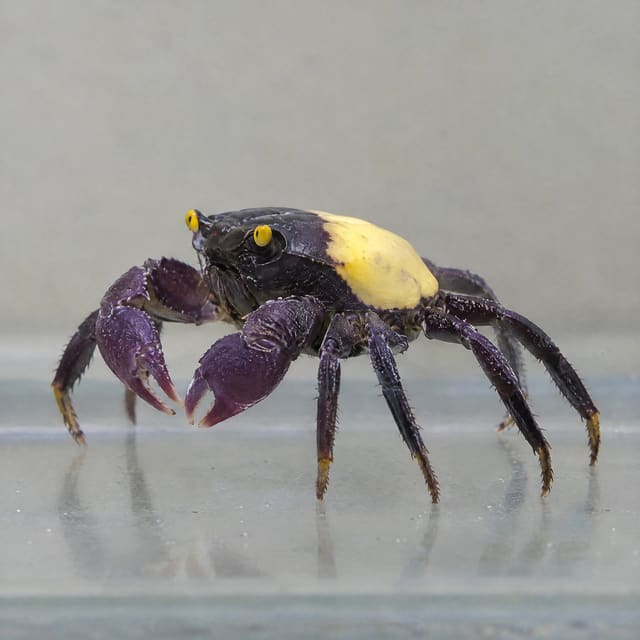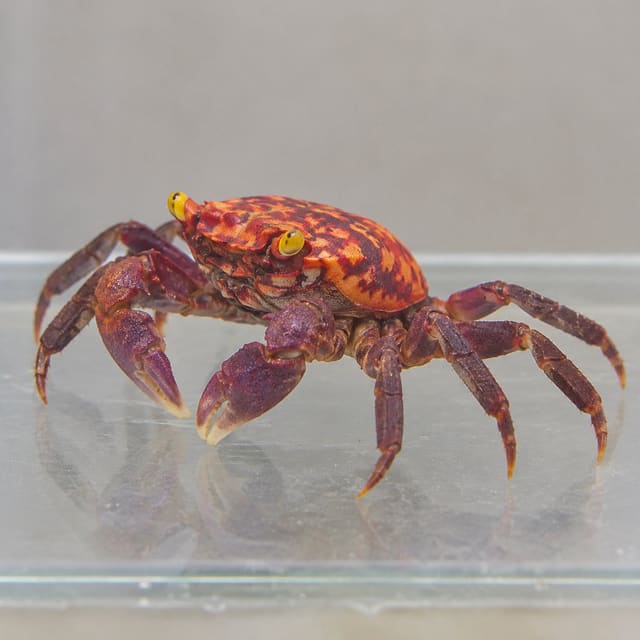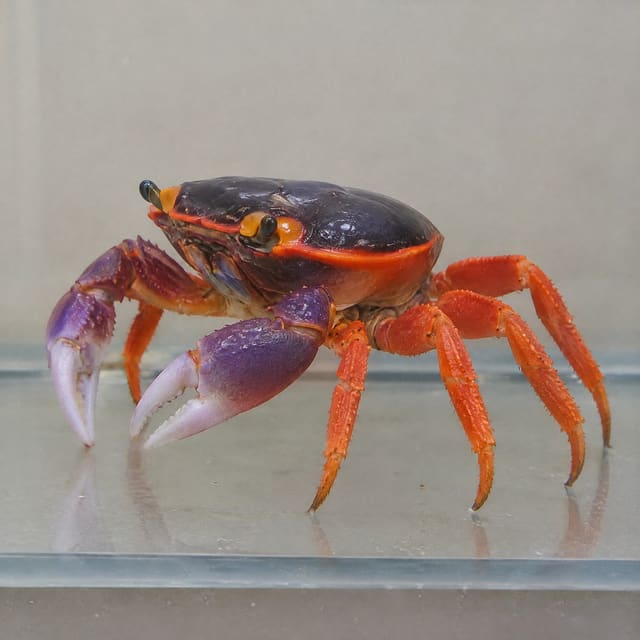
Halloween Crab (Gecarcinus quadratus)
£83.99
The Red Tropical Crab is the red-clawed crab, Parasesarma bidens (formerly Perisesarma bidens), a small, active mangrove crab that lives as much on land as in the water. Keep it in a paludarium of at least 60 litres with a real land area, shallow low-brackish water at 24–27°C and a lid that seals every gap. Sold individually as one live crab.
Adult size is the maximum length this species reaches at full maturity (scientific sources). The livestock you receive will be younger and smaller. Product-photo provenance and any image-specific limitations are stated on the listing.
Parasesarma bidens
The Red Tropical Crab is the red-clawed crab, Parasesarma bidens (formerly Perisesarma bidens), a small, active mangrove crab that lives as much on land as in the water. Keep it in a paludarium of at least 60 litres with a real land area, shallow low-brackish water at 24–27°C and a lid that seals every gap. Sold individually as one live crab.
Adult size is the maximum length this species reaches at full maturity (scientific sources). The livestock you receive will be younger and smaller. Product-photo provenance and any image-specific limitations are stated on the listing.
The Red Tropical Crab is the UK trade name for the red-clawed crab, Parasesarma bidens, a small, busy crab from coastal mangroves in Asia that most shops still sell as Perisesarma bidens. It lives as much on land as in the water: it climbs roots and branches, forages along the shoreline and drops back into the water to wet its gills, feed and moult. Kept well, it is one of the most watchable invertebrates you can buy, with bold red claws, constant activity at the water's edge and a lively response to food.
It is not a fully aquatic animal and it is not a crab for a community fish tank. SeaLifeBase records it as a brackish-water crab that belongs to both the ground-dwelling and the tree-climbing communities of mangrove shores, and the Fishkeeper profile stresses that it must have an area where it can climb free of the water. Everything on this page follows from that: the Red Tropical Crab needs a paludarium with real land, shallow water and a lid that seals.
| Name | What it means |
|---|---|
| Red Tropical Crab | The UK shop name we use for this crab |
| Red claw crab, red-clawed crab | The most widely used English names, after the bright claws |
| Mangrove crab, red crab | Other names used in the trade |
| Parasesarma bidens (De Haan, 1835) | The accepted scientific name in WoRMS, the World Register of Marine Species |
| Perisesarma bidens | The former name, still the most common one on labels; a 2018 peer-reviewed revision by Shahdadi and Schubart moved most Perisesarma species into Parasesarma |
| Sesarma bidens, Chiromantes bidens, Grapsus bidens | Older names for the same crab in books and on some labels |
It belongs to the family Sesarmidae, the same family as the vampire crabs and the Red Apple Crab. Like them, it is a semi-terrestrial crab, but it comes from salty coastal water rather than inland streams, which affects how you set up the water part of its home.
Turn the crab gently over, or look from below through the glass. OATA explains that crabs are easy to sex by the flap, sometimes called the tail, folded under the body: a male's is narrow and pointed, a female's is much wider and rounded. The Fishkeeper profile adds that males usually have larger, brighter claws. Males are very territorial, so in a smaller tank keep one male with several females. If you want a group, buy several crabs, sex them on arrival and be ready to separate any extra males into a second set-up.
The Fishkeeper profile gives a maximum size of 4.5 cm for the Red Tropical Crab. That sounds small, but this crab uses every surface: the land, the shoreline, the water and anything it can climb. OATA recommends an aquarium of at least 60 litres for a small group of crabs and advises choosing a tank that is as long and wide as possible, because floor area is what crabs use. A tall, narrow tank wastes most of its volume.
OATA describes the standard crab layout: slope rocks, large pebbles and gravel to make a bank of land the crabs can reach, cover it with sand, then add plants, roots and caves so the crabs can behave naturally. The Fishkeeper profile asks for a sandy land area with plenty of roots and rocky caves, which the crabs use as hiding places while they moult. Because SeaLifeBase lists this species among the tree-climbing crabs of mangrove shores, give it height as well: roots or branches that start in the water and rise above the land are used all day.
| Zone | What to build | Why it matters |
|---|---|---|
| Land | A stable bank of rock and gravel capped with sand, at least half of the floor | The crab spends much of its time here and must be able to dry off completely |
| Shore | A gentle slope or flat stones leading into the water | Easy routes in and out, including for a soft, newly moulted crab |
| Water | Shallow, filtered, heated low-brackish water | Feeding, wetting the gills and moulting |
| Climbing | Roots and branches rising from the water above the land | Matches its tree-climbing habit in mangroves |
| Shelter | Rocky caves and root tangles, at least one per crab | Safe places to hide, especially while moulting |
Fix every rock and root firmly before you add the crabs, so nothing can slide and trap an animal. Build the bank so that it cannot slump into the water when it gets wet: sand alone will slowly wash down a slope.
This is the point most new crab keepers underestimate. OATA warns that crabs are very good at escaping and that a secure lid must be fitted with every hole blocked, and the Fishkeeper profile calls these crabs great escape artists and says a tight-fitting lid is essential. A Red Tropical Crab will climb filter pipes, heater cables, airline and silicone corners, and it will find any gap at the back of the hood. An escaped crab dries out quickly in a centrally heated room.
The two care sources give overlapping ranges. The Fishkeeper profile, written for this species, recommends brackish water; OATA gives general values for crabs in the trade and says to ask your retailer about salinity, noting that some species come from estuaries and need salt added. We recommend working inside both.
| Value | Fishkeeper (red-clawed crab) | OATA (crabs in the trade) | Our working range |
|---|---|---|---|
| Temperature | 24–27°C | 22–27°C | 24–27°C |
| pH | 7.5–8.5 | 7.0–8.0 | 7.5–8.0 |
| General hardness | 10–25 dH | 8–18 dGH | 10–18 dGH |
| Carbonate hardness | Not given | 10–15 dKH | 10–15 dKH |
| Salinity | Brackish, specific gravity 1.005 | Ask your retailer | About 1.005, kept steady |
| Ammonia and nitrite | Not given | Zero | Zero |
| Nitrate | Not given | No more than 20 mg/l above tap water | No more than 20 mg/l above tap water |
UK tap water ranges from soft to very hard depending on where you live, so test pH, general hardness (GH) and carbonate hardness (KH) before you set up; much of the country supplies the hard, alkaline water this crab likes. Treat all new water with a tap water conditioner to remove chlorine and chloramine. Our water parameter matcher compares your readings with the crab's needs, and the water chemistry guide explains pH, GH and KH.
Mix marine aquarium salt into conditioned water in a bucket, never in the tank, and check the result with a hydrometer or refractometer before using it. Make every water change with water mixed to the same specific gravity and temperature. As Practical Fishkeeping explains for brackish crabs, evaporation removes water but leaves the salt behind, so top up losses with plain conditioned fresh water only. Mark the correct water level on the glass so you can see at a glance when a top-up is due.
A filter is always essential, OATA says, even when the water section is small and shallow. In a paludarium that usually means a small internal filter or an air-driven sponge filter that works at a low water level. Put a sponge over any intake so that a crab cannot be pulled against it, and keep the heater guarded and out of reach of climbing legs. Ammonia and nitrite rise quickly in a small volume, so mature the filter before the crabs go in; our guide to the nitrogen cycle explains how.
The Fishkeeper profile describes this crab as an omnivorous detritivore. Dry foods such as sinking pellets, algae wafers and specialist crab foods make a good staple. Add meaty foods such as bloodworm, mysis shrimp and chopped krill or prawn, plus vegetable matter. Dead leaves, such as Indian almond (catappa) leaves, give it something to pick at between meals. OATA adds courgette, cucumber and lettuce to the list for crabs.
OATA advises feeding crabs once a day, leaving the food for about 30 minutes so they have time to eat, then removing what is left. That 30-minute rule is your measure: offer only what the crabs clear in that time. Place food on the land near the water's edge as well as in the water, so a shy or newly moulted crab can feed without crossing a dominant male's territory. Uneaten food rots quickly in a shallow water section and raises ammonia, so if leftovers keep appearing, feed less.
Before the crab arrives, check that ammonia and nitrite are at zero and that temperature and salinity are stable. OATA describes the floating-bag method for crabs: switch off the tank lights, float the closed bag in the water for 10 minutes to match the temperature, then add small amounts of tank water to the bag over at least 30 minutes. Release the crab with as little bag water as possible. For a semi-terrestrial crab, open the bag at the shoreline so it can walk out onto land or into the water as it chooses. Our acclimatisation guide walks through the method step by step.
| When | What to check | What to do |
|---|---|---|
| Day 1 | The crab has found a hiding place | Leave the lights low and the crab alone; do not dig it out |
| Days 2–3 | Feeding at dusk | Offer a small portion near its cave and remove leftovers after 30 minutes |
| Days 1–7 | Ammonia, nitrite, salinity and temperature | Test more often than usual; OATA advises close monitoring in the first week |
| Day 7 | Sex, behaviour and territories | Sex the crabs and separate males that fight constantly |
The Fishkeeper profile rates the Red Tropical Crab as non-community and says a species tank is best. It will hunt small fish, so bottom-dwelling fish should be avoided; some keepers have kept it with small, fast-swimming brackish fish where there is enough water volume and land. OATA's advice for crabs in general is the same: they are opportunistic and will hunt small and slow-swimming fish, so a dedicated set-up is recommended.
| Suits | Avoid |
|---|---|
| A species-only paludarium | A community fish aquarium with no land |
| One male with several females | Several males in a small tank |
| Small, fast brackish fish in a large set-up with plenty of water and land | Bottom-dwelling, small or slow fish |
| Plenty of caves and roots, one per crab or more | Shrimp, which are easy prey |
| Low-brackish water kept stable | Other crab species with different water needs |
If you are tempted by a mixed set-up, look through our brackish fish first and check each candidate's adult size and water needs, then run the mix through our tank mate checker. Our vampire crab and paludarium guide explains how to plan land, water and territories for crabs.
We keep several other crabs that live between land and water, each with its own needs: the Red Apple Crab, the Red Vietnam Crab and the Wetland Crab, as well as brackish shore crabs such as the Rainbow Fiddler Crab. Keep different crab species in separate set-ups. Browse the whole range in our crayfish and crabs category, our Sesarma crabs and the wider shrimps and crustaceans collection.
Crabs grow by moulting, and OATA warns that the shed skin can look just like a dead crab, so check before you panic. A freshly moulted crab is soft for several days and hides in a cave; the Fishkeeper profile notes that caves are especially important at this time. Leave it undisturbed, keep the water clean and make sure other crabs cannot reach it. Like all crabs, it is very sensitive to copper and will die even at low levels, so only use treatments that are labelled safe for invertebrates (OATA).
| What you see | What to do |
|---|---|
| Less activity, restlessness or unusual behaviour | Test the water first, including salinity and temperature |
| Colour turning darker or paler than normal | Check water quality and stress from other crabs |
| Hiding much more or fighting more than usual | Add caves and check the male-to-female balance |
| Trouble moulting or an incompletely shed shell | Review water hardness, salinity and diet, and keep the crab undisturbed |
| Weight loss, swelling or refusing food | Test the water and ask us or your vet for advice |
These are the warning signs OATA lists for crabs. Always start with a water test, because almost every problem in a small paludarium traces back to water quality.
Female Red Tropical Crabs are often seen carrying eggs under the abdomen, but the Fishkeeper profile explains that raising the young is extremely difficult because of their complex life cycle, so the species is unlikely to breed in a home paludarium. OATA describes the same problem for crabs with planktonic larval stages, which cannot easily be reproduced at home. Buy this crab as a display animal rather than as a breeding project. OATA also notes that smaller crabs often live only a couple of years, so a Red Tropical Crab is a short-to-medium-term pet that rewards a carefully built habitat.
Every decision on this page comes back to three things: enough land to leave the water, stable low-brackish water, and a lid with no gaps. Get those right and the Red Tropical Crab is an active and endlessly entertaining animal; neglect any one of them and even a perfect diet will not make up for it.
It is the UK trade name for the red-clawed crab, Parasesarma bidens, a small semi-terrestrial crab of the family Sesarmidae from coastal mangroves in Asia. Most shops still list it under its former name, Perisesarma bidens. It spends much of its time out of the water and needs a paludarium with land, shallow water and a secure lid.
Yes. Red Tropical Crab, red claw crab, red-clawed crab, mangrove crab and red crab are all names used for Parasesarma bidens. A 2018 revision moved most Perisesarma species into Parasesarma, and WoRMS now lists Perisesarma bidens as a superseded name for the same crab.
SeaLifeBase records it as a brackish-water mangrove crab, and the Fishkeeper profile recommends brackish water at a specific gravity of about 1.005, with pH 7.5–8.5 and 24–27°C. It is often sold as a freshwater crab, but low brackish water matches its natural habitat. Measure the salinity with a hydrometer or refractometer and keep it steady.
No. It must be able to climb completely out of the water, so it needs a paludarium or an aquarium with a lowered water level and décor rising above the surface. OATA recommends filling only a half to a third of the tank with water for crabs that need land, and a lid that closes every gap.
The Fishkeeper profile gives a maximum size of 4.5 cm. OATA recommends at least 60 litres for a small group of crabs, with the floor area mattering more than the height, because the crabs live on the land and at the shoreline.
It is best kept in a species-only set-up. Both OATA and the Fishkeeper profile warn that crabs of this kind will hunt small and slow fish, and bottom-dwelling fish and shrimp are at particular risk. Some keepers add small, fast brackish fish to a large paludarium with plenty of water and land.
Males are very territorial, so the Fishkeeper profile suggests one male with several females in a smaller tank. We cannot choose the sex for you, so sex your crabs on arrival by the shape of the flap under the body and be ready to separate extra males.
Probably not. Crabs moult regularly, and OATA notes that a shed skin can look just like a dead crab. A freshly moulted crab is soft and hides for some days, so leave it undisturbed in its cave, keep the water clean and make sure other crabs cannot reach it.
No reviews for this item yet. Bought one? Honest reviews only, good or bad.
What customers say about ordering from us
Easy website plenty of info on fish your buying great to pick a time slot
TRACEY DURRANT · 7 Oct 2026
Got some lovely fish thank you
Kevin Mackie · 7 Oct 2026
Reviews of our shop, collected by Judge.me, an independent third-party review collector. Newest first.
Moved by UK carriers licensed to handle live animals
Hand-packed with oxygen bags, poly box, heat pack
Email photos the same day; an optional unboxing video helps us review problems faster — claim terms apply
Klarna & PayPal Pay in 3 at checkout