Moderate
Purple Vampire Crab (Geosesarma dennerle) – Semi-Terrestrial Paludarium Crab
£8.09
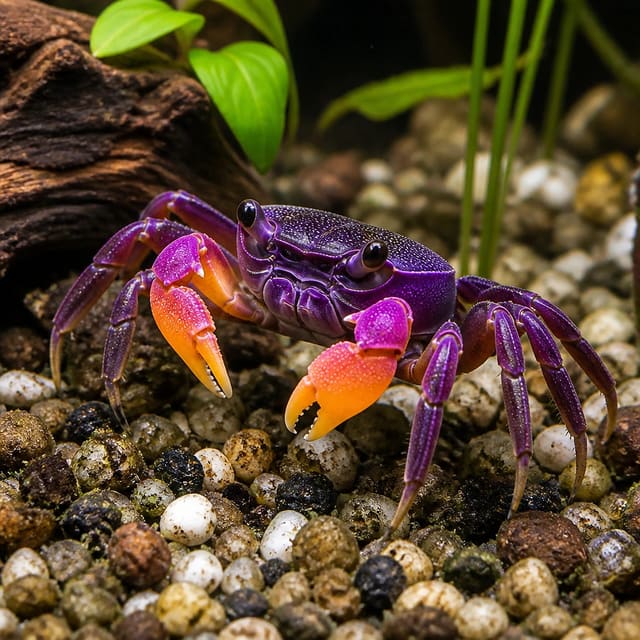
The Batik Vampire Crab is a semi-terrestrial crab of the genus Geosesarma, sold under a trade name without an identified species. It needs a secure, humid paludarium with plenty of land, a deep burrowing substrate, leaf litter and hides, clean fresh water it can reach easily and a varied diet. Each purchase is one crab, and sex is not guaranteed.
Geosesarma sp.
The Batik Vampire Crab is a semi-terrestrial crab of the genus Geosesarma, sold under a trade name without an identified species. It needs a secure, humid paludarium with plenty of land, a deep burrowing substrate, leaf litter and hides, clean fresh water it can reach easily and a varied diet. Each purchase is one crab, and sex is not guaranteed.
The Batik Vampire Crab is a small semi-terrestrial crab sold under a trade name within the genus Geosesarma. You receive one live crab. It spends most of its time on land and uses water as well, so the one condition that matters most is its home: a secure, humid paludarium with a large land area and clean fresh water it can reach easily, rather than an ordinary fish tank.
Kept that way, a vampire crab is an absorbing animal to watch. In a well-planted enclosure it walks over moss and wood, burrows into moist soil and picks through leaf litter for food, and it has a life cycle that stays on land from egg to adult. It is a good choice for a keeper who enjoys building a small living landscape and is happy to manage humidity, cleanliness and a secure lid.
| Suits | Think twice if |
|---|---|
| A dedicated paludarium with much more land than water | You want an animal for a fish community aquarium |
| Keepers happy to manage humidity and a close-fitting lid | The enclosure has gaps you cannot close |
| A varied menu of prepared crab food, small animal foods, fruit and greens | You cannot remove leftovers and waste regularly |
| Buyers comfortable with a genus-level identification | You need a named species or a guaranteed male or female |
| Classification | Genus Geosesarma, family Sesarmidae; species not identified |
| Lifestyle | Semi-terrestrial: mostly on land, with access to fresh water |
| Life cycle | The genus lives and reproduces on land; larval stages develop inside the egg |
| Where the genus occurs | South and South-East Asia and Pacific islands, including Hawaii |
| Housing | Secure, humid paludarium with land, a pool, burrowing substrate and hides |
| Diet | Omnivorous scavenger: prepared crab food, small animal foods, fruit and greens |
| Water safety | Clean, tested fresh water; copper-free products only |
| Companions | Best in a set-up of its own; take care with fish |
Each purchase supplies one live crab, so a basket quantity of three brings three crabs. Crabs are dispatched at a 3–4 cm grade. That figure describes the crab you receive, not an adult size for this trade form.
The exact species has not been identified, so the care advice here follows the genus Geosesarma and its care group. Batik is a trade name for this form rather than a scientific name, which is why the listing uses Geosesarma sp.
The abbreviation sp. stands for species. Written after a genus name, it marks an animal identified to its genus but not to a particular species, which is exactly the position with this crab. WoRMS lists Geosesarma as an accepted genus in the crab family Sesarmidae.
Sex is guaranteed only when the selected option explicitly states male or female. This Batik Vampire Crab listing has no sex-guaranteed option. Whatever the sex, plan the enclosure so that each crab has enough land and hides of its own.
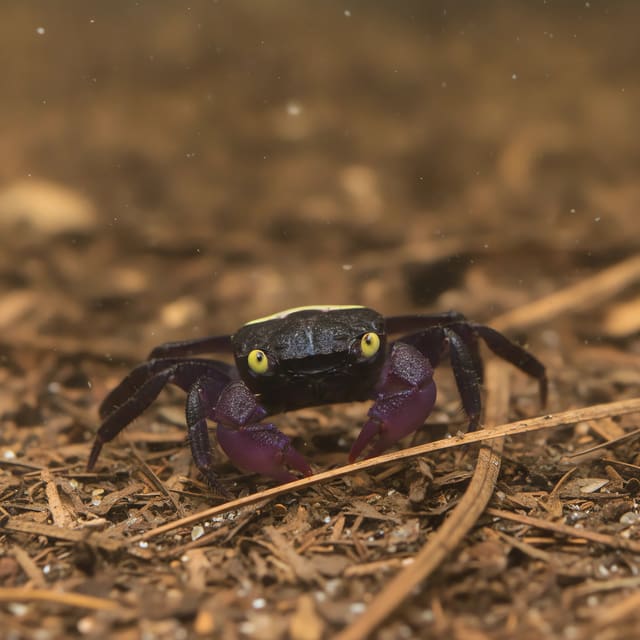
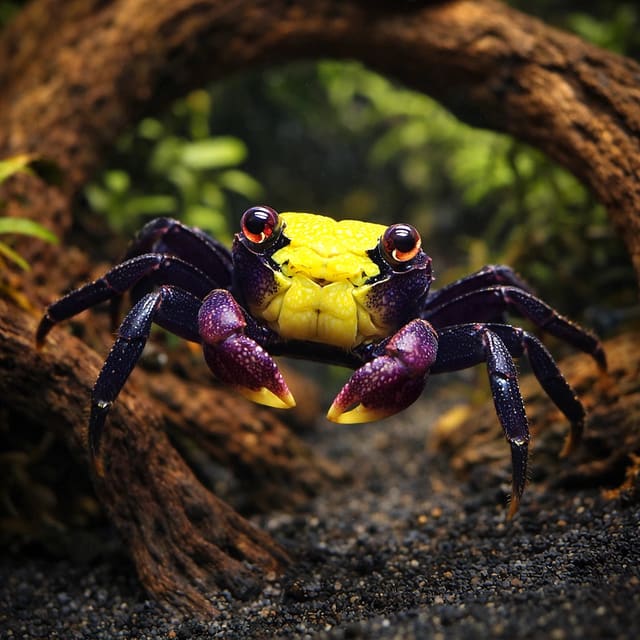
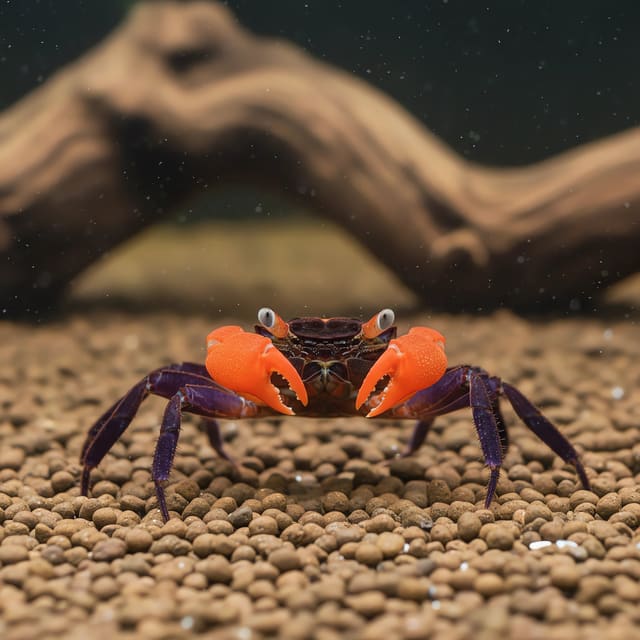
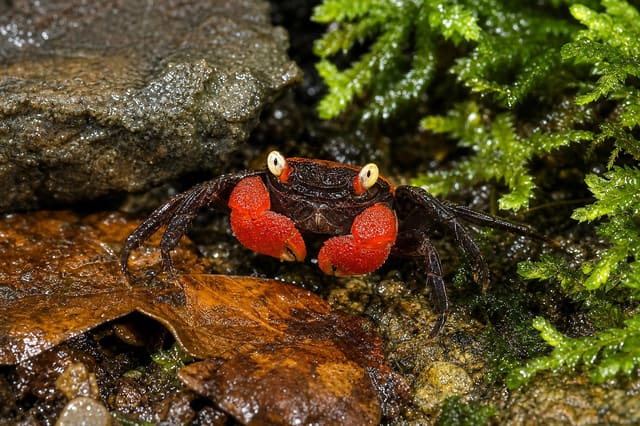
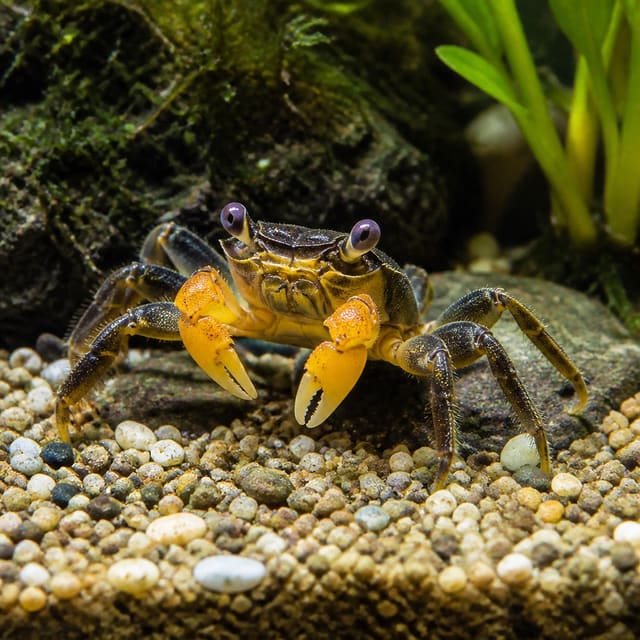
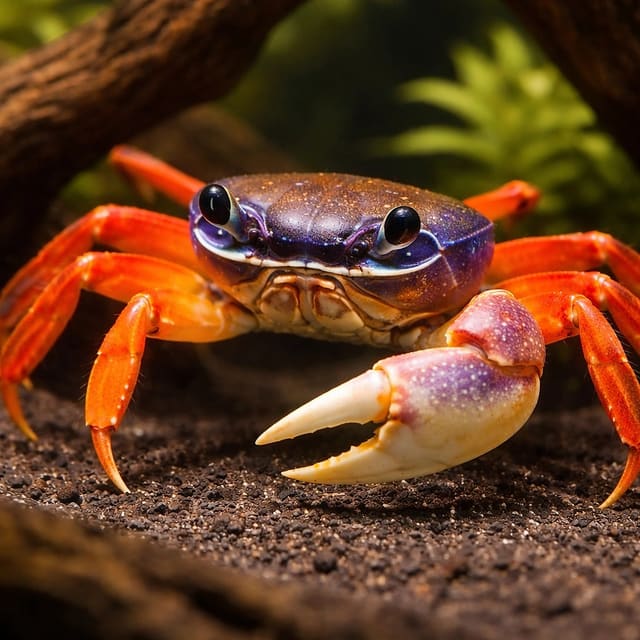
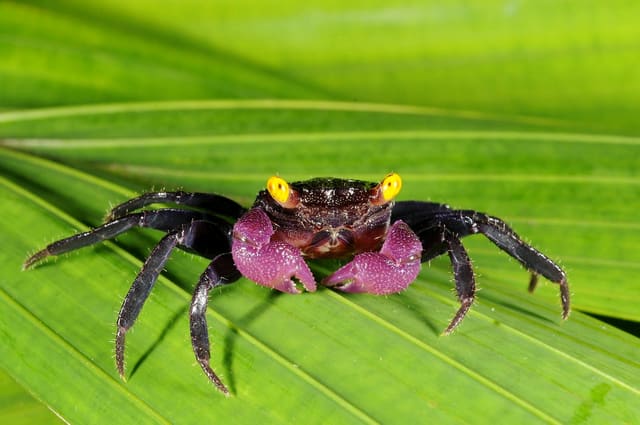
Gallery images have been digitally enhanced to improve image quality. Natural colour, pattern, size and maturity can vary between live animals.
If all four sound manageable, the Batik Vampire Crab is a rewarding way into semi-terrestrial keeping.
Other crabs and crustaceans we stock are in our shrimp and crustacean collection. The shrimp in that range are fully aquatic animals with very different needs from this crab, so check each listing before planning any shared set-up.
Wikipedia describes Geosesarma as a genus of small freshwater or terrestrial crabs that live and reproduce on land, with the larval stages completed inside the egg. The young do not need open water to develop, and the adults do not need to be submerged, which is the whole reason this crab belongs in a paludarium.
A specialist Geosesarma care sheet from The Tye-Dyed Iguana describes these crabs as spending most of their time on land while still venturing into water. The Los Angeles Zoo’s account of a related species, Geosesarma dennerle, describes the same pattern: a warm, humid, thickly planted habitat with wet soil beside fresh water, where the crabs use the land extensively and burrow. That account is for one named species, but it paints a clear picture of the kind of home the genus needs.
Wikipedia lists Geosesarma from India, Indonesia, Malaysia, Thailand, the Philippines, the Solomon Islands and Hawaii. The Batik form is sold without a precise locality, so plan its care around the genus as a whole rather than one particular place.
Measured across the carapace, the hard shell over the body, crabs in this genus are typically less than 10 mm wide. With the legs spread, a vampire crab looks considerably larger than that. Plan the enclosure around what the crab does — walking, burrowing, hiding and visiting water — rather than around a single measurement.
Like every crab, it grows by moulting its shell. Plenty of hides let it stay out of sight while it does so, and a calm, stable enclosure means you rarely need to disturb it.
Knowing these habits helps you read the crab. A burrowing, foraging crab that visits the pool and comes out to feed is behaving as the genus does.
Vampire crabs are animals to watch rather than to handle. If you need to move one during maintenance, guide it gently into a small container instead of picking it up, and return it to the land area of the enclosure. Keep the lid closed whenever you are not working inside.
Choose a glass tank or terrarium that can take a close-fitting lid and hold a deep layer of substrate as well as a pool. Floor area is what the crab uses most, because it lives on the land surface and burrows into it, so favour a footprint that gives plenty of room for land, hides and planting. A front-opening terrarium makes feeding and cleaning easier, provided the doors close without gaps.
Security comes first. Fit a close-fitting lid and check for gaps around cables, pipes and hinges before the crab goes in, then check again after any maintenance. A lid does a second job as well: it holds in the humidity this crab needs.
Give the crab much more usable land than water. The specialist care sheet describes a primarily land-based set-up, and the zoo describes extensive land use in G. dennerle. Make the land varied rather than flat, with moss, wood, plants and hides spread across it, so the crab can move between damp and slightly drier spots and always has cover nearby.
Include a pool of clean fresh water the crab can walk into and out of without effort. A gentle slope of substrate, stones or wood at the edge makes the water accessible. Keep that water clean. Writing about aquariums, the RSPCA explains that fish release ammonia, which is toxic, and that a working biological filter lets bacteria convert it into nitrite and then into the safer nitrate. Crab waste and leftover food foul a small pool in the same way, so a small filter on the pool, regular partial water changes with dechlorinated water and prompt removal of food all help.
Our freshwater shrimp set-up guide explains how to prepare and mature the water side of an invertebrate set-up before livestock arrives, and those steps apply to the pool here.
Use a deep, moisture-retentive substrate that the crab can burrow into. The specialist care sheet describes soil or sand with moss laid over it, under leaf litter or cork bark, and the zoo describes wet soil and burrowing in G. dennerle. Keep the substrate moist; damp soil holds a burrow and helps keep the air humid.
Leaf litter and cork bark give the crab places to hide and forage, and live plants and moss add cover while helping to hold humidity. Offer several hides spread over the land rather than one, so the crab always has shelter close by wherever it is.
Building in this order keeps the pool edge stable and lets plants and moss settle before the crab arrives. Running the enclosure for a while before ordering also shows you how quickly it dries out, so you can adjust the lid, substrate or planting in advance.
The zoo describes G. dennerle living in a warm, humid habitat, and the specialist sheet describes a humid set-up for the genus. Keep the enclosure warm and stable, check it with a thermometer, and hold humidity with the lid, moist substrate, moss and live plants. Steady conditions matter more than any single reading, so make changes gradually and watch how the crab responds.
The OATA care sheet for crayfish and freshwater crabs expressly includes vampire crabs. Its water figures are general guidance for that whole group, not an optimum for any one crab:
| Measure | OATA group guidance |
|---|---|
| Temperature | 22–27 °C |
| pH | 7.0–8.0 |
| General hardness | 8–18 °dH |
| Scope | Group guidance for crayfish and freshwater crabs |
Use those numbers as a starting reference for the pool and the enclosure, and put your effort into keeping the water clean, stable and tested.
A small pool can foul quickly, because food and waste are concentrated in very little water. Test it regularly for ammonia and nitrite, and change part of the water when readings rise. The guide to aquarium water parameters explains what each test tells you, and the water parameter matcher compares your own readings with the OATA figures above.
Measure the temperature where the enclosure will stand, through a full day and in a cold spell, before you order. If the room runs cooler than the OATA temperature range above, plan how you will keep the enclosure warm and steady, and confirm it with a thermometer inside the enclosure rather than relying on the room thermostat.
A dry enclosure usually comes down to a lid that does not fit well, a substrate that has dried out or too few plants. Check those three first, moisten the substrate and add moss or plants where the surface looks dry. Make one change at a time, so you can see which one helps.
Expect the balance to shift with the seasons. Heating in winter tends to dry indoor air, and a warm spell in summer speeds evaporation from the pool, so check humidity, the pool level and the moisture of the substrate more often at those times.
Vampire crabs are omnivorous scavengers. The specialist care sheet’s menu combines prepared crab food, small animal foods, fruit and greens, and OATA advises a varied diet of animal and plant foods for freshwater crabs. The zoo’s account of G. dennerle describes scavenging on both animal and plant material.
Rotate between these rather than relying on one food. Variety covers the gaps that any single food leaves, and it keeps a scavenging crab foraging.
Offer food on the land in small amounts, in a shallow dish or on a flat stone, so leftovers are easy to find and remove and stay out of the pool. Start small and adjust to what the crab actually clears. Remove uneaten fruit, greens and animal food before they spoil; in a warm, humid enclosure, leftovers break down and foul both the soil and the water.
Watch at feeding time as well. A crab that comes out to take food is settling in; a crab that stops feeding is a prompt to check the water, the humidity and whether it has enough places to hide.
Every order is hand-packed by our team: bagged in pure oxygen, placed in an insulated poly box, with a heat pack when the weather calls for it, and carried by a licensed live-animal courier with tracking. We email you the tracking number and your confirmed delivery date so you know when to be in. The full policy is on our delivery and Live Arrival Guarantee page.
The float-and-release routine on our delivery page is written for fish. A vampire crab lives mostly on land, so it goes from the opened bag onto land in its prepared enclosure instead of into open water.
The parcel needs to be opened and inspected on the day it arrives. If anything has gone wrong, contact us the same day with your order number and the unboxing video, which should show the sealed parcel, the opening and the crab still in the bag. WhatsApp is the fastest way to reach us, and we will arrange a replacement or refund.
Expect the crab to explore and then choose a hide or burrow. Leave it to settle: keep the enclosure humid and quiet, offer a small amount of food on the land and remove what is left. Note where it spends its time, whether it has found cover and whether it comes out to feed. Those observations become your baseline for spotting changes later.
Most care comes down to cleanliness and stability. Remove uneaten food as soon as you notice it, keep the pool clean with partial changes of dechlorinated water, and keep the substrate moist. Top up leaf litter as the old leaves break down, so the crab always has cover and something to forage through.
OATA advises invertebrate-safe, copper-free treatments for freshwater crabs. Check the label of any treatment, plant product or water additive before it goes into or near the enclosure, and avoid anything containing copper. If you also keep fish, use separate nets and equipment for the crab set-up so fish treatments do not reach it.
| When | What to do |
|---|---|
| Every day | Check the crab, the lid and the humidity; remove leftover food |
| Every week | Test the pool and change part of its water |
| As needed | Moisten the substrate and top up leaf litter and moss |
| Before any treatment | Confirm the product is copper-free and invertebrate-safe |
| What you notice | What to check or do |
|---|---|
| Substrate drying out | Check the lid fit, moisten the soil and add moss or plants |
| Pool cloudy or smelly | Remove food, change part of the water and check any filter |
| Mould on leftover food | Offer smaller portions and remove leftovers sooner |
| Crab not seen for days | Often normal burrowing; check that food is being taken |
| Crab found outside the enclosure | Return it gently and seal the gap it used |
Learn your crab’s normal pattern in the first weeks: where it rests, when it comes out and how readily it feeds. A change from that pattern, such as a crab that stops feeding or stays in one place for much longer than usual, is the signal to test the pool, check the humidity and look for waste or spoiled food in the enclosure. If you are concerned, ask us for advice with your readings to hand.
A crab spending long periods out of sight is not necessarily a problem, because burrowing and hiding are normal behaviour for this genus. What matters is whether it still comes out and still feeds.
OATA advises caution when keeping crabs with fish, and the simplest way to follow that advice is a set-up dedicated to vampire crabs. A fish aquarium is also the wrong shape of home: this crab needs far more land than water, a secure lid and a humid atmosphere, none of which a community tank provides.
Keep fish out of the vampire crab enclosure. For any other animal, add it only when you have specific guidance that it suits a humid, mostly terrestrial set-up and will not compete with the crab for hides and food. When in doubt, keep the paludarium for vampire crabs alone.
A paludarium pool is small by design, because the crab needs most of the floor as land. Fish would crowd the only water the crab uses, add waste to it and need conditions built around water rather than land. That is the practical side of OATA’s caution about crabs and fish.
One purchase supplies one crab, and you can order more than one. If you keep several, give the enclosure enough land for each crab to have its own space, spread hides and feeding points across it, and watch at feeding time that every crab gets a share.
If you add crabs later, have extra hides and planting in place first, add the newcomers to the land area in the same calm way as the first, and watch closely at the next few feeds.
| Companion | Guidance |
|---|---|
| Fish | Take care; a dedicated crab set-up is the better choice |
| Other vampire crabs | Possible with plenty of land, hides and feeding points |
| Fully aquatic shrimp | Different needs; plan a separate aquarium |
| Any animal needing copper treatments | Keep completely separate |
It is a semi-terrestrial crab that spends most of its time on land but also uses water. Geosesarma crabs live and reproduce on land, so a fully aquatic tank does not suit them. They need a secure, humid enclosure with plenty of land and clean fresh water they can reach.
Make most of the enclosure usable land, with moss, wood, plants and hides, and add a pool of clean, dechlorinated fresh water with a gentle slope at the edge so the crab can walk in and out easily. A close-fitting lid keeps the crab in and helps hold humidity.
Use a deep, moisture-retentive substrate of soil or sand that the crab can burrow into, topped with moss and leaf litter, and spread cork bark and other hides across the land area. Keep the substrate moist, so burrows hold their shape and the enclosure stays humid.
It is an omnivorous scavenger. Offer a varied menu of prepared crab food, small animal foods, fruit and greens in small amounts, and remove anything uneaten before it spoils. Feeding on the land keeps leftovers out of the pool.
No. OATA advises invertebrate-safe, copper-free treatments for freshwater crabs, so check the label of every treatment or product before it goes into or near the enclosure.
OATA advises caution when keeping crabs with fish, and this crab needs far more land than a fish aquarium offers, so a set-up dedicated to vampire crabs is the better choice.
Batik is a trade name. The crab belongs to the genus Geosesarma, but its species has not been identified, so its care follows the genus and its care group rather than a named species.
We hand-pack it in a bag with pure oxygen inside an insulated box and send it by a licensed live-animal courier with tracking. Someone must be in to receive it. Record one continuous unboxing video from the sealed parcel to the crab still in its bag, then open the bag on the land area of its prepared enclosure and let it walk out without adding the transport water.
The care advice on this page draws on these public references:
No reviews for this item yet. Bought one? Honest reviews only, good or bad.
What customers say about ordering from us
Easy website plenty of info on fish your buying great to pick a time slot
TRACEY DURRANT · 7 Oct 2026
Got some lovely fish thank you
Kevin Mackie · 7 Oct 2026
Reviews of our shop, collected by Judge.me, an independent third-party review collector. Newest first.