Moderate
Purple Vampire Crab (Geosesarma dennerle) – Semi-Terrestrial Paludarium Crab
£8.09
Orange Vampire Crab (Geosesarma sp.) is an orange trade form of the vampire crab genus Geosesarma whose exact species has not been identified. It lives mostly on land, so it needs a secure, humid paludarium with a burrowing substrate, hides and easy access to shallow, clean freshwater, plus a varied diet of animal and plant foods. One live crab per purchase.
Geosesarma sp.
Orange Vampire Crab (Geosesarma sp.) is an orange trade form of the vampire crab genus Geosesarma whose exact species has not been identified. It lives mostly on land, so it needs a secure, humid paludarium with a burrowing substrate, hides and easy access to shallow, clean freshwater, plus a varied diet of animal and plant foods. One live crab per purchase.
Orange Vampire Crab (Geosesarma sp.) is a small, semi-terrestrial crab sold under an orange trade name within the genus Geosesarma. The exact species has not been identified, so the care advice here follows the genus Geosesarma and its care group. The World Register of Marine Species lists Geosesarma as an accepted genus in the family Sesarmidae, and crabs in the genus are known in the UK trade as vampire crabs.
Vampire crabs reach the UK under a range of colour names, and many of those names, this one included, are trade labels rather than scientific species. Colour alone cannot tell you which Geosesarma species a crab belongs to, and two differently coloured vampire crabs may or may not be the same species. That is why this listing names only the genus and plans care around what the whole genus needs.
The most important thing to know before ordering is that this is a land-living crab, not an aquarium animal. It needs a secure, humid paludarium: an enclosure that is mostly moist land, with a shallow pool of clean freshwater it can walk into and out of easily. In a fully aquatic tank it would have nowhere to live the way it naturally does, so if you already keep fish, plan a separate enclosure for this crab.
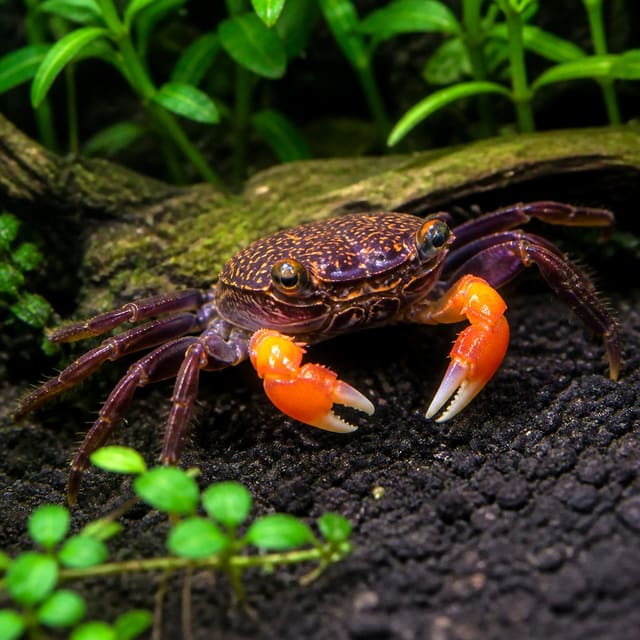
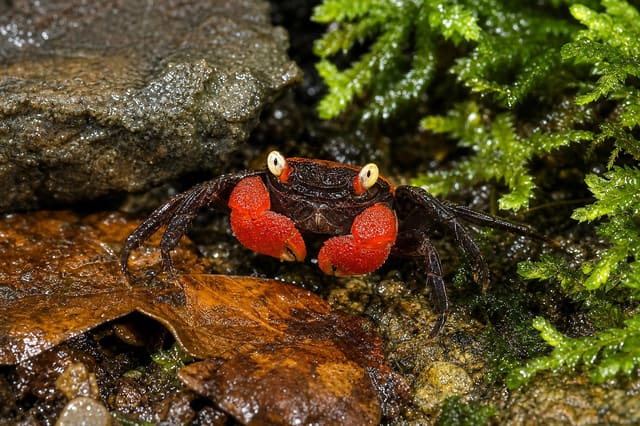
Vampire crabs burrow and shelter under cover, so a well-planted enclosure with leaf litter, moss and cork bark gives it the security it needs, while still letting you watch it forage when it comes out, its orange claws showing clearly against dark soil and leaf litter.
| Suits | Think again if |
|---|---|
| A dedicated paludarium with plenty of moist land | You only have a fully aquatic fish tank |
| A tight-fitting, escape-resistant lid | The enclosure has an open top or gaps around cables |
| Keepers ready to keep the land moist and the water clean | The set-up would often be left to dry out |
| A naturalistic layout with soil, moss and leaf litter | You want a bare, easy-wipe enclosure |
| An enclosure planned around the crab | You hoped to add it to a community of fish |
One purchase supplies one live crab, graded at about 2–3 cm for dispatch. That grade describes the crab you receive, not a promise about how large it will become. For scale, Wikipedia's summary of the genus describes Geosesarma crabs as typically less than 10 mm across the carapace, the hard shell of the body. Carapace width measures the shell alone, so it is not directly comparable with the dispatch grade. There is only one size, so the only choice on this page is how many crabs you order.
Sex is guaranteed only when the selected option explicitly states male or female. This Orange Vampire Crab listing has no sex-guaranteed option. Colour and the photograph give no reliable clue to which sex you will receive.
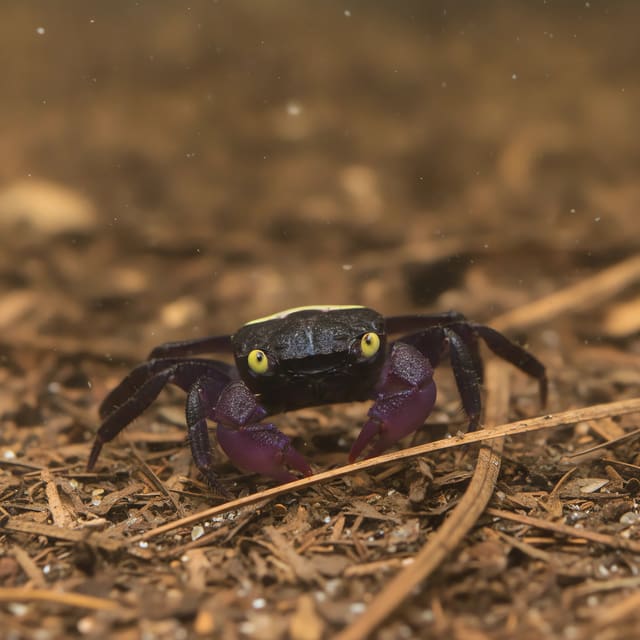
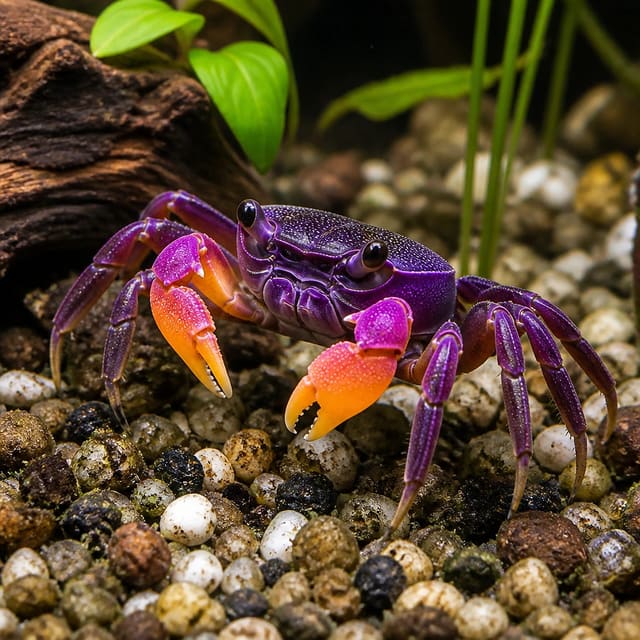
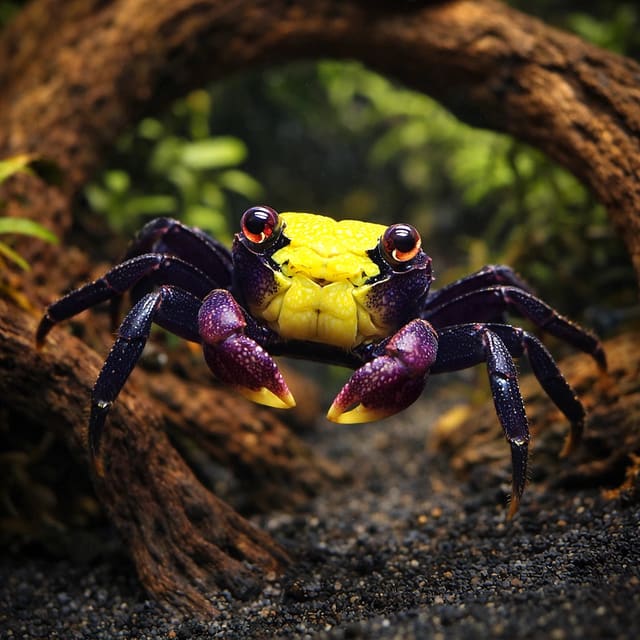
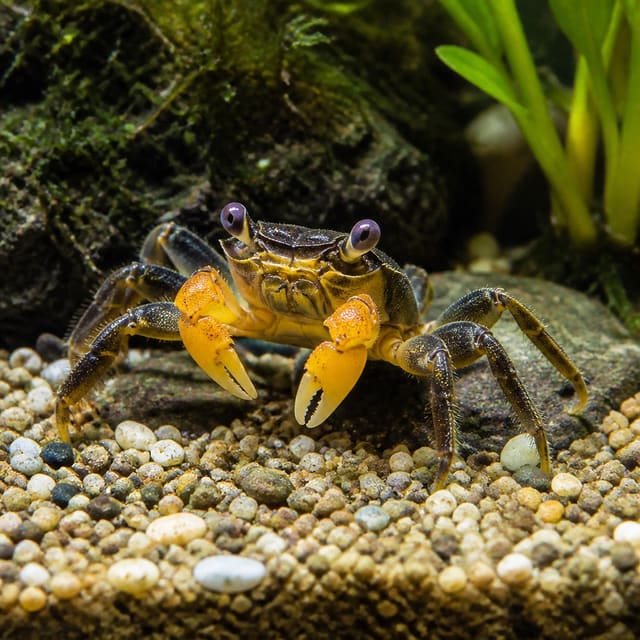
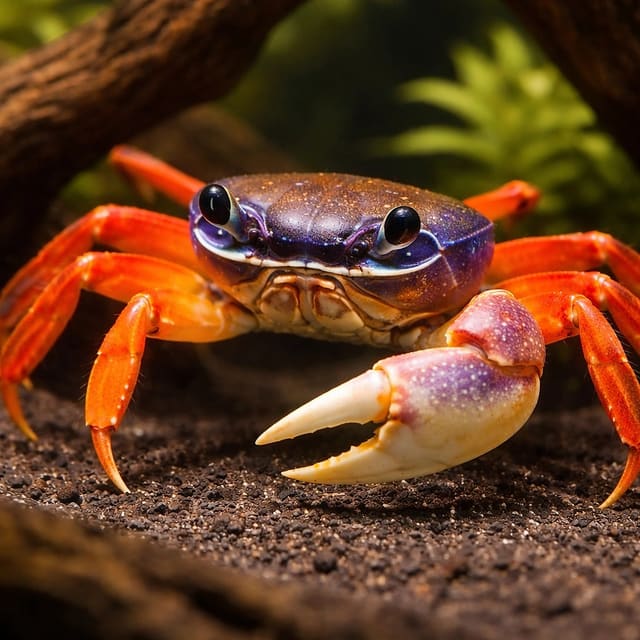
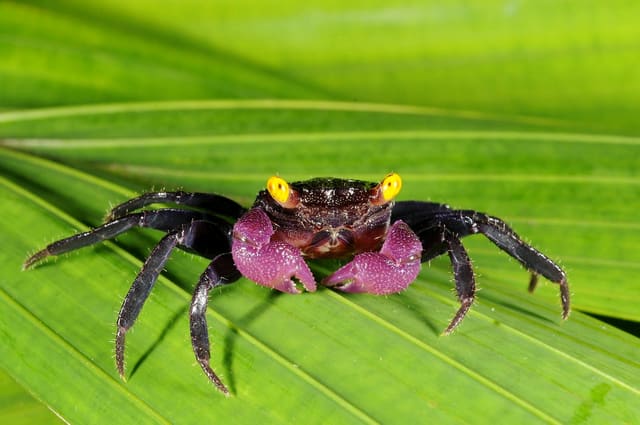
Gallery images have been digitally enhanced to improve image quality. Natural colour, pattern, size and maturity can vary between live animals.
The photograph shows a crab with bright orange claws and eyestalks, pale eyes, a dark carapace and deep purple legs. Treat it as a guide to the colouring of this trade form rather than a picture of the individual crab you will receive.
If you are comparing small crustaceans, our shrimp and crustacean range shows the other animals we sell in this group. The shrimp there are fully aquatic, so their housing is very different from a vampire crab's, and each needs its own plan.
Wikipedia's genus summary describes Geosesarma as small freshwater or terrestrial crabs that live and reproduce on land, with the larval stages completed inside the egg. In practice that means there is no free-swimming larval stage: these crabs are adapted to life around damp ground, not open water.
A specialist Geosesarma care sheet from The Tye-Dyed Iguana describes the crabs spending most of their time on land while still using water. The Los Angeles Zoo account of its purple vampire crab, Geosesarma dennerle, describes a warm, humid, thickly planted setting on wet soil beside fresh water, with the crabs burrowing and scavenging. That zoo account covers one named species rather than this orange trade form, but it matches the picture for the genus: land first, with water close by.
A paludarium gives the crab everything that picture asks for:
Wikipedia records the genus from India, Indonesia, Malaysia, Thailand, the Philippines, the Solomon Islands and Hawaii. Where this orange trade form was originally collected is not recorded, so plan its care from the genus-wide needs above rather than from the climate of one particular island.
Start with security. Specialist guidance for Geosesarma stresses an escape-resistant enclosure, and a crab that gets out of a humid set-up into a dry room is at risk of drying out. Fit a tight lid and close off the gaps around cables, pipes and hinges before the crab arrives.
Then plan the layout around land, with water as one feature within it:
Floor space is what the crab uses: it needs room for deep substrate, several hides, plants and a water area side by side. A layout that is all water with a small island, or all bare land with a bowl in the corner, misses the point of a paludarium.
Set the enclosure up and let it run before the crab arrives. That gives the plants time to settle, the substrate time to reach an even dampness, and you time to check that humidity and warmth hold steady from one day to the next.
A vampire crab should go straight into an enclosure that is already running. Before you order, gather:
Run the set-up before ordering so you can see the land stay damp and the temperature hold steady. It is far easier to adjust an empty enclosure than to rebuild one around a newly arrived crab.
Substrate is the crab's main living space, so it deserves the most thought. The Tye-Dyed Iguana care sheet describes soil or sand with moss on top, under leaf litter or cork bark, and the Los Angeles Zoo describes its vampire crabs burrowing into wet soil.
| Layer | What it does |
|---|---|
| Deep soil and sand mix | Holds moisture and gives the crab room to burrow and hide |
| Moss | Helps keep the surface damp and gives soft cover |
| Leaf litter | Adds shelter, foraging interest and a natural forest-floor surface |
| Cork bark | Creates ready-made hides the crab can shelter under |
| Live plants | Hold humidity, add cover and make the enclosure feel secure |
Build the substrate deep enough for burrowing and keep it moist rather than dry and dusty. Keep the land beside the water area firm, so the edges of the pool do not collapse as the crab digs.
Give more than one hide even for a single crab. Spreading shelters across damp and slightly drier parts of the land lets the crab choose where to rest, and it means you are not forced to disturb its only refuge whenever you tidy the enclosure.
Leaf litter breaks down over time, which is part of its value as a natural surface, but replace any that becomes mouldy or fouled with food. Moss that stays wet and smells stale should be refreshed too.
The care sources for these crabs describe a humid setting, and the Los Angeles Zoo describes its vampire crabs in warm, humid conditions. The aim is an enclosure where the land stays damp and the air stays moist, with conditions that stay steady from day to day.
For the water, OATA's care sheet for crayfish and freshwater crabs, which expressly includes vampire crabs, gives 22–27 °C, pH 7.0–8.0 and 8–18 °dH. Those figures are broad guidance for the whole crayfish and freshwater-crab group, not a measured optimum for this orange trade form, so use them as background for the water area rather than a precise target.
The crab visits the water rather than living in it, but that water still needs to be clean. OATA puts clean, tested water first for freshwater crabs, and the RSPCA's aquarium welfare guidance explains why: animals release ammonia, which is toxic, and only a working biological filter turns it into nitrite and then the safer nitrate.
| Water point | What to aim for |
|---|---|
| Source water | Tap water treated with a conditioner to remove chlorine or chloramine |
| Cleanliness | No detectable ammonia or nitrite, with food and waste removed promptly |
| Depth and access | Shallow, with easy exits back onto land |
| Temperature, pH and hardness | Stable; OATA's group figures are background, not an exact target |
| Treatments | Invertebrate-safe and copper-free only |
A small unfiltered pool needs changing often, because waste builds up quickly in a little water. If you run a small filter in a larger water area, mature it first and test the water, just as you would for an aquarium.
The pool can be a shallow dish sunk into the substrate or a shaped water area within the enclosure. Either way, the crab should be able to stand in it and walk out without needing to swim, and the edges should be firm enough that digging does not wash substrate into the water. Siphon out debris when you change the water, and keep plants trimmed back so the easy exits stay open.
Our freshwater shrimp-keeping guide covers how to prepare, mature and test water for small invertebrates, and that preparation applies to the crab's water area too, even though the crab itself needs land rather than a full tank. If ammonia, nitrite, GH and KH are new to you, our guide to aquarium water parameters explains what each test tells you. Once you have readings for your tap water, the water parameter matcher lets you compare them with published ranges before you fill the pool.
Vampire crabs are omnivorous scavengers. The Los Angeles Zoo describes its crabs scavenging on both animal and plant material, OATA recommends a varied diet of animal and plant foods for freshwater crabs, and the Tye-Dyed Iguana care sheet lists a mixed menu of prepared crab food, small animal foods, fruit and greens.
Feed small amounts and put food on the land area or on a small dish, where leftovers are easy to spot. A crab this small eats very little, and uneaten food quickly spoils in a warm, humid enclosure, fouling the substrate and the water. Removing leftovers is as important as choosing the food.
Rotate the menu rather than relying on one item. If food is regularly left untouched, offer less rather than more, and keep checking the enclosure for hidden scraps under leaf litter or bark.
Crabs are invertebrates, and OATA advises using only invertebrate-safe, copper-free treatments around them. Copper appears in some fish medicines and other aquarium products, so read the label of anything that could reach the crab's water area.
Prevention is the practical way to keep this crab healthy: clean water, fresh food and stable, humid conditions.
Every order is hand-packed by our team and sent in an insulated box, with a heat pack when the weather calls for it. A tracked, licensed live-animal courier carries the parcel, and you receive the tracking number and your confirmed Thursday or Friday delivery date by email. Someone needs to be at the address to receive it, because live animals cannot be left unattended. Our delivery and Live Arrival Guarantee page has the full terms.
The fish routine of floating a bag in an aquarium does not apply to a semi-terrestrial crab. Instead, work through these steps:
The video comes first because it shows the parcel sealed and the crab undisturbed, which makes a claim quicker and fairer to settle; our licensed courier may also ask for continuous unboxing footage when we raise a claim with them.
Afterwards, observe closely but calmly. Because vampire crabs burrow and use hides, it is normal for a new crab to disappear from view. Resist digging it out to check on it; look instead for signs of activity, such as moved substrate or food that has been taken.
A new crab may spend long stretches out of sight while it explores and digs in. That is normal for a burrowing animal, and patience is better than searching for it.
Signs that it is settling:
Adjustments to make:
Avoid rearranging the enclosure in the first weeks, so the hides the crab has chosen stay where it found them.
A paludarium needs a little attention most days and a tidy-up each week. Small, regular care keeps conditions stable and saves you from disturbing the crab with big clean-outs.
Every day or two
Every week
Work around the crab's hides rather than through them. Moving every piece of bark to find the crab each week undoes the security that makes it comfortable.
Handle the crab as little as possible. If you need to move it, for example while rebuilding part of the enclosure, guide it gently into a small container rather than picking it up, and return it to the land near a hide.
OATA advises caution when keeping crabs with fish, and a vampire crab's needs pull in a different direction from most fish. The crab lives on land and visits shallow water; fish need a full body of water. A standard community aquarium does not give the crab the land it needs.
Some keepers build larger paludariums with a deeper water section, but that is a different project from keeping this crab well. If you are considering it, plan the enclosure around the crab first, keep the crab's land area generous and secure, and treat any fish as a separate responsibility with its own water-quality needs.
In any shared set-up, fish food and fish treatments also reach the crab's water, which makes copper-free treatment choices even more important. For most keepers the simplest and safest plan is a dedicated vampire crab enclosure. It lets you set humidity, water depth, food and cleaning routines entirely for the crab.
This listing supplies one crab per purchase. If you plan to keep more than one, give each crab its own hides and spread food across more than one spot, so that no individual has to compete for shelter or a meal.
Other Geosesarma forms, such as the purple vampire crab, have their own care details and identities. Keep each listing's guidance with the crab it describes, and do not assume that two differently coloured vampire crabs are the same species. If you would prefer a vampire crab with a named species, the purple vampire crab, Geosesarma dennerle, is sold as a separate listing.
Geosesarma crabs live and reproduce on land, and specialist keepers describe them spending most of their time out of the water. An Orange Vampire Crab therefore needs a secure, humid enclosure that is mostly moist land, with a shallow freshwater area it can walk into and out of, rather than a fully aquatic tank.
Build most of the enclosure as moist, planted land and add a shallow water area with gentle slopes, stones or wood so the crab can climb out easily. Fill it with dechlorinated freshwater and keep it clean; OATA's guidance for freshwater crabs puts clean, tested water first.
A deep, moisture-retentive mix of soil and sand that it can burrow into, topped with moss and leaf litter, plus cork bark or similar cover. Dense planting helps the land stay humid and adds more places to shelter.
It is an omnivorous scavenger. Offer a varied menu of prepared crab food, small animal-based foods, fruit and leafy greens in small amounts, and remove leftovers before they spoil.
No. OATA advises using only invertebrate-safe, copper-free treatments around crabs, so check the label of anything that could reach the water area and keep copper-based products away from the enclosure.
OATA advises caution when crabs share space with fish, and this crab spends most of its life on land, so a dedicated paludarium planned around the crab is the better choice. A standard fish aquarium does not give it the land it needs.
Its exact species has not been identified. It is sold under an orange trade name within the genus Geosesarma, so its care follows the genus and its care group rather than one named species.
It is hand-packed by our team and delivered by a tracked, licensed live-animal courier on a confirmed Thursday or Friday, so someone needs to be at home. Film a continuous unboxing video from the sealed parcel onwards, which is needed for any Live Arrival Guarantee claim, then move the crab gently onto the land of its prepared paludarium without adding the transport water.
No reviews for this item yet. Bought one? Honest reviews only, good or bad.
What customers say about ordering from us
Easy website plenty of info on fish your buying great to pick a time slot
TRACEY DURRANT · 7 Oct 2026
Got some lovely fish thank you
Kevin Mackie · 7 Oct 2026
Reviews of our shop, collected by Judge.me, an independent third-party review collector. Newest first.